Mostrando entradas con la etiqueta CO2 emissions. Mostrar todas las entradas

jueves, 19 de septiembre de 2019

I have a dream that the powerful take the climate crisis seriously. The time for their fairytales is over

IN A HIGHLY ANTICIPATED SPEECH IN CONGRESS AFTER TRAVELLING HALF THE WAY ACROSS THE ATLANTIC BY BOAT, GRETA THUNBERG URGES US SENATORS TO LEARN FROM THE SACRIFICES OF MARTIN LUTHER KING AND OTHER CIVIL RIGHTS ACTIVISTS IN THE FIGHT AGAINST CLIMATE CHANGE. HERE IS THE TRANSCRIPT



My name is Greta Thunberg, I am 16 years old and I’m from Sweden. I am grateful for being with you here in the USA. A nation that, to many people, is the country of dreams.

I also have a dream: that governments, political parties, and corporations grasp the urgency of the climate and ecological crisis and come together despite their differences - as you would in an emergency - and take the measures required to safeguard the conditions for a dignified life for everybody on earth.

Because then - we millions of school striking youth - could go back to school.

I have a dream that the people in power, as well as the media, start treating this crisis like the existential emergency it is. So that I could go home to my sister and my dogs. Because I miss them.

In fact, I have many dreams. But this is the year 2019. This is not the time and place for dreams. This is the time to wake up. This is the moment in history when we need to be wide awake.

And yes, we need dreams, we can not live without dreams. But there’s a time and place for everything. And dreams can not stand in the way of telling it like it is.

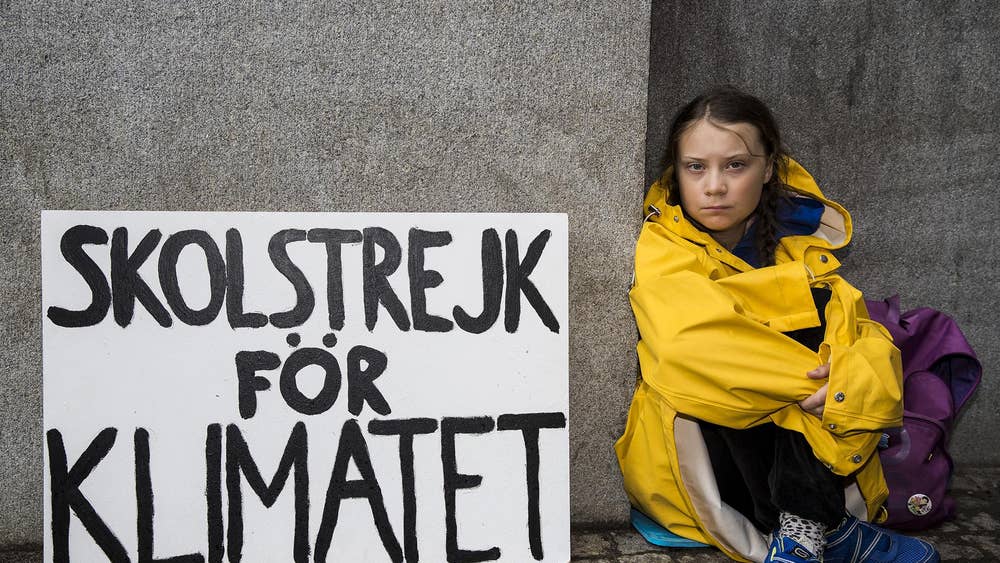
Greta Thunberg inspires climate activists everywhere: in pictures

And yet, wherever I go I seem to be surrounded by fairytales. Business leaders, elected officials all across the political spectrum spending their time making up and telling bedtime stories that soothe us, that make us go back to sleep.

These are “feel-good” stories about how we are going to fix everything. How wonderful everything is going to be when we have “solved” everything. But the problem we are facing is not that we lack the ability to dream or to imagine a better world. The problem now is that we need to wake up. It’s time to face the reality, the facts, the science.

And the science doesn’t mainly speak of “great opportunities to create the society we always wanted”. It tells of unspoken human sufferings, which will get worse and worse the longer we delay action - unless we start to act now. And yes, of course, a sustainable transformed world will include lots of new benefits. But you have to understand. This is not primarily an opportunity to create new green jobs, new businesses or green economic growth. This is above all an emergency, and not just any emergency. This is the biggest crisis humanity has ever faced.

And we need to treat it accordingly so that people can understand and grasp the urgency. Because you can not solve a crisis without treating it as one. Stop telling people that everything will be fine when in fact, as it looks now, it won’t be very fine. This is not something you can package and sell or ”like” on social media.

Stop pretending that you, your business idea, your political party or plan will solve everything. We must realize that we don’t have all the solutions yet. Far from it. Unless those solutions mean that we simply stop doing certain things.

Changing one disastrous energy source for a slightly less disastrous one is not progress. Exporting our emissions overseas is not reducing our emission. Creative accounting will not help us. In fact, it’s the very heart of the problem.

Some of you may have heard that we have 12 years from 1 January 2018 to cut our emissions of carbon dioxide in half. But I guess that hardly any of you have heard that there is a 50 percent chance of staying below a 1.5 degree Celsius of global temperature rise above pre-industrial levels. Fifty percent chance.

And these current, best available scientific calculations do not include nonlinear tipping points as well as most unforeseen feedback loops like the extremely powerful methane gas escaping from rapidly thawing arctic permafrost. Or already locked in warming hidden by toxic air pollution. Or the aspect of equity; climate justice.

So a 50 percent chance - a statistical flip of a coin - will most definitely not be enough. That would be impossible to morally defend. Would anyone of you step onto a plane if you knew it had more than a 50 percent chance of crashing? More to the point: would you put your children on that flight?


And why is it so important to stay below the 1.5 degree limit? Because that is what the united science calls for, to avoid destabilizing the climate so that we stay clear of setting off an irreversible chain reaction beyond human control. Even at 1 degree of warming, we are seeing an unacceptable loss of life and livelihoods.

So where do we begin? Well, I would suggest that we start looking at chapter 2, on page 108 in the IPCC report that came out last year. Right there it says that if we are to have a 67 per cent chance of limiting the global temperature rise to below 1.5 degrees Celsius, we had, on 1 January 2018, about 420 Gtonnes of CO2 left to emit in that carbon dioxide budget. And of course, that number is much lower today. As we emit about 42 Gtonnes of CO2 every year if you include land use.

With today’s emissions levels, that remaining budget is gone within less than 8 and a half years. These numbers are not my opinions. They aren’t anyone’s opinions or political views. This is the current best available science. Though a great number of scientists suggest even these figures are too moderate, these are the ones that have been accepted by all nations through the IPCC.

And please note that these figures are global and therefore do not say anything about the aspect of equity, clearly stated throughout the Paris Agreement, which is absolutely necessary to make it work on a global scale. That means that richer countries need to do their fair share and get down to zero emissions much faster, so that people in poorer countries can heighten their standard of living, by building some of the infrastructures that we have already built. Such as roads, hospitals, schools, clean drinking water, and electricity.

The USA is the biggest carbon polluter in history. It is also the world’s number one producer of oil. And yet, you are also the only nation in the world that has signaled your strong intention to leave the Paris Agreement. Because quote ”it was a bad deal for the USA”.

Four-hundred and twenty GTons of CO2 left to emit on 1 January 2018 to have a 67 percent chance of staying below 1.5 degrees of global temperature rise. Now that figure is already down to less than 360 GTons.

These numbers are very uncomfortable. But people have the right to know. And the vast majority of us have no idea these numbers even exist. In fact, not even the journalists that I meet seem to know that they even exist. Not to mention the politicians. And yet they all seem so certain that their political plan will solve the entire crisis.

But how can we solve a problem that we don’t even fully understand? How can we leave out the full picture and the current best available science?

I believe there is a huge danger in doing so. And no matter how political the background to this crisis may be, we must not allow this to continue to be a partisan political question. The climate and ecological crisis are beyond party politics. And our main enemy right now is not our political opponents. Our main enemy now is physics. And we can not make “deals” with physics.

Everybody says that making sacrifices for the survival of the biosphere - and to secure the living conditions for future and present generations - is an impossible thing to do.

Americans have indeed made great sacrifices to overcome terrible odds before.

Think of the brave soldiers that rushed ashore in that first wave on Omaha Beach on D Day. Think of Martin Luther King and the 600 other civil rights leaders who risked everything to march from Selma to Montgomery. Think of President John F. Kennedy announcing in 1962 that America would “choose to go to the moon in this decade and do the other things, not because they are easy, but because they are hard…”

Perhaps it is impossible. But looking at those numbers - looking at the current best available science signed by every nation - then I think that is precisely what we are up against.

But you must not spend all of your time dreaming or see this as some political fight to win.

And you must not gamble your children’s future on the flip of a coin.

Instead, you must unite behind the science.

You must take action.

You must do the impossible.

Because giving up can never ever be an option.

ORIGINAL: The Independent
by Greta Thumberg
2019/09/19

domingo, 15 de septiembre de 2019

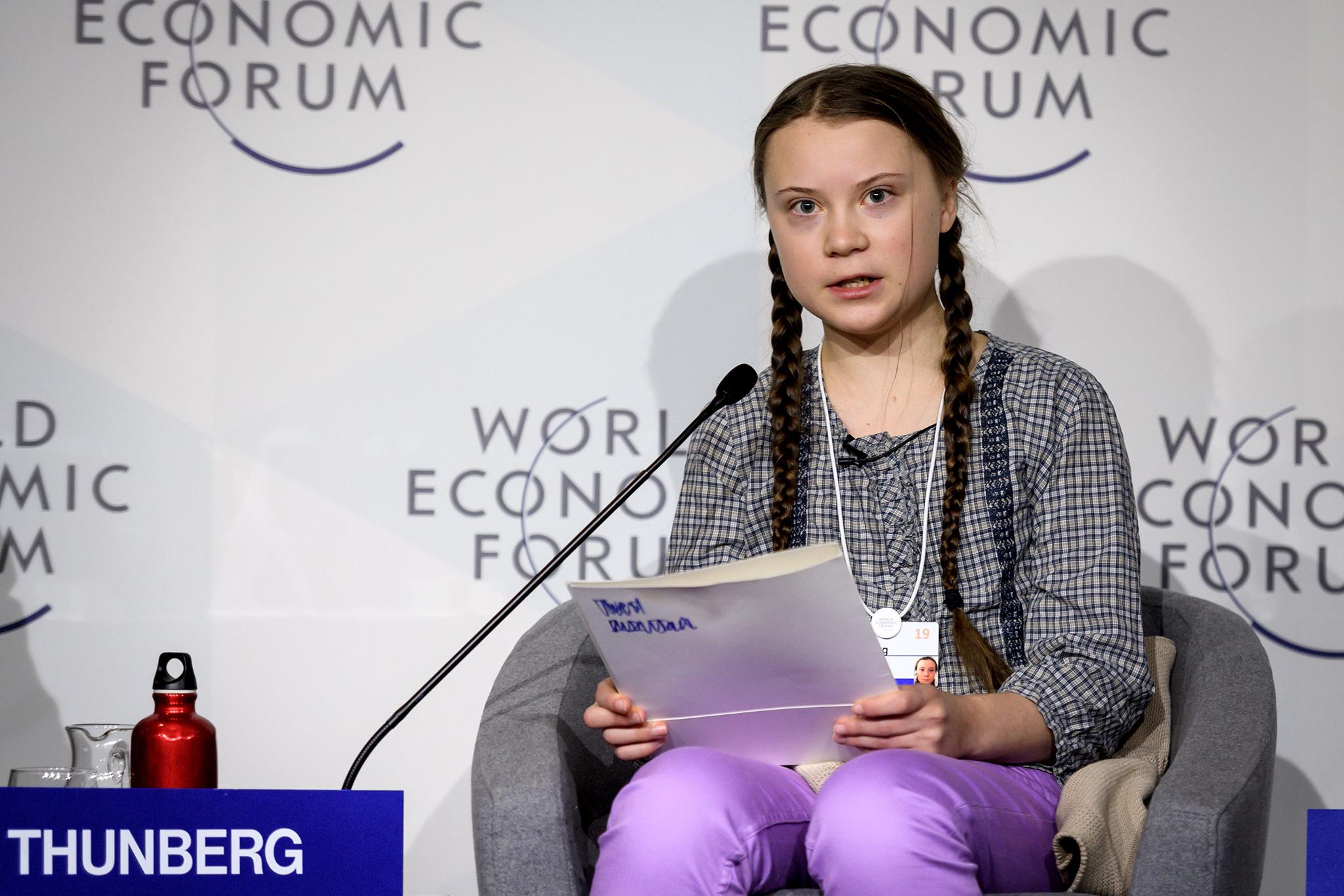
Greta Thunberg speech at the National Assembly in Paris 2019-07-23


Transcript:
"I have some good news and some bad news regarding the climate emergency. I will start with the good news.

The world, as a small number of people have been saying lately, will not end in 11 years.

The bad news, however, is that around the year 2030, if we continue with business as usual, we will likely be in a position where we may pass a number of tipping points. And then we might no longer be able to undo the irreversible climate breakdown.

A lot of people, a lot of politicians, business leaders, journalists say they don't agree with what we are saying. They say we children are exaggerating, that we are alarmists. To answer this I would like to refer to page 108, chapter 2 in the latest IPCC report. There you will find all our "opinions" summarized because there you find a remaining carbon dioxide budget. Right there it says that: if we are to have a 67% chance of limiting the global temperature rise to below 1.5 degrees, we had on January 1st, 2018, 420 gigatons of carbon dioxide left in our CO2 budget. And of course, that number is much lower today. We emit about 42 gigatons of CO2 every year.

At current emissions levels, that remaining budget is gone within roughly eight and a half years. These numbers are as real as it gets, though a great number of scientists suggests that they are too generous, these are the ones that have been accepted by all nations through the IPCC.

And not once, not one single time have I heard any politician, journalists or business leader even mention these numbers. It is almost like you don't even know they exist, as if you haven't even read the latest IPCC reports on which the future of our civilization is depending.

Or maybe you are simply not mature enough to tell it like it is. Because even that burden you leave to us children. We become the bad guys who have to tell people these uncomfortable things because no one else wants to or dares to. And just for quoting and acting on these numbers, these scientific facts, we receive unimaginable amounts of hate and threats. We are being mocked and lied about by elected officials, members of Parliament's, business leaders, journalists. What I really would like to ask all of those who question our so-called "opinions" or think that we are extreme: - Do you have a different budget for at least a reasonable chance of staying below the 1.5 degrees of warming limit? Is there another intergovernmental panel on climate change? Is there a secret Paris agreement that we don't know about? One that not includes the aspect of equity? Because these are the numbers that count, this is the current best available science. You can't simply make up your own facts just because you don't like what you hear.

There is no middle ground when it comes to the climate and ecological emergency. Of course, you could argue that we should go for a more risky pathway, such as the alternative of 580 gigatons of CO2 from January 1st, 2018, which gives us a 50/50 percent chance of limiting the global temperature rise to below 1.5 degrees. That amount of carbon dioxide will run out in about 12 years of current business as usual. But why should we do that, why should we accept taking that risk, leaving the future living conditions for humankind to a 50/50 flip of a coin. 420 gigatons left of CO2 to emit. And now that number is down to less than 360 gigatons. And please note that these figures are global and therefore do not say anything about the aspect of equity, clearly stated throughout the Paris agreement, which is absolutely necessary to make it work on a global scale. That means that richer countries need to get down to zero emissions faster, so the people in poorer parts of the world can heighten their standard of living by building some of the infrastructures that we have already built, such as roads, hospitals, electricity, schools and providing clean drinking water.

And because you have ignored these facts, because you and pretty much all of the media to this very minute, keep ignoring them, people do not know what is going on. If you respect science, if you understand science, then this is it. 420 gigatons of CO2 left to emit on January 1st to have a 67% chance of staying below 1.5 degrees of global temperature rise, according to the IPCC.

In the Paris agreement, we have only signed up for staying below 1.5 to 2 degrees of temperature rise. And that, of course, gives us a bigger remaining carbon dioxide budget. But the latest IPCC report shows that aiming instead for below 1.5 degrees would significantly reduce the climate impacts, and that would most certainly save countless human lives.

This is what it's all about, this is all that we are saying. But I will also tell you this: -You cannot solve the crisis without treating it as a crisis, without seeing the full picture. You cannot leave the responsibility to individuals, politicians, the market or other parts of the world to take. This has to include everything and everyone.

Once you realize how painfully small the size of our remaining carbon dioxide budget is, once you realize how fast it is disappearing, once you realize that basically nothing is being done about it and once you realize that almost no one is even aware of the fact that carbon dioxide budgets even exists, then tell me what exactly do you do? And how do we do it without sounding alarmist? That is the question we must ask ourselves, and the people in power.

The science is clear and all we children are doing is communicating and acting on that united science. Now political leaders in some countries are starting to talk. They are starting to declare climate emergencies and announcing dates for so-called climate neutrality. And declaring a climate emergency is good. But only setting up these vague, distant dates and saying things which give the impression of that things are being done and that action is on the way, will most likely do more harm than good. Because of the changes required are still nowhere in sight. Not in France, not in the EU, nowhere. And I believe that the biggest danger is not our inaction. The real danger is when companies and politicians are making it look like real action is happening, when in fact almost nothing is being done, apart from clever accounting and creative PR.

The climate and ecological emergency is right here, right now. But it has only just begun, it will get worse. 420 gigatons of CO2 left to emit on January 1st 2018 to have a 67 percent chance of staying below a 1.5 degrees of global temperature rise. And now that figure is already down to less than 360 gigatons.

At current emissions levels that remaining budgets is gone within roughly eight and a half years. In fact, since I started this speech the world has emitted about 800,000 tons of carbon dioxide. And if anyone still has excuses not to listen, not to act, not to care, I ask you once again: -Is there another Intergovernmental Panel on Climate Change? Is there a secret Paris agreement that we don't know about? One that does not include the aspect of equity? Do you have a different budget for at least a reasonable chance of staying below 1.5 degrees of global temperature rise? Some people have chosen not to come here today, some people have chosen not to listen to us, and that is fine, we are after all just children. You don't have to listen to us, but you do have to listen to the United science, the scientists. And that is all we ask, just unite behind the science!"


domingo, 24 de diciembre de 2017

MIT Just Created Living Plants That Glow Like A Lamp, And Could Grow Glowing Trees To Replace Streetlights


Roads of the future could be lit by glowing trees instead of streetlamps, thanks to a breakthrough in creating bioluminescent plants. Experts injected specialized nanoparticles into the leaves of a watercress plant, which caused it to give off a dim light for nearly four hours. This could solve lots of problems.

The chemical involved, which produced enough light to read a book by, is the same as is used by fireflies to create their characteristic shine. To create their glowing plants, engineers from the Massachusetts Institute of Technology (MIT) turned to an enzyme called luciferase. Luciferase acts on a molecule called luciferin, causing it to emit light.
 
Roads of the future could be lit by glowing trees instead of streetlamps, thanks to a breakthrough in creating bioluminescent plants. Experts created a watercress plant which caused it to glow for nearly four hours and gave off enough light to illuminate this book
Another molecule called Co-enzyme A helps the process along by removing a reaction byproduct that can inhibit luciferase activity. The MIT team packaged each of these components into a different type of nanoparticle carrier.

The nanoparticles help them to get to the right part of the plant and also prevent them from building to concentrations that could be toxic to the plants. The result was a watercress plant that functioned like a desk lamp.

Researchers believe with further tweaking, the technology could also be used to provide lights bright enough to illuminate a workspace or even an entire street, as well as low-intensity indoor lighting. 

Michael Strano, professor of chemical engineering at MIT and the senior author of the study, said: 'The vision is to make a plant that will function as a desk lamp — a lamp that you don't have to plug in. The light is ultimately powered by the energy metabolism of the plant itself. Our work very seriously opens up the doorway to streetlamps that are nothing but treated trees, and to indirect lighting around homes.'

Luciferases make up a class of oxidative enzymes found in several species that enable them to 'bioluminesce', or emit light.
Fireflies are able to emit light via a chemical reaction.

In the chemical reaction luciferin is converted to oxyluciferin by the luciferase enzyme. Some of the energy released by this reaction is in the form of light. The reaction is highly efficient, meaning nearly all the energy put into the reaction is rapidly converted to light.

Lighting accounts for around 20 per cent of worldwide energy consumption, so replacing them with naturally bioluminescent plants would represent a significant cut to CO2 emissions. The researchers’ early efforts at the start of the project yielded plants that could glow for about 45 minutes, which they have since improved to 3.5 hours.

The light generated by one ten centimetre (four inch) watercress seedling is currently about one-thousandth of the amount needed to properly read by, but it was enough to illuminate the words on a page of John Milton's Paradise Lost.

The MIT team believes it can boost the light emitted, as well as the duration of light, by further optimising the concentration and release rates of the chemical components. For future versions of this technology, the team hopes to develop a way to paint or spray the nanoparticles onto plant leaves, which could make it possible to transform trees and other large plants into light sources. 

The researchers have also demonstrated that they can turn the light off by adding nanoparticles carrying a luciferase inhibitor. This could enable them to eventually create plants that shut off their light emission in response to environmental conditions such as sunlight, they say.

The full findings of the study were published in the American Chemical Society journal Nano Letters.

ORIGINAL: The Space Academy
December 18, 2017