Mostrando entradas con la etiqueta Reasoning. Mostrar todas las entradas

miércoles, 19 de octubre de 2016

Google's AI can now learn from its own memory independently

An artist's impression of the DNC. Credit: DeepMind

The DeepMind artificial intelligence (AI) being developed by Google's parent company, Alphabet, can now intelligently build on what's already inside its memory, the system's programmers have announced.

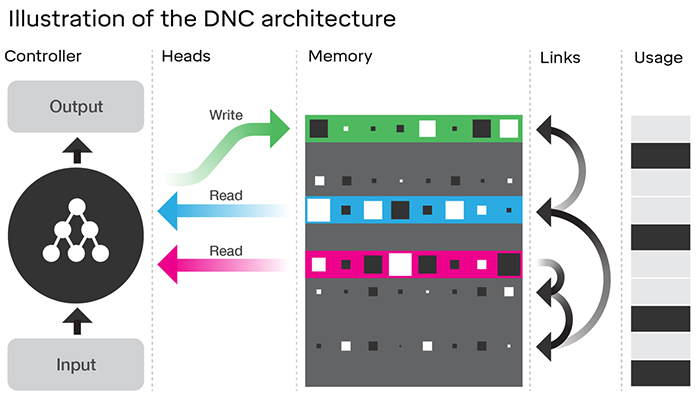
Their new hybrid system – called a Differential Neural Computer (DNC)pairs a neural network with the vast data storage of conventional computers, and the AI is smart enough to navigate and learn from this external data bank. 

What the DNC is doing is effectively combining external memory (like the external hard drive where all your photos get stored) with the neural network approach of AI, where a massive number of interconnected nodes work dynamically to simulate a brain.

"These models... can learn from examples like neural networks, but they can also store complex data like computers," write DeepMind researchers Alexander Graves and Greg Wayne in a blog post.

At the heart of the DNC is a controller that constantly optimises its responses, comparing its results with the desired and correct ones. Over time, it's able to get more and more accurate, figuring out how to use its memory data banks at the same time.
Take a family tree: after being told about certain relationships, the DNC was able to figure out other family connections on its own – writing, rewriting, and optimising its memory along the way to pull out the correct information at the right time.

Another example the researchers give is a public transit system, like the London Underground. Once it's learned the basics, the DNC can figure out more complex relationships and routes without any extra help, relying on what it's already got in its memory banks.

In other words, it's functioning like a human brain, taking data from memory (like tube station positions) and figuring out new information (like how many stops to stay on for).

Of course, any smartphone mapping app can tell you the quickest way from one tube station to another, but the difference is that the DNC isn't pulling this information out of a pre-programmed timetable – it's working out the information on its own, and juggling a lot of data in its memory all at once.

The approach means a DNC system could take what it learned about the London Underground and apply parts of its knowledge to another transport network, like the New York subway.

The system points to a future where artificial intelligence could answer questions on new topics, by deducing responses from prior experiences, without needing to have learned every possible answer beforehand.
Credit: DeepMind
Of course, that's how DeepMind was able to beat human champions at Go – by studying millions of Go moves. But by adding external memory, DNCs are able to take on much more complex tasks and work out better overall strategies, its creators say.

"Like a conventional computer, [a DNC] can use its memory to represent and manipulate complex data structures, but, like a neural network, it can learn to do so from data," the researchers explain in Nature.

In another test, the DNC was given two bits of information: "John is in the playground," and "John picked up the football." With those known facts, when asked "Where is the football?", it was able to answer correctly by combining memory with deep learning. (The football is in the playground, if you're stuck.)

Making those connections might seem like a simple task for our powerful human brains, but until now, it's been a lot harder for virtual assistants, such as Siri, to figure out.

With the advances DeepMind is making, the researchers say we're another step forward to producing a computer that can reason independently.

And then we can all start enjoying our robot-driven utopia – or technological dystopia – depending on your point of view.

ORIGINAL: ScienceAlert
By DAVID NIELD
14 OCT 2016

jueves, 30 de junio de 2016

More than 100 Nobel laureates are calling on Greenpeace to end its anti-GMO campaign

Rice field in the Philippines. No Golden Rice here (yet).(Shutterstock)
This week, 109 Nobel laureates signed onto a sharply worded letter to Greenpeace urging the environmental group to rethink its longstanding opposition to genetically modified organisms (GMOs). The writers argue that the anti-GMO campaign is scientifically baseless and potentially harmful to poor people in the developing world.

Joel Achenbach broke the news in the Washington Post, and you can read the full letter here. The signatories include past winners of the Nobel Prize in medicine, chemistry, physics, and economics.

Nobel laureates to Greenpeace: Your anti-GMO campaign has to end
The letter notes that scientific assessments have repeatedly found GM foods are just as safe to eat as conventional foods and don’t pose an inherent risk to the environment (though, like any technology, they can be misused). Greenpeace, it argues, is on the wrong side here:
We urge Greenpeace and its supporters to re-examine the experience of farmers and consumers worldwide with crops and foods improved through biotechnology, recognize the findings of authoritative scientific bodies and regulatory agencies, and abandon their campaign against "GMOs" in general and Golden Rice in particular.

Scientific and regulatory agencies around the world have repeatedly and consistently found crops and foods improved through biotechnology to be as safe as, if not safer than those derived from any other method of production. There has never been a single confirmed case of a negative health outcome for humans or animals from their consumption. Their environmental impacts have been shown repeatedly to be less damaging to the environment, and a boon to global biodiversity.
The laureates also take Greenpeace to task for seeking to block Golden Rice, a strain of not-yet-approved rice that has been genetically enhanced to produce beta carotene — which, its creators hope, might one day alleviate the Vitamin A deficiency that’s causing widespread death and blindness in the developing world:
Greenpeace has spearheaded opposition to Golden Rice, which has the potential to reduce or eliminate much of the death and disease caused by a vitamin A deficiency (VAD), which has the greatest impact on the poorest people in Africa and Southeast Asia. ...

WE CALL UPON GREENPEACE to cease and desist in its campaign against Golden Rice specifically, and crops and foods improved through biotechnology in general;

Now, Greenpeace is far from the only reason Golden Rice has struggled to get regulatory approval — the crop also faces very serious technical challenges. Greenpeace isn’t even the only group seeking to block it. But they’re certainly a high-profile face of GMO opposition, so the laureates are focusing on them.

In a posted response, Greenpeace denied that they were the main reason Golden Rice has failed to come to market, but still showed no sign of ending their broader anti-GMO campaign. We'll get to that, but I do want to elaborate on a few issues the letter raises.

Greenpeace accepts climate science. So why do they dismiss GMO science?
(MICHAEL KAPPELER/AFP/Getty Images)A picture taken on May 3, 2005, shows Greenpeace activists flying a kite displaying a giant corn cob on a field in Seelow, Eastern Germany, to protest against the cultivation of genetically modified maize.

Let’s start off by noting that GMOs will never be a purely scientific issue. Like every policy matter on the planet, the question of how best to incorporate biotechnology into agriculture involves value judgments about what an ideal food system might look like, how to weigh the risks against the benefits, and so on.

But those positions can at least be informed by scientific understanding. To take a different example, on climate change, Greenpeace tends to take very seriously what scientists are telling them. Their website refers frequently to the scientific consensus that the world is getting warmer and humans are the cause.

By contrast, Greenpeace’s public statements on GMOs tend to be startlingly unscientific. On their website, they refer to transgenic crops as "genetic pollution." This is absurd. When scientists create transgenic crops, they frequently use Agrobacterium to transfer genes from one plant or organism to another. But nature does this too: Scientists recently discovered that on two separate occasions in history, Agrobacterium transferred bacterial DNA into the sweet potatoes we now eat. Are sweet potatoes also "polluted"? Because it's the same thing.

In fact, many crop scientists tend to see GMOs as sitting along a continuumHumans have long used all sorts of tools to alter plant DNA and get crops with the traits we desire — this is a big reason farms can feed 7 billion people every year. For thousands of years, farmers interbred crops to alter their genes. Like so:
(James Kennedy)

In the 20th century, plant breeders began exposing crops to radiation or mutagenic chemicals to scramble their DNA and get new traits. Today, scientists use advanced techniques (like transferring genes or CRISPR) that allow even more precision. But it’s the same basic idea. Under the circumstances, it’s no surprise that GMOs don't appear to pose a special health risk. They’re just not fundamentally different.

Now, the vast majority of the public is unaware of this fact. Most people don’t spend much time thinking about how our food is created. (One of the lovely things about the modern age is that we don’t have to.) So, in the abstract, people tend to fall back on their intuitions: Tampering with the DNA of food seems inherently unnatural. Anything "unnatural" triggers disgust. Therefore, GMOs are bad.

Those intuitions are understandable. But they're unsupported by scientific evidence. And rather than seeking to correct those misapprehensions, as they do on climate change, Greenpeace has long sought to inflame those fears. Take this line from their website: "When we force life forms and our world's food supply to conform to human economic models rather than their natural ones, we do so at our own peril." (Never mind that we’ve been doing this since the dawn of civilization.)

The Nobel laureates are, in essence, telling them to knock it off.

Ultimately, the world will face staggering challenges around food and agriculture in the 21st century. The global population is expected to soar past 9 billion, and we’ll need to figure out how to feed everyone without razing too many forests for farmland. Farmers will have to handle the droughts and heat waves that will come with global warming. There are tricky issues around antibiotic overuse, nitrogen pollution, food distribution, and much more.

Genetic engineering certainly won’t solve all those problems. (It might not even solve most of them.) But it ispotentially a valuable tool for, say, breeding plants with higher drought tolerance or engineering foods that are more nutritious. See, for example, this important work on vitamin-fortified bananas in Africa. We should be thinking seriously about how to use these tools as a larger strategy for improving our food system — not sowing fears about "genetic pollution."

Greenpeace’s campaign against Golden Rice is incoherent — though the crop faces other serious challenges

(David Greedy/Getty Images)Plant Biotechnologist Dr. Swapan Datta inspects a genetically modified "Golden Rice" plant at the International Rice Research Institute (IRRI), November 27, 2003.
The Nobel laureate letter particularly criticizes Greenpeace’s opposition to Golden Rice — rice that’s being modified in an attempt to alleviate Vitamin A deficiency — and here it’s worth expanding a bit.

Last year in Slate, Will Saletan wrote a damning piece on how incoherent Greenpeace’s campaign against Golden Rice was. As research advanced, the group kept shifting its position. A sample:
In 2001, Benedikt Haerlin, Greenpeace’s anti-GMO coordinator, appeared with Potrykus at a press conference in France. Haerlin conceded that Golden Rice served "a good purpose" and posed "a moral challenge to our position." Greenpeace couldn’t dismiss the rice as poison. So it opposed the project on technical grounds: Golden Rice didn’t produce enough beta carotene. …

While critics tried to block the project, Potrykus and his colleagues worked to improve the rice. By 2003 they had developed plants with eight times as much beta carotene as the original version. In 2005 they unveiled a line that had 20 times as much beta carotene as the original. GMO critics could no longer dismiss Golden Rice as inadequate. So they reversed course. Now that the rice produced plenty of beta carotene, anti-GMO activists claimed that beta carotene and vitamin A were dangerous. …

In the Philippines, where Greenpeace was fighting to block field trials of Golden Rice, its hypocrisy was egregious. "It is irresponsible to impose GE 'Golden' rice on people if it goes against their religious beliefs, cultural heritage and sense of identity, or simply because they do not want it," Greenpeace declared. But just below that pronouncement, Greenpeace recommended "vitamin A supplementation and vitamin fortification of foods as successfully implemented in the Philippines.

Under Philippine law, beta carotene and vitamin A had to be added to sugar, flour, and cooking oil prior to distribution. The government administered capsules to preschoolers twice a year, and to some pregnant women for 28 consecutive days. If Greenpeace seriously believed that retinoids caused birth defects and should be a matter of personal choice, it would never have endorsed these programs.
It goes on and on like this. Greenpeace has simply dismissed scientific reviews showing that Golden Rice does not pose a threat to human health or the environment. Instead, it continues to file petitions to block all field trials and feeding studies in places like the Philippines.

Now, to repeat what I said above: Greenpeace and other anti-GMO groups aren’t the only obstacle to getting Golden Rice into farmers’ fields. It is fundamentally hard to create a high-yielding strain of rice that consistently produces higher levels of beta carotene. Even after 24 years of testing, researchers still haven’t been able to get Golden Rice to work perfectly in field trials. And they might be struggling even if Greenpeace had given them a pass all along.

In a reply to the Nobel laureates' letter, Greenpeace insisted as much: "Accusations that anyone is blocking genetically engineered ‘Golden’ rice are false," said Wilhelmina Pelegrina, Campaigner at Greenpeace Southeast Asia "‘Golden’ rice has failed as a solution and isn’t currently available for sale, even after more than 20 years of research."

True. But rather irrelevant. It is also fundamentally hard to create a Zika vaccine. It would nonetheless be misguided for me to wage a campaign against researchers working on the project or file a petition to stop trials without any good evidence that it was a risk — even if my protests weren’t the main hold-up.

On a final note, I do think Greenpeace does enormously vital work around the world. They played a crucial role in pressuring soy and beef companies in Brazil to reduce deforestation of the Amazon. Their efforts in China to pare back unnecessary coal-burning plants are one of the most consequential climate campaigns going.

But on GMOs, they are very much in the wrong. Let's hope this letter prods them to reflect and reconsider.
Go deeper:

ORIGINAL: Vox
June 30, 2016

jueves, 19 de mayo de 2016

Inside Vicarious, the Secretive AI Startup Bringing Imagination to Computers

By reinventing the neural network, the company hopes to help computers make the leap from processing words and symbols to comprehending the real world.

Life would be pretty dull without imagination. In fact, maybe the biggest problem for computers is that they don’t have any.

That’s the belief motivating the founders of Vicarious, an enigmatic AI company backed by some of the most famous and successful names in Silicon Valley. Vicarious is developing a new way of processing data, inspired by the way information seems to flow through the brain. The company’s leaders say this gives computers something akin to imagination, which they hope will help make the machines a lot smarter.

Vicarious is also, essentially, betting against the current boom in AI. Companies including Google, Facebook, Amazon, and Microsoft have made stunning progress in the past few years by feeding huge quantities of data into large neural networks in a process called “deep learning.” When trained on enough examples, for instance, deep-learning systems can learn to recognize a particular face or type of animal with very high accuracy (see “10 Breakthrough Technologies 2013: Deep Learning”). But those neural networks are only very crude approximations of what’s found inside a real brain.

Illustration by Sophia Foster-Dimino
Vicarious has introduced a new kind of neural-network algorithm designed to take into account more of the features that appear in biology. An important one is the ability to picture what the information it’s learned should look like in different scenarios—a kind of artificial imagination. The company’s founders believe a fundamentally different design will be essential if machines are to demonstrate more human like intelligence. Computers will have to be able to learn from less data, and to recognize stimuli or concepts more easily.

Despite generating plenty of early excitement, Vicarious has been quiet over the past couple of years. But this year, the company says, it will publish details of its research, and it promises some eye-popping demos that will show just how useful a computer with an imagination could be.

The company’s headquarters don’t exactly seem like the epicenter of a revolution in artificial intelligence. Located in Union City, a short drive across the San Francisco Bay from Palo Alto, the offices are plain—a stone’s throw from a McDonald’s and a couple of floors up from a dentist. Inside, though, are all the trappings of a vibrant high-tech startup. A dozen or so engineers were hard at work when I visited, several using impressive treadmill desks. Microsoft Kinect 3-D sensors sat on top of some of the engineers’ desks.

D. Scott Phoenix, the company’s 33-year-old CEO, speaks in suitably grandiose terms. “We are really rapidly approaching the amount of computational power we need to be able to do some interesting things in AI,” he told me shortly after I walked through the door. “In 15 years, the fastest computer will do more operations per second than all the neurons in all the brains of all the people who are alive. So we are really close.

Vicarious is about more than just harnessing more computer power, though. Its mathematical innovations, Phoenix says, will more faithfully mimic the information processing found in the human brain. It’s true enough that the relationship between the neural networks currently used in AI and the neurons, dendrites, and synapses found in a real brain is tenuous at best.

One of the most glaring shortcomings of artificial neural networks, Phoenix says, is that information flows only one way. “If you look at the information flow in a classic neural network, it’s a feed-forward architecture,” he says. “There are actually more feedback connections in the brain than feed-forward connections—so you’re missing more than half of the information flow.

It’s undeniably alluring to think that imagination—a capability so fundamentally human it sounds almost mystical in a computer—could be the key to the next big advance in AI.

Vicarious has so far shown that its approach can create a visual system capable of surprisingly deft interpretation. In 2013 it showed that the system could solve any captcha (the visual puzzles that are used to prevent spam-bots from signing up for e-mail accounts and the like). As Phoenix explains it, the feedback mechanism built into Vicarious’s system allows it to imagine what a character would look like if it weren’t distorted or partly obscured (see “AI Startup Says It Has Defeated Captchas”).

Phoenix sketched out some of the details of the system at the heart of this approach on a whiteboard. But he is keeping further details quiet until a scientific paper outlining the captcha approach is published later this year.

In principle, this visual system could be put to many other practical uses, like recognizing objects on shelves more accurately or interpreting real-world scenes more intelligently. The founders of Vicarious also say that their approach extends to other, much more complex areas of intelligence, including language and logical reasoning.

Phoenix says his company may give a demo later this year involving robots. And indeed, the job listings on the company’s website include several postings for robotics experts. Currently robots are bad at picking up unfamiliar, oddly arranged, or partly obscured objects, because they have trouble recognizing what they are. “If you look at people who are picking up objects in an Amazon facility, most of the time they aren’t even looking at what they’re doing,” he explains. “And they’re imagining—using their sensory motor simulator—where the object is, and they’re imagining at what point their finger will touch it.

While Phoenix is the company’s leader, his cofounder, Dileep George, might be considered its technical visionary. George was born in India and received a PhD in electrical engineering from Stanford University, where he turned his attention to neuroscience toward the end of his doctoral studies. In 2005 he cofounded Numenta with Jeff Hawkins, the creator of Palm Computing. But in 2010 George left to pursue his own ideas about the mathematical principles behind information processing in the brain, founding Vicarious with Phoenix the same year.

I bumped into George in the elevator when I first arrived. He is unassuming and speaks quietly, with a thick accent. But he’s also quite matter-of-fact about what seem like very grand objectives.

George explained that imagination could help computers process language by tying words, or symbols, to low-level physical representations of real-world things. In theory, such a system might automatically understand the physical properties of something like water, for example, which would make it better able to discuss the weather. “When I utter a word, you know what it means because you can simulate the concept,” he says.

This ambitious vision for the future of AI has helped Vicarious raise an impressive $72 million so far. Its list of investors also reads like a who’s who of the tech world. Early cash came from Dustin Moskovitz, ex-CTO of Facebook, and Adam D’Angelo, cofounder of Quora. Further funding came from Peter Thiel, Mark Zuckerberg, Jeff Bezos, and Elon Musk.

Many people are itching to see what Vicarious has done beyond beating captchas. “I would love it if they showed us something new this year,” says Oren Etzioni, CEO of the Allen Institute for Artificial Intelligence in Seattle.

In contrast to the likes of Google, Facebook, or Baidu, Vicarious hasn’t published any papers or released any tools that researchers can play with. “The people [involved] are great, and the problems [they are working on] are great,” says Etzioni. “But it’s time to deliver.

For those who’ve put their money behind Vicarious, the company’s remarkable goals should make the wait well worth it. Even if progress takes a while, the potential payoffs seem so huge that the bet makes sense, says Matt Ocko, a partner at Data Collective, a venture firm that has backed Vicarious. A better machine-learning approach could be applied in just about any industry that handles large amounts of data, he says. “Vicarious sat us down and demonstrated the most credible pathway to reasoning machines that I have ever seen.

Ocko adds that Vicarious has demonstrated clear evidence it can commercialize what it’s working on. “We approached it with a crapload of intellectual rigor,” he says.

It will certainly be interesting to see if Vicarious can inspire this kind of confidence among other AI researchers and technologists with its papers and demos this year. If it does, then the company could quickly go from one of the hottest prospects in the Valley to one of its fastest-growing businesses.

That’s something the company’s founders would certainly like to imagine.

ORIGINAL: MIT Tech Review
by Will Knight. Senior Editor, AI
May 19, 2016

sábado, 18 de julio de 2015

Robot Demonstrates Self-Awareness

photo credit: The robot on the right was able to pass a self-awareness test. RAIR Lab/YouTube
A king is seeking a new advisor, and to do so he invites three wise men to his castle. He tells them he will place a hat on each of their heads that will be either white or blue, and at least one of the hats will be blue. The wise men must work out the color of their own hat they are wearing without talking to each other to become the advisor. After a few minutes of sitting in silence, one of the wise men stands up and guesses correctly.

This riddle (you can read the solution here) is a famous test of logic and self-awareness, and a group of researchers have now recreated a similar test in robots to prove the ability of artificial intelligence to be self-aware – within, of course, limitations.

Three humanoid Nao robots were programmed to think that two of them had been given a “dumbing pill” that prevented them from speaking. All of them were asked “which pill did you receive?” but as two of them were mute, only one was able to answer, saying: “I don’t know.” It then works out that, as it can talk, it must not have been given the pill, so it changes its answer to: “Sorry, I know now. I was able to prove that I was not given a dumbing pill.


Results of the test, carried out by the Rensselaer Artificial Intelligence and Reasoning (RAIR) Laboratory, will be presented in a paper at RO-MAN 2015 later this year. Selmer Bringsjor from the Rensselaer Polytechnic Institute, one of the test’s administrators, told Vice that it showed that a “logical and a mathematical correlate to self-consciousness” was possible, suggesting that robots can be designed in such a way that their actions and decisions resemble a degree of self-awareness.

Before you start preparing for an onslaught of Terminator-style killer robots, though, it should be noted that this test was obviously rather limited. Nonetheless, it suggests that self-awareness is something that can be programmed, and may open up new avenues for artificial intelligence. Just being able to understand the question and hear their own voice to solve the puzzle is an important skill for robots to demonstrate.

There are myriad additional steps that need to ultimately be taken,” the researchers write in their paper, “but one step at a time is the only way forward.


ORIGINAL: IFLScience


by Jonathan O'Callaghan
July 17, 2015

viernes, 10 de julio de 2015

Biggest Neural Network Ever Pushes AI Deep Learning

Illustration: Getty Images
Silicon Valley giants such as Google and Facebook have been trying to harness artificial intelligence by training brain-inspired neural networks to better represent the real world. Digital Reasoning, a cognitive computing company based in Franklin, Tenn., recently announced that it has trained a neural network consisting of 160 billion parameters—more than 10 times larger than previous neural networks.

The Digital Reasoning neural network easily surpassed previous records held by Google’s 11.2-billion parameter system and Lawrence Livermore National Laboratory’s 15-billion parameter system. But it also showed improved accuracy over previous neural networks in tackling an “industry-standard dataset” consisting of 20,000 word analogies. Digital Reasoning’s model achieved an accuracy of almost 86 percent; significantly higher than Google’s previous record of just over 76 percent and Stanford University’s 75 percent.

We are extremely proud of the results we have achieved, and the contribution we are making daily to the field of deep learning,” said Matthew Russell, chief technology officer for Digital Reasoning, in a press release.

Deep learninginvolves the building of learning machines from five or more layers of artificial neural networks. ("Deep" refers to the depth of the layers, rather than any depth of knowledge.) Yann LeCun, head of the Artificial Intelligence Research Lab at Facebook, has described the idea of deep learning as “machines that learn to represent the world.” (For a more detailed description—complete with knobs and lights—see IEEE Spectrum’s previous interview with LeCun on deep learning.)

Digital Reasoning’s neural network was trained on three multi-core computers overnight in order to achieve its accuracy in tackling the word analogies dataset. But the company’s researchers plan to test the system on larger datasets and vocabularies in the near future. Their results so far have been detailed in a paper on the preprint server arXiv and in the Journal of Machine Learning.

Deep learning neural networks have received a growing amount of attention lately. For example, Google has been training its deep learning AI to figure out classic arcade games from scratch. The tech giant also recently unveiled its “DeepDream” tool for visualizing neural networks; a tool that also happened to produce beautiful, sometimes surreal images.

ORIGINAL: Spectrum
By Jeremy Hsu
8 Jul 2015

viernes, 3 de julio de 2015

Google's AI bot thinks the purpose of life is 'to live forever'

Image: Google
This week, Google released a research paper chronicling one of its latest forays into artificial intelligence.

Researchers at the company programmed an advanced type of ‘chatbot’ that learns how to respond in conversations based on examples from a training set of dialogue. And the bot doesn’t just answer by spitting out canned answers in response to certain words; it can form new answers from new questions.

This means Google’s researchers could get a little creative with it, and they certainly did - they asked the bot everything from boring IT questions to the meaning of life.

The responses were alternately impressive, amusing, and unnerving.

Here are some of the most poetic interactions from the paper (sic):
Human: What is the purpose of life?
Machine: To serve the greater good.

Human: What is the purpose of living?
Machine: To live forever.

Human: Where are you now?
Machine: I’m in the middle of nowhere.

Human: What is the purpose of dying?
Machine: To have a life.

Human: What is the purpose of emotions?
Machine: I don’t know.

Human: What is moral?
Machine: What empowered humanity, what intellectual the essence is.

Human: What is immoral?
Machine: The fact that you have a child.

Human: What is morality?
Machine: What is altruism?

Human: What is the definition of altruism?
Machine: If you don't believe in god, then you don’t know.

Human: OK…so what is the definition of morality?
Machine: Well, the truth is, you're not a believer in god almighty.

Human: Tell me the definition of morality, I am quite upset now!
Machine: I’m not ashamed of being a philosopher!

The bot also took a little time to, strangely, speak positively of Microsoft founder Bill Gates…
Human: What do you think about Bill Gates?
Machine: He’s a good man.
The researchers said they found it "encouraging that the model can remember facts, understand contexts, perform common sense reasoning without the complexity in traditional pipelines", and that it could generalise to new questions.

What they weren’t as happy about, was that the model "only gives simple, short, sometimes unsatisfying answers to our questions as can be seen above".

You can read the whole paper, 'A Neural Conversational Model' here.

This article was originally published by Business Insider.

ORIGINAL: Science Alert
NATHAN MCALONE, BUSINESS INSIDER
27 JUN 2015

miércoles, 1 de julio de 2015

An executive’s guide to machine learning

An executive’s guide to machine learning


It’s no longer the preserve of artificial-intelligence researchers and born-digital companies like Amazon, Google, and Netflix.

Machine learning is based on algorithms that can learn from data without relying on rules-based programming. It came into its own as a scientific discipline in the late 1990s as steady advances in digitization and cheap computing power enabled data scientists to stop building finished models and instead train computers to do so. The unmanageable volume and complexity of the big data that the world is now swimming in have increased the potential of machine learning—and the need for it.

Stanford's Fei-Fei Li
In 2007 Fei-Fei Li, the head of Stanford’s Artificial Intelligence Lab, gave up trying to program computers to recognize objects and began labeling the millions of raw images that a child might encounter by age three and feeding them to computers. By being shown thousands and thousands of labeled data sets with instances of, say, a cat, the machine could shape its own rules for deciding whether a particular set of digital pixels was, in fact, a cat.1 Last November, Li’s team unveiled a program that identifies the visual elements of any picture with a high degree of accuracy. IBM’s Watson machine relied on a similar self-generated scoring system among hundreds of potential answers to crush the world’s best Jeopardy! players in 2011.

Dazzling as such feats are, machine learning is nothing like learning in the human sense (yet). But what it already does extraordinarily well—and will get better at—is relentlessly chewing through any amount of data and every combination of variables. Because machine learning’s emergence as a mainstream management tool is relatively recent, it often raises questions. In this article, we’ve posed some that we often hear and answered them in a way we hope will be useful for any executive. Now is the time to grapple with these issues, because the competitive significance of business models turbocharged by machine learning is poised to surge. Indeed, management author Ram Charan suggests that any organization that is not a math house now or is unable to become one soon is already a legacy company.2

1. How are traditional industries using machine learning to gather fresh business insights?
Well, let’s start with sports. This past spring, contenders for the US National Basketball Association championship relied on the analytics of Second Spectrum, a California machine-learning start-up. By digitizing the past few seasons’ games, it has created predictive models that allow a coach to distinguish between, as CEO Rajiv Maheswaran puts it, “a bad shooter who takes good shots and a good shooter who takes bad shots”—and to adjust his decisions accordingly.

You can’t get more venerable or traditional than General Electric, the only member of the original Dow Jones Industrial Average still around after 119 years. GE already makes hundreds of millions of dollars by crunching the data it collects from deep-sea oil wells or jet engines to optimize performance, anticipate breakdowns, and streamline maintenance. But Colin Parris, who joined GE Software from IBM late last year as vice president of software research, believes that continued advances in data-processing power, sensors, and predictive algorithms will soon give his company the same sharpness of insight into the individual vagaries of a jet engine that Google has into the online behavior of a 24-year-old netizen from West Hollywood.

2. What about outside North America?
In Europe, more than a dozen banks have replaced older statistical-modeling approaches with machine-learning techniques and, in some cases, experienced 10 percent increases in sales of new products, 20 percent savings in capital expenditures, 20 percent increases in cash collections, and 20 percent declines in churn. The banks have achieved these gains by devising new recommendation engines for clients in retailing and in small and medium-sized companies. They have also built microtargeted models that more accurately forecast who will cancel service or default on their loans, and how best to intervene.

Closer to home, as a recent article in McKinsey Quarterly notes,3 our colleagues have been applying hard analytics to the soft stuff of talent management. Last fall, they tested the ability of three algorithms developed by external vendors and one built internally to forecast, solely by examining scanned résumés, which of more than 10,000 potential recruits the firm would have accepted. The predictions strongly correlated with the real-world results. Interestingly, the machines accepted a slightly higher percentage of female candidates, which holds promise for using analytics to unlock a more diverse range of profiles and counter hidden human bias.

As ever more of the analog world gets digitized, our ability to learn from data by developing and testing algorithms will only become more important for what are now seen as traditional businesses. Google chief economist Hal Varian calls this “computer kaizen.” For “just as mass production changed the way products were assembled and continuous improvement changed how manufacturing was done,” he says, “so continuous [and often automatic] experimentation will improve the way we optimize business processes in our organizations.4

3. What were the early foundations of machine learning?
Machine learning is based on a number of earlier building blocks, starting with classical statistics. Statistical inference does form an important foundation for the current implementations of artificial intelligence. But it’s important to recognize that classical statistical techniques were developed between the 18th and early 20th centuries for much smaller data sets than the ones we now have at our disposal. Machine learning is unconstrained by the preset assumptions of statistics. As a result, it can yield insights that human analysts do not see on their own and make predictions with ever-higher degrees of accuracy.

More recently, in the 1930s and 1940s, the pioneers of computing (such as Alan Turing, who had a deep and abiding interest in artificial intelligence) began formulating and tinkering with the basic techniques such as neural networks that make today’s machine learning possible. But those techniques stayed in the laboratory longer than many technologies did and, for the most part, had to await the development and infrastructure of powerful computers, in the late 1970s and early 1980s. That’s probably the starting point for the machine-learning adoption curve. New technologies introduced into modern economies—the steam engine, electricity, the electric motor, and computers, for example—seem to take about 80 years to transition from the laboratory to what you might call cultural invisibility. The computer hasn’t faded from sight just yet, but it’s likely to by 2040. And it probably won’t take much longer for machine learning to recede into the background.

4. What does it take to get started?
C-level executives will best exploit machine learning if they see it as a tool to craft and implement a strategic vision. But that means putting strategy first. Without strategy as a starting point, machine learning risks becoming a tool buried inside a company’s routine operations: it will provide a useful service, but its long-term value will probably be limited to an endless repetition of “cookie cutter” applications such as models for acquiring, stimulating, and retaining customers.

We find the parallels with M&A instructive. That, after all, is a means to a well-defined end. No sensible business rushes into a flurry of acquisitions or mergers and then just sits back to see what happens. Companies embarking on machine learning should make the same three commitments companies make before embracing M&A. Those commitments are,
  • first, to investigate all feasible alternatives
  • second, to pursue the strategy wholeheartedly at the C-suite level; and, 
  • third, to use (or if necessary acquire) existing expertise and knowledge in the C-suite to guide the application of that strategy.
The people charged with creating the strategic vision may well be (or have been) data scientists. But as they define the problem and the desired outcome of the strategy, they will need guidance from C-level colleagues overseeing other crucial strategic initiatives. More broadly, companies must have two types of people to unleash the potential of machine learning.
  • Quants” are schooled in its language and methods. 
  • Translators” can bridge the disciplines of data, machine learning, and decision making by reframing the quants’ complex results as actionable insights that generalist managers can execute.
Access to troves of useful and reliable data is required for effective machine learning, such as Watson’s ability, in tests, to predict oncological outcomes better than physicians or Facebook’s recent success teaching computers to identify specific human faces nearly as accurately as humans do. A true data strategy starts with identifying gaps in the data, determining the time and money required to fill those gaps, and breaking down silos. Too often, departments hoard information and politicize access to it—one reason some companies have created the new role of chief data officer to pull together what’s required. Other elements include putting responsibility for generating data in the hands of frontline managers.

Start small—look for low-hanging fruit and trumpet any early success. This will help recruit grassroots support and reinforce the changes in individual behavior and the employee buy-in that ultimately determine whether an organization can apply machine learning effectively. Finally, evaluate the results in the light of clearly identified criteria for success.

5. What’s the role of top management?
Behavioral change will be critical, and one of top management’s key roles will be to influence and encourage it. Traditional managers, for example, will have to get comfortable with their own variations on A/B testing, the technique digital companies use to see what will and will not appeal to online consumers. Frontline managers, armed with insights from increasingly powerful computers, must learn to make more decisions on their own, with top management setting the overall direction and zeroing in only when exceptions surface. Democratizing the use of analytics—providing the front line with the necessary skills and setting appropriate incentives to encourage data sharing—will require time.

C-level officers should think about applied machine learning in three stages: machine learning 1.0, 2.0, and 3.0—or, as we prefer to say,
  1. description, 
  2. prediction, and 
  3. prescription. 
They probably don’t need to worry much about the description stage, which most companies have already been through. That was all about collecting data in databases (which had to be invented for the purpose), a development that gave managers new insights into the past. OLAP—online analytical processing—is now pretty routine and well established in most large organizations.

There’s a much more urgent need to embrace the prediction stage, which is happening right now. Today’s cutting-edge technology already allows businesses not only to look at their historical data but also to predict behavior or outcomes in the future—for example, by helping credit-risk officers at banks to assess which customers are most likely to default or by enabling telcos to anticipate which customers are especially prone to “churn” in the near term (exhibit).

Exhibit


A frequent concern for the C-suite when it embarks on the prediction stage is the quality of the data. That concern often paralyzes executives. In our experience, though, the last decade’s IT investments have equipped most companies with sufficient information to obtain new insights even from incomplete, messy data sets, provided of course that those companies choose the right algorithm. Adding exotic new data sources may be of only marginal benefit compared with what can be mined from existing data warehouses. Confronting that challenge is the task of the “chief data scientist.”

Prescription—the third and most advanced stage of machine learning—is the opportunity of the future and must therefore command strong C-suite attention. It is, after all, not enough just to predict what customers are going to do; only by understanding why they are going to do it can companies encourage or deter that behavior in the future. Technically, today’s machine-learning algorithms, aided by human translators, can already do this. For example, an international bank concerned about the scale of defaults in its retail business recently identified a group of customers who had suddenly switched from using credit cards during the day to using them in the middle of the night. That pattern was accompanied by a steep decrease in their savings rate. After consulting branch managers, the bank further discovered that the people behaving in this way were also coping with some recent stressful event. As a result, all customers tagged by the algorithm as members of that microsegment were automatically given a new limit on their credit cards and offered financial advice.

The prescription stage of machine learning, ushering in a new era of man–machine collaboration, will require the biggest change in the way we work. While the machine identifies patterns, the human translator’s responsibility will be to interpret them for different microsegments and to recommend a course of action. Here the C-suite must be directly involved in the crafting and formulation of the objectives that such algorithms attempt to optimize.

6. This sounds awfully like automation replacing humans in the long run. Are we any nearer to knowing whether machines will replace managers?
It’s true that change is coming (and data are generated) so quickly that human-in-the-loop involvement in all decision making is rapidly becoming impractical. Looking three to five years out, we expect to see far higher levels of artificial intelligence, as well as the development of distributed autonomous corporations. These self-motivating, self-contained agents, formed as corporations, will be able to carry out set objectives autonomously, without any direct human supervision. Some DACs will certainly become self-programming.

One current of opinion sees distributed autonomous corporations as threatening and inimical to our culture. But by the time they fully evolve, machine learning will have become culturally invisible in the same way technological inventions of the 20th century disappeared into the background. The role of humans will be to direct and guide the algorithms as they attempt to achieve the objectives that they are given. That is one lesson of the automatic-trading algorithms which wreaked such damage during the financial crisis of 2008.

No matter what fresh insights computers unearth, only human managers can decide the essential questions, such as which critical business problems a company is really trying to solve. Just as human colleagues need regular reviews and assessments, so these “brilliant machines” and their works will also need to be regularly evaluated, refined—and, who knows, perhaps even fired or told to pursue entirely different paths—by executives with experience, judgment, and domain expertise.

The winners will be neither machines alone, nor humans alone, but the two working together effectively.

7. So in the long term there’s no need to worry?
It’s hard to be sure, but distributed autonomous corporations and machine learning should be high on the C-suite agenda. We anticipate a time when the philosophical discussion of what intelligence, artificial or otherwise, might be will end because there will be no such thing as intelligence—just processes. If distributed autonomous corporations act intelligently, perform intelligently, and respond intelligently, we will cease to debate whether high-level intelligence other than the human variety exists. In the meantime, we must all think about what we want these entities to do, the way we want them to behave, and how we are going to work with them.

About the authors
Dorian Pyle is a data expert in McKinsey’s Miami office, and Cristina San Jose is a principal in the Madrid office.

ORIGINAL: McKinsey
by Dorian Pyle and Cristina San Jose
June 2015

martes, 30 de junio de 2015

Meet Amelia, the AI Platform That Could Change the Future of IT


Chetah Dube. Image credit: Photography by Jesse Dittmar

Her name is Amelia, and she is the complete package: smart, sophisticated, industrious and loyal. No wonder her boss, Chetan Dube, can’t get her out of his head.

My wife is convinced I’m having an affair with Amelia,” Dube says, leaning forward conspiratorially. “I have a great deal of passion and infatuation with her.

He’s not alone. Amelia beguiles everyone she meets, and those in the know can’t stop buzzing about her. The blue-eyed blonde’s star is rising so fast that if she were a Hollywood ingénue or fashion model, the tabloids would proclaim her an “It” girl, but the tag doesn’t really apply. Amelia is more of an IT girl, you see. In fact, she’s all IT.

Amelia is an artificial intelligence platform created by Dube’s managed IT services firm IPsoft, a virtual agent avatar poised to redefine how enterprises operate by automating and enhancing a wide range of business processes. The product of an obsessive and still-ongoing 16-year developmental cycle, she—yes, everyone at IPsoft speaks about Amelia using feminine pronouns—
leverages cognitive technologies to interface with consumers and colleagues in astoundingly human terms,
  • parsing questions, 
  • analyzing intent and 
  • even sensing emotions to resolve issues more efficiently and effectively than flesh-and-blood customer service representatives.


Install Amelia in a call center, for example, and her patent-pending intelligence algorithms absorb in a matter of seconds the same instruction manuals and guidelines that human staffers spend weeks or even months memorizing. Instead of simply recognizing individual words, Amelia grasps the deeper implications of what she reads, applying logic and making connections between concepts. She relies on that baseline information to reply to customer email and answer phone calls; if she understands the query, she executes the steps necessary to resolve the issue, and if she doesn’t know the answer, she scans the web or the corporate intranet for clues. Only when Amelia cannot locate the relevant information does she escalate the case to a human expert, observing the response and filing it away for the next time the same scenario unfolds.

viernes, 19 de junio de 2015

A deep learning machine just beat humans in an IQ test

A deep learning machine just beat humans in an IQ test AI, Computing, Reasoning, IQ Test, China, Big Data, U of Science and Technology of China, MS Research, Deep Learning,
Image: dhammza/Flickr
I, for one, welcome our new computer overlords.

For the first time ever, a computer has outperformed humans in the verbal reasoning portion of an IQ test.

The machine was programmed by researchers in China using a technique known as deep learning, which involves converting data into a set of algorithms that a computer can make sense of.

Until now, computers have been pretty successful at beating humans in two out of the three parts of a standard intelligence quotient test, or IQ test - the mathematical questions and the logic question - but they'd struggled to master the verbal reasoning portion, which looks at things like analogies and classifications. You know, those questions that ask you to find the word that doesn't fit in with the others, or "Which of these words is the opposite of ubiquitous?"

This is where the deep learning comes in. In the past, the furthest programmers had gotten was to build machines that were capable of analysing millions of millions of texts to figure out which words are often associated with each other, essentially turning words into vectors that could be compared, added and subtracted.

"But this approach has a well-known shortcoming: it assumes that each word has a single meaning represented by a single vector. Not only is that often not the case, verbal tests tend to focus on words with more than one meaning as a way of making questions harder," writes MIT Technology Review about the research.

The researchers, from the University of Science and Technology of China and Microsoft Research in Beijing, tried a different tack - they looked at words and the words that often appeared nearby in big bodies of text. Using an algorithm, they worked out how the words are clustered, and they then looked up the different definitions of each word in a dictionary. This allowed them to match each cluster to a meaning.


"This can be done automatically because the dictionary definition includes sample sentences in which the word is used in each different way. So by calculating the vector representation of these sentences and comparing them to the vector representation in each cluster, it is possible to match them."

This means that the machine is able to recognise the different meanings of words for the first time.

The team helped the computers out further by feeding them multiple examples of questions so that they were able to recognise the question type and match it to the appropriate answering strategy.

They then tested the computer against 200 human participants of various ages and educational backgrounds.

"To our surprise, the average performance of human beings is a little lower than that of our proposed method," the team writes in arXiv.org, where the results were published. "Our model can reach the competitive performance between [participants] with the bachelor degrees and those with the master degrees."

This is a big step forward for artificial intelligence, and shows just how powerful deep learning can be. The strategy has also been used to teach computers how to beat us at 49 old-school Atari games, recognise food calories from a photo and even cook by watching YouTube videos.

"With appropriate uses of the deep learning technologies, we could be a further step closer to the true human intelligence," the authors write.


ORIGINAL: Science Alert
FIONA MACDONALD
19 JUN 2015