Mostrando entradas con la etiqueta Rusia. Mostrar todas las entradas

miércoles, 5 de febrero de 2014

Winter Olympics: Downhill forecast


Winter sports face an uncertain future as the planet warms.
Sergei Grits/AP
Snow has been stockpiled for the Olympic Winter Games in Sochi, Russia, for a year.

Skiers, snowboarders and other athletes got a bit of a shock when they arrived in Sochi, Russia, for the 22nd Olympic Winter Games. On the way into town from the airport, competitors passed rows of palm trees that thrive in the breezes blowing off the Black Sea. Forty kilometres away, on the ski slopes of Rosa Khutor, Sochi organizers have spent a year stockpiling manufactured snow as a hedge against the region’s mild climate.

Meteorologists may scoff at the decision to hold a winter sporting event in a city where February averages a balmy 6 °C and temperatures hover just above freezing in the nearby mountains. But Sochi and its massive snow-making operation offer a glimpse of the future of skiing and the pressures that will confront Olympic planners as the world heats up.

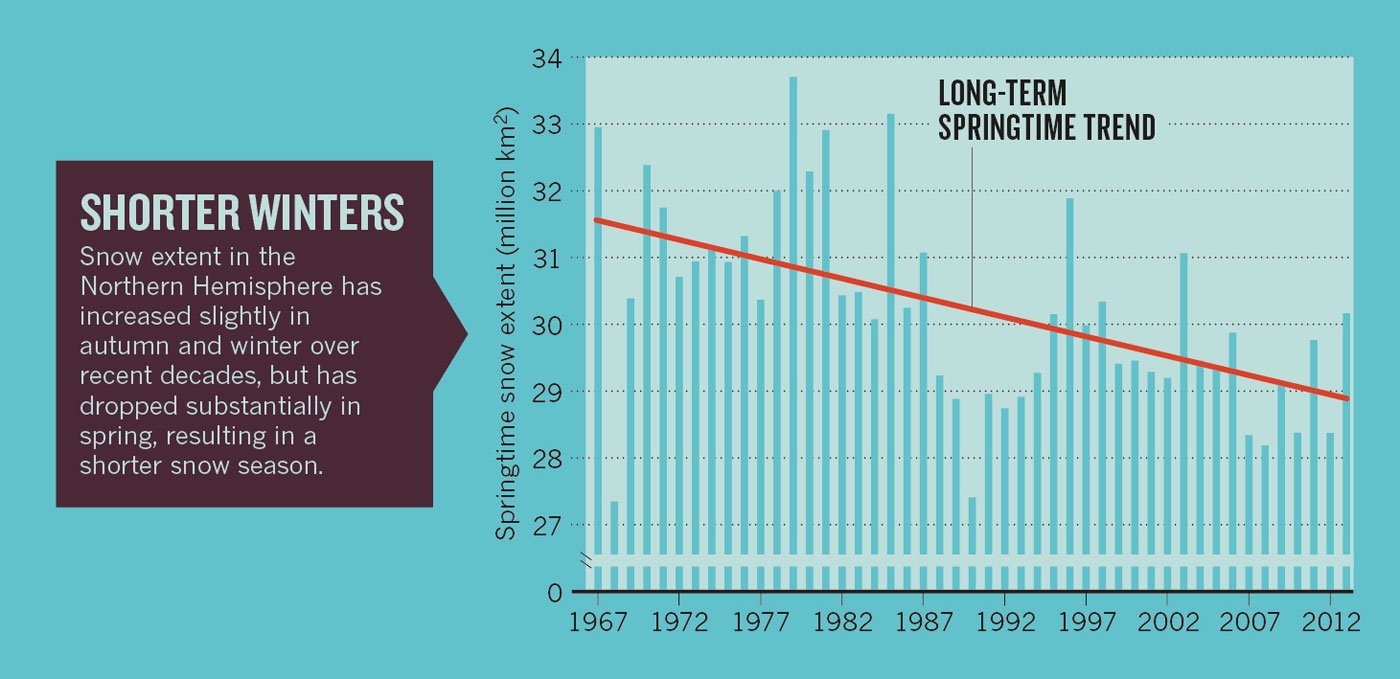
Source: Rutgers Univ. Global Snow Lab

“We know things are going to get warmer, and eventually, when you have temperatures above freezing more commonly than not, you’re going to see less snow,” says David Robinson, a hydro-climatologist who runs the Global Snow Lab at Rutgers University in Piscataway, New Jersey. In the Northern Hemisphere, the snow season has shrunk by about three weeks since the early 1970s (see ‘Shorter winters’), and snow cover is projected to decline substantially by the end of the century, according to a report released in September by the Intergovernmental Panel on Climate Change.

There is considerable uncertainty in regional forecasts for individual skiing regions, but climate researchers say that models agree on broad patterns. “By the second half of the twenty-first century, the models suggest we’ll be seeing really big changes in temperature and precipitation,” says Martin Beniston, a climate physicist at the University of Geneva in Switzerland. Already, signs of an unwelcome thaw have appeared at even the highest elevations. This season, the Verbier 4 Vallées resort in Switzerland eliminated two chair lifts after the lower edge of Tortin Glacier, at 2,800 metres elevation, receded by 40 metres in just 15 years.

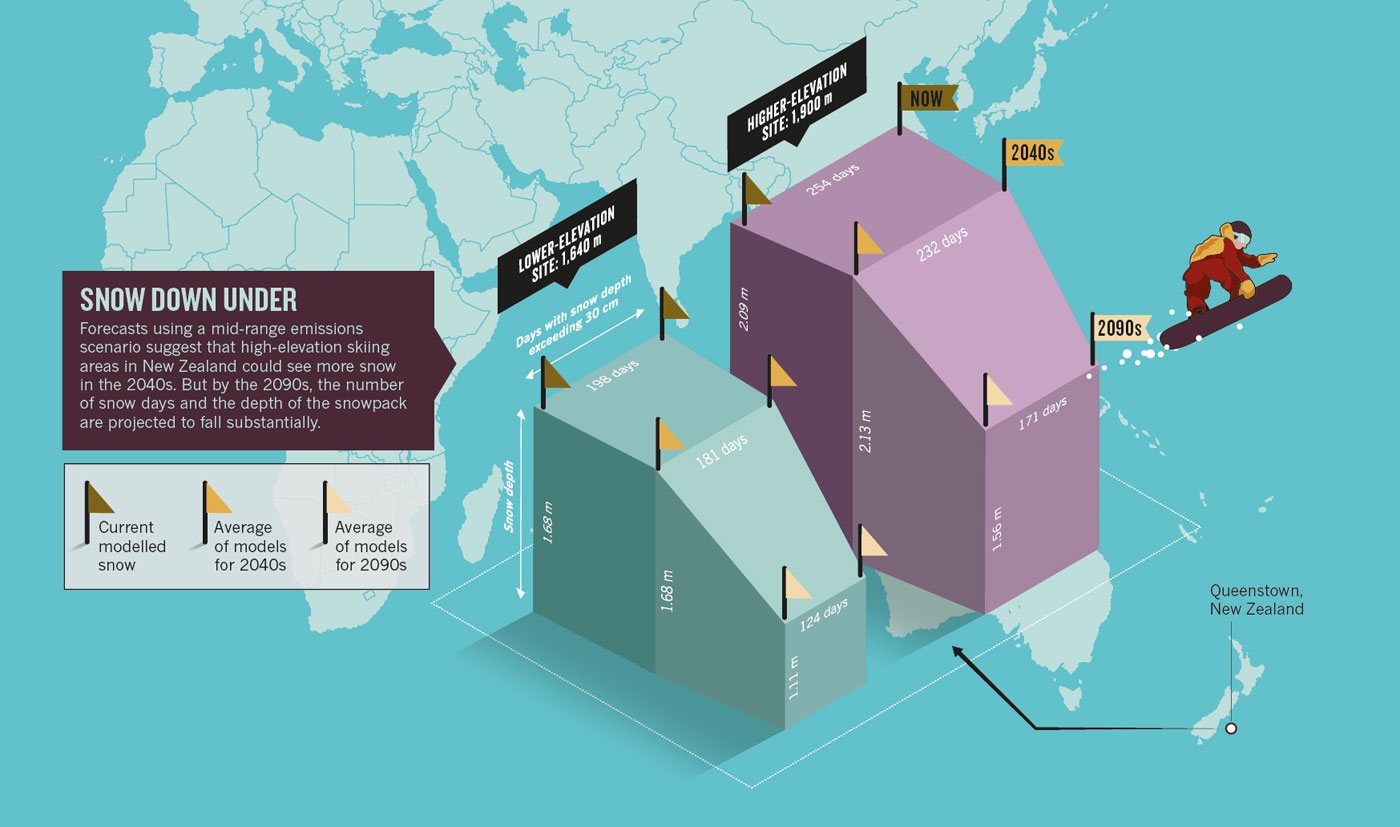
Source: J. Hendrikx et al. Clim. Change. 119, 965–978 (2013)

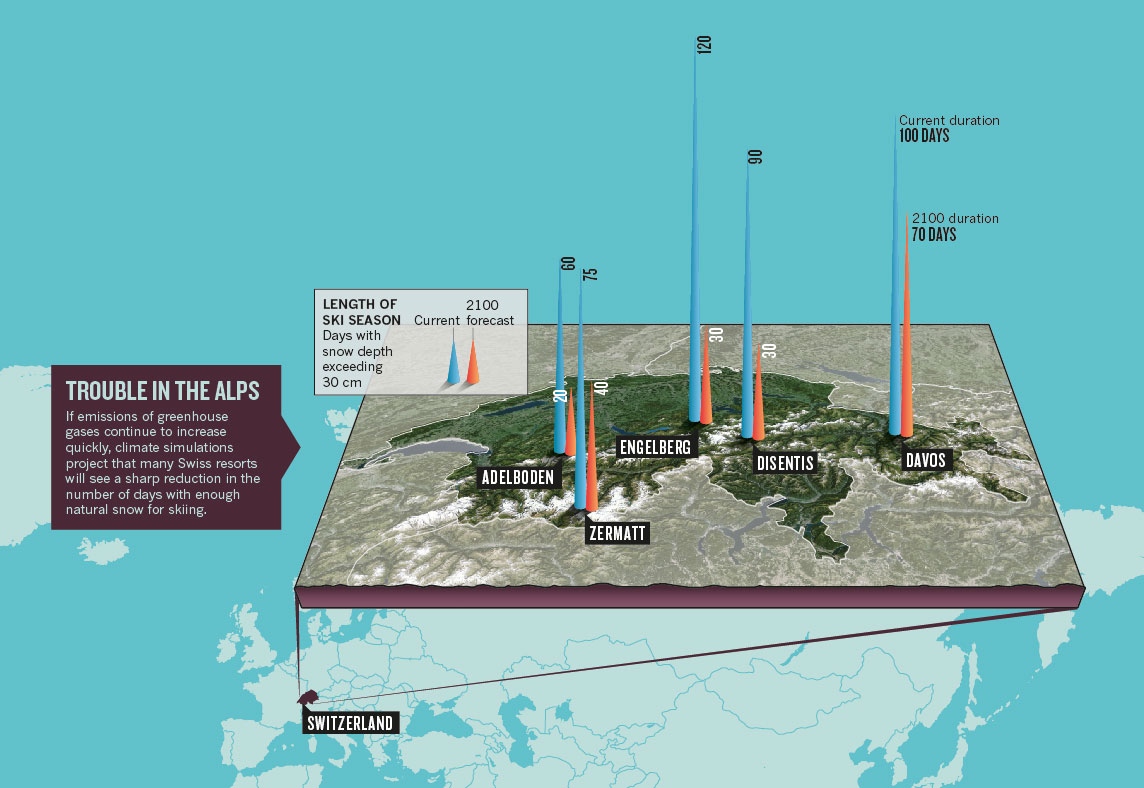
 The outlook is not so gloomy everywhere, at least initially(see ‘Snow down under’). A warmer atmosphere can hold more moisture, so rising temperatures may actually increase snow at some high-elevation sites — such as the peaks of New Zealand and parts of the Swiss Alps — for several decades, until winter temperatures inch above freezing (see ‘Trouble in the Alps’). In fact, average snowfall over the past decade at the Verbier resort has outpaced that in each of the previous three decades. But the area has also had to deal with more variability, warmer summers and a spate of hit-or-miss winters. “The extremes are much higher or much deeper,” says Eric Balet, chief executive of Téléverbier, the company that owns 4 Vallées. That introduces an unwelcome element of unpredictability for resort managers.

Source: M. Beniston WIREs Clim. Change 3, 349–358 (2012)

Skiing areas at low elevations face the worst forecasts. The US states of Connecticut and Massachusetts are home to a combined 17 skiing areas, and a study suggests that by 2039, none will sustain a viable skiing season — defined by industry as 100 days or more — even with artificial snow-making (J. Dawson and D. Scott Tourism Mgmt 35, 244–254; 2013). But at least 94% of the 18 resorts in the more northerly state of Vermont are projected to be viable until 2070 or beyond. A big difference is altitude: all the resorts in Connecticut and Massachusetts have a peak elevation below 750 metres, whereas 16 of those in Vermont exceed that, many by hundreds of metres.

Quality and quantity

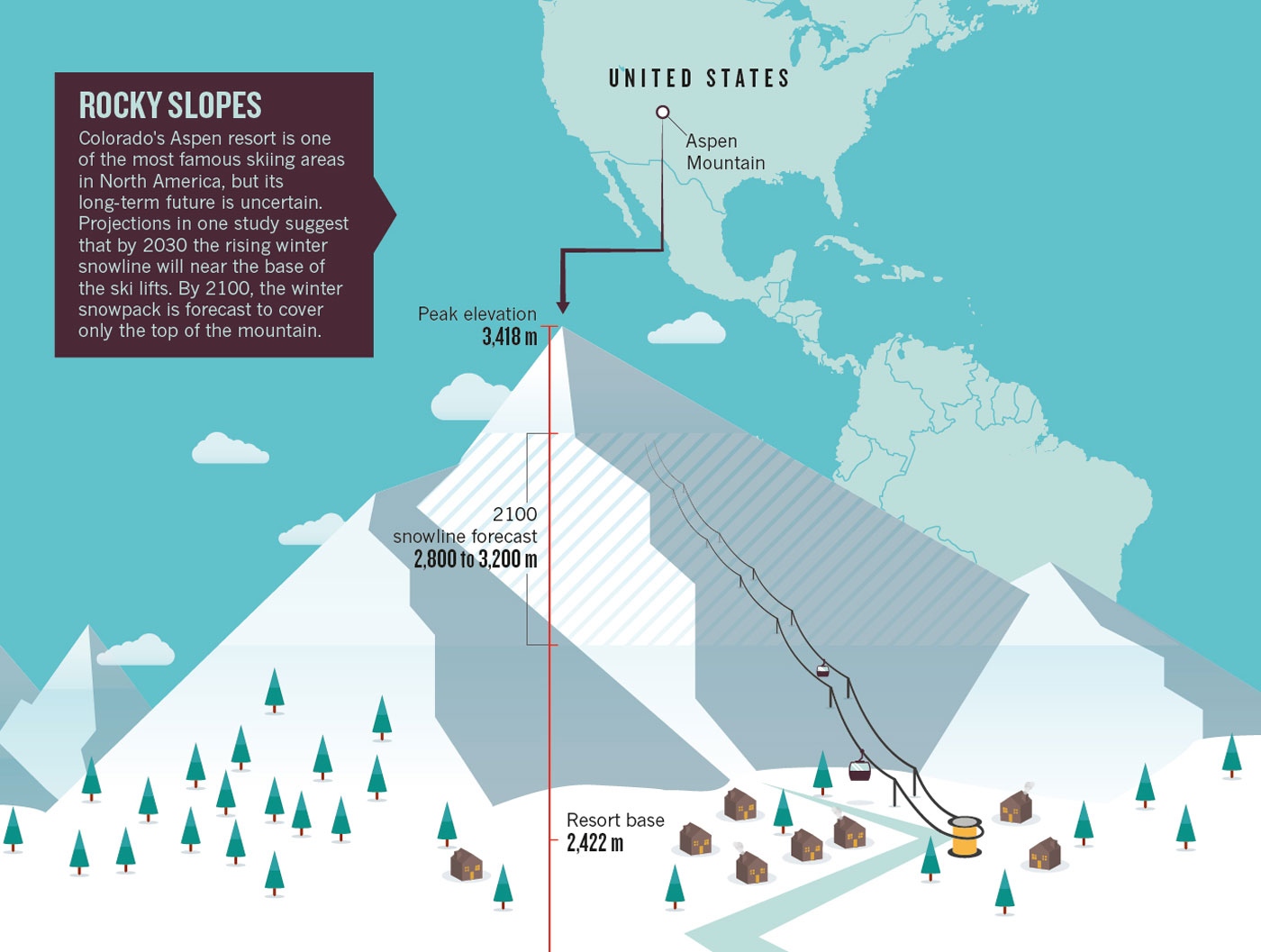
The prospect of losing small skiing areas worries Auden Schendler, vice-president for sustainability at Aspen Skiing Company, which runs the Aspen and Snowmass resorts high in central Colorado (see ‘Rocky slopes’). “We call those feeder resorts,” he says, because their lower prices and gentler slopes attract new skiers to the sport. “It doesn’t serve us for other resorts to go out of business.” And small mountains can produce big stars. The 2010 Olympic downhill champion, Lindsey Vonn, started skiing at Buck Hill, a 364-metre mountain in Burnsville, Minnesota; reigning World Cup slalom champion Mikaela Shiffrin trained as a child at New Hampshire’s Storrs Hill Ski Area, where the peak elevation is just 177 metres.

Source: B. Lazar & M. Williams Proc. Whistler 2008 Int. Snow Sci. Workshop 998–1005 (2008)

It is not only the quantity of snow that is crucial for winter sports such as skiing and snowboarding. Quality matters too, says Anne Nolin, a snow hydrologist at Oregon State University in Corvallis. A warmer, moister atmosphere will produce heavier, wetter snow, not the dry, fluffy ‘champagne powder’ prized by many recreational skiers. Artificial snow created with snow-making cannons is often icy, perfect for laying the base of lightning-fast competition runs but less favourable for the average skier. And temperatures that skirt the freezing mark increase the risk that precipitation will fall as rain, not snow, and will raise the density of the snowpack. “These just aren’t the kind of conditions that people go skiing for,” says Nolin. 
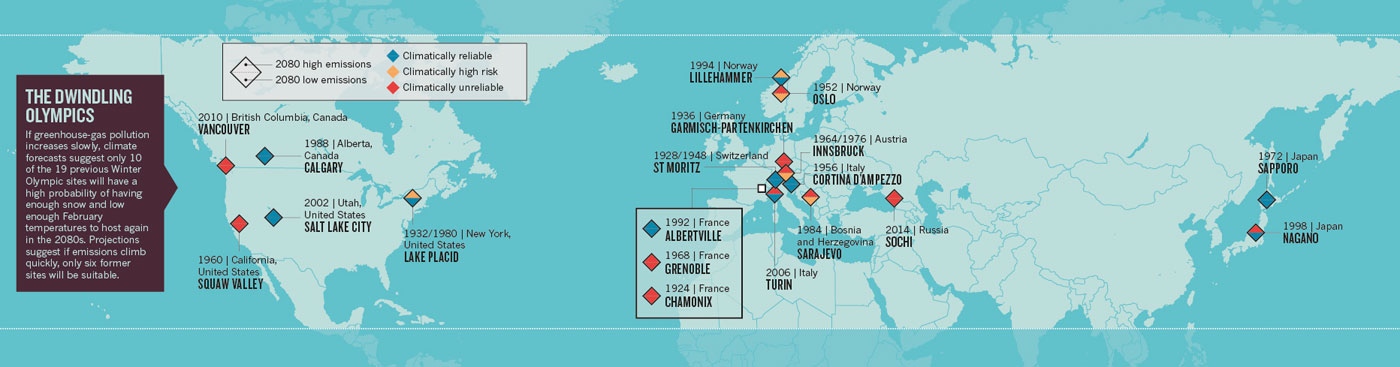
Source: D. Scott et al. The Future of the Winter Olympics in a Warming World (Univ. Waterloo, 2014)

It is not clear what the changing face of winter portends for future Olympic Games (see ‘The dwindling Olympics’). The competition has already been shaped by the vagaries of weather and climate, beginning with the decision decades ago to move figure skating, speed skating, ice hockey and curling indoors, says Daniel Scott, a geographer at the University of Waterloo in Canada. His research suggests that the pool of locations capable of hosting the games will shrink as the climate warms — and the colder mountain cities that may be the best fit may not have the infrastructure to handle a massive influx of athletes, spectators and organizers. That will force some difficult decisions, he says. “It’s an interesting dilemma the International Olympic Committee will be caught in.”


Download the full graphic as an A3 PDF Nature506,20–22(06 February 2014)doi:10.1038/506020a

ORIGINAL:
Nature
Lauren Morello
04 February 2014

domingo, 19 de enero de 2014

These 7 Countries Are Responsible for Over 60 Percent of Global Warming

And guess how the U.S. rates?
Throughout a century of climate-damaging activity, seven countries have emerged as the worst offenders. According to a new study published in Environmental Research Letters, the U.S., China, Russia, Brazil, India, Germany and the UK top the list.

The research, as digested by New Scientist:

Damon Matthews of Concordia University in Montreal, Canada, and his colleagues calculated national contributions to warming by weighting each type of emission according to the atmospheric lifetime of the temperature change it causes. Using historical data, they included carbon dioxide from burning fossil fuels and changes in land use – such as deforestation. They also accounted for methane, nitrous oxide and sulphate aerosols. These together account for 0.7 °C of the world’s 0.74 °C warming between 1906 and 2005.

The US is the clear leader, responsible for 0.15 °C, or 22 percent of the 0.7 °C warming. China accounts for 9 percent, Russia for 8 percent, Brazil and India 7 per centeach, and Germany and the UK for 5 percent each.
(Credit: IOP Science)

The above map shows the U.S., Western Europe, Japan and India bloated by their disproportionate contribution to global temperature rise as compared to their size — in this visualization, the blame shouldered by Russia, China and Brazil appears less extreme, while places like Canada, Australia and most of Africa all but disappear.

“It is these very questions of equity and responsibility that currently represent major barriers to progress in international negotiations attempting to set national emissions targets, ” the researchers write, “and yet are critical to resolve as we move forward with climate mitigation efforts.” Of course, as the Onion brilliantly pointed out, 7 billion key individuals are responsible for the global warming crisis — and we’re all equally responsible for working to reduce our contribution to climate change.

ORIGINAL: AlterNet / (Salon.com)
By Lindsay Abrams
January 17, 2014

Lindsay Abrams is an assistant editor at Salon and a former writer and producer for The Atlantic's Health Channel.

domingo, 18 de agosto de 2013

Bizarre Behavior in Endangered Tigers Traced to Dog Virus

ORIGINAL: Live Science
By Tanya Lewis, Staff Writer
August 16, 2013

Marty is an endangered Amur tiger. Credit: Jan Morse | RZSS

A rare breed of tigers in Russia has been spotted behaving bizarrely for more than a decade, and now researchers say they may know why.

The majestic, endangered felines have stumbled into villages and roads, emaciated and unafraid of people. Eventually, most of the tigers died, or had to be killed.

Now a new study shows these Amur tigers (also called Siberian tigers) suffered from a fatal neurological infection called canine distemper virus.


The virus, which normally infects domestic dogs, may be responsible for the deaths of at least 1 percent of Amur tigers since 2009, the researchers said. [Gallery: Rare and Beautiful Amur Leopards]

"Losing 1 percent of an endangered population is pretty significant," study researcher Denise McAloose, a pathologist at the Wildlife Conservation Society in the Bronx, New York, said in a statement.

McAloose and her colleagues examined tissue samples from five wild Amur tigers that died or were killed as a result of a neurological disease. Canine distemper virus was responsible for the deaths of two of the big cats, and caused a severe infection in a third, the team reportedin the journal mBio.

The brains of the two tigers were full of lesions, suggesting they suffered from severe viral encephalitis, which explains the animals' strange stumbling behavior. Molecular analysis of proteins and antibodies confirmed the presence of the virus, and a gene associated with the virus was found in the third tiger.

The afflicted tigers were found across the Russian Far East, throughout the range where Amur tigers live. The virus appears to be a recent threat, because blood taken from tigers before the year 2000 tested negative for viral antibodies, McAloose said.

The researchers said they suspect the tigers might have contracted the virus from unvaccinated domestic dogs in Russia, or possibly from raccoon dogs or foxes.

To determine the source of the tiger infections, McAloose and her team are now collecting samples from dogs and small wild carnivores in the region.

McAloose called the situation for Amur tigers "quite serious."

Once found throughout the Russian Far East, northern China and the Korean peninsula, the animals were nearly driven to extinction by hunting. By the 1940s, just 40 tigers were living, according to the World Wildlife Fund. Thanks to conservation efforts, the population has increased to around 450 today.

Follow Tanya Lewis on Twitter and Google+. Follow us @livescience, Facebook & Google+. Original article on LiveScience.


Editor's Recommendations
Gallery: Tiger Species of the World
Images: One-of-a-Kind Places on Earth
Acadia National Park: Glacier-Carved Beauty
Author Bio
Add caption

Tanya Lewis Tanya joined the LiveScience staff in 2013. She received a graduate certificate in science communication from the University of California, Santa Cruz in 2012. Before that, she earned a bachelor's degree in biomedical engineering from Brown University. She has interned previously at Wired.com, Science News, Stanford Medical School, and the radio program Big Picture Science. To find out what her latest project is, you can follow Tanya on

sábado, 13 de julio de 2013

Ocean Elders call on Putin to protect Antarctica’s ocean

ORIGINAL: Mission Blue
July 14th, 2013


Today Ocean Elders, including Sir Richard Branson, Dr. Sylvia Earle, James Cameron, Jean-Michel Cousteau and Capt. Don Walsh, wrote a letter to Russian president Vladimir Putin calling for the protection of Antarctica’s Southern Ocean at CCAMLR’s meeting in Germany 2013. 
Below is a copy of the letter:

Dear President Putin,

As you are aware, in Bremerhaven, Germany this week (July 11th – 16th) there will be a special meeting to consider marine protected area (MPA) proposals for the Ross Sea and several areas off the coast of East Antarctica. The Ross Sea remains one of the most intact marine ecosystems on the planet, with robust populations of whales, penguins, seals, albatrosses and other species. East Antarctica is a remote region of high ecological importance, home to a significant proportion of the Southern Ocean’s penguins, seabirds, seals and whales. Russia’s position will be crucial to the protection of these areas which are amongst the most iconic areas for marine wildlife on earth.

Russia was a founding member of the Commission for the Conservation of Antarctic Marine Living Resources (CCAMLR) and has an extensive Antarctic exploration history as well as a long tradition of important scientific research. As such, Russia has a critical leadership role to play in determining the future of Antarctica.

CCAMLR’s 2009 decision to establish a network of MPAs was a bold and forward-looking step. Agreeing to designate meaningful MPAs at the CCAMLR meetings this year will help fulfill this commitment. If the Ross Sea and the East Antarctic marine protected areas are designated, they will be the largest in the world and would more than double in size the area of ocean that is afforded significant protection worldwide. This would reaffirm the leadership of CCAMLR member countries on marine conservation of the high seas and leave a substantial legacy for future generations.

The proposed MPAs in these regions offer all CCAMLR Members unprecedented research and monitoring opportunities for scientists to understand how large-scale, fully functioning ecosystems work, and also how such ecosystems are influenced by climate change and ocean acidification. Thus far, the Ross Sea and East Antarctica have been spared the impact of widespread pollution, invasive species, bottom trawling and other large-scale commercial fishing operations that are imperiling other marine areas around the world. But conditions are changing, and the need to take steps to better protect key areas in the Southern Ocean is compelling.

We hope that with your leadership Russia will support the Ross Sea and East Antarctica marine protected area proposals at the Bremerhaven meeting this week. We stand ready to assist in any way.

Kind regards,

Sir Richard Branson James Cameron Jean-Michel Cousteau
Dr. Sylvia Earle Capt. Don Walsh

viernes, 8 de marzo de 2013

Russia finds 'new bacteria' in Antarctic lake

ORIGINAL: Physorg
March 7, 2013

Russian researchers pose for a picture after reaching the subglacial Lake Vostok in Antarctica on February 5, 2012. Russian scientists believe they have found a wholly new type of bacteria in the mysterious subglacial Lake Vostok in Antarctica.
Russian scientists believe they have found a wholly new type of bacteria in the mysterious subglacial Lake Vostok in Antarctica, the RIA Novosti news agency reported on Thursday. 
he samples obtained from the underground lake in May 2012 contained a bacteria which bore no resemblance to existing types, said Sergei Bulat of the genetics laboratory at the Saint Petersburg Institute of Nuclear Physics.

"After putting aside all possible elements of contamination, DNA was found that did not coincide with any of the well-known types in the global database," he said.

"We are calling this life form unclassified and unidentified," he added.

The discovery comes from samples collected in an expedition in 2012 where a Russian team drilled down to the surface of Lake Vostok, which is believed to have been covered by ice for more than a million years but has kept its liquid state.

Lake Vostok is the largest subglacial lake in Antarctica and scientists have long wanted to study its eco-system. The Russian team last year drilled almost four kilometres (2.34 miles) to reach the lake and take the samples.

Bulat said that the interest surrounded one particular form of bacteria whose DNA was less than 86 percent similar to previously existing forms.

"In terms of work with DNA this is basically zero. A level of 90 percent usually means that the organism is unknown."

He said it was not even possible to find the genetic descendants of the bacteria.

"If this had been found on Mars everyone would have undoubtedly said there is life on Mars. But this is bacteria from Earth."

Bulat said that new samples of water would be taken from Lake Vostok during a new expedition in May.

"If we manage to find the same group of organisms in this water we can say for sure that we have found new life on Earth that exists in no database," Bulat said.

Exploring environments such as Lake Vostok allows scientists to discover what life forms can exist in the most extreme conditions and thus whether life could exist on some other bodies in the solar system.

There has long been excitement among some scientists that life theoretically could exist on Saturn's moon Enceladus and the Jupiter moon Europa as they are believed to have oceans, or large lakes, beneath their icy shells.

The possibility that the lake existed had first been suggested by a Soviet scientist in 1957. Scientific research drilling in the area started in 1989 and the lake's existence was confirmed only in 1996.

The drilling project is of major importance for the prestige of science in Russia and Russian leader Vladimir Putin was given a sample of water from Lake Vostok last year when the expedition began.

(c) 2013 AFP

viernes, 6 de julio de 2012

China: Captan imágenes de tigre siberiano en peligro de extinción

ORIGINAL: Mas Verde

Cámaras automáticas infrarrojas colocadas en un bosque de la nororiental provincia china de Jilin lograron captar dos imágenes de tigres siberianos salvajes, especie en peligro de extinción.

Las fotos fueron tomadas el pasado 4 de abril en la montaña Changbai, del condado Wangqing, en la prefectura autónoma coreana de Yanbian, que limita al este con Rusia y al sur con la República Popular Democrática de Corea.

Financiado por el Fondo Mundial para la Naturaleza (WWF), la Oficina Forestal del lugar puso en marcha más de 100 cámaras automáticas infrarrojas en el bosque para capturar imágenes de animales raramente vistos.

Durante los últimos años, esos equipos captaron muchas imágenes de tigres siberianos y leopardos de Amur, según el WWF, citado por medios de prensa. La población total de los primeros es de aproximadamente 500, concentrada en Rusia, noreste de China y norte de la Península Coreana.

El Leopardo de Amur es otra de las especies de la zona que se encuentra en grave peligro de desaparecer.
China cuenta actualmente con sólo 20 tigres siberianos salvajes registrados.

Empleados del buró de silvicultura de Dongfanghong, lanzaron en febrero pasado una campaña basada en alimentar a corzos y ciervos rojos para la supervivencia de los tigres siberianos (sus depredadores) durante el crudo invierno.

Fuente: Prensa Latina, Agencias

lunes, 2 de julio de 2012

Danger Listing Denied Four Natural World Heritage Sites


ST. PETERSBURG, Russia, June 30, 2012 (ENS) - None of the four natural World Heritage sites recommended for inclusion on the World Heritage Danger List by the official advisory body on nature have been added by the World Heritage Committee.

As the committee's advisory body, the International Union for the Conservation of Nature, IUCN, had recommended that
  • Lake Turkana National Parks in Kenya, 
  • the Dja Faunal Reserve in Cameroon, 
  • the Virgin Komi Forests in Russia, and 
  • the Pitons Management Area in the Caribbean island nation of Saint Lucia 
be added to the List of World Heritage in Danger.
Lake Turkana in Kenya (Photo by International Rivers) 
The committee, meeting in St. Petersburg until July 6, has rejected all four recommendations.

A UNESCO agency, the World Heritage Committee identifies cultural and natural properties of Outstanding Universal Value that are to be protected under the treaty protecting World Cultural and Natural Heritage and inscribes those properties on the World Heritage List and the List of World Heritage in Danger.

"We are disappointed that the committee has not inscribed any of these threatened sites on the List of World Heritage in Danger this year," said Tim Badman, director of IUCN's World Heritage Programme.

"These four sites face significant threats to their values, from threats including major infrastructure projects, the extractive industry and property speculation," said Badman.

The proposal to include Kenya's Lake Turkana on the Danger List was made due to construction of Gibe III dam in Ethiopia, a transboundary issue between Kenya and Ethiopia.
The Dja River in the Cameroon's Dja Faunal Reserve (Photo by Cameroon Travel ) 
An IUCN assessment shows that dam construction will result in a steep reduction in the water level of the world's largest desert lake, increased salinity and a decline in fish stocks and wildlife. It will also affect local communities who depend on the lake for their livelihoods. Local communities have been demonstrating against the dam for years.

Oil exploration and poaching pose additional threats to the area. Flagship species such as the reticulated giraffe and Grevy's zebra seem to have disappeared.

Cameroon's Dja Faunal Reserve is one of the largest and best preserved rainforests in Africa, surrounded by the Dja River and inhabited by a wide variety of primates, including the Critically Endangered western lowland gorilla and the Endangered chimpanzee.

Mining activities in the vicinity of the reserve as well as wildlife poaching and ongoing dam construction on the river Dja were the main reasons for the site's danger listing proposal, the IUCN said.
Russia's Virgin Komi Forests (Photo by MerJade )
For the second year in a row, IUCN's recommendation to include Russia's Virgin Komi Forests on the Danger List has not been followed. Preparation works for a gold mine inside the site and national level boundary changes, which led to the loss of legal protection for parts of the site, are both clear criteria for a site to be declared in danger, warned the IUCN.

In the Northern Ural mountains of Russia's Komi Republic, the Virgin Komi Forests cover 3.28 million hectares of tundra and mountain tundra, as well as one of the most extensive areas of virgin boreal forest remaining in Europe. Both European and Asiatic species inhabit the site with some 43 mammal, 204 bird and 16 fish species recorded. Threatened mammal species include wolf, otter, beaver, sable, wolverine and lynx.

The Pitons Management Area in Saint Lucia has been subjected to significant development since its inscription on the World Heritage List in 2004, and development threats risk irreversible loss of its outstanding universal value.

Recognizable for its two eroded remnants of lava domes rising from the sea to heights greater than 700 meters, Pitons Management Area includes a geothermal field with sulphurous fumeroles and hot springs. The forested spires contain eight rare tree species. The larger one is inhabited by some 27 bird species, five of them found nowhere else on Earth.
Pitons Management Area in the Caribbean island nation of Saint Lucia (Photo by Michael Blanding ) 
Coral reefs cover almost 60 percent of the site's marine area, which is inhabited by 168 species of finfish.

Badman said, "Inscription on the Danger List is not a black mark for countries, but a way of drawing attention and providing support to the sites that need it the most."

The World Heritage Fund provides about US$4 million annually to support activities requested by governments in need of international assistance. The World Heritage Committee allocates funds according to the urgency of requests, priority being given to the most threatened sites.

The committee is composed of representatives from 21 governments that are Parties to the Convention Concerning the Protection of the World Cultural and Natural Heritage, adopted by UNESCO in 1972.

At the 2012 meeting they are: Algeria, Cambodia, Colombia, Estonia, Ethiopia, France, Germany, India, Iraq, Japan, Malaysia, Mali, Mexico, Qatar, Russia, Senegal, Serbia, South Africa, Switzerland, Thailand and United Arab Emirates.

On Tuesday, the IUCN released a new independent review of World Heritage and extractive industries, published in response to growing concerns over the rapidly increasing number of World Heritage Sites threatened by planned mining or oil and gas projects.

Threats to natural World Heritage sites from mining activities are growing, especially in Africa, where one out of four iconic natural areas is negatively affected.

The outcome of a joint project by IUCN, the International Council on Mining and Metals, JP Morgan Bank, Shell International and UNESCO, the report proposes practical ways of strengthening the role of the World Heritage Convention in safeguarding these areas of outstanding value.

"These exceptional places, which cover less than one percent of the Earth's surface, have been included on the World Heritage List because they are of outstanding value to all of humanity. It's the duty of every one of us to cooperate in their protection and conservation," said Badman.

Companies such as Shell and the financial services firm JP Morgan, as well as ICMM, which brings together many of the world's major mining companies, have recognized the importance of conserving World Heritage Sites and have committed not to undertake activities that would damage them.

Yet other companies and some countries still profit from resource exploration in these sensitive areas.

"It is clear that the desired conservation outcomes will not be achieved through individual corporate commitments alone," Badman said. The task of ensuring World Heritage Sites are not impacted by extractive industries cannot be effective if it is a commitment of only a few responsible companies."

"Mining and energy companies' ability to fund substantial environmental programmes in the vicinity of their operations should not be viewed as adequate recompense for negative impacts on natural World Heritage properties. Nor are offsets an admissible strategy to compensate for such impacts," the report states.

"Nevertheless, the extractive industries should not automatically be seen as a threat to these properties. Instead, there may be opportunities, within broader planning and management frameworks, to identify mutually beneficial strategies for company support to environmental initiatives and capacity development that directly or indirectly benefit them," according to the report, which points out, "In the 21st century, a positive environmental profile is an increasingly valuable asset for the private sector."

After more than 10 years of dicussion on this issue, the World Heritage Committee has decided to develop formal policy guidelines governing extractive industries affecting natural World Heritage sites.

The joint industry-UNESCO-IUCN review proposes wording for the policy guidelines that would prohibit extractive industry operations in natural World Heritage sites. The proposed wording would provide for the committee to encourage and assist governments in ending any existing concessions or operations. And it proposes that governments take legislative and planning measures to prevent negative impacts on natural World Heritage sites by extractive industry operations beyond their boundaries.

The World Heritage List includes 951 properties forming part of the cultural and natural heritage which the World Heritage Committee considers to have outstanding universal value.

These include 739 cultural sites, 183 natural sites and 29 mixed cultural-natural properties in 155 countries. As of March 2012, 189 of the world's 193 governments had ratified the World Heritage Convention.

domingo, 10 de junio de 2012

Stop the illegal killing of strays in Ukraine for Eurocopa 2012

ORIGINAL: ThePetitionSite
Target: Viktor Yanukovych, President of Ukraine
Sponsored by: Olga Pronina

Animal Welfare Association of Ukraine discovered an illegal plan to bring together the groups of outlaw dog hunters from both Russia and Ukraine in order to kill the mass amount of strays in Lviv as well as other cities and towns of Ukraine in preparation for Euro 2012. Other such plans were stopped with international help, so now they are using illegal means.

The dates: 27,28,29 of May, 2012. 


There is a shameful understanding between the killers and the local authorities. The police will not stop them. The border guards will not stop them. They are going to shoot and poison every animal in their way, even those who have owners are in danger. The local residents have been warned to keep their children at home, to stop going out after dark.
This is a war. A bloody and illegal war against the helpless animals. 
Ukraine needs your voices to be heard, people of the world. Please help. 

(Here's some information in the Ukrainian language

Princess of whales: How a naked female scientist tries to tame belugas in the freezing Arctic

ORIGINAL: DailyMail
Created 11:47 PM on 15th June 2011

Braving sub-zero temperatures, she has thrown caution — and her clothes — to the wind to tame two beluga whales in a unique and controversial experiment.

Natalia Avseenko, 36, was persuaded to strip naked as marine experts believe belugas do not like to be touched by artificial materials such as diving suits.

The skilled Russian diver took the plunge as the water temperature hit minus 1.5 degrees Centigrade.

The beauty of nature: Like a scene from a classic pre-Raphaelite painting, naked Natalia Avseenko swims with beluga whales in the Arctic
Belugas are famed for the way in which their faces are able to convey human-like expressions. 

Certainly Matrena and Nilma seemed to enjoy frolicking with Natalia. 

The taming of the whales happened in the Murmansk Oblast region in the far north-west of Russia at the shore of the White Sea near the Arctic Circle branch of the Utrish Dophinarium.

An area of the sea is enclosed to stop whales and dolphins getting out and instructors tame the mammals before they are transported to dolphinariums around the world — a practice many animal conservationists consider cruel. 

Belugas have a small hump on their heads used for echo-location and it was thought that there would be more chance of striking up a rapport with them without clothes as a barrier. 

Breathtaking: the scientist uses yoga techniques to hold her breath for up to ten minutes at a time ask she frolics with the whales, Nilma and Matrena
Come on in, the water's lovely: The whales wait for Natalia to take the plunge, but the sub-zero waters are enough to kill most people within five minutes
The average human could die if left in sub-zero temperature sea water for just five minutes.

However, Natalia is a yoga expert and used meditation techniques to hold her breath and stay under water for an incredible ten minutes and 40 seconds.

There are around 100,000 belugas in the wild. 

The first to be held in captivity was shown at Barnum's Museum in New York in 1861, and there are belugas in aquariums and sea life parks across Europe, North America and Asia.

Their large range of 'facial expressions' comes from them having a more flexible bone structure than other whales.

Certainly these two had a big smile for the naked Natalia. 

Rare space: Natalia's encounters with the whales take place in an area of sea which is enclosed to stop whales and dolphins getting out
Here's looking at you: Belugas have a wider range of 'facial expressions' due to a more flexible bone structure, and it has made them a hit in aquariums around the world

viernes, 25 de mayo de 2012

Identifican a la primera orca albina adulta

ORIGINAL: LaTercera

Investigadores de Rusia han divisado un ejemplar que tendría unos 16 años. Ahora, iniciarán una expedición para observar esta especie.

Investigadores rusos dieron a conocer el hallazgo en las costas de la península de Kamchatka, al este del país, de la primera orca albina en su etapa adulta, la que fue denominada "Iceberg".

El cetáceo tendría alrededor de 16 años (dado el tamaño de su aleta dorsal), y cuando fue detectado viajaba junto a un grupo, que podría tratarse de su madre y hermanos.

Hasta el momento, uno de los casos de los que se tenía conocimiento hasta ahora era un macho joven que murió en un acurio en canadá en 1972. Debido a esta condición, los animales en general no alcanzan la vida adulta, pues su visibilidad se tranforma en una situación de desventaja en la búsqueda de alimentos.

Ahora, los científicos comenzarán una expedición para analizar y observar esta particular especie.

jueves, 29 de marzo de 2012

Chimpancé bebé acogido por perros domésticos

ORIGINAL: Medicina Veterinaria


Este chimpancé bebé fue abandonado por su madre en un zoológico de Rusia y fue llevado a la casa de uno de los funcionarios tenía un mastín. Las imágenes hablan por sí mismas.

jueves, 23 de febrero de 2012

Pelícanos en peligro de extinción han quedado en el Mar Congelado

ORIGINAL: Global Animal
23 de febrero 2012
Los funcionarios rusos que alimentan a los pelícanos en peligro de extinción obligados a trasladarse debido a la helada del mar Caspio.
Fotografía: Sergei Rasulov / AP
(Rescate de Animales) RUSIA - Con la congelación del Mar Caspio por primera vez en muchos años, cientos de especies en peligro y pelícanos dálmatas hambrientos están compartiendo una rara y pequeña porción de agua congelada en Makhachkala, Rusia. El Ministerio de Protección de la Naturaleza se ha asociado con los legisladores locales para ofrecer a los pelícanos alimentos hasta que puedan cazar por su cuenta, pero alrededor de 20 han muerto ya. Siga leyendo para obtener más información acerca de lo que Rusia está haciendo para proteger a estos pelícanos. - Animal Mundial

The Huffington Post
Makhachkala, Rusia (AP) - Las autoridades se apresuran a salvar a cientos de los pelícanos dálmatas muertos de hambre y en peligro de extinción después de que el Mar Caspio se congeló por primera vez en muchos años.

Cientos de los pájaros de color blanco grisáceo con plumas rizadas distintivas en sus nucas se empujaban unos a otros en un manchón de agua congelada en un astillero cerca de la ciudad de Makhachkala, la capital de la sureña provincia rusa de Daguestán.

Alrededor de 20 aves han muerto de hambre a pesar de los cientos de kilos (libras) de pescado que su ministerio y un legislador local están comprando todos los días para darles de comer, dijo el martes el portavoz del Ministerio de de Protección de la Naturaleza de Daguestán, Arslan Dydymov.

Menos de 1.400 pelícanos dálmatas, la mayor del mundo, viven en el sur de Rusia.

Las aves están recibiendo el compras en el mercado local, porque el pescado fresco desde el mar Caspio helado no está disponible más.

"Ayer parecía que habían comidoa más que suficiente", dijo Kurban Kuniev de la reserva de la naturaleza Daguestán.

Los pájaros volaban a Makhachkala la semana pasada de los deltas helados de los ríos Volga y Terek en el norte. Los residentes locales estaban tan emocionados por la llegada que los guardias en el astillero de Makhachkala tuvo que evitar dejar a cientos entrar con pan y otros alimentos no aptos.

"Nosotros no los dejamos entrar por el bien de los pelícanos", dijo el jefe de guardia de Magomed Eldarov.

Más Huffington Post: http://www.huffingtonpost.com/2012/02/21/dalmatian-pelicans-caspian-sea-fed_n_1290147.html

miércoles, 22 de febrero de 2012

Una planta regenerada a partir de semillas de 32.000 años. Es la más antigua a la fecha.

ORIGINAL: NatGeo
Rachel Kaufman

National Geographic News
21 de febrero 2012
Una planta regenerada a partir de semillas de 32.000 años.
Fotografía cortesía de la Academia Nacional de Ciencias.
La planta más antigua en ser regenerada ha pasado 32.000 años de edad, sus semillas, batiendo el anterior poseedor del record en unos 30.000 años. (Relacionado: "Árbol" Matusalén " semillas de más de 2.000 Años.")
Un equipo ruso descubrió un alijo de semillas de Silene stenophylla, una planta con flor nativa de Siberia, que había sido enterrado por una ardilla en la Edad de Hielo cerca de las orillas del río Kolyma (mapa). La datación por radiocarbono confirmaron que las semillas eran de 32.000 años de antigüedad.

Las semillas maduras e inmaduras, que habían sido completamente encerradas en el hielo, fueron desenterrados de 124 pies (38 metros) por debajo del permafrost, rodeado de capas que incluye mamuts, bisontes, rinocerontes lanudos y los huesos.

Las semillas maduras se habían dañado, tal vez por la propia ardilla, para evitar la germinación en la madriguera. Pero algunas de las semillas inmaduras conservaban material vegetal viable.

El equipo extrajo el tejido de las semillas congeladas, se colocaron en viales, y se germinaron con éxito las plantas, de acuerdo con un estudio reciente. Las plantas-idénticas entre sí, pero con diferentes formas de la flor de la moderna S. stenophylla crecieron, florecieron y, después de un año, crearon las semillas de su propia cuenta.

"No puedo ver ningún fallo intrínseco en el artículo," dijo el botánico Peter Raven, presidente emérito del Jardín Botánico de Missouri, que no participó en el estudio. "Aunque es un informe tan extraordinario que, por supuesto, te gustaría repetirlo."

Raven es también jefe del Comité de National Geographic para la Investigación y Exploración. (La sociedad propietaria de National Geographic News.)

Estudio de la planta podría ayudar a Bóvedas de semillas?

El nuevo estudio sugiere que el permafrost podría ser un "depositario de un patrimonio genético antiguo," un lugar donde podría ser cualquier número de especies extintas ahora encontrado y resucitado, dicen los expertos.

"Ciertamente, algunas de las plantas que fueron cultivadas en la antigüedad y se han extinguido y otras plantas importantes para los ecosistemas, una vez que han desaparecido, sería muy útiles hoy en día si podrían ser devueltas a la vida", dijo Elaine Solowey, un botánico en el Instituto Arava de Estudios del Medio Ambiente en Israel.

Solowey resucitó la palmera datilera de dos mil años de edad, que anteriormente ostentaba el título de las más antiguas de semilla regenerada.

Su semilla de palma, sin embargo, había sido enterrado en un lugar seco, fresco, muy lejos de ser el medio ambiente permafrost de las semillas de S. stenophylla.

La regeneración de las semillas que han estado congeladas a 19 grados Fahrenheit (-7 grados centígrados) durante tanto tiempo podría tener implicaciones importantes, dijo Solowey, que no estuvo involucrado en el nuevo estudio.

Eso es porque de todos los proyectos de protección de semillas más famoso es quizás la llamada bóveda del fin del mundo de Noruega, también conocido como la Bóveda Global de Semillas de Svalbard (ver fotos)-dependen de semillas congeladas.

"Cualquier conocimiento que se obtiene de las semillas que se hayan congelado y la forma de descongelar y hacerlas brotar es muy valiosa", dijo.

Raven del Jardín Botánico de Missouri, agregó que, si somos capaces de descubrir las condiciones que mantienen a las semillas viables durante 32.000 años, a continuación, "si lo estuviera haciendo uno mismo, se podrían preservar las semillas [] durante más tiempo."

Regenerada de semillas estudio publicado esta semana en Proceedings of the National Academy of Sciences.

viernes, 10 de febrero de 2012

20 fotos asombrosas del severo invierno Europeo

ORIGINAL World Geography

Mientras en los Estados Unidos continúa la tibieza de un invierno inusualmente leve, el fuerte invierno en el Continente Europeo, ha cobrado ya 300 víctimas de Suiza a Roma con temperaturas que han descendido hasta -30ºC a través de toda Europa Occidental. También un invierno extremadamente severo ha cobrado 200 vidas e Rusia, Polonia, Alemania, Rumania, Serbia... desde el inicio del año.


Un hombre pasa junto a un coche cubierto de hielo en el paseo marítimo en el Lago de Ginebra congelado  en  Versoix de la ciudad, cerca de Ginebra, Suiza, en las primeras 05 de febrero 2012. (Getty Images / Coffrini Fabrice)  Buzzfeed

Carámbanos cuelgan de un techo en Hochfilzen, provincia austríaca de Tirol, en el Lunes, 06 de febrero 2012. Europa fue golpeada por una ola de frío con temperaturas de muy por debajo del punto de congelación. (Kerstin Joensson / AP) stamfordadvocate
Niño rumano trata de encontrar el coche de su padre.  pozehaioase
Un hombre de Bosnia excava la nieve profunda para despejar el camino para los peatones, en la capital bosnia de Sarajevo. Belfasttelegraph
Una mujer camina junto a un perro al río Spree parcialmente congelado en Berlín, Alemania, Lunes, 06 de febrero 2012   Denverpost

Coches cubiertos de nieve, Rumania. 
  Arena.Md
Una niña camina sobre el hielo cubrió el pavimento a lo largo de la orilla del lago Leman en Versoix cerca de Ginebra, el 5 de febrero de 2012 (Reuters / Denis Balibouse).  The Atlantic
Una vaca se ve fuera de su establo detrás de carámbanos de hielo en Davos, Suiza, Jueves, 02 de febrero 2012. (Foto AP / Keystone, Arno Balzarini)   The State
La gente camina sobre el pavimento cubierto de hielo en la orilla del lago Leman en Versoix cerca de Ginebra, Suiza, 5 de febrero de 2012. (Reuters / Denis Balibouse)  National Post
Un carguero y un transbordador se abren camino a través de las capas de hielo que cubren el agua en la zona portuaria de Hamburgo, Alemania, el 5 de febrero de 2012. (Marcus Brandt / AFP / Getty Images) National Post
Los canales helados de Amsterdam se convirtió en un inmenso terreno de juego como para los residentes, que montan en bicicleta, patinan y caminan por el hielo.Dailymail.co.uk
La gente patina sobre el lago congelado Sihlsee en el valle Euthal ubicado en el cantón suizo de Schwyz el Domingo, 05 de febrero 2012. (Foto AP / Keystone / Urs Flueeler)  Denver Post
Un hombre ve carámbanos en una ventana en Uzice, 125 millas (200 km) al suroeste de Belgrado, Serbia el 2 de febrero de 2012. (Foto AP)  cbsnews   
Una cascada se congela en Lille, Norte de Francia, cuando una ola de frío se ha dirigido a Francia en estos días. (Photo credit should read Philippe Huguen / AFP / Getty Images) Buzzfeed
El hombre trata de entrar en un coche que está bajo la nieve, Rumania.  Puterea
Los patos reposan en el hielo en Svisloch río en un parque en el centro de Minsk (Bielorrusia). Un clima inusualmente frío de menos 24 grados Celsius (-13 grados Fahrenheit) registrados en la capital bielorrusa, el sábado, según medios locales. (Reuters) Emirates247
Un hombre limpia la nieve del techo de una casa en Sjenica, a unos 250 kilómetros (155 millas) al suroeste de Belgrado, Serbia, Domingo, 05 de febrero 2012. (Foto AP / Delic Samir)  The National
Un joven foca gris aparece en el agua parcialmente congelada, en una estación de cría de focas en Friedrichskoog, el norte de Alemania, el 9 de febrero de 2012. Seis focas grises se conserva actualmente en la estación de cría. (Carsten Rehder / Getty Images) Washington Post
Carámbanos colgando del puente del mar en la playa de Schoenberg en el Mar Báltico, al norte de Alemania, cuando las temperaturas llegan a -6 ° C (21 F). (Eribert Proepper / AP)  The Star
Los ciudadanos de Gdansk en Polonia, han hecho un campo para hockey sobre hielo en la capa de hielo de la Bahía de Gdansk, Mar Báltico. .  PolskaLokalna