"For our series People Who Think Good, John Oliver sits down for a banana with Dr. Jane Goodall, one of the world's foremost experts in chimpanzees."

Mostrando entradas con la etiqueta Chimpancé. Mostrar todas las entradas
Mostrando entradas con la etiqueta Chimpancé. Mostrar todas las entradas
miércoles, 19 de noviembre de 2014

jueves, 17 de abril de 2014
Jane Goodall Talks To John Seigenthaler
She's best known for her pioneering work with chimpanzees, but Goodall is also a keen conservationist

John Seigenthaler: Your latest project is a book about plants. Can you draw the line for us between plants and chimpanzees?
Jane Goodall: Without plants, none of us would be here, chimpanzees, people or anything else, because everything either lives on plant food or lives on creatures that live on plant food.
One of the things you also discuss in this book is the challenges facing forests around the world. What do you think are the biggest challenges?
Human greed and human need. I mean, on the one hand, you've got desperately poor people, and they've got to try and feed their family. They don't have money to buy food, so they're cutting down trees to grow crops or to make charcoal so that they can get a bit of money and buy a bit of food. Then on the other hand, you've got the big timber companies coming in, some of them still clear-cutting and paying lots of money for a forest concession to the government. Then the people living in the forest suffer, as well as everything else.
In fact, in your book — I just want to read a couple of lines that you write — you say, "The truth is that when corporate greed and public demand for a better and better lifestyle are pitted against the health of the environment and the health of people, for that matter, it is the bottom line that wins …" You sound like an environmental activist, an angry environmental activist here.
Well, I do get angry when I think of the unsustainable lifestyle of so many about this materialistic, Western-based culture. How many of us have so much more than we need? I mean, we need money to live, and what goes wrong is when we live for money. That's happening more and more often. And as a result, I think, it's a very empty kind of society, and people, when you live and money is your goal and your god, then I think people lose a lot of sensitivity and human values and love and compassion.
You have great hope for nature, and hope is a theme through much of your writing. I was touched by the stories at the end of the book that talk about a couple of trees — Survivor, in particular. Could you tell that story?
Yes, Survivor is very dear to me because I was in New York at 9/11, and they found the one piece of tree that was still alive out of all the trees that were around those Twin Towers. It looked like a dead stump, blackened with fire and everything. But some people took it and nurtured it. This tree now is back at Ground Zero, and it's a beautiful pear. I've seen it in blossom. But that tree somehow epitomizes the resilience of nature and the passion of people because so many people said, "Oh, throw it away. You'll never get this tree to grow." But they didn't give up.
I do get angry when I think of the unsustainable lifestyle of so many about this materialistic, Western-based culture. How many of us have so much more than we need?
It was also damaged by a storm, wasn't it?
Yes, it had just begun to recover, and I think it was Hurricane Sandy that tore it down, and they rushed out and desperately propped it up. It's had a very dramatic life.
You speak of another tree, a cherry tree at Fukushima, another example of a tree surviving. But, you know, in that example, I really wonder about our world and where we're headed and whether or not there is hope when you see a disaster like that. Fukushima?
Fukushima. Yes. As I said, it's a hope based on the fact that we can do it, but in order to change the world and make it start moving in a better direction — instead of heading downhill, just start leveling it off, and then eventually coming up. We have to change attitudes. That's the thing. When people lose hope, as many people do — because many biologists point out that there isn't any hope — if everybody loses hope, what happens? You fall into apathy. There's no point doing anything. It doesn't matter. But how can we be bringing our children into a world and telling them there's no hope? That's cruel.
There's a saying about inheriting the earth from our parents. But you say in some ways, we've stolen …
We have. We have stolen their future. I began the youth program because I met so many young people who had lost hope, who said, "Well, you compromised our future, and there's nothing we can do about it." We have, but there is something we can do about it. At least I shall die fighting for that.
What's the most interesting thing you've learned about chimpanzees over the years?
How like us they are or how like them we are. I think the most shocking but very fascinating thing is when I realized that, like us, they have a dark side. That made them sadly seem more like us than I had thought before. But they are capable of violence, brutality and a kind of primitive war.

Can you take me back to the beginning? You were a secretary for anthropologist Louis Leakey. That's where you got your start, right?
That's where I got my start.
How did that happen?
When I was a tiny little girl, I wanted to go and study animals in Africa because I fell in love with Tarzan. And silly man married the wrong Jane, didn't he? But anyway, I was very jealous of her. But I decided I wanted to go to Africa and live with animals and write books about them. Everybody laughed except my amazing mother, who just said, "Well, if you really want something, you'll just have to work hard and take advantage of opportunity, and you'll get there in the end." I got invited by school friends, saved up my money working as a waitress, got out to Africa, heard about Louis Leakey, went to see him at the museum. I wasn't asking for a job. But he took me around. He asked me hundreds of questions, and because I had gone on learning about Africa and animals and spent hours in the Natural History Museum in London, I could answer many of his questions, and he just offered me a job as his secretary.
When was your first attempt to observe the chimpanzees?
It was 1960 he finally got the money for me to go, and the biggest problem to start with was that they all ran away. You know, they're very conservative. Never seen a white ape before. So they ran away. But eventually one of them, whom I named David Greybeard, with his nice, white beard, began to lose his fear, and that really opened a door for me.
How did you gain their trust?
Patience, wearing the same colored clothes all the time, pretending I wasn't interested in them.
How did your family see the work that you did? What did they have to say about it when you first started going into the jungle and hanging out with chimps?
My mother came. I wasn't allowed to be alone by the British authorities. It was Tanganyika then. And they said, "No, no, no," and they said, "Oh, but she must come with a companion." So my amazing mother volunteered for four months. I mean, how many mothers would? You know, we had this old, secondhand army tent, no sewn-in ground sheet — so, piece of canvas on the ground, roll up the sides to let in the air, and you let in the spiders and the snakes and the scorpions as well, which I didn't mind, but poor Mum.
You just turned 80 years old.
People are making a big deal of it, but, you know, well ...
Well, in some ways, you're a timeless figure in the study of nature and chimpanzees. Tell me what your life is like now at 80.
Well, it's ridiculous, really, because it's literally going from one continent to another. It's airplanes and hotels and interviews and lectures.
You said you're on the road some 300 days a year.
Yes. It's absurd, isn't it?
And you like it?
I hate the travel.
You do?
I hate it. Who could like going through airports today? I mean, it's really horrible. Then of course it's a carbon footprint, all this flying, but nobody's given me a magic carpet yet. And we do have, I would say, millions of young people planting trees now, so I hope it makes up.
Who could like going through airports today? I mean, it’s really horrible. Then of course it’s a carbon footprint, all this flying, but nobody’s given me a magic carpet yet.
Well, you've started this organization called Roots & Shoots. Tell us about it.
It began with 12 high school students, and it was about, actually, empowering young people to roll up their sleeves and make a difference. So once they understand the problems, they get to choose. We don't tell them what to do. But between them, they must choose a project to help people, a project to help animals, a project to help the environment. And woven in it is, "Let's learn to live in peace and harmony between religions and cultures." We have so far to go between us and the natural world.
You've spent your life protecting animals, but recently you've been involved in trying to help save elephants. Can you talk a little bit about that effort?
The poaching of elephants and rhinos and some other animals, too, have increased so dramatically. And it's become such a money earner. So you get criminal cartels coming in, and the money from slaughtering elephants and selling the ivory is actually supporting some of these terrorist groups. And of course it's the demand in Asia. And so we're using our Roots & Shoots groups in China — I would say we're using them because they want to do it. The slogan is, "If the buying stops, the killing stops." And a lot of the Chinese honestly believe that elephants shed their tusks, like deer. So they don't understand the horrible slaughter and suffering of individual animals, whether it's elephants, rhino, tigers, apes being shot for bush meat. You know, the slaughter is going on, and it's going on very fast. But once people understand and get a feeling for these animals, then they're more prepared to go out and do something about it.
You've also fought to protect animals from experimentation for medicine. Where does that stand today?
I first began talking to NIH [the National Institutes of Health] in 1986, and just last year the new director, Francis Collins, had — well, actually three years ago he had a committee put together to investigate what tests were being done on the over 300 NIH chimpanzees, and found none of them, nothing, was beneficial to humans. So he said, "Fine, they can go into sanctuary, into retirement." We have to raise the money now to get them all — but a lot of them are already in Chimp Haven Sanctuary. More and more chimps are coming out of medical research. There's very few left.
What do you think of zoos?
Zoos and zoos and zoos. Some zoos shouldn't be. The change in zoos over my life has been just incredible. Yes, there's an idea that wild animals and freedom — it's the best thing, but in so many cases they're under threat, their habitats being destroyed. There's hunters out there. Then you look at a group in a really good zoo, which has the right kind of environment. Then you think, "Well, let me be a chimp. Where would I rather be?" In the really well-protected places, obviously you want wild animals.
How has technology changed the study of animals and plants over your life?
It's completely changed. I started with a notebook and a pencil and a pair of secondhand binoculars, which was all we could afford. Now, we have a GIS, GPS satellite imagery mapping, and we have ways of measuring stress levels by collecting fecal samples. We hope to do a lot of conservation with working with Google Earth, Esri, DigitalGlobe, and getting software that enable us to, you know, get much more accurate pictures of where the trees are. But the most key thing is that we've actually trained the local people to use these Android tablets. So they're restoring the forest now, letting it regenerate. It's because in early '91, I flew over the whole area around Gombe, and I was so shocked because I knew there was deforestation — I hadn't realized it was total. It was pretty clear that we can't even try and save the chimps if the people are just struggling to survive because they're going to come into this last, lush, tiny island forest. We began improving their lives. As a result, they're now our partners in protecting the chimp habitat, but also restoring the habitat around their own villages. All those bales are now sprinkled with green, and the chimps have three times more forest than they had 10 years ago.
I think some people might be surprised to learn that the chimpanzee is not your favorite animal. Is that right?
Well, I just love dogs. I mean, I just love dogs. You know, when I got to Cambridge and was told I shouldn't have given the chimps names, they should have been numbered, and, you know, I couldn't talk about them having a personality, mind or emotion, I knew from the childhood teacher, my dog Rusty, that that couldn't be true. Animals — of course they have personality. Of course they can feel happy and sad and afraid, just like us.
Clearly, at 80 years old, you have no intention of slowing down.
Well, I suppose my body will slow me down at some point, but, you know, I'm lucky, and I got my father's genes. In fact, all my family lived long. So as long as I can, I shall go on doing this.
This interview has been condensed and edited.
ORIGINAL: Al Jazeera
April 17, 2014
viernes, 4 de abril de 2014
Q&A: On Her 80th Birthday, Jane Goodall Discusses Her Legacy—and What's Next
As field biologist and activist, she has spent her life understanding and protecting our chimp cousins.
On April 3, Jane Goodall turned 80. Her work in behavioral primatology, for which the world first came to know her, focused on the chimpanzees of Gombe, a small forest reserve (now a national park) on the eastern shore of Lake Tanganyika, in Tanzania.
She began her chimp studies there in July 1960 and continued until 1986. By then she had become acutely aware of the threats facing wild chimpanzees and of the sufferings of chimps held in captivity for medical research. (See "Being Jane Goodall")
So she left the satisfactions of doing field biology and became an activist. For almost three decades now she has spent most of her time on the road, lecturing, speaking with schoolchildren, testifying in public, using her gentle but forceful suasion on government officials, world leaders, other scientists, and anyone else she might meet.
Much of her effort is channeled through the Jane Goodall Institute and its programs, such as Roots & Shoots (involving young people especially in efforts to mitigate the human impact on the natural world) and TACARE (promoting conservation-related development in villages surrounding Gombe and elsewhere). She also continues to write—her new book is Seeds of Hope: Wisdom and Wonder From the World of Plants. (Related: "Happy 80th Birthday and Thanks Jane Goodall!")
But sometimes even a dinner conversation with a key decision-maker (as she explains below) can yield important results. National Geographic spoke with Jane shortly before her birthday.
Q: Eighty years old. It seems a good time for looking forward.
A: [Laughs.] Somebody asked me the other day at a lecture—they said, "Your life has gone into these neat phases. What do you think the next phase is?"
What do you think the next phase is?
I said, "Well, I suspect it's death."
No, no, the next phase is something . . . else. What are the things you most hope still to get done?
Well, growing Roots & Shoots. I'm really passionate about that. It's in 136 countries. As far as we can estimate, it's approximately 160,000 active groups. We got a commitment yesterday to form an adult group among the staff of the World Bank.
And the TACARE program?
All around Gombe the villagers put land aside to be a buffer. The chimps apparently have three times more forest now than ten years ago. Some of the trees are 30 feet high. Other villagers have put land aside to make a corridor toward this other group [of chimps] in the south.
This is how it was originally conceived. Taken a long time, but you mustn't give up. Now the villagers are our partners instead of our competitors, and they're realizing the value of the forest to them. Better water supply and no more erosion. No more silting of the valleys, no more mudslides—which killed a few people a while back.
And now coffee? Some of the villagers are growing forest-friendly coffee?
Coffee is going super well. Over 2,000 individual farms, and they've got this cooperative. It's amazing.
So Gombe National Park is less isolated now, and the chimps aren't necessarily doomed to isolation effects, such as inbreeding?
Yes. Getting towards that. We're still not sure if it's going to work. But it's all we can do. We've tried, and it looks as though it might be working.
About chimps in captivity, and their use in medical experiments: You began working against that years ago, yes? As it was then practiced within agencies such as the U.S. National Institutes of Health?
1986, '87, I suppose, was the first interaction with the National Institutes of Health about the conditions they were keeping their chimps in. We had the first conference, funded actually by HSUS [Humane Society of the United States] and NIH. It was the first time that lab people and veterinarians had sat down with [animal] welfare people and field people. Ever. I got a lot of flak for that. Sitting down with the enemy. You don't talk to the enemy, nothing can change.
And that sort of dialogue, that engagement with "the enemy" toward better treatment of chimps, has continued? Have you pressed it with them recently?
Just last year, maybe the year before. Francis Collins is the director of the NIH. I sat next to him at dinner, and he said he didn't know much about the chimps. Because I asked him. So of course I spent the rest of dinner telling him all about it. Bless him, he got together a committee. And at first it was very biased toward the lab people, but he let me look at it. So we added in some field people, and there was a hearing on the Hill, and I testified at it. And this committee, their finding—do you know what it was? Not one single [research] protocol involving chimps being done today is useful to human health. And so Francis Collins said that they would retire almost all the NIH chimps to sanctuary. He has been wonderful! It's taken all that time, but we got there.
ORIGINAL: NatGeo
David Quammen for National Geographic
April 2, 2014
On April 3, Jane Goodall turned 80. Her work in behavioral primatology, for which the world first came to know her, focused on the chimpanzees of Gombe, a small forest reserve (now a national park) on the eastern shore of Lake Tanganyika, in Tanzania.

She began her chimp studies there in July 1960 and continued until 1986. By then she had become acutely aware of the threats facing wild chimpanzees and of the sufferings of chimps held in captivity for medical research. (See "Being Jane Goodall")
So she left the satisfactions of doing field biology and became an activist. For almost three decades now she has spent most of her time on the road, lecturing, speaking with schoolchildren, testifying in public, using her gentle but forceful suasion on government officials, world leaders, other scientists, and anyone else she might meet.
Much of her effort is channeled through the Jane Goodall Institute and its programs, such as Roots & Shoots (involving young people especially in efforts to mitigate the human impact on the natural world) and TACARE (promoting conservation-related development in villages surrounding Gombe and elsewhere). She also continues to write—her new book is Seeds of Hope: Wisdom and Wonder From the World of Plants. (Related: "Happy 80th Birthday and Thanks Jane Goodall!")
But sometimes even a dinner conversation with a key decision-maker (as she explains below) can yield important results. National Geographic spoke with Jane shortly before her birthday.
Q: Eighty years old. It seems a good time for looking forward.
A: [Laughs.] Somebody asked me the other day at a lecture—they said, "Your life has gone into these neat phases. What do you think the next phase is?"
What do you think the next phase is?
I said, "Well, I suspect it's death."
No, no, the next phase is something . . . else. What are the things you most hope still to get done?
Well, growing Roots & Shoots. I'm really passionate about that. It's in 136 countries. As far as we can estimate, it's approximately 160,000 active groups. We got a commitment yesterday to form an adult group among the staff of the World Bank.
And the TACARE program?
All around Gombe the villagers put land aside to be a buffer. The chimps apparently have three times more forest now than ten years ago. Some of the trees are 30 feet high. Other villagers have put land aside to make a corridor toward this other group [of chimps] in the south.
This is how it was originally conceived. Taken a long time, but you mustn't give up. Now the villagers are our partners instead of our competitors, and they're realizing the value of the forest to them. Better water supply and no more erosion. No more silting of the valleys, no more mudslides—which killed a few people a while back.
And now coffee? Some of the villagers are growing forest-friendly coffee?
Coffee is going super well. Over 2,000 individual farms, and they've got this cooperative. It's amazing.
So Gombe National Park is less isolated now, and the chimps aren't necessarily doomed to isolation effects, such as inbreeding?
Yes. Getting towards that. We're still not sure if it's going to work. But it's all we can do. We've tried, and it looks as though it might be working.
About chimps in captivity, and their use in medical experiments: You began working against that years ago, yes? As it was then practiced within agencies such as the U.S. National Institutes of Health?
1986, '87, I suppose, was the first interaction with the National Institutes of Health about the conditions they were keeping their chimps in. We had the first conference, funded actually by HSUS [Humane Society of the United States] and NIH. It was the first time that lab people and veterinarians had sat down with [animal] welfare people and field people. Ever. I got a lot of flak for that. Sitting down with the enemy. You don't talk to the enemy, nothing can change.
And that sort of dialogue, that engagement with "the enemy" toward better treatment of chimps, has continued? Have you pressed it with them recently?
Just last year, maybe the year before. Francis Collins is the director of the NIH. I sat next to him at dinner, and he said he didn't know much about the chimps. Because I asked him. So of course I spent the rest of dinner telling him all about it. Bless him, he got together a committee. And at first it was very biased toward the lab people, but he let me look at it. So we added in some field people, and there was a hearing on the Hill, and I testified at it. And this committee, their finding—do you know what it was? Not one single [research] protocol involving chimps being done today is useful to human health. And so Francis Collins said that they would retire almost all the NIH chimps to sanctuary. He has been wonderful! It's taken all that time, but we got there.
ORIGINAL: NatGeo
David Quammen for National Geographic
April 2, 2014
jueves, 3 de abril de 2014
Jane Goodall's Global 80th Birthday Celebration
Jane's Google Hangout Birthday Party


Dr. Goodall's Google+ Hangout on Air birthday party is now over. You can watch a recording of the party and still join the celebration by signing Jane's birthday card or sending a message on social media using #80yearsofJane.
ORIGINAL: Jane Goodall
ORIGINAL: Jane Goodall
jueves, 27 de marzo de 2014
Happy 80th Birthday, Jane Goodall

Jane Goodall holds a baby Cebus capucinus monkey during a 2013 visit to a primate rescue center in Chile.Hector Retamal/AFP/Getty Images
On April 3, one week from today, Dr. Jane Goodall, the world-renowned chimpanzee expert and conservationist, will turn 80.
In advance of this milestone birthday, we all have a chance to thank Goodall for her lifelong work on behalf of chimpanzees and other wildlife.
As a scientist, I have found Goodall's long-term data from Gombe, Tanzania, on chimpanzee social ties, intelligence and felt emotion to be incredibly significant to my understanding of what it means to be human. That these other apes solve problems with tools they create, feel deeply connected to each other and can express a range of emotions — from kind compassion to violent brutality — tells us how much we share with these closest of all (along with bonobos) living relatives.
Of all the videos Goodall and her associates have created from Gombe over the decades, my favorite remains the waterfall video. In this two-and-a-half minute clip, we see the chimpanzees' "rhythmic dance" in and around water, and hear Goodall argue for their sense of "wonder and awe."
We diverge from chimpanzees too, of course. Prime examples include our expressions of wonder and awe through elaborated language, as well as through the complex processes associated with highly developed science and/or organized religion.
Yet it is the similarities between our two species that move me profoundly and underscore an urgent need to protect our next of kin wherever they may live.
On a personal note, I would add that the best part for me of talking with Goodall — three times over the years, once each in Dar es Salaam, Tanzania, Santa Fe, New Mexico, and here at the College of William and Mary — was sharing in her knowledge of, and compassion for, animals of all shapes and sizes. Listen, for instance, to Goodall explain why she is a vegetarian in a video on her website.
By no means am I a close friend of Goodall's. I do believe, though, that I can successfully deliver this post to her attention.
So, with that in mind, have you been inspired by hearing Goodall speak? By reading her books? Or watching her documentary videos? How about through participation in her Roots and Shootsprogram for children? However she may have inspired you, please consider recounting your experience below in the comments section.
That way, together we may thank Dr. Goodall for her innovative science and outreach and wish her a very happy, healthy 80th birthday.
Barbara's most recent book on animals will be released in paperback in April. You can keep up with what she is thinking on Twitter:
ORIGINAL: NPR
by BARBARA J. KING
March 27, 2014
jueves, 9 de enero de 2014
Our Woman of the Forest: Jane Goodall Speaks at TED
 This video of Dr.Jane Goodall is a few years old but it is extremely important to anyone who has an interest in field biology, animal and habitat conservation, primatology, humanism, or the history of science.
I should actually write the living history of science since Dr. Goodall, who at 79-years-old, is still with us and is as active as ever.
Through her presentations and her foundation, The Jane Goodall Institute, she and others are helping to save wild chimpanzees from extinction as well as save what is left of their habitat from deforestation.
Here is her powerful TED Talk (c. 2002):
I am amazed and pleased by her rather jolly attitude. But the light flutter of her speech pattern should not be discounted as she is a very deep thinker. After a lifetime of living amongst and studying human and non-human primates, she is an activist with a profound message to bring forward.
In this less than half-hour video, she shares her many passions and as a very serious woman who has some very serious stuff to say, explains concisely what it means to be both human and humane. Here is just one poignant section:
"We see deforestation; we see the desert spreading; we see massive hunger; we see disease and we see population growth in areas where there are more people living on a certain piece of land than the land can possibly support, and they're too poor to buy food from elsewhere. Were the people that we heard about yesterday, on the Easter Island, who cut down their last tree -- were they stupid? Didn't they know what was happening? Of course, but if you've seen the crippling poverty in some of these parts of the world it isn't a question of "Let's leave the tree for tomorrow." "How am I going to feed my family today? Maybe I can get just a few dollars from this last tree which will keep us going a little bit longer, and then we'll pray that something will happen to save us from the inevitable end." So, this is a pretty grim picture."
Grim yes. But overall this is a very positive presentation.
Enjoy!
jueves, 21 de febrero de 2013
Jane Goodall: Cuando un joven recicla su móvil salva a un chimpancé
ORIGINAL: MadrI+D
FUENTE | ABC Periódico Electrónico S.A.
21/02/2013
21/02/2013
 |
| Jane Goodall is kissed by Pola, a young chimpanzee in Budapest Zoo in this file photo.— Photo: AFP |
Entrevista a Jane Goodall, Príncipe de Asturias de Investigación Científica 2003. La naturalista, activista y primatóloga inglesa que ha dedicado su vida al estudio del comportamiento de los chimpancés en África.
Parece imposible que una mujer tan menuda pueda hacer tanto ruido. No solo a nivel mundial, con sus viajes, informando acerca de los peligros que sufren los chimpancés en el Congo, sino también de forma literal, cuando imita con aullidos la forma en que se comunica con estos animales al recordar los años que pasó junto a ellos.
La primatóloga Jane Goodall, Príncipe de Asturias de Investigación Científica 2003, está en España, una vez más, para recordar a la industria del móvil, cuyos máximos representantes se reúnen en Barcelona a finales de mes con motivo del Mobile World Congress, lo mucho que se puede ayudar al planeta al reciclar los teléfonos móviles que ya no se utilizan. Goodall aprovecha su estancia en la capital catalana para subrayar la necesidad de concienciar a la sociedad de los riesgos del abuso de la tecnología.
Pregunta. ¿Una persona que deja su viejo móvil guardado en casa mata a un chimpancé en África al hacerlo?
Respuesta. Me gusta más verlo de otra forma. Yo diría que cuando un joven recicla su móvil salva a un chimpancé.
P. ¿Qué tiene que ver lo primero con lo segundo?
R. Una parte importante del coltán (un tipo de mineral) que se utiliza para la fabricación de los móviles proviene del Congo. Una parte de él se obtiene de minas clandestinas en las que sus trabajadores realizan sus tareas bajo condiciones inhumanas, ganando sueldos ínfimos. Estas condiciones laborales los empujan a matar la fauna que los rodea, entre ellos los chimpancés, para poder comer.
P. ¿Todo está conectado?
R. Exacto, si reciclamos la mayor parte de este material, reduciremos su demanda y podremos asegurarnos de que las minas que existan cumplan con una regulación más justa para estos trabajadores.
P. ¿Y los chimpancés?
R. Para salvar a los chimpancés, necesitamos ayudar a sus vecinos, esa gente que termina talando indiscriminadamente los bosques, abriendo camino a los cazadores, para poder llevar un pan a la mesa.
P. ¿Y cómo podemos ayudarles?
R. Gracias al reciclado de móviles se genera un dinero que después se puede invertir en programas educativos en esas comunidades.
P. En Europa también tendríamos que aprender algunas cosas.
R. Sí, tenemos que aprender a cuidar mejor el mundo en el que vivimos, poniendo atención las decisiones que tomamos. No pensarlo como un todo, sino decisión por decisión: comprar ciertos productos en lugar de otros, separar la basura, no apoyar acciones que dañan a los animales, reciclar móviles.
P. Es difícil educar sobre algo que no aprendimos en la infancia, ¿no cree?
R. La dinámica se ha invertido. Ahora, los niños aprenden a reciclar en la escuela, vuelven a casa y les enseñan a sus padres a hacerlo. Hay que incentivar que en las escuelas se promueva el cuidado del medio ambiente.
R. La dinámica se ha invertido. Ahora, los niños aprenden a reciclar en la escuela, vuelven a casa y les enseñan a sus padres a hacerlo. Hay que incentivar que en las escuelas se promueva el cuidado del medio ambiente.
P. Cuesta trabajo dejar atrás costumbres de años y años.
R. A los niños de escasos recursos les cuesta menos trabajo, no tienen que privarse de mucho. Los que tienen todo lo ven más difícil, aunque también lo asimilan si se les comparte desde temprana edad.
P. Los niños no pueden cambiarlo todo...
R. A los mayores nos toca escucharles y apoyarles. Hay cien millones de móviles viejos guardados en cajones en España, sin utilizar
R. Actualmente, a nivel mundial solo se reutilizan el 5% de estos aparatos. Se puede reutilizar hasta un 90% del material de cada móvil inservible.
R. Actualmente, a nivel mundial solo se reutilizan el 5% de estos aparatos. Se puede reutilizar hasta un 90% del material de cada móvil inservible.
P. ¿Qué nos corresponde hacer?
R. Reciclar, a través de asociaciones como el Instituto Jane Goodall, pero también presionar a empresas y gobiernos para que tengan políticas que hagan obligatorio ese reciclaje.
P. Pero a la industria del móvil eso no le interesa...
R. Estamos destruyendo nuestro planeta tan rápidamente... Nos estamos comportando de una manera muy estúpida.
P. Una vez más, los paradigmas.
R. Hasta hace pocos años en Inglaterra la gente se reunía en las plazas públicas a ver cómo ahorcaban a sus vecinos. Aunque el consumismo forme parte de nuestra cultura, podemos cambiarla. Si los franceses vieran cómo se crían los patos para hacer foie, seguramente dejarían de comerlo, aunque forme parte de su cultura.
jueves, 31 de enero de 2013
Trend-setting chimp teaches friend to use a straw
ORIGINAL: New Scientist
By Sandrine Ceurstemont, editor, New Scientist TV
31 January 2013
If your friend has a more efficient way of getting food, it makes sense to copy them. Now an experiment is showing for the first time that chimps also come to the same conclusion.
Captured by Shinya Yamamoto from Kyoto University in Japan and colleagues, this video shows how a chimp improves its use of a straw after observing a more proficient companion. At first, it uses the tool almost like an eye-dropper, dipping it in a box to sop up juice. But after it watches its friend drink faster by sucking on the straw, it learns to adopt this new approach. According to the team, which studied nine chimps, once an ape switched to straw-sucking, it never went back to the less efficient dipping technique.
Although it's well known that chimps learn socially, it's the first time they've been shown to improve the way they use a tool, which is a comparatively sophisticated ability. It requires a chimp to differentiate between two techniques involving the same instrument to achieve an identical goal.
The experiment shows that these apes have the mental capacity to evolve their cultural learning. "The limitations might be due to ecological, social and motivational factors rather than cognitive abilities," write the researchers.
If you enjoyed this clip, see how chimps carry corpses to mourn their dead or watch a bonobo genius make stone tools.
viernes, 10 de agosto de 2012
Chimpancé pide ayuda a humanos para escapar del zoológico
ORIGINAL: CEMA YouTube (uaceb)
Un chimpancé pidió ayuda a un visitante para escapar de su jaula. Todos amamos la libertad, también los animales en cautiverio.
PETICION: http://www.avaaz.org/es/petition/Chimpance_pide_claramente_con_lenguaje_de_signos_ser_liberado/
Un visitante del parque natural Montaña de Gales, en Gran Bretaña, vivió una escena conmovedora cuando se acercó a la jaula de un chimpancé y el animal le hizo señas para que le abriera la puerta y lo ayudara a escapar.
Con sus dedos, le indicaba el modo de levantar el pestillo y liberar la puerta, tal y como había observado hacer tantas veces a los cuidadores del zoo.
Aunque los parques naturales salvaguardan a muchas especies animales de la extinción permitiendo su reproducción en cautiverio, lejos de los depredadores y cazadores, la imagen de un animal salvaje atrapado en el mínimo espacio de una jaula siempre inspira compasión. A fin de cuentas, para ellos no existe mejor lugar que aquel al que pertenecen por naturaleza.
♦♦♦♦♦♦♦♦♦♦♦♦♦♦♦♦♦♦♦♦♦♦♦♦♦♦♦♦♦♦
Difundimos desde:
C.E.M.A. Contra el Maltrato Animal (Argentina)
@CEMAargentina

Los visitantes toman ligeramente la solicitud del chimpancé para salir de su jaula..
miércoles, 4 de julio de 2012
South Africa's Chimp Eden maulers escape death penalty
ORIGINAL: BBC
 |
| Andrew Oberle was giving a tour of the sanctuary when he was attacked |
Two chimpanzees which mauled an American student in South Africa will not be put down, a government investigator says.
They were defending their territory and there was no evidence of negligence by their keepers, said Dries Pienaar.
Andrew Oberle was studying at a sanctuary in north-eastern South Africa when he was attacked last Thursday.
The chimps tore off some of his fingers, a testicle and mauled his head.
Mr Pienaar, a conservationist who is leading the investigation into the attack said the animals were defending their territory.
He said Mr Oberle, a Masters student in anthropology and primatology at the University of Texas at San Antonio, should not have crossed a fence that marked a "no-go zone".
"The only thing that happened is Andrew stepped over the small barrier fence and went right up to the electric fence," Mr Pienaar told the Associated Press.
"We all know that they are tame chimps, but he shouldn't have done that... I'm not having the chimps put down. I don't think there's reason for that," he said.
Safety fence
Mr Oberle is in a stable condition, under a medically induced coma in hospital.
His family have flown from the United States to South Africa to join him.
Mr Oberle was showing tourists around the Chimp Eden sanctuary when he was attacked.
He wanted to remove a stone that the chimps could throw at passers-by.
As Mr Oberle went to climb back over the fence, the chimps grabbed his foot, pulled him down and dragged him 30 metres away.
Eugene Cousins, a manager at Chimp Eden, said that he fired warning shots to scare off the animals but then one of the chimps attacked his vehicle, smashing the bonnet and windshield.
He fired another shot through the windscreen, wounding the chimpanzee, he told AFP news agency.
Chimp Eden was founded by renowned primatologist Jane Goodall in 2006 to house chimpanzees rescued from central Africa.
lunes, 2 de julio de 2012
Danger Listing Denied Four Natural World Heritage Sites
ORIGINAL: Environment News Service
ST. PETERSBURG, Russia, June 30, 2012 (ENS) - None of the four natural World Heritage sites recommended for inclusion on the World Heritage Danger List by the official advisory body on nature have been added by the World Heritage Committee.
As the committee's advisory body, the International Union for the Conservation of Nature, IUCN, had recommended that
- Lake Turkana National Parks in Kenya,
- the Dja Faunal Reserve in Cameroon,
- the Virgin Komi Forests in Russia, and
- the Pitons Management Area in the Caribbean island nation of Saint Lucia
 |
| Lake Turkana in Kenya (Photo by International Rivers) |
The committee, meeting in St. Petersburg until July 6, has rejected all four recommendations.
A UNESCO agency, the World Heritage Committee identifies cultural and natural properties of Outstanding Universal Value that are to be protected under the treaty protecting World Cultural and Natural Heritage and inscribes those properties on the World Heritage List and the List of World Heritage in Danger.
"We are disappointed that the committee has not inscribed any of these threatened sites on the List of World Heritage in Danger this year," said Tim Badman, director of IUCN's World Heritage Programme.
"These four sites face significant threats to their values, from threats including major infrastructure projects, the extractive industry and property speculation," said Badman.
The proposal to include Kenya's Lake Turkana on the Danger List was made due to construction of Gibe III dam in Ethiopia, a transboundary issue between Kenya and Ethiopia.
 |
| The Dja River in the Cameroon's Dja Faunal Reserve (Photo by Cameroon Travel ) |
An IUCN assessment shows that dam construction will result in a steep reduction in the water level of the world's largest desert lake, increased salinity and a decline in fish stocks and wildlife. It will also affect local communities who depend on the lake for their livelihoods. Local communities have been demonstrating against the dam for years.
Oil exploration and poaching pose additional threats to the area. Flagship species such as the reticulated giraffe and Grevy's zebra seem to have disappeared.
Cameroon's Dja Faunal Reserve is one of the largest and best preserved rainforests in Africa, surrounded by the Dja River and inhabited by a wide variety of primates, including the Critically Endangered western lowland gorilla and the Endangered chimpanzee.
Mining activities in the vicinity of the reserve as well as wildlife poaching and ongoing dam construction on the river Dja were the main reasons for the site's danger listing proposal, the IUCN said.
 |
| Russia's Virgin Komi Forests (Photo by MerJade ) |
For the second year in a row, IUCN's recommendation to include Russia's Virgin Komi Forests on the Danger List has not been followed. Preparation works for a gold mine inside the site and national level boundary changes, which led to the loss of legal protection for parts of the site, are both clear criteria for a site to be declared in danger, warned the IUCN.
In the Northern Ural mountains of Russia's Komi Republic, the Virgin Komi Forests cover 3.28 million hectares of tundra and mountain tundra, as well as one of the most extensive areas of virgin boreal forest remaining in Europe. Both European and Asiatic species inhabit the site with some 43 mammal, 204 bird and 16 fish species recorded. Threatened mammal species include wolf, otter, beaver, sable, wolverine and lynx.
The Pitons Management Area in Saint Lucia has been subjected to significant development since its inscription on the World Heritage List in 2004, and development threats risk irreversible loss of its outstanding universal value.
Recognizable for its two eroded remnants of lava domes rising from the sea to heights greater than 700 meters, Pitons Management Area includes a geothermal field with sulphurous fumeroles and hot springs. The forested spires contain eight rare tree species. The larger one is inhabited by some 27 bird species, five of them found nowhere else on Earth.
 |
| Pitons Management Area in the Caribbean island nation of Saint Lucia (Photo by Michael Blanding ) |
Coral reefs cover almost 60 percent of the site's marine area, which is inhabited by 168 species of finfish.
Badman said, "Inscription on the Danger List is not a black mark for countries, but a way of drawing attention and providing support to the sites that need it the most."
The World Heritage Fund provides about US$4 million annually to support activities requested by governments in need of international assistance. The World Heritage Committee allocates funds according to the urgency of requests, priority being given to the most threatened sites.
The committee is composed of representatives from 21 governments that are Parties to the Convention Concerning the Protection of the World Cultural and Natural Heritage, adopted by UNESCO in 1972.
At the 2012 meeting they are: Algeria, Cambodia, Colombia, Estonia, Ethiopia, France, Germany, India, Iraq, Japan, Malaysia, Mali, Mexico, Qatar, Russia, Senegal, Serbia, South Africa, Switzerland, Thailand and United Arab Emirates.
On Tuesday, the IUCN released a new independent review of World Heritage and extractive industries, published in response to growing concerns over the rapidly increasing number of World Heritage Sites threatened by planned mining or oil and gas projects.
Threats to natural World Heritage sites from mining activities are growing, especially in Africa, where one out of four iconic natural areas is negatively affected.
The outcome of a joint project by IUCN, the International Council on Mining and Metals, JP Morgan Bank, Shell International and UNESCO, the report proposes practical ways of strengthening the role of the World Heritage Convention in safeguarding these areas of outstanding value.
"These exceptional places, which cover less than one percent of the Earth's surface, have been included on the World Heritage List because they are of outstanding value to all of humanity. It's the duty of every one of us to cooperate in their protection and conservation," said Badman.
Companies such as Shell and the financial services firm JP Morgan, as well as ICMM, which brings together many of the world's major mining companies, have recognized the importance of conserving World Heritage Sites and have committed not to undertake activities that would damage them.
Yet other companies and some countries still profit from resource exploration in these sensitive areas.
"It is clear that the desired conservation outcomes will not be achieved through individual corporate commitments alone," Badman said. The task of ensuring World Heritage Sites are not impacted by extractive industries cannot be effective if it is a commitment of only a few responsible companies."
"Mining and energy companies' ability to fund substantial environmental programmes in the vicinity of their operations should not be viewed as adequate recompense for negative impacts on natural World Heritage properties. Nor are offsets an admissible strategy to compensate for such impacts," the report states.
"Nevertheless, the extractive industries should not automatically be seen as a threat to these properties. Instead, there may be opportunities, within broader planning and management frameworks, to identify mutually beneficial strategies for company support to environmental initiatives and capacity development that directly or indirectly benefit them," according to the report, which points out, "In the 21st century, a positive environmental profile is an increasingly valuable asset for the private sector."
After more than 10 years of dicussion on this issue, the World Heritage Committee has decided to develop formal policy guidelines governing extractive industries affecting natural World Heritage sites.
The joint industry-UNESCO-IUCN review proposes wording for the policy guidelines that would prohibit extractive industry operations in natural World Heritage sites. The proposed wording would provide for the committee to encourage and assist governments in ending any existing concessions or operations. And it proposes that governments take legislative and planning measures to prevent negative impacts on natural World Heritage sites by extractive industry operations beyond their boundaries.
The World Heritage List includes 951 properties forming part of the cultural and natural heritage which the World Heritage Committee considers to have outstanding universal value.
These include 739 cultural sites, 183 natural sites and 29 mixed cultural-natural properties in 155 countries. As of March 2012, 189 of the world's 193 governments had ratified the World Heritage Convention.
domingo, 1 de julio de 2012
Fauna Chimps
ORIGINAL: Fauna Foundation Chimps

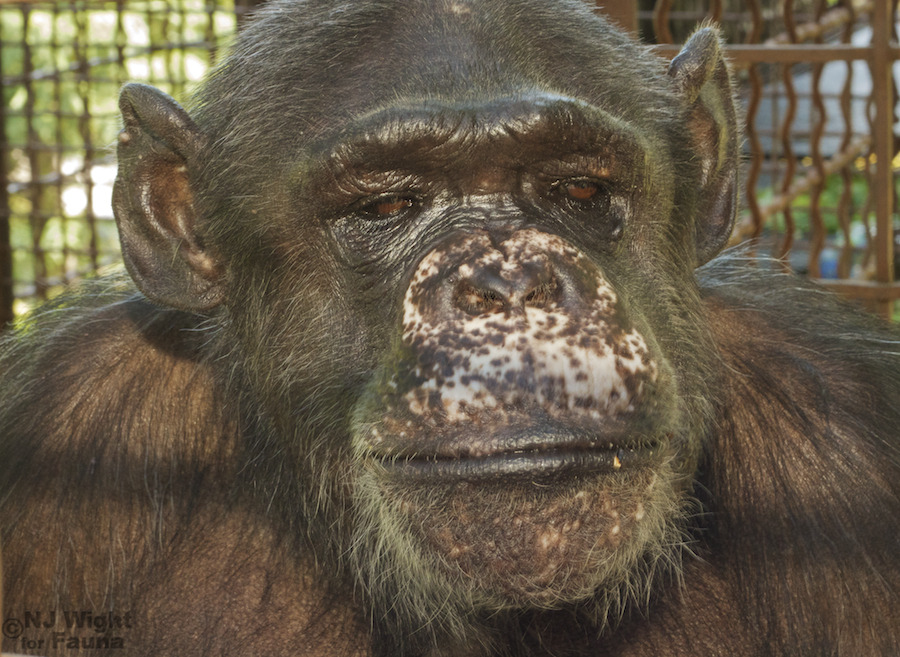
Nothing beats a cold smoothie on a hot day out in the skywalks. (The chimps have about 500 feet of skywalks elevated on the 2.5 acres of enclosed land they live on.)
From Tony Smith, President of the Fauna Sanctuary and Advisory Board member of Fauna Foundation.
Dear friends and supporters of the Fauna family of chimpanzees.
Some of you may be aware that Miss Pepper has been sick for some time now and that over the past week her health has considerably deteriorated. Gloria has asked me to let you all know of Pepper’s condition and to provide you with a little update.
During the past week her condition has changed, as well as her routine. She is sleeping a lot more now and is still getting up for food and drinks. Unfortunately, she has become very weak and has been experiencing more discomfort.
She appreciates all the help everyone is giving, making her nice clean beds and serving her favourite foods. She is still changing places to have her naps, but prefers her bed up in the outside mezzanine area.
Her best girlfriend, Sue Ellen, comes to visit and groom her on occasion.
Gloria, close family, all care-givers and friends have been constantly by her side making her as comfortable as possible and ensuring that she is never alone.
To her great delight Pepper has had many visitors around the clock, all familiar faces to her, and she perks up each time one appears.
Pepper appears to be in no pain, as tough as she is, but is very tired now.
On behalf of Gloria and all the Fauna family and staff, sincere thanks to all of you who have supported and visited Pepper over the past weeks, some from a great distance.
She is loved by many and we will keep you updated.
Our chimps are surrounded by beauty! Fauna have over 40 gorgeous gardens throughout the property. They are a changing spectacle of colour and attract a variety of local birds. If you are in Montreal, consider joining the Bird-Watching and Garden Tour this weekend! http://bit.ly/LbwWge
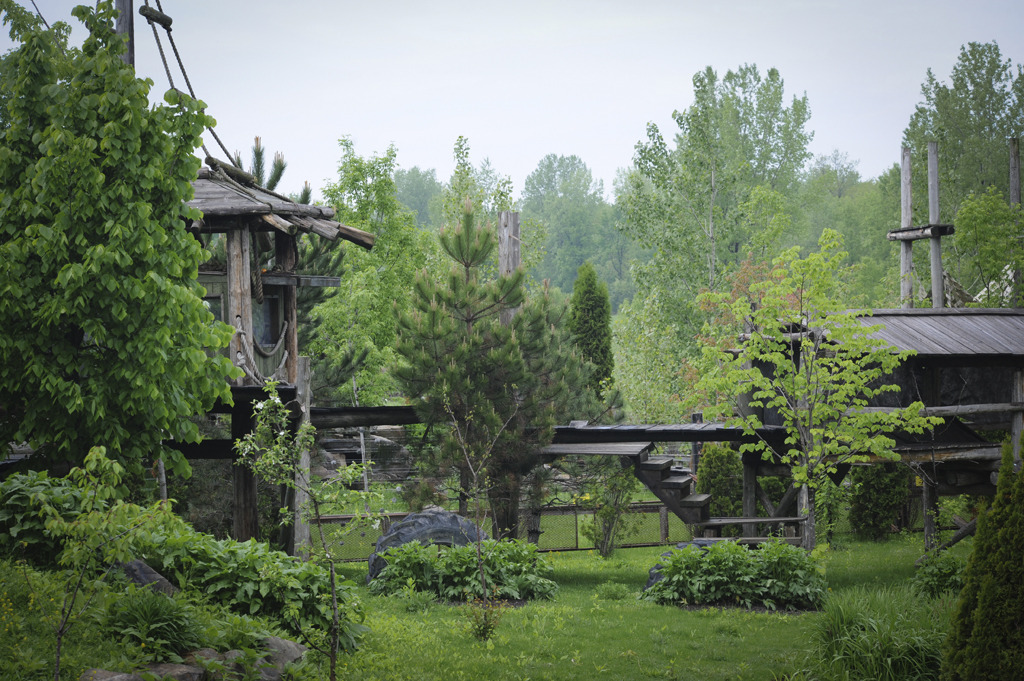
One of the lush, green islands surrounding the chimphouse. The chimps have 2.5 acres of enclosed space, including the islands and their enormous chimp house. Photo ©Jo-anne McArthur
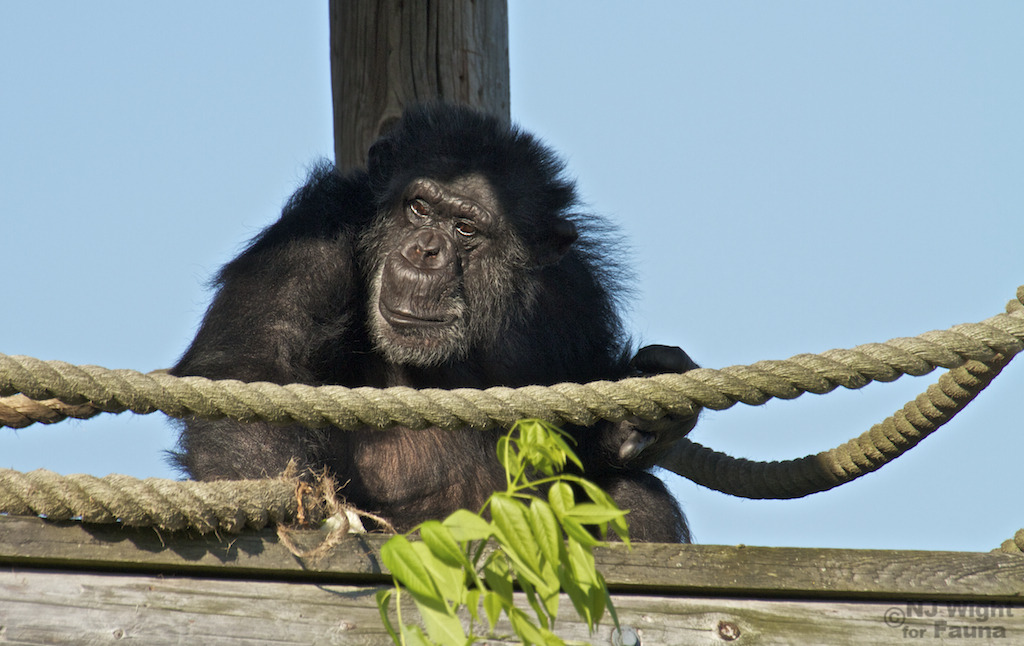
You are a handsome lad Toby!
Thanks so much to all of you who are following and reblogging–and to theanimalblog for posting Rachel. We really appreciate you all checking-in on the chimps and helping to spread the word.

Rachel waking up…! (I know how she feels.)
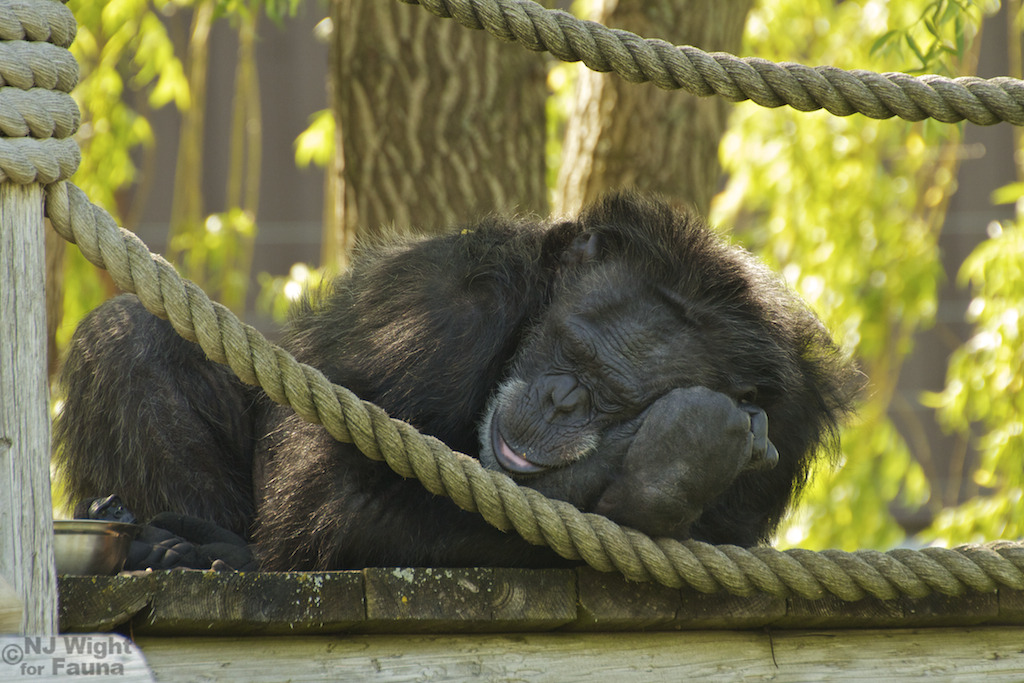
Rachel sleeping…
It is a bitter-sweet Father’s Day at Fauna. Billy-Jo would have been 40 years old today. This post is in honor of all the amazing male chimpanzees out there who would have, or could have been amazing fathers, but never had the chance or the freedom to live a normal life…
Billy Jo was born on June 17, 1968. He was a real looker and is responsible for luring most of the women here to Fauna with his charm, good looks and bad boy quality–but he was super soft and sensitive too.
Billy’s life was tragic and he endured many hardships before coming to Fauna. He spent 15 years in entertainment where he had his teeth knocked out with a crowbar. His next 14 years in the lab were no better. He was knocked down over 289 times, 65 times by dart, and he bit off his index finger during an anxiety attack. When he arrived at Fauna Billy Jo found it in his enormous heart to open up and let the love we all had for him in, and so he had some years here where he was loved unconditionally. He was able to laugh, and relax or vent and be angry without consequence. He was a pleasure to serve.
Billy answered to many names, and William was one that suited him well as he truly was majestic and sophisticated. He loved it when we used all his different names. He had more human friends than any of the other residents and was a great ambassador for the sanctuary. We are grateful to him for helping so many people come to understand the tragedy and sadness that he and his family of chimpanzees in captivity would face daily. Billy Jo will never be forgotten.
And thanks so much for following us and helping us!
Suscribirse a:
Entradas (Atom)