Mostrando entradas con la etiqueta ORNL. Mostrar todas las entradas

viernes, 10 de junio de 2016

IUPAC is naming the four new elements nihonium, moscovium, tennessine, and oganesson

http://iupac.org/
IUPAC IS NAMING THE FOUR NEW ELEMENTS NIHONIUM, MOSCOVIUM, TENNESSINE, AND OGANESSON

Following earlier reports that the claims for discovery of these elements have been fulfilled [1, 2], the discoverers have been invited to propose names and the following are now disclosed for public review:
  • Nihonium and symbol Nh, for the element 113,
  • Moscovium and symbol Mc, for the element 115,
  • Tennessine and symbol Ts, for the element 117, and
  • Oganesson and symbol Og, for the element 118.
The IUPAC Inorganic Chemistry Division has reviewed and considered these proposals and recommends these for acceptance. A five-month public review is now set, expiring 8 November 2016, prior to the formal approval by the IUPAC Council.

The guidelines for the naming the elements were recently revised [3] and shared with the discoverers to assist in their proposals. Keeping with tradition, newly discovered elements can be named after:
  • (a) a mythological concept or character (including an astronomical object),
  • (b) a mineral or similar substance,
  • (c) a place, or geographical region,
  • (d) a property of the element, or
  • (e) a scientist.
The names of all new elements in general would have an ending that reflects and maintains historical and chemical consistency. This would be in general 
  • “-ium” for elements belonging to groups 1-16, 
  • “-ine” for elements of group 17 and 
  • “-on” for elements of group 18. 
Finally, the names for new chemical elements in English should allow proper translation into other major languages.

For the element with atomic number 113 the discoverers at RIKEN Nishina Center for Accelerator-Based Science (Japan) proposed the name nihonium and the symbol Nh. Nihon is one of the two ways to say “Japan” in Japanese, and literally mean “the Land of Rising Sun”. The name is proposed to make a direct connection to the nation where the element was discovered. Element 113 is the first element to have been discovered in an Asian country. While presenting this proposal, the team headed by Professor Kosuke Morita pays homage to the trailblazing work by Masataka Ogawa done in 1908 surrounding the discovery of element 43. The team also hopes that pride and faith in science will displace the lost trust of those who suffered from the 2011 Fukushima nuclear disaster.

For the element with atomic number 115 the name proposed is moscovium with the symbol Mc and for element with atomic number 117, the name proposed is tennessine with the symbol Ts. These are in line with tradition honoring a place or geographical region and are proposed jointly by the discoverers at the Joint Institute for Nuclear Research, Dubna (Russia), Oak Ridge National Laboratory (USA), Vanderbilt University (USA) and Lawrence Livermore National Laboratory (USA).
Moscovium is in recognition of the Moscow region and honors the ancient Russian land that is the home of the Joint Institute for Nuclear Research, where the discovery experiments were conducted using the Dubna Gas-Filled Recoil Separator in combination with the heavy ion accelerator capabilities of the Flerov Laboratory of Nuclear Reactions.
Tennessine is in recognition of the contribution of the Tennessee region, including Oak Ridge National Laboratory, Vanderbilt University, and the University of Tennessee at Knoxville, to superheavy element research, including the production and chemical separation of unique actinide target materials for superheavy element synthesis at ORNL’s High Flux Isotope Reactor (HFIR) and Radiochemical Engineering Development Center (REDC).

For the element with atomic number 118 the collaborating teams of discoverers at the Joint Institute for Nuclear Research, Dubna (Russia) and Lawrence Livermore National Laboratory (USA) proposed the name oganesson and symbol Og. The proposal is in line with the tradition of honoring a scientist and recognizes Professor Yuri Oganessian (born 1933) for his pioneering contributions to transactinoid elements research. His many achievements include the discovery of superheavy elements and significant advances in the nuclear physics of superheavy nuclei including experimental evidence for the “island of stability”.

“It is a pleasure to see that specific places and names (country, state, city, and scientist) related to the new elements is recognized in these four names. Although these choices may perhaps be viewed by some as slightly self-indulgent, the names are completely in accordance with IUPAC rules”, commented Jan Reedijk, who corresponded with the various laboratories and invited the discoverers to make proposals. “In fact, I see it as thrilling to recognize that international collaborations were at the core of these discoveries and that these new names also make the discoveries somewhat tangible.”

Ultimately, and after the lapse of the public review, the final Recommendations will be published in the IUPAC journal Pure and Applied Chemistry. The Provisional Recommendation regarding the naming of the four new elements can be found on the IUPAC website at www.iupac.org/recommendations/under-review-by-the-public/.

Finally, laboratories are already working on searches for the elements in the 8th row of the periodic table, and they are also working to consolidate the identification of copernicium and heavier elements. To be able to evaluate this work, IUPAC and the International Union of Pure and Applied Physics (IUPAP) are currently reviewing the selection principle and operations of a future Joint Working Party (JWP) and as soon as these principles have been decided a new group will be formed. This new JWP will review new claims and the consistency of new results with those already evaluated by earlier JWPs.

References:
[1] P.J. Karol, R.C. Barber, B.M. Sherrill, E. Vardaci, T. Yamazaki, Pure Appl. Chem. 88 (2016) 139; http://dx.doi.org/10.1515/pac-2015-0502
[2] P.J. Karol, R. C. Barber, B. M. Sherrill, E. Vardaci, T. Yamazaki, Pure Appl. Chem. 88 (2016) 155; http://dx.doi.org/10.1515/pac-2015-0501
[3] W.H. Koppenol, J. Corish, J. Garcia-Martinez, J. Meija, J. Reedijk, Pure Appl. Chem. 88 (2016) 401 ; online 21 Apr 2016; http://dx.doi.org/10.1515/pac-2015-0802

* For further information, contact Dr. Lynn M. Soby, Executive Director, IUPAC, at secretariat@iupac.org or lsoby@iupac.org.


ORIGINAL: IUPAC
8 June 2016

martes, 5 de abril de 2016

Scientists have just discovered a new state of matter

Genevieve Martin/Oak Ridge National Laboratory
This is big.

Researchers have just discovered evidence of a mysterious new state of matter in a real material. The state is known as 'quantum spin liquid' and it causes electrons - one of the fundamental, indivisible building blocks of matter - to break down into smaller quasiparticles.

Scientists had first predicted the existence of this state of matter in certain magnetic materials 40 years ago, but despite multiple hints of its existence, they've never been able to detect evidence of it in nature. So it's pretty exciting that they've now caught a glimpse of quantum spin liquid, and the bizarre fermions that accompany it, in a two-dimensional, graphene-like material.

"This is a new quantum state of matter, which has been predicted but hasn't been seen before," said one of the researchers, Johannes Knolle, from the University of Cambridge in the UK.

They were able to spot evidence of quantum spin liquid in the material by observing one of its most intriguing properties - electron fractionalisation - and the resulting Majorana fermions, which occur when electrons in a quantum spin state split apart. These Majorana fermions are exciting because they could be used as building blocks of quantum computers.

To be clear, the electrons aren't actually splitting down into smaller physical particles - which of course would be an even bigger deal (that would mean brand new particles!). What's happening instead is the new state of matter is breaking electrons down into quasiparticles. These aren't actually real particles, but are concepts used by physicists to explain and calculate the strange behaviour of particles.

And the quantum spin liquid state is definitely making electrons act weirdly - in a typical magnetic material, electrons behave like tiny bar magnets. So when the material is cooled to a low enough temperature, these magnet-like electrons order themselves over long ranges, so that all the north magnetic poles point in the same direction.

But in a material containing a quantum spin liquid state, even if a magnetic material is cooled to absolute zero, the electrons don't align, but instead form an entangled soup caused by quantum fluctuations.

"Until recently, we didn't even know what the experimental fingerprints of a quantum spin liquid would look like," said one of the researchers, Dmitry Kovrizhin. "One thing we've done in previous work is to ask, if I were performing experiments on a possible quantum spin liquid, what would I observe?"

To figure out what was going on, the researchers worked alongside a team from Oak Ridge National Laboratory in Tennessee and used neutron scattering techniques to look for evidence of electron fractionalisation in alpha-ruthenium chloride - a material that's structurally similar to graphene.

This also allowed them to measure the signatures of Majorana fermions for the first time by illuminating the material with neutrons, and then observing the pattern of ripples that the neutrons produced when scattered from the sample. 

These patterns were exactly what they'd expect to see based on the main theoretical model of quantum spin liquid, confirming for the first time that they'd seen evidence of it happening in a material.

"This is a new addition to a short list of known quantum states of matter," said Knolle.

"It's an important step for our understanding of quantum matter," added Kovrizhin. "It's fun to have another new quantum state that we've never seen before - it presents us with new possibilities to try new things."

Some of those new things involve quantum computers - which would be exponentially faster than regular computers - so even though all of this sounds pretty theoretical, they could actually have some really exciting potential applications.

The results have been published in Nature Materials.

ORIGINAL: New Scientist
FIONA MACDONALD 
5 APR 2016

jueves, 14 de enero de 2016

ORNL cell-free protein synthesis is potential lifesaver

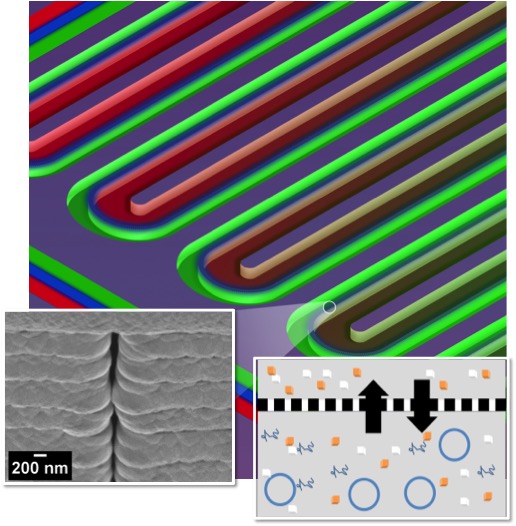
This section of a serpentine channel reactor shows the parallel reactor and feeder channels separated by a nanoporous membrane. At left is a single nanopore viewed from the side; at right is a diagram of metabolite exchange across the membrane.
OAK RIDGE, Tenn., Dec. 29, 2015 – Lives of soldiers and others injured in remote locations could be saved with a cell-free protein synthesis system developed at the Department of Energy’s Oak Ridge National Laboratory.

The device, a creation of a team led by Andrea Timm and Scott Retterer of the lab’s Biosciences Division, uses microfabricated bioreactors to facilitate the on-demand production of therapeutic proteins for medicines and biopharmaceuticals. Making these miniature factories cell-free, which eliminates the maintenance of a living system, simplifies the process and lowers cost.

“With this approach, we can produce more protein faster, making our technology ideal for point-of-care use,” Retterer said. “The fact it’s cell-free reduces the infrastructure needed to produce the protein and opens the possibility of creating proteins when and where you need them, bypassing the challenge of keeping the proteins cold during shipment and storage.”

ORNL’s bioreactor features elegance through a permeable nanoporous membrane and serpentine design fabricated using a combination of electron beam and photolithography and advanced material deposition processes. This design enables prolonged cell-free reactions for efficient production of proteins, making it easily adaptable for use in isolated locations and at disaster sites.

From a functional perspective, the design uses long serpentine channels integrated in a way to allow the exchange of materials between parallel reactor and feeder channels. With this approach, the team can control the exchange of metabolites, energy and species that inhibit production of the desired protein. Through other design features, researchers extend reaction times and improve yields.

“We show that the microscale bioreactor design produces higher protein yields than conventional tube-based batch formats and that product yields can be dramatically improved by facilitating small molecule exchange with the dual-channel bioreactor,” the authors wrote in their paper, published in the journal Small.

The researchers also note that on-demand biologic synthesis would aid the production of drugs that are costly to mass-produce, including orphan drugs and personalized medicines.

Other authors of the paper, titled “Towards Microfluidic Reactors for Cell-Free Protein Synthesis at the Point-of-Care,” are ORNL’s Peter Shankles, Carmen Foster and Mitchel Doktycz.

Funding for this project was provided by the Defense Advanced Research Projects Agency through a collaboration with researchers from Leidos (https://www.leidos.com) and Northwestern University. This accomplishment represents the culmination of research led by Doktycz and Retterer funded by multiple grants from the National Institutes of Health and DOE over the last decade. A portion of the work was performed at the Center for Nanophase Materials Sciences, a DOE Office of Science User Facility.

UT-Battelle manages ORNL for the DOE's Office of Science. The Office of Science is the single largest supporter of basic research in the physical sciences in the United States, and is working to address some of the most pressing challenges of our time. For more information, please visit http://science.energy.gov/.

ORIGINAL: ORNL
Ron Walli, Communications. wallira@ornl.gov, 865.576.0226
December 29, 2015

miércoles, 24 de abril de 2013

9 Materials That Will Change the Future of Manufacturing [Slide Show]

April 22, 2013

Researchers are developing cutting-edge foams, coatings, metals and other substances to make our homes, vehicles and gadgets more energy efficient and environmentally friendly


Future of Manufacturing
When we are unable to find what we need in nature, we make it. This in-depth report examines new technologies, materials and methods shaping the future of fabrication »


CHITIN + SILK: Materials have a tremendous influence on the properties of manufactured goods, including weight, strength and energy consumption. The "Shrilk" pictured here was inspired insect exoskeleton material and could someday be used to make biomedical products.Image: Courtesy of Wyss Institute, Harvard University

The future of manufacturing depends on a number of technological breakthroughs in robotics, sensors and high-performance computing, to name a few. But nothing will impact how things are made, and what they are capable of, more than the materials manufacturers use to make those things. New materials change both the manufacturing process and the end result.

Scientific American’s May special report “How to Make the Next Big Thing” presents several new materials under development to help inventors and engineers deliver next-generation technologies. These ingredients include superinsulating aerogels for spacesuits, flexible concrete cloth for construction projects and complex natural polymers that could replace toxic plastics.

Yet this lineup of advanced materials merely scratches the surface. Carmakers, for example, are developing porous polymers and new steel alloys that are stronger and lighter than steel, ostensibly making vehicles both safer and more fuel efficient. And environmentally savvy entrepreneurs are growing fungi-based packing materials to provide a biodegradable alternative to Styrofoam.

The following slide show presents these and several other substances that manufacturers could someday us to make many of the things we use.

FUNGAL FOAM: (Courtesy of mycobond, via Flickr)
Initially conceived as a cost-effective, environmentally friendly and high-performance alternative to Styrofoam, Ecovative Design makes its Mushroom Packaging from agricultural crop waste—plant stalks and rice and wheat husks—bonded together with mushroom roots (called mycelium). The company is now adapting its mushroom material to produce biodegradable alternative to petroleum-based plastic foams used in automotive bumpers, doors, roofs, engine bays, trunk liners, dashboards and seats. Other potential uses include tabletops, surfboards and clothing.

ELECTRIC INK: Courtesy of University of Illinois / S. Brett Walker
Quantum-electronic magic can make strange but useful semiconductors that are insulators on the inside and conductors on the surface. The bulk of the material acts as an insulator that blocks electron flow whereas the surface is a very good, metal-like conductor that allows electrons to travel freely at almost light-speed, unaffected by impurities that normally hinder electron motion through materials. Metal-free conductive inks will play a role in making printed electronic materials used in display screens, sensors and batteries. University of Illinois researchers, for example, have created a silver-based electric ink that leaves a trail of conductive material when it evaporates. The new formulation is easier to make than conventional electronic inks, adheres to many materials and can be printed at a lower temperature using a simple desktop device. 

WASTE-TO-ENERGY THERMOELECTRICS: Courtesy of General Motors
Northwestern University and Michigan State University scientists have demonstrated a thermoelectric material that is highly efficient at converting waste heat to electricity. That’s good news if you consider that nearly two thirds of all energy input is lost as waste heat. The inefficiency of existing thermoelectric materials has limited their commercial use. The record-setting, environmentally stable formulation is expected to convert 15 to 20 percent of waste heat to useful electricity, enabling greater industrial adoption of thermoelectrics. Waste-heat recovery systems could be attached, for example, to vehicle tailpipes or could process the exhaust streams from glass- and brick-making factories, refineries, fossil-fuel power plants as well as large transport ships and tankers. 


ROCK-SOLID COATING: Courtesy of Oak Ridge National Laboratory
Engineers from the Oak Ridge and Lawrence Livermore National laboratories, the Colorado School of Mines and elsewhere have designed extreme-duty, iron-based, glassy alloy coatings for industrial drill bits, bores and cutters to make this equipment more resistant to breaking even under heavy loads. NanoSHIELD Coatings—short for Nano Super Hard Inexpensive Laser Deposited Coatings—require a laser to fuse alloy powder to the surface of cutters and other tunnel-boring tools. The coatings cost far less than conventional materials such as tungsten carbide cobalt, and their longer operating life improves the efficiency of the tunnel-boring process.

DESIGNER NANOCRYSTALS: Courtesy of the University of Chicago/Chris Strong
Three University of Chicago chemists have created a new way to assemble what they call “designer atoms” into novel materials with a broad array of potentially useful properties and functions. These designer atoms are nano crystals—tiny crystalline arrays small enough that new quantum phenomena begin to emerge but large enough to provide building blocks for new functional materials and substances that could be useful in harvesting solar energy and delivering quantum computing. Greg Engel, associate professor in chemistry, is pictured here tuning a femtosecond laser system used to dissect couplings between nano crystals.

MEGA MAGNETS: Courtesy of Images-of-Elements.com, via WikiMedia Commons
Rare earth materials are vital to the manufacture of wind turbines, electric and hybrid cars, and consumer electronics due to their powerful magnetic properties. Yet they are also expensive and come almost entirely from one source—China. Whereas electric motors use magnets to transform electrical energy into mechanical energy, sintered rare earth magnets produce incredibly strong magnetic fields at small sizes, allowing manufacturers to build smaller, lighter motors, according to Electron Energy Corp. The firm has teamed up with University of Delaware researchers to develop a manufacturing process that increases sintered rare earth magnets’ electrical resistivity by at least 30 percent. Their goal is to make magnets with increased electrical resistivity that can reduce motor efficiency losses even when motors operate at high speeds. Shown here are blocks of nickel-plated neodymium magnet, one of the most widely used types of rare-earth magnet. 

CHEAPER, LIGHTER CARBON FIBER: Courtesy of Oak Ridge National Laboratory
Autos of the future will require strong, lightweight carbon-fiber composite structures to enhance efficiency and driving range, but low-cost fibers will be needed for market success. A consortium of national labs, industry and academia working at Oak Ridge National Laboratory’s Carbon Fiber Technology Facility are working to overcome the challenges of making cheaper carbon fiber. The U.S. Department of Energy gave Oak Ridge a $35-million award to build and operate the lab, which will include a pilot plant capable of producing up to 25 tons a year of new carbon-fiber materials. Pictured here is a polymer resin used to make carbon fiber.

ULTRATHIN PLATINUM: Courtesy of Gokcen/the National Institute of Standards and Technology
Hydrogen fuel cell vehicles could provide clean transportation in the future, but they remain expensive in part because they use the precious metal platinum to facilitate the chemical reactions that produce electricity within the cell. A new method for quickly and cheaply depositing ultrathin layers of platinum might make it practical to reduce the amount of the metal used in fuel-cell catalysts, thereby lowering their cost significantly. Current methods for applying atom-thick layers of platinum—mainly, atomic layer deposition—are slow and complicated. The new approach is cheap and easy to implement, according to the National Institute of Standards and Technology. Essentially, platinum dissolved in a solution is deposited in single-atom-thick layers by alternately applying positive and negative voltages. Repetition can quickly and easily build layers of any desired atomic thickness. Shown here is a scanning tunneling microscope image of an ultrathin film layer of platinum deposited on gold after five seconds. Darker areas are exposed gold substrate not yet covered by the platinum. 

BIO-INSPIRED PLASTIC: Courtesy of Wyss Institute, Harvard University
Light enough to permit flight and thin enough to accommodate flexibility and strong enough to protect its host, natural insect cuticle—found in the rigid exoskeletons of houseflies and grasshoppers—provides its host protection without adding weight or bulk. Researchers at Harvard University’s Wyss Institute for Biologically Inspired Engineering have developed a new material called Shrilk to replicate insect cuticle’s strength, durability and versatility. Shrilk—so called because it is composed of chitin commonly extracted from discarded shrimp shells and fibroin protein from silk—could be used to make trash bags, packaging and diapers that degrade quickly. As an exceptionally strong, biocompatible material, it might also be used to suture wounds that bear high loads, such as in hernia repair or as a scaffold for tissue regeneration.


More In This Article

Future of Substance: New Materials Promise Better Batteries, Stronger Steel

Getting 3-D Printing and Next-Generation Manufacturing to the Factory Floor [Video]

Information Is Driving a New Revolution in Manufacturing

The Short History of the Future of Manufacturing

Atomic Toolbox: Manufacturing at the Nanoscale

martes, 8 de mayo de 2012

Energía del mar

ORIGINAL: ORNL

Innovación en la encrucijada entre la seguridad global y la energía verde

Los avances tecnológicos son generalmente los cambios incrementales que se deslizan sobre todo lo desapercibido en las prácticas empresariales, procesos industriales y las rutinas diarias. Aquellos que no son del tipo de avances científicos, son los que el Programa de Innovación Abierta de Lockheed Martin Corporation (LMC)  trata de abordar. Johnnie Cannon, quien encabeza la colaboración la Dirección de Seguridad Global de ORNL con el programa, dice que su objetivo es desarrollar "tecnologías que superen la competencia, en lugar de avanzar en forma gradual y predecible. En la actualidad el portafolio de colaboración de Cannon consiste en proyectos activos en una amplia gama de disciplinas, incluyendo materiales avanzados, la computación cuántica y la conversión de energía térmica oceánica.

"Una de nuestras colaboraciones de más alto perfil con el Programa de Innovación Abierta es la  de Conversión de Energía Térmica Oceánica", dice Cannon. "Esto representa una inversión sustancial por LMC durante varios años." OTEC se puede utilizar para atender las necesidades de energía de los militares de EE.UU. en algunas partes del mundo donde las largas filas de suministro o lejanía de los centros de generación de energía hacen que la generación de energía sea problemática.
Representación visual de un sistema OTEC. (Cortesía de Lockheed Martin) 
La energía del mar

El siguiente mapa muestra la diferenciación de temperatura en las aguas de nuestros mares. Las áreas resaltadas representan los lugares más óptimos para OTEC. ORIGINAL: Lockheed Martin Corporation
OTEC utiliza las diferencias de temperatura en los océanos del mundo para crear energía. En los trópicos, la temperatura superficial del agua es de unos 25 grados C, y a 3000 metros de profundidad es de unos 5 grados C. "Esa es una diferencia de unos 20 grados C, y puede ser utilizado para generar energía", dice James Klett de la División de Ciencia y Tecnología de  Materiales en el ORLN. El sistema de generación de energía OTEC trabaja mediante el uso de esta diferencia de temperatura para conducir una planta de energía de bucle cerrado de ciclo Rankine.

El ciclo Rankine comienza bombeando el agua superficial de 25 grados C a través de un intercambiador de calor para hervir el amoníaco. El amoníaco se convierte en un gas, que se utiliza para hacer girar una turbina-generador para producir energía. A continuación, los 5 grados C del agua se usan para enfriar el amoníaco, que se condensa a su estado líquido dentro de un intercambiador de calor llamado un condensador, y el ciclo comienza de nuevo.

ORIGINAL: Lockheed Martin Corporation
Dado el estado de la actual tecnología OTEC, una planta OTEC a escala comercial puede requerir al menos 20 intercambiadores de calor de gran tamaño. Ahí es donde entran los intercambiadores de calor de espuma de grafito desarrollados por Klett y su equipo de investigación. La espuma de grafito combina una enorme cantidad de superficie con una alta capacidad para conducir el calor, permitiendo a estos intercambiadores de calor para mejorar el rendimiento de las unidades estándar térmicamente conductoras mientras que reducen su tamaño y coste. Hacer que los intercambiadores de calor sean dos veces más eficaces significa que una planta de energía OTEC podría reducir el tamaño de sus intercambiadores de calor en la mitad, la reducción de los gastos de capital para la planta de OTEC y hacer una alternativa ecológica de energía mucho más práctica. Por otra parte, los intercambiadores de calor del mismo tamaño podría producir el doble de potencia por el mismo costo.

Los estudios han estimado que los intercambiadores de calor para una planta OTEC de 100 MW representaría una porción significativa de sus costes, y los intercambiadores de calor a base  espuma de grafito de tener el potencial para reducir esa cifra en un 50%. Debido a que los intercambiadores de calor son una gran parte de la huella de una planta OTEC, y las plantas OTEC están situados en las plataformas marinas como los utilizados para la perforación de petróleo y gas, reducir la huella es importante.

Energía abundante, confiable

"Hay varias ventajas de peso para el sistema", dice Klett. "En primer lugar, que produce energía totalmente verde, no hay subproductos También es muy parecida a la energía geotérmica, solar o eólica, ya que no asume ningún tipo de combustible fósil para conducir, lo que los costes se limitan a la construcción y el mantenimiento.". Además, Klett es particularmente enfático acerca de la disponibilidad de energía OTEC. Él señala que los consumidores no siempre entienden que el único tipo de energía "verde" que está disponible actualmente como "energía de base"- la energía que está disponible 24 horas al día, 7 días a la semana-es geotérmica. "Con otras energías renovables", dice, "cuando el viento cesa, usted no tiene energía. Si se trata de un día nublado, no hay energía. Incluso la energía hidroeléctrica está a merced de los niveles fluctuantes de agua. OTEC realidad puede ser utilizar para suministro de la base. " Las estimaciones sugieren que, en las latitudes tropicales, OTEC tiene el potencial de generar de 3 a 5 teravatios de energía sin afectar a la temperatura del océano o el medio ambiente del mundo. "Eso es más que la capacidad de generación eléctrica de este país", dice. "Si podemos suministrar una gran parte de nuestras necesidades básicas de energía con la energía verde, se puede revolucionar la generación de energía."

Espuma de Grafito de gran superficie y de alta capacidad para conducir calor es fundamental en el rendimiento de los intercambiadores de calor, mientras que reduce su tamaño y costo.
Klett y sus colegas de Lockheed Martin están construyendo un intercambiador de calor a escala de laboratorio que mide 3 metros de diámetro y 20 pies de largo y se envío a Hawaii para poner a prueba en el Laboratorio Nacional de Energía de la Autoridad de Hawai (NELHA). Hawai, que es también rica en recursos geotérmicos, se ha comprometido a eliminar su dependencia de fuentes externas de energía en un 40% en el año 2030. OTEC es visto como una alternativa muy atractiva para lograr este objetivo.

Las capacidades únicas

Klett señala que la tecnología utilizada para construir intercambiadores de calor para OTEC podría ser utilizado para aumentar la eficacia de otros tipos de centrales eléctricas. "Potencialmente, cualquier tecnología que utiliza intercambiadores de calor, bombas de calor, la desalinización, de regasificación de GNL para centrales eléctricas, podrían beneficiarse de este desarrollo", añade Cannon. Experiencia de ORNL en colaboración con Lockheed Martin a través del Programa de Innovación Abierta ha abierto la puerta a trabajar con ellos fuera del programa en otros proyectos de investigación y desarrollo, Klett, dice. "Cuanto más aprendemos sobre nosotros y las capacidades únicas que tenemos, vienen más a nosotros en busca de ayuda en áreas fuera del Programa de Innovación Abierta.

En cuanto al futuro de la tecnología OTEC, Klett, dice, "Creo que este es un caso en el que si lo construyes, vendrán. Si podemos construir una fuente de energía que no requiere de combustible y sólo requiere mantenimiento, entonces no vamos tener que preocuparnos por los altibajos del precio del combustible. El precio de la energía generada por una planta OTEC estarán ligados a los gastos de mantenimiento, y si nos topamos con maneras más baratas de mantener la planta, el precio de la energía OTEC en realidad podría ir hacia abajo, y esperamos que sea competitiva con las centrales eléctricas convencionales. "

"La demostración de que el proyecto está prevista para esta primavera en Hawai", dice Cannon. "Si todo funciona como se espera, podría ser un cambio de juego en términos de generación de energía verde."-Jim Pearce


viernes, 20 de abril de 2012

Carbon dioxide caused global warming at Ice Age's end, pioneering simulation shows


Groundbreaking demo proves model to predict climate's future can reproduce its past

Global temperature mirrored and generally lagged behind rising carbon dioxide during Ice Age's deglaciation, pointing to carbon dioxide as the major driver of global warming.
Climate science has an equivalent to the "what came first—the chicken or the egg?" question: What came first, greenhouse gases or global warming? A multi-institutional team led by researchers at Harvard, Oregon State University, and the University of Wisconsin used a global dataset of paleoclimate records and the Jaguar supercomputer at Oak Ridge National Laboratory (ORNL) to find the answer (spoiler alert: carbon dioxide drives warming). The results, published in the April 5 issue of Nature, analyze 15,000 years of climate history. Scientists hope amassing knowledge of the causes of natural global climate change will aid understanding of human-caused climate change.

"We constructed the first-ever record of global temperature spanning the end of the last ice age based on 80 proxy temperature records from around the world," said Jeremy Shakun, a National Oceanic and Atmospheric Administration (NOAA) Climate and Global Change postdoctoral fellow at Harvard and Columbia Universities and first author of the paper. "It's no small task to get at global mean temperature. Even for studies of the present day you need lots of locations, quality-controlled data, careful statistics. For the past 21,000 years, it's even harder. But because the data set is large enough, these proxy data provide a reasonable estimate of global mean temperature."

Proxy records from around the world—derived from ice cores and ocean and lake sediments -- provide estimates of local surface temperature throughout history, and carbon-14 dating indicates when those temperatures occurred. For example, water molecules harboring the oxygen-18 isotope rain out faster than those containing oxygen-16 as an air mass cools, so the ratio of these isotopes in glacial ice layers tells scientists how cold it was when the snow fell. Likewise, the amount of magnesium incorporated into the shells of marine plankton depends on the temperature of the water they live in, and these shells get preserved on the seafloor when they die. The authors combined these local temperature records to produce a reconstruction of global mean temperature. Additionally, samples of ancient atmosphere are trapped as air bubbles in glaciers, providing a direct measure of carbon dioxide levels through time that could be compared to the global temperature record.

Being the first to reconstruct global mean temperatures throughout this time interval allowed the researchers to show what many suspected but none could yet prove: "This is the first paper to definitively show the role carbon dioxide played in helping to end the last ice age," said Shakun, who co-wrote the paper with Peter Clark of Oregon State University. "We found that global temperature mirrored and generally lagged behind rising carbon dioxide during the last deglaciation, which points to carbon dioxide as the major driver of global warming." Prior results based on Antarctic ice cores had indicated that local temperatures in Antarctica started warming before carbon dioxide began rising, which implied that carbon dioxide was a feedback to some other leading driver of warming. The delay of global temperature behind carbon dioxide found in this study, however, shows that the ice-core perspective does not apply to the globe as a whole and instead suggests that carbon dioxide was the primary driver of worldwide warming.


While the geologic record showed a remarkable correlation between carbon dioxide and global temperature, the researchers also turned to state-of-the-art model simulations to further pin down the direction of causation suggested by the temperature lag. Jaguar recently ran approximately 14 million processor hours to simulate the most recent 21,000 years of Earth's climate. Feng He of the University of Wisconsin, Madison, a postdoctoral researcher, plugged the main forcings driving global climate over this time interval into an Intergovernmental Panel on Climate Change (IPCC)-class model called the Community Climate System Model version 3, a global climate model that couples interactions between atmosphere, oceans, lands, and sea ice. The climate science community developed the model with support from the National Science Foundation (NSF), Department of Energy (DOE), and National Aeronautics and Space Administration (NASA) and used many codes developed by university researchers.

"Our model results are the first IPCC-class Coupled General Circulation Model (CGCM) simulation of such a long duration (15,000 years)," said He, who conducted the modeling with Zhengyu Liu of the University of Wisconsin-Madison and Bette Otto-Bliesner of the National Center for Atmospheric Research (NCAR). "This is of particular significance to the climate community because it shows, for the first time, that at least one of the CGCMs used to predict future climate is capable of reproducing both the timing and amplitude of climate evolution seen in the past under realistic climate forcing."

The group ran simulations that used 4.7 million processor hours in 2009, 6.6. million in 2010, and 2.5 million in 2011. The Innovative and Novel Computational Impact on Theory and Experiment program, jointly managed by leadership computing facilities at Argonne and Oak Ridge National Laboratories, awarded the allocations.

Shaun Marcott and Alan Mix of Oregon State University analyzed data, and Andreas Schmittner, also of Oregon State, interpreted links between ocean currents and carbon dioxide. Edouard Bard of Centre Européen de Recherche et d'Enseignement des Géosciences de l'Environnement provided data and expertise about radiocarbon calibration.

NSF supported this research through its Paleoclimate Program for the Paleovar Project and NCAR. The researchers used resources of the Oak Ridge Leadership Computing Facility, located in the National Center for Computational Sciences at ORNL, which is supported by DOE's Office of Science. The paleoclimate community generated the proxy data sets and provided unpublished results of the DATED Project on retreat history of the Eurasian ice sheets. The NOAA NGDC and PANGAEA databases were also essential to this work.

Plot twist: the 'bipolar seesaw'

As the dominant theory goes, the variation of Earth's orbit around the sun is responsible for the growth and deterioration of glaciers because it changes insolation, or solar radiation reaching and warming an area. About 21,000 years ago the orbit of the Earth was slightly predisposed to warmer summers in the Northern Hemisphere, and the planet experienced a general warming.

Next comes a plot twist. Geologic data show that about 19,000 years ago, Northern Hemisphere glaciers began to melt, and sea levels rose. Melting glaciers dumped so much freshwater into the ocean that it slowed a system of currents that transports heat throughout the world. Called the Atlantic Meridional Overturning Circulation (AMOC), this ocean conveyor belt is particularly important in the Atlantic where it flows northward across the equator, stealing Southern Hemisphere heat and exporting it to the Northern Hemisphere. The AMOC then sinks in the North Atlantic and returns southward in the deep ocean. A large pulse of glacial meltwater, however, can place a freshwater lid over the North Atlantic and halt this sinking, backing up the entire conveyor belt.

The simulation showed weakening of the AMOC due to the increase in glacial melt beginning about 19,000 years ago, which decreased ocean heat transport, keeping heat in the Southern Hemisphere and cooling the Northern Hemisphere. Other studies suggest this southern warming caused sea ice to retreat and shifted winds around the Southern Ocean, uncorking carbon dioxide that had previously been stored in the deep ocean and venting it to the atmosphere around 17,500 years ago. This rise in carbon dioxide then initiated worldwide warming.

The seesawing of heat between the hemispheres due to the AMOC shutdown explains why Southern Hemisphere warming led the rise in carbon dioxide while Northern Hemisphere temperatures lagged behind and reconciles these patterns with the key role played by carbon dioxide in driving global mean warming. "Differences in the deglacial temperature evolution of the Northern and Southern Hemispheres can largely be explained by variations in the strength of the Atlantic Meridional Overturning Circulation," said He.

Before the team's groundbreaking efforts, researchers could only simulate single time slices of Earth's climate. Just as multiple images are stitched together to make an animation, speedy petascale supercomputers, capable of executing a quadrillion calculations each second, enable stitching together of multiple time slices to produce a continuous simulation. Liu, Otto-Bliesner, and He's group was the first to continuously capture climate from 21,000 years ago to the present day so that scientists could compare the relationship of carbon dioxide and global mean temperature over time. The Nature article covers events up to about 6,000 years ago. The group has since extended the simulation through the present day.

"Climate model output housed at Oak Ridge is currently in the hundreds of terabytes [trillion bytes] and will soon exceed a petabyte, so you need a large facility just to accommodate the large data output," said He. "Right now the climate model output is a top consumer of data storage in Oak Ridge. Also, [continuous simulations] definitely cannot be performed at other sites because the system needs to be quite consistent. This simulation has been run continuously for more than 3 years. Each simulation [step] depends on what happened earlier."

To understand the relevance of the study's finding to today, it is worth considering that carbon dioxide concentrations rose from 185 parts per million (ppm) to 260 ppm over the approximately 10,000 years during which the last ice age ended. In just the past two centuries, human activity has increased concentrations by about the same amount, reaching a carbon dioxide concentration of 392 ppm in 2011—higher than at any time in at least the last 800,000 years.

The work builds on a continuous simulation by Liu and colleagues of Earth's climate between 21,000 and 14,000 years ago, reported in a 2009 Science article detailing the first continuous simulation of climate change during Earth's most recent period of natural global warming. Using ORNL's Cray X1E supercomputer named Phoenix and the even faster Cray XT system called Jaguar, the scientists used nearly a million processor hours in 2008 to run one-third of their simulation, from 21,000 years ago (the most recent glacial maximum) to 14,000 years ago (the most recent major period of natural global warming). The effort validated the ability to simulate large climate changes in the past and is critical for assessing future projections of changes, such as the fate of ocean circulation in the face of continued glacial melting in Greenland and Antarctica.— Dawn Levy, April 4, 2012