Mostrando entradas con la etiqueta Matter. Mostrar todas las entradas

martes, 5 de abril de 2016

Scientists have just discovered a new state of matter

Genevieve Martin/Oak Ridge National Laboratory
This is big.

Researchers have just discovered evidence of a mysterious new state of matter in a real material. The state is known as 'quantum spin liquid' and it causes electrons - one of the fundamental, indivisible building blocks of matter - to break down into smaller quasiparticles.

Scientists had first predicted the existence of this state of matter in certain magnetic materials 40 years ago, but despite multiple hints of its existence, they've never been able to detect evidence of it in nature. So it's pretty exciting that they've now caught a glimpse of quantum spin liquid, and the bizarre fermions that accompany it, in a two-dimensional, graphene-like material.

"This is a new quantum state of matter, which has been predicted but hasn't been seen before," said one of the researchers, Johannes Knolle, from the University of Cambridge in the UK.

They were able to spot evidence of quantum spin liquid in the material by observing one of its most intriguing properties - electron fractionalisation - and the resulting Majorana fermions, which occur when electrons in a quantum spin state split apart. These Majorana fermions are exciting because they could be used as building blocks of quantum computers.

To be clear, the electrons aren't actually splitting down into smaller physical particles - which of course would be an even bigger deal (that would mean brand new particles!). What's happening instead is the new state of matter is breaking electrons down into quasiparticles. These aren't actually real particles, but are concepts used by physicists to explain and calculate the strange behaviour of particles.

And the quantum spin liquid state is definitely making electrons act weirdly - in a typical magnetic material, electrons behave like tiny bar magnets. So when the material is cooled to a low enough temperature, these magnet-like electrons order themselves over long ranges, so that all the north magnetic poles point in the same direction.

But in a material containing a quantum spin liquid state, even if a magnetic material is cooled to absolute zero, the electrons don't align, but instead form an entangled soup caused by quantum fluctuations.

"Until recently, we didn't even know what the experimental fingerprints of a quantum spin liquid would look like," said one of the researchers, Dmitry Kovrizhin. "One thing we've done in previous work is to ask, if I were performing experiments on a possible quantum spin liquid, what would I observe?"

To figure out what was going on, the researchers worked alongside a team from Oak Ridge National Laboratory in Tennessee and used neutron scattering techniques to look for evidence of electron fractionalisation in alpha-ruthenium chloride - a material that's structurally similar to graphene.

This also allowed them to measure the signatures of Majorana fermions for the first time by illuminating the material with neutrons, and then observing the pattern of ripples that the neutrons produced when scattered from the sample. 

These patterns were exactly what they'd expect to see based on the main theoretical model of quantum spin liquid, confirming for the first time that they'd seen evidence of it happening in a material.

"This is a new addition to a short list of known quantum states of matter," said Knolle.

"It's an important step for our understanding of quantum matter," added Kovrizhin. "It's fun to have another new quantum state that we've never seen before - it presents us with new possibilities to try new things."

Some of those new things involve quantum computers - which would be exponentially faster than regular computers - so even though all of this sounds pretty theoretical, they could actually have some really exciting potential applications.

The results have been published in Nature Materials.

ORIGINAL: New Scientist
FIONA MACDONALD 
5 APR 2016

martes, 26 de mayo de 2015

Quantum physics: What is really real?

A wave of experiments is probing the root of quantum weirdness.

Article tools
Dan Harris/MIT
An experiment showing that oil droplets can be propelled across a fluid bath by the waves they generate has prompted physicists to reconsider the idea that something similar allows particles to behave like waves.

Owen Maroney worries that physicists have spent the better part of a century engaging in fraud.

Ever since they invented quantum theory in the early 1900s, explains Maroney, who is himself a physicist at the University of Oxford, UK, they have been talking about how strange it is — how it allows particles and atoms to move in many directions at once, for example, or to spin clockwise and anticlockwise simultaneously. But talk is not proof, says Maroney. “If we tell the public that quantum theory is weird, we better go out and test that's actually true,” he says. “Otherwise we're not doing science, we're just explaining some funny squiggles on a blackboard.”

It is this sentiment that has led Maroney and others to develop a new series of experiments to uncover the nature of the wavefunction — the mysterious entity that lies at the heart of quantum weirdness. On paper, the wavefunction is simply a mathematical object that physicists denote with the Greek letter psi (Ψ) — one of Maroney's funny squiggles — and use to describe a particle's quantum behaviour.

 
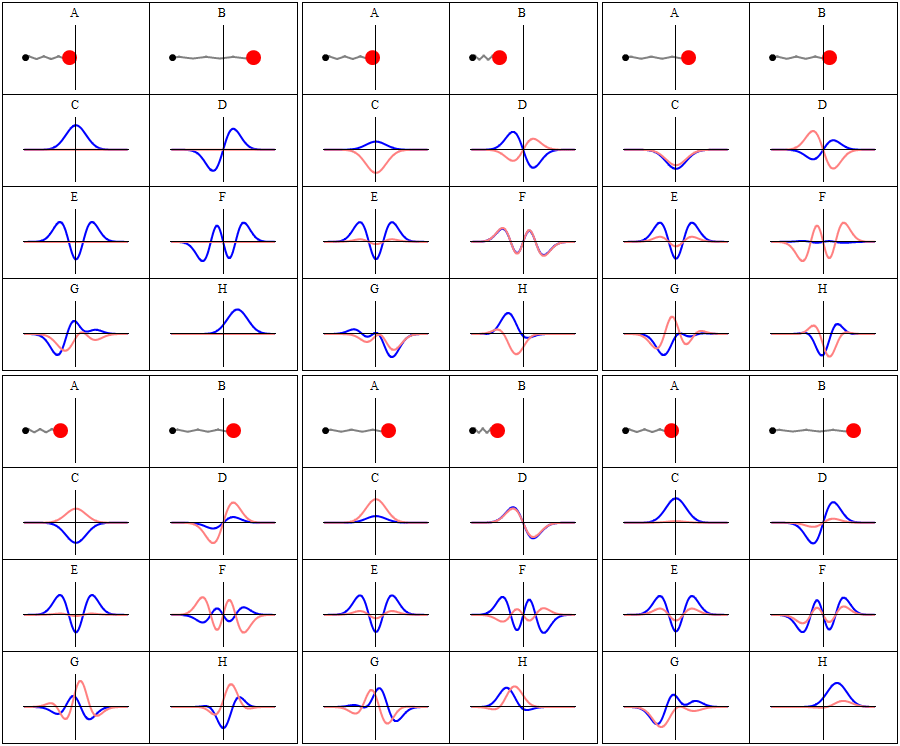
Quantum Harmonic Oscillator Animation.Comparison of classical and quantum harmonic oscillator conceptions for a single spinless particle. The two processes differ greatly.
The classical process (A–B) is represented as the motion of a particle along a trajectory.
The quantum process (C–H) has no such trajectory. Rather, it is represented as a wave.
Panels (C–F) show four different standing wave solutions of the Schrödinger equation.
Panels (G–H) further show two different wave functions that are solutions of the Schrödinger equation but not standing waves.
 Wikipedia


jueves, 14 de mayo de 2015

Scientists have discovered a new state of matter, called 'Jahn-Teller metals'

Image: High temperature superconductor levitating above a ring magnet. Credit: Julian Litzel/Wikimedia

And it could be the key to understanding one of the biggest mysteries in physics today - high-temperature superconductors.

An international team of scientists has announced the discovery of a new state of matter in a material that appears to be an 
all rolled into one, saying that it could lead to the development of more effective high-temperature superconductors.

Why is this so exciting?
Well, if these properties are confirmed, this new state of matter will allow scientists to better understand why some materials have the potential to achieve superconductivity at a relativity high critical temperature (Tc) - "high" as in −135 °C as opposed to −243.2 °C. Because superconductivity allows a material to conduct electricity without resistance, which means no heat, sound, or any other form of energy release, achieving this would revolutionise how we use and produce energy, but it’s only feasible if we can achieve it at so-called high temperatures.

As Michael Byrne explains at Motherboard, when we talk about states of matter, it’s not just 
  • liquids
  • plasmas 
that we have to think about. We also have to consider the more obscure states that don’t occur in nature, but are rather created in the lab -
  • Bose–Einstein condensate
  • degenerate matter
  • supersolids and
  • superfluids
  • quark-gluon plasma
for example. 

By introducing rubidium into carbon-60 molecules - more commonly known as 'buckyballs' - a team led by chemist Kosmas Prassides from Tokohu University in Japan was able to change the distance between them, which forced them into a new, crystalline structure. When put through an array of tests, this structure displayed a combination of insulating, superconducting, metallic, and magnetic phases, including a brand new one, which the researchers have named 'Jahn-Teller metals'. 

Named after the Jahn-Teller effect, which is used in chemistry to describe how at low pressures, the geometric arrangement of molecules and ions in an electronic state can become distorted, this new state of matter allows scientists to transform an insulator - which can’t conduct electricity - into a conductor by simply applying pressure. Byrne explains at Motherboard: 

"This is what the rubidium atoms do: apply pressure. Usually when we think about adding pressure, we think in terms of squeezing something, forcing its molecules closer together by brute force. But it's possible to do the same thing chemically, tweaking the distances between molecules by adding or subtracting some sort of barrier between them - sneaking in some extra atoms, perhaps.

What happens in a Jahn-Teller metal is that as pressure is applied, and as what was previously an insulator - thanks to the electrically-distorting Jahn-Teller effect - becomes a metal, the effect persists for a while. The molecules hang on to their old shapes. So, there is an overlap of sorts, where the material still looks an awful lot like an insulator, but the electrons also manage to hop around as freely as if the material were a conductor."

And it’s this transition phase between insulator and conductor that, until now, scientists have never seen before, and hints at the possibility of transforming insulating materials into super-valuable superconducting materials. And this buckyball crystalline structure appears to be able to do it at a relatively high TC. "The relationship between the parent insulator, the normal metallic state above Tc, and the superconducting pairing mechanism is a key question in understanding all unconventional superconductors," the team writes in Science Advances.

There’s a whole lot of lab-work to be done before this discovery will mean anything for practical energy production in the real world, but that’s science for you. And it’s got people excited already, as chemist Elisabeth Nicol from the University of Guelph in Canada told Hamish Johnston at PhysicsWorld: "Understanding the mechanisms at play and how they can be manipulated to change the Tc surely will inspire the development of new [superconducting] materials".

ORIGINAL: Science Alert
BEC CREW
12 MAY 2015