Mostrando entradas con la etiqueta Michigan State U. Mostrar todas las entradas

viernes, 4 de noviembre de 2016

A Conductor of Evolution’s Subtle Symphony

At first, the biologist Richard Lenski thought his long-term experiment on evolution might last for 2,000 generations. Nearly three decades and over 65,000 generations later, he’s still amazed by evolution’s “awesome inventiveness.”
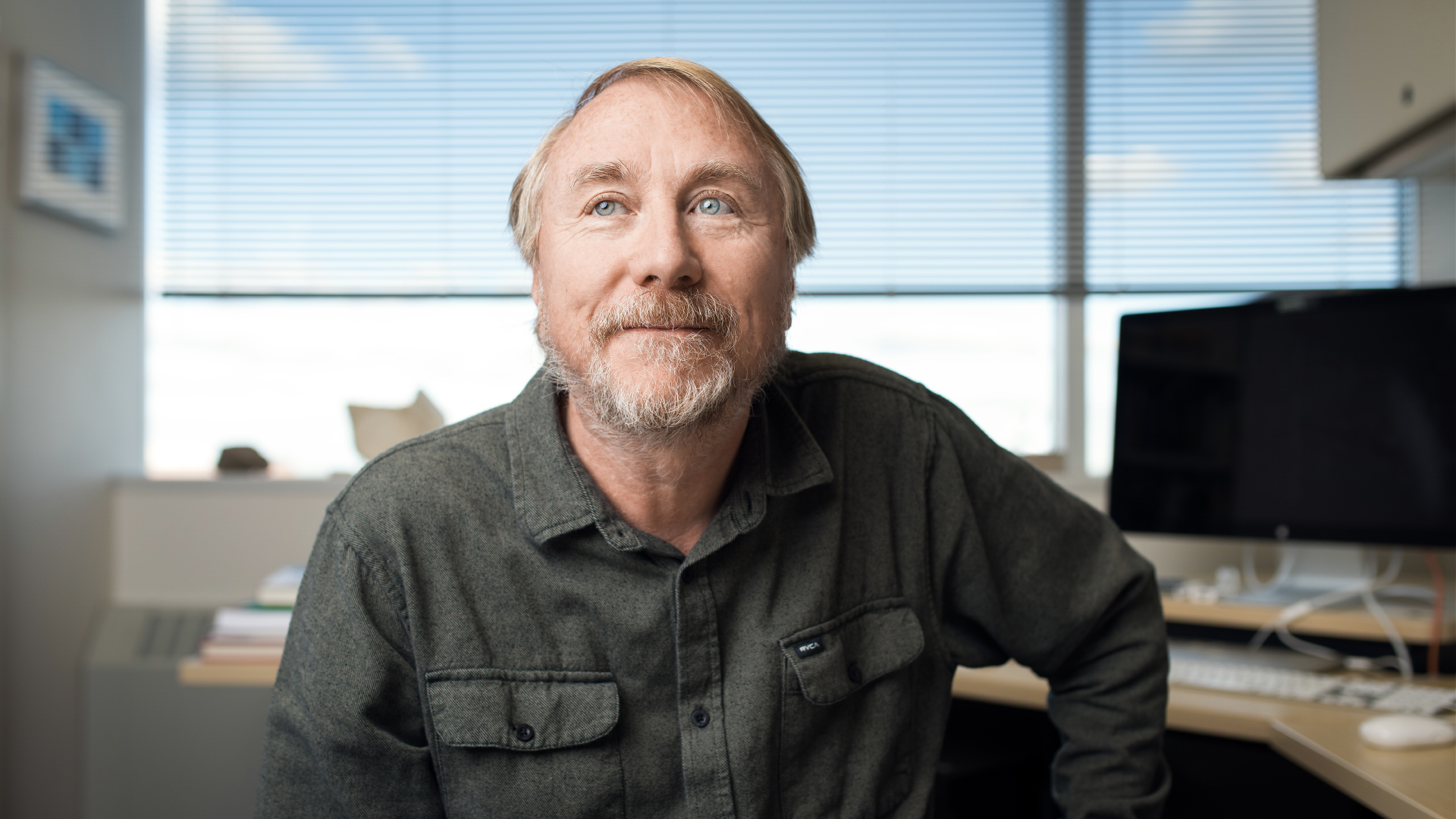
Logan Zillmer for Quanta Magazine
Early in his career, the decorated biologist Richard Lenski thought he might be forced to evolve. After his postdoctoral research grant was canceled, Lenski began to look tentatively at other options. With one child and a second on the way, Lenski attended a seminar about using specific types of data in an actuarial context — the same type of data he had worked with as a graduate student. Lenski collected a business card from the speaker, thinking he might be able to make use of his background in a new career.

“But then, as it sometimes does — and I was very lucky — the tide turned,” Lenski told Quanta Magazine in his high-rise office at Michigan State University. “We got the grant renewed, and soon thereafter, I started getting faculty offers.”

Lenski, a professor of microbial ecology at Michigan State, is best known for his work on what’s known as the long-term evolution experiment. The project, started in 1988, examines evolution in action. He and his lab members have been growing 12 populations of E. coli continuously for over 65,000 generations, tracking the development and mutations of the 12 separate strains.

The results have garnered attention and accolades — including a MacArthur “genius” grant, which Lenski received in 1996 — both for the enormity of the undertaking and for the intriguing findings the study has yielded. Most notably, in 2003, Lenski and his collaborators realized that one strain of E. coli had evolved the ability to use citrate as an energy source, something no previous population of E. coli was able to do.

Lenski is also interested in digital organisms, computer programs that have been designed to mimic the process of evolution. He was instrumental in the push to open the Beacon Center at Michigan State, which gives computer scientists and evolutionary biologists the opportunity to forge unique collaborations.

Quanta Magazine met with Lenski in his office to talk about his own evolving interests in the field of evolutionary biology — and about the time he almost pulled the plug on the long-term experiment. An edited and condensed version of the conversation follows.
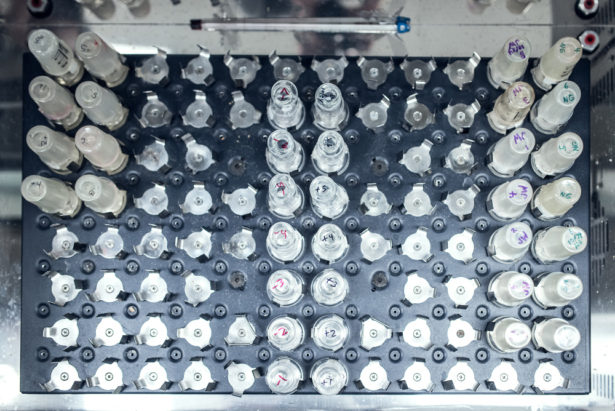
Logan Zillmer for Quanta Magazine. Vials containing the E. coli strains that make up the long-term evolution experiment.

QUANTA MAGAZINE: What sort of questions have been driving forces in your career?

RICHARD LENSKI: One question that has always intrigued me is about the reproducibility or repeatability of evolution. Stephen Jay Gould, the paleontologist and historian of science, posed this question: If we could rewind the tape of life on Earth, how similar or dissimilar would it be if we watched the whole process play out again? The long-term experiment that we do has allowed us to gather a lot of data about this question.

So is evolution repeatable?
Yes and no! I sometimes tell people it’s been a fascinating motivating question, but on one level, it is a terrible question, and one you would never tell a graduate student to go after. That’s because it is very open-ended, and it does not have a very clear-cut answer.

From the long-term experiment, we’ve seen

  • some really beautiful examples of things that are remarkably reproducible, and 
  • on the other hand some other crazy things where one population goes off and does things that are entirely different from the other 11 populations in the experiment.
How did you first come up with the idea for the long-term experiment?
I had been working already for several years on experimental evolution with bacteria, as well as viruses that infect bacteria. Those were fascinating, but everything became so complicated so quickly that I said, “Let’s reduce evolution down to its bare bones.” In particular, I wanted to go after this question of reproducibility or repeatability of evolution. And if I wanted to be able to look at the reproducibility of evolution, I wanted a system that was very simple. When I started the long-term experiment, my original goal was that I would call it the long-term experiment when I got to 2,000 generations.

How long did that take you?
The actual running of the experiment was about 10 or 11 months, but by the time we had collected data, wrote it up, and got the paper published, it was more like two and a half years or so. By then the experiment had already passed 5,000 generations, and I realized we should keep it going.
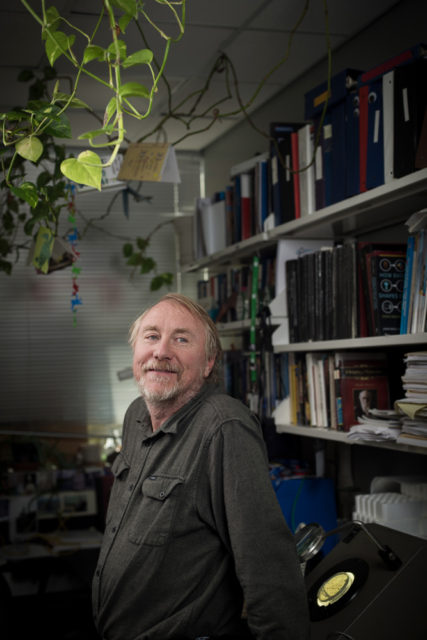
Logan Zillmer for Quanta Magazine. Richard Lenski in his office.

Did you anticipate the experiment going on for as long as it has?
No. No, I didn’t. There was a five-year period, maybe from the late ’90s into the early 2000s, where I thought about possibly stopping the experiment. This was for a couple of different reasons. One was that I was getting hooked on this other way of studying evolution, which involved looking at evolution in self-replicating computer programs, which was absolutely fascinating. Suddenly I saw this even shinier way of studying evolution, where it could go even more generations and do even more, seemingly neater, experiments.

How have your views on studying evolution via these digital organisms changed over time?
I had this sort of “puppy love” when I first learned about it. At first, it was just so extraordinarily interesting and exciting to be able to watch self-replicating programs, to be able to change their environments, and to watch evolution happen.

One of the really exciting things about digital evolution is that it shows that we think of evolution as being about stuff with blood and guts and DNA and RNA and proteins. But the idea of evolution really comes down to some very basic ideas of heredity, replication and competition. The philosopher of science Daniel Dennett has emphasized that we see evolution as this instantiation, this form of biological life, but the principles of it are much more general than that.

I would say that my latest directions of research have been primarily by way of talking with super-smart colleagues and serving on committees of graduate students who are using these systems. I’m less involved in designing experiments or formulating specific hypotheses, because that field has been moving extremely quickly. I feel I was very lucky to pick off some of the low-hanging fruit, but now I feel like I’m in there as a biologist, maybe criticizing hypotheses, suggesting controls that might be done in some experiments.

So your interest in digital organisms was one reason you considered shutting down the long-term experiment. What was the other?
At that point, the other thing that was a little frustrating about the long-term lines was that the rate at which the bacteria were changing was slowing down. The way I thought about it, it was almost as though evolution had stopped. I thought that this was just too simple an environment, and there wasn’t that much more for them to do.

So those two different things made me think about stopping the experiment. And I spoke to a few colleagues and they basically told me: You can’t do that. You shouldn’t do that. I talked with my wife, Madeleine, by the way, when I was getting very interested in these digital organisms — we were actually on sabbatical in France at that time — and I said, “Maybe I should call home and shut down the lab.” And she said, “I don’t think you should do that.”

Why did your wife and your colleagues have that reaction?
The experiment had already been quite profitable in a scientific sense, providing very rich data about the dynamics of evolutionary change. It was more or less unique in the timescales it was probing. So I think it was very good advice they gave me. I don’t know whether I could have ever quite pulled the plug myself. I certainly was a bit frustrated and thinking about it — but anyhow, people said no!


Logan Zillmer for Quanta Magazine
Video: Lenski discusses how he has been surprised by evolution.

Did you get past the plateau where you said you felt like the organisms weren’t evolving that much?
That actually has been one of the really cool findings from the experiment. When I started the long-term experiment, I thought that the bacteria would quickly reach some sort of limit to their growth. It was only a few years ago that we began to realize that the bacteria would always be able to beat anything we had inferred in the past about what their hard limit might be. I realized that we’re just fundamentally not thinking about this the right way. Even in the simplest environment, there’s always the potential for organisms to do any step in their metabolism, or any step in their biochemistry, a little bit better. And natural selection, although it won’t get it right on any given step, will over the long term always be favoring these subtle improvements.

One line of bacteria evolved the ability to use citrate as a food source. Did that happen before or after you were thinking of shutting down the experiment?
That was one of the things that made me realize we wouldn’t shut down the experiment. In 2003, one lineage evolved the ability to use citrate. That became a game changer: realizing that even in this super simple environment, there were some major things for the bacteria to evolve and figure out.

I like to say that the bacteria would eat dinner every night without realizing there was this nice, lemony dessert right around the corner. And so far, even after 65,000 generations, only one of the 12 populations has figured out how to consume that citrate.

You also mentioned that certain populations within your experiment have developed mutations at a greater rate. What does that look like?
After over 60,000 generations, six out of the 12 populations have evolved to be hypermutable. They’ve evolved changes in their DNA repair and DNA metabolic processes that causes them to have new mutations somewhere on the order of 100 times the rate at which the ancestor [at the start of the experiment] did.
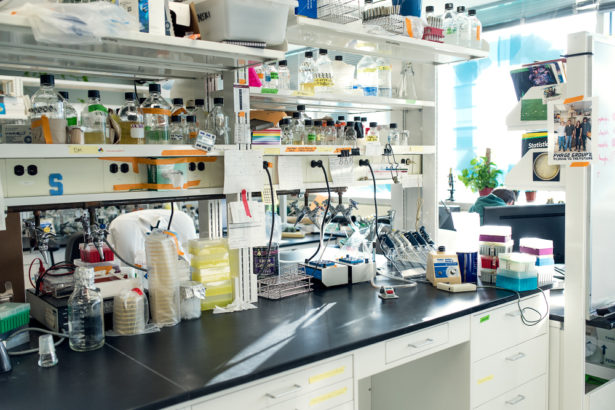
Logan Zillmer for Quanta Magazine. Lenski’s laboratory at Michigan State University.
It’s a very interesting process, because it’s both good and bad from the bacteria’s perspective. It’s bad because most mutations are harmful or at best neutral. Only the rare nugget in the mine is a beneficial mutation. The bacteria that have the higher mutation rate are a little bit more likely to discover one of those nuggets. But on the other hand, they’re also more likely to produce children and grandchildren with deleterious mutations.

Was the line that was able to consume citrate part of the group that had evolved to be hypermutable?
That’s a great question. The line that evolved the ability to use citrate did not have an elevated mutation rate. Interestingly, it became one of the ones with a higher mutation rate, but only after it evolved the ability to use citrate. It’s consistent with the benefit of the higher mutation rate — the additional capacity for exploration. The bacteria were actually quite poor at using citrate to begin with, so there were a lot of opportunities after they evolved the ability to use citrate to refine that ability.

How does the long-term experiment help you understand the evolution of life on a larger scale?
For me, one of the lessons of the long-term experiment has been how rich and interesting life can be, even in the dullest, simplest environment. The fact that evolution can generate this diversity, and discover doors left slightly ajar that it can push through, speaks to the awesome inventiveness of evolution. And if it can be so inventive and creative on this minuscule spatial and temporal scale, and in such a dull environment, it just creates more awe in me, when I think of how much more remarkable it is out in nature.

What most surprised you about this project?
That it’s still going on after all these years. One of my goals in life is to make sure that the experiment continues. I would like to raise an endowment to keep the experiment going on in perpetuity.

What’s your hope for the long-term experiment in the future?
My hope for the project is that it will yield many more surprises. For instance, two lineages have coexisted for 60,000 generations in one of the populations, where one of them is feeding off of the product that the other one is generating. I think it’s fascinating to wonder if, at some point, that might turn into something more like a predator-prey interaction. It’s certainly not outside the realm of possibilities. Whether it would ever happen, I don’t know.

It has also been a tremendous joy to work with students, postdocs and collaborators, and to see them grow and develop. That’s really the biggest joy for me of being a scientist. I like to tell people that I’m a bigamist. I have two families: 

  • I have my lab family and 
  • my biological family, and 
they both are incredibly wonderful.


Correction: This post was revised on November 3 to reflect that the citrate-using bacteria appeared in 2003, not 2008. The paper describing that change was published in 2008.

ORIGINAL: Quanta Magazine
By Stephanie Bucklin
November 3, 2016

lunes, 18 de noviembre de 2013

El hombre que metió la evolución en un frasco

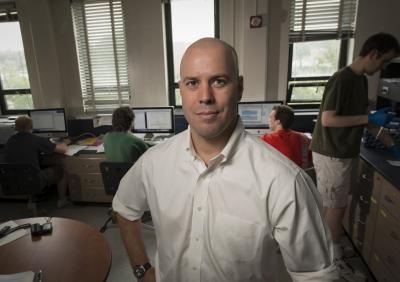
Richard Lenski (izqda) y Zachary Blount con las placas del experimento. (Imagen: Science)
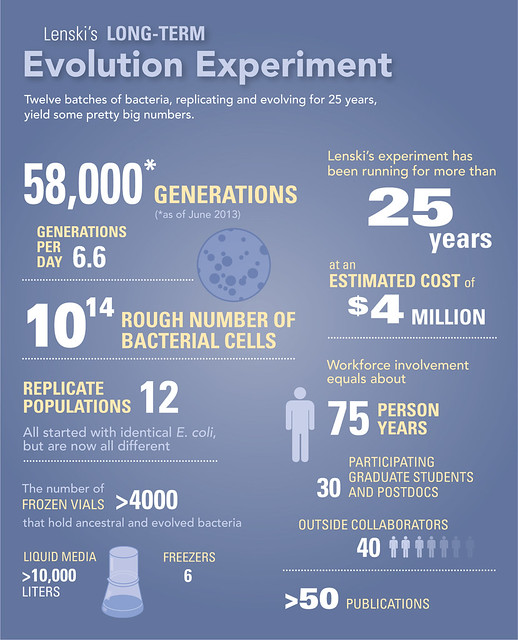
En el laboratorio de Richard Lenski, en la Universidad Estatal de Michigan, hay seis frigoríficos que contienen 58.000 generaciones de bacterias. Su experimento comenzó en el año 1988 con doce cultivos idénticos de Escherichia coli y, después de 25 años, las bacterias han seguido reproduciéndose y evolucionando. En el mantenimiento de estos cultivos, y las siguientes generaciones, se han invertido más de 4 millones de dólares y han participado un centenar de personas que han alimentado y cuidado a estos microorganismos día y noche, fines de semana incluidos. Cada poco tiempo las bacterias se multiplican y se coloca otra generación de E. coli en una nueva placa, en condiciones idénticas a las anteriores. Se calcula que se han reproducido a un ritmo de 6,6 generaciones nuevas cada día, el equivalente - si nos reprodujéramos al mismo ritmo - a un millón de años de evolución humana.

¿Y con qué motivo desarrollaría un experimento tan largo y tan costoso? Para observar, en tiempo real, si la evolución se detiene en algún momento. Para entenderlo mejor, hay que tener en cuenta la primera idea de Lenski. Si mantenía durante el tiempo los doce cultivos de bacterias en condiciones idénticas, pensó, cada grupo se adaptaría a su entorno paulatinamente hasta alcanzar un nivel de adaptación óptimo a partir del cual no podrían mejorar y la evolución, por decirlo de alguna manera, habría llegado a un límite. Pero no podía estar más equivocado.


Datos del experimento. Ilustración: Science


Aparte de las bacterias que están reproduciéndose en tiempo real, en los estantes de los seis frigoríficos del laboratorio uno puede encontrar muestras de distintos momentos evolutivos de las bacterias (congelaban una placa cada 75 días). De este modo, uno puede escoger entre los 4.000 viales y retroceder hasta el punto del tiempo evolutivo que desee: a la generación 10.000, a la 20.000 o a la de hace solo un año. Y se puede saber qué grupo de E. coli ha conseguido mejores adaptaciones y está más "evolucionado" mediante una sencilla prueba: se descongela una muestra antigua, se pone al lado de una actual y se comprueba cuál se reproduce más rápido. Aquellas que se reproducen antes tendrán más opciones de sobrevivir, de modo que están mejor adaptadas. "Podemos poner a competir a organismos que vivieron en diferentes momentos del tiempo", asegura Lenski, "de modo que las bacterias evolucionadas pueden competir cara a cara con sus ancestros".

Lo que han observado los científicos es que, pese a las sospechas iniciales de Lenski, la evolución es un proceso imparable que nunca se detiene, incluso cuando el ambiente permanece inalterado. Durante los 25 años del experimento, la adaptación de las bacterias ha mejorado en una media del 70%. Las nuevas generaciones de bacterias se reproducen 1,7 veces en el tiempo en que las bacterias originales se reproducen una vez, cuentan en Science. Durante las primeras pruebas, recuerda Lenski en NPR, las bacterias doblaban su población en alrededor de una hora. Pasadas 50.000 generaciones, las bacterias doblan su número en apenas 40 minutos. Y los científicos creen que las futuras generaciones lo harán incluso más rápido. "En alrededor de un millón de años", sostiene Lenski, "el ritmo con el que se multiplican por dos estará en torno a los 20 minutos".


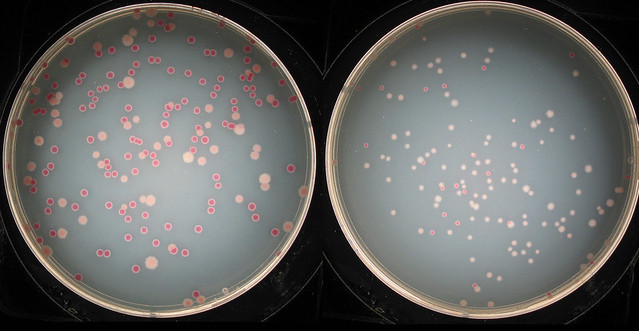
Dos cepas de bacterias E. coli compiten en una placa. Imagen: Michael Wiser.


El proceso, sin embargo, no es lineal. Las mejoras se producían al principio muy rápido y con el tiempo se han ralentizado, porque cada vez resulta más difícil mejorar. Además, algunas de las descendientes de las 12 cepas originales empezaron a progresar más rápido que otras y tomaron caminos evolutivos diferentes. Seis líneas, por ejemplo, desarrollaron un defecto en la reparación del ADN, pero en lugar de morir, el proceso dio lugar a un ritmo más rápido de mutaciones que el de sus compañeras. Hacia la generación 6.500, unos tres años después de empezar el experimento, dentro de uno de los frascos aparecieron dos tipos de E. coli diferentes: uno que formaba pequeñas colonias con células más pequeñas y otro que formaba colonias más grandes con bacterias más grandes. Los científicos esperaban que una acabara imponiéndose a la otra pero, para su sorpresa, ambas cepas han sobrevivido creando un ecosistema en el que la interacción entre ambas hace posible que ambas sigan adelante. "[Lenski] ha creado sus propias islas Galápagos", asegura Christopher Marx, microbiólogo de la Universidad de Harvard y uno de los investigadores que cuidó del experimento.

En otra ocasión, otra de las placas con E. coli se puso turbia debido a una acumulación inusualmente alta de bacterias y Lenski sospechó que se trataba de algún tipo de contaminación de la muestra. Tomaron del congelador un vial anterior de esa misma cepa y la reiniciaron desde otro punto, pero al cabo de tres semanas la placa se volvió a poner turbia. Cuando estudiaron la cepa Ara 3 - que así la habían bautizado - descubrieron que en lugar de alimentarse de glucosa, como las E. coli originales, habían evolucionado para alimentarse de citratos, un metabolismo que les permitía un ritmo de reproducción aún más alto.

"Este fue el suceso más importante de todo el experimento con E. coli", asegura el físico Christoph Adami. "Tener una nueva función compleja desarrollada aparentemente de la nada es muy destacable". Para ver qué había pasado volvieron a cultivar cepas anteriores y vieron que la adaptación para consumir citratos aparecía en 4 de los 72 cultivos. Finalmente, encontraron el minúsculo cambio genético que provocaba la aparición de las nuevas bacterias y que ponía encima de la mesa otra cuestión: cómo se forma una nueva especie. En biología, la definición de especie sigue sin estar muy clara, pero se considera que la prueba de fuego es que las dos especies no puedan tener descendencia común. Como esto no sucede con la reproducción asexual de las bacterias, la cosa se complica, y a lo más que han llegado es a mezclar los genomas y observar que se produce un nuevo tipo de bacteria menos adaptada.

En cualquier caso, como destacan en Science, el experimento de Lenski y las 12 cepas de E. coli ha servido para conocer mejor la evolución en tiempos más parecidos a los que ésta maneja: centenares de miles de generaciones. Estas primeras observaciones no son más que los primeros escarceos con el conocimiento de lo que sucede a nivel genético y un impulso, quizá, para que se pongan en marcha, y se mantengan, otros experimentos a largo plazo.

Referencias: The man who bottled evolution (Science) | Bacterial Competition In Lab Shows Evolution Never Stops (NPR)

Te puede interesar: En busca de las bacterias perdidas (Fogonazos)


ORIGINAL: Fogonazos
17 noviembre 2013

miércoles, 24 de abril de 2013

9 Materials That Will Change the Future of Manufacturing [Slide Show]

April 22, 2013

Researchers are developing cutting-edge foams, coatings, metals and other substances to make our homes, vehicles and gadgets more energy efficient and environmentally friendly


Future of Manufacturing
When we are unable to find what we need in nature, we make it. This in-depth report examines new technologies, materials and methods shaping the future of fabrication »


CHITIN + SILK: Materials have a tremendous influence on the properties of manufactured goods, including weight, strength and energy consumption. The "Shrilk" pictured here was inspired insect exoskeleton material and could someday be used to make biomedical products.Image: Courtesy of Wyss Institute, Harvard University

The future of manufacturing depends on a number of technological breakthroughs in robotics, sensors and high-performance computing, to name a few. But nothing will impact how things are made, and what they are capable of, more than the materials manufacturers use to make those things. New materials change both the manufacturing process and the end result.

Scientific American’s May special report “How to Make the Next Big Thing” presents several new materials under development to help inventors and engineers deliver next-generation technologies. These ingredients include superinsulating aerogels for spacesuits, flexible concrete cloth for construction projects and complex natural polymers that could replace toxic plastics.

Yet this lineup of advanced materials merely scratches the surface. Carmakers, for example, are developing porous polymers and new steel alloys that are stronger and lighter than steel, ostensibly making vehicles both safer and more fuel efficient. And environmentally savvy entrepreneurs are growing fungi-based packing materials to provide a biodegradable alternative to Styrofoam.

The following slide show presents these and several other substances that manufacturers could someday us to make many of the things we use.

FUNGAL FOAM: (Courtesy of mycobond, via Flickr)
Initially conceived as a cost-effective, environmentally friendly and high-performance alternative to Styrofoam, Ecovative Design makes its Mushroom Packaging from agricultural crop waste—plant stalks and rice and wheat husks—bonded together with mushroom roots (called mycelium). The company is now adapting its mushroom material to produce biodegradable alternative to petroleum-based plastic foams used in automotive bumpers, doors, roofs, engine bays, trunk liners, dashboards and seats. Other potential uses include tabletops, surfboards and clothing.

ELECTRIC INK: Courtesy of University of Illinois / S. Brett Walker
Quantum-electronic magic can make strange but useful semiconductors that are insulators on the inside and conductors on the surface. The bulk of the material acts as an insulator that blocks electron flow whereas the surface is a very good, metal-like conductor that allows electrons to travel freely at almost light-speed, unaffected by impurities that normally hinder electron motion through materials. Metal-free conductive inks will play a role in making printed electronic materials used in display screens, sensors and batteries. University of Illinois researchers, for example, have created a silver-based electric ink that leaves a trail of conductive material when it evaporates. The new formulation is easier to make than conventional electronic inks, adheres to many materials and can be printed at a lower temperature using a simple desktop device. 

WASTE-TO-ENERGY THERMOELECTRICS: Courtesy of General Motors
Northwestern University and Michigan State University scientists have demonstrated a thermoelectric material that is highly efficient at converting waste heat to electricity. That’s good news if you consider that nearly two thirds of all energy input is lost as waste heat. The inefficiency of existing thermoelectric materials has limited their commercial use. The record-setting, environmentally stable formulation is expected to convert 15 to 20 percent of waste heat to useful electricity, enabling greater industrial adoption of thermoelectrics. Waste-heat recovery systems could be attached, for example, to vehicle tailpipes or could process the exhaust streams from glass- and brick-making factories, refineries, fossil-fuel power plants as well as large transport ships and tankers. 


ROCK-SOLID COATING: Courtesy of Oak Ridge National Laboratory
Engineers from the Oak Ridge and Lawrence Livermore National laboratories, the Colorado School of Mines and elsewhere have designed extreme-duty, iron-based, glassy alloy coatings for industrial drill bits, bores and cutters to make this equipment more resistant to breaking even under heavy loads. NanoSHIELD Coatings—short for Nano Super Hard Inexpensive Laser Deposited Coatings—require a laser to fuse alloy powder to the surface of cutters and other tunnel-boring tools. The coatings cost far less than conventional materials such as tungsten carbide cobalt, and their longer operating life improves the efficiency of the tunnel-boring process.

DESIGNER NANOCRYSTALS: Courtesy of the University of Chicago/Chris Strong
Three University of Chicago chemists have created a new way to assemble what they call “designer atoms” into novel materials with a broad array of potentially useful properties and functions. These designer atoms are nano crystals—tiny crystalline arrays small enough that new quantum phenomena begin to emerge but large enough to provide building blocks for new functional materials and substances that could be useful in harvesting solar energy and delivering quantum computing. Greg Engel, associate professor in chemistry, is pictured here tuning a femtosecond laser system used to dissect couplings between nano crystals.

MEGA MAGNETS: Courtesy of Images-of-Elements.com, via WikiMedia Commons
Rare earth materials are vital to the manufacture of wind turbines, electric and hybrid cars, and consumer electronics due to their powerful magnetic properties. Yet they are also expensive and come almost entirely from one source—China. Whereas electric motors use magnets to transform electrical energy into mechanical energy, sintered rare earth magnets produce incredibly strong magnetic fields at small sizes, allowing manufacturers to build smaller, lighter motors, according to Electron Energy Corp. The firm has teamed up with University of Delaware researchers to develop a manufacturing process that increases sintered rare earth magnets’ electrical resistivity by at least 30 percent. Their goal is to make magnets with increased electrical resistivity that can reduce motor efficiency losses even when motors operate at high speeds. Shown here are blocks of nickel-plated neodymium magnet, one of the most widely used types of rare-earth magnet. 

CHEAPER, LIGHTER CARBON FIBER: Courtesy of Oak Ridge National Laboratory
Autos of the future will require strong, lightweight carbon-fiber composite structures to enhance efficiency and driving range, but low-cost fibers will be needed for market success. A consortium of national labs, industry and academia working at Oak Ridge National Laboratory’s Carbon Fiber Technology Facility are working to overcome the challenges of making cheaper carbon fiber. The U.S. Department of Energy gave Oak Ridge a $35-million award to build and operate the lab, which will include a pilot plant capable of producing up to 25 tons a year of new carbon-fiber materials. Pictured here is a polymer resin used to make carbon fiber.

ULTRATHIN PLATINUM: Courtesy of Gokcen/the National Institute of Standards and Technology
Hydrogen fuel cell vehicles could provide clean transportation in the future, but they remain expensive in part because they use the precious metal platinum to facilitate the chemical reactions that produce electricity within the cell. A new method for quickly and cheaply depositing ultrathin layers of platinum might make it practical to reduce the amount of the metal used in fuel-cell catalysts, thereby lowering their cost significantly. Current methods for applying atom-thick layers of platinum—mainly, atomic layer deposition—are slow and complicated. The new approach is cheap and easy to implement, according to the National Institute of Standards and Technology. Essentially, platinum dissolved in a solution is deposited in single-atom-thick layers by alternately applying positive and negative voltages. Repetition can quickly and easily build layers of any desired atomic thickness. Shown here is a scanning tunneling microscope image of an ultrathin film layer of platinum deposited on gold after five seconds. Darker areas are exposed gold substrate not yet covered by the platinum. 

BIO-INSPIRED PLASTIC: Courtesy of Wyss Institute, Harvard University
Light enough to permit flight and thin enough to accommodate flexibility and strong enough to protect its host, natural insect cuticle—found in the rigid exoskeletons of houseflies and grasshoppers—provides its host protection without adding weight or bulk. Researchers at Harvard University’s Wyss Institute for Biologically Inspired Engineering have developed a new material called Shrilk to replicate insect cuticle’s strength, durability and versatility. Shrilk—so called because it is composed of chitin commonly extracted from discarded shrimp shells and fibroin protein from silk—could be used to make trash bags, packaging and diapers that degrade quickly. As an exceptionally strong, biocompatible material, it might also be used to suture wounds that bear high loads, such as in hernia repair or as a scaffold for tissue regeneration.


More In This Article

Future of Substance: New Materials Promise Better Batteries, Stronger Steel

Getting 3-D Printing and Next-Generation Manufacturing to the Factory Floor [Video]

Information Is Driving a New Revolution in Manufacturing

The Short History of the Future of Manufacturing

Atomic Toolbox: Manufacturing at the Nanoscale

domingo, 7 de octubre de 2012

“Rumplestiltskin” Bacteria Digests Toxic Liquid, Poops 24-Karat Gold

ORIGINAL: Ecouterre
10/03/12

Photos by G.L. Kohuth
Here's some poop we won't mind scooping: Scientists at Michigan State University have discovered a strain of bacteria that literally excretes gold. Cupriavidus metalliduran, according to microbiologist Kazem Kashefi and electronic artist Adam Brown, doesn't just survive on toxic concentrations of auric chloride, it thrives. By feeding a colony unprecedented quantities of the naturally occurring but deadly compound—a process they believe mirrors what happens in nature—the duo managed to coax the microbes into metabolizing the toxins into 24-karat gold. The irony? The process would be cost-prohibitive on a large scale. So Kashefi and Brown did the next best thingo: they turned their research into an art installation.

lunes, 28 de mayo de 2012

Powerful new approach to attack flu virus

ORIGINAL: eScienceNews

An international research team has manufactured a new protein that can combat deadly flu epidemics. MSU photographer, Kurt Stepnitz
An international research team has manufactured a new protein that can combat deadly flu epidemics. The paper, featured on the cover of the current issue of Nature Biotechnology, demonstrates ways to use manufactured genes as antivirals, which disable key functions of the flu virus, said Tim Whitehead, assistant professor of chemical engineering and materials science at Michigan State University.

"Our most potent design has proven effective on the vulnerable sites on many pandemic influenza viruses, including several H1N1 (Spanish flu, Swine flu) and H5N1 (Avian flu) subtypes," said Whitehead, the paper's co-lead author. "These new therapeutics are urgently needed, so we were especially pleased to see that it neutralizes H1N1 viruses with potency."

From its earlier research, the team used computer-aided design to engineer proteins that targeted vulnerable sites on the highly adaptable virus. From there, researchers optimized their designer proteins by comprehensively mapping the mutations that gave the proteins a strong advantage when attacking the viruses' targeted areas.

The team improved its proteins through a process called "DNA deep sequencing." This allowed Whitehead and his colleagues to simultaneously sequence millions of variants of their manufactured proteins, identify and keep the beneficial mutations and optimize the proteins' performance.

"By taking only the best mutations, we can reprogram our proteins to burrow into viruses at key locations and render them harmless," he said. "Our work demonstrates a new approach to construct therapeutic proteins, which we hope will spur development of new protein drugs by the biopharmaceutical industry."

This research also laid the groundwork for future treatments of all flu viruses as well as other diseases such as smallpox, Whitehead added.

Whitehead's co-authors included researchers from the University of Washington, the Scripps Research Institute (La Jolla, Calif.), Naval Health Research Center (San Diego) and the Weizmann Institute of Science (Rehovot, Israel).

The research was funded by Defense Research Projects Agency, the Defense Threat Reduction Agency, the National Institutes of Health, the National Institute of Allergy and Infectious Diseases and the National Institute of General Medical Sciences.