Mostrando entradas con la etiqueta bacteriófagos. Mostrar todas las entradas

viernes, 18 de enero de 2013

Descrita una nueva ruta de señalización clave en la transferencia de genes virulentos entre bacterias

ORIGINAL: DCYT

El trabajo, publicado en la revista Molecular Cell, asigna a una enzima una nueva función señalizadora
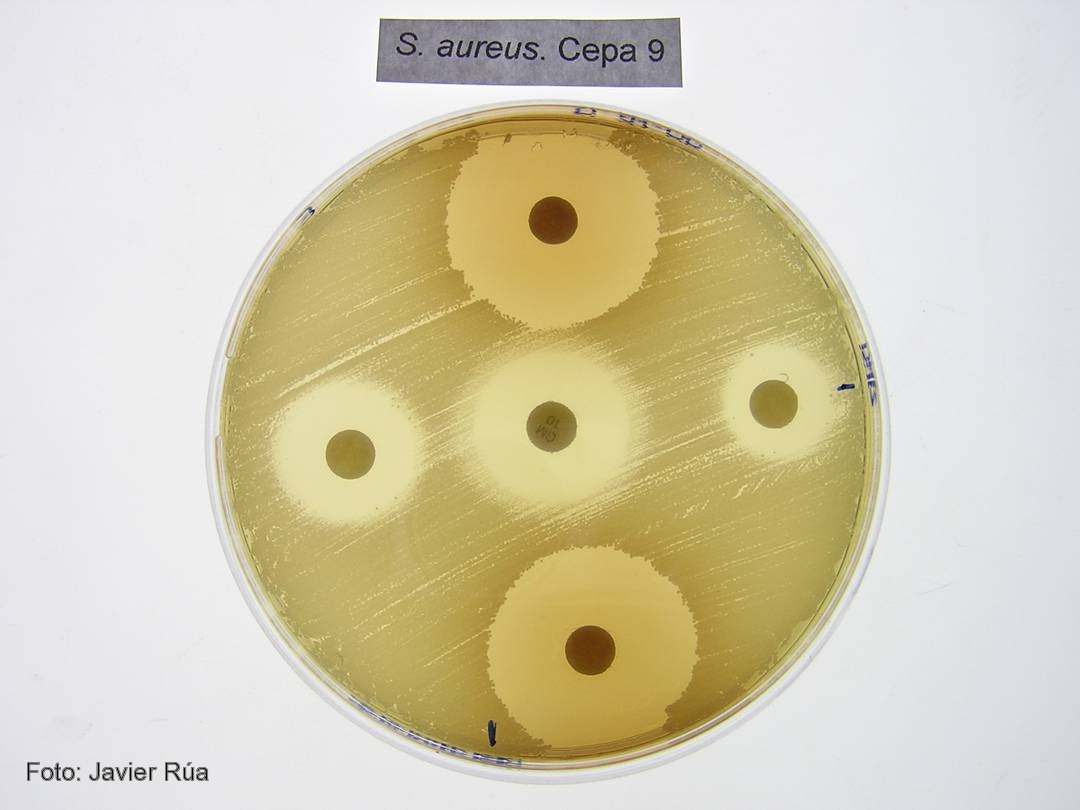
Cultivo de 'Staphylococcus aureus' tratado con los fenoles BHA (derecha) e hidroquinona (arriba).

CSIC/DICYT Un trabajo con participación del Consejo Superior de Investigaciones Científicas (CSIC) ha asignado a una enzima presente en todos los organismos vivos una nueva función en la transferencia de genes virulentos entre bacterias, un proceso que acaba provocando una infección. Los resultados, que aparecen publicados en el último número de Molecular Cell, y que han empleado como modelo la bacteria Staphylococcus aureus, la más frecuente en las infecciones adquiridas en hospitales, establecen el mecanismo de actuación de estas moléculas.

Las bacterias son capaces de transferir material genético entre sí mediante mecanismos de transferencia horizontal de genes. Cuando estos genes son virulentos, las bacterias que los reciben adquieren la capacidad de provocar enfermedades. “Algunos de los genes que codifican para toxinas y otros factores de virulencia están presentes en unas regiones denominadas islas de patogenicidad. Estas islas se transfieren de unas bacterias a otras utilizando virus que infectan bacterias, los llamados bacteriófagos”, explica el investigador del CSIC José Rafael Penadés, que trabaja en el Instituto de Biomedicina de Valencia.

El equipo de investigadores, formado también por científicos del Centro de Investigación y Tecnología Animal y la Universidad CEU Cardenal Herrera, en Valencia, han descubierto que las enzimas dUTPasas son capaces de despertar a las islas de patogenicidad para que detecten que la bacteria está siendo atacada por un virus. Antes de que la bacteria muera infectada, las islas inician su replicación y se transfieren a otras bacterias inocuas, a las que convierten en virulentas.

“El proceso evolutivo ha hecho que las islas detecten que un virus está infectando a las bacterias, lo que producirá su muerte, y utilicen la presencia del bacteriófago para activarse e iniciar su ciclo. Esto ocurre porque algunas proteínas del fago se unen a un represor que bloquea la isla”, explica el investigador del CSIC.

Proteínas G protooncogénicas
Los resultados confirman que las dUTPasas son moléculas señalizadoras que emplean un mecanismo similar al descrito para una familia de proteínas presentes en células eucariotas: las proteínas G protooncogénicas. “Las dUTPasas son activas como señalizadoras cuando se unen a un nucleótido dUTP. Es entonces cuando cambian su conformación y, una vez cumplida su función, degradan el nucleótido y pasan a estar apagadas. Este mecanismo de encendido y apagado es el mismo que el empleado por los protooncogenes”, destaca Penadés.

Según el investigador del CSIC Alberto Marina, el estudio sugiere por primera vez que las dUTPasas cumplen una función señalizadora no sólo en la mayoría de los virus, sino además en organismos vivos complejos como los eucariotas superiores. “Nuestros resultados aportan una visión completamente nueva del mecanismo de actuación de estas enzimas, que depende de una serie de características presentes en las enzimas de los bacteriófagos de Staphylococcus aureus y que están también presentes en otras muchas dUTPasas de un gran número de organismos vivos. Todo ello sugiere que el mecanismo descrito es universal”, concluye el investigador del CSIC.

Referencia bibliográfica 
María Ángeles Tormo-Más, Jorge Donderis, María García-Caballer, Aaron Alt, Ignacio Mir-Sanchís, Alberto Marina y José R. Penadés. Phage dUTPases Control Transfer of Virulence Genes by a Proto-Oncogenic G Protein-like Mechanism. Molecular Cell. DOI: 10.1016.

miércoles, 23 de mayo de 2012

DNA used as rewritable data storage in cells

ORIGINAL: ScienceNews
Monday, May 21st, 2012

Genetically encoded memory could track cell division inside the body

They aren’t yet competition for Intel, but bioengineers have created a one-bit “memory” made of DNA that can record, erase and rewrite data within living cells.

One day, doctors might be able to insert such devices into a cancer patient to tally how many times a cell divides and flag when to shut the cancer down. Or researchers might track exactly what happens inside cells as they age.

The work is a step forward in synthetic biology, a new field in which scientists create tools to control life’s basics from the cell on up.

“We can write and erase DNA in a living cell,” says Jerome Bonnet, a bioengineer at Stanford University. “Now we can bring logic and computation inside a cell itself.”

Bonnet and his colleagues, led by Stanford’s Drew Endy, describe the feat in a paper published online May 21 in the Proceedings of the National Academy of Sciences.

Figure S2: Alternate architecture for a reset circuit. A, Schematic diagram of the decoupled reset circuit where integrase is expressed from a low-copy plasmid while excisionase is expressed from a medium-copy plasmid. B, Cells bearing the chromosomal LR DNA register were transformed with both plasmids encoding integrase and excisionase, pulsed with arabinose and analyzed by flow cytometry. Cells relaxed to the BP state after induction with approximatively 85% efficiency.
Scientists have long dreamed of putting tiny computers inside the body to monitor and perhaps even control what’s going on. But nobody has yet made a silicon-based computer chip small enough to embark on a fantastic computing voyage inside a cell.

So researchers are turning instead to biological tools, such as enzymes and DNA. Some biologists have devised DNA switches that can be turned on and off within a cell. And in 2009, bioengineers reported making a genetic “counter” that could tally the number of times a particular event, like a cell dividing, took place (SN: 6/20/09, p. 5).

But these previous efforts made systems that could write a piece of information only once. Truly useful digital data storage allows the information to be erased and rewritten over and over again, like burning new information onto a CD with each pass. “What we didn’t have is some kind of logic that also has memory,” says Pakpoom Subsoontorn, a graduate student on the team.

The researchers chose DNA as the stuff of memory and used enzymes called recombinases as the tools to flip it on and off. Those enzymes came from bacteriophages, which are viruses that infect bacteria. These viruses use one enzyme to integrate into the genome of the bacterium they’re infecting.

In the experiment, the enzyme traveled to a particular place on the sequence of DNA that contains genetic information and flipped a small section so that it read backward. Sending a second signal then flipped the sequence back to its original state. The flipped and unflipped versions thus represent the “0” and “1” states of a computer bit, says Bonnet.

Working in the bacterium Escherichia coli, the team also tweaked the DNA so that it would fluoresce in different colors depending on the orientation of the strand in question. By watching the cells’ glow change between red and green and then back again, the scientists could tell when the DNA strand had been flipped.

So far, Endy’s team has just one bit of memory. Next they hope to scale up to eight bits, or a byte — a goal that could take many more years, Bonnet says. The scientists are also working on speeding up the flips; it currently takes about an hour to invert a DNA segment.

But the team has gotten the flips to hold for more than 100 generations within a living cell, a laboratory first. “This was an important proof of concept that it was doable,” says Bonnet. “Now we want to build a more complex system, something other people can use.”

Though interesting, it’s not yet clear whether DNA-based memory will ever replace silicon-based memory for certain applications, says Roger Brent, a researcher at the Fred Hutchinson Cancer Research Center and director of the Center for Biological Futures in Seattle. “It will need to prove itself in the marketplace of ideas.”