I’m at a Whole Foods in Palo Alto with Dror Sharon, cofounder and CEO of Consumer Physics, based in San Francisco and Israel. Sharon is holding his smartphone and a tiny handheld device he calls SCiO, which is about the size of a TicTac box. We are browsing around the produce department, checking out the Brix level of various items. The Brix number represents the sugar content of a solution and, for fruits, is an indicator of whether or not a particular fruit has much flavor. The tomatoes, according to the SCiO’s accompanying smartphone app, are horrible; not a big surprise in March. The apples are mixed, there is only one variety Sharon would buy right now. The mangos, he proclaims, are just perfect, and contemplates filling a bag before we go.
Photo: Tekla PerryTesting the SCiO portable analyzer at the Whole Foods dairy case
We move onto the dairy case, where the labels of cellophane-wrapped cheeses provided only price and name. Sharon’s smartphone app popped up all sorts of additional information as he pointed the SCiO gadget at different chunks (still in their wrapping), including fat content, calories per gram, and protein content.
On the way to Whole Foods, we stopped outside a restaurant where two women were having brunch, and asked them if we could scan their food before they ate it. Sharon told them the strawberries would be excellent (they women agreed they were), but the whipped cream would be abnormally sweet, there was so much sugar in it wasn’t recognizable as dairy (it was).
It was all pretty magical, pointing a gadget at food and getting an instant analysis. To be fair, I can’t verify the accuracy of what I was seeing on the screen; I didn’t take the fruits and cheeses back to a laboratory to confirm the analysis using more traditional technology. But it certainly seemed real, real enough that I would be pretty excited to have this kind of technology built into my smart phone, given I have my phone out anyway when I’m grocery shopping to scan shelf tags in order to download coupons. And Sharon promises it is indeed coming into phones—as soon as the third quarter of this year in China, fourth quarter in the United States.
Here’s how SCiO works—and why it exists.
Photo: Tekla PerryThese apples should be pretty good
The gadget uses standard infrared spectroscopy; it measures the absorption of infrared light. It may not be as accurate as a benchtop spectrometer used in a laboratory environment, but Sharon says it makes up for this with its algorithms. The user starts out by simplifying the problem a bit by identifying the category of the item to be examined—it’s not “What fruit is this,” but, “This is an apple, is it any good?” Consumer Physics’ cloud-based software then taps into its knowledge base, for an apple, it defines “good” as “sweet” (hence the Brix measurement), and considers an apple’s typical range of sweetness based on thousands of scans. A graphic on the phone then places the apple on a quality range.
Besides having data on most fruits and vegetables, the system also knows about dairy products; for those, it provides information on calories and fat content. And it knows about the cocoa content of chocolate, the amount of alcohol in drinks, and the protein, fat, and calories in raw fish, poultry, beef, and pork. And while, to date, the focus has been on food, Sharon stresses that the technology works with all sorts of materials. The company has started holding workshops for people who want to develop their own databases.
Sharon had been wanting this kind of gadget for a long time before he finally set out to build one. He grew up on a farm in Israel; he was used to eating produce that hadn’t been shipped further than across the property. So, when he moved to Massachusetts for business school at MIT (his bachelor’s degree is in electrical engineering), he was surprised by just how tasteless he found the produce at local groceries. “The food just didn’t taste the same. And when I saw that I was buying grapes from Chile, I was sure something was not right about them.”
He decided that he should get himself something to determine whether or not the food in the stores was any good before he bought it, so he logged onto Amazon and searched for such a gadget. He didn’t find one. Disappointed, he resigned himself to occasionally buying tasteless produce or traveling 30 miles to a grocer he discovered that he could trust.
But about five years later, in 2010, after a few years working in the U.S. and then moving back to Israel, he came back to the idea. There ought to be a scanner that could give you useful information about the food you are about to buy, he insisted. He teamed up with Damian Goldring, a friend from his undergraduate days with a PhD in silicon photonics, and the two started investigating sensing technologies that, potentially, could be built into a phone. They landed on infrared spectrometry, and, in 2011, started Consumer Physics. In mid-2012, they rented one of those expensive, luggable, commercial spectrometers for a day and demonstrated to a large cellular service provider that the technology could be used to analyze food, doing a demo on chocolate mixtures that looked the same, but had different substances mixed in, like regular butter and peanut butter. “We’re going to put this into a phone,” Sharon said. (The company didn’t fund them.)
Photo: Tekla PerryDon’t buy these tomatoes
Sharon and Goldring may not have convinced that company, but they had convinced themselves, and began working on the technology, first on their own dime, and then with a little money from angel investors and crowd-sourced funding from OurCrowd. In early 2014, they were convinced enough that they could deliver the technology as a small Bluetooth peripheral—not inside a phone quite yet, but pretty close—to launch a Kickstarter campaign, pitching a $200 portable infrared spectrometer. Some 13,000 people signed up, ponying up about $2.7 million.
Things from Kickstarter funding to shipped product were not exactly smooth sailing. Come September of 2016, we reported that only 5000 of the Kickstarter backers had received products, far later than originally estimated, and many of the remaining backers were angry. To make things worse, the backers could no longer communicate with the company via Kickstarter, the page had been taken down in a trademark dispute over the name “SCiO”.
What happened? Sharon says the delays were due to manufacturing challenges, as well as a redesign to improve sensitivity, resistance to ambient light, and penetration depth. And the company has now fulfilled almost all of its Kickstarter orders, with the exception of customers who haven’t yet provided shipping addresses, have unique shipping requirements, or are choosing to wait for a Special Edition version of the gadget—that’s fewer than 10 percent of the backers, Sharon says.
But while the Kickstarter rollout was more than normally bumpy, the company’s efforts to get venture funding have born, well, fruit. After picking up some funding from angel investors and people using crowdfunding platform OurCrowd, Consumer Physics closed a round of venture investment led by Khosla Ventures. To date, Sharon said, funding totals over $25 million.
Photo: Tekla PerryThanks to Analog Devices, the SCiO technology can now fit inside a smart phone
The company also lined up some critical partnerships: with Analog Devices, which worked with the company to reduce the size of the sensor package into something that will easily fit into smartphones and is manufacturing this version of the device; and with Chinese phone manufacturer Changhong, which will be incorporating the technology in the Changhong H2 smartphone starting in China in the third quarter of this year and in the U.S. towards the end of 2017. Consumers in China, Sharon points out, are particularly interested in checking food safety, given the history of problems with the food supply. Sharon hopes other smartphone manufacturers will follow, turning using a phone to scan food as common a practice as using one to photograph food.
Consumer Physics now has about 100 employees, with corporate offices in San Francisco, a sales team based in the Midwestern United States, and a development team in Israel. Dozens of people are scanning food 24/7, Sharon said, to increase the kinds of food that can be analyzed as well as the accuracy of the analysis.
While the initial applications surround food, Sharon says that the technology is not just for checking out food freshness and nutritional information; it’s good at analyzing body fat, and distinguishing real pharmaceuticals from their fake counterparts. “We’ve done a demo that distinguishes real Viagra from fake Viagra,” says Sharon. “That’s the most commonly counterfeited drug.”
Consumer Physics has, to date, shipped more than 3000 developer kits, and is hoping some interesting consumer applications will emerge. One such in the works by French company Terallion, Sharon said, is a kitchen scale, intended for diabetics, that can use SCiO’s analysis to allow it to give users accurate information about protein and carbohydrate content of the food they are about to eat. The company is also working directly with industrial partners, in particular, with those working to develop tools for digital agriculture.
William Shockley’s employees toast him for his Nobel Prize, 1956. Photo courtesy Computer History Museum.
“You can’t really understand what is going on now without understanding what came before.”
Steve Jobs is explaining why, as a young man, he spent so much time with the Silicon Valley entrepreneurs a generation older, men like Robert Noyce, Andy Grove, and Regis McKenna.
It’s a beautiful Saturday morning in May, 2003, and I’m sitting next to Jobs on his living room sofa, interviewing him for a book I’m writing. I ask him to tell me more about why he wanted, as he put it, “to smell that second wonderful era of the valley, the semiconductor companies leading into the computer.” Why, I want to know, is it not enough to stand on the shoulders of giants? Why does he want to pick their brains?
“It’s like that Schopenhauer quote about the conjurer,” he says. When I look blank, he tells me to wait and then dashes upstairs. He comes down a minute later holding a book and reading aloud:
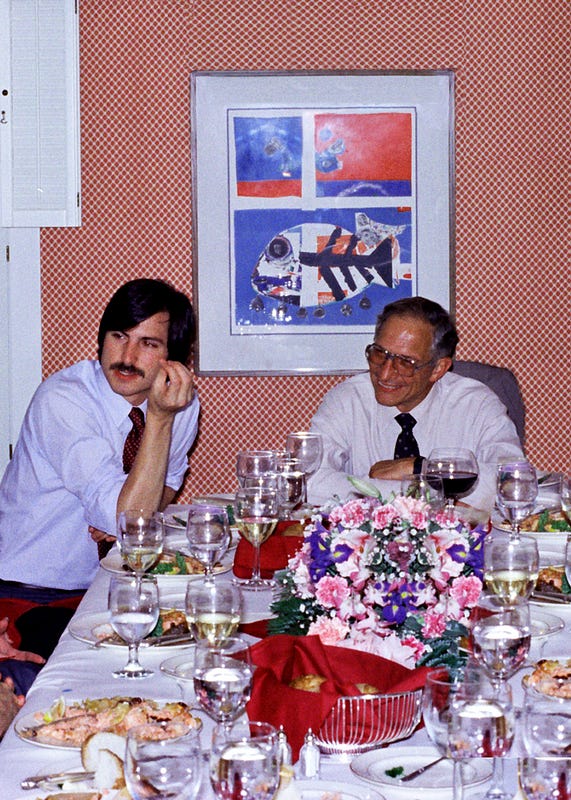
Steve Jobs and Robert Noyce. Courtesy Leslie Berlin.
He who lives to see two or three generations is like a man who sits some time in the conjurer’s booth at a fair, and witnesses the performance twice or thrice in succession. The tricks were meant to be seen only once, and when they are no longer a novelty and cease to deceive, their effect is gone.
History, Jobs understood, gave him a chance to see — and see through — the conjurer’s tricks before they happened to him, so he would know how to handle them.
Flash forward eleven years. It’s 2014, and I am going to see Robert W. Taylor. In 1966, Taylor convinced the Department of Defense to build the ARPANET that eventually formed the core of the Internet. He went on to run the famous Xerox PARC Computer Science Lab that developed the first modern personal computer. For a finishing touch, he led one of the teams at DEC behind the world’s first blazingly fast search engine — three years before Google was founded.
Visiting Taylor is like driving into a Silicon Valley time machine. You zip past the venture capital firms on Sand Hill Road, over the 280 freeway, and down a twisty two-lane street that is nearly impassable on weekends, thanks to the packs of lycra-clad cyclists on multi-thousand-dollar bikes raising their cardio thresholds along the steep climbs. A sharp turn and you enter what seems to be another world, wooded and cool, the coastal redwoods dense along the hills. Cell phone signals fade in and out in this part of Woodside, far above Buck’s Restaurant where power deals are negotiated over early-morning cups of coffee. GPS tries valiantly to ascertain a location — and then gives up.
When I get to Taylor’s home on a hill overlooking the Valley, he tells me about another visitor who recently took that drive, apparently driven by the same curiosity that Steve Jobs had: Mark Zuckerberg, along with some colleagues at the company he founded, Facebook.
“Zuckerberg must have heard about me in some historical sense,” Taylor recalls in his Texas drawl. “He wanted to see what I was all about, I guess.”
To invent the future, you must understand the past.
I am a historian, and my subject matter is Silicon Valley. So I’m not surprised that Jobs and Zuckerberg both understood that the Valley’s past matters today and that the lessons of history can take innovation further. When I talk to other founders and participants in the area, they also want to hear what happened before. Their questions usually boil down to two:
Why did Silicon Valley happen in the first place, and
why has it remained at the epicenter of the global tech economy for so long?
I think I can answer those questions.
First, a definition of terms. When I use the term “Silicon Valley,” I am referring quite specifically to the narrow stretch of the San Francisco Peninsula that is sandwiched between the bay to the east and the Coastal Range to the west. (Yes, Silicon Valley is a physical valley — there are hills on the far side of the bay.) Silicon Valley has traditionally comprised
Santa Clara County and
the southern tip of San Mateo County. In the past few years,
parts of Alameda County and
the city of San Francisco
can also legitimately be considered satellites of Silicon Valley, or perhaps part of “Greater Silicon Valley.”
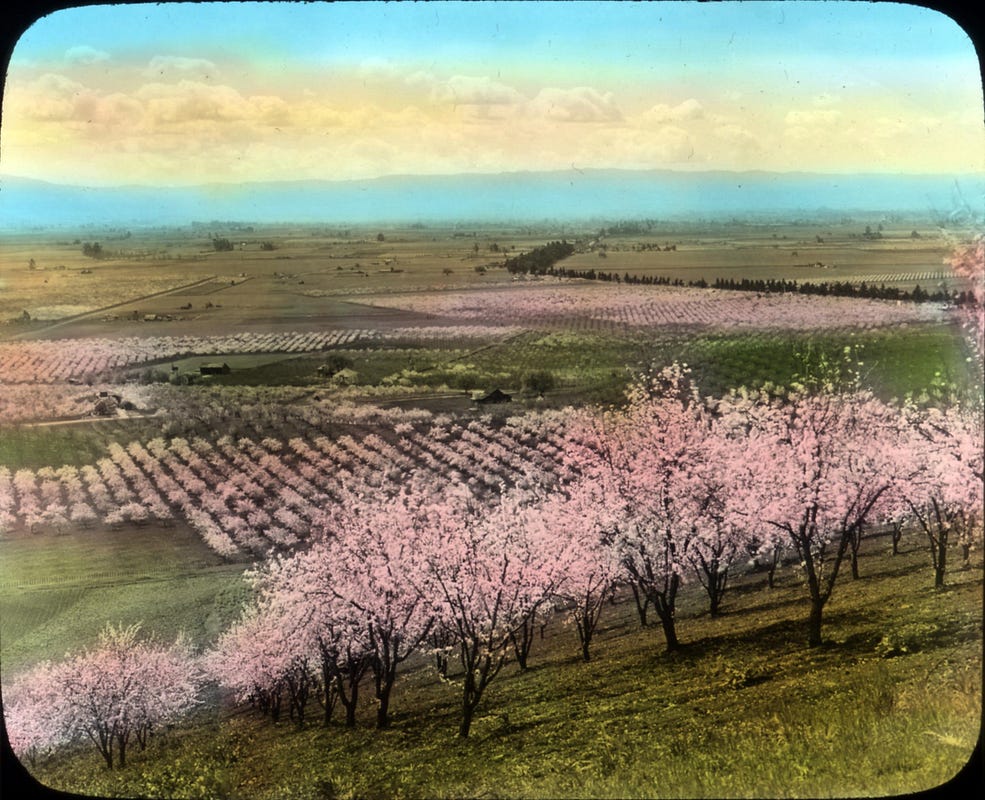
The name “Silicon Valley,” incidentally, was popularized in 1971 by a hard-drinking, story-chasing, gossip-mongering journalist named Don Hoefler, who wrote for a trade rag called Electronic News. Before, the region was called the “Valley of the Hearts Delight,” renowned for its apricot, plum, cherry and almond orchards.
“This was down-home farming, three generations of tranquility, beauty, health, and productivity based on family farms of small acreage but bountiful production,” reminisced Wallace Stegner, the famed Western writer. To see what the Valley looked like then, watch the first few minutes of this wonderful 1948 promotional video for the “Valley of the Heart’s Delight.”
Three historical forces — technical, cultural, and financial — created Silicon Valley.
Technology
On the technical side, in some sense the Valley got lucky. In 1955, one of the inventors of the transistor, William Shockley, moved back to Palo Alto, where he had spent some of his childhood. Shockley was also a brilliant physicist — he would share the Nobel Prize in 1956 — an outstanding teacher, and a terrible entrepreneur and boss. Because he was a brilliant scientist and inventor, Shockley was able to recruit some of the brightest young researchers in the country — Shockley called them “hot minds” — to come work for him 3,000 miles from the research-intensive businesses and laboratories that lined the Eastern Seaboard from Boston to Bell Labs in New Jersey. Because Shockley was an outstanding teacher, he got these young scientists, all but one of whom had never built transistors, to the point that they not only understood the tiny devices but began innovating in the field of semiconductor electronics on their own.
And because Shockley was a terrible boss — the sort of boss who posted salaries and subjected his employees to lie-detector tests — many who came to work for him could not wait to get away and work for someone else. That someone else, it turned out, would be themselves. The move by eight of Shockley’s employees to launch their own semiconductor operation called Fairchild Semiconductor in 1957 marked the first significant modern startup company in Silicon Valley. After Fairchild Semiconductor blew apart in the late-1960s, employees launched dozens of new companies (including Intel, National and AMD) that are collectively called the Fairchildren.
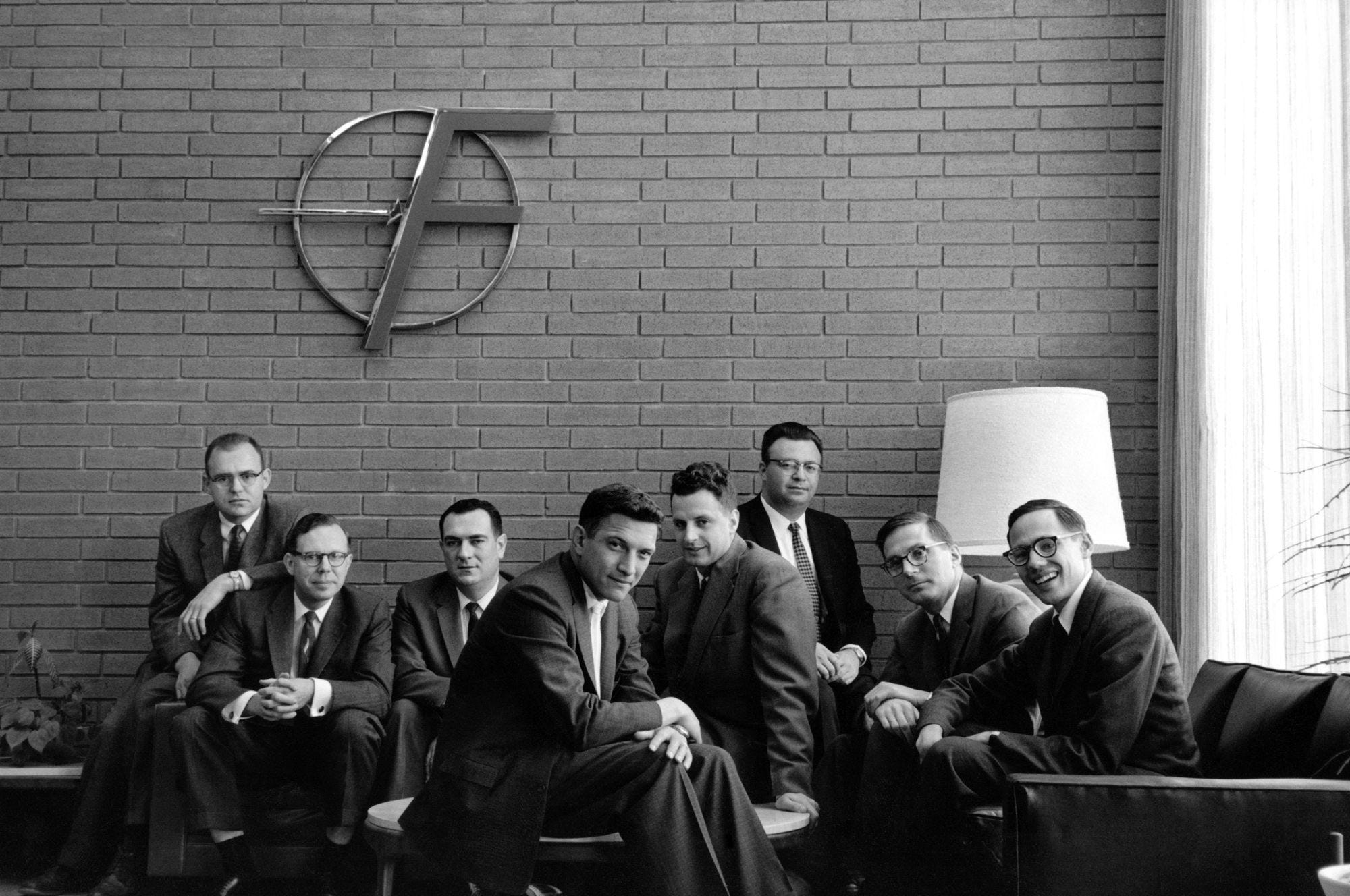
The Fairchild 8: Gordon Moore, Sheldon Roberts, Eugene Kleiner, Robert Noyce, Victor Grinich, Julius Blank, Jean Hoerni, and Jay Last. Photo courtesy Wayne Miller/Magnum Photos.
Equally important for the Valley’s future was the technology that Shockley taught his employees to build: the transistor. Nearly everything that we associate with the modern technology revolution and Silicon Valley can be traced back to the tiny, tiny transistor.
Think of the transistor as the grain of sand at the core of the Silicon Valley pearl. The next layer of the pearl appeared when people strung together transistors, along with other discrete electronic components like resistors and capacitors, to make an entire electronic circuit on a single slice of silicon. This new device was called a microchip. Then someone came up with a specialized microchip that could be programmed: the microprocessor. The first pocket calculators were built around these microprocessors. Then someone figured out that it was possible to combine a microprocessor with other components and a screen — that was a computer. People wrote code for those computers to serve as operating systems and software on top of those systems. At some point people began connecting these computers to each other: networking. Then people realized it should be possible to “virtualize” these computers and store their contents off-site in a “cloud,” and it was also possible to search across the information stored in multiple computers. Then the networked computer was shrunk — keeping the key components of screen, keyboard, and pointing device (today a finger) — to build tablets and palm-sized machines called smart phones. Then people began writing apps for those mobile devices … .
You get the picture. These changes all kept pace to the metronomic tick-tock of Moore’s Law.
The skills learned through building and commercializing one layer of the pearl underpinned and supported the development of the next layer or developments in related industries. Apple, for instance, is a company that people often speak of as sui generis, but Apple Computer’s early key employees had worked at Intel, Atari, or Hewlett-Packard. Apple’s venture capital backers had either backed Fairchild or Intel or worked there. The famous Macintosh, with its user-friendly aspect, graphical-user interface, overlapping windows, and mouse was inspired by a 1979 visit Steve Jobs and a group of engineers paid to XEROX PARC, located in the Stanford Research Park. In other words, Apple was the product of its Silicon Valley environment and technological roots.
Culture
This brings us to the second force behind the birth of Silicon Valley: culture. When Shockley, his transistor and his recruits arrived in 1955, the valley was still largely agricultural, and the small local industry had a distinctly high-tech (or as they would have said then, “space age”) focus. The largest employer was defense contractor Lockheed. IBM was about to open a small research facility. Hewlett-Packard, one of the few homegrown tech companies in Silicon Valley before the 1950s, was more than a decade old.
Stanford, meanwhile, was actively trying to build up its physics and engineering departments. Professor (and Provost from 1955 to 1965) Frederick Terman worried about a “brain drain” of Stanford graduates to the East Coast, where jobs were plentiful. So he worked with President J.E. Wallace Sterling to create what Terman called “a community of technical scholars” in which the links between industry and academia were fluid. This meant that as the new transistor-cum-microchip companies began to grow, technically knowledgeable engineers were already there.
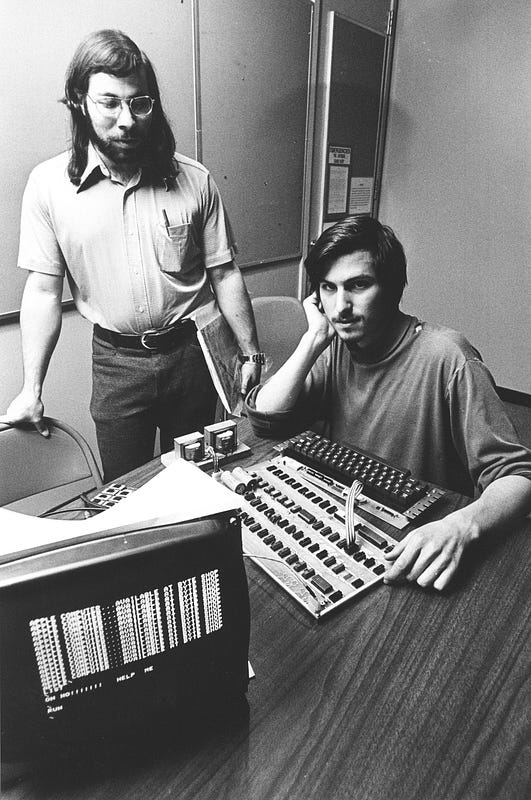
Woz and Jobs. Photo courtesy Computer History Museum.
These trends only accelerated as the population exploded. Between 1950 and 1970, the population of Santa Clara County tripled, from roughly 300,000 residents to more than 1 million. It was as if a new person moved into Santa Clara County every 15 minutes for 20 years. The newcomers were, overall, younger and better educated than the people already in the area. The Valley changed from a community of aging farmers with high school diplomas to one filled with 20-something PhDs.
All these new people pouring into what had been an agricultural region meant that it was possible to create a business environment around the needs of new companies coming up, rather than adapting an existing business culture to accommodate the new industries. In what would become a self-perpetuating cycle, everything from specialized law firms, recruiting operations and prototyping facilities; to liberal stock option plans; to zoning laws; to community college course offerings developed to support a tech-based business infrastructure.
Historian Richard White says that the modern American West was “born modern” because the population followed, rather than preceded, connections to national and international markets. Silicon Valley was bornpost-modern, with those connections not only in place but so taken for granted that people were comfortable experimenting with new types of business structures and approaches strikingly different from the traditional East Coast business practices with roots nearly two centuries old.
From the beginning, Silicon Valley entrepreneurs saw themselves in direct opposition to their East Coast counterparts. The westerners saw themselves as cowboys and pioneers, working on a “new frontier” where people dared greatly and failure was not shameful but just the quickest way to learn a hard lesson. In the 1970s, with the influence of the counterculture’s epicenter at the corner of Haight and Ashbury, only an easy drive up the freeway, Silicon Valley companies also became famous for their laid-back, dressed-down culture, and for their products, such as video games and personal computers, that brought advanced technology to “the rest of us.”
Money
The third key component driving the birth of Silicon Valley, along with the right technology seed falling into a particularly rich and receptive cultural soil, was money. Again, timing was crucial. Silicon Valley was kick-started by federal dollars. Whether it was
the Department of Defense buying 100% of the earliest microchips,
Hewlett-Packard and Lockheed selling products to military customers, or
federal research money pouring into Stanford,
Silicon Valley was the beneficiary of Cold War fears that translated to the Department of Defense being willing to spend almost anything on advanced electronics and electronic systems. The government, in effect, served as the Valley’s first venture capitalist.
The first significant wave of venture capital firms hit Silicon Valley in the 1970s. Both Sequoia Capital and Kleiner Perkins Caufield and Byers were founded by Fairchild alumni in 1972. Between them, these venture firms would go on to fund Amazon, Apple, Cisco, Dropbox, Electronic Arts, Facebook, Genentech, Google, Instagram, Intuit, and LinkedIn — and that is just the first half of the alphabet.
This model of one generation succeeding and then turning around to offer the next generation of entrepreneurs financial support and managerial expertise is one of the most important and under-recognized secrets to Silicon Valley’s ongoing success. Robert Noyce called it “re-stocking the stream I fished from.” Steve Jobs, in his remarkable 2005 commencement address at Stanford, used the analogy of a baton being passed from one runner to another in an ongoing relay across time.
So that’s how Silicon Valley emerged. Why has it endured?
After all, if modern Silicon Valley was born in the 1950s, the region is now in its seventh decade. For roughly two-thirds of that time, Valley watchers have predicted its imminent demise, usually with an allusion to Detroit.
First, the oil shocks and energy crises of the 1970s were going to shut down the fabs (specialized factories) that build microchips.
In the 1980s, Japanese competition was the concern.
The bursting of the dot-com bubble,
the rise of formidable tech regions in other parts of the world,
the Internet and mobile technologies that make it possible to work from anywhere:
all have been heard as Silicon Valley’s death knell.
The Valley of Heart’s Delight, pre-technology. OSU Special Collections.
The Valley economy is notorious for its cyclicity, but it has indeed endured. Here we are in 2015, a year in which more patents, more IPOs, and a larger share of venture capital and angel investments have come from the Valley than ever before. As a recent report from Joint Venture Silicon Valley (***) put it, “We’ve extended a four-year streak of job growth, we are among the highest income regions in the country, and we have the biggest share of the nation’s high-growth, high-wage sectors.” Would-be entrepreneurs continue to move to the Valley from all over the world. Even companies that are not started in Silicon Valley move there (witness Facebook).
Why? What is behind Silicon Valley’s staying power? The answer is that many of the factors that launched Silicon Valley in the 1950s continue to underpin its strength today even as the Valley economy has proven quite adaptable.
Technology
The Valley still glides in the long wake of the transistor, both in terms of technology and in terms of the infrastructure to support companies that rely on semiconductor technology. Remember the pearl. At the same time, when new industries not related directly to semiconductors have sprung up in the Valley — industries like biotechnology — they have taken advantage of the infrastructure and support structure already in place.
Money
Venture capital has remained the dominant source of funding for young companies in Silicon Valley. In 2014, some $14.5 billion in venture capital was invested in the Valley, accounting for 43 percent of all venture capital investments in the country. More than half of Silicon Valley venture capital went to software investments, and the rise of software, too, helps to explain the recent migration of many tech companies to San Francisco. (San Francisco, it should be noted, accounted for nearly half of the $14.5 billion figure.) Building microchips or computers or specialized production equipment — things that used to happen in Silicon Valley — requires many people, huge fabrication operations and access to specialized chemicals and treatment facilities, often on large swaths of land. Building software requires none of these things; in fact, software engineers need little more than a computer and some server space in the cloud to do their jobs. It is thus easy for software companies to locate in cities like San Francisco, where many young techies want to live.
Culture
The Valley continues to be a magnet for young, educated people. The flood of intranational immigrants to Silicon Valley from other parts of the country in the second half of the twentieth century has become, in the twenty-first century, a flood of international immigrants from all over the world. It is impossible to overstate the importance of immigrants to the region and to the modern tech industry. Nearly 37 percent of the people in Silicon Valley today were born outside of the United States — of these, more than 60 percent were born in Asia and 20 percent in Mexico. Half of Silicon Valley households speak a language other than English in the home. Sixty-five percent of the people with Bachelors degrees working in science and engineering in the valley were born in another country. Let me say that again: 2/3 of people in working in sci-tech Valley industries who have completed their college education are foreign born. (Nearly half the college graduates working in all industries in the valley are foreign-born.)
Here’s another way to look at it: From 1995 to 2005, more than half of all Silicon Valley startups had at least one founder who was born outside the United States.[13] Their businesses — companies like Google and eBay — have created American jobs and billions of dollars in American market capitalization.
Silicon Valley, now, as in the past, is built and sustained by immigrants.
Gordon Moore and Robert Noyce at Intel in 1970. Photo courtesy Intel.
Stanford also remains at the center of the action. By one estimate, from 2012, companies formed by Stanford entrepreneurs generate world revenues of $2.7 trillion annually and have created 5.4 million jobs since the 1930s. This figure includes companies whose primary business is not tech: companies like Nike, Gap, and Trader Joe’s. But even if you just look at Silicon Valley companies that came out of Stanford, the list is impressive, including Cisco, Google, HP, IDEO, Instagram, MIPS, Netscape, NVIDIA, Silicon Graphics, Snapchat, Sun, Varian, VMware, and Yahoo. Indeed, some critics have complained that Stanford has become overly focused on student entrepreneurship in recent years — an allegation that I disagree with but is neatly encapsulated in a 2012 New Yorker article that called the university “Get Rich U.”
Change
The above represent important continuities, but change has also been vital to the region’s longevity.Silicon Valley has been re-inventing itself for decades, a trend that is evident with a quick look at the emerging or leading technologies in the area:
• 1940s: instrumentation
• 1950s/60s: microchips
• 1970s: biotech, consumer electronics using chips (PC, video game, etc)
• 1980s: software, networking
• 1990s: web, search
• 2000s: cloud, mobile, social networking
The overriding sense of what it means to be in Silicon Valley — the lionization of risk-taking, the David-versus-Goliath stories, the persistent belief that failure teaches important business lessons even when the data show otherwise — has not changed, but over the past few years, a new trope has appeared alongside the Western metaphors of Gold Rushes and Wild Wests: Disruption.
“Disruption” is the notion, roughly based on ideas first proposed by Joseph Schumpeter in 1942, that a little company can come in and — usually with technology — completely remake an industry that seemed established and largely impervious to change. So: Uber is disrupting the taxi industry. Airbnb is disrupting the hotel industry. The disruption story is, in its essentials, the same as the Western tale: a new approach comes out of nowhere to change the establishment world for the better. You can hear the same themes of adventure, anti-establishment thinking, opportunity and risk-taking. It’s the same song, with different lyrics.
The shift to the new language may reflect the key role that immigrants play in today’s Silicon Valley. Many educated, working adults in the region arrived with no cultural background that promoted cowboys or pioneers. These immigrants did not even travel west to get to Silicon Valley. They came east, or north. It will be interesting to see how long the Western metaphor survives this cultural shift. I’m betting that it’s on its way out.
Something else new has been happening in Silicon Valley culture in the past decade. The anti-establishment little guys have become the establishment big guys. Apple settled an anti-trust case. You are hearing about Silicon Valley companies like Facebook or Google collecting massive amounts of data on American citizens, some of which has ended up in the hands of the NSA. What happens when Silicon Valley companies start looking like the Big Brother from the famous 1984 Apple Macintosh commercial?
A Brief Feint at the Future
I opened these musings by defining Silicon Valley as a physical location. I’m often asked how or whether place will continue to matter in the age of mobile technologies, the Internet and connections that will only get faster. In other words, is region an outdated concept?
I believe that physical location will continue to be relevant when it comes to technological innovation. Proximity matters. Creativity cannot be scheduled for the particular half-hour block of time that everyone has free to teleconference. Important work can be done remotely, but the kinds of conversations that lead to real breakthroughs often happen serendipitously. People run into each other down the hall, or in a coffee shop, or at a religious service, or at the gym, or on the sidelines of a kid’s soccer game.
It is precisely because place will continue to matter that the biggest threats to Silicon Valley’s future have local and national parameters. Silicon Valley’s innovation economy depends on its being able to attract the brightest minds in the world; they act as a constant innovation “refresh” button. If Silicon Valley loses its allure for those people —
if the quality of public schools declines so that their children cannot receive good educations,
if housing prices remain so astronomical that fewer than half of first-time buyers can afford the median-priced home, or
if immigration policy makes it difficult for high-skilled immigrants who want to stay here to do so —
the Valley’s status, and that of the United States economy, will be threatened. Also worrisome: ever-expanding gaps between the highest and lowest earners in Silicon Valley; stagnant wages for low- and middle-skilled workers; and the persistent reality that as a group, men in Silicon Valley earn more than women at the same level of educational attainment. Moreover, today in Silicon Valley, the lowest-earning racial/ethnic group earns 70 percent less than the highest earning group, according to the Joint Venture report. The stark reality, with apologies to George Orwell, is that even in the Valley’s vaunted egalitarian culture, some people are more equal than others.
Another threat is the continuing decline in federal support for basic research. Venture capital is important for developing products into companies, but the federal government still funds the great majority of basic research in this country. Silicon Valley is highly dependent on that basic research — “No Basic Research, No iPhone” is my favorite title from a recently released report on research and development in the United States. Today, the US occupies tenth place among OECD nations in overall R&D investment. That is investment as a percentage of GDP — somewhere between 2.5 and 3 percent. This represents a 13 percent drop below where we were ten years ago (again as a percentage of GDP). China is projected to outspend the United States in R&D within the next ten years, both in absolute terms and as a fraction of economic development.
People around the world have tried to reproduce Silicon Valley. No one has succeeded.
And no one will succeed because no place else — including Silicon Valley itself in its 2015 incarnation — could ever reproduce the unique concoction of academic research, technology, countercultural ideals and a California-specific type of Gold Rush reputation that attracts people with a high tolerance for risk and very little to lose. Partially through the passage of time, partially through deliberate effort by some entrepreneurs who tried to “give back” and others who tried to make a buck, this culture has become self-perpetuating.
The drive to build another Silicon Valley may be doomed to fail, but that is not necessarily bad news for regional planners elsewhere. The high-tech economy is not a zero-sum game. The twenty-first century global technology economy is large and complex enough for multiple regions to thrive for decades to come — including Silicon Valley, if the threats it faces are taken seriously.
Cuando se habla de innovación, por políticos y economistas, generalmente se argumenta que la innovación reside en las fuerzas del mercado, en el empresariado innovador con su capacidad para afrontar riesgos. El estado es lo opuesto de la innovación y el riesgo. El estado es lento, burocrático, y desperdicia recursos.
Sin embargo, la realidad de la innovación no parece ser así. La innovación no reside en el mercado sino en el estado, el gobierno. Los economistas neoliberales como publicistas de la iniciativa privada no estarán de acuerdo, protestarán y dirán que se equivocan quienes reclaman ese papel para el estado, que no hay nada superior al mercado.
Los trabajos de la investigadora y economista Mariana Mazzucato, egresada de la New School for Social Research University (NY) -también mi Alma Máter-, y profesora en la universidad de Sussex, Inglaterra, señalan al estado como el factor más importante para generar innovación tecnológica. Su reciente libro el Estado Empresarial: Derribando los Mitos Sector Público vs Sector Privado (The Entrepreneurial State, 2013) discurre sobre esta hipótesis, al igual que su libro previo (2011). La presentación del libro en su sitio web www.marianamazzucato.com se puede resumir así:
El "Estado Empresarial" echa por tierra el mito del Estado como una organización burocrática grande que puede en el mejor de los casos facilitar la innovación creativa que sucede en el dinámico sector privado. En el análisis de varios estudios de casos sobre el crecimiento impulsado por la innovación, el libro describe la situación opuesta, señalando que el sector privado sólo se atreve a invertir después de que el Estado ha realizado las inversiones de alto riesgo. Este libro sostiene que en la historia del capitalismo moderno, el Estado ha generado actividad económica que de otro modo no habría sucedido, y ha abierto activamente nuevas tecnologías y mercados en los que los inversores privados más adelante pueden entrar. Lejos de las críticas a menudo escuchadas al Estado de que potencialmente “desplaza” las inversiones privadas, el Estado hace que sucedan, formando y creando mercados, no sólo “corrigiendo” sus fallas. Ignorar esta realidad sólo sirve a fines ideológicos, y perjudica a la formulación de políticas eficaces.
Este libro examina estudios de casos que van desde el advenimiento de Internet al surgimiento de las industrias de la biotecnología y la nanotecnología. En particular, el volumen desmiente el mito de que Silicon Valley ha sido creado por el capital de riesgo privado. Un capítulo importante se centra en inversiones del estado detrás del éxito de Apple, y revela que todas las principales tecnologías que sustentan el desarrollo del iPhone deben su origen a los fondos públicos. Mientras las personas emprendedoras como Steve Jobs son necesarias, su éxito es casi imposible sin su habilidad para subirse a la ola de inversiones del Estado. Y si Europa quiere sus propios Googles, necesita más acción del Estado, no menos.
Dos de los capítulos del libro se centran en el examen de la próxima gran área de innovación después de internet: la “revolución verde”. Tanto la energía solar y la tecnología eólica actualmente están siendo guiados por el gasto del Estado, ya sea a través del programa ARPA-E (EE.UU) o por los bancos de inversión de los estados chino y brasileño. La discusión refrescante se mueve más allá de la habitual división entre los partidarios de la austeridad frente a los defensores de los estímulos fiscales. Argumenta que las inversiones del estado no sólo ayudan a disparar el crecimiento durante los períodos de recesión, sino que además, incluso en períodos de auge, conducen a inversiones productivas en nuevas tecnologías radicales que luego promueven décadas de crecimiento.
El libro termina con una pregunta fundamental: si el Estado es tan importante para las inversiones en innovación de alto riesgo, ¿por qué captura tan poco en el retorno directo de las inversiones? Sin embargo, Google y Apple por ejemplo, deberían devolver más a la sociedad, y los ciudadanos que financiaron sus innovaciones con impuestos.
¿Dónde estaría hoy Google sin las inversiones financiadas por el estado en el desarrollo de internet, y sin las subvenciones con que la Fundación Nacional de Ciencias de EE.UU (NSF) financió el descubrimiento de su propio algoritmo? ¿El iPad sería tan exitoso sin las innovaciones financiadas por el estado de las tecnologías de comunicación, GPS y pantalla táctil?
No se trata de que el estado corrija las fallas del mercado, o que la política industrial escoja a los “ganadores”, o que el gasto público estimule la demanda insuficiente, se trata de que el estado tome el papel líder en la innovación. El estado funciona, en términos de Mazzucato, en el papel de asumir los riesgos, abriendo el camino a nuevas tecnologías, antes de que el sector privado entre a rentabilizarlas en aplicaciones industriales.
En conclusión, para la realidad colombiana, la transformación de Colciencias, como instrumento institucional del gobierno para el desarrollo de la ciencia, la tecnología y la innovación, es una necesidad apremiante, a la luz de las experiencias de los países desarrollados, como las descritas y analizadas por Mazzucato. Es necesario un estado, y un sector privado, más comprometido con la ciencia y la investigación, sin dejar de lado el desarrollo experimental y la innovación. Sin embargo, Colciencias retrocede, y el gobierno la entrega a los políticos, de acuerdo a Moisés Wasserman, ex rector de la UN.
In each unit, water flows through small tubes, each with pores 1/100th the width of a human hair
This fall, Santa Clara county residents will get a new source of water. This water is local and pristine. In fact, it's cleaner than almost anything coming out of taps today. But – for now at least – no one will drink it.
Silicon Valley Advanced Water Purification Center. Photo courtesy of the Santa Clara Valley Water District
In each unit, water flows through small tubes, each with pores 1/100th the width of a human hair
Next, water is forced under high pressure through reverse osmosis tubes
Finally, water is zapped with ultraviolet rays to sterilize any remaining viruses
Ultraviolet bulbs, like this one, are often used to sterilize medicine and fruit juice
Purified water will flow through purple pipes and hydrants, which indicate the water is not for drinking
That's because the water is recycled from wastewater – sewage – from a wastewater treatment plant across the street. Engineers say it's possible to purify sewage water until it's cleaner than much of what residents drink today. The bigger challenge, they say, is convincing people to drink it.
San Diego’s recycling plan nearly died in 2007 when the mayor uttered the three most dreaded words for this industry: “Toilet to tap.”
“We're basically at the limits of our current water supply,” he says.
California's population will increase in coming years. Climate change will make snowmelt from the Sierra Mountains more erratic. Policy battles over farms and endangered fish in the Delta mean more competition for less supply. The important thing to realize, says Luthy, is that where we get our water and what we do with it have to change.
“What we're realizing now,” he says, “is that the ways of the past are not the ways of the future.”
When it comes online, the plant will produce eight million gallons of purified water a day, using some of the most high-tech water purification systems available today.
The first step is microfiltration. Canisters filled with spaghetti-like fibers filter out anything larger than one micron – 1/300th of the width of a human hair – including bacteria. Next, high-pressure pumps force water through a reverse osmosis membrane, with pores so small they exclude anything larger than a water molecule, including viruses and traces of pharmaceuticals.
Finally, the water gets zapped by ultraviolet rays to scramble the DNA of (and therefore sterilize) anything that might be left living in it. “We are removing 99.99 percent of all pathogens,” says Crystal Yezman, an engineer for the Santa Clara Valley Water District.
San Jose's been recycling water for more than a decade, but this water will be much cleaner. Theoretically, says plant spokesman Marty Grimes, you could drink it.
“This water is ours,” he says. “No one can take it away”
Add caption
Initially, at least, this water will be more expensive than current water sources, like the Delta or underground aquifers. It will also be more expensive than measures to conserve current water supply, like low-flow shower heads or more efficient toilets.
But managers expect recycled water costs to fall in the future, as the practice becomes more common, and say that recycled water is much less expensive than other “new” sources of water, such as desalination.
Still, water recycling has been a tough sell here in California. San Diego’s recycling plan nearly died in 2007 when the mayor uttered the three most dreaded words for this industry: “Toilet to tap.”
A few years ago Brent Haddad, an environmental engineer at UC Santa Cruz, noticed that he kept finding himself at industry meetings listening to water managers complaining about an “irrational” public unwilling to accept perfectly clean, recycled water.
(For more on this, here's a terrific NPR story from a couple years ago.)
So Haddad conducted a national survey, to try and understand this resistance and what it would take to change it.
“We found it has nothing to do with level of education or any other personal demographic traits, like race, religion or salary,” says Haddad.
Fear about drinking recycled water, he says, is “a great equalizer.”
So how do you convince the public to embrace recycled water? Haddad says the first step is to explain to people how the water is treated, and why it is safe to drink.
Part of that process is explaining that Americans have effectively been drinking recycled water for generations.
Take, for instance, cities along the Mississippi or Colorado Rivers. Cities treat their sewage and pump it back into the river. Downstream, other cities suck water from the river, treat it, and pipe it to customers.
“Any city that gets its water from Colorado river, like Las Vegas and southern California utilities,” says Dave Smith, Managing Director for Water Reuse California. “are getting some of their water supply through incidental potable reuse.”
Brent Haddad says another way to reassure customers is to use what he calls “psychological cleansing.”
“You have to break the memory, the line of history of the water.”
In other words, re-write the history of the water, editing out the part about sewage. One way to do this is to take recycled water and put it back into nature, for instance, a river.
“That river is something that's comforting to people. We don’t have to think that the water came through a city. We just begin the history of the water in the river itself.”
In fact California's Department of Public Health, which works with utilities to design water recycling facilities, currently requires this kind of “environmental buffer.” (Though the Department is currently reevaluating that policy.)
An environmental buffer is built into the design of the world's largest water recycling facility, operated by the Orange County Water District.
“Toilet to tap.” A water fountain at San Francisco's Exploratorium challenges people's assumptions about where their water comes from. Photo courtesy of Windell Oskay
Instead of a river, the county's Groundwater Replenishment System cleans treated sewage, then pumps it into underground aquifers, where it mixes with other water and eventually gets pumped up, re-treated, and piped to peoples’ houses.
Water managers call these systems “indirect potable reuse.”
“We put it back into the ground and then eventually it becomes part of the water supply,” says the district's general manager Michael Markus.
Markus says getting water clean enough that it can be put back into an aquifer is the easy part. Much more of a challenge, he says, was convincing the public that the water would be safe enough to drink. The district decided on a policy of total transparency, he says, and started planning a series of public meetings.
“We went to our local state elected officials, the health and medical community, environmental groups, Rotary clubs,” he says. “We talked to the Sons and Daughters of the American Revolution, scouting troops… anyone who would want to hear or receive a presentation.”
The irony is that when you put recycled water back into the ecosystem, it actually gets dirtier, and has to be treated again.
Markus says it's “frustrating” to watch this facility pump pristine water into a hole in the ground. But he realizes that winning people over to recycled water is an ongoing process.
That process is farther along in Southern California. In Los Angeles, says Dave Smith, “One-fifth of the population is already getting part of their water supply from indirect potable reuse.”
In West Texas, which faces critical water shortages, at least two recycling facilities skip the “environmental buffer” stage entirely, using advanced purification to treat wastewater and pump it directly to customers.
Here in Northern California, the process of use and acceptance is just beginning. When the Silicon Valley Advanced Water Purification Center opens up in late fall, the pristine water will be destined for golf courses and power plants.
But one day, if policies and public opinion change, it could be there for drinking, too.
Breakthrough Prize in Life Sciences is founded by Art Levinson, Sergey Brin, Anne Wojcicki, Mark Zuckerberg and Priscilla Chan, and Yuri Milner to recognize excellence in research aimed at curing intractable diseases and extending human life.
The prize is administered by the Breakthrough Prize in Life Sciences Foundation, a not-for-profit corporation dedicated to advancing breakthrough research, celebrating scientists and generating excitement about the pursuit of science as a career.
Founding sponsors of the Breakthrough Prize in Life Sciences include Sergey Brin and Anne Wojcicki, Mark Zuckerberg and Priscilla Chan, and Yuri Milner, who collectively have agreed to establish 5 annual prizes, US$3 million each, going forward.
These prizes will be awarded for past achievements in the field of life sciences, with the aim of providing the recipients with more freedom and opportunity to pursue even greater future accomplishments.
11 Inaugural winners receive US$3 million each for Groundbreaking Achievements in Life Science Research
February 20, 2013 (San Francisco) – Art Levinson, Sergey Brin, Anne Wojcicki, Mark Zuckerberg, Priscilla Chan and Yuri Milner announced today the launch of the Breakthrough Prize in Life Sciences (“Breakthrough Prize”), recognizing excellence in research aimed at curing intractable diseases and extending human life. The prize will be administered by the Breakthrough Prize in Life Sciences Foundation, a not-for-profit corporation (“Foundation”) dedicated to advancing breakthrough research, celebrating scientists and generating excitement about the pursuit of science as a career.
The first 11 recipients of the Breakthrough Prize are:
Cornelia I. Bargmann
David Botstein
Lewis C. Cantley
Hans Clevers
Napoleone Ferrara
Titia de Lange
Eric S. Lander
Charles L. Sawyers
Bert Vogelstein
Robert A. Weinberg
Shinya Yamanaka
All prize winners have agreed to serve on the Selection Committee of the Foundation to choose recipients of future prizes.
Founding sponsors of the Breakthrough Prize include Sergey Brin and Anne Wojcicki, Mark Zuckerberg and Priscilla Chan, and Yuri Milner, who collectively have agreed to establish 5 annual prizes, US$3 million each, going forward.
Art Levinson, Chairman of the Board of Apple and Chairman and former CEO of Genentech, will serve as the Chairman of the Board of the Foundation, while additional directors will include Anne Wojcicki, Mark Zuckerberg and Yuri Milner.
“I am delighted to announce the launch of the Breakthrough Prize in Life Sciences and welcome its first recipients," said Art Levinson. “I believe this new prize will shine a light on the extraordinary achievements of the outstanding minds in the field of life sciences, enhance medical innovation, and ultimately become a platform for recognizing future discoveries. I also want to thank our founding sponsors, Sergey Brin, Anne Wojcicki, Mark Zuckerberg, Priscilla Chan and Yuri Milner. Without their contribution, this prize would not have been possible.”
“We are thrilled to support scientists who think big, take risks and have made a significant impact on our lives. These scientists should be household names and heros in society,” said Anne Wojcicki.
“Curing a disease should be worth more than a touchdown,” said Sergey Brin.
“Priscilla and I are honored to be part of this,” said Mark Zuckerberg. “We believe the Breakthrough Prize in Life Sciences has the potential to provide a platform for other models of philanthropy, so people everywhere have an opportunity at a better future.”
“Solving the enormous complexity of human diseases calls for a much bigger effort compared to fundamental physics and therefore requires multiple sponsors to reward outstanding achievements,” said Yuri Milner.
Going forward, each year’s prize winners will join the Selection Committee for future awardees. One of the distinguishing characteristics of the Breakthrough Prize will be a transparent selection process, in which anyone will be able to nominate a candidate online for consideration. Also, the prize can be shared between any number of deserving scientists and can be received more than once. In addition, there are no age restrictions for nominees.
All Breakthrough Prize recipients will be invited to present public talks targeting a general audience. These lectures, together with supporting materials, will be made available to the public, allowing everyone to keep abreast of the latest developments in life sciences, guided by contemporary masters of the field.
LAUREATES
Cornelia I. Bargmann
Torsten N. Wiesel Professor and Head of the Lulu and Anthony Wang Laboratory of Neural Circuits and Behavior at the Rockefeller University. Howard Hughes Medical Institute Investigator.
For the genetics of neural circuits and behavior, and synaptic guidepost molecules.
David Botstein
Director of the Lewis-Sigler Institute for Integrative Genomics and the Anthony B. Evnin Professor of Genomics at Princeton University.
For linkage mapping of Mendelian disease in humans using DNA polymorphisms.
Lewis C. Cantley
Margaret and Herman Sokol Professor and Director of the Cancer Center at Weill Cornell Medical College and NewYork-Presbyterian Hospital.
For the discovery of PI 3-Kinase and its role in cancer metabolism.
Hans Clevers
Professor of Molecular Genetics at Hubrecht Institute.
For describing the role of Wnt signaling in tissue stem cells and cancer.
Titia de Lange
Leon Hess Professor, Head of the Laboratory of Cell Biology and Genetics, and Director of the Anderson Center for Cancer Research at the Rockefeller University.
For research on telomeres, illuminating how they protect chromosome ends and their role in genome instability in cancer.
Napoleone Ferrara
Distinguished Professor of Pathology and Senior Deputy Director for Basic Sciences at Moores Cancer Center at the University of California, San Diego.
For discoveries in the mechanisms of angiogenesis that led to therapies for cancer and eye diseases.
Eric S. Lander
President and Founding Director of the Eli and Edythe L. Broad Institute of Harvard and MIT. Professor of Biology at MIT.
For the discovery of general principles for identifying human disease genes, and enabling their application to medicine through the creation and analysis of genetic, physical and sequence maps of the human genome.
Charles L. Sawyers
Chair, Human Oncology and Pathogenesis Program at Memorial Sloan-Kettering Cancer Center. Howard Hughes Medical Institute Investigator.
For cancer genes and targeted therapy.
Bert Vogelstein
Director of the Ludwig Center and Clayton Professor of Oncology and Pathology at the Johns Hopkins Sidney Kimmel Comprehensive Cancer Center. Howard Hughes Medical Institute Investigator.
For cancer genomics and tumor suppressor genes.
Robert A. Weinberg
Daniel K. Ludwig Professor for Cancer Research at MIT and Director of the MIT/Ludwig Center for Molecular Oncology. Member, Whitehead Institute for Biomedical ReFor linkage mapping of Mendelian disease in humans using DNA polymorphisms.search.
For characterization of human cancer genes.
Shinya Yamanaka
Director of Center for iPS Cell Research and Application, Kyoto University. Senior Investigator, Gladstone Institutes, San Francisco.