Mostrando entradas con la etiqueta Pesca. Mostrar todas las entradas

miércoles, 13 de febrero de 2013

Six animals changing size before your eyes

ORIGINAL: New Scientist
06 February 2013
Michael Le Page

Many animals around the world, from birds to butterflies, are shrinking – although a few are growing larger. What on earth on is going on? 

The Canada lynx, also called the Alaskan lynx, feeds mainly on snowshoe hares. A study of 500 skulls suggests that its size has shrunk over the past 50 years. This could be due to fewer hares – a lack of food – or to warmer conditions that allow smaller individuals to survive and breed. (Image: Momatiuk Eastcott/Fuse/Getty
The semi-wild sheep that live on the Scottish island of Soay are also shrinking a little, and here the reason is definitely the climate getting warmer. Small individuals lose heat faster than larger counterparts, so are more vulnerable to the cold. As the world warms, more of the smallest individuals are surviving and thus the average body size of many species is decreasing. (Image: Colin Monteath/Hedgehog House/Getty)
A changing climate affects different animals in different ways. American martens are getting larger rather than smaller, for instance, perhaps because they can find more food when winters are less bitter(Image: Sylvain Cordier/FLPA)
Just how complex the effects of a changing climate can be is shown by the dipper. This small bird uses its wings to swim underwater in fast-flowing streams, where it catches small invertebrates. In the Sierra Nevada in Spain, the weight of dippers has changed little over the past 20 years, but their wings have lengthened and their legs have shrunk. It's thought that because of a decline in river flow over this period, dippers are spending less time underwater and more time catching non-aquatic insects – favouring individuals with longer wings, which are better for flying than diving(Image: Image Broker/Rex Features)
For cold-blooded animals, rising temperatures might seem a boon. But there can be serious drawbacks in the short term. As temperatures rise, these animals' metabolism speeds up and so they consume more energy even when inactive. If temperatures rise 6 °C by 2100, reptiles and amphibians will need to eat up to 75 per cent more food just to maintain their body size. For Komodo dragons, that would mean catching an extra 200 chickens a year. (Image: KeystoneUSA-ZUMA/Rex Features)
Fish like the Atlantic cod face a double whammy. Like other cold-blooded animals, they will need to consume more food and oxygen as temperatures rise – but oxygen is less soluble in warmer water, so there's less and less of it. That means fish will have to either stop growing sooner or migrate to cooler waters. The average weight of many species is expected to fall by as much as a quarter by 2050. Many fish are also shrinking for a quite different reason: unnatural selection caused by fishing. (Image: Gerard Lacz/Rex Features)
In warmer conditions, all kinds of cold-blooded animals – from bees and butterflies to bullfrogs and boas – develop more quickly and reach adulthood sooner. In the vast majority of cases, the rate at which creatures reach maturity speeds up more than the rate of growth, meaning animals end up smallerWhy this is so isn't clear, but it could have profound consequences for many species as the mercury soars. (Image: Roy Toft/NGS/Getty)

viernes, 11 de enero de 2013

Naked Celebrities Get Friendly With Fish

ORIGINAL: FastCoExist

A campaign to stop overfishing features photos of celebs in their birthday suits, cuddling up with marine creatures to draw attention to overfishing. It’s safe for work, unless your boss hates fish.
Here’s a lesson in PR. Do you have a cause? Okay, good. Now, find attractive people, make them take their clothes off, and photograph them styled with some totem symbolizing your mission. Articles (like this one) and buzz are the natural output. We can’t help it.

Apologies for the sarcasm, but mixing sex with activism never seems to die as a strategy, and perhaps because it works--see PETA. The more outlandish the better: case in point, the photo campaign Fishlove, which paired topless models and actors with squid, starfish, and crabs--some of which are overfished--in an attempt to raise awareness about the devastating effects of the fishing industry on marine life. And so, thanks to that vision, we get to see naked Ben Kingsley, Lizzy Jagger, and a host of other celebrities (some only celebrities if you’re British) holding aquatic life.

Lili Loveless
"Scientists predict that all marine life will effectively disappear from our oceans by the middle of this century if nothing is done about over-fishing," reads the Fishlove site. "The people in these photographs want over-fishing to stop." Viewers are asked to pledge their support for Ocean2012, an advocacy group working to enshrine more sustainable fishing practices into law in the E.U.
Lizzy Jagger
A collaboration between Ocean2012, online grocer Waitrose, and sushi restaurant Moshimo in Brighton, U.K., the sexy images help the bleak facts at the heart of the campaign go down a bit more easily. In the Mediterranean, 82% of fish stock are overfished. In the North Sea, 93% of cod are caught before they reproduce. Many once thriving species, including Atlantic bluefin tuna, could go extinct due to overfishing.

Ocean2012 is working toward a comprehensive overhaul of the EU’s fishing policies that would end overfishing and create a framework for fishing policies based on the needs of ecosystems, not the market. Find out more about their work here.

Ben Kingsley

Eleanor Mills
Emilia Fox
Jerry Hall and Lizzy Jagger

Lenny Henry
Lizzy Jagger
Richard E. Grant
Terry Gilliam


ZAK STONE

Zak Stone is a writer and editor in Los Angeles and a co-founder of Tomorrow Magazine.Continued
Twitter
stone.zak@gmail.com

sábado, 20 de octubre de 2012

Persian Gulf Shark Finning Trade Hits Species Hard

ORIGINAL: Huffington Post
By MICHAEL CASEY
10/19/2012


DUBAI, United Arab Emirates (AP) — Armed with a clip board and wearing bright yellow waders, Rima Jabado looked the part of a government inspector at the Dubai fish market as workers sawed the fins off hundreds of dead sharks from Oman and bagged them for export to Asian restaurants.

But the 33-year-old Lebanese-Canadian doctoral student was not chatting with fisherman on the market's slippery floors and jotting down notes to monitor the lucrative and largely unregulated trade that has decimated stocks of certain sharks, but rather to document what species are being caught in the waters across the Persian Gulf.

"The government will not react unless we give them actual data," said Jabado, as she raced to take genetic samples from the sharks before their carcasses were carted off and fins auctioned to the highest bidder.

"The problem is that I'm the only one doing research. There is not enough being done in the UAE and the region," she said. "We know shark populations are depleting around the world so we are kind of racing against time to see what is going on."

Fishermen across the globe kill as many as 70 million sharks each year for their fins, which can sell for $700 a pound (450 grams), while the soup prized for Chinese banquets and weddings can cost $100 a bowl. The fin trade has devastated several species including hammerheads, oceanic whitetip, blue, threshers and silky and contributed to 181 shark and ray species being listed by the International Union for Conservation of Nature as threatened with extinction.

The trade is legal, though efforts are being made to ban the practice of "finning" — hacking the fins off of sharks and throwing the rest overboard, often while they are still alive. Four years ago, under international pressure, the UAE joined the growing number of countries banning the practice.

Spain is top among 82 countries that export fins, mostly to Hong Kong and other Asian markets, followed by Singapore and Taiwan, according to Sonja Fordham, president of the Washington, D.C.-based Shark Advocates International. The United Arab Emirates is ranked fourth mostly because it is a regional hub for the trade in sharks coming predominantly from Oman but also from Yemen, Iran and Africa.

The trade thrives in the Gulf, as it does worldwide, shark conservationists said, mainly because there aren't enough people out there like Jabado. The fast-talking Jabado, who favors a white bandanna, black T-shirt and trousers when she is in the field, is the only person in the UAE assessing shark numbers.

Governments in the region have until now largely ignored sharks in favor of more commercial fish species like grouper.

They have almost no data on the numbers and species of sharks that can be found from the Red Sea to the Gulf of Oman, often lack the laws that would curb the trade and don't have the money or the political will to enforce the laws they do have on the books, such as bans on shark fishing.

"In an ideal world what we would have is every population of every shark monitored so we know how many adults there are," said Nick Dulvy, a Canadian researcher who is the co-chair of IUCN's Shark Specialist Group that is tasked with determining which species are endangered.

The challenges were laid bare at a shark conservation workshop in the UAE this month. Governments from across the Gulf sent representatives and all offered testimony of just why their country wasn't doing more to protect sharks.

Kuwait talked of protecting two shark species but admitted enforcement of its ban on shark fishing was weak and that government inspectors and fishermen couldn't even identify them. Saudi Arabia claimed it banned the export of fins in 2008 but had no answers as to why its fins continue to turn up in Hong Kong markets. Oman sent a government team with no experience with sharks while Bahrain and the UAE admitted they lacked sufficient data to determine whether sharks were overfished in their waters.

"Our hands are tied because of insufficient data," Mohammed Tabish, a fisheries specialist with the UAE Ministry of Environment and Water, told the conference. "It's all collected in general form and includes no species specific data which makes it difficult to take the necessary actions for particular species."

Yemen and Somalia, whose sharks routinely turn up in Dubai's market, are typical of countries with bigger problems. Both have thriving shark fisheries — Yemen ranks sixth in exporters to Hong Kong and is one of the few countries that consume sharks domestically.

Yemen has no laws protecting sharks while Somalia lacks the means to enforce the laws it has on the books due to a lack of funds, its long-running civil war and fledging government.

"If you go to the Somalia coast at night, you will see thousands of ships fishing illegally, mostly for sharks and lobster," Ahmed Shaikh Mahmoud Osman, wildlife director for Somalia's Ministry of Fisheries and Environment, said of the boats which come primarily from Asian countries. "We need fishing boats to safeguard the coast. We also need renewal of formal laws to stop criminals and greedy business people who come to our coast and smuggle our resources."

Dulvey, Fordham and Jabado encouraged the region's governments to start collecting data and using it to draw up management plans which can include quotas and outright bans on endangered shark species.

Until now, no governments in the Gulf have quotas on shark fishing nor have any national shark conservation plans. The UAE, Bahrain and Qatar do, however, give protection to sawfish — a shark-like ray species that is the most threatened marine species in the world.

Fordham also said Oman and Yemen could join the UAE in requiring that sharks are landed with their fins attached — rather than processed at sea — which helps with enforcement and makes it easier to collect scientific data.

"Overall a lot more needs to be done to insure sustainability of shark population, especially species that are exceptionally vulnerable," Fordham said.

Oman and Yemen have promised to develop shark conservation plans while Oman and Abu Dhabi have started doing stock assessments of several shark species — the first step in developing a management plan.

For the most part, though, the job of data collection is left to Jabado, who for the past two years has visited fish markets across the UAE 180 times, identifying shark species, sex ratio and abundance among other things. From that, she has concluded there are 30 shark species in the waters off the coast of the UAE and 37 coming in from Oman — about two-thirds which are listed by the IUCN as near threatened or endangered including several hammerheads.

She also has interviewed more than 100 fishermen and spent more than 100 hours on boats tagging sharks in the Persian Gulf. She has only caught five sharks herself in that time, confirming what 82 percent of the Emirati fishermen she interviewed have said: Shark numbers are down and those caught are much smaller.

"They say that 15 years ago, you looked at sunset in Dubai and could see fins," Jabado said. "They used to catch monstrous sharks, sharks bigger than a bus. They don't see those sizes anymore."

sábado, 13 de octubre de 2012

PETITION: We want the French and United States Governments to stop anyone using puppies and kittens as shark and alligator bait. Together we WILL put an end to this!

ORIGINAL:  Causes
August 31

To: The French, Mexican and United States Governments
We have to stop this PLEASE help! 

French Islanders using live puppies and kittens as shark bait?? 

Please stop this senseless abuse to innocent puppies and kittens. French Islander, Mexican and yes American fishermen and hunters are using LIVE puppies and kittens as shark and alligator bait!! No living being should have to undergo this torture and insurmountable fear! This is inhumane and must stop NOW. Together we can make a difference and let our voice be heard as ONE. Please sign this petition and please pass this along. Thank you for caring. Blessed be ^;^ 

Currently the penalty is only 2 years and a little over $5,000 USD that is far too little for such a heinous crime. We urge that you raise the penalty to 10 years in prison with NO parole and a fine of $100,000. As well as offering a reward of $10,000 for turning in the offenders, which will come from the fines collected.This will hopefully act as a deterrent and will stop these horrendous acts against innocent animals FOREVER. Please do the right thing and help us stop these people. 


Islanders on the French controlled Reunion Island have been using live dogs as shark bait. 

The Sun claims that “a six-month-old labrador pup was recently found alive with a huge double hook through its snout – like the dog above – and another through a leg.” 

It is also claimed that local fisherman have also been using kittens! 

Reunion Island is an overseas départements of France and an official region of France, giving it the same status as a province or state in other countries.

Dogs Used as Shark Bait on French Island 

by Patrizio • 
On feb 12, 2012 

Stephanie Roche of the Brigitte Bardot Foundation, another animal-welfare group in Paris, confirmed that live animals are used as bait on Réunion. But, she said, it is not a common practice

The Bardot organization has been fighting the practice for a decade. But this is the first time Réunion politicians have reacted strongly and swiftly to stop it, Roche said. 

The French Embassy in Washington, D.C., issued a written statement condemning the use of dogs as shark bait, emphasizing that such acts are illegal and will not be tolerated in the French territory. 

The embassy maintains these are very isolated cases and authorities on the island are closely monitoring the situation. 

The Sea Shepherd Conservation Society in Friday Harbor, Washington State, is offering a U.S. $1,000 reward to any Réunion police officer who arrests anyone using live dogs or cats as bait for sharks.


Petition-x 
  

This puppy was found with this horrible hook pierced through his face. Please help stop this!

Because this is horrendous and hideous. Can you imagine the fear these animals must be in the last minutes of their lives? No living being deserves to be treated and used this way. These are private fishermen and the penalty is ONLY 2 years and a monetary fine of a little over $5,000 USD, we want the penalty to be stiffened to deter this horrific crime to 10 years in prison (no parole) and $100,000 fine. 

Here is a video (it is in French) that shows the dog pictured is REAL, that this crime is real and it must be stopped worldwide. Please join this cause together we WILL put an end to using live animals as bait WORLDWIDE! 
Chiens âppats

viernes, 3 de agosto de 2012

What’s a Mola? Behind the Strange Fish Picture

By Kastalia Medrano
Posted by David Braun of National Geographic on August 1, 2012 

Ocean sunfish (Mola mola) photo courtesy of Daniel Botelho.

The remarkable ability of Internet users to make a post go viral has produced a new treat: an enchanting picture of a Mola mola, or ocean sunfish, undulating just below the surface of the ocean. The image, snapped by photographer Daniel Botelho in 2010, is now making waves around Facebook.

The attention might be focused on the one image for the moment, but sunfish are worth learning about in their own right. National Geographic spoke to Dr. Tierney Thys, who in addition to being named a National Geographic Explorer, is both founder and director of the Ocean Sunfish Tagging and Research Program.

NG: Let’s start with the basics—what exactly is a sunfish?

TT: It’s the world’s heaviest bony fish. It’s in the same order as puffer fish and porcupine fish, but it’s one of the most evolutionarily derived fishes in the sea. So, it has a cranium more like what ours looks like, along with fewer vertebrae; its spinal column is actually shorter than its brain. And they’re one of the most fecund vertebrates in the world; a 4-ft female was recorded as having an estimated 300 million eggs.

Are they endangered?

It’s unknown because they’re not commercially targeted. And as adults they don’t school; younger ones will, but as adults they become loners. So we don’t really know the status of their population.

We’ve been tagging them all over the world. They’re very vulnerable to fishermen’s nets, they get caught in huge numbers [because] they spend a lot of time lying around on top of the ocean. Some of our data is on whether that’s having an impact on their population. There are inklings that it is.

Where do they live?

That’s something we’re working on right now, understanding the global population. They have a huge range. They live in all tropical and temperate oceans, up farther north than the Arctic Circle, and all the way down by Cape Town in South Africa.

Sunfish look flatter and more compact than other fish. Why is that?

The only way to understand [the sunfish] is to study its ancestry. Their design has evolved to be more like an armored tank with a stiff body as opposed to a streamlined torpedo body like other fish. They just look like big puffer fish on steroids. They use mostly their fins for propulsion as opposed to wagging their body.

Sunfish can grow to be more than 10 feet long. Are they aggressive?

They’re not dangerous to people. They will bite if you’re harassing them, but they’re actually very gentle in nature, very passive.

They look lazy, but they’re really industrious. They dive up and down as much as 40 times a day. We recorded them off the Galapagos Islands diving as deep as 1,100 meters [3,600 feet].

So they don’t munch on people?

They’re actually the world’s largest jelly-eater. And people love the sunfish, it’s a lot of people’s favorite fish. There’s poetry, folklore—you can even adopt them.
Watch a National Geographic video of Tierney Thys swimming with molas, talking about her work

lunes, 28 de mayo de 2012

Subienda: el ciclo fecundo de La Magdalena

ORIGINAL: UniversoCentro
Juan Alberto Gómez Duque. Fotografías del autor.


Vicente Salas vino al mundo a pescar. Su padre no tenía por qué saberlo, ni para qué. Poco importan las vocaciones cuando se nace a orillas del río grande de La Magdalena y el pulso de los años se mide en subiendas: la pesca se impone por destino y por necesidad.

Tenía cuatro años cuando mi papá murió, pero me acuerdo cuando caminaba detrás de él, de peñón en peñón, y lo veía lanzar la atarraya mientras mi mamá ayuntaba el nicuro”, relata ahora Vicente, cincuenta años después, jalando la chinchorra que, a medida que se cierra contra la orilla, deja escuchar el chapoteo de los peces en la superficie del agua.

Por los meses de enero a marzo de cada año, Vicente llega a este sitio del río llamado San Fermín con su compañero Ómar Betancur, arman su ranchería y repiten la faena de tantos años, cuya acción principal denominan lance: extender la red trazando un semicírculo contra la orilla, e irla cerrando para ensenar los peces, que terminan agitándose en la ribera lodosa en un reverbero plateado y un palmoteo de aletas.

El día de nosotros es la noche. Comenzamos a las ocho y echamos lances cada hora. Por la mañana, uno de los dos saca el pescado a vender al comercio de La Dorada, mientras el otro se queda haciendo la comida. Así se nos van los días en subienda”, refiere Ómar.

El calor del día los hace preferir la noche, pero también el ruido de personas y motores de canoas que ariscan el pescado. “En la noche hay menos bulla y el pescado sube más orillao”, explica Vicente. Por supuesto, los peces no le huyen al silencio nocturno de La Magdalena, populoso de grillos, ranas, cigarras, murciélagos y remotas alarmas de guacharacas. “Pero si usted pudiera ir a esta hora a Honda y a Puerto Bogotá, donde yo nací, vería el gentío pescando día y noche”.

La subienda es como una piñata”, comenta Vicente; y él desde muy niño se preparó para la fiesta: “en el barrio cosíamos pedazos de redes viejas y les aplastábamos tapas de gaseosa a los extremos como semejando las plomadas, entonces las lanzábamos en los solares y decíamos que las hojas, los palitos y las piedritas que cogíamos eran los pescados”. Así, el juego los iniciaba en el oficio familiar, común a muchos habitantes de Honda y Puerto Bogotá, las dos poblaciones que se miran, cara a cara, desde las orillas del Magdalena, entre los departamentos de Tolima y Cundinamarca.

La subienda es migración de peces, pero también lo ha sido de pescadores a lo largo del río Magdalena, y un día Vicente cogió su canalete y se fue río abajo a encontrar la desembocadura del río La Miel, donde la pesca era abundante y el río encantador. Estacionó su canoa en el corregimiento Buenavista del municipio de La Dorada, le gustó el lugar y se quedó a vivir. Pero cada año, por subienda, sigue levantando el cobertizo de paja que constituye la ranchería en el sitio San Fermín, sobre el Magdalena, a unos veinte minutos en canoa desde Buenavista; y aunque ya tiene motor y usa carpas en vez de plásticos, el ritual y la ilusión siguen siendo los mismos. “Antes, los pescadores nos movíamos más por el río; una canoa con motor remolcaba otras cuatro o cinco hasta los sitios de pesca, pero ya nos volvimos más estacionarios en las rancherías y ya nadie tira canalete. El precio del pescado tampoco justifica moverse, por el costo de la gasolina”, me sigue contando Vicente mientras selecciona los nicuros y bocachicos, cuidando bien de que sigan tocando el agua debajo de la red para devolver los más pequeños al río.

He contado cinco lances y la pesca es buena. Vicente y Ómar extienden el chinchorro, seleccionan los peces y los depositan en un cajón de 160 centímetros de largo, 60 de ancho y 40 de alto que permanece medio sumergido en el agua, para mantener el pescado vivo y entregarlo más fresco. El último lance es a las cuatro de la mañana y hay que apurarse a ensartar el pescado para llevarlo a vender. Lo derraman sobre un plástico, pero antes hay que rayar los nicuros, es decir, hacerles una incisión en el vientre para permitir que el hielo enfríe mejor las vísceras. “Ahora hacemos yuntas hasta de 35 pescados que pesan entre cuatro y cinco libras pa venderlas a tres o cuatro mil pesos, dependiendo de cómo esté el mercado, cuando hace quince años las hacíamos con diez pescados”, apunta Vicente. Con el desgaste del recurso se hace difícil cumplir con las tallas mínimas, que para el nicuro es de 18 centímetros y para el bocachico de 25.

El carraspeo desapacible de las guacharacas va llenando el aire, y las líneas del horizonte definen mejor las franjas que van entre el gris claro de la masa de agua, el azul oscuro de la vegetación y el gris azulado del cielo que empieza a insinuar la claridad. Vuelan los primeros cormoranes, y los cantos de chilacos, torcazas, trespiés y sanjuaneros compiten con las nubes de golondrinas atravesadas por el vuelo de garzas estridentes. Diviso otras tres rancherías que deben estar consagradas a la misma tarea que apura a Vicente y a Ómar, porque a las seis deben estar listos en el lugar adonde llega la camioneta en la que transportarán el pescado hasta el mercado de La Dorada. Cuarenta sartas llenan el vientre de la canoa. Vicente toma un baño en el río y prende el motor.

Apenas se disuelve el ruido del motor, tomo súbita conciencia del peso de la noche y el rudo trabajo en el rostro de Ómar. Me invita a la ranchería y se ocupa de encender el fuego. Con un gesto amable rechaza mi ayuda y, aunque me siento inútil, el cansancio vence a la vergüenza lo suficiente para no insistir Me duermo en la hamaca con el efecto sedante de sus movimientos ceremoniosos y su voz serena de viejo pescador.

Cuando despierto, Ómar sigue hablando. Parece no importarle que el sueño le hubiera robado mi atención. Me ofrece tinto con pan. “Pal almuerzo voy a preparar viudo de pescado”, me dice y se acuesta un rato.

Mirando el río es inevitable notar el vuelo constante de los rayadores cerca de la ribera, que abren el pico para trazar con su mandíbula inferior una incisión fugaz sobre la superficie del agua buscando alevinos. Su tamaño, de unos cincuenta centímetros, la envergadura de sus alas, de más de un metro, así como el color blanco rotundo de su parte frontal, que contrasta con el negro del plumaje y el rojo de la base del pico, imponen su presencia en el paisaje e invitan a la contemplación; lo que en mi estado significa una invitación al sueño.


El ojo de la piñata

En Puerto Bogotá conocen a Vicente por el apodo de “Tuna”, y así lo saludan cuando llego con él al barrio Patio Bonito, donde creció. “De pelao me decían pilatuna y con el tiempo me fui quedando Tuna”, me explica con una sonrisa. Su “vieja”, doña Emelina, se emocionó al verlo. Se le colgó del cuello, le puso su cabeza en el pecho y luego alzó la vista: “está flaco mijo”, le dijo. “Siempre he sido así mamá. ¿Ya no se acuerda?”. Por lo menos, yo puedo asegurar que desde hace tres años que lo conozco, lo he visto igual: ligero y ágil como una canoa de ceiba amarilla.

Mucho gusto don Urbano”, saludo al hermano mayor de Vicente, otro veterano pescador que al enterarse de mi interés por la subienda se transforma en un surtidor de historias. No le oculto mi ansiedad por llegar al río, pero es difícil resistirse a tan experta inducción. “Aquí toda la ribera del río tiene sus dueños. No tienen títulos de propiedad pero se ha respetado la tradición. Cada punto de pesca es una cama, o sea que son sitios en la orilla que los pescadores arreglan con piedras y cemento cuando el río está bajito. El pescao se entra a descansar ahí pa superar la corriente y así es más fácil cogerlo con la atarraya”, me explica Urbano.

La propiedad o derecho de pesca en esos puntos se va heredando, y el número de propietarios no pasa de doce que se rotan en turnos de una hora. El propietario es libre de ceder o alquilar su turno, y en este caso el pescador es un turnero; pero para vender su derecho vitalicio debe consultar a los demás, que evaluarán al comprador: “si vemos que es una buena persona y que es de aquí, de pronto lo aceptamos”, complementa Urbano. Hace poco se vendió un derecho por seis millones de pesos, pero se han transado hasta por quince millones. “Es que pescar en un punto ya arreglao es muy diferente y le garantiza mejor pesca”, sentencia. La cotización del turno depende de la época y del precio del pescado, que fluctúa entre diez mil y cien mil pesos.

Domino mi excitación mientras me acerco. Desciendo torpemente por una callejuela y desemboco en La Magdalena. Una franja estridente de casas y cantinas flanquea el hervidero humano que se agita al lado del río. “Miré usted: aquí el río es más caudaloso y angosto, entonces los peces se orillan y es más fácil cogerlos”, me dice Vicente extendiendo la mano. En la ribera de enfrente, la de Honda, el hormigueo no es menor, pero son más evidentes los estragos del invierno, que la transformó en una montonera de rocas bajo una cornisa anómala de paredes sobre barrancos socavados. “Honda se quedó con la fama, pero la subienda tradicional se vive más en Puerto Bogotá”, me asegura otro pescador que se acercó a saludar.

En algunos sitios las camas están delimitadas por espigones de roca y concreto; incluso, en el extremo las coronan toscas plataformas acompañadas de una especie de poceta para echar el pescado. Este es el caso de El Fondazo, donde tiene el derecho doña Emelina, que lo heredó de su esposo don Jesús, y en el que pesca don Urbano. Pero también están lascamas de La Oreja, El Manso, El Chisguete, La Moya, El Moyete, La Mina, Piedra Rucia, La Plancheta, El Rebozo, El Ancianato, y unas sesenta más hasta el emblemático puente Luis Eduardo Andrade que une las dos poblaciones.

Todo comienza en El Remolino donde el caudal se estrella contra la peña y forma la moya de Santa Marta. Allí pescan con las atarrayas desde las canoas que circulan incesantes en todas las direcciones. El movimiento de la orilla corre por cuenta de los compradores, turistas y curiosos; también de las casetas en las que se vende licor al son de los vallenatos.

Cada arte y aparejo exige su destreza y hay quienes prefieren la cóngola, una especie de nasa, o red en forma de bolsa, sostenida en los extremos arqueados de dos largueros. Con ella escarban el fondo para atrapar los peces. En esta actividad, a la que llamanguambiar, Estiven, de once años quiere volverse experto para responder al desafío burlón de sus amigos del barrio La Caimana. “Me dijeron que yo no era capaz de pescar y por eso me vine a esta subienda. Ya he sacado varios peces y me ha parecido muy divertido. Ahora me respetan más”, declara Estiven parado en una roca e izando la cóngola como un estandarte.

Es domingo de puente festivo en pleno Carnaval del Río y el Pescador, la fiesta tradicional de Puerto Bogotá. El panorama confirma la definición de Vicente sobre la subienda. Todos se afanan por agarrar lo que más puedan, aunque la mayoría son pescadores ocasionales. “La subienda es una redención económica para mucha gente, también es diversión y encuentro. Para los niños es como un dulce”, cuenta Erzaín Castellanos, que llegó de siete años desde Villavicencio, aprendió el oficio y también es comerciante de pescado, que aquí llaman moinos.

El moino compra el pescado en la orilla, lo hace ayuntar y rayar para venderlo a los mayoristas. A las encargadas de ayuntar o ensartar el pescado en cogollos de palma de nolí o de iraca se les llama corincheras, y cobran cuatrocientos pesos por yunta o sarta, que se compone de unos treinta nicuros y se vende a cuatro mil pesos. Las guayungas son las sartas con nicuros de mejor tamaño y se venden hasta en quince mil pesos. “Tengo mucho que agradecerle a la subienda, con ella pago las deudas y le doy estudio a mis hijos”, dice Umbertina Olaya, que en un día puede armar ochenta yuntas.

A esta altura del recorrido Vicente se ha disuelto en la boruca, pero el ambiente cordial y la actitud abierta de la gente ya no exige anfitrión. Puedo moverme a mis anchas, entre rocas, atarrayas y cóngolas, pescando entrevistas y observando.


Los baldes se llenan con nicuro, bocachico y capaz. Familias enteras disfrutan la faena, los peces se cogen hasta con las manos y las atarrayas apenas exigen esfuerzo para desplegarlas. Así encuentro a Andrés de doce años y a Elibeth de diez, seleccionando el pescado que su papá, Luis Sandoval, les acerca enredado en la atarraya. “Soy de Abejorral, Antioquia y hace 34 años trabajo en la subienda, pero el resto del tiempo sobrevivo de la venta de agua y gaseosa en los buses y de las cosechas de café en pueblos como Villeta, Guaduas, Sasaima y La Vega. También voy a Antioquia y a Caldas”.

Elibeth no se muestra menos cordial: “Me gusta venir acá, es más divertido. Juego con los nicuros y le ayudo a mi papá”. “Yo juego en la arena mientras ayudo a desengravillar el pescado”, dice Andrés antes de saltar a mirar un pez que cayó en la red. Él encontró un blanquillo y yo lo perdí a él. Pero hallé a don Gonzalo Rojas, el pescador más antiguo de Puerto Bogotá. “Póngale cuidado pues mijo porque no le voy a repetir”, levanta el índice sin hacer caso de la grabadora. “Llevo 55 años dedicado a la pesca y cuando comencé aquí había una sola canoa. Nos tocaba llevar el pescado hasta la estación del ferrocarril, desagallao y estripao. Póngale biencuidao. Allá me lo comparaba Plutarco Díaz, y si a uno lo dejaba el tren perdíamos el pescado”. Don Gonzalo desgrana nombres de viejos pescadores: todos muertos. “Yo también me voy a morir en el río porque no sé hacer otra cosa. La subienda es el pulmón de Puerto Bogotá, le da trabajo hasta a los viejos que ya no contrata nadie. No se le olvide lo que le digo. Escríbalo bien”.

El pan que hornea el río

Me despierto en la hamaca con la voz de don Gonzalo en la cabeza: “ponga cuidao. Escríbalo bien”. Los rayadores siguen pasando y Vicente ya ha regresado: parece satisfecho. El calor sube. Mientras Ómar prepara el viudo de pescado, Vicente habla. “Los peces salen gorditos de las ciénagas y aprovechan las crecientes de la temporada lluviosa de noviembre para salir al río a reproducirse desde el mes de diciembre. Van subiendo y quemando grasa. Ya después, en abril, bajan poniendo los huevos, principalmente en las bocas de los caños que comunican las ciénagas con el río. Yo he visto el agua agitada y el ruido de los peces cuando los fecundan. Los alevinos entran a las ciénagas y allí se crían. Ese es el ciclo de la subienda”.

Con la deforestación y la desecación de ciénagas para la ganadería, la contaminación minera, los pulsos irregulares de las crecidas producidos por la liberación de grandes masas de agua de los embalses, entre otros, la subienda, y en general la pesca artesanal, viene sufriendo graves impactos. Y aunque conserva ese aire festivo, la piñata es cada vez más incierta.

Vicente no es optimista, pero se esfuerza por mantener el oficio con el mismo espíritu vivaz que refleja en su rostro. Habla también con la serenidad y la paciencia que otorgan lo ríos. “Ningún aparejo de pesca es de por sí dañino, sino que es el pescador el que debe manejarlo bien; por ejemplo: no coger si no está garantizada la venta, tratar de respetar las tallas. Y hay que cuidar las moyas, que son las barreras o meandros naturales que remansan el río y reducen la erosión de las orillas…”.


Se interrumpe para ayudar a servir el viudo de pescado. Para eso extiende maderos sobre los que apoya tablas. Luego las cubren con hojas de plátano y cuidadosamente van sirviendo arroz, yuca y papa. Los nicuros hacen cadena con los bocachicos, rodeando el plato. Ómar y Vicente invitan a comer. Cruzan las piernas. Observo sus torsos desnudos, la expresión reposada, el alimento dispuesto: el sentido íntimo de la subienda concentrado en un instante.

jueves, 17 de mayo de 2012

El llamado del tiburón

ORIGINAL: PelagicLife


OBJETIVO
La idea es comprar y liberar los tiburones vivos enganchados a los pescadores en la península de Baja California. Además la liberación de los tiburones que posiblemente morirían, el principal objetivo de este proyecto es mostrar a los pescadores los beneficios económicos de un tiburón vivo. Ecoturismo ofrece mayores ingresos y menos riesgos para los pescadores. No sólo con el pago directo de los clientes, sino de ingresos indirectos por el paso de los exploradores en los pueblos locales. Creemos que este proyecto traerá la atención necesaria y el flujo de clientes a las ciudades seleccionadas en la Península de Baja California mientras se prepara para recibir a los pescadores buzos de tiburón.


Para más información o si desea participar en este proyecto, por favor envíenos un email a info@pelagiclife.com

por: Eduardo Martínez

viernes, 11 de mayo de 2012

Más de 2.000 aves muertas fueron halladas en playa de Santo Domingo

11/05/2012


Según las primeras hipótesis, se ahogaron al enredarse en redes pesqueras.
Entre ellas hay farderas grises, pelícanos, piqueros y guanays.

Al menos 2.000 aves marinas fueron halladas muertas en el balneario Santo Domingo que, según las primeras hipótesis, se habrían ahogado al enredarse en las redes de pescadores de la zona, según dijeron fuentes del Museo de Ciencias Naturales de San Antonio.

Entre las especies encontradas a lo largo de los cinco kilómetros de la playa figuran aves silvestres como farderas grises, pelícanos, piqueros y guanays.

Según los primeros análisis anatómicos realizados por biólogos del museo, antes de su muerte, las aves se estaban alimentando de anchovetas y tanto sus alas como sus extremidades muestran hematomas, así como evidencias de dislocación.

Esto demostraría que las aves se quedaron atrapadas mientras intentaban abastecerse de los peces capturados por las redes de los pescadores de la zona, que durante la última semana han iniciado la temporada de pesca de anchovetas y sardinas, explicó el director del Museo de Historia Natural y experto en fauna, José Luis Britos.

"Cuando los peces saltan para intentar salir de la red, las aves se sienten atraídas por el alimento y se lanzan sobre la bolsa que los pescadores están cerrando. Es ahí cuando quedan atrapadas y entonces se ahogan", relata Britos.

Así, para evitar que el número de casos aumente, el director del museo reclamó a los pescadores de la zona que intenten sacar las aves de las redes para impedir que se ahoguen.

"No es culpa de los pescadores, pero hay que hacer algo. No podemos permitir que esto siga ocurriendo, por eso pedimos a los pescadores que hagan un esfuerzo y saquen las aves de la red para que no se ahoguen", reclamó.

Ante lo ocurrido, personal del Servicio Agrícola y Ganadero (SAG) se reunió esta mañana para evaluar las causa exactas de las muertes y evitar que el número de aves fallecidas aumente.

Anteriormente se han presentado casos de muertes masivas de aves

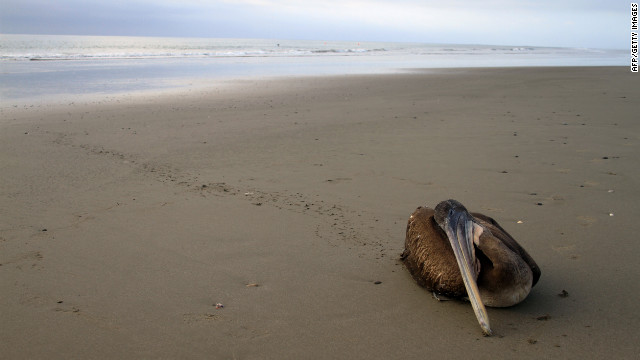
Warm waters blamed for at least 5,000 pelican deaths on Peru's coast

ORIGINAL: CNN
By Marilia Brocchetto, CNN
May 12, 2012 -- Updated 0031 GMT (0831 HKT)

A dying pelican crawls away from the surf. Peruvian officials say warm water has affected the birds' food supply.
(CNN) -- Warm waters off Peru are to blame in the deaths of more than 5,000 marine birds on the coast, government authorities say.

The Peruvian National Center for the Study of El Niño reported earlier this week that since February the Peruvian coast has had an abundance of warm water as a result of marine currents throughout the world's oceans. The warm water has altered the marine ecosystem, it said.

The warm water has led fish such as anchovy and other species that live in surface waters to migrate to deeper water toward the south. As a result, pelicans and other birds that feed from the surface of the water died of starvation.

"If these oceanographic conditions persist, it is likely that its impact will spread to other areas of the (Peruvian) coast even during the fall, which could make the numbers increase and affect other marine species" said the report.

The ministry of environment said seafood is still safe to eat, and encouraged everyone to continue to support local fishermen, according to state-run Andina news agency.

"Marine resources are fully guaranteed, so we promote consumption and discard the speculation that some people or institutions disseminated irresponsibly," said the deputy minister for strategic development of natural resources, Gabriel Quijandria.
Andina reported that Quijandria also clarified the beach warning that had been issued by authorities last week.
"The health alert does not prohibit admission to the beaches, but people are advised to avoid contact with the remains of pelicans, dolphins and other animals that are stranded," he said.

Officials in Peru continue to search for the culprit in the death of almost 900 dolphins since the beginning of the year. The health ministry is awaiting final results from molecular analysis looking for the morbillivirus, which previously has been linked to dolphin deaths.