Mostrando entradas con la etiqueta Pez. Mostrar todas las entradas

domingo, 9 de febrero de 2014

Crazy Jumping Fish in River – Fishing Made Easy!


In the 1970s, silver carp are accidentally introduced to American waters after skipping from a fishpond.

Silver carp were imported to North America from Asia in an attempt to combat and control the algae growth in southern cat fish farms. But large floods washed the silver carp into the Mississippi and Missouri rivers. They now outnumbered local fish in the scale of 10:1.

But these fish has bizarre behavior that makes fishing so easy – when a boat motor reaches a certain frequency, silver carp will get frightened and will jump out of the water as seen on the video above. Due to large in number, they will display an amazing jumping fish phenomenon. Not fatal but they can hurt boaters as they can grow and weigh up 100 lbs.


ORIGINAL: My Amazing Earth
by basti
August 18, 2012

miércoles, 15 de enero de 2014

Scientists Discover the Very First Hipster

You’ve seen the cartoon before: a fish hoisting itself up on land with its front fins, being greeted with some snarky sign like, “Evolve at your own risk,” or something similar. 
This fish has become a meme, so much so that when the discovery of Tiktaalik roseae, a 375-million year old fossil that displays a mix of fish and tetrapod characters, was announced in 2006 by the lab I was working in at the University of Chicago, I thought I’d start a movement with the geekiest version of the Darwin fish ever:
The world's geekiest version of the Darwin fish bumper sticker. Too bad it's WRONG!

Well, wouldn’t ya know it, that pesky thing called progress has unseated the “front-wheel drive” version of life invading land and replaced it with something much more… well, hipster. More evidence is in, and Tiktaalik, it seems, was built like an old Volvo – with rear-wheel drive.

A new paper in the January 13th early edition of PNAS describes Tiktaalik‘s newly discovered tail end, complete with a beautifully preserved pelvic bone and partial hind fin from the same specimen that made headlines in 2006. Finally, a near-complete image of Tiktaalik is emerging:

Tiktaalik reconstruction © Kalliopi Monoyios

What is so incredible about this find is a delightful detail of the pelvis. The hip socket is smooth and round – a ball and socket joint – that suggests the hind fin had quite a wide range of motion. This is unlike the shoulder joint which has an oblong shape with an angled facet that would have prevented the front fin from rotating up and around. Judging by fossil data alone, the front fins were robust and capable of supporting weight but they were probably not helping Tiktaalik walk like an amphibian on land without some serious body drag. The hind fins were also quite strong and clearly played a part in holding up the beast. But what of the ball and socket hip joint?

The trouble with fossils is that they’re terribly static. We can learn a lot about what was physically possible from looking at the anatomy, but we can never hot-wire a fossil into moving again, and we certainly can’t observe their behaviors in their natural environment. But this is where interdisciplinary studies can be so powerful.

Upstairs from Neil Shubin’s paleontology lab at the University of Chicago in 2010 was a graduate student named Heather King. King was studying the biomechanics of African lungfish and had rigged up a long, thin aquarium where she could film the lungfish as they did what lungfish do (spoiler alert: not much). Very occasionally, she noticed a bizarre behavior: the lungfish would use their whip-like hind fins to walkalong the bottom of the tank.

It was at a presentation to her advisory committee that King first revealed this behavior, and Shubin and another adviser familiar with Tiktaalik‘s pelvis, Michael Coates, nearly fainted. Lungfish, after all, are one of Tiktaalik‘s closest living relatives, being part of a group of fish known as lobe-finned fish (most of the fish you can think of – tuna, goldfish, blobfish, chub – belong to a different group, the ray-fins). Suddenly, the round hip socket of Tiktaalik came sharply into focus. Would Tiktaalikhave been capable of walking along the bottom of a stream with its hind fins like its cousin the lungfish? Was Tiktaalik a rear-wheel drive beast?

And with that revelation, I declare it’s time for a new meme:
Rear-wheel drive fish by Ed Heck, http://edheck.com

Articles cited:
  • Neil H. Shubin, Edward B. Daeschler, & Farish A. Jenkins, Jr. (2014). The Pelvic Girdle and Fin of Tiktaalik roseae PNAS :10.1073/pnas.1322559111
  • King HM, Shubin NH, Coates MI, & Hale ME (2011). Behavioral evidence for the evolution of walking and bounding before terrestriality in sarcopterygian fishes.Proceedings of the National Academy of Sciences of the United States of America, 108 (52), 21146-51 PMID: 22160688

By Kalliopi Monoyios
January 15, 2014

sábado, 6 de abril de 2013

Un pez de sangre transparente en el acuario de Tokio

ORIGINAL: Publimetro
el 5 de abril de 2013 

El acuario de Tokio presentó un pez con sangre totalmente transparente, una criatura única en el mundo procedente de las profundidades del Antártico. Foto: Yoshikazu Tsuno/afp.com © 2013 AFP
"Este pez es el único animal vertebrado conocido con sangre transparente. Su sangre es transparente porque no tiene hemoglobina, que da el color rojo a la sangre y transporta el oxígeno", explicó a la AFP Satoshi Tada, un empleado del acuario de Tokio.

El acuario de la capital japonesa afirma ser el único en tener ejemplares de este pez sin escamas que encontraron unos pescadores. "Por suerte tenemos un macho y una hembra, y en enero tuvieron relaciones", dijo Tada.

Según los investigadores, este pez, que vive a 1.000 metros de profundidad, pueda sobrevivir sin hemoglobina gracias al tamaño de su corazón y utiliza su plasma sanguíneo para hacer circular el oxígeno a través de su cuerpo.

Según parece absorbe el oxígeno a través de su piel, pero todavía queda un misterio por resolver: "¿Porque perdió su hemoglobina? Harán falta estudios e investigaciones para elucidar este punto", dijo Tada.


jueves, 7 de febrero de 2013

Capturan por primera vez el pensamiento de un pez

ORIGINAL: alt1040
1 de febrero, 2013, 16:13

Un equipo de científicos de la Universidad de Saitama en Japón ha conseguido lo que posiblemente jamás hubiéramos creído, capturar el pensamiento de un pez. Los investigadores lograron tomar una imagen de la actividad cerebral en el momento antes de capturar a una presa. Una toma que revela el patrón preciso que gobierna el comportamiento de caza.


Se trata del primer estudio capaz de producir una imagen en tiempo real de los procesos cerebrales exactos que se dan en un animal que lleva a cabo un comportamiento en su entorno natural. Aunque estudios anteriores habían estimado los patrones de la actividad cerebral a través de resonancias magnéticas para identificar el momento en el que las diferentes regiones del cerebro se activan o desactivan, el trabajo reciente utiliza técnicas diferentes de captura.

La importancia del logro significa que la nueva tecnología podría llegar a utilizarse para obtener una mayor comprensión de los procesos de pensamiento en los animales y los seres humanos, para aprender más acerca de las anomalías que se dan lugar en enfermedades del cerebro, pudiendo en última instancia desarrollarnuevos fármacos para enfermedades psiquiátricas. Según Koichi Kawakami, uno de los científicos del estudio:

Hemos hecho visible lo invisible. En este trabajo hemos demostrado un mapa en el cerebro (en este caso la captura del pensamiento de un pez cebra). Un mapa similar que también está presente en el cerebro humano ... sabiendo cómo actúa el modelo del cerebro animal, podemos relacionarlo para conocer el cerebro humano.

En el futuro, podremos interpretar el comportamiento de un animal, incluyendo el aprendizaje y la memoria, el miedo, la alegría o la ira, basándonos en la actividad de las combinaciones particulares de las diferentes neuronas (células cerebrales). Esto tiene el potencial de acortar los largos procesos para el desarrollo de nuevos medicamentos psiquiátricos.

¿Y cómo lo consiguieron? Lo que vemos en las imágenes fue una captura a tiempo real a través de una cámara de alta resolución y un microscopio, el momento en el que un pez detecta una posible presa. En ese preciso instante pudieron observar como el pez modifica su actividad cerebral a un estado de alerta anterior a la caza.

Todo gracias al desarrollo de un tipo de fluorescencia extremadamente sensible que reflejaba la actividad de las neuronas. Los investigadores lograron alterar genéticamente las células que expresan proteínas fluorescentes en el momento en el que se elevan las concentraciones de calcio, cuando las neuronas se activan.

A partir del seguimiento de la actividad neurona del pez, los científicos esperan desarrollar una técnica mejorada que permita realizar un monitoreo en tiempo real de los fármacos que actúan sobre el cerebro. Con ello se acortarían los tiempos para desarrollar medicamentos en esta área.

lunes, 6 de agosto de 2012

Equipo de la BBC descubre "nuevas especies" en Venezuela

ORIGINAL: BBC
Lunes, 6 de agosto de 2012

El grillo nadador que aún no tiene nombre científico fue hallado en una cueva en Venezuela.
Un grillo nadador y otras dos posiblemente nuevas especies fueron registradas en Venezuela por un equipo de filmación de la BBC.

"Es el animal más increíble que he visto", dijo el biólogo George McGavin refiriéndose al grillo. "Nada debajo del agua, impulsándose con sus patas delanteras como si estuviera nadando estilo libre y pateando con las traseras".

McGavin y sus colegas viajaron a Sudamérica para filmar una nueva serie coproducida por la BBC y titulada, "Oscuridad: el mundo natural durante la noche".

Fue un grupo de científicos de La Venta, la sociedad de exploración italiana especializada en sitios de acceso difícil, quien alertó al equipo de la BBC sobre la importancia de una cueva en particular. La cueva estaba ubicada en un tepuy, un tipo de meseta con paredes abruptas y cimas planas característica de Venezuela.

Sin ojos
Nada podría haber preparado al biólogo para lo que estaba a punto de ver. Con un color pálido y apenas rastros de lo que en el pasado fueron ojos, un pez gato navegaba utilizando órganos sensoriales en su cabeza.

Vivir en la oscuridad total de la cueva parece haber eliminado evolutivamente la necesidad de comunicación visual. McGavin cree que los antepasados del pez deben haber vivido hace millones de años en el área donde se formó la cueva.

"Como biólogo, no puedo expresar en palabras la emoción que se siente al fimar algo que jamás ha sido registrado". George McGavin

"Lo que fue originalmente tal vez un pez gato en un lago se convirtió de pronto en un pez aislado en estas cuevas subterráneas", dijo McGavin.

El científico descubrió en la misma cueva un opilión, conocido vulgarmente como murgaño o segador, que -según cree- es nuevo para la ciencia.

"Es un animal muy extraño y no recuerdo haber visto una imagen o ilustración de nada que se le parezca, por lo que podría ser una especie no descrita hasta el momento", dijo McGavin.

Los opiliones son arácnidos, un grupo que incluye a arañas y escorpiones, pero este especimen en particular se comportó en forma inusual, no reaccionando en absoluto a la luz de las linternas.

Al acercarse al animal, el equipo de la BBC descubrió que el opilión no tenía ojos.

Millones por descubrir
"Si hubiéramos tenido más tiempo para permanecer en la cueva, seguramente habríamos hecho otros descubrimientos", comentó McGavin.

El mono que estornuda, Rhynopitecus strykeri, es una de las diez especies más espectaculares seleccionadas este año por un panel de científicos.

Los tres especímenes aún no han sido descritos formalmente, pero el científico cree que se trata de especies nuevas.

"Como biólogo, no puedo expresar en palabras la emoción que se siente al filmar algo que jamás ha sido registrado".

"Las cuevas tienden a ser muy aisladas. Si una especie logra establecerse en ellas suele no tener contacto con poblaciones en otras cuevas o con los ancestros de los que desciende", dijo a la BBC el profesor Quentin Wheeler, director del Instituto Internacional para la Exploración de Especies de la Universidad Estatal de Arizona.

"Cuando una población es muy reducida con frecuencia se da una especialización mucho más rápida que en el caso de grupos mayores".

Biodiversidad

Áreas como la del tepuy en Venezuela son conocidas como "hotspots" o punto calientes de biodiversidad, como se denomina a las zonas habitadas por un alto número de especies endémicas, es decir, que no pueden hallarse en ningún otro lugar.

"Las islas pequeñas, las cimas de montañas o las cuevas son verdaderos laboratorias de experimentación genética", dijo Wheeler.

El Instituto Internacional de Exploración de Especies compila información sobre especies nuevas, por su valor en la historia evolutiva y por su importancia para la conservación.

"Cerca de dos millones de especies han sido nombradas y descritas científicamente hasta ahora, pero creemos que hay por lo menos 10 millones de especies". Quentin Wheeler, Universidad Estatal de Arizona.

Wheeler dijo a la BBC que cada año registran unas 18.000 nuevas especies, pero que esto es apenas el comienzo.

"Cerca de dos millones de especies han sido nombradas y descritas científicamente hasta ahora, pero creemos que hay por lo menos diez millones de especies", añadió el científico de la Universidad Estatal de Arizona.

"Y esa cifra sólo toma en cuenta las plantas y animales multicelulares. Si consideramos microbios la estimación cambia completamente".

Cada año, el instituto publica una lista de las diez especies nuevas más espectaculares, compilada en base a la selección de diversos expertos. Wheeler eligió como favorito al llamado "gusano del diablo", un nemátodo encontrado en una mina de oro en Sudáfrica cerca de un kilómetro y medio bajo tierra.

"Nadie esperaba encontrar un organismo multicelular de ese tamaño viviendo a esta profundidad", dijo Wheeler.

"Para mí, este hallazgo nos plantea una nueva pregunta. ¿Qué más no sabemos y debemos descubrir?".

Presidencia ofrece recompensa por captura de dañino pez

ORIGINAL: El Tiempo


Según el Instituto Humboldt, el pez león es una de las 581 especies invasoras que afectan la biodiversidad nacional. Foto: Archivo
Buscan controlar presencia del pez león, que depreda las especies nativas.

En la rendición de cuentas del área de medio ambiente que se llevó a cabo el fin de semana en Santa Marta, el presidente Juan Manuel Santos anunció su intención de ofrecer una recompensa económica a los pescadores que capturen al temible pez león, que depreda las especies nativas y se ha convertido en una plaga en el Caribe.

Hasta el momento, no hay más detalles sobre el monto de la recompensa ni los alcances legales de la medida. Sin embargo, para los expertos es una de las opciones viables para enfrentar esta plaga, dado que el único depredador natural que podría hacerlo es el mero, pero este animal está en vías de extinción.

Hace poco, en una entrevista con EL TIEMPO, Ricardo Betancur, doctor en biología molecular y vinculado como investigador en The George Washington University, destacó que ya que su erradicación del Atlántico es prácticamente imposible, "se requiere la implementación urgente de campañas de extracción frecuentes en las áreas vulnerables y con interés de conservación".

La otra opción, dice Betancur, sería educar a las comunidades para que lo consuman y estimular así su extracción, pues a pesar de que el proceso para sacarlo del agua es complicado por el riesgo de picaduras, su carne es comestible. El veneno del pez león se localiza en las espinas de sus aletas y se descompone rápidamente al cocinarse.

Inofensivo, solo en apariencia 
El pez león es lento, tiene muchas espinas y colores, mide unos 40 centímetros y, en apariencia, es inofensivo. Sin embargo, también es venenoso y un voraz depredador. Destruye los arrecifes de coral al comerse los peces que lo pueblan, así como las larvas y peces pequeños, claves para el ecosistema una vez crecen.

viernes, 3 de agosto de 2012

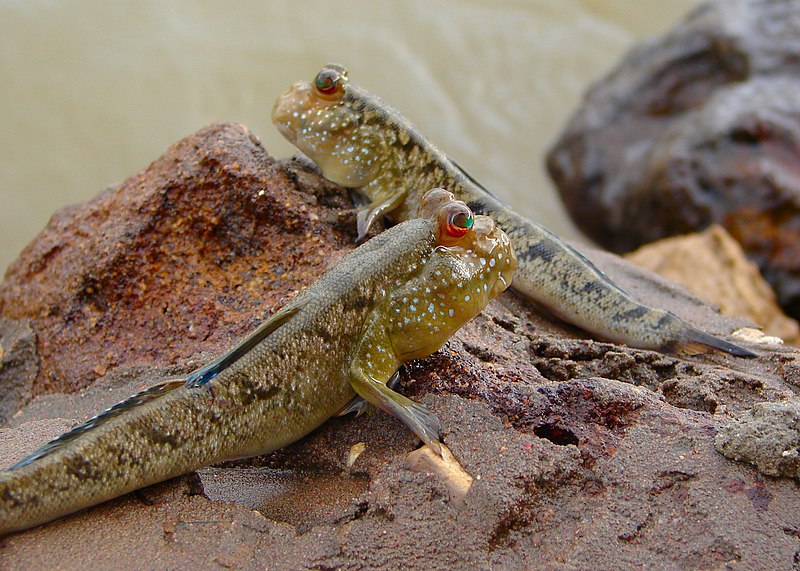
Mudskipper: a fish that lives on land

ORIGINAL: BBC-YouTube / Wkipedia

Excerpt from BBC's Life series

Just an example how fish can evolve to live on land.

Mudskippers are members of the subfamily Oxudercinae (tribePeriophthalmini),[1] within the family Gobiidae (Gobies). They are completely amphibious fish, fish that can use their pectoral fins to walk on land.[2][3] Being amphibious, they are uniquely adapted tointertidal habitats, unlike most fish in such habitats which survive the retreat of the tide by hiding under wet seaweed or in tidal pools.[4] Mudskippers are quite active when out of water, feeding and interacting with one another, for example to defend theirterritories. They are found in tropical, subtropical and temperateregions, including the Indo-Pacific and the Atlantic coast of Africa.

What’s a Mola? Behind the Strange Fish Picture

By Kastalia Medrano
Posted by David Braun of National Geographic on August 1, 2012 

Ocean sunfish (Mola mola) photo courtesy of Daniel Botelho.

The remarkable ability of Internet users to make a post go viral has produced a new treat: an enchanting picture of a Mola mola, or ocean sunfish, undulating just below the surface of the ocean. The image, snapped by photographer Daniel Botelho in 2010, is now making waves around Facebook.

The attention might be focused on the one image for the moment, but sunfish are worth learning about in their own right. National Geographic spoke to Dr. Tierney Thys, who in addition to being named a National Geographic Explorer, is both founder and director of the Ocean Sunfish Tagging and Research Program.

NG: Let’s start with the basics—what exactly is a sunfish?

TT: It’s the world’s heaviest bony fish. It’s in the same order as puffer fish and porcupine fish, but it’s one of the most evolutionarily derived fishes in the sea. So, it has a cranium more like what ours looks like, along with fewer vertebrae; its spinal column is actually shorter than its brain. And they’re one of the most fecund vertebrates in the world; a 4-ft female was recorded as having an estimated 300 million eggs.

Are they endangered?

It’s unknown because they’re not commercially targeted. And as adults they don’t school; younger ones will, but as adults they become loners. So we don’t really know the status of their population.

We’ve been tagging them all over the world. They’re very vulnerable to fishermen’s nets, they get caught in huge numbers [because] they spend a lot of time lying around on top of the ocean. Some of our data is on whether that’s having an impact on their population. There are inklings that it is.

Where do they live?

That’s something we’re working on right now, understanding the global population. They have a huge range. They live in all tropical and temperate oceans, up farther north than the Arctic Circle, and all the way down by Cape Town in South Africa.

Sunfish look flatter and more compact than other fish. Why is that?

The only way to understand [the sunfish] is to study its ancestry. Their design has evolved to be more like an armored tank with a stiff body as opposed to a streamlined torpedo body like other fish. They just look like big puffer fish on steroids. They use mostly their fins for propulsion as opposed to wagging their body.

Sunfish can grow to be more than 10 feet long. Are they aggressive?

They’re not dangerous to people. They will bite if you’re harassing them, but they’re actually very gentle in nature, very passive.

They look lazy, but they’re really industrious. They dive up and down as much as 40 times a day. We recorded them off the Galapagos Islands diving as deep as 1,100 meters [3,600 feet].

So they don’t munch on people?

They’re actually the world’s largest jelly-eater. And people love the sunfish, it’s a lot of people’s favorite fish. There’s poetry, folklore—you can even adopt them.
Watch a National Geographic video of Tierney Thys swimming with molas, talking about her work

jueves, 26 de julio de 2012

Engineers are designing, building mechanical ray

ORIGINAL: Science Daily

ScienceDaily (July 26, 2012) — Batoid rays, such as stingrays and manta rays, are among nature's most elegant swimmers. They are fast, highly maneuverable, graceful, energy-efficient, can cruise, bird-like, for long distances in the deep, open ocean, and rest on the sea bottom.

The mantabot doing a tight left turn. (Credit: Image courtesy of University of Virginia)
"They are wonderful examples of optimal engineering by nature," said Hilary Bart-Smith, an associate professor of mechanical and aerospace engineering in the University of Virginia's School of Engineering and Applied Science.

Bart-Smith and her colleagues at three other universities are trying to emulate the seemingly effortless but powerful swimming motions of rays by engineering their own ray-like machine modeled on nature.

They are designing an "autonomous underwater vehicle" that someday may surpass what nature has provided as a model. The vehicle has potential commercial and military applications, and could be used for undersea exploration and scientific research.

Sometimes called "bio-mimicry" -- the attempt to copy nature -- Bart-Smith calls her work "bio-inspired."

"We are studying a creature to understand how it is able to swim so beautifully, and we are hoping to improve upon it," she said. "We are learning from nature, but we also are innovating; trying to move beyond emulation."

Bart-Smith's team, which includes researchers at U.Va., Princeton University, the University of California-Los Angeles and West Chester University, are modeling their mechanical ray on the cow-nosed ray, a species common to the western Atlantic and Chesapeake Bay.

The team members, who are experts in marine biology, biomechanics, structures, hydrodynamics and control systems, have created a prototype molded directly from a real cow-nosed ray. By studying the motions of living rays in the field and the laboratory and through dissection, this prototype attempts to replicate the near-silent flaps of the wing-like pectoral fins of a ray, to swim forward, turn, accelerate, glide and maintain position.

"Biology has solved the problem of locomotion with these animals, so we have to understand the mechanisms if we are going to not only copy how the animal swims, but possibly even to improve upon it," Bart-Smith said.

Her team is trying to achieve optimal silent propulsion with a minimum input of energy.

The mechanical ray is remotely controlled by researchers via computer commands. The plastic body of the vehicle contains electronics and a battery, while the flexible silicone wings contain rods and cables that expand and retract and change shape to facilitate what is essentially underwater flight.

Bart-Smith's ultimate goal is to engineer a vehicle that would operate autonomously, and could be deployed for long periods of time to collect undersea data for scientists, or as a surveillance tool for the military. It also could be scaled up, or down, to serve as a platform carrying various payloads, such as environmental monitoring instruments. For example, it possibly could be used for pollution monitoring, such as tracking the locations of underwater oil spills.

And because the vehicle looks and behaves like a common sea creature, it likely would operate in the sea without affecting natural creatures or their habitats.

viernes, 25 de mayo de 2012

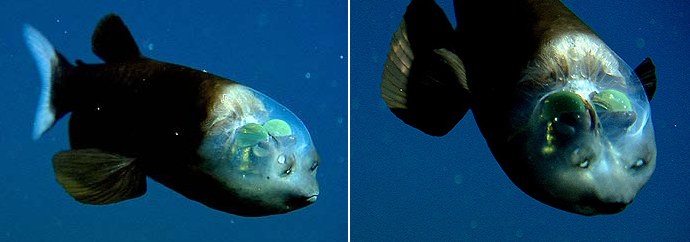
Resuelven el misterio del pez de cabeza transparente

ORIGINAL: Fogonazos
24 febrero 2009
Imágenes: Acuario de Monterrey
Investigadores del Acuario de la Bahía de Monterey acaban de resolver uno de los enigmas que intrigaba desde hacía años a los biólogos marinos: la utilidad de la cabeza transparente del pez Macropinna microstoma y sus ojos tubulares. Después de estudiar concienzudamente su comportamiento en aguas profundas de California, los investigadores han llegado a la conclusión de que este mecanismo le permite aumentar su ángulo de visión y detectar mejor a sus presas. En otras palabras: el pez ve a través de su propia cabeza.


Las imágenes de esta criatura pueden resultar engañosas, puesto que sus ojos no son los dos puntos oscuros que veis en la parte frontal de la cabeza, sino esas dos estructuras verdes que flotan en su interior. Ambos ojos pueden rotar literalmente dentro del cráneo y permiten al pez observar lo que sucede por encima de él, de frente y a ambos lados. Los dos puntos oscuros de la parte delantera son en realidad dos órganos olfatorios.


martes, 8 de mayo de 2012

Killer Canadian coelacanth discovered

ORIGINAL: CosmosMagazine

The fast-swimming coelacanth Rebellatrix chasing smaller species of fishes in the Early Triassic ocean west of Pangaea. Credit: Artwork by Michael Skrepnick.
LONDON: Canadian scientists have discovered a fossilised ‘rebel’ coelacanth fish with an unusual body shape that suggests it was a fast-swimming predator.

The finding suggests that contrary to popular belief, coelacanths, the so-called ‘living fossils’, have undergone significant morphological change during their history.

“Rebellatrix divaricerca, most importantly, shatters the commonly held notion that coelacanths were an evolutionarily stagnant group,” said Andrew Wendruff from University of Alberta, in Edmonton, one of the researchers who discovered the fossil and lead author of the paper published in the Journal of Vertebrate Palaeontology.

Dramatically different to other coelacanth

The largest specimen of Rebellatrix, though partial, shows that it grew upwards of 1 meter in length. Credit: Photograph and drawing by A. Wendruff
“Rebellatrix is dramatically different from any coelacanth previously known, and thus had undergone significant evolutionary change in its ancestry,” he said.

Until the 1930s coelacanths were thought to have been extinct since the Late Cretaceous period, around 70 million years ago, when dinosaurs were still alive on Earth.

However, in 1938 a fisherman in Africa caught a living coelacanth. The most striking thing about the newly discovered fish was that their body plan differed very little from ancient fossil specimens resulting in the fish being referred to as ‘living fossils’.

Rebel without a cause

The modern coelacanth, Latimeria chalumnae, and most of the fossil specimens discovered to date have broad, flexible tails suitable for moving at slow speeds and lying in wait for prey.

In contrast, “the forked tail of Rebellatrix indicated that it was a fast-moving, aggressive predator,” said Wendruff.

“Rebellatrix was able to search actively for the fishes that it preyed upon and catch them at high speed,” added Mark Wilson, co-author of the study and fellow University of Alberta researcher.

Wendruff and Wilson found the R. divaricerca fossil in the Lower Triassic Sulphur Mountain Formation near Tumbler Ridge in the Rocky Mountains in British Columbia, Canada.

It is thought to be from the Early Triassic period, approximately 250 million years ago. The closest coelacanth fossil in age is known as Alenypterus. It dates from the Mississippian period and is at least 70 million years older. It also has a very different body plan that is more similar to that of living coelacanths than that of Rebellatrix.

Prior to findings such as Rebellatrix, scientists believed that coelacanths have changed little over time, but this now seems unlikely.

“The similar body forms are not a result of close relationships,” said Wendruff. “Nature is constantly recycling ideas, body forms and structures. This is referred to as convergent evolution. Many times there is one particular form that is most efficient for a particular function.”

When asked about why Rebellatrix evolved such a different body shape to other members of the coelacanth family, Wendruff suggested that as the mass extinction event that happened just before the beginning of the Triassic period wiped out 90% of marine life Rebellatrix could have evolved to fill a newly vacant predator ‘niche’ in the marine ecosystem.

Forked tail before it's time

“Large predators seem to be particularly vulnerable during such intervals, so this extinction might have 'opened the door' for coelacanths to explore new functional roles,” said palaeobiologist and coelacanth expert Matt Friedman from the University of Oxford in the UK.

The newly evolved body form was not successful, however, because “while other fork-tailed fishes appear later in the fossil record, Rebellatrix and its descendants are noticeably absent. This leads us to believe that Rebellatrix was a dead end in the evolution of cruising predation,” said Wendruff.

Friedman said: “this discovery adds to a growing view that coelacanth evolution was more nuanced than textbook portrayals would suggest.”

He added: “It is the latest in a series of finds over the past decade or so that have shown coelacanths didn't just have a static evolutionary history when it came to body form. Rebellatrix, with its unusual tail fin and body proportions, can be added to other anatomical 'experiments' in coelacanth history, including eel- and leaf-shaped forms.”

Wendruff believes that other unique forms of coelacanth have yet to be found and that “in the future they will have many more surprises in store.”