Mostrando entradas con la etiqueta Perú. Mostrar todas las entradas

jueves, 10 de abril de 2014

Actividad minera ilegal afecta humedales de región Madre de Dios en Perú

Sobrecogedor Comentario a sobrevuelo por Madre de Dios.
Video: Ministerio del Ambiente - Perú


De los humedales de Madre de Dios se concluye que 13 aguajales tienen un gran impacto con más del 5% de su superficie comprometida, 10 son consideradas de moderado impacto, 3 de bajo impacto y 8 sin impacto.
Perú El estudio presentado por la WWF, manifiesta que más de la mitad de las principales cochas y más de una tercera parte de los aguajales de Madre de Dios han sido impactados por la minería.

Lima. Las actividades extractivas ilegales en la región de Madre de Dios tienen un impacto directo en los aguajales y las cochas de este departamento, observándose que la minería aurífera afecta a 116,577 hectáreas de humedales, precisa un informe ambiental.

De acuerdo a un último estudio, que realizó la organización no gubernamental WWF, donde se evaluó a 34 aguajales y 30 cochas, considerados los más importantes por la magnitud del área que ocupan, se determinó que 3 aguajales superaron el 30% de área destruida y 7 cochas superan el 50%.

De los humedales de Madre de Dios se concluye que 13 aguajales tienen un gran impacto con más del 5% de su superficie comprometida, 10 son consideradas de moderado impacto, 3 de bajo impacto y 8 sin impacto.

Mientras que 17 cochas tienen una afectación de alto impacto, 2 de moderado impacto, 2 de bajo impacto y 9 sin impacto.

En tal sentido los resultados precisan que los principales aguajales han sido afectados por la minería aurífera, ya que el 38% tiene un impacto alto, un 30 por ciento un impacto moderado, un 8% de impacto bajo y 23% sin impacto.

En cuanto a las principales cochas se determinó que el 57% tienen un impacto alto, el 7% un impacto moderado, impacto bajo el 6% y sin impacto el 30%.

Programas de turismo. El estudio presentado por la WWF, manifiesta que más de la mitad de las principales cochas y más de una tercera parte de los aguajales de Madre de Dios han sido impactados por la minería.

Dicho documento concluye con la recomendación de desarrollar programas integrados para el turismo de humedales que contribuya con la economía de los pobladores locales, así como su conservación en la región de Madre de Dios.

En la cuenca baja del río Madre de Dios y sus principales afluentes existe un total de 2,521 aguajales que ocupan 174,065 hectáreas y 246 cochas cuya superficie es de 10,642 hectáreas.

ORIGINAL: América Economía
03/06/2014

viernes, 27 de diciembre de 2013

New Clues and Some Wild Guesses About Those Strange Spider Towers in the Amazon


Late last week, we revealed that the elaborate, fenced-in spires spotted in the Peruvian Amazon are made by spiders. We were with a team of scientists on the ground in Peru, who watched as three spiderlings hatched from eggs concealed at the base of the towers.

More on the Web Tower Mystery:

We Went to the Amazon to Find Out What Makes These Towers

WTF Is This Weird Web-Tower Thing? No One Knows

But the scientists are still trying to figure out what kind of spider is building these intricate silk structures — a very hard task when you’ve only got photos and video of three, two-day-old spiderlings to go on. Unfortunately, the team had to leave Peru before the spiders grew up, so the spiders’ final adult form remains unknown.

We’ve asked experts in both arachnology and the evolution of spider silk for their opinions on what species those tiny spiderlings could be. We’ve also received reports of these structures appearing in other places; now that people know what to look for, will we find that these silky spires have been hiding in plain sight, all over the world? Can we learn anything from their geographic distribution?


The structure spotted along a riverbank in Ecuador earlier this year. Photo: Courtesy of Brian Lee

So far, we’ve been able to confirm, using photos and descriptions, additional sightings in Ecuador and French Guiana. Both of those structures were seen in neotropical areas similar to the one we visited in Peru, near the Tambopata Research Center. The structure in French Guiana was spotted nearly a decade ago by biologist Julien Grangier, a post-doc at the University of Lyon, in France. Photographer Brian Lee saw the Ecuadorian structure last January, on an island in an Amazon tributary. We’ve also gotten unconfirmed reports of sightings from Brazil, several places in the United States, and Belgium, and are awaiting photos from those locations.

In Peru, we only saw the structures on a small island near the research center, along a stretch of trail running through stands of cecropia and bamboo. Now, what the confirmed South American sightings suggest is that the critter responsible is more widespread that we’d initially thought – but that it might be picky about the kind of habitat it lives in.

Alas, identifying the spider responsible for the structures has proven to be much more difficult than searching for more sightings. What little we know about the spiders themselves comes from the photos and video of the tiny newborns climbing the silk fences. And, it seems, those records aren’t going to be good enough for a specific identification.

“There is no way a photo can show me all the info I would need to make an accurate identification,” said Norm Platnick, curator emeritus of spiders at the American Museum of Natural History. “If these specimens exist, they should be examined by a competent arachnologist. If they don’t exist, there is no real knowledge achievable.”


This structure was found in French Guiana in 2004 while biologist Julien Grangier was in the field, studying social structures in ant colonies. Photo: Courtesy of Julien Grangier

It gets worse. Even under the best of circumstances, identifying spiders is hard.

“Keying out spiders was the one lab I taught in which I made sure to have chocolate and tissues on hand for the inevitable nervous breakdown by a student,” said Gwen Pearson, entomologist and WIRED bug blogger.

Arachnologists normally rely on mature, adult specimens for identifications. If they have these specimens in hand, they’ll carefully study the spiders’ eyes, front and back legs, claws, and reproductive organs. Of these, the latter bits are the most crucial for identifying a mature spider down to the level of species.

“The truly diagnostic characters are all with genitalia,” said Chris Buddle, an entomologist at McGill University. That means adult animals will be necessary to make a definitive ID.

But in the Amazon, researchers only have these freshly hatched spiderlings, which could take weeks or months to mature into their adult forms. As they grow, the features used to identify a spider’s species will begin develop.

Despite the difficulties involved, some brave experts have been willing to speculate about what kind of spider we’re looking at — and what we aren’t looking at.

Less specific identifications – for instance, at the family level – can sometimes be made based on the arrangement of a spiders’ eyes, which vary significantly among families. “Some families can be identified clearly by eye arrangement,” said Joe Lapp, who used to manage the spider collection for the University of Texas in Austin. “Some families sport a variety of not-too-different eye arrangements that overlap with spider of other families.”

The eyes seem to rule out Salticidae – jumping spiders. “I think you can rule out some families, including Salticidae, due to the relatively small size of the anterior median eyes, and the positions of the other eyes,” said William Eberhard, a senior scientist at the Smithsonian Tropical Research Institute. In other words, the spiderlings lack adult jumping spiders’ characteristic big-eyed cuteness.

Other clues come from the silky tower itself.

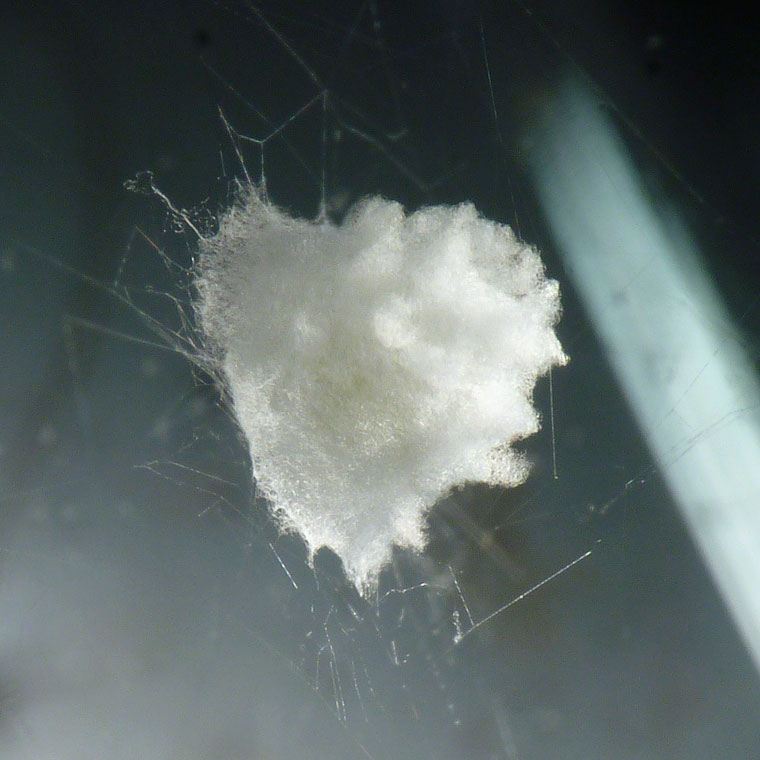
For starters, based on the silk in the structures, it seems likely we’re looking at a spider in the superfamily Orbiculariae, says Leslie Brunetta, who’s studied the evolution of spider silk. This superfamily includes spiders that weave cribellate silk, which is fluffy and frizzy like the silk in the fences, as well as all the spiders that spin orb-shaped webs. Over time, some of these spiders’ descendants have modified their orb webs to the point that they no longer resemble the original orb shape. Brunetta suggests the corral could be one of these modified orbs, with sturdy fence posts connected by fluffy, cribellate silk.

One of the spiderlings that emerged from the mysterious Amazon structures. Photo: Courtesy of Jeff Cremer/PeruNature.com

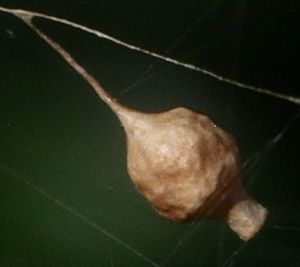
An alternative idea, suggested by two arachnologists, is that the tower-building spiders belong to the family Mimetidae, which makes cocoons that are similar to the towers. At least superficially. Known colloquially as Pirate Spiders, this is a group that cannibalizes other spiders. Instead of spinning webs of their own, Mimetids crawl into the webs of other spiders and mimic tangled up prey. Then, when the spider approaches, they bite into its foreleg and paralyze it. Then, dinner.

“I think the spiderling is in the vicinity of Mimetidae,” said Jonathan Coddington curator of arachnids at the National Museum of Natural History. But Coddington acknowledges the difficulty in identifying spiders at such an early stage of development. “It is feckless to try to identify second-instar spiderlings,” he said.

“If you look at the cocoon itself, it looks a bit like Mimetidae, or Theridiidae,” said Peter Jaeger, head of arachnology at the Senckenberg Research Institute and Natural History Museum in Frankfurt, Germany. “It is only a superficial similarity, but nevertheless, the silk piles around the egg sac, together with the 3-D threads, is amazing.”

Jaeger suggests these structures don’t appear to be the work of the crazy corpse spiders we found hiding in spooky nests near the structures. These spiders live in nests camouflaged with prey corpses. Scientists have seen them near the tower structures, but Jaeger doesn’t see any reason to think they built the fenced-in spires: Usually, these spiders lay their eggs inside their creepy nests of death.

Alexandre Bonaldo, a curator at the Museu Paraense Emilio Goeldi in Brazil, questions whether the spiders spotted near the towers actually built the corpse-ridden nests at all. “That second spider is a Corinninae,” Bonaldo said. He notes that Corinninae often occupy old retreats made by other spiders, rather than building their own creepy, corpse-covered houses. Moreover, the spiderlings that emerged from the tower don’t look like Corinninae anyway, Bonaldo says. “I can’t give you a positive identification, but it isn’t a Corinninae.”

Another idea, by far the most detailed we’ve heard so far, comes from arachnologist John Kochalka of Paraguay’s National Museum of Natural History. Kochalka suspects the spiderling belongs to an undescribed genus within the subfamily Hadrotarsinae — a group of very tiny spiders whose adults often grow to only several millimeters long.

“The adult spider is not much bigger than the hatchling, which explains why the female can only lay one egg at a time,” Kochalka said, noting that some Hadrotarsinae also make a conical egg sac.

He also considered the location where the structures were spotted — along a trail lined by cecropia trees, which have hollow trunks normally inhabited by ants. The tiny towers were also clustered in areas where tree trunks were covered in lichen. ”My latest thoughts are that the spider in question is a specialist in eating ants, as some — or most — Hadrotarsinae are known to do,” Kochalka said. “The female chooses a site where she knows there will be lots of very small ants to feed her baby. The picket fence is a very specific adaptation to keep ants out, and incidentally also serves as a lichen/fungus mimic for camouflage.”

As Kochalka noted, additional clues to the spider’s identity might come from the fence itself. One possibility is that it’s built simply to deter predators who might fancy a bit of spiderling sashimi. In the Amazon, research assistant Geena M. Hill, from the Florida Museum of Natural History, watched as a large ant crawling down a cecropia tree went out of its way to avoid the woven fence – and towering egg sac — in its path.

But it’s also possible the fences are acting to trap food for the spiderlings, such as mites, which were seen crawling inside and stuck on many of the fences.

Ultimately, we still don’t know what kind of spider is making these strange structures, and if it’s a new species, or a known species doing something that hasn’t yet been formally described.

Have you seen a structure like these? Do you have any ideas about what these spiders could be? Let us know in the comments.

Editor’s Note: This story was updated at 8:45 a.m. Pacific time to include the opinions of arachnologist John Kochalka.


ORIGINAL: Wired
By Nadia Drake
12.24.13

sábado, 21 de diciembre de 2013

We Went to the Amazon to Find Out What Makes These Weird Web-Tower Things


TAMBOPATA, Peru — After six months of speculation, we finally know what’s building these bizarre silk structures in the Amazon: a spider! But its precise identity is still a mystery that scientists are scrambling to solve as I write this.

Last week we followed these spider-hunting scientists, led by entomologist Phil Torres, deep into the Amazon rainforest as they attempted to find the tiny silk towers and figure out where they came from. It has not been an easy case to crack.

“With a lot of other weird mysteries, once you make an observation of some sort, spend enough time out there, the pieces kind of fit together,” said Torres, a graduate student at Rice University. “I’m surprised by how difficult this one is to solve.”

The bizarre structures first surfaced on the internet late this summer, when graduate student Troy Alexander posted photos to Reddit and Facebook, hoping that somebody could tell him what the structures were. He had discovered them on a small island near the Tambopata Research Center, deep in the Peruvian Amazon.

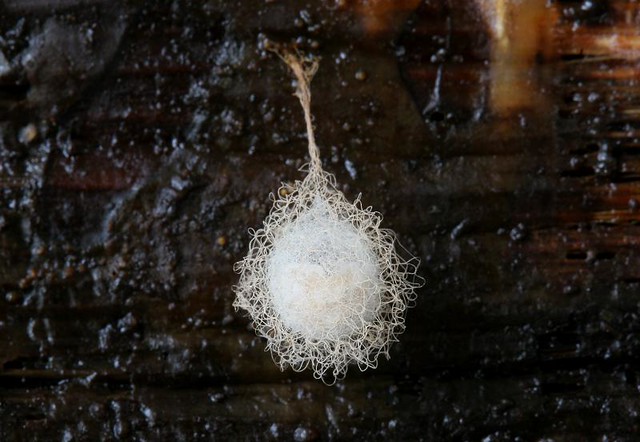
Made out of silk, the intricate constructions have two parts: a tall, central tower, and a circular fence that’s about 6 millimeters across. Back then, we asked as many entomologists as we could find, but no one had any idea what the structures were, or what made them. Until now.

Before sunrise on Dec. 10, Torres’ team went to the same small island. As the skies brightened and the mists lifted, they started walking through the forest. A half-hour later, Torres had spotted the first of the tiny towers. Much smaller than he had expected, the structure was on the bark of a cecropia tree, nestled near some branches.

“It’s so weird!” Torres said. “What the hell is that small?”

Within 20 minutes, the team had found four more of the tiny structures. Over the next few days (and nights), return trips to the island brought the total number spotted to somewhere around 40. Half of the structures were built on cecropia trees. Many were on bamboo. A few were on leaves. And, most them appeared to be in clusters containing between two and six structures.

“The one thing that is consistent is that they are in clusters,” said Geena M. Hill, a research assistant at the Florida Museum of Natural History.

The team got help from super high-res photos snapped by wildlife photographer Jeff Cremer, who is also the marketing director for Rainforest Expeditions, which manages the lodges where the scientists stay. Cremer often accompanies Torres on his jungle hunts, to take photos. His close-up images captured on the island revealed that tiny mites were crawling inside and on the fences. At that point, the mites were either an intriguing clue or a confusing observation, since most mites don’t make silk.

A more helpful observation came from one of the towers the team studied early on that had been knocked over. Super high-res photos revealed what appeared to be a ruptured egg at its base – perhaps a hint that the tower could be an elaborate egg sac. But that didn’t make much obvious sense either.
“Why not lay more than one egg?” asked Lary Reeves, an entomologist and conservation biologist at the University of Florida.

Reeves and Torres collected some of the structures and brought them back to the research center. They isolated the towers from one another, took measurements, and waited for something to hatch. Additional photos taken at the lodge showed small sacs consistently concealed within the base of the towers, and more small mites crawling around or stuck in the fences.

Based on the silk the structures were made from, the team ruled out butterflies, moths, and fungus as the source. But the problem was, the team couldn’t rule anything in.

For six days, Reeves, Torres, and Hill watched the tiny towers, all the while considering different hypotheses.

They debated whether the structures could have been made by mites (not too likely, given how small the mites are), or if the fluffy, fine silk pointed toward a spider (yes). They questioned whether the sacs were eggs at all. Maybe, Reeves suggested, they were looking at a structure called a spermatophore — a type of gift containing sperm and nutrients that some insects and spiders exchange during mating. Could these structures be the work of the huntsman spiders the team kept seeing on tree trunks? It was hard to say. Every time a hypothesis began to gain traction, another observation would swoop it and kill it.

Finally, on Dec. 16 as the scientists were preparing to leave the rainforest without an answer, two of the eggs hatched and Torres saw two tiny spiderlings running around the base of the structures. “We were excited about that but still hesitant,” Torres said, noting that most of their hypotheses so far had fallen through.

But the next day, a third egg hatched and produced another small spider. “That really confirmed it for me,” Torres said. “Anything we saw crawling in there had to have come out of the structure.”


One of the three hatched spiderlings. Photo: Courtesy Jeff Cremer/PeruNature.com

Now, even though the team is sure that they’re looking at some kind of intricate spider nursery, they’re still confused. For starters, a spider laying only one egg in a particular spot is exceptionally rare. “Traditionally, the female will lay a bunch of eggs, wrap it up very well, sit, and protect it,” Torres said. “This is kind of the opposite.”

And the amount of parental investment in the structures is immense, considering the single spiderling inside.

Then there’s the question of the spider’s identity. It could be a jumping spider – the spiderlings’ body shape resembles the Salticidae family, and they have two giant eyes, resembling a jumping spider’s adorable head. But the rest of their eyes aren’t quite in the right place.

It’s also possible the structures could be the work of a spider with a dark side. Near some of the clusters, the team saw several spiders that camouflage their nests with the corpses of their prey, such as ants and smaller spiders. Could the small spiderlings grow into these crazy corpse spiders? We’ll have to wait and see, as Torres and his colleagues continue their investigation.

ORIGINAL: Wired
By Nadia Drake
12.20.13

miércoles, 4 de septiembre de 2013

What Is This? Mysterious Amazon Web Baffles Scientists

ORIGINAL: LiveScience
By Douglas Main, Staff Writer
September 04, 2013
This strange formation found in the Peruvian Amazon resembles a tiny spire surrounded by a webby picket fence and is about 2 centimeters (0.8 inches) wide. Credit: Troy Alexander / Tambopata Research Center
A bizarre-looking web structure has been found in the Peruvian Amazon, and apparently nobody knows what it is, not even scientists.

The strange formation resembles a tiny spire surrounded by a webby picket fence and is about 2 centimeters (0.8 inches) wide. Georgia Tech graduate student Troy Alexander first spotted one of these on the underside of a tarp near the Tambopata Research Center in the Peruvian Amazon. At first he thought it might have been an aborted moth cocoon, he wrote on Reddit. But then he found several more, all of which looked quite similar.

He posted the photos to Reddit and asked other scientists to help him out, besides making queries around the Tambopata Research Center, to no avail. His guess is that "there are eggs in the base of the maypole in the middle of the horse corral, though it might be something pupating," he wrote on Reddit. [See Images of Weird Amazon Web Structure]

Chris Buddle
, an arachnologist at McGill University, said that neither he nor any of his associates know what it is. "I have no clue," he said. It's "a seriously fascinating mystery."

"I have no idea what animal made that," Norman Platnick, curator emeritus of spiders at the American Museum of Natural History in New York, told LiveScience.
The weird structure was first spotted on the underside of a tarp near the Tambopata Research Center in the Peruvian Amazon. Credit: Troy Alexander / Tambopata Research Center
So far, Redditors and others have guessed that it could be some kind of moth cocoon, an intricate defense for spider eggs, or even the fruiting body of some type of fungus.

Alexander fell in love with the Peruvian Amazon while on vacation there, he told Colossal, an art blog. So he asked his adviser if he could take a leave of absence to be a volunteer researcher. Shortly thereafter, Alexander flew back to Peru to work at the Tambopata Macaw Project, which focuses on parrot biology and conservation, he told Colossal.

If whatever produces this structure turns out to be a new species, it should come as no surprise — the world's rain forests are expected to perhaps contain millions of new species of arthropods (a group of animals with hard exoskeletons, which includes spiders and insects), according to various scientific estimates. One survey of arthropods in Panama's jungle, in an area about the size of Manhattan, found 25,000 species of insects, spiders and other arthropods, 70 percent of which were new to science. That study also found that there were 300 arthropod species for every one mammal species.

Email Douglas Main or follow him on Twitter or Google+. Follow us @livescience, Facebook or Google+. Article originally on LiveScience.

sábado, 22 de junio de 2013

Pyura chilensis: the closest thing to getting blood from a stone

ORIGEN: Scientific American
By Becky Crew
June 21, 2012
Credit: Arvid Puschnig

“Period Rock? You’re calling me Period Rock now? Guys, seriously, I might look like a stone, but that doesn’t mean I have the heart of one. Why doesn’t anyone ever just call me Michael?”

****

Despite appearances, this is not some kind of cruelly bisected alien stone organism or a tomato thunderegg. This is Pyura chilensis, a sea creature that lives on the rocky coast of Chile and Peru. And if (like me, very recently) you’ve never seen one of these before, you’ll probably be interested to know that in Chile, they are fished commercially, and the locals eat them raw or cooked with salad and rice because apparently they’re delicious.

P. chilensis belongs to the Ascidiacea class of non-moving, sac-like marine invertebrate filter feeders that are otherwise known as sea squirts. They belong to the Tunicata subphylum, so-called because they wear thick ‘tunics’ made of tunicin, which is a hardy matrix of molecules that help the animal attach itself to a hard surface on which it will carry out its days. The insides of this tunic are lined with an epidermis and a muscular band, and inside these layers lies the main part of the animal.

P. chilensis has two siphons that connect the animal to the surrounding ocean through its tunicin – one for exhaling and one for inhaling. It eats by inhaling the water and filtering out the edible microalgae using a moving layer of mucus in its enlarged pharynx, or branchial sac, before exhaling the water back out the other siphon. The pharynx is connected to the animal’s digestive tract, which basically acts like a mouth.

Their blood is clear and, strangely, can accumulte extremely high qualities of a mysterious and rare element called vanadium. The concentration of vanadium in the blood of P. chilensis and other tunicates can be up to 10 million times that of the surrounding seawater. Just why and how these creatures are able to accumulate vanadium in such huge quantities remains unknown. 
A Pyura chilensis dish from a market in Valparaiso in Chile

P. chilensis can often be found in densely packed aggregations of thousands or small handfuls of just a few, or they can be found on their own – in which case they must reproduce on their own, as there is no way of them moving to find a mate. This means P. chilensis is hermaphroditic, with the gonads of both a male and a female that can release eggs and sperm simulataneouly to meet as a fertile cloud in the surrounding water. If the sperm-egg collisions are successful, they will produce tiny tadpole-like offspring that will eventually settle onto a rock to grow into the adult form.

In 2005, biologists Patricio H. Manríquez from the Universidad Austral de Chile and Juan Carlos Castilla from the Pontificia Universidad Católica de Chile published a paper in the Marine Ecology Progress Series revealing for the first time the particulars of this creature’s reproductive habits (They also use the verb ‘selfing’ often and with glorious earnestness). They collected 30 sexually mature P. chilensis from habits in central and northern Chile and set them up in lab tanks as isolated and paired individuals. They wanted to assess the occurrence and success of fertilisation via these two types of reproduction followed by the settlement of the resulting offspring to a hard surface and their subsequent metamorphosis into adulthood.

First, the isolated individuals were placed in plastic bottles, and were left alone for 90 days, free to do all the selfing they wanted (YOLO). After this period, their body size relative to the amount of sperm in the water was measured for each spawning episode. Next, the researchers combined pairs either from the same population, or from two different populations, to see how well they would breed in comparison to the selfers. A third experiment saw them keep P. chilensis individuals in isolation for one to 16 months, to see if an extended period alone would improve the success of selfing. Finally, the researchers conducted ‘manipulated ferilisation’, which involved removing eggs from the specimens and fertilising them with extracted sperm in Petri dishes.

The results showed that P. chilensis is born male, before becoming cosexual – having both male and female gonads – in its adolescence as it increased in size. The researchers also found that given the choice – that is, if situated around other individuals – these organisms prefer to breed via cross-fertilisation, writing, “Given that more events of natural egg spawning followed by successful settlement and metamorphosis were recorded in our paired specimens and in our manipulated cross trials … it appears that cross-fertilisation predominates in this species.”

Manríquez and Castilla also found that a greater number of fertilised eggs resulted from the paired specimens, which suggests that cross-fertilisation, or reproducing with another individual, predominates because it is more effective. This assumption was strengthened by the fact that individuals that had cross-fertilised before being put in isolation took at least two months before successfully producing offspring via selfing. However, they were careful to note that while cross-fertilisation was preferred, selfing did not produce inferior offspring. “No perceptible differences in fertilisation, settlement and metamorphosis success among self and outcross progeny were found,” they reported. This suggests that when stuck alone in the ocean, selfing provides an advantageous opportunity for loner P. chilensis individuals to still pass on their genes.

Here’s a video of a German man knifing some P. chilensis with great aplomb to the tune of a handful of angry YouTube villagers.
About the Author: Becky Crew is a Sydney-based science writer, award-winning blogger and former online editor of COSMOS magazine. She is the author of 'Zombie Tits, Astronaut Fish and Other Weird Animals' (NewSouth Press). Follow on Twitter @BecCrew.

lunes, 13 de mayo de 2013

Peru says no to GMO

ORIGINAL: CSMonitor
By Annie Murphy
April 25, 2013

Peru is the first country in the Americas to ban genetically modified foods, putting its food policy closer to that of Europe, than the United States or many of its South American neighbors.

A man drags a cart loaded with vegetables in downtown Lima, Peru, Wednesday.  Mariana Bazo/Reuters
LIMA, PERU
There isn’t much local Chef Pedro Miguel Schiaffino won’t eat. His highly accliamed Amaz restaurant is devoted to finding and using Amazonian food native to the country, like a 600-pound freshwater fish or a little-known fruit nicknamed “cannonball” that tastes like a cross between a guava, coconut, and melon.

But a year ago Mr. Schiaffino stopped eating supermarket tomatoes.

Even though Peru is the birthplace of the crop, it’s difficult to find anything other than hard, pale Roma tomatoes in supermarkets, and Schiaffino says that worried him.

“They’re a big monoculture, which is why people usually end up using [genetically modified organisms] GMOs. Because when you have monocultures, the crops end up getting diseases, and you have to look for these extreme ways to fix them,” he says.

Peru was the cradle of the Inca Empire, and today it’s home to many crops indigenous to the Americas. It has 400 varieties of potato alone, and a geography that allows farmers to grow almost anything.

It's also the only country in the Americas to put a 10-year ban on genetically modified food, with a law that was first introduced in 2011, and went into effect at the end of last year. Its basic intention, say Schiaffino and others, is to protect Peru’s biodiversity, as well as the practices that have kept it intact for so long. 

“In the end, it’s not a law that’s ‘against’ anything,” says Antonietta Gutierrez, a biologist at Peru’s National Agrarian University. “This is a law in favor of biosecurity. The idea is that there should be a responsible way of using technology, so that it helps us develop resources – and at the same time, doesn’t destroy what we already have."

GMOs are organisms that have been altered via genetic engineering – and this can mean anything from bacteria, to animals, and plants. Supporters praise the ability of engineers to do things like create plants resistant to pests and drought, or ones that have higher yields. Yet those wary of GMO crops worry about food safety, a lack of longterm research, and the potential for contaminating and even wiping out non-GMO species.

For the past few decades, Profesor Gutierrez has kept a packed schedule, doing experiments in the test fields and laboratories of the agrarian university, and as a proponent of laws to regulate GMO crops.

“There aren’t yet long term studies of GMOs,” says Gutierrez in a spartan concrete and linoleum lab just outside the capital. “You can’t measure their real effects in five, 10, or even 20 years. It takes more time to observe those effects, especially when we’re talking about entire ecosystems.”

Peru's new law puts its food policy closer to that of Europe, than to that of the United States or many of its South American neighbors. While genetically modified species can still be tested in controlled lab settings, as of December 2012, they can’t be planted or set free, and GMO seeds are barred from entering the country. Both activists and many scientists consider this a coup.

GMOs produced outside the country, however, are still present in products sold in supermarkets. A law requiring products containing GMOs to be labeled was passed in 2011 – but terms and regulations were never set. According to a study done by the Peruvian Association of Consumers and Users, of 13 basic products bought and tested for the presence of GMOs, 10 tested positive.

Activists say this is all the start of a long fight. 

'Ancient culture'
Uldarico Reyes Roldán has been working at the popular Madre Natura natural food market in Lima’s Miraflores neighborhood since the store opened 30 years ago. He jokes that a lot of the people who come into the store “want to stay thin,” and that if healthy food also happens to be organic and GMO-free, they just see it as an added bonus.

“But seriously, for instance, take a look at this,” he says, pawing through a wooden cabinet filled with bags of freshly milled grain. He holds up a small sack of coarsely ground wheat the color of tree bark, explaining that it’s a Peruvian variety, unaltered, and free of pesticides. “People taste the difference. It’s nuttier, more malty. They come back asking for this stuff. Not some stuff that comes from who knows where.” 

Many of these products have been around for centuries—since the Incas, and earlier.

“Our ancient cultures knew how to do this,” says Schiaffino, the chef. “They grew crops together, in terraces, with the seasons, with the rain, and natural irrigation. I think they had more knowledge about crops and cultivation and farming than we have now.”

Back in the dining room of Amaz, one of Schiaffino’s two restaurants, an enormous mural of a tropical serpent covers the wall behind him. It’s done in tiny iridescent beads, meant to evoke the indigenous, plant-based hallucinogen ayahuasca.

Schiaffino’s restaurants function according to the logic that monoculture and the implementation of GMOs is “going against nature. What nature tells you is that you have to have different plants and different animals around.” He relies on small producers and foragers, many of whom are from indigenous groups that have long acted as stewards of Peru’s biodiversity. A few of those producers even introduced him to a tomato native to the Amazon.

“It’s an heirloom seed that’s stayed in the Amazon. It looks like a bull’s heart, but smaller. Very tasty.”

Schiaffino says the flavor of a good tomato is all about the smell. 

“Like some humidity, with earth, along with a green scent. You can tell it’s just-picked," he says. "The supermarket tomatoes have no smell. 

"Sometimes we don't think to appreciate the possibility of doing this another way."

miércoles, 17 de octubre de 2012

La primera red de ciencia latinoamericana será de acceso abierto

ORIGINAL: ACAC
Artículo de Javier Salas (@javisalas)

Los nueve primeros países en investigación de Latinoamérica lanzan este mes una plataforma que difundirá gratuitamente toda su producción científica

La ciencia latinoamericana se sube al tren del acceso abierto. Este mismo mes lanzará su primera red de estudios en línea y los nueve países que la formarán quieren que sea accesible a todo el mundo. La intención de esta plataforma es compartir y dar visibilidad a la producción científica generada en las instituciones latinoamericanas, y la mejor forma es que la información fluya rápida y eficazmente; que se pueda consultar y compartir libremente.

La investigación pública será accesible y gratuita en la red. / MINCYT.
Argentina, Brasil, Chile, Colombia, Ecuador, El Salvador, México, Perú y Venezuela firmarán el firmarán el próximo 29 de noviembre en Buenos Aires el lanzamiento de LAReferencia, como se llamará este punto de encuentro de la ciencia producida en Latinoamérica, destinada en principio a sus más de 700.000 docentes e investigadores y a sus más de 15 millones de estudiantes. Los países de la región reconocen un problema de visibilidad y estandarización de su producción, y LAReferencia aspira a cambiar esa tendencia.

“LAReferencia está íntimamente ligada al movimiento por el acceso abierto a la información científico-tecnológica, por lo tanto, las investigaciones cosechadas por la red serán de acceso abierto a todos los ciudadanos”, explica Sergio Matheos, responsable de coordinación Institucional del Ministerio de Ciencia de Argentina.

El representante argentino en las negociaciones explica que los usuarios podrán, de forma gratuita, leer, descargar, copiar, distribuir, imprimir, buscar o enlazar los textos completos de los artículos científicos “sin otras barreras económicas, legales o técnicas que las que suponga internet en sí misma”, siempre que los autores mantengan el control sobre la integridad de su trabajo y el derecho a ser adecuadamente reconocidos y citados. Recientemente, la Unión Europea decidió que toda producción científica pagada con fondos públicos deberá ser de acceso abierto.

En agosto se puso la última piedra del proyecto, la relacionada con la difícil comunicación tecnológica de las 18 instituciones que tendrán que gestionar todo ese cauce de información. La intención es que no sea un repositorio unificado con un solo servidor que contenga toda la información, sino que se busca trabajar en red, por lo que cada universidad u organismo tendrá que desarrollar sus propias bases de datos. Así, todas las instituciones deberán asegurar que se siguen estándares internacionales, acordados y convenidos con sus pares para la consecución de los objetivos de difusión y trabajo colaborativo.

Frente a las revistas de pago
El proyecto pretende evitar uno de los principales galimatías financieros y formales a los que se enfrentan las instituciones investigadores: pagar varias veces por el mismo trabajo. 
  • Primero, financiar la investigación; 
  • después, abonar la publicación en una revista científica; y 
  • por último, sufragar la suscripción a esa revista para que sus investigadores puedan acceder a sus contenidos.
Los científicos mantendrán la autoría intelectual, y las instituciones, los derechos económicos. Y el organismo científico que no cumpla liberando su producción dejará de recibir financiación pública. Una experiencia que Argentina ya había puesto en marcha y que ahora se extiende a buena parte del continente.

LAReferencia está financiada por el Banco Interamericano de Desarrollo aunque, según explica Matheos, “se está trabajando en un plan de sostenibilidad para dar continuidad a la red, para lo que se ha diseñado una estructura eficiente que permita reducir costos de gestión y prever el financiamiento por parte de los países socios”.

——


jueves, 4 de octubre de 2012

Colombia lanzó campaña "Amazonía nuestra"

ORIGINAL: El Heraldo

El reconocimiento del AMAZONAS como Maravilla Natural del Mundo representa el reconocimiento a la riqueza biodiversa que alberga la Amazonía en toda su extensión y que la convierte en uno de los "pulmones del planeta".

Juan Gabriel Uribe, ministro del Medio Ambiente.
Un colorido y espectacular spot televisivo y tres cuñas radiales son algunas de los productos que hacen parte de la Campaña “Amazonía Nuestra”, que el Ministro de Ambiente y Desarrollo Sostenible de Colombia, Juan Gabriel Uribe, lanzó en simultánea con los países miembros de la Comunidad Andina de Naciones (CAN).


Por su parte el titular de la cartera de Ambiente y Desarrollo Sostenible de Colombia, Juan Gabriel Uribe, resaltó “hemos dicho que el ambiente y el desarrollo sostenible son centrales al tema de la paz. En amazonas trabajamos con responsabilidades claras para enfrentar problemas como los efectos del narcotráfico y la minería ilegal, pero también trabajamos en bonos ambientales y deforestación evitada”.

“Este país va a entrar en un proceso de paz serio y para eso es sustancial la conservación de la amazonia”, destacó el alto funcionario.

La campaña “Amazonia Nuestra” se realiza en el marco del Programa Regional de Biodiversidad en la Amazonía de los Países Miembros de la CAN- BioCAN, que cuenta con el apoyo financiero del Gobierno de Finlandia.

“El propósito de la campaña es buscar que miremos al Amazonas con el respeto que merece y valoremos su importancia estratégica para todos los países que la compartimos”, señaló el Ministro de Ambiente de Colombia Juan Gabriel Uribe.

La campaña -continuó- está orientada a difundir y visibilizar la riqueza biológica y cultural de la región amazónica, a través de spots televisivos, cuñas radiales, afiches, postales, entre otros productos.

Con el lema “un privilegio que nos toca” la campaña busca motivar la participación de la ciudadanía y de las organizaciones, tanto al nivel del sentido de pertenencia como de compromisos hacia su conservación y cuidado.

Concurso fotográfico

Dentro de los ítems que maneja la Campaña “Amazonía Nuestra”, hoy se lanzó un concurso de fotografía sobre la Amazonía para el público en general, además de un concurso de afiches escolares centrado en la no tenencia de animales silvestres como mascotas. Todo aquel que quiera sumarse a la campaña, puede entrar al Facebook/ciudadanoscan.

Cifras de nuestra Amazonía
  • Bolivia, Colombia, Ecuador y Perú constituyen el 2,5% de la superficie terrestre.
  • En los 4 países se encuentra el 10% de agua dulce del planeta.
  • En un árbol de nuestra Amazonía pueden habitar más de 400 especies de insectos.
  • Constituye el 30% de la cuenca amazónica, es decir, aproximadamente 2,3 millones de km2.
  • Más de la mitad de los territorios de Bolivia, Colombia, Ecuador y Perú
  • Es amazónico (59%).
A pesar de su gran biodiversidad y riqueza cultural, la Amazonía es un ecosistema frágil pues sus recursos naturales han sido explotados desmedidamente. Por eso, los cuatro países, a través del programa BioCAN, se han propuesto usar sabia y sosteniblemente los recursos de la biodiversidad para el bienestar de las comunidades amazónicas y la reducción de la pobreza.

La campaña pone hincapié en que la Amazonía de los países andinos es un patrimonio natural compartido que constituye un privilegio tener, y ante el cual no podemos ser indiferentes.

El 10% del agua dulce del planeta se encuentra en Bolivia, Colombia, Ecuador y Perú. Gran parte recorre Nuestra Amazonía, nutriendo su exuberante biodiversidad desde las alturas de los Andes hasta sus extensas llanuras.

sábado, 22 de septiembre de 2012

#BicisPorLaVida hoy 22 de septiembre

ORIGINAL: La Ciudad Verde


¿De qué se trata #BicisPorLaVida? Es una expresión ciudadana pacífica e independiente, que se manifiesta a través del arte y de la acción comunicativa para promover el uso de bicicletas en nuestras ciudades.

¿Qué llevar? Si en tu casa tienen una brocha, y/ó un rodillo, y/ó una escoba, tráela(s). Así ahorraremos comprar más de lo necesario, en una actividad que por definición busca promover la sostenibilidad urbana.

¿Cuándo? Este 22 de Septiembre, Día Mundial sin Carro.

¿Dónde? El gran simbolismo de esta acción es que la desarrollaremos en simultánea en varias ciudades. Las ciudades confirmadas son:

Barranquilla
-Lugar de Intervención: Intermitente durante un ciclopaseo desde la Plaza de la Paz hasta el Boulevard de BuenaVista
-Punto de Encuentro: Plaza de la Paz
-Hora: 4.30 pm
-Coordinador: David Montero. david@laciudadverde.org

Bogotá - 2 puntos
-Lugar de Intervención: Canal Arzobispo: Diagonal 42A con Carrera 21. Teusaquillo. 
-Punto de Encuentro: Diagonal 42A con Carrera 21. Teusaquillo. 
-Hora: 8:00 a.m
-Coordinador: Martín Rivera. martinriveraalzate@gmail.com - Combo 2600
-Lugar de Intervención: Carrera 7 entre calles 11 y 12 Centro de Bogotá.

-Punto de Encuentro: Plaza de Bolívar Costado Norte 
-Hora: 8:30 a.m
-Coordinador: Camilo Rey, 3102267748 / camilorey12@hotmail.com

Cali
-Lugar de Intervención: Parque de las Banderas-Calle 5a.- Carrera 5- Calle 34- Avenida 3 Norte - Avenida de las Américas - CAM y terminamos en la Calle 5a. con Carrera 4.
-Punto de Encuentro: Parque de las Banderas 
-Hora: 4:00 p.m
-Coordinador: Kathy Osorio. kathy@laciudadverde.org. Twitter @chigorodo

Medellín
-Lugar de Intervención: Avenida de las Vegas desde el MAMM hasta el Politécnico.
-Punto de Encuentro: Encuentro en el MAMM
-Hora: 9:00 a.m 
-Coordinador: Juan Pablo Salazar, juanpablosalazar@buenanota.org. 3003609389.

Tunja: 
-Lugar de Intervención: Avenida Circunvalar.
-Punto de Encuentro: Unicentro entrada por la Avenida Circunvalar. 
-Hora: 8:30 a.m 
-Coordinador: Juan Ricardo Díaz Ayure - juanchoric22@hotmail.com

Popayán:
-Lugar de Intervención: Cicloruta Coliseo La Estancia.
-Punto de Encuentro: Coliseo La Estancia.
-Hora: 3.00 pm.
-Coordinador: Francisco Zúñiga. 3002851168


También actuaremos de manera coordinada con aliados en México, Brasil y Perú.

Si usted ó su colectivo se quiren unir, por favor mánde un mensaje a info@laciudadverde.org.

Si usted nos quiere apoyar desde redes sociales, por favor utilice el hashtag: #BicisPorLaVida.

Participación ciudadana constructiva e independiente.

miércoles, 19 de septiembre de 2012

Talisman is the fifth oil company that the Achuar have forced to leave

ORIGINAL: Amazon Watch


Late last week I called Achuar leader Peas Peas Ayui with terrific news: Our long and hard campaign has forced Talisman Energy to abandon oil drilling plans in Achuar territory in the Peruvian Amazon.

“I thank you and our allies for standing with us in solidarity to confront this problem,”Peas exclaimed. “It brings me great happiness to have achieved what we set out to do.”

It's your support of Amazon Watch that makes victories like these possible.


Talisman is the fifth oil company that the Achuar have forced to leave. It demonstrates that together we can stop the destruction of the rainforest. Here's how: 
  • The Achuar remained strong and united with support from around the world. 
  • Over 10,000 of you signed a petition demanding Talisman to leave. 
  • Hundreds supported Achuar leaders' travel to Canada. 
  • Dozens turned out to protest outside Talisman's offices in Calgary, Canada. 

“It does not end here, we have to remain awake.
We ask that our allies do not forget us and do not leave us.”

— Peas Peas Ayui 

We cannot walk away now. Peru and Ecuador are poised to auction new oil concessions in and around Achuar territory. In response Amazon Watch is building international solidarity for the Achuar cause, pressuring the Peruvian government to abandon oil drilling plans, and supporting the Achuar's own vision of development with sustainable income projects, traditional medicine centers and bilingual education.

Our combination of hard-hitting international campaigns and direct support for the Achuar is working. Help support an Amazon without oil drilling: Donate today.

For the Achuar,


Gregor MacLennan

Peru Program Coordinator