
Strawbees, a fantastic prototyping toy for makers of all ages. Build huge mechanical objects from standard straws and cardboard!


Strawbees is a construction kit based on one simple unit that lets you connect straws to each other. You stick a Strawbee into the ends of a standard quarter inch (6mm) straw to make struts and then connect them with another Strawbee.

It's a wonderful system for trial and error construction and allows you to do a lot of things impossible with other systems.

With the Strawbees you can build everything from mathematical shapes like the platonic solids to mechanical birds, claws, or even huge animated snakes.

Just come up with an idea and start building, or simply start building and see where you end up. With the Strawbees you can always modify things as you go, add straws, cut straws, or add new connections to get a stronger, more flexible or bigger construction.

The claw above is made by searching for crabs claws on Youtube and image search on Google. That was enough to reverse engineer a claw with the strong muscle being a human hand and a rubber band for the weak opening action muscle.
Besides connecting straws the Strawbees can be used to connect cardboard. This means you can build large scale mechanical objects from cardboard with the same pieces you use for the straws.

These kickstarter kits are in an early stage and will not feature any instructions, instead we are going to post instruction videos on already available video sharing and instruction platforms. But the best part is that you don't really need any instructions to get started, just look at a mechanical object and try to reverse engineer it. We can't wait to see what you build!


The Strawbees act as a pivot point and as a connector to join straws. Take a quarter inch straw, add Strawbees to make a strut. Continue adding Strawbees to get as many legs as you want in the vertices.

Connecting cardboard is as easy as connecting straws, just make a hole with a regular pencil and then join them with Strawbees. If you run out of straws, you can always find some cardboard to build huge objects with. The standard Strawbees connects two normal layers of cardboard, but maybe you can figure out a way around this.

A lot of food chains seem to provide excellent Strawbees Construction Tubes!


We have let kids from the age of five play with the strawbees and have found it suitable not only for them but for makers, engineers and creatives of all ages and fields.
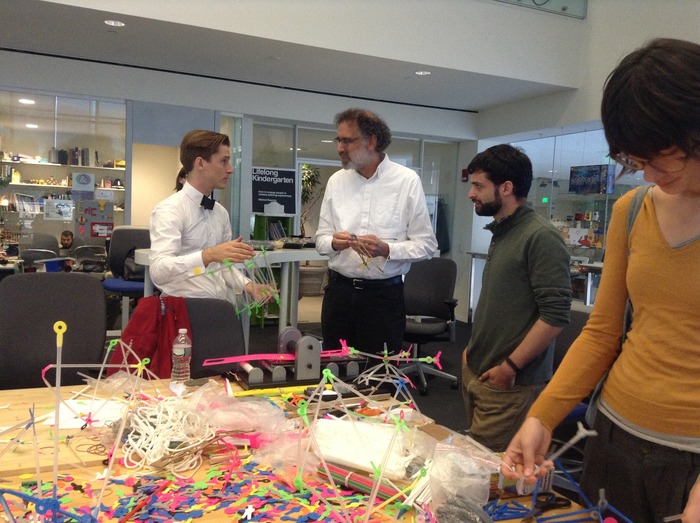
Actually it seems to appeal to anyone who wants to build big flexible structures, and who doesn't? We had a great time at M.I.T. where we had an afternoon workshop full of open ended construction play.

Strawbees are great for imaginative play, why not make a strange dog shaped thing? Or go high tech and construct a flex sensor controlled mechanical finger?

All pieces are connected with strawbees, even the servo and lever. There are always many different of ways of achieving the same thing and it's a truly open ended construction kit. It is also very hackable as you can modify the connector with a regular pair of scissors.
This combination of flexibility and iterative construction makes Strawbees perfect for fun and engaging STEM education activities at any level, from preschool to university engineering studies of both statics and dynamics. One feature for the higher studies is that the straws are weak enough that they bend under pressure, which makes it possible to visually inspect structures you have built to see how the applied load is distributed up until the breaking point. We think science education should be fun and believe this system really allows you to play your way to knowledge.
We are also co-founders of the global initiative www.kidshackday.com where we combine programming with construction activities and the Strawbees offer a great way to get things out of the computer into the real world in a large scale. The constructions are so light weight that a simple micro servo is enough to control even the biggest structures.

To help us get this out to more people, and let you get your hands on them before everyone else wee have devised the following fantastic pre-launch Strawbee kit rewards. The retail version of Strawbees will not be available until this fall, so be part of the beginning of this new toy and help us make it even better with your creations!
NOTE: WORLDWIDE SHIPPING INCLUDED IN KIT PRiCES!
(except for Infinite Kit and workshops)


When we designed the Strawbees, we didn’t really know exactly what we were doing. It was when our DIY clothespin was used as a construction toy by kids in India we figured that maybe we should try designing a real construction toy.

Our goal was to make a connector everyone could afford that could be made using commonly available scrap materials and preferably in one of our manual die cutting machines from Accucut.
One day at a public workshop at the Science Center Universeum in Gothenburg the organizers asked us if maybe we could come up with something smarter than the fragile connectors they had been using for some maths activities, a fully proprietary system with proprietary straws. That's when we started playing with regular straws, and found that the quarter inch straw is one of the most common dimensions.
All of a sudden this little thing appeared and after some tweaking we had developed what seemed to be the lowest common denominator for the joints of most polygon structures. We had to try building a geodesic dome.

Since then we have been trying it out inhouse, modifying it a couple of times and we have made four different tools and thousands of prototypes.

We have done test runs at five schools here in Sweden and more than five science centers around the world to make sure it works.

Built by a nine-year-old at Oslo maker fair. Note the visible stress in the lower pyramids!
We have also tried the Strawbees at public workshops and visited NY Maker Faire where we got a lot of positive reactions but most importantly young maker Chris Hodges came up with the brilliant name. A lot of people wanted to get their hands on them, but we weren't ready back then. Now we feel it's time to let it out into the world. We need your help!

To make this into the toy we want it to be, an open source construction kit available to all kids, we need your help.
First we need help to cover the costs of a large scale production, with big expensive tools, both for the Strawbees and also for a nice toy store worthy packaging.
The second and even more important reason is that we want to involve you in making and spreading construction ideas. We feel this is only possible if we keep a toy open. At the same time an open hardware project in the toy industry as simple as the Strawbee is much harder to finance so we figured why not team up with you from the beginning!
Our goal with the Strawbees is an online evolution of ideas and constructions where users build on or better each others ideas. Having this in mind, what better users to start with than the people on Kickstarter?
A stretch goal if the project gets successfully funded would be to have a part of the site featuring an evolution tree where we can post videos/instructions into a hierarchy so we can follow the development of ideas through time. If you know how to achieve a site such as this and feel inspired you are very welcome to contact us!


During the kickstarter we will develop the prototype packaging to suit the production sheets of Strawbees. Production tools will be ordered immediately after a finished kickstarter ends and we will get the production set up for when they arrive. We will pack & ship continuously during the production so shipping will be spread throughout April.


Risks and challenges Learn about accountability on Kickstarter
We have a couple of successful product launches behind us such as www.ass-savers.com but are still a struggling startup team and have never attempted to get into the very tricky business of making educational toys so we have some issues to address.
We are confident about reaching the march launch with a custom prototype packaging, but the big organization that is needed for instructions and a massive world wide launch is not there.
We have three years experience with production in PP sheets so we have most of the production chain sorted out already, the only challenge is to get as many pieces per sheet as possible but still have the machines cut trough cleanly. Worst case scenario is having to modify the tool to suit the machine we use which could delay us up to a week, but it would still allow shipping within the set schedule.
The second issue is to be able to pack & ship the product efficiently, which really is the biggest unknown and affects the total amount of pieces in a kit. Hopefully we have done our research and sorted this out, but it's the first time we are doing this many pieces per kit so we are on our toes ready for tweaking this process.
ORIGINAL: Kicstarter

