Mostrando entradas con la etiqueta Universo. Mostrar todas las entradas

martes, 19 de mayo de 2015

La NASA publica la foto más grande del mundo. Esto perturbará tu noción del universo

¡No intentes descargar esto en tu computador! 
El 15 de enero recién pasado, la NASA lanzó una imagen de la galaxia de Andrómeda; la galaxia más cercana al Planeta Tierra. Esta verdadera obra de arte fue capturada, en parte, con el ESA Hubble. ¿Cómo lo lograron? Se tomaron 411 fotos y se montaron una al lado de la otra, para crear la fotografía más grande jamás tomada. ¿El resultado? Un archivo de 1,5 mil millones de pixeles que requiere alrededor de 4,3 GB de espacio en disco:


First & Last photo by Cory Poole: https://www.facebook.com/CoryPoolePho...

Music is 'Koda - The Last Stand' from Silk Music...
Listen: http://bit.ly/1ySODuV
Download: http://bit.ly/1CKxuE3
More from Silk Music: http://bit.ly/1ySE7p7
Super-high resolution image of Andromeda from Hubble (NASA/ESA): http://www.spacetelescope.org/images/heic1502a/

Space is crazy.

ORIGINAL: UpSocl
Por Bárbara Samaniego

lunes, 17 de marzo de 2014

Witness the joy of the man who predicted today's Big Bang discovery as they tell him the news


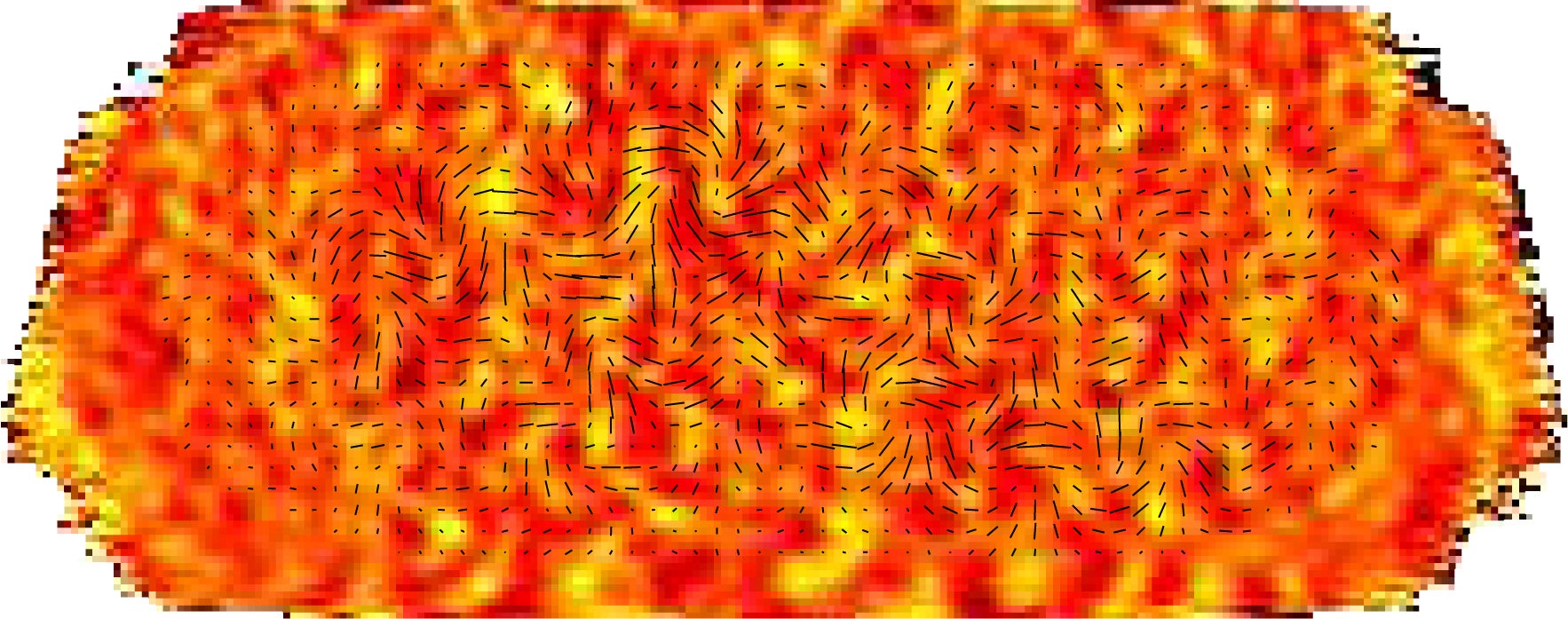
It looks like an explosion from an 80s game, but you're looking at the first direct proof of the event that started the Universe—the Big Bang. Those black lines represent the polarization of the Cosmic Microwave Background, which "could have been produced by gravitational waves created by inflation" as predicted by Einstein. If confirmed, it could be one of the biggest scientific discoveries in history.…

Scientists capture first ever signal from the beginning of the Universe


Today is a great day for science, Humanity and Andrei Dmitriyevich Linde—one of the main authors of the inflationary universe theory that was confirmed today. Watch his emotions as assistant Professor Chao-Lin Kuo surprises him with the news of the evidence that supports his theoretical work.

Kuo and his colleagues were the ones who got "the first images of gravitational waves, or ripples in space-time—the "first tremors of the Big Bang."


ORIGINAL: Sploid


jueves, 13 de febrero de 2014

Fox Networks Group To Launch ‘Cosmos: A Spacetime Odyssey’ In 181 Countries, 220 Channels

Fox Networks Group today announced its first ever cross-network global premiere event — for Seth MacFarlane‘s passion project, Cosmos: A Spacetime Odyssey, on Sunday, March 9, 9-10 PM ET/PT. In addition to premiering on the 10 U.S. networks simulcasting the premiere episode — Fox Broadcasting Company, National Geographic Channel, FX, FXX, FXM, FOX Sports 1, FOX Sports 2, Nat Geo Wild, Nat Geo Mundo and FOX Life — and on the Fox International Channels and National Geographic Channels International, as previously announced, Cosmos will premiere on all 90 National Geographic Channels in 180 countries, as well as 120 Fox-branded channels in 125 countries, making this the largest global launch ever for a television series. Rolling out immediately after the U.S. premiere, international markets will begin airing the premiere episode day and date on both Fox-branded and National Geographic Channels, concluding within one week of the domestic premiere event. The additional 12 episodes will air exclusively on National Geographic Channels outside the U.S.


TV Trailer: Seth MacFarlane’s ‘Cosmos’

This first multi-network launch event for Fox Networks Group, along with the series debut on Fox International Channels and National Geographic Channels International, will make Cosmos: A Spacetime Odyssey available on 220 channels in 181 countries, with an overall footprint of more than half a billion homes.

In today’s announcement, Fox Networks Group chairman and CEO Peter Rice called it “one of the most incredible experiences ever imagined for television.” From the announcement:

After the cross-network premiere event, COSMOS: A SPACETIME ODYSSEY will continue its epic 13-episode run, airing Sundays (9:00-10:00 PM ET/PT) on FOX, and Mondays – with all-new bonus footage and behind-the-scenes content – on the National Geographic Channel (NGC) (10:00-11:00 PM ET/PT).

More than three decades after the debut of “Cosmos: A Personal Voyage,” Carl Sagan’s stunning and iconic exploration of the universe as revealed by science, Seth MacFarlane has teamed with Sagan’s original creative collaborators – writer/executive producer Ann Druyan and co-writer, astronomer Steven Soter – to conceive the 13-part series that will serve as a successor to the Emmy and Peabody Award-winning original series.

COSMOS: A SPACETIME ODYSSEY is hosted by renowned astrophysicist Dr. Neil deGrasse Tyson. As with the legendary original series, the new COSMOS is the saga of how we discovered the laws of nature and found our coordinates in space and time. The series brings to life never-before-told stories of the heroic quest for knowledge, transporting viewers to new worlds and across the universe for a vision of the cosmos on the grandest – and the smallest – scale. The series invents new modes of scientific storytelling to reveal the grandeur of the universe and re-invent celebrated elements of the original series, including the Cosmic Calendar and the Ship of the Imagination. The most profound scientific concepts are presented with stunning clarity, uniting skepticism and wonder, and weaving rigorous science with the emotional and spiritual into a transcendent experience.

ORIGINAL:
Deadline
By THE DEADLINE TEAM
February 13, 2014

sábado, 21 de septiembre de 2013

Did a hyper-black hole spawn the Universe?

ORIGINAL: Nature
Zeeya Merali
13 September 2013

Big Bang was mirage from collapsing higher-dimensional star, theorists propose. 
The event horizon of a black hole — the point of no return for anything that falls in — is a spherical surface. In a higher-dimensional universe, a black hole could have a three-dimensional event horizon, which could spawn a whole new universe as it forms.  ARTIST'S IMPRESSION BY VICTOR DE SCHWANBERG/SCIENCE PHOTO LIBRARY

It could be time to bid the Big Bang bye-bye. Cosmologists have speculated that the Universe formed from the debris ejected when a four-dimensional star collapsed into a black hole — a scenario that would help to explain why the cosmos seems to be so uniform in all directions.

The standard Big Bang model tells us that the Universe exploded out of an infinitely dense point, or singularity. But nobody knows what would have triggered this outburst: the known laws of physics cannot tell us what happened at that moment.

“For all physicists know, dragons could have come flying out of the singularity,” says Niayesh Afshordi, an astrophysicist at the Perimeter Institute for Theoretical Physics in Waterloo, Canada.

Related storiesTheoretical physics: The origins of space and time
Big Bang light reveals minimum lifetime of photons
Polarization detected in Big Bang's echo

More related stories

It is also difficult to explain how a violent Big Bang would have left behind a Universe that has an almost completely uniform temperature, because there does not seem to have been enough time since the birth of the cosmos for it to have reached temperature equilibrium.

To most cosmologists, the most plausible explanation for that uniformity is that, soon after the beginning of time, some unknown form of energy made the young Universe inflate at a rate that was faster than the speed of light. That way, a small patch with roughly uniform temperature would have stretched into the vast cosmos we see today. But Afshordi notes that “the Big Bang was so chaotic, it’s not clear there would have been even a small homogenous patch for inflation to start working on”.

On the brane

In a paper posted last week on the arXiv preprint server1, Afshordi and his colleagues turn their attention to a proposal2 made in 2000 by a team including Gia Dvali, a physicist now at the Ludwig Maximilians University in Munich, Germany. In that model, our three-dimensional (3D) Universe is a membrane, or brane, that floats through a ‘bulk universe’ that has four spatial dimensions.

Ashfordi's team realized that if the bulk universe contained its own four-dimensional (4D) stars, some of them could collapse, forming 4D black holes in the same way that massive stars in our Universe do: they explode as supernovae, violently ejecting their outer layers, while their inner layers collapse into a black hole.

In our Universe, a black hole is bounded by a spherical surface called an event horizon. Whereas in ordinary three-dimensional space it takes a two-dimensional object (a surface) to create a boundary inside a black hole, in the bulk universe the event horizon of a 4D black hole would be a 3D object — a shape called a hypersphere. When Afshordi’s team modelled the death of a 4D star, they found that the ejected material would form a 3D brane surrounding that 3D event horizon, and slowly expand.

The authors postulate that the 3D Universe we live in might be just such a brane — and that we detect the brane’s growth as cosmic expansion. “Astronomers measured that expansion and extrapolated back that the Universe must have begun with a Big Bang — but that is just a mirage,” says Afshordi.

Model discrepancy

The model also naturally explains our Universe’s uniformity. Because the 4D bulk universe could have existed for an infinitely long time in the past, there would have been ample opportunity for different parts of the 4D bulk to reach an equilibrium, which our 3D Universe would have inherited.

The picture has some problems, however. Earlier this year, the European Space Agency's Planck space observatory released data that mapped the slight temperature fluctuations in the cosmic microwave background — the relic radiation that carries imprints of the Universe’s early moments. The observed patterns matched predictions made by the standard Big Bang model and inflation, but the black-hole model deviates from Planck's observations by about 4%. Hoping to resolve the discrepancy, Afshordi says that his is now refining its model.

Despite the mismatch, Dvali praises the ingenious way in which the team threw out the Big Bang model. “The singularity is the most fundamental problem in cosmology and they have rewritten history so that we never encountered it,” he says. Whereas the Planck results “prove that inflation is correct”, they leave open the question of how inflation happened, Dvali adds. The study could help to show how inflation is triggered by the motion of the Universe through a higher-dimensional reality, he says. Naturedoi:10.1038/nature.2013.13743

References
Pourhasan, R., Afshordi, N. & Mann, R. B. Preprint available at http://arxiv.org/abs/1309.1487 (2013).
PubMed Show context

Dvali, G., Gabadadze, G. & Porrati, M. Phys. Lett. B 485, 208–214 (2000).
Article
ISI
ChemPort Show context

miércoles, 24 de julio de 2013

First Trailer for New "Cosmos" Series Arrives

ORIGINAL: Mental Floss
Chris Higgins
July 22, 2013
Image credit: YouTube / FoxBroadcasting
In 1980, Carl Sagan's Cosmos: A Personal Voyage aired on PBS. More than three decades later, Neil DeGrasse Tyson is at the helm of Cosmos: A Spacetime Odyssey, set to air on Fox in 2014. Some of the team who made the original series, including Sagan's widow Ann Druyan, have returned to work on this one; Druyan is both Executive Producer and Writer for the show. The first trailer was released over the weekend at Comic-Con, and it's a doozy -- cut like a summer blockbuster, it invites re-watching and pausing to peek at the places the show will take us. Behold (and be aware that, yes, the first 15 seconds are intentionally left black):


To get warmed up, watch the original series on Netflix (it's streaming), buy it on DVD for a zillion dollars, or follow the new show on Facebook. Get excited, people!

domingo, 9 de junio de 2013

Life & The Universe Most Astounding Fact - Neil deGrasse Tyson

ORIGINAL: YouTube
Jan 8, 2013

Astrophysicist Dr. Neil DeGrasse Tyson was asked by a reader of TIME magazine, "What is the most astounding fact you can share with us about the Universe?" This is his answer.

www.facebook.com/EducateInspireChange

Special thanks to:
Reid Gower http://saganseries.com/
Carl Sagan http://www.hulu.com/cosmos
Neil deGrasse Tyson http://www.facebook.com/neiltyson
NASA http://www.nasa.gov/
...for their inspiration.

CREDITS
Narration: TIME Magazine's "10 Questions for Neil Degrasse Tyson"
http://www.youtube.com/watch?v=wiOwqD...
Music: "To Build a Home" by the Cinematic Orchestra feat. Patrick Watson
http://www.cinematicorchestra.com/

Video (in order of appearance):
IMAX: Hubble 3D (Orion)
http://www.imax.com/hubble/
Yellowstone: Battle for Life (Tree & Waterfall)
http://www.bbc.co.uk/programmes/b00jcdml
Supernova to Crab Nebula
http://www.spacetelescope.org/videos/...
BBC: Wonders of the Solar System (formation of the solar system)
http://www.bbc.co.uk/programmes/b00qyxfb
Accretion and First Eukaryotes from the 2011 film "Tree of Life" directed by Terrence Malick
http://en.wikipedia.org/wiki/Accretio...)
http://en.wikipedia.org/wiki/Origin_o...
http://en.wikipedia.org/wiki/Timeline...
http://www.wired.com/wiredscience/200...
http://www.twowaysthroughlife.com/
BBC: Charles Darwin and the Tree of Life
http://www.wellcometreeoflife.org/
"Salar de Uyuni, Bolivia" by Ayrton Orio (Model: Xharon Kendelker)
http://vimeo.com/9505354
"Afghanistan - touch down in flight" by Augustin Pictures
http://vimeo.com/31426899
http://lukasugustin.de
"mongolia!" by wiissa
http://vimeo.com/27876709
http://wiissa.com

Excerpt from "Outside In", Copyright Stephen van Vuuren/SV2 Studios (Saturn's moon Mimas)
http://www.outsideinthemovie.com
IMAX: Hubble 3D (Inside Orion Nebula)
http://en.wikipedia.org/wiki/Orion_Ne...
Shuttle Launch from 1985 IMAX film "The Dream is Alive"
http://en.wikipedia.org/wiki/The_Drea...
"Earth -- Time Lapse View from Space, Fly Over -- NASA, ISS" by Michael Konig
http://www.youtube.com/watch?v=ls9yJT...
http://koenigm.com
Excerpt from "The Island" - La Palma Time Lapse Video by Christoph Malin
http://vimeo.com/27539860
http://christophmalin.com
Galaxy Map and Galaxy Formation by NCSA's Advanced Visualization Lab
http://avl.ncsa.illinois.edu/
"Mars sunset" captured by NASA's Mars Exploration Rover Spirit http://www.nasa.gov/multimedia/imageg...

Edited by Max Schlickenmeyer

Neil goes on to say "For me, that is the most profound revelation of 20th century astrophysics and I look forward to what the 21st century will bring us, given the frontiers that are now unfolding."

Copyright Disclaimer Under Section 107 of the Copyright Act 1976, allowance is made for "fair use" for purposes such as criticism, comment, news reporting, teaching, scholarship, and research. Fair use is a use permitted by copyright statute that might otherwise be infringing. Non-profit, educational or personal use tips the balance in favor of fair use. All copyrighted materials contained herein belong to their respective copyright holders, I do not claim ownership over any of these materials. I realize no profit, monetary or otherwise, from the exhibition of these videos.

martes, 30 de abril de 2013

Talking about the Computational Future at SXSW 2013

March 19, 2013

Last week I gave a talk at SXSW 2013 in Austin about some of the things I’m thinking about these days—including quite a few that I’ve never talked publicly about before. Here’s a video, and a slightly edited transcript:


Well, this is a pretty exciting time for me. Because it turns out that a whole bunch of things that I’ve been working on for more than 30 years are all finally converging, in a very nice way. And what I’d like to do here today is tell you a bit about that, and about some things I’ve figured out recently—and about what it all means for our future.

This is going to be a bit of a wild talk in some ways. It’s going to go from pretty intellectual stuff about basic science and so on, to some really practical technology developments, with a few sneak peeks at things I’ve never shown before.

Let’s start from some science. And you know, a lot of what I’ll say today connects back to what I thought at first was a small discovery that I made about 30 years ago. Let me tell you the story.

I started out at a pretty young age as a physicist. Diligently doing physics pretty much the way it had been done for 300 years. Starting from this-or-that equation, and then doing the math to figure out predictions from it. That worked pretty well in some cases. But there were too many cases where it just didn’t work. So I got to wondering whether there might be some alternative; a different approach.

At the time I’d been using computers as practical tools for quite a while—and I’d even created a big software system that was a forerunner of Mathematica. And what I gradually began to think was that actually computers—and computation—weren’t just useful tools; they were actually the main event. And that one could use them to generalize how one does science: to think not just in terms of math and equations, but in terms of arbitrary computations and programs.

So, OK, what kind of programs might nature use? Given how complicated the things we see in nature are, we might think the programs it’s running must be really complicated. Maybe thousands or millions of lines of code. Like programs we write to do things.

But I thought: let’s start simple. Let’s find out what happens with tiny programs—maybe a line or two of code long. And let’s find out what those do. So I decided to do an experiment. Just set up programs like that, and run them. Here’s one of the ones I started with. It’s called a cellular automaton. It consists of a line of cells, each one either black or not. And it runs down the page computing the new color of each cell using the little rule at the bottom there.


OK, so there’s a simple program, and it does something simple. But let’s point our computational telescope out into the computational universe and just look at all simple programs that work like the one here.


Well, we see a bunch of things going on. Often pretty simple. A repeating pattern. Sometimes a fractal. But you don’t have to go far before you see much stranger stuff.

This is a program I call “rule 30“. What’s it doing? Let’s run it a little longer.


That’s pretty complicated. And if we just saw this somewhere out there, we’d probably figure it was pretty hard to make. But actually, it all comes just from that tiny program at the bottom. That’s it. And when I first saw this, it was my sort of little modern “Galileo moment”. I’d seen something through my computational telescope that eventually made me change my whole world view. And made me realize that computation—even as done by a tiny program like the one here—is vastly more powerful and important than I’d ever imagined.


Well, I’ve spent the past few decades working through the consequences of this. And it’s led me to build a new kind of science, to create all sorts of practical technology, and to make me think about almost everything in a different way. I published a big book about the science about ten years ago. And at the time when the book came out, there was a quite a bit of “paradigm shift turbulence“. But looking back it’s really nice to see how well the science has taken root.


And for example there are models based on my kinds of simple programs showing up everywhere. After 300 years of being dominated by Newton-style equations and math, the frontiers are definitely now going to simple programs and the new kind of science.

But there’s still one ultimate app out there to be done: to figure out the fundamental theory of physics—to figure out how our whole universe works. It’s kind of tantalizing. We see these very simple programs, with very complex behavior.


It makes one think that maybe there’s a simple program for our whole universe. And that even though physics seems to involve more and more complicated equations, that somewhere underneath it all there might just be a tiny little program. We don’t know if things work that way. But if out there in the computational universe of possible programs, the program for our universe is just sitting there waiting to be found, it seems embarrassing not to be looking for it.

Now if there is indeed a simple program for our universe, it’s sort of inevitable that it has to operate kind of underneath our standard notions like space and time and so on. Maybe it’s a little like this.


A giant network of nodes, that make up space a bit like molecules make up the air in this room. Well, you can start just trying possible programs that create such things. Each one is in a sense a candidate universe.


And when you do this, you can pretty quickly say most of them can’t be our universe. Time stops after an instant. There are an infinite number of dimensions. There can’t be particles or matter. Or other pathologies.

But what surprised me is that you don’t have to go very far in this universe of possible universes before you start finding ones that are very plausible. And that for example seem like they’ll show the standard laws of gravity, and even some features of quantum mechanics. At some level it turns out to be irreducibly hard to work out what some of these candidate universes will do. But it’s quite possible that already caught in our net is the actual program for our universe. The whole thing. All of reality.

Well, if you’d asked me a few years ago what I thought I’d be doing now, I’d probably have said “hunting for our universe”. But fortunately or unfortunately, I got seriously sidetracked. Because I realized that once one starts to understand the idea of computation, there’s just an incredible amount of technology one can build—that’s to me quite fascinating, and that I think is also pretty important for the world. And in fact, right off the bat, there’s a whole new methodology one can use for creating technology.

jueves, 31 de enero de 2013

The Scale of the Universe 2

ORIGINAL: htwins.net
Maravillosa puesta en perspectiva de la escala del Universo.
-Vanessa Restrepo Schild

You need a more recent version of Adobe Flash Player.
-->
You need a more recent version of Adobe Flash Player.

http://htwins.net/scale2/

sábado, 1 de diciembre de 2012

Atom Smasher Creates New Kind of Matter

ORIGINAL: Space
Clara Moskowitz, LiveScience Senior Writer
27 November 2012

A proton collides with a lead nucleus, sending a shower of particles through the CMS detector.
CREDIT: CERN 
Collisions between particles inside the Large Hadron Collider atom smasher have created what looks like a new form of matter.

The new kind of matter is called color-glass condensate, and is a liquidlike wave of gluons, which are elementary particles related to the strong force that sticks quarks together inside protons and neutrons (hence they are like "glue").

Scientists didn't expect this kind of matter would result from the type of particle collisions going on at the Large Hadron Collider at the time. However, it may explain some odd behavior seen inside the machine, which is a giant loop where particles race around underneath Switzerland and France.

When scientists sped up protons (one of the building blocks of atoms) and lead ions (lead atoms, which contain 82 protons each, stripped of their electrons), and crashed them into each other, the resulting explosions liquefied those particles and gave rise to new particles in their wake. Most of these new particles, as expected, fly off in all directions at close to the speed of light. [Photos: The World's Largest Atom Smasher (LHC)]

But recently scientists noticed that some pairs of particles were flying off from the collision point in correlated directions.

"Somehow they fly at the same direction even though it's not clear how they can communicate their direction with one another. That has surprised many people, including us," MIT physicist Gunther Roland, whose group led the analysis of the collision data along with Wei Li of Rice University, said in a statement.

A similar flight pattern is seen when two heavy particles, such as lead and lead, crash into each other. In this case, the collisions create what's called quark-gluon plasma — a superhot soup of particles similar to the state of the universe just after the Big Bang. This soup can sweep particles in the same direction, explaining why their flight directions would be correlated.

But quark-gluon plasma isn't possible with lead-proton collisions, like the ones in the new study. Now researchers think a different state of matter, the color-glass condensate, may act in a similar way. The color-glass condensate's dense swarm of gluons may also sweep particles off in the same direction, suggested Brookhaven National Laboratory physicist Raju Venugopalan, who first predicted the substance, which may also be seen after proton-proton collisions.

The mechanism may depend on a weird quirk of particles called quantum entanglement. Two particles can be entangled so that they retain a connection even after they are separated, and an action on one reverberates on the other.

Entangled gluons in the color-glass condensate could explain how particles flying away from the collision point might share information about their flight direction with each other, Venugopalan said.

The intriguing phenomenon was not expected to result from the LHC's run of proton-lead collisions, which was meant to serve as a reference point for comparison to other types of collisions.

"You don't expect quark-gluon plasma effects" with lead-proton collisions, Rolandsaid. "It was supposed to be sort of a reference run — a run in which you can study background effects and then subtract them from the effects that you see in lead-lead collisions.

The findings will be detailed in an upcoming issue of the journal Physical Review B.

This story was provided by LiveScience, a sister site to SPACE.com. Follow Clara Moskowitz on Twitter @ClaraMoskowitz or LiveScience @livescience. We're also on Facebook & Google+.

domingo, 7 de octubre de 2012

La cámara digital más potente del mundo abre los ojos y recoge las primeras imágenes a la caza de la energía oscura

ORIGINAL: Red Renata
Viernes, 28 de Septiembre de 2012 12:57

Tras ocho años de trabajo, los científicos de la colaboración internacional DES (Dark Energy Survey, Cartografiado para la energía oscura) han dado a conocer las primeras imágenes del cielo del hemisferio sur realizadas por la DECam, la Cámara para la energía oscura más potente diseñada hasta la actualidad. Durante cinco años, el cartografiado creará imágenes detalladas en color de una octava parte de la esfera celeste, o 5000 grados cuadrados, para descubrir y medir 300 millones de galaxias, 100 000 cúmulos de galaxias y 4000 supernovas.

DECAM. Foto por DES

Hace ocho mil millones de años, la luz procedente de lejanas galaxias inició su viaje hacia la Tierra. El 12 de septiembre de 2012, esa antiquísima luz estelar terminó su camino en la cima de una montaña en Chile, donde la recién terminada cámara para la energía oscura (DECam, por sus siglas en inglés), la máquina de cartografiado del cielo más poderosa jamás creada, la capturó y almacenó por primera vez. Esa luz podría contener la respuesta a uno de los mayores misterios de la Física: por qué la expansión del universo se acelera.

Los científicos de la colaboración DES (DarkEnergySurvey, o cartografiado para la energía oscura) anunciaron esta semana que DECam, el resultado de ocho años de planificación y construcción realizado por científicos, ingenieros y técnicos de tres continentes, ha recibido su primera luz. Las primeras imágenes del cielo del hemisferio sur fueron recogidas por esta cámara, de 570 megapíxeles, el 12 de septiembre.

El consorcio español de DES, formado por el CIEMAT en Madrid y el IFAE (Institut de Fisica d’Altes Energies) y el ICE (Institut de Ciències de l’Espai; IEEC/CSIC, Institut d’Estudis Espacials de Catalunya/Consejo Superior de Investigaciones Científicas) en Barcelona, y con participación adicional de investigadores de la Universidad Autónoma de Madrid, ha tenido una gran responsabilidad en la construcción y puesta en funcionamiento de DECam.

Se ha encargado del diseño, la verificación y la construcción de toda la electrónica de alta velocidad que contiene DECam, además de diseñar e implementar el programa informático que hace posible orientar con precisión el telescopio y producir simulaciones a gran escala del Universo, que permiten probar los métodos de análisis científico. Además del Consorcio español, en la colaboración DES participan científicos de EE UU, Reino Unido, Brasil, Alemania y Suiza. La colaboración internacional está liderada por Fermilab, en EE UU. La cámara se ha instalado en el telescopio Víctor M. Blanco en el Observatorio de Cerro Tololo, en Chile. Con esta cámara, que tiene, aproximadamente, el tamaño de una cabina telefónica, los físicos y astrónomos investigarán el misterio de la energía oscura, la fuerza que se cree que causa que el universo se expanda cada vez más rápido.
Aerial photograph of CTIO, Cerro Tololo, Chile. Featuring Blanco 4-meter and SMARTS telescopes. Credit: NOAO/AURA/NSF.

“La energía oscura es el descubrimiento más sorprendente que se ha producido en la física en los últimos veinte años, y solamente puede explicarse si existe nueva física más allá de las teorías actuales. Si conseguimos descubrir la naturaleza de la energía oscura será una revolución en el conocimiento del Universo. El proyecto DES se concibió para avanzar en la resolución de este problema, y ahora, tras un gran esfuerzo de diseño y construcción, comenzamos la aventura”, declaró Eusebio Sánchez, investigador responsable del proyecto en el CIEMAT.

DECam es el instrumento de cartografiado más poderoso, capaz de ver luz de más de 100.000 galaxias a más de 8 mil millones de años luz en cada exposición. El mosaico de 64 CCD que contiene la cámara tiene una sensibilidad sin precedentes a la luz roja, y junto con el enorme espejo colector de luz del telescopio Blanco (que mide 4 metros de diámetro), permitirá a los científicos desarrollar investigaciones que van desde el estudio de los asteroides de nuestro Sistema Solar hasta la comprensión del origen y destino del Universo.

“Con la cámara de DES podremos conocer por primera vez la distribución de galaxias en un volumen que es una fracción importante del Universo observable. Esto nos permitirá determinar de una vez por todas la geometría local del Universo y el contenido de materia y energía responsable de su evolución. El descubrimiento del agente responsable de la expansión acelerada marcaría un hito histórico, que nos permitiría conectar el origen y el destino del Universo”, matizó Juan García-Bellido, investigador de la Universidad Autónoma de Madrid.

Los científicos de la colaboración DES realizarán el cartografiado de galaxias más grande jamás propuesto, y analizarán estos datos para realizar cuatro pruebas sobre la energía oscura, estudiando cúmulos de galaxias, supernovas, la distribución de galaxias a gran escala y el efecto lente gravitacional débil sobre dichas galaxias. Esta será la primera vez que estos cuatro métodos se utilizan simultáneamente en un único experimento.

El cartografiado se espera que empiece en diciembre, tras la verificación completa de la cámara, y aprovechará las extraordinarias condiciones atmosféricas de los andes chilenos para proporcionar imágenes con la mejor resolución jamás vista en un cartografiado astronómico de gran campo.

Distribuido por el Centro de Investigaciones Energéticas, Medioambientales y Tecnológicas (CIEMAT) y la Universidad Autónoma de Madrid (UAM), en representación de la colaboración DES.

Contacto
Unidad de Comunicación y RR PP del CIEMAT
Avda. Complutense, 40. 28040 Madrid
Tfno.: 913460822 Correo-e: ucrp@ciemat.es

lunes, 24 de septiembre de 2012

Supercomputer Recreates Universe From Big Bang to Today

ORIGINAL: Space
Clara Moskowitz, SPACE.com Assistant Managing Editor
11 September 2012

Large-scale structures in the universe form over time in these stills from a supercomputer simulation of the evolution of the universe.

CREDIT: Habib et al./Argonne National Lab 

Scientists would love to be able to rewind the universe and watch what happened from the start. Since that's not possible, researchers must create their own mini-universes inside computers and unleash the laws of physics on them, to study their evolution.

Now researchers are planning the most detailed, largest-scale simulation of this kind to date. One of the main mysteries they hope to solve with it is the origin of the dark energy that's causing the universe to accelerate in its expansion.

The new simulation is a project led by physicists Salman Habib and Katrin Heitmann of Illinois' Argonne National Laboratory, and will run on the lab's Mira supercomputer, the third-fastest computer in the world, starting in the next month or two. The program will use trillions of "particles" — elements in the simulation that stand in for small bits of matter. The computer will let time run, and watch as the particles move through space in response to the forces acting on them.

As the simulation progresses, these bits of matter will clump together under gravity to form larger and larger blobs representing galaxies, galaxy clusters and superclusters. To evolve the universe from the Big Bang 13.7 billion years forward to today, the simulation will take up to two weeks. [Video: Simulation of the Universe from Big Bang to Now]


Testing the theory
The ultimate goal is to compare the best telescope observations of structure in the universe to the structure displayed in the computer model, to test the reigning theory of cosmology.

"We are trying to look for subtle ways in which it's wrong," Habib told SPACE.com. "That’s why you need these very high-resolution, very large-scale simulations to see if the observations don't match the predictions."

Dark energy is the name given to whatever is causing the expansion of the universe to accelerate. When this acceleration was first discovered in the 1990s, it shocked the science community, because theories predicted the universe's expansion would be steady or slowing down, because of the inward pull of gravity.

The current reigning theory posits that dark energy is what's called the cosmological constant, a term Einstein first thought to put into his equations of general relativity to represent the vacuum energy of the universe. Although Einstein ultimately decided not to include the term, scientists later realized that it could explain the current observations of the expansion of the universe.

However, cosmologists aren't satisfied with this explanation, Habib said.

Another possibility
"It's just a single number entered as an extra term in the equations," he said. "The problem is that if you ask what its value should be, it's enormous — many orders of magnitude bigger than what is actually observed."

While simulations based on the cosmological constant so far appear to match what's seen in large-scale observations of the universe, scientists think that next-generation observations may reveal discrepant details.

If a cosmological constant is not to blame for the accelerated expansion of the universe, another possibility is that space contains some other type of mass or energy, such as a field, that is pulling everything apart.

"It's basically guesswork; it could be like this, or it could be like that," Habib said. "Either way it's very interesting."

Follow Clara Moskowitz on Twitter @ClaraMoskowitz or SPACE.com @Spacedotcom. We're also onFacebook & Google+.

viernes, 20 de abril de 2012

Magnifying the Universe


Copyright 2012. Magnifying the Universe by Number Sleuth.

The above is an interactive infographic. We have also developed a complimentary poster that you can view here: Sizes of the Universe poster. If you're technically inclined, here's a look at the references we used to construct these infographics: Facts About The Universe.


Introduction:

This interactive infographic from Number Sleuth accurately illustrates the scale of over 100 items within the observable universe ranging from galaxies to insects, nebulae and stars to molecules and atoms. Numerous hot points along the zoom slider allow for direct access to planets, animals, the hydrogen atom and more. As you scroll, a handy dial spins to show you your present magnification level.

While other sites have tried to magnify the universe, no one else has done so with real photographs and 3D renderings. To fully capture the awe of the vastly different sizes of the Pillars of Creation, Andromeda, the sun, elephants and HIV, you really need to see images, not just illustrations of these items. Stunningly enough, the Cat's Eye Nebula is surprising similar to coated vesicles, showing that even though the nebula is more than 40,000,000,000,000,000,000,000 times larger, many things are similar in our universe.

We hope you have a blast magnifying the universe, know that each time you zoom in a depth, you're magnifying the universe 10x ... and every time you zoom out, the bigger objects are 1/10th of their prior size. If you zoom from the biggest object, The Observable Universe (8.8 x 10E26 ... or 880,000,000,000,000,000,000,000,000m across), all the way down to the hydrogen atom's proton nucleus (1.7 x 10E-15 ... or 0.0000000000000017m across), you will have zoomed in over 100,000,000,000,000,000,000,000,000,000,000,000,000,000x! Unbelievable isn't it? Our universe really is immensely massive and surprisingly small.

How To Use:

Step 1:
To experience this interactive infographic in full screen (our recommendation) click the "Full Screen" button in the top right corner of the infographic.

Step 2:
Choose one of nine starting points by moving your mouse over and clicking one of the 9 images (atoms, animals, buildings, mountains, planets, stars, nebulae, galaxies and the observable universe).

Step 3:
Now on the bottom of the infographic, there is a blue blue dot that you can click on with your mouse.Drag the blue circle left to go "up" in size and drag the blue circle right to go "down" in size

Step 4:
To relocate to one of the nine entry points, click the corresponding yellow dot on the scroller at the bottom of the page

Credits:
You can view a list of image credits used in the construction of this infographic by clicking here.

Produced for Number Sleuth by Science is Beautiful in coordination with Mandril Design and Killer Infographics.