Mostrando entradas con la etiqueta Modelos. Mostrar todas las entradas

viernes, 27 de diciembre de 2013

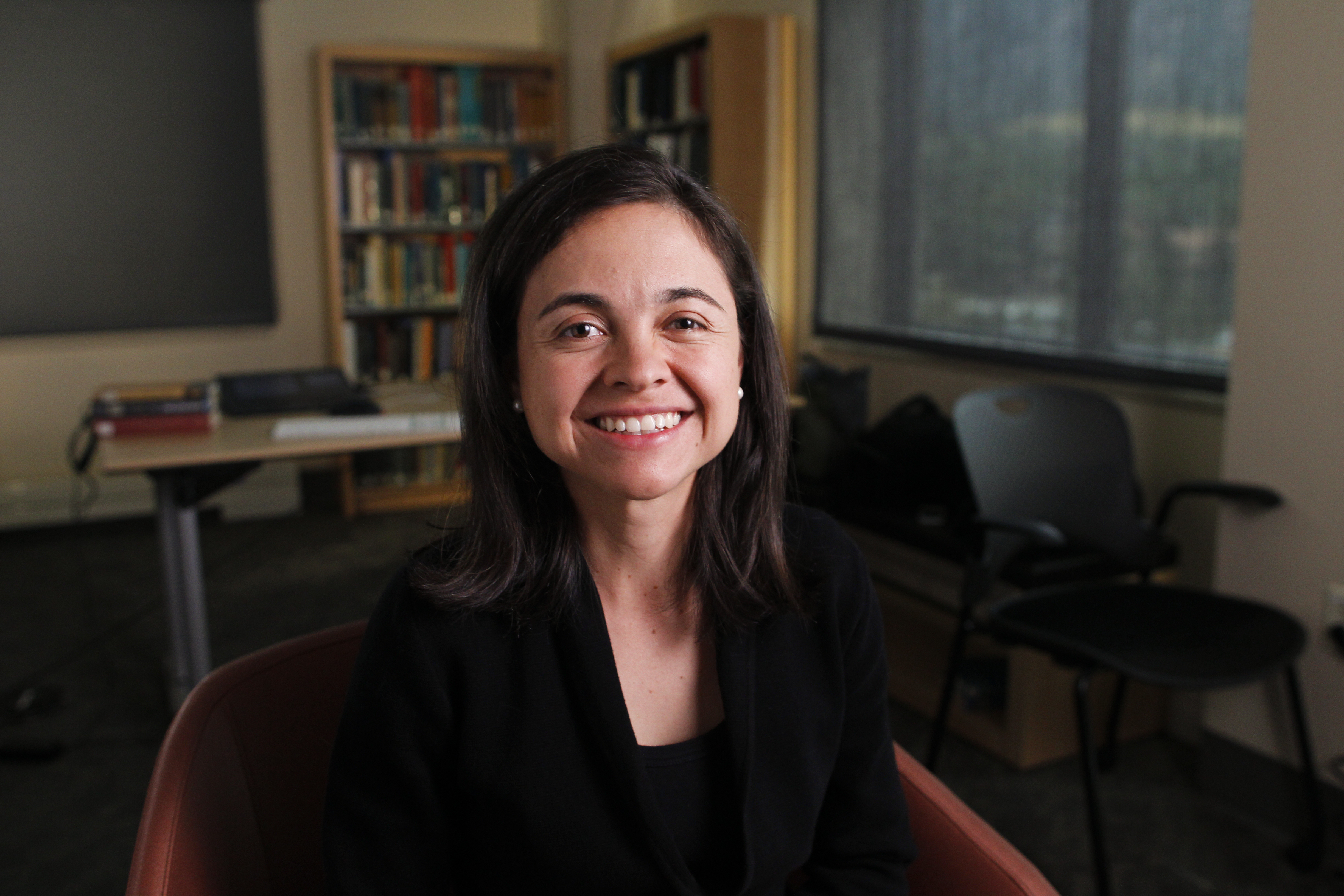
Ana Maria Rey, Atomic Physicist. MacArthur Fellow Class of 2013

MacArthur Fellows / Meet the Class of 2013

Ana Maria Rey. Atomic Physicist. Fellow of JILA. University of Colorado. Boulder, CO. Age: 36

Ana Maria Rey is a theoretical physicist working across the interfaces of atomic, molecular, optical, and condensed matter physics with the goal of using mathematical models to describe the complex behavior of nature. Rey is tackling this challenge through her research on ultracold optical-lattice systems, which will facilitate progress in areas such as quantum simulation and quantum information and enable the preparation of large-scale entanglement between atoms.

Through her ability and willingness to forge close collaborations across the physics community, Rey’s fundamental conceptual research in optical lattices is being leveraged by experimentalists to simulate, manipulate, and control novel states of matter, including quantum magnets, superfluids, and insulators that are important for understanding quantum phenomena like superconductivity. With colleagues, Rey is developing a comprehensive theoretical framework for an optical-lattice quantum computer based on alkaline earth metals. This effort has already proposed solutions for the key problems of storing, addressing, and transporting qubits (the quantum version of a classical bit in computing).

She is now working to resolve long-standing impediments to large-scale entanglement between atoms. A quantum computer requires entangled states—which occurs when the quantum states of two or more atoms become linked or connected—for both communication and computation. Rey’s theory offers a novel solution for maintaining coherence (or stability) in a quantum computer using unique properties of alkaline earth atoms, such as their large number of internal degrees of freedom. Rey’s collaborations with experimentalists have also enabled advances in the development of an optical atomic clock and quantum simulations with polar molecules and trapped ions, which in turn have opened up new theoretical explorations of quantum many-body effects and entanglement. Rey has started her independent career in research with significant contributions to condensed matter physics that harken a promising trajectory for novel theoretical approaches to quantum phenomena.


Ana Maria Rey received a B.S. (1999) from the Universidad de los Andes in Bogotá and a Ph.D. (2004) from the University of Maryland. She was a postdoctoral researcher (2004–2005) with the National Institute of Standards and Technology and a postdoctoral fellow (2005–2008) at the Institute for Theoretical Atomic, Molecular and Optical Physics at the Harvard-Smithsonian Center for Astrophysics, prior to joining the University of Colorado at Boulder, where she is currently a fellow at JILA and a research assistant professor in the Department of Physics.

ORIGINAL: MacArthur Foundation
September 25, 2013 

JILA
Education
University of MarylandCollege Park, Maryland, USA
Ph.D., Physics
August 2004
Dissertation Title: "Ultracold bosonic atoms in optical lattices"
Advisors: Charles W. Clark and Theodore R. Kirkpatrick
Universidad de los AndesBogota, Colombia
B.S., Physics
March 1999
Dissertation Title: "Propagation of electromagnetic radiation in Kerr's metric"
Advisors: Rafael Bautista
Academic Experience
Fellow of JILA
Assistant Professor Adjoint, Department of Physics
January 2012- Present

Associate Fellow of JILA
Assistant Professor Adjoint, Department of Physics
August 2008- 2011t

Institute of theoretical, Molecular, and optical Physics (ITAMP)
At the Harvard- Smithsonian Center for Astrophysics, Cambridge, Massachusetts, USA.
Postdoctoral fellowSeptember, 2005 - 2008

National Institute of Standards and Technology (NIST)Gaithersburg, Maryland, USA.
Postdoctoral researcher
September 2004 - September 2005

University of MarylandCollege Park, Maryland, USA.
Research Assistant
September 2000 - September 2004

Honors & Awards
Great Minds in STEM - Hispanic Engineer National Achievement Award, Award year: 2013

Related News: Ana Maria Rey Wins “Great Minds in STEM” Most Promising Scientist Award

APS Woman Physicist of the Month - APS, Award year: 2012
Related News: Ana Maria Rey selected as APS Woman Physicist of the Month

Physical and Natural Sciences Prize - Fundacion Alejandro Angel Escobar, Award year: 2007

Postdoctoral fellowship, 2005 - 2008 - ITAMP, Award year: 2005

Atomic, Molecular, and Optical Physics Outstanding Doctoral Thesis Award (DAMOP thesis prize) - American Physical Society, Award year: 2005

Cooperative Fellowship NIST/Chemical Physics, 2002 - 2004 - University of Maryland, Award year: 2002

Departmental Fellowship, 2000 - 2002 - University of Maryland, Award year: 2000

Magna cum laude B.S. Physics degree - Universidad de los Andes, Award year: 1999

Best GPA award - Universidad de los Andes, Award year: 1998

Best GPA Award - Universidad de los Andes, Award year: 1997

"Beca 40 años" Fellowship, 1994 - 1998 - Universidad de los Andes, Award year: 1994

miércoles, 3 de julio de 2013

Developing neuroscience knowledge with the Human Brain Project

ORIGINAL: Science Omegaby Richard Walker
02 July 2013

Photo: Vesna Njagulj

What we don’t know today is how much detail is actually needed to reproduce brain function. The proof will come when we have a model with a certain level of detail that actually exhibits the function we are interested in.
Richard Walker 

The Human Brain Project Spokesman Richard Walker tells Editor Lauren Smith why he believes the initiative is capable of producing important new basic science, enabling medical discoveries and allowing new technologies...

In January, the European Commission announced two EU Future and Emerging Technologies (FET) flagship programmes, which would each be allocated €1bn in funding to drive forward radical scientific research across the continent and enable greater understanding of key elements in our society. One focus area was the wonder material graphene; the other the vast Human Brain Project (HBP), which hopes to gain profound insight into the nature of humanity, to develop new treatments for brain diseases and progress revolutionary computing technologies.

In the first of a two-part special on the latter, Richard Walker, of the HBP, explains to Editor Lauren Smith the vast scope, expec­tations and hopes that are being placed on this initiative, looking this time particularly at the elements of developing neuroscience understanding and brain disease treatments.

The HBP will build on, and subsume, what has been learnt already from the Blue Brain Project, both being led by Henry Markram at École polytechnique fédérale de Lausanne (EFPL) in Switzerland, and other neuroscience related models.

"The original idea did come through the Blue Brain Project," Walker begins. "And the Blue Brain did in turn come from a wealth of experience in electrophysiology. Markram started specifically looking at this area in the 1990s and made many important discoveries. It became fairly obvious at that point that the quantity of experimental work that was necessary to really understand the brain was just enormous. There were different routes being taken by people working in different parts of the world, addressing different measures, looking at various problems and using various species. So, putting all of this together to try and get a coherent picture was not possible.

"Markram considered the idea of using brain modelling simulation as an integration tool – to put everything that is known into a model that represents the brain at different levels of detail, whereby each new piece of knowledge is a new constraint on our modelling so that even the unknown parts of the model become even more tightly constrained as things go on."

The flagship concept
This fledgling idea was developed through the specifically Swiss initiative from 2005 to 2011, with the goal to provide a proof of concept and to illustrate the feasibility of this approach. The researchers involved built the basic tools necessary to integrate data into multiple level biologically detailed models.

"In parallel," Walker explains, "Europe was looking for new approaches to funding research. It came up with the flagship concept, to provide a very large amount of money for long-term visionary research. Markram was part of developing the concept of these flagships and so we saw the programme as a way of making a real leap in the scale of what we are doing."

The bigger international undertaking that would become the HBP looks to expand beyond the rat brain that was the focus of the earlier initiative, to the scope of the human brain. "Whereas Blue Brain looked exclusively at neurons," he says, "we wanted to get down to the molecular level, which is fundamental as this is where, for instance, disease happens. In doing that, we were also able to look at the applications of brain research. In the HBP, brain simulation is only one-third of it. The other two-thirds cover medical research – actually using our models to get new insight into brain disease and how to treat them – and information technology – using our knowledge of the brain to build new computing technologies."

The power of ICT
The first stage of the overall plan is to consolidate the massive volume of data that already exists in the relevant fields. Walker explains that the best way to do this is through exploiting the power of information communication technologies (ICT). The first step is to introduce six ICT platforms – 
  • for neuroinformatics, 
  • brain simulation, 
  • high performance computing, 
  • medical informatics, 
  • neuromorphic computing, and 
  • neurorobotics.

"These will be tools that we can use, on the one hand to collect the data and the other to put it into models, to provide the necessary computing power, to provide medical data (about the healthy brain) and add in developing technologies and to add in our brain models to robotics," Walker says.

"Our plan is to build these platforms and then make them available to the scientific community. The first version of these platforms is due to be ready in month 30, and from then on scientists will be able to apply to use our platforms just like you can apply for observation time at a telescope. Proposals will be peer reviewed and checked to make sure that they are feasible with the platform and be cost-effective; then the successful groups will be able to use our platforms to do experiments. We will not tell scientists what research they should do with the instruments, but we will help them to do their research using our instruments."

Once in place, it is anticipated that the brain modelling will have a wide-reaching impact on the research arena for pharmaceuticals and in turn support the development of new treatments for brain conditions over the decades to come.

"In our medical research, the first thing we want to do is federate data from hospitals that are participating in our study," Walker outlines. "Today, if you have a brain scan the doctor will look at it, diagnose you, and the scan will then go into the hospital archive for 10 or 15 years before it is destroyed. No research is going to use that data, which is immensely valuable. This is a very bad use of taxpayers’ money.

"What we would like to do is anonymise data from each brain scan so that it cannot be traced back to the individual, and then mine the data for biological signatures of disease. So, if you have a particular form of Alzheimer’s, we could look at how your brain is different, in respect to someone who has a different form of Alzheimer’s, or in respect to someone who is healthy. That is very valuable in itself, as today it is very hard to objectively diagnose people with any brain disease."

Towards objective testing
As he explains, current diagnosis is usually done in terms of symptoms, but very often people with the same symptoms may have very different problems in their brains and, conversely, people with the same problem may present to a doctor with very different symptoms. It is hoped that, within two or three years of the project commencing, there should be sufficient data to start being able to distinguish between patients with objectively different diseases.

"This has a very practical implication for pharmaceutical companies," Walker comments. "Today, clinical trials compare the impact of drugs in control subjects and in people who are sick. But you will actually find that a large number of the controls are sick but no one knows it, and a large proportion of the people who are sick are not sick with the disease that the pharmaceutical company thinks they have. Once we have objective tests, we can select the people to participate in clinical trials much better, making it more likely that we will have positive results from the trials and find more effective treatments. We might be able to re-purpose drugs that already exist, which is a very cheap solution because they are already known to be safe, or we can find new ones."

Once these differences are better understood, the next step would be to model those variations and make comparisons with the model of the healthy brain. This should vastly enhance mechanistic understanding of the causes of brain disease – from environmental influences, to secondary effects, illness and drug use, for example.

"Untangling all of the potential causes is incredibly complicated," he suggests. "If we’ve got a brain model, we can do experiments that we can’t do with real patients. You may suspect it’s a particular thing that’s had an effect, so if we take it out of the model, we can see if the disease goes away or if a secondary affect has been found that doesn’t matter so much. We can also use them to get a handle on treatments. For treatment of an individual with a particular disease and symptoms, there are a huge number of treatment combinations available. Unless we have an indication that a certain option may work, it would be completely unethical to try this regime on patients, as it may be too dangerous. For many brain diseases we can’t do tests on animals, since we don’t have animals who suffer from delusions, for example. On the model, we can do it free of risk, so we will have a tool for the industry to test new treatments."

No miracle cures
Walker is insistent that they are not promising miracle cures, highlighting that even if a new drug is found that appears to cure a major condition, such as Alzheimer’s, it would still take a decade or more for it to be used in a clinical setting, given the extensive amount of animal and human testing required before it is authorised for use. HBP is not looking to create a system to replace all of the existing processes, but to make them more effective, using simulation to drastically reduce the time and money that is wasted testing things that are never going to work.

The substantial funding that the project has been awarded, to the tune of €1bn over 10 years, reflects the economical and social expectations placed on the outcomes, but Walker feels it is reasonable proportional to what they are trying to achieve.

"Although certainly considerable, if you think of how much it costs to design a new car, which is somewhat simpler than designing a brain, our budget is not so huge," he says. "A manufacturer can put a billion dollars simply into the design of a new engine. So, we do need to have things in perspective, but of course in terms of science funding this is extraordinarily large.

"We believe that we are going to produce very important new basic science, enable medical discoveries and allow new technologies. So the impact is going to be very large, but we also want to warn people against excessive expectations. This will take a very long time – that is the nature of real scientific research. If you know that you’re going to have an impact in one or two years’ time, it’s not research, it is development!"

Risking failure
There are an immense number of variables involved in understanding brain function and translating this into computational models meaning that, as with any major project, there always remains a risk that the lofty aims of the project could fundamentally fail.

"If there is no risk of failure, it is not research," Walker states. "In our research we are making a lot of hypotheses about how things function and we cannot guarantee that those hypotheses are right. We have to test them. Today, we have quite a good comprehension of some of the basic mechanics of the brain. We know a lot about how neurons and synapses function, how they change and some of the basic mechanisms of learning. Cognitive neuroscientists know an awful lot about which areas of the brain light up when you do certain things, such as talking, moving and making decisions.

"But there is a gap. We have very little understanding of the low-level functioning neurons. Imagine it like the transistors on a smartphone and how that links to the high-level activity, like an app running on the device. We don’t understand that link and we want to resolve that through modelling and simulation. We are going to model the brain circuitry and the neurons one by one, with each having an individual behaviour and so on. What we don’t know today is how much detail is actually needed to reproduce brain function. The proof will come when we have a model with a certain level of detail that actually exhibits the function we are interested in. Until we reach that point, there is a risk that our hypotheses could indeed be wrong."

As Walker concludes, people have been trying to understand how humans think and how the brain works for millennia. "We can’t promise that we’re going to succeed in all of this but we do have a handle on how to do it. It is really amazing that this is no longer an unapproachable problem – it is a difficult problem, but we do begin to see how we could resolve it."

In the next edition of Science Omega Review, we discuss this issue further, exploring the potential the project offers for supercomputing.


Richard Walker
Project Spokesman
Human Brain Project
www.humanbrainproject.eu


[This article was originally published on 1st July 2013 as part of Science Omega Review Europe 02]
Read more: http://www.scienceomega.com/article/1154/developing-neuroscience-knowledge-human-brain-project#ixzz2Y0HNyd6Y

lunes, 10 de junio de 2013

Horticulture Discotech: LED Grow Lights Power Sustainable Farming

ORIGINAL: Ecoimagination / PlantLab
Laurie Stark
Oct 26 2011

TEDxBrainport 2012 - Gertjan Meeuws - Indoor farming, Plant Paradise
08/06/2012

TEDxBrainport 2012 - Making the Future

Gertjan Meeuws is a pretty stubborn Dutch horticultural engineer, convinced that the way we are producing our food today, won't be a sustainable solution for feeding the world of tomorrow. Born in The Netherlands in 1962, he finished the University of Applied Sciences in -Hertogenbosch in 1983. Ever since, he has been involved in improving the performances of crops by combining his plant physiological knowledge with developing mathematical models and disrupting insights. Gertjan says we are using too much land, too much water, too much pesticides and too much transportation to deliver fresh food. He is managing partner of PlantLab, where he and his partners are not looking for improving the existing supply chain, but for creating a totally new and better one, based on their invention: Plant Paradise.


Food - Can we feed the world?
About TEDxBrainport 2012 - Making the Future
There are many challenges in the world today. Hunger and disease continue to affect large parts of the developing world. Financial instability is halting progress in developed countries. We're running out of resources and changing the natural world in ways we don't totally understand. How can we make a better future? Discover the next big bordering-on-crazy ideas for humanity at TEDxBrainport 2012. 

Photography by Gemma Burgio

What if we could grow fruits and vegetables in half the time with no pesticides or hormones and use 90 percent less water to do it? 
What if we could grow those fruits and vegetables anywhere in the world, during any season?

A Netherlands-based company called PlantLab believes we can.

Apples from Chile, asparagus from Peruan average of six to 12 percent of every dollar we spend on food goes to transportation costs.

Traditionally, most agriculture has been limited to large swaths of land with rich soil, controllable pests, and a predictable climate, but even under optimum conditions traditional methods of agriculture drain our water supply, require intensive resources, and produce a crop dependent on an undependable climate. PlantLab believes it might be time to start thinking outside the farm.

The big idea
In order to keep a planet that’s worth living on, we have to change our methods,” says PlantLab’s Gertjan Meeuws in an interview with the Associated Press.

The methods PlantLab is suggesting are revolutionary. The company grows plants indoors, vertically stacking acres upon acres of plants. They use LED lamps to grow the plants and water them with a slow trickle that drains through the soil and is collected and reused. The neon pink light of the lamps make the space look more like a nightclub than an indoor farm.

Computers capture over 160,000 reports per second to determine the exact amount, cycle, and color spectrum of light that’s optimal for the plant, as well as water, so that no resource is wasted and the plant is neither undernourished nor overexposed.

It would be wonderful if in 50 years’ time everyone in the world had decent food.

Plants convert light from the sun into energy through the process of photosynthesis, but plants only need some parts of the sun’s color spectrum. Blue and red LEDs can provide just the light a plant needs, making the process more efficient and growing a stronger, healthier plant.

A bright future
LEDs and climate-controlled indoor farms not only use less energy, less water, and less space than traditional agriculture; they also reduce the unpredictability of our food supply. Indoor farms aren’t at the mercy of droughts, torrential rains, unexpected frosts, and pests. They reduce the danger of food shortages and waste.

The vision for urban agriculture is simple—farms below grocery stores, farms above schools, city skyscrapers filled with fruits and vegetables instead of copy machines. The vision is fresh, local food grown and transported with minimal resources, no matter where in the world you live.

John van Gemert
, a PlantLab engineer, says his dream for the company is to empower communities to produce their own food all over the world. “It would be wonderful if in 50 years’ time everyone in the world had decent food.


Laurie Stark is a writer based in Madison, WI. You can find her writing on Your Ill-fitting Overcoat and in Isthmus, Madison’s alt weekly.

viernes, 29 de junio de 2012

Mysterious African 'Fairy Circles' Stump Scientists

ORIGINAL: Live Science
Stephanie Pappas, LiveScience Senior Writer
27 June 2012

Mysterious bare spots called "fairy circles" dotting the sandy desert grasslands of Nambia have long stumped scientists who have no idea how the strange patterns form. CREDIT: Mike and Ann Scott of the NamibRand Nature Reserve
In the sandy desert grasslands of Namibia in southern Africa, mysterious bare spots known as "fairy circles" will form and then disappear years later for no reason anyone can determine. A new look at these strange patterns doesn't solve the wistful mystery but at least reveals that the largest of the circles can linger for a lifetime.

Small fairy circles stick around an average of 24 years, while larger ones can exist as long as 75 years, according to research detailed today (June 27) in the journal PLoS ONE. Still, the study sheds little light on why the circles form , persist and then vanish into the landscape after decades.

"The why question is very difficult," said study researcher Walter Tschinkel, a biologist at Florida State University. "There are a number of hypotheses on the table, and the evidence for none of them is convincing." [ See Photos of Fairy Circles ]

Circles of life (and death)

Tschinkel grew interested in fairy circles during a 2005 safari to NamibRand Nature Reserve in southwest Namibia, in the Namib Desert. It was his first experience with the round clearings, tens of thousands of which expose the red sandy soil in the area. A short time after the circles form, a tall ring of grass grows around the border, highlighting the bare area.
The smallest are about 6.5 feet (2 meters) in diameter, while the largest can be almost 40 feet (12 m) across. Eventually, plants move back in, re-colonizing the circles and leaving only slightly indented "ghost circles" behind. CREDIT: Mike and Ann Scott of the Namib Rand Nature Reserve
Few researchers have studied fairy circles, in part because of their remoteness, 111 miles (180 km) from the nearest village. It's an arid landscape where springbok, ostriches, leopards and other large animals roam, Tschinkel told LiveScience.

"It's like dying and going to heaven if you like remote, beautiful desert places," he said.

At first glance, Tschinkel assumed the circles marked underground nests of harvester termites. But digs have shown no evidence of termite nests under fairy circles. Other explanations, such as differences in soil nutrients or the death of seedlings by toxic vapors from the ground, have likewise failed to hold up to study.

In fact, little was known even about the life cycle of the circles, Tschinkel said. With the help of the nature reserve's staff, satellite images and aerial photos, he set out to change that. By comparing satellite images from 2004 and 2008, he found that circles are quite stable, popping up at nearly their full size, or growing quickly to full size once they get started. The smallest are about 6.5 feet (2 meters) in diameter, while the largest can be almost 40 feet (12 m) across. Winds scour the bare areas of soil, turning them into slight depressions. Eventually plants move back in, recolonizing the circles and leaving only slightly indented "ghost circles" behind. [ Gallery: Aerial Photos Reveal Mysterious Stone Structures ]

Assuming that the overall number of fairy circles on the landscape is fairly steady, Tschinkel used the satellite photos to look at how quickly the circles go from birth to maturity to revegetation. That yielded rough estimates of the circles' life spans. Most probably exist for 30 to 60 years, Tschinkel said.

Persisting mystery

Tschinkel was able to bolster these estimates thanks to a fundraising effort by the Namib Rand Nature Reserve, which sells sponsorships to fairy circles. The sponsored circles are marked with a ceramic plate, and their GPS coordinates are recorded. Over the 10 years of the sponsorship program, staff members have checked on the status of the sold circles. Their data yielded similar age ranges for fairy circles as the satellite images did, Tschinkel found.

He also determined that the circles form only on sandy soil with minimal stoniness, and that they don't form on shifting dunes or alluvial fans, where sands are deposited by water.

Some of Tschinkel's experiments are still ongoing, but so far, they've generated no leads on the circles' origins. Tschinkel suspects the circles are the product of some form of natural self-organization by plants.

"There are some mathematical models that are based on the idea that plants can withdraw resources toward themselves, which has a positive feedback on plant growth where they're located, but it has a negative effect on plants at a greater distance," he said.

Computer models based on this math can generate landscapes that look a bit like the fairy circle fields of Namibia, he said. But even if that hypothesis is on the right track, it doesn't explain how the plants are creating this pattern, not when hoarding soil nutrients and some other possible factors have already been ruled out.

With few people studying the circles — and no funding for chasing down the mysteries of the landscape of southern Africa — Tschinkel said the fairy circles will likely remain an enigma.

"I'm not too worried that this mystery is going to be solved anytime soon," he said. And the persistence of the mystery makes it ever more intriguing.

"That's science, isn't it?" Tschinkel said. "If you knew the answer ahead of time, it wouldn't be much fun."

Follow Stephanie Pappas on Twitter @sipappas or LiveScience @livescience . We're also on Facebook & Google+ .


lunes, 11 de junio de 2012

Warming Will Unlock Carbon in Forests, Study Warns


Will Owens. Franceska Hopkins, the lead author of the study on the release of carbon from soil in forests.
Climate scientists have long been concerned about the possibility that warming temperatures will speed changes on the earth’s surface that will in turn accelerate global warming. The best illustration of such a feedback loop involves the melting of sea ice in the Arctic. The ice reflects solar radiation back into space rather than absorbing it. When it melts, it leaves open water that absorbs the heat rather than reflecting it. The more warm water there is, the more ice melts, and so on.

Now scientists have identified another feedback loop that may be accelerating the loss of carbon dioxide from the topsoil of forests in the United States, contributing to climate change. In a study published online on Monday, researchers at the University of California, Irvine and the Lawrence Berkeley National Laboratory found that the warmer it gets, the more active are the microbes that eat the topsoil and exhale carbon dioxide afterward.

While that finding is not surprising, said the lead author, Francesca Hopkins, a doctoral researcher in the Department of Earth System Science at Irvine, she and her collaborators also found that in warmer temperatures the microbes are better able to digest decades-old carbon stored in the soils. Scientists had previously that the old carbon was inaccessible because it had become fixed in the soil.

The study was published online in the Proceedings of the National Academy of Sciences.

This has been really hotly debated in the past decade or so,” Ms. Hopkins said in an interview. “Some people think the older soil carbon would decompose more quickly” as temperatures increase, “and some think it wouldn’t decompose at all, because it had stabilized.” The mechanisms by which carbon is stabilized in the soil are poorly understood, although it is clear that some carbon molecules bind to mineral particles in the soil, she said.

But after collecting soils from woodlands in North Carolina and Wisconsin and putting them in mason jars, then storing the jars in incubators at different temperatures,we saw that the microbes could access some carbon that is at least a decade old,” she said.

The age of the carbon was determined by the isotopes in the carbon dioxide exhaled by the microbes; carbon older than a decade has a distinctive isotope signature. The scientists were able to pinpoint the age of the carbon that had been stored for less than a decade more precisely by measuring a different set of isotopes.

The study reported an eightfold increase in carbon dioxide production when temperatures were increased by 20 degrees Celsius (36 degrees Fahrenheit). This is far in excess of the range of temperature increases predicted to occur by the end of the century under existing climate models. Under the moderate warming scenario predicted by the Intergovernmental Panel on Climate Change, Ms. Hopkins’s experiment indicated that the respiration rates of the microbes — and the amount of carbon-dioxide they exhale — would roughly double by 2100.

The ability to measure the age of the carbon in the soil could be an increasingly useful tool for scientists, although the measurements are still being refined. The components of soil, including decaying leaves, roots and other vegetable matter, store at least twice as much carbon as the chemicals in the atmosphere, according to United Nations climate reports.

The findings of the new study further complicate the dynamics underlying forests’ role in carbon storage. Forests are widely known as repositories of carbon — about 104 billion tons of it worldwide — but the role they will play in a warming world is less understood. If they become carbon emitters rather than carbon sinks as temperatures warm, projections of how fast climate change will occur may have to be adjusted.

jueves, 29 de marzo de 2012

"Las tormentas centenarias" pueden convertirse en "tormentas decadales'

ORIGINAL: Cornell
Publicado 21 de febrero 2012, 24:30
Morgan Kelly

Un nuevo estudio sugiere como los cambios climáticos de la Tierra, las peores inundaciones de los huracanes y las tormentas tropicales podrían convertirse en mucho más comunes en las zonas bajas costeras. Investigadores de la Universidad de Princeton y el Instituto de Tecnología de Massachusetts encontraron que las regiones como el área metropolitana de la ciudad de Nueva York que en lugar de sufrir inundaciones desastrosas cada siglo en la actualidad podría quedar sumergida cada uno o dos décadas.

El informe de los investigadores en la revista Nature el Cambio Climático que prevé aumentos en el nivel del mar y la intensidad de las tormentas provocada por el cambio climático sería un incremento súbito de tormentas devastadoras - la masa mortal y destructiva de agua siendo impulsado hacia el interior por tormentas más grandes - con más frecuencia. Utilizando diversos modelos climáticos globales, el equipo desarrolló una herramienta de simulación que se puede predecir la severidad de las futuras inundaciones que se pueden esperar en la zona.

Los investigadores utilizaron la ciudad de Nueva York como un caso de prueba y se encontraron que con las tormentas más feroces y un aumento de 3 pies del nivel del mar debido al cambio climático, "inundaciones centenarias" - una profundidad aproximada de 5,7 metros sobre el nivel de la marea que se produce aproximadamente una vez en un siglo - es más probable que pueda ocurrir cada tres a 20 años. En lo que hoy es Ciudad de Nueva York "inundaciones de 500 años " - o las aguas que llegan a más de 9 metros de profundidad - podría, con el cambio climático, se producirse cada 25 a 240 años, escribieron los investigadores.

La investigación no sólo son la primera en examinar el futuro de la intensidad de las mareas de tormenta, sino también en ofrecer una herramienta para estimar la vulnerabilidad de un área, dijo los coautores Michael Oppenheimer, Albert G. Milcbank profesor de Geociencias y de Asuntos Internacionales de la Universidad de Princeton.

"Los administradores de la costa en ciudades como Nueva York toman decisiones diarias sobre la costosa infraestructura que se verían afectados por estas tormentas. Se necesita un indicador fiable del riesgo", dijo.

"Nuestro enfoque de modelado se ha diseñado como un paso clave en esta dirección", dijo Oppenheimer. "A medida que el mundo se calienta, aumenta los riesgos a través de una variedad de frentes, y la amenaza a la infraestructura costera en la cara de un nivel del mar ya-creciente y potencialmente más fuertes huracanes podría ser una de las más costosas a menos que seamos capaces de anticipar y reducir vulnerabilidad ".
Las simulaciones de los investigadores de la Universidad de Princeton y el Instituto de Tecnología de Massachusetts revelaron que los aumentos proyectados en el nivel del mar y la intensidad de la tormenta provocada por el cambio climático podría hacer que la devastadora tormenta surge con más frecuencia. El uso de la ciudad de Nueva York como modelo, los investigadores encontraron que las inundaciones experimentadas todos los siglos esta vez podrían ocurrir cada una o dos décadas. La peor inundación simulada (izquierda) era una marea de tempestad 15,5 metros en Battery en Manhattan (estrella negra) que se deriva de una tormenta de alta intensidad (en negro) que se mueve al noreste y muy cerca de la ciudad. A más débil pero mayor del noroeste con destino tormenta (derecha) que estaba más lejos de la ciudad se traduciría en aguas de inundación de casi 15 metros de profundidad ya que sus fuertes vientos empujaron el agua hacia Battery. Los contornos de colores representan la altura máxima de aumento, de 0 (color azul) a 5 (violeta) metros. (Imagen de Lin Ning)
El autor principal Ning Lin, es estudiante postdoctoral en el MIT, dijo que el conocimiento de la frecuencia de las oleadas de la tormenta puede ayudar a planificadores de malecones urbanos y costeros y otras estructuras de protección. Lin, quien recibió su doctorado de Princeton en 2010, se inició el proyecto de Princeton luego continuó en el MIT; el informe actual se basa en su trabajo en el MIT.

"Al diseñar los edificios o presas o estructuras en la costa, usted tiene que saber qué tan alto el dique tiene que ser", dijo Lin, haciendo notar que los malecones de Manhattan ahora están a tan sólo 5 metros de altura. "Usted tiene que decidir si se debe construir un dique para evitar que se inunde cada 20 años."

Lin y Oppenheimer trabajó con el estudio con losco-autores de Kerry Emmanuel, un profesor de ciencias atmosféricas del MIT, y Erik Vanmarcke, un profesor de Princeton de ingeniería civil y ambiental. Lin, Vanmarcke y Emanuel también co-escribieron un informe de 2010 sobre el proyecto publicado en el Journal of Geophysical Research que se basa en el trabajo de Lin en Princeton.

Carol Friedland, profesor asistente de la gerencia de la construcción y la ingeniería industrial en la Universidad Estatal de Louisiana, considera que los últimos resultados como una herramienta útil para informar el diseño de la costa - en particular, señala, como la mayoría de los edificios están diseñados con una "esperanza de vida utilizable de  60 - a 120 años."

"Los daños físicos y pérdidas económicas que resultan de la oleada de una tormenta pueden ser devastadores para los individuos, las empresas, la infraestructura y las comunidades", dijo Friedland. "Para la planificación actual de las comunidades costeras y los proyectos en diseño, es esencial que los efectos del cambio climático se incluya en las predicciones de mareas de tempestad."

Los investigadores realizaron un total de 45.000 simulaciones de tormentas para la región de la ciudad de Nueva York, bajo dos escenarios:
  • las condiciones actuales del clima desde 1981 hasta 2000 sobre la base de datos observados y cuatro modelos climáticos globales, y 
  • las condiciones climáticas proyectadas para los años 2081 a 2100 sobre la base de los cuatro los modelos climáticos, así como la producción futura de dióxido de carbono como se predijo por el Grupo Intergubernamental de Expertos sobre el Cambio Climático (IPCC). Oppenheimer es un participante desde hace mucho tiempo en el IPCC.
Las tormentas en las simulaciones se produjeron dentro de un radio de 125 millas (200 kilómetros) de Battery, en el extremo sur de Manhattan, y se generó una velocidad máxima del viento de por lo menos 50 millas por hora. Los huracanes se clasifican así cuando tienen una velocidad máxima del viento de por lo menos 74 millas por hora.

Una vez que los investigadores simularon las tormentas en la región, luego de la tormenta simulada como resultado aumentos usando tres métodos diferentes, entre ellos uno utilizado por el Centro Nacional de Huracanes (CNH). En los días u horas antes de una tierra huracán, el NHC utiliza un modelo de mareas de tempestad para predecir el riesgo y la magnitud de las inundaciones provocadas por la tormenta inminente. Estos modelos, sin embargo, no se han utilizado para evaluar múltiples tormentas simuladas en un escenario de cambio climático.

Una vez más, el grupo comparó los resultados de varios métodos:

  • uno de la CNH, que simula las mareas de tormenta rápidamente, aunque toscamente,
  • otro método que genera la tormenta más precisa subidas de tensión, aunque más lentamente, y
  • un método en el medio, desarrollado por Lin y sus colegas, que estima que las inundaciones aumento relativamente precisa, de forma relativamente rápida.
Los investigadores encontraron que la frecuencia de las tormentas masivas oleadas iría en proporción a un aumento de más tormentas violentas y un aumento en el nivel del mar, informaron los investigadores. Señalaron que los modelos climáticos predicen que el nivel del mar alrededor de Nueva York podría aumentar de 1,5 a casi 5 metros para el final del siglo 21.

Las inundaciones se amplificó por la dirección del viento de la tormenta y la proximidad a la ciudad. La peor inundación simulada, una marejada de 15,5 metros en Battery en Manhattan, surgió de una tormenta de alta intensidad avanzaba hacia el noreste y muy cerca de la ciudad. Por otro lado, una débil pero más grande del noroeste con destino tormenta que estaba más lejos de la ciudad dio lugar a agua de la inundación de casi 15 metros de profundidad, ya que sus fuertes vientos empujaron el agua hacia la batería.

Inundaciones de esta magnitud supere la tormenta más devastadora de los aumentos repentinos en la historia registrada de la ciudad, dijo Lin. La peor acompañó a Norfolk 1821 y el huracán de Long Island, que lleno de vientos de 135 kilómetros por hora y es uno de los cuatro huracanes que se sabe han tocó tierra en Nueva York desde la época precolombina.

"El [aumento de inundaciones] más alto fue de 3,2 metros [10.4 pies], y esto sucedió en 1821", dijo Lin. "Ese es el nivel más alto de agua que se observa en la historia de Nueva York, que es como un regalo de 500 años del evento."

El estudio fue publicado en línea el 14 de febrero por la revista Nature Cambio Climático, y fue apoyado por la Administración Nacional Oceánica y de la Atmósfera de EE.UU. y el Instituto Ambiental de Princeton a través de una beca del Programa de Políticas de Ciencia, Tecnología y Medio Ambiente con sede en Princeton, Escuela Woodrow Wilson de Asuntos Públicos e Internacionales.

Jennifer Chu, del MIT, contribuyó a esta historia.

miércoles, 21 de marzo de 2012

"Weather in a tank"

ORIGINAL: MIT

The Weather in a Tank curriculum includes several rotating tank 

experiments, that are designed to help students understand how 

Earth's atmosphere and oceans work - an image from 

the Dye stirring experiment is shown here. 
Photo: John Marshall, EAPS
In recent years, U.S. undergraduates have shown an increasing interest in introductory meteorology, oceanography and climate classes. But many students find it difficult to grasp the non-intuitive nature of rotating fluids, which is critical to understanding how weather systems and climate work. Part of the problem, it turns out, is that instructors usually have to teach these abstract concepts using only equations or computer simulations because of the limited resources available for lab experiments. 

That may be about to change, thanks to the work of two educators from the Department of Earth, Atmospheric and Planetary Sciences. For nearly a decade, Lodovica Illari, an EAPS senior lecturer, and John Marshall, professor of atmospheric and oceanic sciences, have been developing an undergraduate weather and climate curriculum that’s now being adopted by dozens of schools — and could have a wide impact on science education at many levels.


Known as “Weather in a Tank,” the experiment-based curriculum was designed by Illari and Marshall in 2001 after they began offering an introductory weather and climate class that would also fulfill their students’ lab requirements. 

Since 2006, the curriculum has been tested in a project funded by the National Science Foundation (NSF), which involves MIT and five other universities. The intent was to bridge the gap between real-world weather phenomena and the theories and equations that describe those phenomena. Illari says that we should think of lab experiments as the third leg of a three-legged pedagogical stool that includes observation and theory.

Demonstrating fluid behavior 
The centerpiece of Weather in a Tank is the equipment: an acrylic tank atop a rotating turntable on a portable cart. Experiments conducted in the rotating tank demonstrate the fluid dynamics of geophysical systems — how the motion of water and air influences Earth’s climate.

About the price of a high-end laptop, according to Illari, the equipment can help explain a range of topics related to the atmosphere, oceans and climate, including how Earth’s rotation creates weather systems that play a role in keeping the tropics warm and the poles cool.

To simulate these processes, a bucket of ice is placed in the center of the rotating tank of water. The ice creates a range of temperatures inside the cylindrical tank — colder near the bucket, warmer farther away. This temperature gradient is analogous to that of Earth, which is colder near the poles. As the turntable rotates, its motion causes eddies, or small currents, inside the tank. A few drops of food coloring can help students see this. 

Because of the temperature gradient, the eddies act like atmospheric weather systems. They carry warm water from the edge of the tank (which simulates the equator) toward the bucket of ice at the center. Simultaneously, they carry cold fluid from the bucket (which simulates the poles) toward the periphery of the tank. Students can then change certain parameters, such as the rotation rate, and see how those changes affect the eddies’ circulation at different latitudes. About a dozen of these experiments have been developed, along with associated curriculum materials.