Mostrando entradas con la etiqueta Maíz. Mostrar todas las entradas

martes, 2 de octubre de 2012

Biofuels' Environmental Impact May Be Greater Than Previously Thought, Swiss Researchers Say

ORIGINAL: Huffington Post
09/27/2012

Biofuels were under the microscope all summer in the U.S. due to drought-prompted concerns about the bite they can take out of food supplies. Now they’re under assault by the Swiss Federal Laboratories for Materials Science and Technology (EMPA), who’ve made the blunt assessment that “most biofuels are not green.”

The researchers there say they studied the full life-cycle impact of biofuels – looking at what the fuels consume, what they produce and what they cause, a concept Europeans call “ecobalance” – and found “only a few biofuels (have) an overall better ecobalance than petrol.”

The problems are manifold and not unfamiliar: fertilizers used to grow the crops end up in lakes and rivers; soil acidities rise. “Most biofuels … just deflect the environmental impact: fewer greenhouse gases, thus more growth-related pollution for land used for agriculture,” researcher Rainer Zah says in a statement.

Biogas from “residues and waste materials” fare best in this study, an update and expansion on a 2007 report by EMPA, done in collaboration with Agroscope Reckenholz-Tankion and the Paul Scherrer Institute. Depending on the precise source material, biogas can have about half the impact on the environment that petrol does, the researchers say.

Ethanol-based fuels (corn and sugar cane are the most common inputs) generally have a better ecobalance than do oil-based fuels (think: soybean or palm oil), EMPA says. This is in line with European Commission data that came out earlier this year, which showed palm oil and soybean-derived fuels having a carbon footprint nearly as large as the notorious tar sands oil.

The worst-case biofuel scenario is when rain forests are felled to make way for crops that get channeled to making fuel. Biofuels produced from these lands are the ones that “usually emit more greenhouse gases than fossil fuels,” according to the researchers. This can happen even when the deforested land doesn’t move directly to biofuel crop production; using existing ag land to grow crops for biofuels can lead to other forested areas being cleared to make up for the lost food production. That’s the pernicious indirect land use change phenomenon.

The researchers aren’t without any hope for biofuels, however. They don’t really endorse them, but they do allow that thoughtful management can make a valuable difference. For example, even palm oil cultivation, if done on unused grazing land in Columbia, can increase the carbon content of soil. This points to how highly variable the ecobalance calculation can be, depending on precise locations and practices.

The biofuels industry, as you might imagine, sees things rather differently than EMPA. The key indirect land use change argument is largely dismissed by the industry. For instance, the group Growth Energy, which promotes ethanol, calls it a theory that is “flawed, speculative and withstands no credible scrutiny.” The group notes: ”According to the National Institute of Space Research, deforestation in the Amazon has declined sharply just as American biofuels production doubled. In 2004, 10,588 square miles of the Amazon was deforested and in 2009/10, that number dropped to 2,490.7 square miles. Meanwhile, U.S. ethanol production has gone from approximately 3 billion gallons in 2004 to approximately 13.23 billion gallons in 2010.”

domingo, 16 de septiembre de 2012

Stanford researchers solve plant sex cell mystery

ORIGINAL: Stanford News
BY MAX MCCLURE
Stanford Report, August 6, 2012


Graduate student Tim Kelliher and Professor Virginia Walbot examine corn tassels in the field on the Stanford campus. (Photo: L.A. Cicero)

Although farmers have been manipulating plant germlines since the Neolithic, plant sex cells have stubbornly guarded the secret of their origin. The surprisingly simple answer – low oxygen levels – could change the way we breed plants.

The sex life of corn has gotten a lot of prurient attention over the years. By 5,000 B.C., agriculturalists in the Americas were already producing the first hybrid corn varieties by cross-pollinating plants to generate larger plants or colored kernels.

Today, hybrid seed production in corn is a multibillion-dollar industry, and crossbreeding is fundamental to the production of most other species as well. But despite plant reproduction's central role in agribusiness, researchers have never answered a basic question: Where do plant sex cells come from?

The answer, according to Stanford biology Professor Virginia Walbot and graduate student Timothy Kelliher, is surprisingly simple. In a set of elegant experiments – Walbot prides herself on "thinking of experiments you can do with basically no money" – the researchers demonstrated that low oxygen levels deep inside the developing flowers are all that is needed to trigger the formation of sex cells.

The discovery isn't only of academic interest.

"Controlling plant reproduction is fairly fundamental to modern agriculture," Walbot said.

In a corn industry that still detassels seed corn by hand as a way of controlling who fertilizes whom, a technique that switches sex cell production on or off could allow for dramatically increased control over plant crossbreeding.

The research paper appeared recently in the journal Science.

When two flowers love each other very much
All flowering plants produce pollen within structures called anthers, which in corn grow from the distinctive cluster of male flowers we know as the tassel. But before these anthers mature, they are arranged in a clover shape deep within the plant. The central cells within each of these clover-like lobes will turn into sex cells and, eventually, pollen.

The mechanism behind this development was unknown in plants. In animals, surrounding cells signal the germ line to begin forming from a single "founder cell." Walbot and Kelliher were leaning toward this view, having identified two promising signaling molecules, MAC1 and MSCA1. Plants that lacked the protein MAC1 developed too many germ cells. Plants that lacked MSCA1 had none at all.

Clearly, MAC1 was important for organizing the non-sexual cells around germ cells, while MSCA1 was necessary for cells to develop into sex cells. But the connection between the two, and what initially led to their expression, remained unclear.

A role for redox

Although most researchers assumed that, as in animals, sex cells were developing from a special set of cells with a predetermined predilection for the role, Walbot and Kelliher saw two clues that implied otherwise.
  1. First, the physical arrangement of the sex cells didn't point to the existence of a single "founder." In fact, it suggested a scenario where "your position as a cell mattered more than who your parents were," Kelliher said.
  2. Second, the way the MSCA1 enzyme operated suggested that oxygen levels might play a role in the signaling process.
The environment inside a plant can be either "oxidizing" – where oxygen is plentiful, and oxidation is favored – or "reducing" – where oxidation is prevented, usually by a lack of reactive oxygen, and the opposite process of reduction is favored. MSCA1 happened to send its signal through reduction – meaning that different oxygen levels might have different developmental effects.

To test the theory, the researchers inserted a probe deep into the immature anther tissue of corn. What they found was telling: unusually low oxygen levels – likely a side effect of the rapidly growing anthers' metabolic activity – at the precise time that cells were beginning to turn into sex cells.

Corn hose
To see if low oxygen alone was responsible for sex cell development, the researchers threaded a plastic hose into the developing anther and piped in mixtures of gases.

High concentrations of oxygen drastically decreased the number of sex cells. High concentrations of nitrogen gas, which is inert and provides a reducing environment, increased sex cell formation.

"It was a remarkably easy experiment," said Walbot. "We had the initial results in two days."

The researchers showed that low oxygen levels could even cause cells outside the anther lobes – which would never normally produce pollen – to develop into sex cells.

All together, Walbot explained, the evidence suggests that naturally occurring variations in oxygen levels inside the growing anther causes the central cells to become hypoxic first: "The cells that are most hypoxic then get to throw the switch."

Once oxygen levels drop below a certain threshold, MSCA1 is finally able to go to work and reduce its target, causing central cells to become sex cells. These cells then release MAC1, which in turn ensures that the outside cells don't become germline.

It's an inside-out differentiation pattern, utterly unlike what animal germlines do – which may explain why it took so long to be discovered.

"The plant takes advantage of its own structure to create this developmental signal," said Kelliher. "And then any cell can create the next generation as long as it's in the right place – you don't have to be specially designated. It's kind of a romantic idea."

Children of the corn research
Keeping a close watch over this entire plant fertility process is crucial for the hybrid seed industry. Fields are usually planted with two varieties of seed corn that are going to be crossbred. In order to keep plants from fertilizing themselves – which results in inferior-quality plants – all of the tassels of one species need to be removed.

This is an enormous task that requires specialized detasseling machines, followed up by people who check for plants that were missed.

"Currently they remove the tassels on 1 million acres of corn each year, at 20,000 plants per acre," said Walbot. "That's billions of hand-detasseled plants."

Sterile varieties of corn have been developed that don't require detasseling, but self-perpetuating versions have proven difficult to perfect. A low-oxygen sterilization method could make automated hybridization much simpler, allowing it to be applied to a large number of varieties.

"We leave those applications to industry," said Walbot. But the effects of the research could be wide-ranging. Assuming that the findings hold true for all flowering plants, as a number of research groups are now seeking to confirm, the discovery could open up a new level of fertility control for a huge array of crops.

Stanford University is currently seeking a patent on some of the paper's findings.
Media Contact

Virginia Walbot, Biology: (650) 723-2227, walbot@stanford.edu

Max McClure, Stanford News Service: (650) 725-6737, maxmc@stanford.edu

jueves, 6 de septiembre de 2012

Tell the USDA: Say NO to Monsanto's GMO corn

ORIGINAL: CredoAction (Use this link to support this campaign and send your message)

Add caption
Monsanto has claimed for years that its GMO corn reduced the need to apply toxic pesticides to crops, like the company's own product Roundup (the brand name of the toxic pesticide glyphosate which is believed to cause birth defects in laboratory animals).(1)

Yet the sale of "Roundup Ready" GMO crops immediately increased the use of the dangerous pesticide glyphosate. And as glyphosate use skyrockets, farmers are reporting outbreaks of superweeds that can be killed with larger doses of this hazardous chemical every year. It's a vicious cycle.

Now Monsanto has applied for USDA (US department of Agriculture) approval to let yet another Roundup Ready corn variety escape regulation under rules against plant pests, in spite of evidence that some of these superweeds are the product of transgenic crossbreeding with Roundup Ready GMO crops.(2) The USDA is now accepting public comments.

Tell the USDA to start saying no to GMO crops that breed superweeds and increase hazardous pesticide use.

Monsanto can't control genetic drift from its genetically engineered crops, and farmers' continued use of Roundup gives a potential survival advantage to weed populations that absorb Roundup Ready transgenes.

What's Monsanto's solution? Buy more Roundup from Monsanto. Buy more Roundup Ready crops from Monsanto. Spray more Roundup into our environment and, when it doesn't work, do it all over again. Enough.

Tell the USDA to stop superweeds and the pesticide brew at the source by rejecting GMO corn and conducting a full environmental review.

Thank you for standing up to Monsanto.

1. Claire Robinson, "The inside story on Monsanto and the glyphosate birth defect data," The Ecologist, June 13, 2011.
2. Carol Mallory-Smith and Maria Zapiola, "Gene flow from glyphosate resistant crops," Pest Management Science, 2008.

lunes, 20 de agosto de 2012

Las vacas están matando el planeta

ORIGINAL: El Puercoespín
August 17th, 2012

El ganado ocupa el treinta por ciento de la superficie de la tierra.

En países desarrollados como los Estados Unidos, donde se las alimenta con maíz y soja en lugar de pasto, las vacas se han convertido en una seria amenaza al medio ambiente, al mismo nivel que los autos, los aviones y los trenes.

Sólo en los Estados Unidos, las vacas producen más gases de efecto invernadero que 22 millones de autos juntos por año.

Su excremento es responsable de dos tercios de toda la polución mundial por óxido nitroso.

Y otros datos inquietantes, en este video animado del Center for Investigative Reporting:

miércoles, 18 de julio de 2012

Drought Grips the United States

ORIGINAL: NASA
July 17, 2012

acquired June 25 - July 10, 2012
download large image (5 MB, JPEG, 3480x2234)


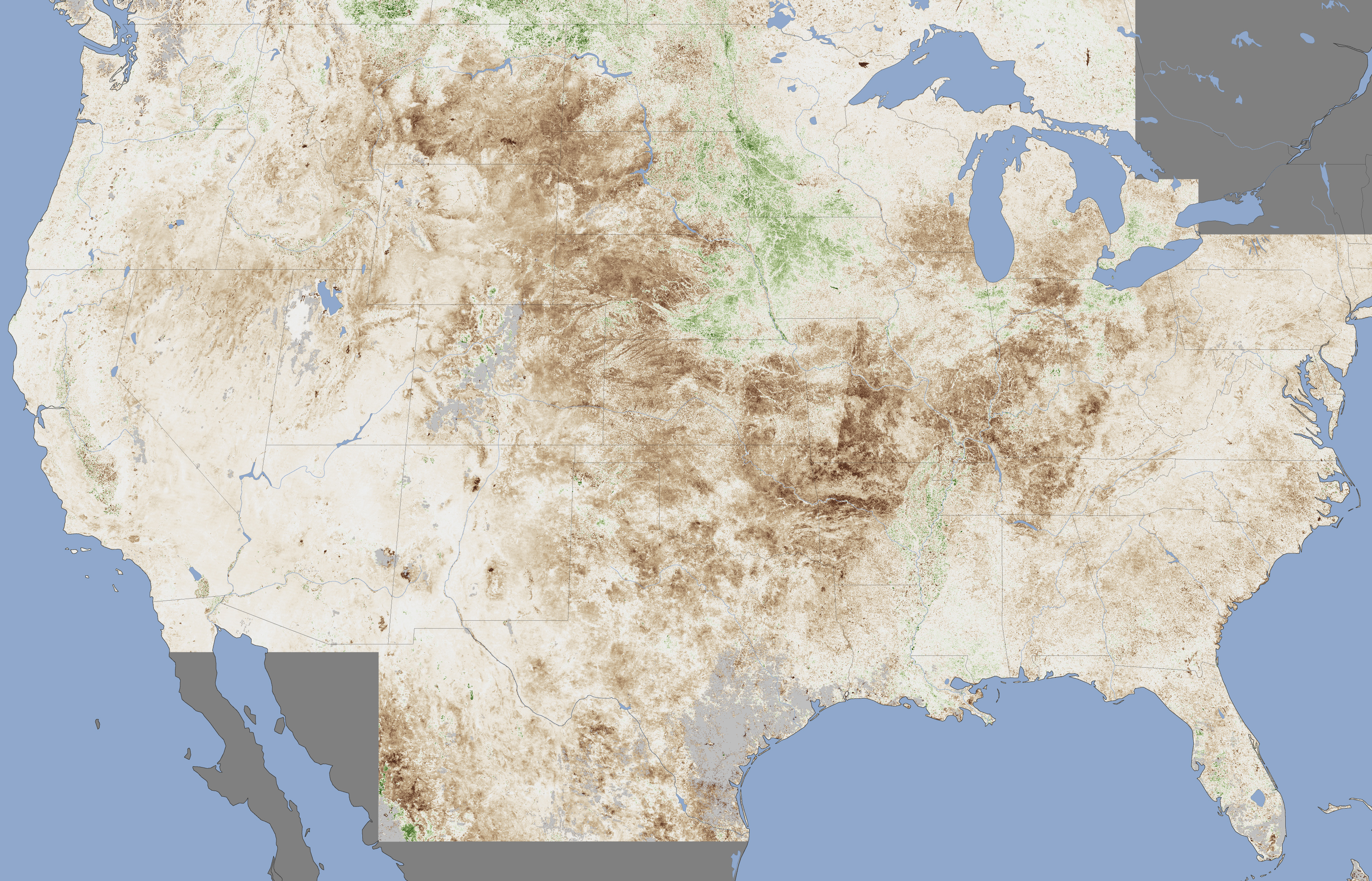
Farmers across the United States hoped for rain in July 2012 as a drought of historic proportions parched key commodity crops, including corn, soybeans, and wheat. On July 11, the United States Department of Agriculture announced that more than 1,000 counties in 26 states qualified as natural disaster areas—the largest total area ever declared a disaster zone by the agency.

The extent of the damage to crops is depicted in this vegetation anomaly map based on data from the Moderate Resolution Imaging Spectroradiometer (MODIS) on NASA’s Terra satellite. The map contrasts plant health in the central United States between June 25 and July 10, 2012, against the average conditions between 2002 and 2012. Brown areas show where plant growth was less vigorous than normal; cream colors depict normal levels of growth; and green indicates abnormally lush vegetation. Data was not available in the gray areas due to snow or cloud cover. The image is based on the Normalized Difference Vegetation Index (NDVI), a measure of how much plant leaves absorb visible light and reflect infrared light. Drought-stressed vegetation reflects more visible light and less infrared than healthy vegetation.

The most severe damage to crops appears to be centered on Missouri, Arkansas, Oklahoma, Texas, Kansas, Nebraska, and South Dakota. Crops in much of the upper Midwest—southern Wisconsin, Michigan, Indiana, southern Illinois, western Kentucky, and western Tennessee—also show signs of strain. States in the Mountain West that are in the midst of a busy wildfire season—Montana, Wyoming, and Colorado—have also experienced marked declines in the health of vegetation. The drought has been less severe in Iowa, a key corn-growing state.

This drought, like all extreme weather events, has its direct cause in a complex set of atmospheric conditions that produce short-term weather. However, weather occurs within the broader context of climate, and there’s widespread agreement among scientists that the climate is changing due to human activity.

According to a recent IPCC report on extreme weather, there is “medium confidence” that droughts have grown longer and more severe in some parts of the world since 1950, particularly in southern Europe and West Africa. However, the trends appear to be the reverse for droughts in central North America and northwestern Australia. Overall, the scientists who prepared the IPCC report assert a medium level of confidence in their ability to attribute observed changes in drought patterns to human activity.

References
Atlantic Wire. (2012, July 12). U.S. Declares the Largest National Disaster Area Ever Due to Drought. Accessed July 16, 2012.
Climate Central. (2012, July 13). Midwest to Mid-Atlantic Bracing for Onslaught of Heat. Accessed July 16, 2012.
NASA Earth Observatory. (2010, June 3). Global Warming.
U.S. Drought Monitor. (2012, July). U.S. Drought Monitor: July 10 (pdf). Accessed July 16, 2012.

Further Reading
Farm Futures. (2012, July 14). Satellite Imagery Reveals Widespread Farm Crop Stress. Accessed July 16, 2012.
NOAA. (2012). State of the Climate National Overview: June. Accessed July 16, 2012.
Peterson, T. (2012, July). Explaining Extreme Events of 2011 from a Climate Perspective. Bulletin of the American Meteorological Society.

NASA Earth Observatory image by Jesse Allen, Earth Observatory,using data provided by Inbal Reshef, Global Agricultural Monitoring Project. Caption by Adam Voiland.Instrument: Terra - MODIS

martes, 17 de julio de 2012

The Big Heat

JULY 23, 2012

Corn sex is complicated. As Michael Pollan observes in “The Omnivore’s Dilemma,” the whole affair is so freakishly difficult it’s hard to imagine how it ever evolved in the first place. Corn’s female organs are sheathed in a sort of vegetable chastity belt—surrounded by a tough, virtually impenetrable husk. The only way in is by means of a silk thread that each flower extends, Rapunzel-like, through a small opening. For fertilization to take place, a grain of pollen must land on the tip of the silk, then shimmy its way six to eight inches through a microscopic tube, a journey that requires several hours. The result of a successfully completed passage is a single kernel. When everything is going well, the process is repeated something like eight hundred times per ear, or roughly eighty thousand times per bushel.

It is now corn-sex season across the Midwest, and everything is not going well. High commodity prices spurred farmers to sow more acres this year, and unseasonable warmth in March prompted many to plant corn early. Just a few months ago, the United States Department of Agriculture was projecting a record corn crop of 14.79 billion bushels. But then, in June and July, came broilingly high temperatures, combined with a persistent drought across much of the midsection of the country.

“You couldn’t choreograph worse weather conditions for pollination,” Fred Below, a crop biologist at the University of Illinois at Urbana-Champaign, told Bloomberg News recently. “It’s like farming in Hell.” Last week, the U.S.D.A. officially cut its yield forecast by twelve per cent, citing a “rapid decline in crop conditions since early June and the latest weather data.” Also last week, because of the dryness, the U.S.D.A. declared more than a thousand counties in twenty-six states to be natural disaster areas. This was by far the largest such designation the agency has ever made. In the past month, as the severity of the situation has become apparent, corn prices have risen by more than forty per cent. Since so much corn is used to feed livestock, it’s likely that the increase will translate into higher prices for dairy products and beef—although, as many have pointed out, beef prices were already rising, owing to last year’s devastating drought in Texas.

Up until fairly recently, it was possible—which, of course, is not the same as advisable—to see climate change as a phenomenon that was happening somewhere else. In the Arctic, Americans were told (again and again and again), the effects were particularly dramatic. The sea ice was melting. This was bad for native Alaskans, and even worse for polar bears, who rely on the ice for survival. But in the Lower Forty-eight there always seemed to be more pressing concerns, like Barack Obama’s birth certificate. Similarly, the Antarctic Peninsula was reported to be warming fast, with unfortunate consequences for penguins and sea levels. But penguins live far away and sea-level rise is prospective, so again the issue seemed to lack “the fierce urgency of now.”

The summer of 2012 offers Americans the best chance yet to get their minds around the problem. In late June, just as a sizzling heat wave was settling across much of the country—in Evansville, Indiana, temperatures rose into the triple digits for ten days, reaching as high as a hundred and seven degrees—wildfires raged in Colorado. Hot and extremely dry conditions promoted the flames’ spread. “It’s no exaggeration to say Colorado is burning,” KDVR, the Fox station in Denver, reported. By the time the most destructive blaze was fully contained, almost three weeks later, it had scorched nearly twenty-nine square miles. Meanwhile, a “super derecho”—a long line of thunderstorms—swept from Illinois to the Atlantic Coast, killing at least thirteen people and leaving millions without power.

Referring to the fires, the drought, and the storms, Jonathan Overpeck, a professor of geosciences and atmospheric sciences at the University of Arizona, told the Associated Press, “This is certainly what I and many other climate scientists have been warning about.” He also noted, “This is what global warming looks like at the regional or personal level.”

Or, at least, what it looks like right now. One of the most salient—but also, unfortunately, most counterintuitive—aspects of global warming is that it operates on what amounts to a time delay. Behind this summer’s heat are greenhouse gases emitted decades ago. Before many effects of today’s emissions are felt, it will be time for the Summer Olympics of 2048. (Scientists refer to this as the “commitment to warming.”) What’s at stake is where things go from there. It is quite possible that by the end of the century we could, without even really trying, engineer the return of the sort of climate that hasn’t been seen on earth since the Eocene, some fifty million years ago.

Along with the heat and the drought and the super derecho, the country this summer is also enduring a Presidential campaign. So far, the words “climate change” have barely been uttered. This is not an oversight. Both President Obama and Mitt Romney have chosen to remain silent on the issue, presumably because they see it as just too big a bummer.

And so, while farmers wait for rain and this season’s corn crop withers on the stalk, the familiar disconnect continues. There’s no discussion of what could be done to avert the worst effects of climate change, even as the insanity of doing nothing becomes increasingly obvious. ♦

ILLUSTRATION: TOM BACHTELL

martes, 29 de mayo de 2012

A Last (Chemical) Gasp for Bees?

ORIGINAL: Yes Magazine
by Shannan Stoll
May 27, 2012 
Colony collapse disorder threatens food crops valued at $15 billion a year. New research says farm chemicals put our food system at risk.
(Photo by Brian Wolfe)
Newly published scientific evidence is bolstering calls for greater regulation of some of the world’s most widely used pesticides and genetically modified crops.

Earlier this year, three independent studies linked agricultural insecticides to colony collapse disorder, a phenomenon that leads honeybees to abandon their hives.

Beekeepers have reported alarming losses in their hives over the last six years. The USDA reports the loss in the United States was about 30 percent in the winter of 2010-2011.

Bees are crucial pollinators in the ecosystem. Their loss also impacts the estimated $15 billion worth of fruit and vegetable crops that are pollinated by bees in the United States.

The studies, conducted in the United States, France, and the United Kingdom, all pointed to neonicotinoids, a class of chemicals used widely in U.S. corn production, as likely contributors to colony collapse disorder. The findings challenged the EPA’s position—based on studies by Bayer CropScience, a major producer of the neonicotinoid clothianidin—that bees are only exposed to small, benign amounts of these insecticides.

The new studies found that bees are exposed to potentially lethal amounts of neonicotinoids in pollen and in dust churned up by farm equipment. They also found that exposure to neonicotinoids can reduce the number of queen bees and disorient worker bees.

An alliance of beekeepers and environmental groups filed a petition on March 21 asking the EPA to block the use of clothianidin in agricultural fields until the EPA conducts a sound scientific review of the chemicals.

Meanwhile, farm chemicals and the biotech industry have come under fire for the problem of pest resistance. Some weeds and bugs have become less susceptible or immune to the chemicals or biotechnology used to control them.

In March, national experts on corn pests published a letter to the EPA describing how rapidly rootworms are becoming resistant to the larvae-killing gene in Monsanto’s genetically engineered “Bt” corn. The letter warns that the EPA should move to regulate Bt corn—by requiring, for example, non-GM buffer zones—with “some sense of urgency.”

In a similarly alarming trend, Monsanto’s “Roundup Ready” soy and corn, which are genetically modified to tolerate the active ingredient in Roundup, are associated with the creation of “super weeds.” The widespread use of these crops has led farmers to vastly increased use of the herbicide, leading to the development of resistant weeds.

The agriculture industry has responded to Roundup’s failure by developing new crop varieties resistant to another pesticide/herbicide, 2,4-D. An ingredient of Agent Orange, 2,4-D is linked to birth defects, hormone disruption, and cancer. Last December, Dow AgroSciences LLC asked the U.S. Department of Agriculture to approve the new varieties for cultivation.

Shannan Stoll wrote this article for Making it Home, the Summer 2012 issue of YES! Magazine. 
Shannan Stoll is an intern at YES! Magazine

martes, 22 de mayo de 2012

El 90 por ciento de semillas de maíz están cubiertas con plaguicidas de Bayer que están exterminando las abejas

ORIGINAL: MotherJones
Por Tom Philpott
May. 16, 2012

calxfornia/Flickr
Estoy haciendo algo muy extraño esta semana: hablando en la conferencia anual de CropLife America, el grupo comercial principal de la industria agroquímica EE.UU.. Los miembros de Croplife incluyen Monsanto, Dow, Bayer y Syngenta, todas las empresas grandes multinacionales sobre las que escribo con regularidad y mordacidad. Estoy asombrado de que Croplife quiera escuchar lo que tengo que decir-lo que pienso de las empresas miembros del grupo y sus productos es un asunto de registro público, y tengo curiosidad por escuchar lo que tienen que decir a mí.

Mientras me preparaba para la conferencia, algunos artículos interesantes noticias sobre la industria pasaron por mi escritorio.
  • Como he escrito antes, los pesticidas neonicotinoides de Bayer, que ahora llegan a recubrir el 90 por ciento de las semillas de maíz de Estados Unidos y las semillas de porciones cada vez mayores de otros cultivos importantes como la soya, han surgido como un factor desencadenante para el trastorno del colapso de colonias de abejas. Vea este informe de NBC News de la semana pasada vinculado con la muerte de abejas en Minnesota y el producto altamente rentable de Bayer. Mientras tanto, el Columbus Dispatch informa semejante mortandad de abejas en las granjas de Ohio del país de la granja, con los apicultores allí, también, señalar con el dedo a Bayer.
  • Uno de mis mayores quejas acerca de la industria agroquímica es su dominio del mercado. Como he dicho anteriormente, más del 90 por ciento de las semillas de maíz plantado hoy en día son tratados con pesticidas de Bayer. ¿Qué pasa si un agricultor quiere optar, para plantar las semillas libres de los neonicotinoides? Buena suerte. Según un comunicado de prensa de la Red de Acción en Plaguicidas que he recibido hoy, los agricultores del medio Oeste se quejan de que es prácticamente imposible comprar las semillas no tratadas. En otras palabras, los agricultores allí tienes dos opciones: o bien pagar hasta por el veneno de Bayer, o salir del negocio de cultivo del maíz.
  • Hablando de la dominación del mercado, fundamentalmente Monsanto posee el mercado de semillas modificadas genéticamente, una posición altamente lucrativa, dada la manera en la cual los organismos modificados genéticamente se han apoderado de los cultivos masivos como el maíz, la soja y el algodón. Y como cualquier empresa bien gestionada para maximizar las ganancias para sus accionistas, Monsanto invierte parte de sus beneficios en la protección de su mercado de los reguladores molestos que pudieran colocar el interés público sobre Monsanto. Del Center for Responsive Politics, que rastrea el dinero en la política: "De acuerdo a los datos de OpenSecrets.org, en los tres primeros meses de este año, Monsanto gastó $ 1,4 millones de cabildeo en Washington, y ha gastado unos $ 6,3 millones en total el año pasado, más que cualquier empresa agrícola, excepto de la compañía tabacalera Altria."
La inversión del año pasado parecía que pagaría a la empresa. A pesar de que la tecnología Roundup Ready de Monsanto falló en un bombardeo de supermalezas resistentes, el USDA aprobó sin condiciones la alfalfa Roundup Ready, después de  insinuar que impondría limitaciones en el cultivo. El USDA también aprobó la remolacha de azúcar Roundup Ready, desafiando una orden judicial que retrasar la aprobación pendiente de una revisión ambiental.

Cuando una empresa domina los mercados y puede comprar poder de cabildeo en Washington, sus productos en realidad no tienen que servir, supongo.