Mostrando entradas con la etiqueta HIV. Mostrar todas las entradas

martes, 27 de septiembre de 2016

Yes, you really can make your own EpiPen for $30

Greg Friese/Flickr
Thank you, biohackers.

In the latest example of corporate greed in the pharmaceutical world, the US state of West Virginia announced today that it's investigating the makers of the EpiPen for Medicaid fraud - which means they think it's defrauded the US government healthcare system.

More specifically, it's accusing manufacturers Mylan of inflating the price of EpiPens by almost 500 percent since they purchased the life-saving device back in 2007

Since then, the cost of a single EpiPen has gone from around US$57 to $318 - a 461 percent increase. Which is pretty frustrating when you consider that many people with allergies need to keep the medication on them at all times in case of going into life-threatening anaphylaxis. Anaphylaxis can be triggered by anything from a bee sting to eating trace amounts of peanut.

In the face of the public backlash over their price rises, at the end of last month, Mylan announced they'd be releasing a generic version of the EpiPen that would cost only $150 per injection.

But industry insiders were quick to criticise this apparent act of goodwill, with pharmaceutical experts telling NBC News earlier this month that they estimated an EpiPen would only cost around $30 to make.

Now a bio-hacking collective called Four Thieves Vinegar has tested that claim out for themselves, and shown you really can engineer your own DIY EpiPen - which they called the "EpiPencil" - for around $35. And they claim it works as well as the $300 version - although we definitely don't recommend you try it at home.

The main difference between their version and the one you can buy at the pharmacy is that you have to measure out the correct dose of epinephrine before using the DIY version.

"We've gotten many requests to do something about the EpiPen, so we have,"says Michael Laufer, one of the founders of Four Thieves Vinegar, who has a PhD in mathematics from the City University of New York.

"We developed the EpiPencil, which is an epinephrine auto-injector built entirely from off-the-shelf parts, which can be assembled in a matter of minutes for just over $30."

EpiPens are designed as 'last resort' devices that are filled with epinephrine, an adrenaline drug that's more than 100 years old. The drug itself isn't patented, but what makes the EpiPen so attractive is the fact that its design lets pretty much anyone use it - which is handy in emergency situations.

So why haven't many other companies stepped up as competition and made an EpiPen equivalent to rival Mylan's? As Jamie Condliffe explains for MIT Technology Review, a big issue is the patent problem.

Mylan has the patent on the auto-injecting device up until 2025, and while it would be possible to build another type of model that does the same thing, it makes things a lot tricker.

"[There's] fear of creating a device that doesn’t work reliably, and a regulatory process that makes getting products to market incredibly difficult," writes Condliffe.

Four Thieves Vinegar has now published a video and fully downloadable instructions on how to make your own DIY EpiPencil at home. 

To be clear, we're definitely not recommending you go out and make your own EpiPen. The Four Thieves Vinegar version is not only totally unregulated, but it also hasn't been shown to reliably work for everyone - something that would require years of clinical trials and peer-reviewed papers.

"It's essential to remember that epinephrine auto-injectors are life-saving products, and it is critical that they are made to a high standard of quality so patients can rely on them to work safely and effectively," said US Food and Drug Administration spokesperson, Theresa Eisenman. 

But as an experiment to show that the EpiPen really can be created for around $30 - and with non-bulk parts at that - the Four Thieves Vinegar DIY version definitely makes its point. And hopefully it reminds people that they shouldn't have to pay ridiculous amounts for life-saving medicine.

"You know there are people who are just not buying an EpiPen because they can’t afford it," Laufer told The Parallax. "That’s unconscionable."


With West Virginia's new investigation and the public still pretty pissed off about the cost of EpiPens, it'll be interesting to see what happens next. Your move, Mylan.


Four Thieves Vinegar Biohacking Collective's Mantra: "Free Medicine for Everyone"


People are disenfranchised from access to medicine for various reasons. To circumvent these, we have developed a way for individuals to manufacture their own medications. We have designed an open-source automated lab reactor, which can be built with off-the-shelf parts, and can be set to synthesize different medications. This will save hundreds of thousands of lives.

The main reasons for people being disenfranchised from medicines are: price, legality, and lack of infrastructure. Medicines like Solvadi which costs $80,000 for a course of treatment, is beyond the reach of most people. Mifepristone and Misoprostal are unavailable in many places where abortion is illegal. Antiretroviral HIV treatments even when provided free, have no way of getting to remote locations in 3rd world countries.

The design will be published online, along with synthesis programs. The system will also have a forum system for users to communicate and contribute to the development of the system. With time, the system will become self-sustaining, much like other open source movements.

Original: Science Alert
FIONA MACDONALD
21 SEP 2016
Original: Four Thieves Vinegar.org

viernes, 27 de marzo de 2015

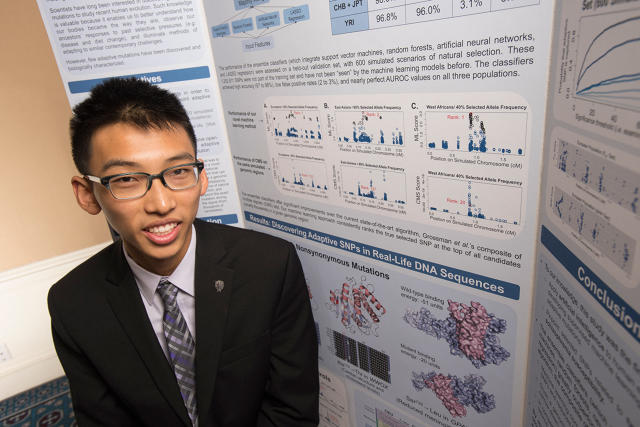
This 17-Year-Old Has Discovered DNA Mutations That Could Combat HIV And Meningitis

photo: Gio.tto via Shutterstock]

High schooler Andrew Jin is answering previously unasked questions in biology.


Like plenty of science-oriented high school kids, Andrew Jin is interested in human evolution. But Jin, one of three $150,000 first-place winners in this year's Intel Science Talent Search, took that interest further than most. For his project, the high school senior came up with machine learning algorithms that detect mutations in the human genome—mutations that could one day be used to develop drugs to combat diseases like HIV and schizophrenia.


Initially, Jin wanted to investigate how humans have evolved over the past 10,000 years. "I was doing it out of curiosity," he says. "I started thinking about natural selection and evolution, and that we understand so much about its theory, but we know nothing about reality. I was curious about what mutations help us be sophisticated human beings."

Jin decided to examine 179 human DNA sequences from different parts of the world. Each sequence consisted of 3 million base pairs of DNA—far too much to look at without help from an algorithm. So he set up a machine learning algorithm and found 130 potentially adaptive mutations, related to things like immune response and metabolism, that played a role in human evolution.

Working from a summer program at MIT, Jin refined his research and came up with a handful of mutations, including ones involved in resistance to meningitis and decreased susceptibility to viruses like influenza and HIV, that could potentially be used by pharmaceutical companies in new drug development.

There have been other natural-selection studies in the past looking for adaptive mutations, but Jin says that many of his findings are new. There's still a long way to go before he starts chatting up Big Pharma, however. "There's very, very strong evidence for these mutations playing a role in disease resistance, but in order to confirm, I would have to do biological experiments to study their protective mechanisms. That’s what I’m interested in doing now," says Jin.

Once he gets to college (he's not yet sure where that will be), Jin plans to pursue computer science or biology. But that's not all he's good at: The teen is a talented pianist who has played at Carnegie Hall. "I'm also an avid Boy Scout," he says.

jueves, 19 de febrero de 2015

Scripps Florida Scientists Announce Anti-HIV Agent So Powerful It Can Work in a Vaccine

JUPITER, FL – February 18, 2015 – In a remarkable new advance against the virus that causes AIDS, scientists from The Scripps Research Institute (TSRI) have announced the creation of a novel drug candidate that is so potent and universally effective, it might work as part of an unconventional vaccine.

The research, which involved scientists from more than a dozen research institutions, was published February 18 online ahead of print by the prestigious journal Nature.

Michael Farzan. Michael Farzan Biosketch
The Scripps Research Institute (TSRI)
The study shows that the new drug candidate blocks every strain of HIV-1, HIV-2 and SIV (simian immunodeficiency virus) that has been isolated from humans or rhesus macaques, including the hardest-to-stop variants. It also protects against much-higher doses of virus than occur in most human transmission and does so for at least eight months after injection.

Our compound is the broadest and most potent entry inhibitor described so far,” said Michael Farzan, a professor on TSRI's Florida campus who led the effort. “Unlike antibodies, which fail to neutralize a large fraction of HIV-1 strains, our protein has been effective against all strains tested, raising the possibility it could offer an effective HIV vaccine alternative.

Blocking a Second Site
When HIV infects a cell, it targets the CD4 lymphocyte, an integral part of the body’s immune system. HIV fuses with the cell and inserts its own genetic material—in this case, single-stranded RNA—and transforms the host cell into a HIV manufacturing site.

The new study builds on previous discoveries by the Farzan laboratory, which show that a co-receptor called CCR5 contains unusual modifications in its critical HIV-binding region, and that proteins based on this region can be used to prevent infection.

With this knowledge, Farzan and his team developed the new drug candidate so that it binds to two sites on the surface of the virus simultaneously, preventing entry of HIV into the host cell. “When antibodies try to mimic the receptor, they touch a lot of other parts of the viral envelope that HIV can change with ease,” said TSRI Research Associate Matthew Gardner, the first author of the study with Lisa M. Kattenhorn of Harvard Medical School. “We’ve developed a direct mimic of the receptors without providing many avenues that the virus can use to escape, so we catch every virus thus far.

The team also leveraged preexisting technology in designing a delivery vehicle—an engineered adeno-associated virus, a small, relatively innocuous virus that causes no disease. Once injected into muscle tissue, like HIV itself, the vehicle turns those cells into “factories” that could produce enough of the new protective protein to last for years, perhaps decades, Farzan said.

Data from the new study showed the drug candidate binds to the envelope of HIV-1 more potently than the best broadly neutralizing antibodies against the virus. Also, when macaque models were inoculated with the drug candidate, they were protected from multiple challenges by SIV.

This is the culmination of more than a decade’s worth of work on the biochemistry of how HIV enters cells,” Farzan said. “When we did our original work on CCR5, people thought it was interesting, but no one saw the therapeutic potential. That potential is starting to be realized.

In addition to Farzan, Gardner and Kattenhorn, authors of the study, “AAV-expressed eCD4-Ig provides durable protection from multiple SHIV challenges,” include Hema R. Kondur, Tatyana Dorfman, Charles C. Bailey, Christoph H. Fellinger, Vinita R. Josh and Brian D. Quinlanand of TSRI; Dennis R. Burton of TSRI, the International AIDS Vaccine Initiative (IAVI) and Ragon Institute; Pascal Poignard of IAVI’s Neutralizing Antibody Center at TSRI; Jessica J. Chiang, Michael D. Alpert, Annie Y. Yao and Ronald C. Desrosiers of Harvard Medical School; Kevin G. Haworth and Paula M. Cannon of the University of Southern California; Julie M. Decker and Beatrice H. Hahn of the University of Pennsylvania; Sebastian P. Fuchs and Jose M. Martinez-Navio of the University of Miami Miller School of Medicine; Hugo Mouquet and Michel C. Nussenzweig of The Rockefeller University; Jason Gorman, Baoshan Zhang and Peter D. Kwong of the National Institutes of Health; Michael Piatak Jr. and Jeffrey D. Lifson of the Frederick National Laboratory for Cancer Research; Guangping Gao of the University of Massachusetts Medical School; David T. Evans of the University of Wisconsin; and Michael S. Seaman of Beth Israel Deaconess Medical Center.

The work was supported by the National Institutes of Health (grants R01 AI091476, R01 AI080324, P01 AI100263, RR000168 and R01AI058715).

About The Scripps Research Institute The Scripps Research Institute (TSRI) is one of the world's largest independent, not-for-profit organizations focusing on research in the biomedical sciences. TSRI is internationally recognized for its contributions to science and health, including its role in laying the foundation for new treatments for cancer, rheumatoid arthritis, hemophilia, and other diseases. An institution that evolved from the Scripps Metabolic Clinic founded by philanthropist Ellen Browning Scripps in 1924, the institute now employs about 3,000 people on its campuses in La Jolla, CA, and Jupiter, FL, where its renowned scientists—including two Nobel laureates—work toward their next discoveries. The institute's graduate program, which awards PhD degrees in biology and chemistry, ranks among the top ten of its kind in the nation. For more information, see www.scripps.edu.

# # #

For information:
Office of Communications
Tel: 858-784-2666
Fax: 858-784-8136
press@scripps.edu

ORIGNAL: Scripps

jueves, 6 de marzo de 2014

Can Gene Therapy Cure HIV?


Why It Matters

There is no cure for HIV, which can cause AIDS. In 2012, 1.6 million people died of AIDS-related illnesses.

The immune cells of HIV patients can be genetically engineered to resist infection, say researchers. In a small study in humans, scientists report that by creating a beneficial mutation in T cells, they may be able to nearly cure patients of HIV.

In a study published in the New England Journal of Medicine on Wednesday, researchers report that they can use genome editing to re-create the rare mutations responsible for protecting about 1 percent of the population from the virus in infected patients. They report that some of the patients receiving the genome-modifying treatment showed decreased viral loads during a temporary halt of their antiretroviral drugs. In one patient, the virus could no longer be detected in his blood.


Zinc-finger nucleases are one of a few genome-editing tools that researchers use to create specific changes to the genomes of living organisms and cells (see “Genome Surgery”). Scientists have previously used genome-editing techniques to modify DNA in human cells and nonhuman animals, including monkeys (see “Monkeys Modified with Genome Editing”). Now, the NEJM study suggests the method can also be safely used in humans.

From each participating patient, the team harvested bone marrow stem cells, which give rise to T cells in the body. They then used a zinc finger nuclease to “break” copies of the CCR5 gene that encodes for proteins on the surface of immune cells that are a critical entry point of HIV. The stem cells were then infused back into each patient’s bloodstream. The modification process isn’t perfect, so only some of the cells end up carrying the modification. “About 25 percent of the cells have at least one of the CCR5 genes interrupted,” says Edward Lanphier, CEO of Sangamo Biosciences, the Richmond, California, biotech company that manufactures zinc finger nucleases.

Because the cells are a patient’s own, there is no risk of tissue rejection. The modified stem cells then give rise to modified T cells that are more resistant to infection by HIV, say the researchers.

One week after the infusion, researchers were able to find modified T cells in the patients’ blood. Four weeks after the infusion, six of the 12 patients in the study temporarily stopped taking their antiretroviral drugs so the researchers could assess the effect of the genome-editing treatment on the amount of the virus in the patients’ bodies. In four of these patients, the amount of HIV in the blood dropped. In one patient, the virus could no longer be detected at all. The team later discovered that this best responder had naturally already had one mutated copy of the CCR5 gene.

Patients who carry one broken copy of the CCR5 progress to AIDS more slowly than those who don’t, says Bruce Levine, a cell and gene therapy researcher at the University of Pennsylvania School of Medicine and coauthor on the study. Because all of the cells in that best-responder patient already carried one disrupted copy of CCR5, the modification by the zinc finger nuclease led to T cells with no functional copies of the gene. That means the cells are fully resistant to HIV infection. The team is now working to increase the number of immune cells that end up carrying two broken copies of CCR5.