Mostrando entradas con la etiqueta Neural Networks. Mostrar todas las entradas

miércoles, 18 de octubre de 2017

Stunning AI Breakthrough Takes Us One Step Closer to the Singularity

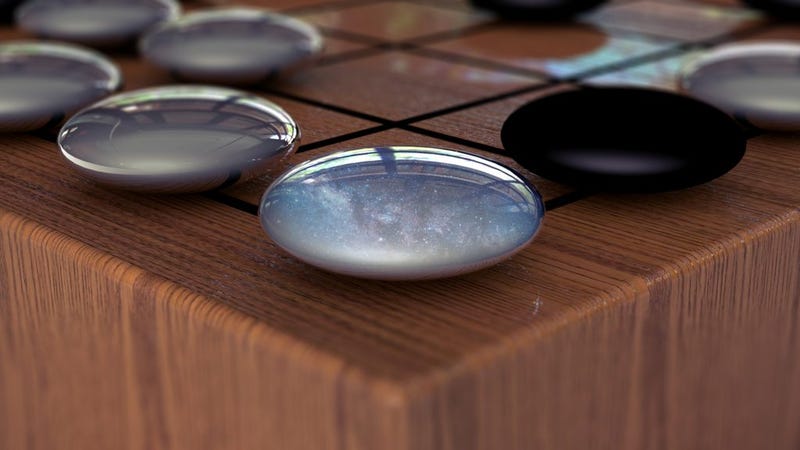
As a new Nature paper points out, “There are an astonishing 10 to the power of 170 possible board configurations in Go—more than the number of atoms in the known universe.” (Image: DeepMind)
Remember AlphaGo, the first artificial intelligence to defeat a grandmaster at Go?
Well, the program just got a major upgrade, and it can now teach itself how to dominate the game without any human intervention. But get this: In a tournament that pitted AI against AI, this juiced-up version, called AlphaGo Zero, defeated the regular AlphaGo by a whopping 100 games to 0, signifying a major advance in the field. Hear that? It’s the technological singularity inching ever closer.

A new paper published in Nature today describes how the artificially intelligent system that defeated Go grandmaster Lee Sedol in 2016 got its digital ass kicked by a new-and-improved version of itself. And it didn’t just lose by a little—it couldn’t even muster a single win after playing a hundred games. Incredibly, it took AlphaGo Zero (AGZ) just three days to train itself from scratch and acquire literally thousands of years of human Go knowledge simply by playing itself. The only input it had was what it does to the positions of the black and white pieces on the board.
  • In addition to devising completely new strategies
  • the new system is also considerably leaner and meaner than the original AlphaGo.

Lee Sedol getting crushed by AlphaGo in 2016. (Image: AP)
Now, every once in a while the field of AI experiences a “holy shit” moment, and this would appear to be one of those moments. Looking back, other “holy shit” moments include:
This latest achievement qualifies as a “holy shit” moment for a number of reasons.

First of all, the original AlphaGo had the benefit of learning from literally thousands of previously played Go games, including those played by human amateurs and professionals. AGZ, on the other hand, received no help from its human handlers, and had access to absolutely nothing aside from the rules of the game. Using “reinforcement learning,” AGZ played itself over and over again, “starting from random play, and without any supervision or use of human data,” according to the Google-owned DeepMind researchers in their study. This allowed the system to improve and refine its digital brain, known as a neural network, as it continually learned from experience. This basically means that AlphaGo Zero was its own teacher.

This technique is more powerful than previous versions of AlphaGo because it is no longer constrained by the limits of human knowledge,” notes the DeepMind team in a release. “Instead, it is able to learn tabula rasa [from a clean slate] from the strongest player in the world: AlphaGo itself.

When playing Go, the system considers the most probable next moves (a “policy network”), and then estimates the probability of winning based on those moves (its “value network”). AGZ requires about 0.4 seconds to make these two assessments. The original AlphaGo was equipped with a pair of neural networks to make similar evaluations, but for AGZ, the Deepmind developers merged the policy and value networks into one, allowing the system to learn more efficiently. What’s more, the new system is powered by four tensor processing units (TPUS)—specialized chips for neural network training. Old AlphaGo needed 48 TPUs.

After just three days of self-play training and a total of 4.9 million games played against itself, AGZ acquired the expertise needed to trounce AlphaGo (by comparison, the original AlphaGo had 30 million games for inspiration). After 40 days of self-training, AGZ defeated another, more sophisticated version of AlphaGo called AlphaGo “Master” that defeated the world’s best Go players and the world’s top ranked Go player, Ke Jie. Earlier this year, both the original AlphaGo and AlphaGo Master won a combined 60 games against top professionals. The rise of AGZ, it would now appear, has made these previous versions obsolete.

The time when humans can have a meaningful conversation with an AI has always seemed far off and the stuff of science fiction. But for Go players, that day is here.

This is a major achievement for AI, and the subfield of reinforcement learning in particular. By teaching itself, the system matched and exceeded human knowledge by an order of magnitude in just a few days, while also developing 
  • unconventional strategies and 
  • creative new moves
For Go players, the breakthrough is as sobering as it is exciting; they’re learning things from AI that they could have never learned on their own, or would have needed an inordinate amount of time to figure out.
[AlphaGo Zero’s] games against AlphaGo Master will surely contain gems, especially because its victories seem effortless,” wrote Andy Okun and Andrew Jackson, members of the American Go Association, in a Nature News and Views article. “At each stage of the game, it seems to gain a bit here and lose a bit there, but somehow it ends up slightly ahead, as if by magic... The time when humans can have a meaningful conversation with an AI has always seemed far off and the stuff of science fiction. But for Go players, that day is here.”
No doubt, AGZ represents a disruptive advance in the world of Go, but what about its potential impact on the rest of the world? According to Nick Hynes, a grad student at MIT’s Computer Science and Artificial Intelligence Laboratory (CSAIL), it’ll be a while before a specialized tool like this will have an impact on our daily lives.

So far, the algorithm described only works for problems where there are a countable number of actions you can take, so it would need modification before it could be used for continuous control problems like locomotion [for instance],” Hynes told Gizmodo. “Also, it requires that you have a really good model of the environment. In this case, it literally knows all of the rules. That would be as if you had a robot for which you could exactly predict the outcomes of actions—which is impossible for real, imperfect physical systems.

The nice part, he says, is that there are several other lines of AI research that address both of these issues (e.g. machine learning, evolutionary algorithms, etc.), so it’s really just a matter of integration. “The real key here is the technique,” says Hynes.

It’s like an alien civilization inventing its own mathematics which allows it to do things like time travel...Although we’re still far from ‘The Singularity,’ we’re definitely heading in that direction.
As expected—and desired—we’re moving farther away from the classic pattern of getting a bunch of human-labeled data and training a model to imitate it,” he said. “What we’re seeing here is a model free from human bias and presuppositions: It can learn whatever it determines is optimal, which may indeed be more nuanced that our own conceptions of the same. It’s like an alien civilization inventing its own mathematics which allows it to do things like time travel,” to which he added: “Although we’re still far from ‘The Singularity,’ we’re definitely heading in that direction.

Noam Brown, a Carnegie Mellon University computer scientist who helped to develop the first AI to defeat top humans in no-limit poker, says the DeepMind researchers have achieved an impressive result, and that it could lead to bigger, better things in AI.

While the original AlphaGo managed to defeat top humans, it did so partly by relying on expert human knowledge of the game and human training data,” Brown told Gizmodo. “That led to questions of whether the techniques could extend beyond Go. AlphaGo Zero achieves even better performance without using any expert human knowledge. It seems likely that the same approach could extend to all perfect-information games [such as chess and checkers]. This is a major step toward developing general-purpose AIs.

As both Hynes and Brown admit, this latest breakthrough doesn’t mean the technological singularity—that hypothesized time in the future when greater-than-human machine intelligence achieves explosive growth—is imminent. But it should cause pause for thought. Once 
  • we teach a system the rules of a game or 
  • the constraints of a real-world problem, 
the power of reinforcement learning makes it possible to simply press the start button and let the system do the rest. It will then figure out the best ways to succeed at the task, devising solutions and strategies that are beyond human capacities, and possibly even human comprehension.

As noted, AGZ and the game of Go represent an oversimplified, constrained, and highly predictable picture of the world, but in the future, AI will be tasked with more complex challenges. Eventually, self-teaching systems will be used to solve more pressing problems, such as protein folding to conjure up new medicines and biotechnologies, figuring out ways to reduce energy consumption, or when we need to design new materials. A highly generalized self-learning system could also be tasked with improving itself, leading to artificial general intelligence (i.e. a very human-like intelligence) and even artificial superintelligence.

As the DeepMind researchers conclude in their study, “Our results comprehensively demonstrate that a pure reinforcement learning approach is fully feasible, even in the most challenging of domains: it is possible to train to superhuman level, without human examples or guidance, given no knowledge of the domain beyond basic rules.

And indeed, now that human players are no longer dominant in games like chess and Go, it can be said that we’ve already entered into the era of superintelligence. This latest breakthrough is the tiniest hint of what’s still to come.

[Nature]

ORIGINAL: Gizmodo 
By George Dvorsky 
2017/10/18

sábado, 3 de junio de 2017

We Could Build an Artificial Brain Right Now

Large-scale brainlike systems are possible with existing technology—if we’re willing to spend the money

Photo: Dan Saelinger


Brain-inspired computing is having a moment. Artificial neural network algorithms like deep learning, which are very loosely based on the way the human brain operates, now allow digital computers to perform such extraordinary feats as translating language, hunting for subtle patterns in huge amounts of data, and beating the best human players at Go.

But even as engineers continue to push this mighty computing strategy, the energy efficiency of digital computing is fast approaching its limits. Our data centers and supercomputers already draw megawatts—some 2 percent of the electricity consumed in the United States goes to data centers alone. The human brain, by contrast, runs quite well on about 20 watts, which represents the power produced by just a fraction of the food a person eats each day. If we want to keep improving computing, we will need our computers to become more like our brains.

Hence the recent focus on neuromorphic technology, which promises to move computing beyond simple neural networks and toward circuits that operate more like the brain’s neurons and synapses do. The development of such physical brainlike circuitry is actually pretty far along. Work at my lab and others around the world over the past 35 years has led to artificial neural components like synapses and dendrites that respond to and produce electrical signals much like the real thing.

So, what would it take to integrate these building blocks into a brain-scale computer? 
In 2013, Bo Marr, a former graduate student of mine at Georgia Tech, and I looked at the best engineering and neuroscience knowledge of the time and concluded that it should be possible to build a silicon version of the human cerebral cortex with the transistor technology then in production. What’s more, the resulting machine would take up less than a cubic meter of space and consume less than 100 watts, not too far from the human brain.

That is not to say creating such a computer would be easy. The system we envisioned would still require a few billion dollars to design and build, including some significant packaging innovations to make it compact. There is also the question of how we would program and train the computer. Neuromorphic researchers are still struggling to understand how to make thousands of artificial neurons work together and how to translate brainlike activity into useful engineering applications.

Still, the fact that we can envision such a system means that we may not be far off from smaller-scale chips that could be used in portable and wearable electronics. These gadgets demand low power consumption, and so a highly energy-efficient neuromorphic chip—even if it takes on only a subset of computational tasks, such as signal processing—could be revolutionary. Existing capabilities, like speech recognition, could be extended to handle noisy environments. We could even imagine future smartphones conducting real-time language translation between you and the person you’re talking to. Think of it this way: In the 40 years since the first signal-processing integrated circuits, Moore’s Law has improved energy efficiency by roughly a factor of 1,000. The most brainlike neuromorphic chips could dwarf such improvements, potentially driving down power consumption by another factor of 100 million. That would bring computations that would otherwise need a data center to the palm of your hand.

The ultimate brainlike machine will be one in which we build analogues for all the essential functional components of the brain
  • the synapses, which connect neurons and allow them to receive and respond to signals; 
  • the dendrites, which combine and perform local computations on those incoming signals; and 
  • the core, or soma, region of each neuron, which integrates inputs from the dendrites and transmits its output on the axon.
Simple versions of all these basic components have already been implemented in silicon. The starting point for such work is the same metal-oxide-semiconductor field-effect transistor, or MOSFET, that is used by the billions to build the logic circuitry in modern digital processors.

These devices have a lot in common with neurons. Neurons operate using voltage-controlled barriers, and their electrical and chemical activity depends primarily on channels in which ions move between the interior and exterior of the cell—a smooth, analog process that involves a steady buildup or decline instead of a simple on-off operation.

MOSFETs are also voltage controlled and operate by the movement of individual units of charge. And when MOSFETs are operated in the “subthreshold” mode, below the voltage threshold used to digitally switch between on and off, the amount of current flowing through the device is very small—less than a thousandth of what is seen in the typical switching of digital logic gates.

The notion that subthreshold transistor physics could be used to build brainlike circuitry originated with Carver Mead of Caltech, who helped revolutionize the field of very-large-scale circuit design in the 1970s. Mead pointed out that chip designers fail to take advantage of a lot of interesting behavior—and thus information—when they use transistors only for digital logic. The process, he wrote in 1990 [PDF], essentially involves “taking all the beautiful physics that is built into...transistors, mashing it down to a 1 or 0, and then painfully building it back up with AND and OR gates to reinvent the multiply.A more “physical” or “physics-based” computer could execute more computations per unit energy than its digital counterpart. Mead predicted such a computer would take up significantly less space as well.

In the intervening years, neuromorphic engineers have made all the basic building blocks of the brain out of silicon with a great deal of biological fidelity. The neuron’s dendrite, axon, and soma components can all be fabricated from standard transistors and other circuit elements. In 2005, for example, Ethan Farquhar, then a Ph.D. candidate, and I created a neuron circuit using a set of six MOSFETs and a handful of capacitors. Our model generated electrical pulses that very closely matched those in the soma part of a squid neuron, a long-standing experimental subject. What’s more, our circuit accomplished this feat with similar current levels and energy consumption to those in the squid’s brain. If we had instead used analog circuits to model the equations neuroscientists have developed to describe that behavior, we’d need on the order of 10 times as many transistors. Performing those calculations with a digital computer would require even more space.
Illustration: James Provost Synapses and Soma: The floating-gate transistor [top left], which can store differing amounts of charge, can be used to build a “crossbar” array of artificial synapses [bottom left]. Electronic versions of other neuron components, such as the soma region [right], can be made from standard transistors and other circuit components.
Emulating synapses is a little trickier. A device that behaves like a synapse must have the ability to remember what state it is in, respond in a particular way to an incoming signal, and adapt its response over time.

There are a number of potential approaches to building synapses. The most mature one by far is the single-transistor learning synapse (STLS), a device that my colleagues and I at Caltech worked on in the 1990s while I was a graduate student studying under Mead.

We first presented the STLS in 1994, and it became an important tool for engineers who were building modern analog circuitry, such as physical neural networks. In neural networks, each node in the network has a weight associated with it, and those weights determine how data from different nodes are combined. The STLS was the first device that could hold a variety of different weights and be reprogrammed on the fly. The device is also nonvolatile, which means that it remembers its state even when not in use—a capability that significantly reduces how much energy it needs.

The STLS is a type of floating-gate transistor, a device that is used to build memory cells in flash memory. In an ordinary MOSFET, a gate controls the flow of electricity through a current-carrying channel. A floating-gate transistor has a second gate that sits between this electrical gate and the channel. This floating gate is not directly connected to ground or any other component. Thanks to that electrical isolation, which is enhanced by high-quality silicon-insulator interfaces, charges remain in the floating gate for a long time. The floating gate can take on many different amounts of charge and so have many different levels of electrical response, an essential requisite for creating an artificial synapse capable of varying its response to stimuli.

My colleagues and I used the STLS to demonstrate the first crossbar network, a computational model currently popular with nanodevice researchers. In this two-dimensional array, devices sit at the intersection of input lines running north-south and output lines running east-west. This configuration is useful because it lets you program the connection strength of each “synapse” individually, without disturbing the other elements in the array.

Thanks in part to a recent Defense Advanced Research Projects Agency program called SyNAPSE, the neuromorphic engineering field has seen a surge of research into artificial synapses built from nanodevices such as

  • memristors
  • resistive RAM, and 
  • phase-change memories (as well as floating-gate devices). 
But it will be hard for these new artificial synapses to improve on our two-decade-old floating-gate arrays. Memristors and other novel memories come with programming challenges; some have device architectures that make it difficult to target a single specific device in a crossbar array. Others need a dedicated transistor in order to be programmed, adding significantly to their footprint. Because floating-gate memory is programmable over a wide range of values, it can be more easily fine-tuned to compensate for manufacturing variation from device to device than can many nanodevices. A number of neuromorphic research groups that tried integrating nanodevices into their designs have recently come around to using floating-gate devices.

So how will we put all these brainlike components together? 
In the human brain, of course, neurons and synapses are intermingled. Neuromorphic chip designers must take a more integrated approach as well, with all neural components on the same chip, tightly mixed together. This is not the case in many neuromorphic labs today: To make research projects more manageable, different building blocks may be placed in different areas. Synapses, for example, may be relegated to an off-chip array. Connections may be routed through another chip called a field-programmable gate array, or FPGA.

But as we scale up neuromorphic systems, we’ll need to take care that we don’t replicate the arrangement in today’s computers, which lose a significant amount of energy driving bits back and forth between logic, memory, and storage. Today, a computer can easily consume 10 times the energy to move the data needed for a multiple-accumulate operation—a common signal-processing computation—as it does to perform the calculation.

The brain, by contrast, minimizes the energy cost of communication by keeping operations highly local. The memory elements of the brain, such as synaptic strengths, are mixed in with the neural components that integrate signals. And the brain’s “wires”—the dendrites and axons that extend from neurons to transmit, respectively, incoming signals and outgoing pulses—are generally fairly short relative to the size of the brain, so they don’t require large amounts of energy to sustain a signal. From anatomical data, we know that more than 90 percent of neurons connect with only their nearest 1,000 or so neighbors.

Another big question for the builders of brainlike chips and computers is the algorithms we will run on them. Even a loosely brain-inspired system can have a big advantage over digital systems. In 2004, for example, my group used floating-gate devices to perform multiplications for signal processing with just 1/1,000 the energy and 1/100 the area of a comparable digital system. In the years since, other researchers and my group have successfully demonstrated neuromorphic approaches to many other kinds of signal-processing calculations.

But the brain is still 100,000 times as efficient as the systems in these demonstrations. That’s because while our current neuromorphic technology takes advantage of the neuronlike physics of transistors, it doesn’t consider the algorithms the brain uses to perform its operations.

Today, we are just beginning to discover these physical algorithms—that is, the processes that will allow brainlike chips to operate with more brainlike efficiency. Four years ago, my research group used silicon somas, synapses, and dendrites to perform a word-spotting algorithm that identifies words in a speech waveform. This physical algorithm exhibited a thousandfold improvement in energy efficiency over predicted analog signal processing. Eventually, by lowering the amount of voltage supplied to the chips and using smaller transistors, researchers should be able to build chips that parallel the brain in efficiency for a range of computations.

When I started in neuromorphic research 30 years ago, everyone believed tremendous opportunities would arise from designing systems that are more like the brain. And indeed, entire industries are now being built around brain-inspired AI and deep learning, with applications that promise to transform—among other things—our mobile devices, our financial institutions, and how we interact in public spaces.

And yet, these applications rely only slightly on what we know about how the brain actually works. The next 30 years will undoubtedly see the incorporation of more such knowledge. We already have much of the basic hardware we need to accomplish this neuroscience-to-computing translation. But we must develop a better understanding of how that hardware should behave—and what computational schemes will yield the greatest real-world benefits.

Consider this a call to action. We have come pretty far with a very loose model of how the brain works. But neuroscience could lead to far more sophisticated brainlike computers. And what greater feat could there be than using our own brains to learn how to build new ones?

This article appears in the June 2017 print issue as “A Road Map for the Artificial Brain.”

About the Author

Jennifer Hasler is a professor of electrical and computer engineering at the Georgia Institute of Technology.

ORIGINAL: IEEE Spectrum
By JENNIFER HASLER 
Posted 1 Jun 2017 | 19:00 GMT

jueves, 19 de mayo de 2016

Inside Vicarious, the Secretive AI Startup Bringing Imagination to Computers

By reinventing the neural network, the company hopes to help computers make the leap from processing words and symbols to comprehending the real world.

Life would be pretty dull without imagination. In fact, maybe the biggest problem for computers is that they don’t have any.

That’s the belief motivating the founders of Vicarious, an enigmatic AI company backed by some of the most famous and successful names in Silicon Valley. Vicarious is developing a new way of processing data, inspired by the way information seems to flow through the brain. The company’s leaders say this gives computers something akin to imagination, which they hope will help make the machines a lot smarter.

Vicarious is also, essentially, betting against the current boom in AI. Companies including Google, Facebook, Amazon, and Microsoft have made stunning progress in the past few years by feeding huge quantities of data into large neural networks in a process called “deep learning.” When trained on enough examples, for instance, deep-learning systems can learn to recognize a particular face or type of animal with very high accuracy (see “10 Breakthrough Technologies 2013: Deep Learning”). But those neural networks are only very crude approximations of what’s found inside a real brain.

Illustration by Sophia Foster-Dimino
Vicarious has introduced a new kind of neural-network algorithm designed to take into account more of the features that appear in biology. An important one is the ability to picture what the information it’s learned should look like in different scenarios—a kind of artificial imagination. The company’s founders believe a fundamentally different design will be essential if machines are to demonstrate more human like intelligence. Computers will have to be able to learn from less data, and to recognize stimuli or concepts more easily.

Despite generating plenty of early excitement, Vicarious has been quiet over the past couple of years. But this year, the company says, it will publish details of its research, and it promises some eye-popping demos that will show just how useful a computer with an imagination could be.

The company’s headquarters don’t exactly seem like the epicenter of a revolution in artificial intelligence. Located in Union City, a short drive across the San Francisco Bay from Palo Alto, the offices are plain—a stone’s throw from a McDonald’s and a couple of floors up from a dentist. Inside, though, are all the trappings of a vibrant high-tech startup. A dozen or so engineers were hard at work when I visited, several using impressive treadmill desks. Microsoft Kinect 3-D sensors sat on top of some of the engineers’ desks.

D. Scott Phoenix, the company’s 33-year-old CEO, speaks in suitably grandiose terms. “We are really rapidly approaching the amount of computational power we need to be able to do some interesting things in AI,” he told me shortly after I walked through the door. “In 15 years, the fastest computer will do more operations per second than all the neurons in all the brains of all the people who are alive. So we are really close.

Vicarious is about more than just harnessing more computer power, though. Its mathematical innovations, Phoenix says, will more faithfully mimic the information processing found in the human brain. It’s true enough that the relationship between the neural networks currently used in AI and the neurons, dendrites, and synapses found in a real brain is tenuous at best.

One of the most glaring shortcomings of artificial neural networks, Phoenix says, is that information flows only one way. “If you look at the information flow in a classic neural network, it’s a feed-forward architecture,” he says. “There are actually more feedback connections in the brain than feed-forward connections—so you’re missing more than half of the information flow.

It’s undeniably alluring to think that imagination—a capability so fundamentally human it sounds almost mystical in a computer—could be the key to the next big advance in AI.

Vicarious has so far shown that its approach can create a visual system capable of surprisingly deft interpretation. In 2013 it showed that the system could solve any captcha (the visual puzzles that are used to prevent spam-bots from signing up for e-mail accounts and the like). As Phoenix explains it, the feedback mechanism built into Vicarious’s system allows it to imagine what a character would look like if it weren’t distorted or partly obscured (see “AI Startup Says It Has Defeated Captchas”).

Phoenix sketched out some of the details of the system at the heart of this approach on a whiteboard. But he is keeping further details quiet until a scientific paper outlining the captcha approach is published later this year.

In principle, this visual system could be put to many other practical uses, like recognizing objects on shelves more accurately or interpreting real-world scenes more intelligently. The founders of Vicarious also say that their approach extends to other, much more complex areas of intelligence, including language and logical reasoning.

Phoenix says his company may give a demo later this year involving robots. And indeed, the job listings on the company’s website include several postings for robotics experts. Currently robots are bad at picking up unfamiliar, oddly arranged, or partly obscured objects, because they have trouble recognizing what they are. “If you look at people who are picking up objects in an Amazon facility, most of the time they aren’t even looking at what they’re doing,” he explains. “And they’re imagining—using their sensory motor simulator—where the object is, and they’re imagining at what point their finger will touch it.

While Phoenix is the company’s leader, his cofounder, Dileep George, might be considered its technical visionary. George was born in India and received a PhD in electrical engineering from Stanford University, where he turned his attention to neuroscience toward the end of his doctoral studies. In 2005 he cofounded Numenta with Jeff Hawkins, the creator of Palm Computing. But in 2010 George left to pursue his own ideas about the mathematical principles behind information processing in the brain, founding Vicarious with Phoenix the same year.

I bumped into George in the elevator when I first arrived. He is unassuming and speaks quietly, with a thick accent. But he’s also quite matter-of-fact about what seem like very grand objectives.

George explained that imagination could help computers process language by tying words, or symbols, to low-level physical representations of real-world things. In theory, such a system might automatically understand the physical properties of something like water, for example, which would make it better able to discuss the weather. “When I utter a word, you know what it means because you can simulate the concept,” he says.

This ambitious vision for the future of AI has helped Vicarious raise an impressive $72 million so far. Its list of investors also reads like a who’s who of the tech world. Early cash came from Dustin Moskovitz, ex-CTO of Facebook, and Adam D’Angelo, cofounder of Quora. Further funding came from Peter Thiel, Mark Zuckerberg, Jeff Bezos, and Elon Musk.

Many people are itching to see what Vicarious has done beyond beating captchas. “I would love it if they showed us something new this year,” says Oren Etzioni, CEO of the Allen Institute for Artificial Intelligence in Seattle.

In contrast to the likes of Google, Facebook, or Baidu, Vicarious hasn’t published any papers or released any tools that researchers can play with. “The people [involved] are great, and the problems [they are working on] are great,” says Etzioni. “But it’s time to deliver.

For those who’ve put their money behind Vicarious, the company’s remarkable goals should make the wait well worth it. Even if progress takes a while, the potential payoffs seem so huge that the bet makes sense, says Matt Ocko, a partner at Data Collective, a venture firm that has backed Vicarious. A better machine-learning approach could be applied in just about any industry that handles large amounts of data, he says. “Vicarious sat us down and demonstrated the most credible pathway to reasoning machines that I have ever seen.

Ocko adds that Vicarious has demonstrated clear evidence it can commercialize what it’s working on. “We approached it with a crapload of intellectual rigor,” he says.

It will certainly be interesting to see if Vicarious can inspire this kind of confidence among other AI researchers and technologists with its papers and demos this year. If it does, then the company could quickly go from one of the hottest prospects in the Valley to one of its fastest-growing businesses.

That’s something the company’s founders would certainly like to imagine.

ORIGINAL: MIT Tech Review
by Will Knight. Senior Editor, AI
May 19, 2016

lunes, 11 de abril de 2016

First Human Tests of Memory Boosting Brain Implant—a Big Leap Forward

You have to begin to lose your memory, if only bits and pieces, to realize that memory is what makes our lives. Life without memory is no life at all.” — Luis Buñuel Portolés, Filmmaker

Image Credit: Shutterstock.com
Every year, hundreds of millions of people experience the pain of a failing memory.

The reasons are many:

  • traumatic brain injury, which haunts a disturbingly high number of veterans and football players; 
  • stroke or Alzheimer’s disease, which often plagues the elderly; or 
  • even normal brain aging, which inevitably touches us all.
Memory loss seems to be inescapable. But one maverick neuroscientist is working hard on an electronic cure. Funded by DARPA, Dr. Theodore Berger, a biomedical engineer at the University of Southern California, is testing a memory-boosting implant that mimics the kind of signal processing that occurs when neurons are laying down new long-term memories.

The revolutionary implant, already shown to help memory encoding in rats and monkeys, is now being tested in human patients with epilepsy — an exciting first that may blow the field of memory prosthetics wide open.

To get here, however, the team first had to crack the memory code.

Deciphering Memory
From the very onset, Berger knew he was facing a behemoth of a problem.

We weren’t looking to match everything the brain does when it processes memory, but to at least come up with a decent mimic, said Berger.

Of course people asked: can you model it and put it into a device? Can you get that device to work in any brain? It’s those things that lead people to think I’m crazy. They think it’s too hard,” he said.

But the team had a solid place to start.

The hippocampus, a region buried deep within the folds and grooves of the brain, is the critical gatekeeper that transforms memories from short-lived to long-term. In dogged pursuit, Berger spent most of the last 35 years trying to understand how neurons in the hippocampus accomplish this complicated feat.

At its heart, a memory is a series of electrical pulses that occur over time that are generated by a given number of neurons, said Berger. This is important — it suggests that we can reduce it to mathematical equations and put it into a computational framework, he said.

Berger hasn’t been alone in his quest.
By listening to the chatter of neurons as an animal learns, teams of neuroscientists have begun to decipher the flow of information within the hippocampus that supports memory encoding. Key to this process is a strong electrical signal that travels from CA3, the “input” part of the hippocampus, to CA1, the “output” node.

This signal is impaired in people with memory disabilities, said Berger, so of course we thought if we could recreate it using silicon, we might be able to restore — or even boost — memory.

Bridging the Gap
Yet this brain’s memory code proved to be extremely tough to crack.

The problem lies in the non-linear nature of neural networks: signals are often noisy and constantly overlap in time, which leads to some inputs being suppressed or accentuated. In a network of hundreds and thousands of neurons, any small change could be greatly amplified and lead to vastly different outputs.

It’s a chaotic black box, laughed Berger.

With the help of modern computing techniques, however, Berger believes he may have a crude solution in hand. His proof?

Use his mathematical theorems to program a chip, and then see if the brain accepts the chip as a replacement — or additional — memory module.

Berger and his team began with a simple task using rats. They trained the animals to push one of two levers to get a tasty treat, and recorded the series of CA3 to CA1 electronic pulses in the hippocampus as the animals learned to pick the correct lever. The team carefully captured the way the signals were transformed as the session was laid down into long-term memory, and used that information — the electrical “essence” of the memory — to program an external memory chip.

They then injected the animals with a drug that temporarily disrupted their ability to form and access long-term memories, causing the animals to forget the reward-associated lever. Next, implanting microelectrodes into the hippocampus, the team pulsed CA1, the output region, with their memory code.

The results were striking — powered by an external memory module, the animals regained their ability to pick the right lever.

Encouraged by the results, Berger next tried his memory implant in monkeys, this time focusing on a brain region called the prefrontal cortex, which receives and modulates memories encoded by the hippocampus.

Placing electrodes into the monkey’s brains, the team showed the animals a series of semi-repeated images, and captured the prefrontal cortex’s activity when the animals recognized an image they had seen earlier. Then with a hefty dose of cocaine, the team inhibited that particular brain region, which disrupted the animal’s recall.

Next, using electrodes programmed with the “memory code,” the researchers guided the brain’s signal processing back on track — and the animal’s performance improved significantly.

A year later, the team further validated their memory implant by showing it could also rescue memory deficits due to hippocampal malfunction in the monkey brain.

A Human Memory Implant
Last year, the team cautiously began testing their memory implant prototype in human volunteers.

Because of the risks associated with brain surgery, the team recruited 12 patients with epilepsy, who already have electrodes implanted into their brain to track down the source of their seizures.

Repeated seizures steadily destroy critical parts of the hippocampus needed for long-term memory formation, explained Berger. So if the implant works, it could benefit these patients as well.

The team asked the volunteers to look through a series of pictures, and then recall which ones they had seen 90 seconds later. As the participants learned, the team recorded the firing patterns in both CA1 and CA3 — that is, the input and output nodes.

Using these data, the team extracted an algorithm — a specific human “memory code” — that could predict the pattern of activity in CA1 cells based on CA3 input. Compared to the brain’s actual firing patterns, the algorithm generated correct predictions roughly 80% of the time.

It’s not perfect, said Berger, but it’s a good start.

Using this algorithm, the researchers have begun to stimulate the output cells with an approximation of the transformed input signal.

We have already used the pattern to zap the brain of one woman with epilepsy, said Dr. Dong Song, an associate professor working with Berger. But he remained coy about the result, only saying that although promising, it’s still too early to tell.

Song’s caution is warranted. Unlike the motor cortex, with its clear structured representation of different body parts, the hippocampus is not organized in any obvious way.

It’s hard to understand why stimulating input locations can lead to predictable results, said Dr. Thoman McHugh, a neuroscientist at the RIKEN Brain Science Institute. It’s also difficult to tell whether such an implant could save the memory of those who suffer from damage to the output node of the hippocampus.

That said, the data is convincing,” McHugh acknowledged.

Berger, on the other hand, is ecstatic. “I never thought I’d see this go into humans,” he said.

But the work is far from done. Within the next few years, Berger wants to see whether the chip can help build long-term memories in a variety of different situations. After all, the algorithm was based on the team’s recordings of one specific task — what if the so-called memory code is not generalizable, instead varying based on the type of input that it receives?

Berger acknowledges that it’s a possibility, but he remains hopeful.

I do think that we will find a model that’s a pretty good fit for most conditions, he said. After all, the brain is restricted by its own biophysics — there’s only so many ways that electrical signals in the hippocampus can be processed, he said.

The goal is to improve the quality of life for somebody who has a severe memory deficit,” said Berger. “If I can give them the ability to form new long-term memories for half the conditions that most people live in, I’ll be happy as hell, and so will be most patients.

ORIGINAL: Singularity Hub

jueves, 21 de enero de 2016

Memory capacity of brain is 10 times more than previously thought

Data from the Salk Institute shows brain’s memory capacity is in the petabyte range, as much as entire Web

LA JOLLA—Salk researchers and collaborators have achieved critical insight into the size of neural connections, putting the memory capacity of the brain far higher than common estimates. The new work also answers a longstanding question as to how the brain is so energy efficient and could help engineers build computers that are incredibly powerful but also conserve energy.

"This is a real bombshell in the field of neuroscience,said Terry Sejnowski from the Salk Institute for Biological Studies. "Our new measurements of the brain's memory capacity increase conservative estimates by a factor of 10 to at least a petabyte (215 Bytes = 1000 TeraBytes), in the same ballpark as the World Wide Web."

Our memories and thoughts are the result of patterns of electrical and chemical activity in the brain. A key part of the activity happens when branches of neurons, much like electrical wire, interact at certain junctions, known as synapses. An output ‘wire’ (an axon) from one neuron connects to an input ‘wire’ (a dendrite) of a second neuron. Signals travel across the synapse as chemicals called neurotransmitters to tell the receiving neuron whether to convey an electrical signal to other neurons. Each neuron can have thousands of these synapses with thousands of other neurons.


When we first reconstructed every dendrite, axon, glial process, and synapse from a volume of hippocampus the size of a single red blood cell, we were somewhat bewildered by the complexity and diversity amongst the synapses,” says Kristen Harris, co-senior author of the work and professor of neuroscience at the University of Texas, Austin. “While I had hoped to learn fundamental principles about how the brain is organized from these detailed reconstructions, I have been truly amazed at the precision obtained in the analyses of this report.

Synapses are still a mystery, though their dysfunction can cause a range of neurological diseases. Larger synapses—with more surface area and vesicles of neurotransmitters—are stronger, making them more likely to activate their surrounding neurons than medium or small synapses.

The Salk team, while building a 3D reconstruction of rat hippocampus tissue (the memory center of the brain), noticed something unusual. In some cases, a single axon from one neuron formed two synapses reaching out to a single dendrite of a second neuron, signifying that the first neuron seemed to be sending a duplicate message to the receiving neuron.

At first, the researchers didn’t think much of this duplicity, which occurs about 10 percent of the time in the hippocampus. But Tom Bartol, a Salk staff scientist, had an idea: if they could measure the difference between two very similar synapses such as these, they might glean insight into synaptic sizes, which so far had only been classified in the field as small, medium and large.

In a computational reconstruction of brain tissue in the hippocampus, Salk scientists and UT-Austin scientists found the unusual occurrence of two synapses from the axon of one neuron (translucent black strip) forming onto two spines on the same dendrite of a second neuron (yellow). Separate terminals from one neuron’s axon are shown in synaptic contact with two spines (arrows) on the same dendrite of a second neuron in the hippocampus. The spine head volumes, synaptic contact areas (red), neck diameters (gray) and number of presynaptic vesicles (white spheres) of these two synapses are almost identical. Credit: Salk Institut
To do this, researchers used advanced microscopy and computational algorithms they had developed to image rat brains and reconstruct the connectivity, shapes, volumes and surface area of the brain tissue down to a nanomolecular level.

The scientists expected the synapses would be roughly similar in size, but were surprised to discover the synapses were nearly identical.

"We were amazed to find that the difference in the sizes of the pairs of synapses were very small, on average, only about 8 percent different in size,said Tom Bartol, one of the scientists. "No one thought it would be such a small difference. This was a curveball from nature."

Because the memory capacity of neurons is dependent upon synapse size, this eight percent difference turned out to be a key number the team could then plug into their algorithmic models of the brain to measure how much information could potentially be stored in synaptic connections.

It was known before that the range in sizes between the smallest and largest synapses was a factor of 60 and that most are small.

But armed with the knowledge that synapses of all sizes could vary in increments as little as eight percent between sizes within a factor of 60, the team determined there could be about 26 categories of sizes of synapses, rather than just a few.

Our data suggests there are 10 times more discrete sizes of synapses than previously thought,” says Bartol. In computer terms, 26 sizes of synapses correspond to about 4.7 “bits” of information. Previously, it was thought that the brain was capable of just one to two bits for short and long memory storage in the hippocampus.

"This is roughly an order of magnitude of precision more than anyone has ever imagined,said Sejnowski

What makes this precision puzzling is that hippocampal synapses are notoriously unreliable. When a signal travels from one neuron to another, it typically activates that second neuron only 10 to 20 percent of the time.

We had often wondered how the remarkable precision of the brain can come out of such unreliable synapses,” says Bartol. One answer, it seems, is in the constant adjustment of synapses, averaging out their success and failure rates over time. The team used their new data and a statistical model to find out how many signals it would take a pair of synapses to get to that eight percent difference.

The researchers calculated that 
  • for the smallest synapses, about 1,500 events cause a change in their size/ability (20 minutes) and 
  • for the largest synapses, only a couple hundred signaling events (1 to 2 minutes) cause a change.
"This means that every 2 or 20 minutes, your synapses are going up or down to the next size," said Bartol. "The synapses are adjusting themselves according to the signals they receive."

From left: Terry Sejnowski, Cailey Bromer and Tom Bartol. Credit: Salk Institute
Our prior work had hinted at the possibility that spines and axons that synapse together would be similar in size, but the reality of the precision is truly remarkable and lays the foundation for whole new ways to think about brains and computers,” says Harris. “The work resulting from this collaboration has opened a new chapter in the search for learning and memory mechanisms.” Harris adds that the findings suggest more questions to explore, for example, if similar rules apply for synapses in other regions of the brain and how those rules differ during development and as synapses change during the initial stages of learning.

"The implications of what we found are far-reaching. Hidden under the apparent chaos and messiness of the brain is an underlying precision to the size and shapes of synapses that was hidden from us."

The findings also offer a valuable explanation for the brain’s surprising efficiency. The waking adult brain generates only about 20 watts of continuous power—as much as a very dim light bulb. The Salk discovery could help computer scientists build ultra-precise but energy-efficient computers, particularly ones that employ deep learning and neural nets techniques capable of sophisticated learning and analysis, such as speech, object recognition and translation.

"This trick of the brain absolutely points to a way to design better computers,"said Sejnowski. "Using probabilistic transmission turns out to be as accurate and require much less energy for both computers and brains."

Other authors on the paper were Cailey Bromer of the Salk Institute; Justin Kinney of the McGovern Institute for Brain Research; and Michael A. Chirillo and Jennifer N. Bourne of the University of Texas, Austin.

The work was supported by the NIH and the Howard Hughes Medical Institute.

ORIGINAL: Salk.edu
January 20, 2016

viernes, 15 de enero de 2016

Microsoft Neural Net Shows Deep Learning can get Way Deeper

PAUL TAYLOR/GETTY IMAGES
COMPUTER VISION IS now a part of everyday life. Facebook recognizes faces in the photos you post to the popular social network. The Google Photos app can find images buried in your collection, identifying everything from dogs to birthday parties to gravestones. Twitter can pinpoint pornographic images without help from human curators.

All of this “seeing” stems from a remarkably effective breed of artificial intelligence called deep learning. But as far as this much-hyped technology has come in recent years, a new experiment from Microsoft Research shows it’s only getting started. Deep learning can go so much deeper.


'We're staring at a huge design space, trying to figure out where to go next.

PETER LEE, MICROSOFT RESEARCH

This revolution in computer vision was a long time coming. A key turning point came in 2012, when artificial intelligence researchers from the University of Toronto won a competition called ImageNet. ImageNet pits machines against each other in an image recognition contest—which computer can identify cats or cars or clouds more accurately?—and that year, the Toronto team, including researcher Alex Krizhevsky and professor Geoff Hinton, topped the contest using deep neural nets, a technology that learns to identify images by examining enormous numbers of them, rather than identifying images according to rules diligently hand-coded by humans.

Toronto’s win provided a roadmap for the future of deep learning. In the years since, the biggest names on the ‘net—including Facebook, Google, Twitter, and Microsoft—have used similar tech to build computer vision systems that can match and even surpass humans. “We can’t claim that our system ‘sees’ like a person does,” says Peter Lee, the head of research at Microsoft. “But what we can say is that for very specific, narrowly defined tasks, we can learn to be as good as humans.

Roughly speaking, neural nets use hardware and software to approximate the web of neurons in the human brain. This idea dates to the 1980s, but in 2012, Krizhevsky and Hinton advanced the technology by running their neural nets atop graphics processing units, or GPUs. These specialized chips were originally designed to render images for games and other highly graphical software, but as it turns out, they’re also suited to the kind of math that drives neural nets. Google, Facebook, Twitter, Microsoft, and so many others now use GPU-powered-AI to handle image recognition and so many others tasks, from Internet search to security. Krizhevsky and Hinton joined the staff at Google.

Deep learning can go so much deeper.
Now, the latest ImageNet winner is pointing to what could be another step in the evolution of computer vision—and the wider field of artificial intelligence. Last month, a team of Microsoft researchers took the ImageNet crown using a new approach they call a deep residual network. The name doesn’t quite describe it. They’ve designed a neural net that’s significantly more complex than typical designs—one that spans 152 layers of mathematical operations, compared to the typical six or seven. It shows that, in the years to come, companies like Microsoft will be able to use vast clusters of GPUs and other specialized chips to significantly improve not only image recognition but other AI services, including systems that recognize speech and even understand language as we humans naturally speak it.

In other words, deep learning is nowhere close to reaching its potential. “We’re staring at a huge design space,” Lee says, “trying to figure out where to go next.

Layers of Neurons
Deep neural networks are arranged in layers. Each layer is a different set of mathematical operations—aka algorithms. The output of one layer becomes the input of the next. Loosely speaking, if a neural network is designed for image recognition, one layer will look for a particular set of features in an image—edges or angles or shapes or textures or the like—and the next will look for another set. These layers are what make these neural networks deep. “Generally speaking, if you make these networks deeper, it becomes easier for them to learn,” says Alex Berg, a researcher at the University of North Carolina who helps oversee the ImageNet competition.

Constructing this kind of mega-neural net is flat-out difficult.
Today, a typical neural network includes six or seven layers. Some might extend to 20 or even 30. But the Microsoft team, led by researcher Jian Sun, just expanded that to 152. In essence, this neural net is better at recognizing images because it can examine more features. “There is a lot more subtlety that can be learned,” Lee says.

In the past, according Lee and researchers outside of Microsoft, this sort of very deep neural net wasn’t feasible. Part of the problem was that as your mathematical signal moved from layer to layer, it became diluted and tended to fade. As Lee explains, Microsoft solved this problem by building a neural net that skips certain layers when it doesn’t need them, but uses them when it does. “When you do this kind of skipping, you’re able to preserve the strength of the signal much further,” Lee says, “and this is turning out to have a tremendous, beneficial impact on accuracy.

Berg says that this is an notable departure from previous systems, and he believes that others companies and researchers will follow suit.

Deep Difficulty
The other issue is that constructing this kind of mega-neural net is tremendously difficult. Landing on a particular set of algorithms—determining how each layer should operate and how it should talk to the next layer—is an almost epic task. But Microsoft has a trick here, too. It has designed a computing system that can help build these networks.

As Jian Sun explains it, researchers can identify a promising arrangement for massive neural networks, and then the system can cycle through a range of similar possibilities until it settles on this best one. “In most cases, after a number of tries, the researchers learn [something], reflect, and make a new decision on the next try,” he says. “You can view this as ‘human-assisted search.'”

Microsoft has designed a computing system that can help build these networks.
According to Adam Gibson—the chief researcher at deep learning startup Skymind—this kind of thing is getting more common. It’s called “hyper parameter optimization.” “People can just spin up a cluster [of machines], run 10 models at once, find out which one works best and use that,” Gibson says. “They can input some baseline parameter—based on intuition—and the machines kind of homes in on what the best solution is.” As Gibson notes, last year Twitter acquired a company, Whetlab, that offers similar ways of “optimizing” neural networks.

‘A Hardware Problem’
As Peter Lee and Jian Sun describe it, such an approach isn’t exactly “brute forcing” the problem. “With very very large amounts of compute resources, one could fantasize about a gigantic ‘natural selection’ setup where evolutionary forces help direct a brute-force search through a huge space of possibilities,” Lee says. “The world doesn’t have those computing resources available for such a thing…For now, we will still depend on really smart researchers like Jian.

But Lee does say that, thanks to new techniques and computer data centers filled with GPU machines, the realm of possibilities for deep learning are enormous. A big part of the company’s task is just finding the time and the computing power needed to explore these possibilities. “This work as dramatically exploded the design space. The amount of ground to cover, in terms of scientific investigation, has become exponentially larger,” Lee says. And this extends well beyond image recognition, into speech recognition, natural language understanding, and other tasks.

As Lee explains, that’s one reason Microsoft is not only pushing to improve the power of its GPUs clusters, but exploring the use of other specialized processors, including FPGAs—chips that can programmed for particular tasks, such as deep learning. “There has also been an explosion in demand for much more experimental hardware platforms from our researchers,” he says. And this work is sending ripples across the wider of world of tech and artificial intelligence. This past summer, in its largest ever acquisition deal, Intel agreed to buy Altera, which specializes in FPGAs.

Indeed, Gibson says that deep learning has become more of “a hardware problem.” Yes, we still need top researchers to guide the creation of neural networks, but more and more, finding new paths is a matter of brute-forcing new algorithms across ever more powerful collections of hardware. As Gibson point out, though these deep neural nets work extremely well, we don’t quite know why they work. The trick lies in finding the complex combination of algorithms that work the best. More and better hardware can shorten the path.

The end result is that the companies that can build the most powerful networks of hardware are the companies will come out ahead. That would be Google and Facebook and Microsoft. Those that are good at deep learning today will only get better.

ORIGINAL: Wired