Mostrando entradas con la etiqueta GPU. Mostrar todas las entradas

martes, 21 de febrero de 2017

End-to-End Deep Learning for Self-Driving Cars

In a new automotive application, we have used convolutional neural networks (CNNs) to map the raw pixels from a front-facing camera to the steering commands for a self-driving car. This powerful end-to-end approach means that with minimum training data from humans, the system learns to steer, with or without lane markings, on both local roads and highways. The system can also operate in areas with unclear visual guidance such as parking lots or unpaved roads.

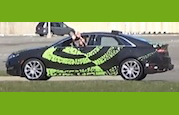
Figure 1: NVIDIA’s self-driving car in action.
We designed the end-to-end learning system using an NVIDIA DevBox running Torch 7 for training. An NVIDIA DRIVETM PX self-driving car computer, also with Torch 7, was used to determine where to drive—while operating at 30 frames per second (FPS). The system is trained to automatically learn the internal representations of necessary processing steps, such as detecting useful road features, with only the human steering angle as the training signal. We never explicitly trained it to detect, for example, the outline of roads. In contrast to methods using explicit decomposition of the problem, such as lane marking detection, path planning, and control, our end-to-end system optimizes all processing steps simultaneously.

We believe that end-to-end learning leads to better performance and smaller systems. Better performance results because the internal components self-optimize to maximize overall system performance, instead of optimizing human-selected intermediate criteria, e. g., lane detection. Such criteria understandably are selected for ease of human interpretation which doesn’t automatically guarantee maximum system performance. Smaller networks are possible because the system learns to solve the problem with the minimal number of processing steps.

This blog post is based on the NVIDIA paper End to End Learning for Self-Driving Cars. Please see the original paper for full details.

Convolutional Neural Networks to Process Visual Data
CNNs[1] have revolutionized the computational pattern recognition process[2]. Prior to the widespread adoption of CNNs, most pattern recognition tasks were performed using an initial stage of hand-crafted feature extraction followed by a classifier. The important breakthrough of CNNs is that features are now learned automatically from training examples. The CNN approach is especially powerful when applied to image recognition tasks because the convolution operation captures the 2D nature of images. By using the convolution kernels to scan an entire image, relatively few parameters need to be learned compared to the total number of operations.

While CNNs with learned features have been used commercially for over twenty years [3], their adoption has exploded in recent years because of two important developments.

  • First, large, labeled data sets such as the ImageNet Large Scale Visual Recognition Challenge (ILSVRC)[4] are now widely available for training and validation. 
  • Second, CNN learning algorithms are now implemented on massively parallel graphics processing units (GPUs), tremendously accelerating learning and inference ability.
The CNNs that we describe here go beyond basic pattern recognition. We developed a system that learns the entire processing pipeline needed to steer an automobile. The groundwork for this project was actually done over 10 years ago in a Defense Advanced Research Projects Agency (DARPA) seedling project known as DARPA Autonomous Vehicle (DAVE)[5], in which a sub-scale radio control (RC) car drove through a junk-filled alley way. DAVE was trained on hours of human driving in similar, but not identical, environments. The training data included video from two cameras and the steering commands sent by a human operator.

In many ways, DAVE was inspired by the pioneering work of Pomerleau[6], who in 1989 built the Autonomous Land Vehicle in a Neural Network (ALVINN) system. ALVINN is a precursor to DAVE, and it provided the initial proof of concept that an end-to-end trained neural network might one day be capable of steering a car on public roads. DAVE demonstrated the potential of end-to-end learning, and indeed was used to justify starting the DARPA Learning Applied to Ground Robots (LAGR) program[7], but DAVE’s performance was not sufficiently reliable to provide a full alternative to the more modular approaches to off-road driving. (DAVE’s mean distance between crashes was about 20 meters in complex environments.)

About a year ago we started a new effort to improve on the original DAVE, and create a robust system for driving on public roads. The primary motivation for this work is to avoid the need to recognize specific human-designated features, such as lane markings, guard rails, or other cars, and to avoid having to create a collection of “if, then, else” rules, based on observation of these features. We are excited to share the preliminary results of this new effort, which is aptly named: DAVE–2.


The DAVE-2 System
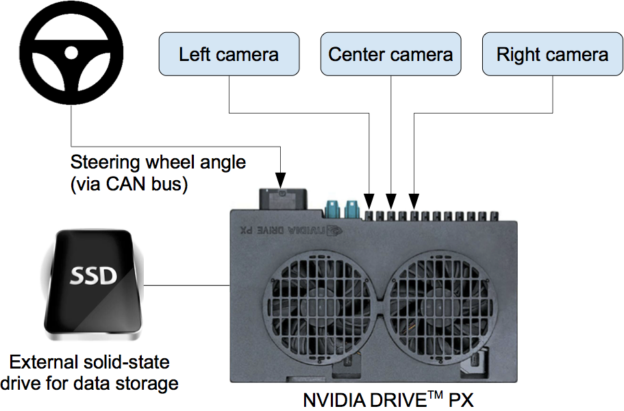
Figure 2: High-level view of the data collection system.
Figure 2 shows a simplified block diagram of the collection system for training data of DAVE-2. Three cameras are mounted behind the windshield of the data-acquisition car, and timestamped video from the cameras is captured simultaneously with the steering angle applied by the human driver. The steering command is obtained by tapping into the vehicle’s Controller Area Network (CAN) bus. In order to make our system independent of the car geometry, we represent the steering command as 1/r, where r is the turning radius in meters. We use 1/r instead of r to prevent a singularity when driving straight (the turning radius for driving straight is infinity). 1/r smoothly transitions through zero from left turns (negative values) to right turns (positive values).

Training data contains single images sampled from the video, paired with the corresponding steering command (1/r). Training with data from only the human driver is not sufficient; the network must also learn how to recover from any mistakes, or the car will slowly drift off the road. The training data is therefore augmented with additional images that show the car in different shifts from the center of the lane and rotations from the direction of the road.

The images for two specific off-center shifts can be obtained from the left and the right cameras. Additional shifts between the cameras and all rotations are simulated through viewpoint transformation of the image from the nearest camera. Precise viewpoint transformation requires 3D scene knowledge which we don’t have, so we approximate the transformation by assuming all points below the horizon are on flat ground, and all points above the horizon are infinitely far away. This works fine for flat terrain, but for a more complete rendering it introduces distortions for objects that stick above the ground, such as cars, poles, trees, and buildings. Fortunately these distortions don’t pose a significant problem for network training. The steering label for the transformed images is quickly adjusted to one that correctly steers the vehicle back to the desired location and orientation in two seconds.

Figure 3: Training the neural network.
Figure 3 shows a block diagram of our training system. Images are fed into a CNN that then computes a proposed steering command. The proposed command is compared to the desired command for that image, and the weights of the CNN are adjusted to bring the CNN output closer to the desired output. The weight adjustment is accomplished using back propagation as implemented in the Torch 7 machine learning package.

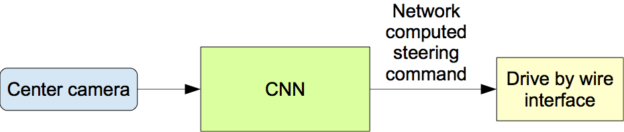
Once trained, the network is able to generate steering commands from the video images of a single center camera. Figure 4 shows this configuration.
Figure 4: The trained network is used to generate steering commands from a single front-facing center camera.
Data Collection
Training data was collected by driving on a wide variety of roads and in a diverse set of lighting and weather conditions. We gathered surface street data in central New Jersey and highway data from Illinois, Michigan, Pennsylvania, and New York. Other road types include two-lane roads (with and without lane markings), residential roads with parked cars, tunnels, and unpaved roads. Data was collected in clear, cloudy, foggy, snowy, and rainy weather, both day and night. In some instances, the sun was low in the sky, resulting in glare reflecting from the road surface and scattering from the windshield.

The data was acquired using either our drive-by-wire test vehicle, which is a 2016 Lincoln MKZ, or using a 2013 Ford Focus with cameras placed in similar positions to those in the Lincoln. Our system has no dependencies on any particular vehicle make or model. Drivers were encouraged to maintain full attentiveness, but otherwise drive as they usually do. As of March 28, 2016, about 72 hours of driving data was collected.
Network Architecture
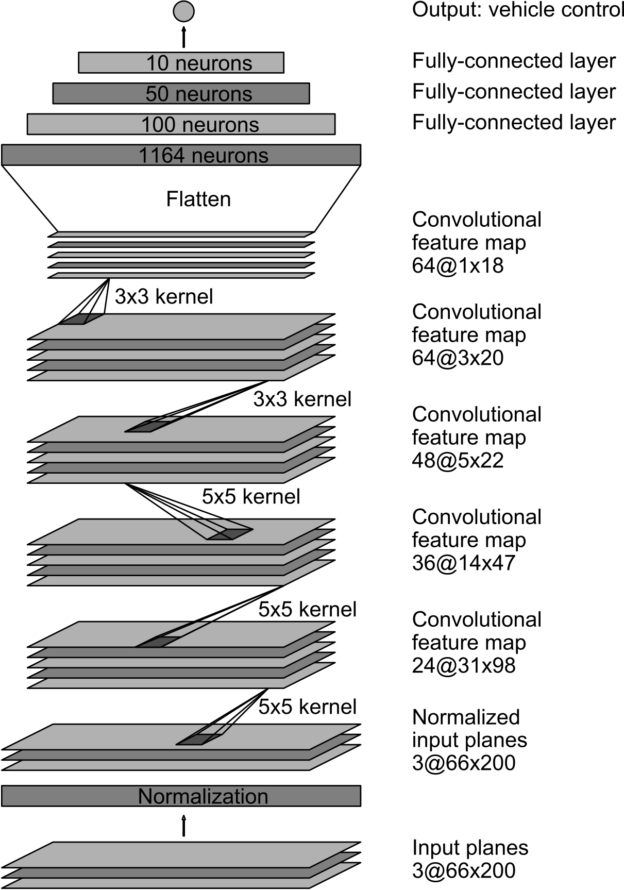
Figure 5: CNN architecture. The network has about 27 million connections and 250 thousand parameters.
We train the weights of our network to minimize the mean-squared error between the steering command output by the network, and either the command of the human driver or the adjusted steering command for off-center and rotated images (see “Augmentation”, later). Figure 5 shows the network architecture, which consists of 9 layers, including a normalization layer, 5 convolutional layers, and 3 fully connected layers. The input image is split into YUV planes and passed to the network.

The first layer of the network performs image normalization. The normalizer is hard-coded and is not adjusted in the learning process. Performing normalization in the network allows the normalization scheme to be altered with the network architecture, and to be accelerated via GPU processing.

The convolutional layers are designed to perform feature extraction, and are chosen empirically through a series of experiments that vary layer configurations. We then use strided convolutions in the first three convolutional layers with a 2×2 stride and a 5×5 kernel, and a non-strided convolution with a 3×3 kernel size in the final two convolutional layers.

We follow the five convolutional layers with three fully connected layers, leading to a final output control value which is the inverse-turning-radius. The fully connected layers are designed to function as a controller for steering, but we noted that by training the system end-to-end, it is not possible to make a clean break between which parts of the network function primarily as feature extractor, and which serve as controller.

Training Details

DATA SELECTION
The first step to training a neural network is selecting the frames to use. Our collected data is labeled with road type, weather condition, and the driver’s activity (staying in a lane, switching lanes, turning, and so forth). To train a CNN to do lane following, we simply select data where the driver is staying in a lane, and discard the rest. We then sample that video at 10 FPS because a higher sampling rate would include images that are highly similar, and thus not provide much additional useful information. To remove a bias towards driving straight the training data includes a higher proportion of frames that represent road curves.

AUGMENTATION
After selecting the final set of frames, we augment the data by adding artificial shifts and rotations to teach the network how to recover from a poor position or orientation. The magnitude of these perturbations is chosen randomly from a normal distribution. The distribution has zero mean, and the standard deviation is twice the standard deviation that we measured with human drivers. Artificially augmenting the data does add undesirable artifacts as the magnitude increases (as mentioned previously).

Simulation
Before road-testing a trained CNN, we first evaluate the network’s performance in simulation. Figure 6 shows a simplified block diagram of the simulation system, and Figure 7 shows a screenshot of the simulator in interactive mode.
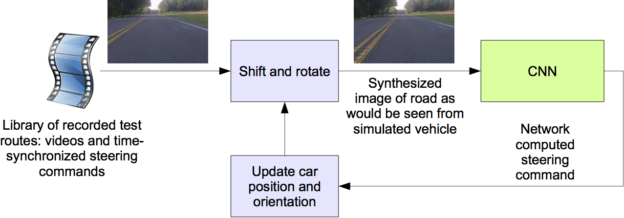
Figure 6: Block-diagram of the drive simulator.
The simulator takes prerecorded videos from a forward-facing on-board camera connected to a human-driven data-collection vehicle, and generates images that approximate what would appear if the CNN were instead steering the vehicle. These test videos are time-synchronized with the recorded steering commands generated by the human driver.

Since human drivers don’t drive in the center of the lane all the time, we must manually calibrate the lane’s center as it is associated with each frame in the video used by the simulator. We call this position the “ground truth”.

The simulator transforms the original images to account for departures from the ground truth. Note that this transformation also includes any discrepancy between the human driven path and the ground truth. The transformation is accomplished by the same methods as described previously.

The simulator accesses the recorded test video along with the synchronized steering commands that occurred when the video was captured. The simulator sends the first frame of the chosen test video, adjusted for any departures from the ground truth, to the input of the trained CNN, which then returns a steering command for that frame. The CNN steering commands as well as the recorded human-driver commands are fed into the dynamic model [7] of the vehicle to update the position and orientation of the simulated vehicle.
Figure 7: Screenshot of the simulator in interactive mode. See text for explanation of the performance metrics. The green area on the left is unknown because of the viewpoint transformation. The highlighted wide rectangle below the horizon is the area which is sent to the CNN.
The simulator then modifies the next frame in the test video so that the image appears as if the vehicle were at the position that resulted by following steering commands from the CNN. This new image is then fed to the CNN and the process repeats.
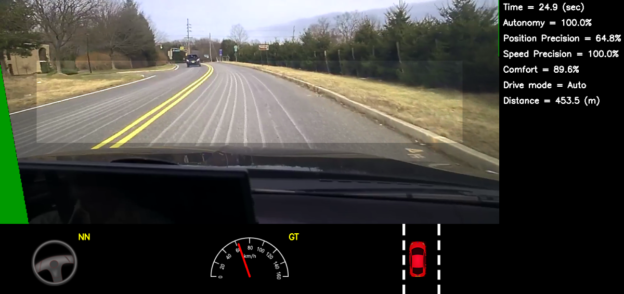
The simulator records the off-center distance (distance from the car to the lane center), the yaw, and the distance traveled by the virtual car. When the off-center distance exceeds one meter, a virtual human intervention is triggered, and the virtual vehicle position and orientation is reset to match the ground truth of the corresponding frame of the original test video.

Evaluation
We evaluate our networks in two steps: first in simulation, and then in on-road tests.

In simulation we have the networks provide steering commands in our simulator to an ensemble of prerecorded test routes that correspond to about a total of three hours and 100 miles of driving in Monmouth County, NJ. The test data was taken in diverse lighting and weather conditions and includes highways, local roads, and residential streets.

We estimate what percentage of the time the network could drive the car (autonomy) by counting the simulated human interventions that occur when the simulated vehicle departs from the center line by more than one meter. We assume that in real life an actual intervention would require a total of six seconds: this is the time required for a human to retake control of the vehicle, re-center it, and then restart the self-steering mode. We calculate the percentage autonomy by counting the number of interventions, multiplying by 6 seconds, dividing by the elapsed time of the simulated test, and then subtracting the result from 1:


Thus, if we had 10 interventions in 600 seconds, we would have an autonomy value of


ON-ROAD TESTS
After a trained network has demonstrated good performance in the simulator, the network is loaded on the DRIVE PX in our test car and taken out for a road test. For these tests we measure performance as the fraction of time during which the car performs autonomous steering. This time excludes lane changes and turns from one road to another. For a typical drive in Monmouth County NJ from our office in Holmdel to Atlantic Highlands, we are autonomous approximately 98% of the time. We also drove 10 miles on the Garden State Parkway (a multi-lane divided highway with on and off ramps) with zero intercepts.

Here is a video of our test car driving in diverse conditions.


Visualization of Internal CNN State
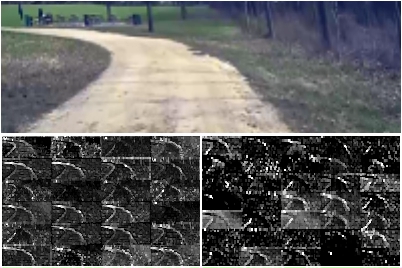
Figure 8: How the CNN “sees” an unpaved road. Top: subset of the camera image sent to the CNN. Bottom left: Activation of the first layer feature maps. Bottom right: Activation of the second layer feature maps. This demonstrates that the CNN learned to detect useful road features on its own, i. e., with only the human steering angle as training signal. We never explicitly trained it to detect the outlines of roads.
Figures 8 and 9 show the activations of the first two feature map layers for two different example inputs, an unpaved road and a forest. In case of the unpaved road, the feature map activations clearly show the outline of the road while in case of the forest the feature maps contain mostly noise, i. e., the CNN finds no useful information in this image.

This demonstrates that the CNN learned to detect useful road features on its own, i. e., with only the human steering angle as training signal. We never explicitly trained it to detect the outlines of roads, for example.
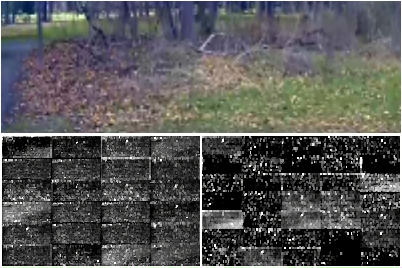
Figure 9: Example image with no road. The activations of the first two feature maps appear to contain mostly noise, i. e., the CNN doesn’t recognize any useful features in this image.
Conclusions
We have empirically demonstrated that CNNs are able to learn the entire task of lane and road following without manual decomposition into road

  • Y. LeCun, B. Boser, J. S. Denker, D. Henderson, R. E. Howard, W. Hubbard, and L. D. Jackel. Backpropagation applied to handwritten zip code recognition. Neural Computation, 1(4):541–551, Winter 1989.
    URL: http://yann.lecun.org/exdb/publis/pdf/lecun-89e.pdf
  • Alex Krizhevsky, Ilya Sutskever, and Geoffrey E. Hinton. Imagenet classification with deep convolutional neural networks
  • In F. Pereira, C. J. C. Burges, L. Bottou, and K. Q. Weinberger, editors, Advances in Neural Information Processing Systems 25, pages 1097–1105. Curran Associates, Inc., 2012. URL: http://papers.nips.cc/paper/4824-imagenet-classification-with-deep-convolutional-neural-networks.pdf.
  • L. D. Jackel, D. Sharman, Stenard C. E., Strom B. I., , and D Zuckert. Optical character recognition for self-service banking. AT&T Technical Journal, 74(1):16–24, 1995.
  • Large scale visual recognition challenge (ILSVRC). URL: http://www.image-net.org/challenges/LSVRC/.
  • Net-Scale Technologies, Inc. Autonomous off-road vehicle control using end-to-end learning, July 2004. Final technical report. URL: http://net-scale.com/doc/net-scale-dave-report.pdf.
  • Dean A. Pomerleau. ALVINN, an autonomous land vehicle in a neural network. Technical report, Carnegie Mellon University, 1989.
    URL: http://repository.cmu.edu/cgi/viewcontent.cgi?article=2874&context=compsci.
  • Danwei Wang and Feng Qi. Trajectory planning for a four-wheel-steering vehicle. In Proceedings of the 2001 IEEE International Conference on Robotics & Automation, May 21–26 2001. URL: http://www.ntu.edu.sg/home/edwwang/confpapers/wdwicar01.pdf.
    rlane marking detection, semantic abstraction, path planning, and control. A small amount of training data from less than a hundred hours of driving was sufficient to train the car to operate in diverse conditions, on highways, local and residential roads in sunny, cloudy, and rainy conditions. 
  • The CNN is able to learn meaningful road features from a very sparse training signal (steering alone).
  • The system learns for example to detect the outline of a road without the need of explicit labels during training.
  • More work is needed to improve the robustness of the network, to find methods to verify the robustness, and to improve visualization of the network-internal processing steps.
For full details please see the paper that this blog post is based on, and please contact us if you would like to learn more about NVIDIA’s autonomous vehicle platform!

REFERENCES

  1. Y. LeCun, B. Boser, J. S. Denker, D. Henderson, R. E. Howard, W. Hubbard, and L. D. Jackel. Backprop- agation applied to handwritten zip code recognition. Neural Computation, 1(4):541–551, Winter 1989. URL: http://yann.lecun.org/exdb/publis/pdf/lecun-89e.pdf.
  2. Alex Krizhevsky, Ilya Sutskever, and Geoffrey E. Hinton. Imagenet classification with deep convolutional neural networks. In F. Pereira, C. J. C. Burges, L. Bottou, and K. Q. Weinberger, editors, Advances in Neural Information Processing Systems 25, pages 1097–1105. Curran Associates, Inc., 2012. URL: http://papers.nips.cc/paper/ 4824-imagenet-classification-with-deep-convolutional-neural-networks. pdf.
  3. L. D. Jackel, D. Sharman, Stenard C. E., Strom B. I., , and D Zuckert. Optical character recognition for self-service banking. AT&T Technical Journal, 74(1):16–24, 1995.
  4. Large scale visual recognition challenge (ILSVRC). URL: http://www.image-net.org/ challenges/LSVRC/.
  5. Net-Scale Technologies, Inc. Autonomous off-road vehicle control using end-to-end learning, July 2004. Final technical report. URL: http://net-scale.com/doc/net-scale-dave-report.pdf.
  6. Dean A. Pomerleau. ALVINN, an autonomous land vehicle in a neural network. Technical report, Carnegie Mellon University, 1989. URL: http://repository.cmu.edu/cgi/viewcontent. cgi?article=2874&context=compsci.
  7. Danwei Wang and Feng Qi. Trajectory planning for a four-wheel-steering vehicle. In Proceedings of the 2001 IEEE International Conference on Robotics & Automation, May 21–26 2001. URL: http: //www.ntu.edu.sg/home/edwwang/confpapers/wdwicar01.pdf.

ORIGINAL: NVidia

viernes, 15 de enero de 2016

Microsoft Neural Net Shows Deep Learning can get Way Deeper

PAUL TAYLOR/GETTY IMAGES
COMPUTER VISION IS now a part of everyday life. Facebook recognizes faces in the photos you post to the popular social network. The Google Photos app can find images buried in your collection, identifying everything from dogs to birthday parties to gravestones. Twitter can pinpoint pornographic images without help from human curators.

All of this “seeing” stems from a remarkably effective breed of artificial intelligence called deep learning. But as far as this much-hyped technology has come in recent years, a new experiment from Microsoft Research shows it’s only getting started. Deep learning can go so much deeper.


'We're staring at a huge design space, trying to figure out where to go next.

PETER LEE, MICROSOFT RESEARCH

This revolution in computer vision was a long time coming. A key turning point came in 2012, when artificial intelligence researchers from the University of Toronto won a competition called ImageNet. ImageNet pits machines against each other in an image recognition contest—which computer can identify cats or cars or clouds more accurately?—and that year, the Toronto team, including researcher Alex Krizhevsky and professor Geoff Hinton, topped the contest using deep neural nets, a technology that learns to identify images by examining enormous numbers of them, rather than identifying images according to rules diligently hand-coded by humans.

Toronto’s win provided a roadmap for the future of deep learning. In the years since, the biggest names on the ‘net—including Facebook, Google, Twitter, and Microsoft—have used similar tech to build computer vision systems that can match and even surpass humans. “We can’t claim that our system ‘sees’ like a person does,” says Peter Lee, the head of research at Microsoft. “But what we can say is that for very specific, narrowly defined tasks, we can learn to be as good as humans.

Roughly speaking, neural nets use hardware and software to approximate the web of neurons in the human brain. This idea dates to the 1980s, but in 2012, Krizhevsky and Hinton advanced the technology by running their neural nets atop graphics processing units, or GPUs. These specialized chips were originally designed to render images for games and other highly graphical software, but as it turns out, they’re also suited to the kind of math that drives neural nets. Google, Facebook, Twitter, Microsoft, and so many others now use GPU-powered-AI to handle image recognition and so many others tasks, from Internet search to security. Krizhevsky and Hinton joined the staff at Google.

Deep learning can go so much deeper.
Now, the latest ImageNet winner is pointing to what could be another step in the evolution of computer vision—and the wider field of artificial intelligence. Last month, a team of Microsoft researchers took the ImageNet crown using a new approach they call a deep residual network. The name doesn’t quite describe it. They’ve designed a neural net that’s significantly more complex than typical designs—one that spans 152 layers of mathematical operations, compared to the typical six or seven. It shows that, in the years to come, companies like Microsoft will be able to use vast clusters of GPUs and other specialized chips to significantly improve not only image recognition but other AI services, including systems that recognize speech and even understand language as we humans naturally speak it.

In other words, deep learning is nowhere close to reaching its potential. “We’re staring at a huge design space,” Lee says, “trying to figure out where to go next.

Layers of Neurons
Deep neural networks are arranged in layers. Each layer is a different set of mathematical operations—aka algorithms. The output of one layer becomes the input of the next. Loosely speaking, if a neural network is designed for image recognition, one layer will look for a particular set of features in an image—edges or angles or shapes or textures or the like—and the next will look for another set. These layers are what make these neural networks deep. “Generally speaking, if you make these networks deeper, it becomes easier for them to learn,” says Alex Berg, a researcher at the University of North Carolina who helps oversee the ImageNet competition.

Constructing this kind of mega-neural net is flat-out difficult.
Today, a typical neural network includes six or seven layers. Some might extend to 20 or even 30. But the Microsoft team, led by researcher Jian Sun, just expanded that to 152. In essence, this neural net is better at recognizing images because it can examine more features. “There is a lot more subtlety that can be learned,” Lee says.

In the past, according Lee and researchers outside of Microsoft, this sort of very deep neural net wasn’t feasible. Part of the problem was that as your mathematical signal moved from layer to layer, it became diluted and tended to fade. As Lee explains, Microsoft solved this problem by building a neural net that skips certain layers when it doesn’t need them, but uses them when it does. “When you do this kind of skipping, you’re able to preserve the strength of the signal much further,” Lee says, “and this is turning out to have a tremendous, beneficial impact on accuracy.

Berg says that this is an notable departure from previous systems, and he believes that others companies and researchers will follow suit.

Deep Difficulty
The other issue is that constructing this kind of mega-neural net is tremendously difficult. Landing on a particular set of algorithms—determining how each layer should operate and how it should talk to the next layer—is an almost epic task. But Microsoft has a trick here, too. It has designed a computing system that can help build these networks.

As Jian Sun explains it, researchers can identify a promising arrangement for massive neural networks, and then the system can cycle through a range of similar possibilities until it settles on this best one. “In most cases, after a number of tries, the researchers learn [something], reflect, and make a new decision on the next try,” he says. “You can view this as ‘human-assisted search.'”

Microsoft has designed a computing system that can help build these networks.
According to Adam Gibson—the chief researcher at deep learning startup Skymind—this kind of thing is getting more common. It’s called “hyper parameter optimization.” “People can just spin up a cluster [of machines], run 10 models at once, find out which one works best and use that,” Gibson says. “They can input some baseline parameter—based on intuition—and the machines kind of homes in on what the best solution is.” As Gibson notes, last year Twitter acquired a company, Whetlab, that offers similar ways of “optimizing” neural networks.

‘A Hardware Problem’
As Peter Lee and Jian Sun describe it, such an approach isn’t exactly “brute forcing” the problem. “With very very large amounts of compute resources, one could fantasize about a gigantic ‘natural selection’ setup where evolutionary forces help direct a brute-force search through a huge space of possibilities,” Lee says. “The world doesn’t have those computing resources available for such a thing…For now, we will still depend on really smart researchers like Jian.

But Lee does say that, thanks to new techniques and computer data centers filled with GPU machines, the realm of possibilities for deep learning are enormous. A big part of the company’s task is just finding the time and the computing power needed to explore these possibilities. “This work as dramatically exploded the design space. The amount of ground to cover, in terms of scientific investigation, has become exponentially larger,” Lee says. And this extends well beyond image recognition, into speech recognition, natural language understanding, and other tasks.

As Lee explains, that’s one reason Microsoft is not only pushing to improve the power of its GPUs clusters, but exploring the use of other specialized processors, including FPGAs—chips that can programmed for particular tasks, such as deep learning. “There has also been an explosion in demand for much more experimental hardware platforms from our researchers,” he says. And this work is sending ripples across the wider of world of tech and artificial intelligence. This past summer, in its largest ever acquisition deal, Intel agreed to buy Altera, which specializes in FPGAs.

Indeed, Gibson says that deep learning has become more of “a hardware problem.” Yes, we still need top researchers to guide the creation of neural networks, but more and more, finding new paths is a matter of brute-forcing new algorithms across ever more powerful collections of hardware. As Gibson point out, though these deep neural nets work extremely well, we don’t quite know why they work. The trick lies in finding the complex combination of algorithms that work the best. More and better hardware can shorten the path.

The end result is that the companies that can build the most powerful networks of hardware are the companies will come out ahead. That would be Google and Facebook and Microsoft. Those that are good at deep learning today will only get better.

ORIGINAL: Wired

martes, 5 de enero de 2016

NVIDIA DRIVE PX 2. NVIDIA Accelerates Race to Autonomous Driving at CES 2016

NVIDIA today shifted its autonomous-driving leadership into high gear.

At a press event kicking off CES 2016, we unveiled artificial-intelligence technology that will let cars sense the world around them and pilot a safe route forward.

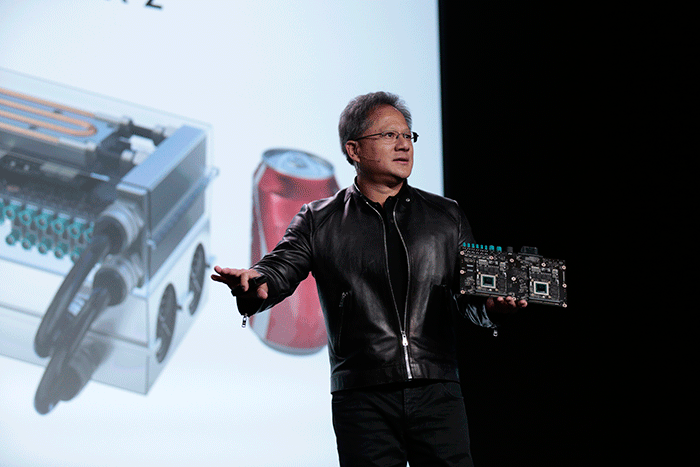
Dressed in his trademark black leather jacket, speaking to a crowd of some 400 automakers, media and analysts, NVIDIA CEO Jen-Hsun Huang revealed DRIVE PX 2, an automotive supercomputing platform that processes 24 trillion deep learning operations a second. That’s 10 times the performance of the first-generation DRIVE PX, now being used by more than 50 companies in the automotive world.

The new DRIVE PX 2 delivers 8 teraflops of processing power. It has the processing power of 150 MacBook Pros. And it’s the size of a lunchbox in contrast to earlier autonomous-driving technology being used today, which takes up the entire trunk of a mid-sized sedan. 

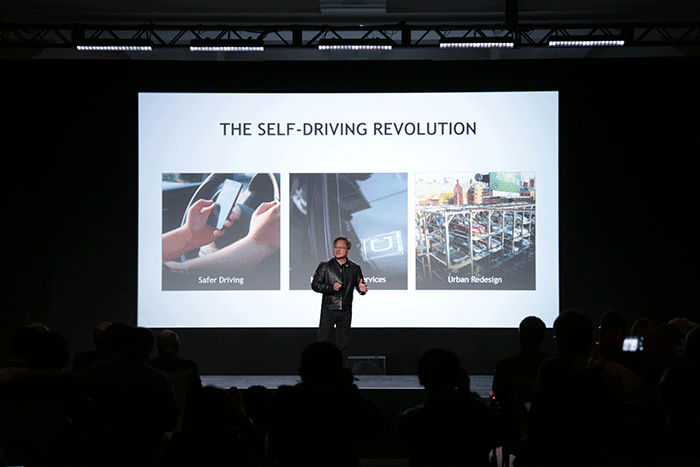
Self-driving cars will revolutionize society,” Huang said at the beginning of his talk. “And NVIDIA’s vision is to enable them.

Volvo to Deploy DRIVE PX in Self-Driving SUVs
As part of its quest to eliminate traffic fatalities, Volvo will be the first automaker to deploy DRIVE PX 2.
Huang announced that Volvo – known worldwide for safety and reliability – will be the first automaker to deploy DRIVE PX 2.

In the world’s first public trial of autonomous driving, the Swedish automaker next year will lease 100 XC90 luxury SUVs outfitted with DRIVE PX 2 technology. The technology will help the vehicles drive autonomously around Volvo’s hometown of Gothenburg, and semi-autonomously elsewhere.

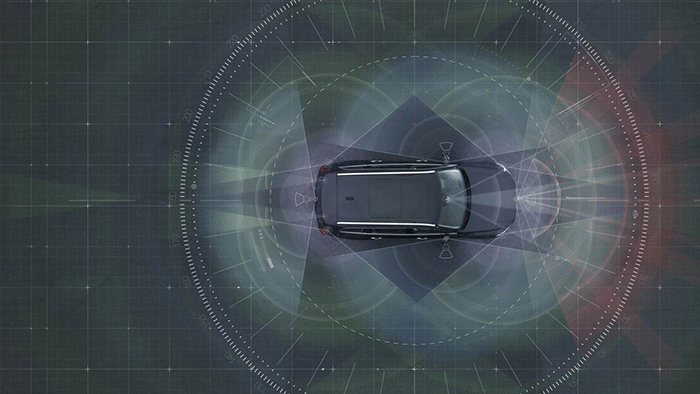
DRIVE PX 2 has the power to harness a host of sensors to get a 360 degree view of the environment around the car.

The rear-view mirror is history,” Jen-Hsun said.

Drive Safely, by Not Driving at All
Not so long ago, pundits had questioned the safety of technology in cars. Now, with Volvo incorporating autonomous vehicles into its plan to end traffic fatalities, that script has been flipped. Autonomous cars may be vastly safer than human-piloted vehicles.

Car crashes – an estimated 93 percent of them caused by human error kill 1.3 million drivers each year. More American teenagers die from texting while driving than any other cause, including drunk driving.

There’s also a productivity issue. Americans waste some 5.5 billion hours of time each year in traffic, costing the U.S. about $121 billion, according to an Urban Mobility Report from Texas A&M. And inefficient use of roads by cars wastes even vaster sums spent on infrastructure.

Deep Learning Hits the Road
Self-driving solutions based on computer vision can provide some answers. But tackling the infinite permutations that a driver needs to react to – stray pets, swerving cars, slashing rain, steady road construction crews – is far too complex a programming challenge.

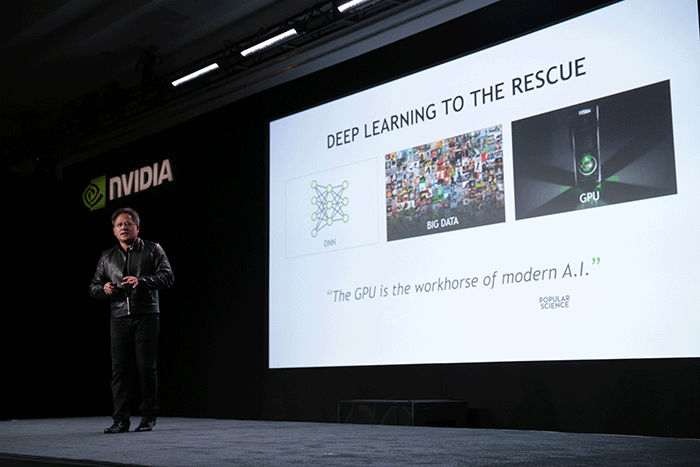
Deep learning enabled by NVIDIA technology can address these challenges. A highly trained deep neural network – residing on supercomputers in the cloud – captures the experience of many tens of thousands of hours of road time.

Huang noted that a number of automotive companies are already using NVIDIA’s deep learning technology to power their efforts, getting speedup of 30-40X in training their networks compared with other technology. BMW, Daimler and Ford are among them, along with innovative Japanese startups like Preferred Networks and ZMP. And Audi said it was able in four hours to do training that took it two years with a competing solution.
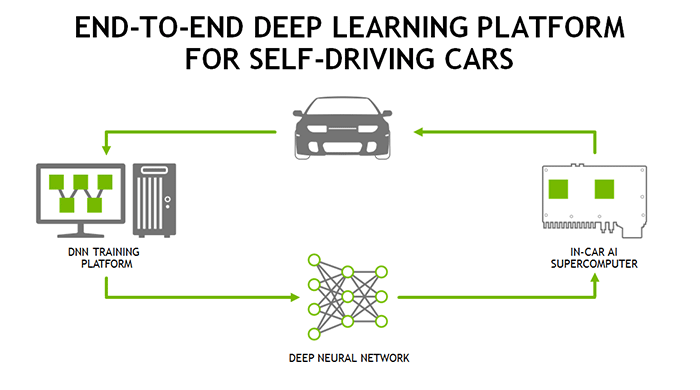
  NVIDIA DRIVE PX 2 is part of an end-to-end platform that brings deep learning to the road.

NVIDIA’s end-to-end solution for deep learning starts with NVIDIA DIGITS, a supercomputer that can be used to train digital neural networks by exposing them to data collected during that time on the road. On the other end is DRIVE PX 2, which draws on this training to make inferences to enable the car to progress safely down the road. In the middle is NVIDIA DriveWorks, a suite of software tools, libraries and modules that accelerates development and testing of autonomous vehicles.

DriveWorks enables sensor calibration, acquisition of surround data, synchronization, recording and then processing streams of sensor data through a complex pipeline of algorithms running on all of the DRIVE PX 2’s specialized and general-purpose processors.

During the event, Huang reminded the audience that machines are already beating humans at tasks once considered impossible for computers, such as image recognition. Systems trained with deep learning can now correctly classify images more than 96 percent of the time, exceeding what humans can do on similar tasks.

He used the event to show what deep learning can do for autonomous vehicles.

A series of demos drove this home, showing in three steps how DRIVE PX 2 harnesses a host of sensors – lidar, radar and cameras and ultrasonic – to understand the world around it, in real time, and plan a safe and efficient path forward.

The World’s Biggest Infotainment System


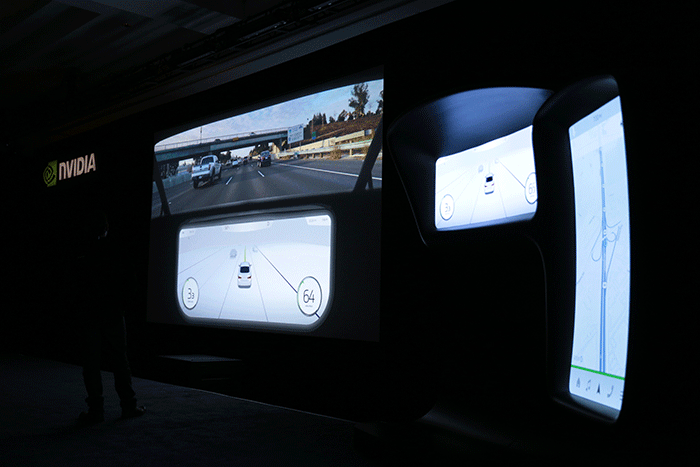
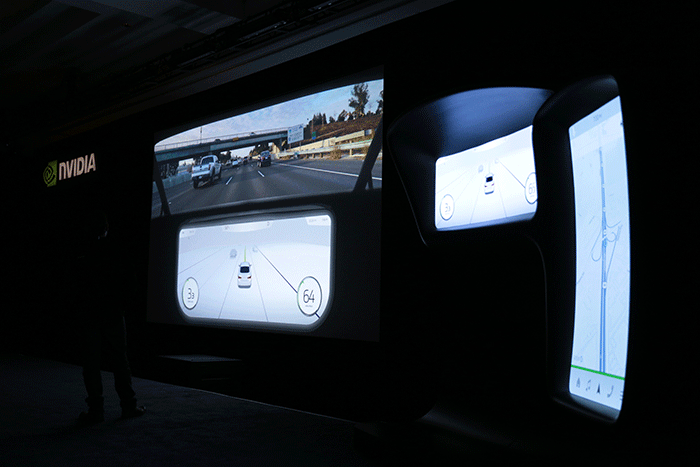
The highlight of the demos was what Huang called the world’s largest car infotainment system — an elegant block the size of a medium-sized bedroom wall mounted with a long horizontal screen and a long vertical one.

While a third larger screen showed the scene that a driver would take in, the wide demo screen showed how the car — using deep learning and sensor fusion — “viewed” the very same scene in real-time, stitched together from its array of sensors. On its right, the huge portrait-oriented screen shows a highly precise map that marked the car’s progress.

It’s a demo that will leave an impression on an audience that’s going to be hear a lot about the future of driving in the week ahead.

Photos from Our CES 2016 Press Event

NVIDIA Drive PX-2

ORIGINAL: Nvidia
By Bob Sherbin on January 3, 2016

jueves, 10 de diciembre de 2015

Facebook Joins Stampede of Tech Giants Giving Away Artificial Intelligence Technology

Leading computing companies are helping both themselves and others by open-sourcing AI tools.
Facebook designed this server to put new power behind the simulated neurons that enable software to do smart things like recognize speech or the content of photos.
Facebook is releasing for free the designs of a powerful new computer server it crafted to put more power behind artificial-intelligence software. Serkan Piantino, an engineering director in Facebook’s AI Research group, says the new servers are twice as fast as those Facebook used before. “We will discover more things in machine learning and AI as a result,” he says.

The social network’s giveaway is the latest in a recent flurry of announcements by tech giants that are open-sourcing artificial-intelligence technology, which is becoming vital to consumer and business-computing services. Opening up the technology is seen as a way to accelerate progress in the broader field, while also helping tech companies to boost their reputations and make key hires.

In November, Google opened up software called .TensorFlow, used to power the company’s speech recognition and image search (see “.Here’s What Developers Are Doing with Google’s AI Brain”). Just three days later Microsoft released software that distributes machine-learning software across multiple machines to make it more powerful. Not long after, IBM announced the fruition of an earlier promise to open-source SystemML, originally developed to use machine learning to find useful patterns in corporate databanks.

Facebook’s new server design, dubbed Big Sur, was created to power deep-learning software, which processes data using roughly simulated neurons (see “.Teaching Computers to Understand Us”). The invention of ways to put more power behind deep learning, using graphics processors, or GPUs, was crucial to recent leaps in the ability of computers to understand speech, images, and language. Facebook worked closely with Nvidia, a leading manufacturer of GPUs, on its new server designs, which have been stripped down to cram in more of the chips. The hardware can be used to run Google’s TensorFlow software.

Yann LeCun, director of Facebook’s AI Research group, says that one reason to open up the Big Sur designs is that the social network is well placed to slurp up any new ideas it can unlock. “Companies like us actually thrive on fast progress; the faster the progress can be made, the better it is for us,” says LeCun. Facebook open-sourced deep-learning software of its own .in February of this year.

LeCun says that opening up Facebook’s technology also helps attract leading talent. A company can benefit by being seen as benevolent, and also by encouraging people to become familiar with a particular way of working and thinking. As Google, Facebook, and other companies have increased their investments in artificial intelligence, competition to hire experts in the technology has intensified (see “.Is Google Cornering the Market in Deep Learning?”).

Derek Schoettle, general manager of IBM Cloud Data Services unit, which offers tools to help companies analyze data, says that machine-learning technology has to be opened up for it to become widespread. Open-source projects have played a major role in establishing large-scale databases and data analysis as the bedrock of modern computing companies large and small, he says. Real value tends to lie in what companies can do with the tools, not the tools themselves.

What’s going to be interesting and valuable is the data that’s moving in that system and the ways people can find value in that data,” he says. Late last month, IBM transferred its SystemML machine-learning software, designed around techniques other than deep learning, to the Apache Software Foundation, which supports several major open-source projects.

Facebook’s Big Sur server design will be submitted to the Open Compute Project, a group started by the social network through which companies including Apple and Microsoft share designs of computing infrastructure to drive down costs (see “.Inside Facebook’s Not-So-Secret New Data Center”).


ORIGINAL: .Technology Review
December 10, 2015

lunes, 25 de agosto de 2014

Why a deep-learning genius left Google & joined Chinese tech shop Baidu (interview)

Image Credit: Jordan Novet/VentureBeat

SUNNYVALE, California — Chinese tech company Baidu has yet to make its popular search engine and other web services available in English. But consider yourself warned: Baidu could someday wind up becoming a favorite among consumers.

The strength of Baidu lies not in youth-friendly marketing or an enterprise-focused sales team. It lives instead in Baidu’s data centers, where servers run complex algorithms on huge volumes of data and gradually make its applications smarter, including not just Web search but also Baidu’s tools for music, news, pictures, video, and speech recognition.

Despite lacking the visibility (in the U.S., at least) of Google and Microsoft, in recent years Baidu has done a lot of work on deep learning, one of the most promising areas of artificial intelligence (AI) research in recent years. This work involves training systems called artificial neural networks on lots of information derived from audio, images, and other inputs, and then presenting the systems with new information and receiving inferences about it in response.

Two months ago, Baidu hired Andrew Ng away from Google, where he started and led the so-called Google Brain project. Ng, whose move to Baidu follows Hugo Barra’s jump from Google to Chinese company Xiaomi last year, is one of the world’s handful of deep-learning rock stars.

Ng has taught classes on machine learning, robotics, and other topics at Stanford University. He also co-founded massively open online course startup Coursera.

He makes a strong argument for why a person like him would leave Google and join a company with a lower public profile. His argument can leave you feeling like you really ought to keep an eye on Baidu in the next few years.

I thought the best place to advance the AI mission is at Baidu,” Ng said in an interview with VentureBeat.

Baidu’s search engine only runs in a few countries, including China, Brazil, Egypt, and Thailand. The Brazil service was announced just last week. Google’s search engine is far more popular than Baidu’s around the globe, although Baidu has already beaten out Yahoo and Microsoft’s Bing in global popularity, according to comScore figures.

And Baidu co-founder and chief executive Robin Li, a frequent speaker on Stanford’s campus, has said he wants Baidu to become a brand name in more than half of all the world’s countries. Presumably, then, Baidu will one day become something Americans can use.

Above: Baidu co-founder and chief executive Robin Li.
Image Credit: Baidu
Now that Ng leads Baidu’s research arm as the company’s chief scientist out of the company’s U.S. R&D Center here, it’s not hard to imagine that Baidu’s tools in English, if and when they become available, will be quite brainy — perhaps even eclipsing similar services from Apple and other tech giants. (Just think of how many people are less than happy with Siri.)

A stable full of AI talent
But this isn’t a story about the difference a single person will make. Baidu has a history in deep learning.

A couple years ago, Baidu hired Kai Yu, a engineer skilled in artificial intelligence. Based in Beijing, he has kept busy.

I think Kai ships deep learning to an incredible number of products across Baidu,” Ng said. Yu also developed a system for providing infrastructure that enables deep learning for different kinds of applications.

That way, Kai personally didn’t have to work on every single application,” Ng said.

In a sense, then, Ng joined a company that had already built momentum in deep learning. He wasn’t starting from scratch.
Above: Baidu’s Kai Yu.
Image Credit: Kai Yu

Only a few companies could have appealed to Ng, given his desire to push artificial intelligence forward. It’s capital-intensive, as it requires lots of data and computation. Baidu, he said, can provide those things.

Baidu is nimble, too. Unlike Silicon Valley’s tech giants, which measure activity in terms of monthly active users, Chinese Internet companies prefer to track usage by the day, Ng said.

It’s a symptom of cadence,” he said. “What are you doing today?” And product cycles in China are short; iteration happens very fast, Ng said.

Plus, Baidu is willing to get infrastructure ready to use on the spot.

Frankly, Kai just made decisions, and it just happened without a lot of committee meetings,” Ng said. “The ability of individuals in the company to make decisions like that and move infrastructure quickly is something I really appreciate about this company.

That might sound like a kind deference to Ng’s new employer, but he was alluding to a clear advantage Baidu has over Google.

He ordered 1,000 GPUs [graphics processing units] and got them within 24 hours,Adam Gibson, co-founder of deep-learning startup Skymind, told VentureBeat. “At Google, it would have taken him weeks or months to get that.

Not that Baidu is buying this type of hardware for the first time. Baidu was the first company to build a GPU cluster for deep learning, Ng said — a few other companies, like Netflix, have found GPUs useful for deep learning — and Baidu also maintains a fleet of servers packing ARM-based chips.
Above: Baidu headquarters in Beijing.
Image Credit: Baidu

Now the Silicon Valley researchers are using the GPU cluster and also looking to add to it and thereby create still bigger artificial neural networks.

But the efforts have long since begun to weigh on Baidu’s books and impact products. “We deepened our investment in advanced technologies like deep learning, which is already yielding near term enhancements in user experience and customer ROI and is expected to drive transformational change over the longer term,” Li said in a statement on the company’s earnings the second quarter of 2014.

Next step: Improving accuracy
What will Ng do at Baidu? The answer will not be limited to any one of the company’s services. Baidu’s neural networks can work behind the scenes for a wide variety of applications, including those that handle text, spoken words, images, and videos. Surely core functions of Baidu like Web search and advertising will benefit, too.

All of these are domains Baidu is looking at using deep learning, actually,” Ng said.

Ng’s focus now might best be summed up by one word: accuracy.

That makes sense from a corporate perspective. Google has the brain trust on image analysis, and Microsoft has the brain trust on speech, said Naveen Rao, co-founder and chief executive of deep-learning startup Nervana. Accuracy could potentially be the area where Ng and his colleagues will make the most substantive progress at Baidu, Rao said.

Matthew Zeiler, founder and chief executive of another deep learning startup, Clarifai, was more certain. “I think you’re going to see a huge boost in accuracy,” said Zeiler, who has worked with Hinton and LeCun and spent two summers on the Google Brain project.

One thing is for sure: Accuracy is on Ng’s mind.
Above: The lobby at Baidu’s office in Sunnyvale, Calif.
Image Credit: Jordan Novet/VentureBeat

Here’s the thing. Sometimes changes in accuracy of a system will cause changes in the way you interact with the device,” Ng said. For instance, more accurate speech recognition could translate into people relying on it much more frequently. Think “Her”-level reliance, where you just talk to your computer as a matter of course rather than using speech recognition in special cases.

Speech recognition today doesn’t really work in noisy environments,” Ng said. But that could change if Baidu’s neural networks become more accurate under Ng.

Ng picked up his smartphone, opened the Baidu Translate app, and told it that he needed a taxi. A female voice said that in Mandarin and displayed Chinese characters on screen. But it wasn’t a difficult test, in some ways: This was no crowded street in Beijing. This was a quiet conference room in a quiet office.

There’s still work to do,” Ng said.

‘The future heroes of deep learning’
Meanwhile, researchers at companies and universities have been hard at work on deep learning for decades.

Google has built up a hefty reputation for applying deep learning to images from YouTube videos, data center energy use, and other areas, partly thanks to Ng’s contributions. And recently Microsoft made headlines for deep-learning advancements with its Project Adam work, although Li Deng of Microsoft Research has been working with neural networks for more than 20 years.

In academia, deep learning research groups all over North America and Europe. Key figures in the past few years include Yoshua Bengio at the University of Montreal, Geoff Hinton of the University of Toronto (Google grabbed him last year through its DNNresearch acquisition), Yann LeCun from New York University (Facebook pulled him aboard late last year), and Ng.

But Ng’s strong points differ from those of his contemporaries. Whereas Bengio made strides in training neural networks, LeCun developed convolutional neural networks, and Hinton popularized restricted Boltzmann machines, Ng takes the best, implements it, and makes improvements.

Andrew is neutral in that he’s just going to use what works,” Gibson said. “He’s very practical, and he’s neutral about the stamp on it.

Not that Ng intends to go it alone. To create larger and more accurate neural networks, Ng needs to look around and find like-minded engineers.

He’s going to be able to bring a lot of talent over,Dave Sullivan, co-founder and chief executive of deep-learning startup Ersatz Labs, told VentureBeat. “This guy is not sitting down and writing mountains of code every day.

And truth be told, Ng has had no trouble building his team.

Hiring for Baidu has been easier than I’d expected,” he said.

A lot of engineers have always wanted to work on AI. … My job is providing the team with the best possible environment for them to do AI, for them to be the future heroes of deep learning.

More information:


Google's innovative search technologies connect millions of people around the world with information every day. Founded in 1998 by Stanford Ph.D. students Larry Page and Sergey Brin, Google today is a top web property in all major glob... read more »


Powered by VBProfiles

ORIGINAL: VentureBeat
July 30, 2014 8:03 AM