Mostrando entradas con la etiqueta Libros. Mostrar todas las entradas

lunes, 17 de noviembre de 2014

Machine Learning Algorithm Ranks the World's Most Notable Authors

Deciding which books to digitise when they enter the public domain is tricky; unless you have an independent ranking of the most notable authors.


Public Domain Day, 1 January, is the day on which previously copyrighted works become freely available to print, digitise, modify or re-use in more or less any way. In most countries, this happens 50 or 70 years after the death of the author.

There is even a website that celebrates this event, announcing all the most notable authors whose works become freely available on that day. This allows organisations such as Project Gutenberg to prepare digital editions and LibriVox to create audio versions and so on

But here’s an interesting question. While the works of thousands of authors enter the public domain each year, only a small percentage of these end up being widely available. So how to choose the ones to focus on?

Today, Allen Riddell at Dartmouth College in New Hampshire, says he has the answer. Riddell has developed an algorithm that automatically generates an independent ranking of notable authors for a given year. It is then a simple task to pick the works to focus on or to spot notable omissions from the past.

Riddell’s approach is to look at what kind of public domain content the world has focused on in the past and then use this as a guide to find content that people are likely to focus on in the future. For this he uses a machine learning algorithm to mine two databases. The first is a list of over a million online books in the public domain maintained by the University of Pennsylvania. The second is Wikipedia. 

Riddell’s begins with the Wikipedia entries of all authors in the English language edition—more than a million of them. His algorithm extracts information such as the article length, article age, estimated views per day, time elapsed since last revision and so on.

The algorithm then takes the list of all authors on the online book database and looks for a correlation between the biographical details on Wikipedia and the existence of a digital edition in the public domain. 

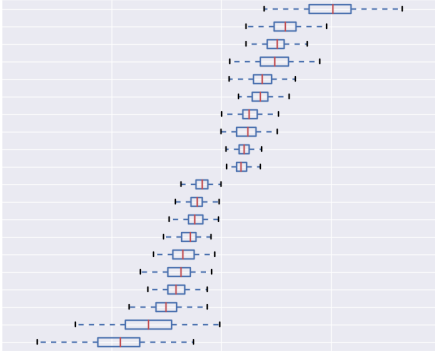
That produces a “public domain ranking” of all the authors that appear on Wikipedia. For example, the author Virginia Woolf has a ranking of 1081 out of 1,011,304 while the Italian painter Giuseppe Amisani, who died in the same year as Woolf, has a ranking of 580,363. So Riddell’s new ranking clearly suggests that organisations like Project Guttenberg should focus more on digitising Woolf’s work than Amisani’s.

The beauty of this approach is that it is entirely independent. That’s in stark contrast to the committees that are often set up to rank works subjectively.

Of the individuals who died in 1965 and whose work will enter the public domain next January in many parts of the world, the new algorithm picks out T S Eliot as the most highly ranked individual. Others highly ranked include Somerset Maugham, Winston Churchill and Malcolm X.

As well as by year of death, it’s possible to rank authors according to categories of interest. For example, the top-ranked Mexican poet is Homero Aridjis, the top-ranked French philosopher, Jean-Paul Sartre and the top-ranked female American writer, Terri Windling.

Riddell says his ranking system compares well with existing rankings compiled by human experts, such as one compiled by the editorial board of the Modern Library. “The Public Domain Rank of the authors selected by the Modern Library editorial board are consistently high,” he says.

It is not perfect, however. Riddell acknowledges that his new Public Domain Ranking is likely to reflect the biases inherent in Wikipedia, which is well known for having few female editors, for example.

But with that in mind, the ranking is still likely to be useful. It should be handy for finding notable authors in the public domain whose works are not yet available electronically because they have somehow been overlooked. “Flannery O’Connor and Sylvia Plath stand out as significant examples of authors whose works might be made available today on Project Gutenberg Canada, “ says Riddell. (Canada follows the 50 year rule rather than 70).

It may even change the nature of Public Domain Day. “Public Domain Rank promises to facilitate—and even automate—Public Domain Day,” says Riddell.

Handy!

Ref: arxiv.org/abs/1411.2180 Public Domain Rank: Identifying Notable Individuals with the Wisdom of the Crowd 

ORIGINAL: Tech Review
November 17, 2014

jueves, 26 de diciembre de 2013

The Best Shots Fired in the Oxford Comma Wars

Image credit: Thinkstock

The Oxford comma, so-called because the Oxford University Press style guidelines require it, is the comma before the conjunction at the end of a list. If your preferred style is to omit the second comma in "red, white, and blue," you are aligned with the anti-Oxford comma faction. The pro-Oxford comma faction is more vocal and numerous in the US, while in the UK, anti-Oxford comma reigns. (Oxford University is an outsider, style-wise, in its own land.) In the US, book and magazine publishers are generally pro, while newspapers are anti, but both styles can be found in both media.

The two main rationales for choosing one style over the other are clarity and economy. Each side has invoked both rationales in its favor. Here are some quotes that have served as shots exchanged in the Oxford comma wars.

Pro: "She took a photograph of her parents, the president, and the vice president."

This example from the Chicago Manual of Style shows how the comma is necessary for clarity. Without it, she is taking a picture of two people, her mother and father, who are the president and vice president. With it, she is taking a picture of four people.

Con: "Those at the ceremony were the commodore, the fleet captain, the donor of the cup, Mr. Smith, and Mr. Jones."

This example from the 1934 style book of the New York Herald Tribune shows how a comma before "and" can result in a lack of clarity. With the comma, it reads as if Mr. Smith was the donor of the cup, which he was not.

Pro: "Zinovieff shot over five hundred of the bourgeoisie at a stroke—nobles, professors, officers, journalists, men and women."

George Ives, the author of a 1921 guide to the usage style of the Atlantic Monthly Press, gives this example to show how making the comma before "and" standard practice is more economical. This way, the reader will know for sure that if it's missing, there's a good reason. Here the reading is that there were both men and women among the nobles, professors, officers, and journalists. Without the expectation of the Oxford comma, the reader has to work harder to figure out that men and women aren't two additional groups on the list.

Con: "There are certain places where for the sake of clarity and good form the presence of a comma is obligatory, but on the other hand a too liberal use of this form of punctuation tends to slow up the pace of the reading matter and to create confusion and hesitancy in the mind of the reader."

The 1937 New York Times style guide put economy on the side of the no comma rule. Use when necessary—otherwise, it's just clutter to slow you down. 

Pro: "...use the comma between all members of a series, including the last two, on the commonsense ground that to do so will preclude ambiguities and annoyances at negligible cost."

Wilson Follett, in his 1966 Modern American Usage, advocates for the comma on the grounds that it can't really hurt.

Con: "All those commas make the flag seem rained on. They give it a furled look. Leave them out, and Old Glory is flung to the breeze, as it should be."

This complaint was addressed to Harold Ross, the founding editor of the New Yorker, by James Thurber, who preferred "the red white and blue" to "the red, white, and blue." Ross, a notorious defender of the serial comma, was impressed by Thurber's argument and responded, "write a piece about it, and I'll punctuate the flag any way you want it—in that one piece."

Pro: "This book is dedicated to my parents, Ayn Rand and God"

A probably apocryphal book dedication, this example has been a favorite of pro-Oxford comma language blogs for a while. Without the comma before "and," you get a rather intriguing set of parents.

Con: "The English are rather more careful than we are, and commonly put a comma after the next-to-last member of a series, but otherwise are not too precise to offend a red-blooded American."

H.L. Mencken, who did not use the serial comma himself, implies, in this quote tucked into a supplement to The American Language, that there is something prissy, pedantic, and altogether un-American about the extra comma.

?: "By train, plane and sedan chair, Peter Ustinov retraces a journey made by Mark Twain a century ago. The highlights of his global tour include encounters with Nelson Mandela, an 800-year-old demigod and a dildo collector."

Languagehat dug this gem out of a comment thread on the serial comma. It's from a TV listing in The Times. It supports the use of the Oxford comma, but only because it keeps Mandela from being a dildo collector. However, even the Oxford comma can't keep him from being an 800-year-old demigod. There's only so much a comma can do.


ORIGINAL: Mental Floss
Arika Okrent

miércoles, 25 de abril de 2012

U of M opens up to open source textbooks

by Stephen Smith, Minnesota Public Radio
April 23, 2012

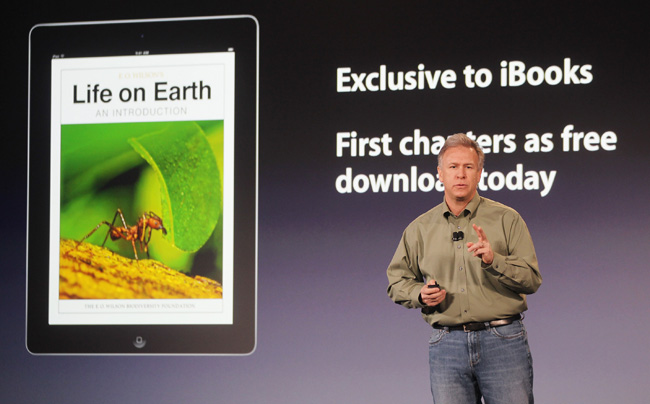
Larger viewPhilip Schiller, Apple's senior vice president of Worldwide Marketing, speaks about Apple's plan to "reinvent" textbooks at an event at the Guggenheim Museum on January 19, 2012 in New York City. Apple announced iBooks 2, a new free app featuring iPad interactive textbooks. The company also announced iBook Author, an application to create digital textbooks, and iTunes U, an educational app for students and teachers. (Mario Tama/Getty Images)

St. Paul, Minn. — The University of Minnesota bookstore has one of the largest textbook departments in the country, with rows of shelves piled high with titles — everything from Algebra One to Nuclear Physics.

Students can buy Shakespeare's books for less than $10, but that's only because the literary rights have long ago expired. The average price of the store's books is about $50 and some titles fetch as much as $225 — another sign of the rising price of college education.

Paying for textbooks is becoming such a burden for college students, that today the University of Minnesota is launching an online project to hunt down free textbooks to replace the pricey ink-and-paper versions. It's part of a national movement to cut the cost of textbooks.

The university has an extensive used and rental program to help make textbooks more affordable. But students like Hengyi Huang try to avoid the campus bookstore altogether.

Huang, a computer science student from China, buys his textbooks on Amazon or eBay. He said it can be tricky to find the right edition required in class.

"Textbooks keep renewing every year," Huang said. "There's only a tiny change in some of the pages. But the instructor requires us to buy the newest edition, which I don't think is necessary."

The average college student spends $1,000 or more each year on textbooks. That annoys pre-med student Amanda Benarroch, of Rochester, Minn.

"Tuition is already higher than it used to be," she said. "Textbook companies are kind of obnoxious."

Obnoxious or not, commercially printed textbooks dominate the market. There's a growing effort to change that, as dozens of so-called open-source textbooks are available online for free.

But such books have been slow to catch on, said David Ernst, director of academic and information technology for the College of Education and Human Development.

"The open textbooks are out there," Ernst said. "And they're scattered."

As a result, it's hard for teachers to find them.

"The second reason is that they don't know what is quality when they do find them," Ernst said.

Written by experts in their fields, open-source textbooks generally allow users to edit the texts or make "mash-ups" from several books.

Ernst is leading a new project at the University of Minnesota that will review open-source textbooks and collect the ones that pass muster in an online catalog. He said the project will concentrate first on the most widely taught courses, like introductory biology and math.

"You know the world doesn't need another $150 Algebra One book," he said. "Algebra One hasn't changed for centuries, probably."

University of Minnesota faculty will be paid $500 to write a review of an open-source textbook. They'll earn the same amount to adopt such a book in class.

Nicolle Allen, textbook advocate for the Student Public Interest Research Group, said Minnesota's peer-reviewed catalog could be a real boost.

"There are some sites that list reviews of open textbooks but I think this one is significant because it's actually developed by a Big Ten, well-respected university," said Allen, director of the research group's Make Textbooks Affordable Project.

The catalog is part of a national effort to create cheaper alternatives to commercially published textbooks. Some educational foundations have paid scholars to write free textbooks. Other publishers offer electronic versions for free, but charge for printed copies.

But the $4 billion commercial textbook industry still retains one big advantage: the financial power to create ancillary materials like study plans, exams, and course-management software. Surveys show that instructors prize those materials above all else, said publishing industry analyst Al Greco of Fordham University.

Another priority for professors is that books be up to date and compatible with their academic viewpoint.

"While we're told price is very important, it's always fourth," said Greco, a marketing professor. "As of today, open access textbooks have very little traction in the business."

Meanwhile another big change is on the textbook horizon, Greco said.

Apple is expected to enter the college market soon, just as it has with K-12 textbooks, where publishers create multimedia textbooks for the iPad.

lunes, 2 de abril de 2012

Open Stax College

ORIGINAL: RICE Conexion


Rice University's Connexions project is about to make it cheaper to attend college by publishing free textbooks online for five of the nation's most-attended undergraduate courses. If Connexions' new OpenStax College captures even 10 percent of the market for these first five courses, 1 million college students in the United States will save in excess of $90 million over the next five years. The initiative, which is backed by the Hewlett Foundation, the Bill & Melinda Gates Foundation, the 20 Million Minds Foundation and the Maxfield Foundation, will publish introductory physics and sociology books in March and three more titles this fall.
It’s innovation in education. And the time is right. OpenStax College offers students free textbooks that meet scope and sequence requirements for most courses. These are peer-reviewed texts written by professional content developers. Adopt a book today for a turnkey classroom solution or modify it to suit your teaching approach.

Free online and low-cost in print, OpenStax College books are built for today’s student budgets. Stay informed through our newsletter, like us on Facebook, or tweet about @openstaxcollege.

domingo, 22 de enero de 2012

No apueste en contra de la idea de Neeru Khosla para salvar a nuestras escuelas

ORIGINAL: Mercury News (Silicon Valley)
Por Mike Cassidy
Publicado: 22/01/2012 07:00:00 AM PST


Neeru Khosla, Co-Fundador y Director Ejecutivo de CK12 Foundation habla con Trisha Chen, de 11 años, una estudiante de 6to grado en la Escuela Nueva, antes de su conferencia de hablar en la Conferencia de aprendizaje innovadores en la Escuela Nueva en Hillsborough el viernes, octubre 21, 2011.La Fundación sin fines de lucro Khosla CK-12 ha producido docenas de libros de texto de código abierto en línea. (Li-Po Ching / Mercury News). (Li-Po Ching)

Desde una pequeña oficina a lo largo de la carretera 101 en Palo Alto, Neeru Khosla está en silencio tratando de poner de cabeza la forma como los profesores enseñan y cómo aprenden los estudiantes.


Es una tarea difícil para una mujer que no es una política, educadora o administradora. En lugar de eso, podría llamarse una guerrera cruzada - una cruzada que ha adoptado la urgencia, la innovación y el talento típico de una empresa de Silicon Valley en un esfuerzo por impulsar la educación escolar (K-12) en el siglo 21.

Neeru Khosla, Co-Fundador y Director Ejecutivo de CK12 Foundation y Todd McPeak, relacionista de aliados de CK-12 FlexMath preparan el material en su stand en la Conferencia de aprendizaje innovadores en la Escuela Nueva en Hillsborough el viernes, octubre 21, 2011. La Fundación sin fines de lucro Khosla CK-12 ha producido docenas de libros de texto de código abierto en línea. (Li-Po Ching / Mercury News). (Li-Po Ching)
En un momento en que los presupuestos de las escuelas públicas están por los suelos y de mayor tamaño de las aulas están haciendo que sea más difícil para los profesores para ofrecer ayuda individual, sin fines de lucro La Fundación Khosla CK-12 mantiene la promesa de una solución de dos armas: libros en línea de texto digitales sobre todo de matemáticas y ciencias, y ejercicios que se pueden personalizar, complementados con videos y otras características interactivas, y que no les cuesten nada a las escuelas.

Maestros a nivel nacional se han descargado los libros de texto y otros materiales del sitio web sin fines de lucro, que pasa a lo largo de millones de estudiantes, por CK-12 del presupuesto.

"Es como ir del pergamino al papel y del lápiz a la computadora", dice Khosla. "Si no les damos a los estudiantes lo que necesitan para tener éxito, vamos a perderlos".
Neeru Khosla, Co-Fundador y Director Ejecutivo de CK12 Foundation habla acerca de su iniciativa sobre libros de texto de código abierto en la Conferencia de aprendizaje innovadores en la Escuela Nueva en Hillsborough el viernes, octubre 21, 2011. La Fundación sin fines de lucro Khosla CK-12 ha producido docenas de libros de texto de código abierto en línea. (Li-Po Ching / Mercury News). (Li-Po Ching)
El proyecto significa que todas las escuelas, no importa cuán pobres sean, pueden darse el lujo de tener material educativo que involucra a los estudiantes si tienen hambre de trabajo más avanzado, o para luchar con los fundamentos. Los libros, que pueden ser descargados a las computadoras y dispositivos móviles, ayudar a los estudiantes construir sus habilidades de lectura y lenguaje, incluso a medida que enseñan matemáticas y conceptos de la ciencia.