Mostrando entradas con la etiqueta Piezoelectricidad. Mostrar todas las entradas

martes, 18 de marzo de 2014

How Smart Dust Could Spy On Your Brain

Intelligent dust particles embedded in the brain could form an entirely new form of brain-machine interface, say engineers
The real time monitoring of brain function has advanced in leaps and bounds in recent years. That’s largely thanks to various new technologies that can monitor the collective behaviour of groups of neurons, such as functional magnetic resonance imaging, magnetoencephalopathy and positron emission tomography.

This work is revolutionising our understanding of the way the brain is structured and behaves. It has also lead to a new engineering discipline of brain-machine interfaces, which allows people to control machines by thought alone.

Impressive though these techniques are, they all suffer from inherent limitations such as limited spatial resolution, a lack of portability and extreme invasiveness.

Today, Dongjin Seo and pals at the University of California Berkeley reveal an entirely new way to study and interact with the brain. Their idea is to sprinkle electronic sensors the size of dust particles into the cortex and to interrogate them remotely using ultrasound. The ultrasound also powers this so-called neural dust.

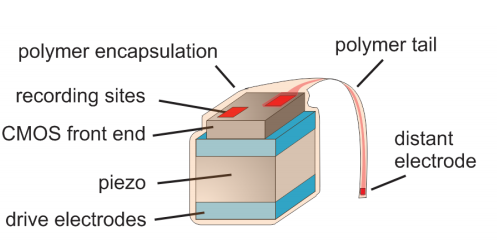
Each particle of neural dust consists of standard CMOS circuits and sensors that measure the electrical activity in neurons nearby. This is coupled to a piezoelectric material that converts ultra-high-frequency sound waves into electrical signals and vice versa.

The neural dust is interrogated by another component placed beneath the scale but powered from outside the body. This generates the ultrasound that powers the neural dust and sensors that listen out for their response, rather like an RFID system.

The system is also tetherless–the data is collected and stored outside the body for later analysis.

That gets around many of the limitations. The system
  • is lower power, 
  • can have a high spatial resolution, and 
  • it is easily portable. 
  • It is also rugged and 
  • can potentially provides a link over long periods of time. 
“A major hurdle in brain-machine interfaces (BMI) is the lack of an implantable neural interface system that remains viable for a lifetime,” say Seo and co.

The difficulty is in designing and building such a system and today’s paper is a theoretical study of these challenges. First is the problem of designing and building neural dust particles on a scale of roughly 100 micrometres that can send and receive signals in the harsh, warm and noisy environment within the body.

That’s why Seo and co have chosen ultrasound to send and receive data. They calculate that the power required to use electromagnetic waves on the scale would generate a damaging amount of heat because of the amount of energy the body absorbs and the troubling signal-to-noise ratios at this scale.

By contrast, ultrasound is a much more efficient and should allow the transmission of at least 10 million times more power than electromagnetic waves at the same scale.

Next is the problem of linking the electronics to the piezoelectric system that converts ultrasound to electronic signals and vice versa. Ensuring that the system works efficiently will be tricky given that it has to be packaged in an inert polymer or insulator film (which must also expose the recording electrodes to nearby neurons).

Finally, there is the challenge of designing and building the interrogation system that generates the ultrasound to power the entire array but at a low enough power to avoid heating skull and the brain.

On top of all this is the additional challenge of implanting the neural dust particles in the cortex. Seo and co say this can probably be done by fabricating the dust particles on the tips of a fine wire array, held in place by surface tension, for example. This array would be dipped into the cortex where the dust particles become embedded.

That’s an ambitious vision that is littered with challenges beyond the state-of-the-art. However, the team has a strong background in nanoelectromechanical systems and in the interface between electronic systems and cells.

Indeed, one of the authors, Michel Maharbiz, developed the world’s first remotely controlled beetle a few years ago, a development that was named one of the top 10 emerging technologies of 2009 by Technology Review.

These guys are clearly not afraid to take on big challenges. It’ll be interesting to see how they fare.

Ref: arxiv.org/abs/1307.2196: Neural Dust: An Ultrasonic, Low Power Solution for Chronic Brain-Machine Interfaces


ORIGINAL: Technology Review
July 16, 2013

lunes, 20 de enero de 2014

Nanoribbons let beating hearts power their own pacemakers

Researchers show that materials called piezoelectrics, packaged onto flexible strips attached to animal hearts, can supply power for medical devices where batteries pose problems.

A thin strip with piezoelectric power generators can convert this cow heart's movements into electrical power to run pacemakers or other medical devices. 
(Credit: University of Illinois and University of Arizona)

Pacemakers supply electrical pulses so hearts can keep a steady beat -- and maybe now it's time for hearts to return the favor.

As electronics spread to smaller and smaller devices, a new technology called energy harvesting can in some cases solve the problem of supplying electrical power. Researchers at the University of Illinois-Champaign have shown they can harvest energy from the movement of internal organs to power pacemakers and other medical devices that today depend on hard-to-change batteries.

The researchers attached small flexible strips they call piezoelectric nanoribbons to organs like the hearts of cows, sheep, and pigs.

The research offers a new option for power pacemakers -- surgically embedded devices that issue electric pulses to keep hearts ticking rhythmically -- as well as heart rate monitors and other medical devices embedded in the human bodies.

They're not the first to try the idea , but their approach -- using flexible strips and a piezoelectric made from lead zirconate titanate -- generates three to five times more current, the researchers said in a Tuesday paper in the Proceedings of the National Academies of Science. In addition, an encapsulation technique protects it from the body's immune system, and it's been tested to maintain its flexibility throughout 20 million flexes. The flexible strips are better suited to real-world bodies than typically rigid electronic devices, they argue in the paper.

"Heart rate monitors, pacemakers, cardioverter-defibrillators, and neural stimulators ... rely on battery power for operation. Means for harvesting power directly from natural processes of the body represent attractive alternatives for these and future types of biomedical devices," the researchers said in the paper. "Here we demonstrate a complete, flexible, and integrated system that is capable of harvesting and storing energy from the natural contractile and relaxation motions of the heart, lung, and diaphragm at levels that meet requirements for practical applications."

Piezoelectric materials already are widely used in everything from sensors to tiny loudspeakers because of a handy property: they produce voltage when compressed, or alternatively compress when a voltage is applied to them. That means piezo electrics can be used as physical sensors since they can convert pressure into an electrical signal that can be measured.

The technique could work on the outside of the body, too. That could be helpful for the hotly active wearable computer field, though the mechanical energy of human movement is more likely to power sensors than something as power-hungry as a mobile phone processor.

Energy harvesting, also called scavenging, is an area of active research relevant to people designing sensors and other small electronic devices. Other energy sources include heat, shock waves, vibrations, and chemical reactions.

One example of energy harvesing: the Holst Centre R&D lab in the Netherlands is developing an energy harvesting system that powers a car tire pressure sensor , including a wireless network to transmit data to the car 's control computer.

ORIGINAL: CNet
January 20, 2014

jueves, 9 de enero de 2014

Viruses Build Piezoelectric Nanogenerator Through Self Assembly

Image: KAIST

Nanotechnology has opened up the possibility of building things like nature does: on the nanoscale. As such, biomimicry has been a guiding principle of nanomanufacturing.

But unlike natural processes, artificial synthesis of nanoscale structures has often required toxic and expensive conditions. Now researchers at the Korea Advanced Institute of Science and Technology (KAIST) say they've developed a synthesis process that can be done in a more natural way without the costly and extreme environments previously required.

What the researchers came up with uses a harmless, man-made virus, known as the M13 viral gene. The researchers modified it so that it acted as a template for a piezoelectric material, barium titanate (BaTiO3).

The research, which was published in the journal ACS Nano (“Virus-Directed Design of a Flexible BaTiO3 Nanogenerator”), demonstrated that they could build a high-performance, flexible nanogenerator from the piezoelectric material using the M13 viral gene as template for guiding self-assembly of the device.

"This is the first time to introduce a bio-templated inorganic piezoelectric material to a self-powered energy harvesting system, which can be realized through eco-friendly and efficient material syntheses," said Professor Keon Jae Lee from the Department of Material Science and Engineering at KAIST in a press release.

But, of course, using man-made viruses to guide the self-assembly of devices has long been the purview of Angela Belcher at MIT for over a decade. Nonetheless, we can’t quibble that this marks the first time that a virus template was used to create a nanogenerator. And it has a pretty respectable electrical output performance, claimed in the research paper to be about 300 nanoampere and 6 volts.

In fact, the real breakthrough of the research may be that the biosynthetic method that the KAIST researchers developed could open up new possibilities in bio-inspired self-assembly for applications ranging from thermoelectrics to biofuel cells.

Learn More KAISTbiomimicrynanogeneratorsnanotechnologypiezoelectricself-assemblyvirus

ORIGINAL: IEEE Spectrum
By Dexter Johnson
5 Dec 2013

jueves, 5 de diciembre de 2013

Viruses Build Piezoelectric Nanogenerator Through Self Assembly


Image: KAIST
Nanotechnology has opened up the possibility of building things like nature does: on the nanoscale. As such, biomimicry has been a guiding principle of nanomanufacturing.

But unlike natural processes, artificial synthesis of nanoscale structures has often required toxic and expensive conditions. Now researchers at the Korea Advanced Institute of Science and Technology (KAIST) say they've developed a synthesis process that can be done in a more natural way without the costly and extreme environments previously required.

What the researchers came up with uses a harmless, man-made virus, known as the M13 viral gene. The researchers modified it so that it acted as a template for a piezoelectric material, barium titanate (BaTiO3).

The research, which was published in the journal ACS Nano (“Virus-Directed Design of a Flexible BaTiO3 Nanogenerator”), demonstrated that they could build a high-performance, flexible nanogenerator from the piezoelectric material using the M13 viral gene as template for guiding self-assembly of the device.

"This is the first time to introduce a bio-templated inorganic piezoelectric material to a self-powered energy harvesting system, which can be realized through eco-friendly and efficient material syntheses," said Professor Keon Jae Lee from the Department of Material Science and Engineering at KAIST in a press release.

But, of course, using man-made viruses to guide the self-assembly of devices has long been the purview of Angela Belcher at MIT for over a decade. Nonetheless, we can’t quibble that this marks the first time that a virus template was used to create a nanogenerator. And it has a pretty respectable electrical output performance, claimed in the research paper to be about 300 nanoampere and 6 volts.

In fact, the real breakthrough of the research may be that the biosynthetic method that the KAIST researchers developed could open up new possibilities in bio-inspired self-assembly for applications ranging from thermoelectrics to biofuel cells.

ORIGINAL: IEEE Spectrum
By Dexter Johnson
Posted 5 Dec 2013

lunes, 23 de septiembre de 2013

(Energy) Harvest Festival

ORIGINAL: Traffic Technology International
August/September 2013

Illustration courtesy of Patrick George
The energy produced by vehicles driving on our roadways is a potentially huge source of untapped electricity. Louise Smyth meets the people who will have cause to celebrate if the concept sparks into life

Although the ideas of piezoelectric generation and embedding functionality into roads are not new, the notion of merging the two is novel. We've long embedded technologies in roadways, a case in point being the much-maligned loop detector Meanwhile, we've used piezoelectric materials for numerous applications over the years. So when considering a marriage between the two, a simple question to ask is, can any of the power created by vehicles driving over our roads be harnessed? Answering how this could be achieved is rather more complicated.

Simple thingsA piezoelectric energy harvesting system for roads is relatively straightforward. Vehicles drive over the surface, their tires place pressure on piezoelectric crystals embedded in the road, wíuch subsequently produce a small amount of energy. Multiply that scenario over a stretch of road with many vehicles traveling over the top and thousands of embedded crystals and you can almost envision a day when the lights of the Golden Gate Bridge could be powered by the vehicles driving over it We're not there yet We're at the academic and research stages, although some commercial outfits are taking the tentative steps to forming a compelling business case, as well as selling energy-harvesting equipment designed for roads. The potential would seem to be enormous, but fulfilling it is not without major challenges - something that anyone who's worked in the área can testify. John Gambatese, professor in the School of Civil and Construction Engineering at Oregon State University, is festival one of those researchers. Hot on the heels of Oregon’s successful solar highway deployment, he submitted his Research Problem Statement on energy harvesting for roadways to Oregon DOT at the end of 2012. 
“We leave a lot of energy on the road in different ways,” he says. “Whether it’s the vibration on a bridge or roadway, or the wind produced by the traffic, there’s energy there that can be harvested. It might only be a small amount at each location but when you add it up, it could help to power our traffic infrastructure, our streetlighting, or other electrical requirements we may have.”
So if that goes according to plan, what about selling the surplus back into the grid? 
“For now we’re just trying to develop the technology so we can start collecting energy,” Gambatese says. “Once we do that, we can monitor how much we obtain and then there’s a chance we can optimize the technologies with the goal being to feed electricity back into the grid. Whether or not we’ll have that capability in the next five to 10 years, though, I’m not so sure.”

From research to reality?
The FHWA is funding work on energy harvesting for roads, indicating that it sees some future potential in the concept. The Administration’s Eric Weaver reveals how the testing is being conducted and what the initial results have shown

The Virginia in Tech Transportation Institute (VTTI) presence is a notable in the testing of piezoelectric energy harvesting for roads and is currently involved in a US$1M FHWA-funded project.  The stated aim isn’t to assess commercially available systems but to put a VTTI-developed system through its paces. The research is being overseen by Eric Weaver, a research civil engineer in the FHWA’s Office of Infrastructure, R&D, and an expert in this sector. “We are currently exploring the potential," says a cautiously optimistic Weaver about the technology. “Our initial research indicates that the amount of energy harvested might be modest but could theoretically offset some utility costs or provide power in areas that  are currently inaccessible to the grid.”

Like many people in the field, Weaver foresees any power generated being used only where it is harvested, for th short term at least. "It's meant to provide energy within the energy right-of-way to be used for transportation infrastructure demands,” he continues. “However, depending on the application and the infrastructure demand, excess energy could potentially be transferred back to the grid, provided that the electric grid infrastructure is updated to enable this.
 “Our work has involved a significant amount of analytical modeling, as well as laboratory trial and error with different  geometric configurations of piezoelectric generators and the materials that encase them. Virginia Tech researchers have installed some sensors at two locations in the state, one of which is at a truck weigh station and the other at a full-scale test road called the VA Smart Road."

Interestingly, for comparison purposes, researchers also installed sensors from the Israeli company Innowattech in at least one of those locations.

Although Weaver reveals that the results so far are perhaps not as encouraging as vendors or proponents of the technology might hope, the work is helping to identify teething problems that likey be overcome. “So far in our research, low power output is observed with each axle load application. Part of the reason for this is that the wheel load doesn’t always pass directly over the generator, because they’re centered in the wheel path, where the wheels don’t onsistently track. To mitigate this problem, researchers are exploring other generator geometries that provide more spatial coverage.”

“The sensors have been rugged enough so far to hold up to the traffic loading they have received,” Weaver continues. “A further benefit is that the data from this project has been used to support another study performed for the California Energy Commission to evaluate the feasibility of all piezoelectric generation technologies currently on the market.”

Complete Text: Traffic Technology International August/September 2013 

"Depending on the application and the infrastructure demand, excess energy could potentially be transferred back to the grid"

www.TrafficTechnologyToday.com