Mostrando entradas con la etiqueta Google Science Fair. Mostrar todas las entradas

viernes, 2 de enero de 2015

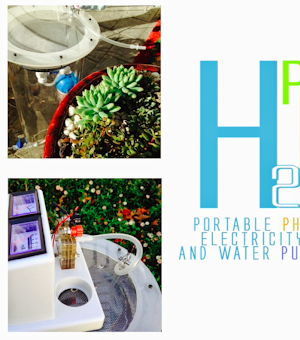
H2PRO - Portable Photocatalytic Electricity Generation and Water Purification Unit


Electricity and clean water -things that we easily have access to are unfortunately luxuries for those in underdeveloped countries.

In fact, not only is there a lack of resources in third-world countries, but also the whole world is facing energy crisis and water pollution. My objective is to find an eco-friendly and economical approach to solve both issues.

My device H2PRO relies on photocatalytic reactions to purify and sterilize wastewater and to generate electricity using hydrogen produced. This sustainable process only requires titania and light. What’s more is that organic pollutant doesn’t only get decomposed but will also enhance the reaction rate.
It is composed of 2 parts –the upper unit for photocatalytic water-purification and hydrogen-generation, which is connected to a fuel cell and the bottom unit for further water filtration.

H2PRO’s feasibility in the removal of organic pollutant was examined to be excellent-almost 90% of organic compound was decomposed after 2hours. However, its performance in electricity generation was quite unstable although theoretically and experimentally the photocatalytic hydrogen yield is proved to be satisfactory and even better in the presence of organic pollutant. I will keep improving this device until stable electricity generation is achieved.

In conclusion, I have successfully introduced a design for a portable electricity-generation and water-purification unit. Generally speaking, H2PRO has demonstrated its potential to feasibly provide clean water and sustainable energy to the needy ones. I will keep "practicalizing" the electricity-generation unit so that people can really benefit from my design one day.

ABOUT ME
Hello! My name is Cynthia Lam. I go to Balwyn High School in Melbourne, Australia. Besides Science, I love travelling, music and making crafts.

I am always fascinated by the how scientists put imaginations into practice to change the world. Rita Levi-Montalcini's perseverance in science is truly an inspiration to me. Yet, although there was always a spark of passion for science in my heart, I always thought that I was too young for researches and inventions - until last year.

In April 2013, out of curiosity and my love for Chemistry, I started my first research on Titania's Photocatalysis. I investigated the optimum conditions for photocatalytic hydrogen generation and it won the Major Bursary in Victoria's Science Talent Search. It was a very rewarding and exciting experience to complete a research, I was hence motivated to challenge myself and to create a helpful device that puts what I investigated into practice.

I would like to study Medicine or Environmental Science in the future because I want to be able to help those in need. By creating H2PRO, I introduced an eco-friendly alternative for providing people in underdeveloped countries clean water and electricity. There is still a long way to go, but I am glad I took my first step to make a difference. Winning would mean a motivation for me to keep improving my device and to bravely follow my dreams. Hopefully it would also raise the awareness of the importance of clean water and electricity in underdeveloped countries.

QUESTION / PROPOSAL
Is it possible to create a portable device that purifies wastewater while generating electricity sustainably and affordably?

This question is raised not only because of the lack of clean water and electricity in third-world countries, but also because we are all facing energy crisis and water pollution. My objective is to find an eco-friendly and economical approach to solve both issues.

Based on what I developed from investigating photocatalysis, I aim to create a device that can put the mechanisms into practice. In photocatalysis, not only water is purified and sterilized, but hydrogen is also produced through water-splitting, which can be used to generate electricity.

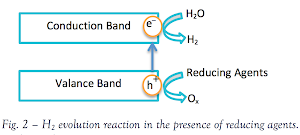
The entire sustainable process only needs titania and light-no additional power source is required. However, hydrogen production is generally low since photoexcited electrons tend to fall back to the hole(i.e.photoinduced electron-hole combination). Fortunately, it can be overcome by adding reductants, while some organic pollutants serve such purpose. Hence, I propose to combine the two mechanisms together to enhance the yield and lower the cost of hydrogen generation, meanwhile efficient water purification can also be achieved.

There are similar designs existing, but they require either an excessively complex use of technology or an external energy source, which means they are not sustainable, affordable and manageable for users in underdeveloped countries. Nonetheless, I hypothesize that photocatalysis can be applied in a manageable scale that allows water purification and electricity production to be economically and sustainably performed in a portable device as well as at a household level.

RESEARCH

EXISTING WORK
There is an existing design for mobile hydrogen energy and water supply, although feasible, that design needs an external solar power source to purify water and produce hydrogen through electrolyzer, which makes it costlier and less efficient. This inspires me to create a self-sustainable portable device that can purify wastewater and produce electricity through only photocatalysis (without any additional electricity source).

METHODOLOGY
I. Photocatalytic Redox Reactions
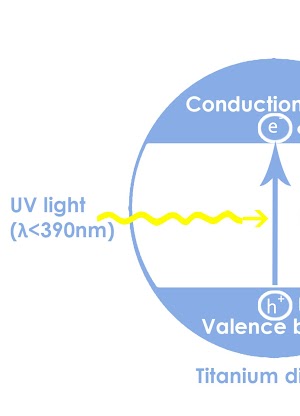
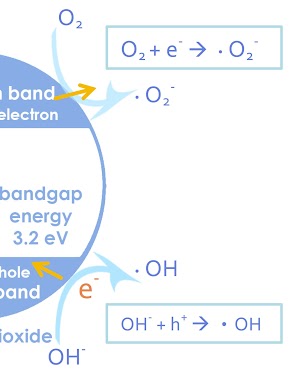
When titania absorbs ultraviolet energy, which is comparable to its band gap, photoexcitation of electron takes place and an electron-hole pair is produced.

Reduced by the excited electron, oxygen forms super oxide anion (•O2-). The hole reacts with water producing hydroxyl radicals (•OH).

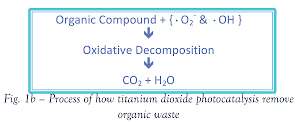
The radicals yielded in the process oxidize organic compound, resulting in water purification. Furthermore, organic compounds may also be oxidized by the hole. In either case, the organic compound decomposed to yield harmless CO2 and H2O.
I. Photocatalytic Water Splitting
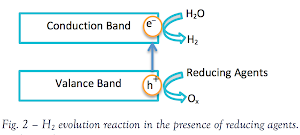
The effect of water splitting using titania was first discovered by Akira Fujishima. The photoinduced electrons and holes cause redox reactions similarly to electrolysis, causing water molecules to be reduced by the electrons to form hydrogen and oxidized by the holes to form oxygen (most oxygen is consumed in side reactions so hydrogen is the major product).

III. Recombination of the photoinduced electron-hole pairs
Electrons tend to move to lower energies. When this transfer occurs from band to band, it is called recombination.
In this process, an electron (e–), which has been excited from the valence band to the conduction band of titania, falls back into an empty state in the valence band, which is the hole (h+).
This phenomenon hinders photocatalytic redox and water-splitting reactions. Hence, preventing the recombination reaction had long been the centerpiece of the field.

Different attempts to hinder the recombination of electron-hole pairs have been proposed; doping titania with noble metals for example. The addition of a sacrificial agent – a reducing agent or an oxidizing agent – is known as an excellent approach to overcome such limitation. When photocatalysis takes place in an aqueous solution including a reductant, a.k.a. electron donors/ hole scavengers, photoinduced holes irreversibly oxidize the reductant instead of water. Therefore, hydrogen production is enhanced.

Lots of common organic pollutants such as methanol, glycerol and EDTA can act as excellent reductants. As hole scavengers, they minimize the chance of recombination of the photoinduced electron-hole pairs, hence enhancing the rate of hydrogen generation. At the same time, they can be effectively decomposed.
III. Hydrogen Fuel Cell
There are various fuel cells, but generally they work similarly. Hydrogen fuel cell has an anode and a cathode separated by a membrane. Oxygen passes over cathode and hydrogen over anode.
H2 reacts to a catalyst on the anode that converts H2 into electrons and hydrogen ion.
The mobile electrons travel through a wire creating the electric current. The hydrogen ions move through the electrolyte membrane to the cathode where they react with oxygen and electrons to form water.


sábado, 1 de noviembre de 2014

16-Year-Old Irish Girls Win Google Science Fair 2014 With World-Changing Crop Yield Breakthrough


Irish teenagers Ciara Judge, Émer Hickey and Sophie Healy-Thow, all 16, have won the Google Science Fair 2014. Their project, Combating the Global Food Crisis, aims to provide a solution to low crop yields by pairing a nitrogen-fixing bacteria that naturally occurs in the soil with cereal crops it does not normally associate with, such as barley and oats. The results were incredible: the girls found their test crops germinated in half the time and had a drymass yield up to 74 percent greater than usual.


All three girls love gardening. In 2011, at school, they were also studying the food crisis in the Horn of Africa and were thinking about ways they could help. One day Hickey pulled up some pea plants from her garden and brought them in to discuss strange nodules on the roots with the girls’ science teacher. Peas, like other leguminous plants, have a symbiotic relationship with diazatrophic rhizobia bacteria found in soil. This relationship leads to nitrogen fixing in the soil, which can reduce the need for added chemical fertilizers.


The girls decided to experiment with the effects of rhizobia on non-leguminous plants. After trialing over 10,000 barley and oat seeds, the results were astonishing. Two types of rhizobia in particular showed great potential for agricultural use. In their submission to the Fair the girls stated: “These results have significant potential for increasing yields of food crops and reducing losses due to adverse weather conditions. They also offer opportunities for reducing the environmental footprint of agriculture by reducing fertilizer usage. As demand for cereals increases with population growth, this discovery could act as a partial solution to the impending food poverty crisis. There is potential for future work in this area and we plan to investigate the biochemical mechanism involved and carry out more extensive field trials.

The trio are not newcomers to scientific achievement. In 2013, they were awarded first place in a national science competition from a field of 2,000 entries. They then represented Ireland in the European Contest for Young Scientists in September 2013, where they also won first place. As the Grand Prize winners of the Google Science Fair 2014, Ciara, Émer and Sophie each receive a 10-day trip to the Galapagos Islands provided by National Geographic, a $50,000 scholarship from Google, a personalized LEGO prize provided by LEGO Education and the chance to participate in astronaut training at the Virgin Galactic Spaceport in the Mojave desert. You can sign up here to be notified when entries open for the Google Science Fair 2015.

ORIGINAL: Inhabitat
09/25/14

sábado, 16 de agosto de 2014

H2prO - Portable Photocatalytic Electricity Generation and Water Purification Unit


Electricity and clean water -things that we easily have access to are unfortunately luxuries for those in underdeveloped countries.

In fact, not only is there a lack of resources in third-world countries, but also the whole world is facing energy crisis and water pollution. My objective is to find an eco-friendly and economical approach to solve both issues.

My device H2PRO relies on photocatalytic reactions to purify and sterilize wastewater and to generate electricity using hydrogen produced. This sustainable process only requires titania and light. What’s more is that organic pollutant doesn’t only get decomposed but will also enhance the reaction rate.


It is composed of 2 parts
  • –the upper unit for photocatalytic water-purification and hydrogen-generation, which is connected to a fuel cell and 
  • the bottom unit for further water filtration.
H2PRO’s feasibility in the removal of organic pollutant was examined to be excellent-almost 90% of organic compound was decomposed after 2 hours. However, its performance in electricity generation was quite unstable although theoretically and experimentally the photocatalytic hydrogen yield is proved to be satisfactory and even better in the presence of organic pollutant. I will keep improving this device until stable electricity generation is achieved.

In conclusion, I have successfully introduced a design for a portable electricity-generation and water-purification unit. Generally speaking, H2PRO has demonstrated its potential to feasibly provide clean water and sustainable energy to the needy ones. I will keep "practicalizing" the electricity-generation unit so that people can really benefit from my design one day.


Question / Proposal

Is it possible to create a portable device that purifies wastewater while generating electricity sustainably and affordably?

This question is raised not only because of the lack of clean water and electricity in third-world countries, but also because we are all facing energy crisis and water pollution. My objective is to find an eco-friendly and economical approach to solve both issues.

Based on what I developed from investigating photocatalysis, I aim to create a device that can put the mechanisms into practice. In photocatalysis, not only water is purified and sterilized, but hydrogen is also produced through water-splitting, which can be used to generate electricity.
The entire sustainable process only needs titania and light-no additional power source is required. However, hydrogen production is generally low since photoexcited electrons tend to fall back to the hole(i.e.photoinduced electron-hole combination). Fortunately, it can be overcome by adding reductants, while some organic pollutants serve such purpose. Hence, I propose to combine the two mechanisms together to enhance the yield and lower the cost of hydrogen generation, meanwhile efficient water purification can also be achieved.

There are similar designs existing, but they require either an excessively complex use of technology or an external energy source, which means they are not sustainable, affordable and manageable for users in underdeveloped countries. Nonetheless, I hypothesize that photocatalysis can be applied in a manageable scale that allows water purification and electricity production to be economically and sustainably performed in a portable device as well as at a household level.
ORIGINAL: Google Science Fair

lunes, 11 de agosto de 2014

This girl invented a new material that could change the world

Wanting to reduce pollution in her home city of Istanbul, Elif Bilgin manufactured a new environmentally-friendly bio-plastic that uses banana peels - an organic material - instead of traditional petroleum sources.

You'll Never Look At A Banana The Same Way Again!

SOURCE: 

ORIGINAL: IFLS
Sat, 08/09/2014

miércoles, 25 de septiembre de 2013

Google Science Fair winners: Flashlights without batteries, ‘bat signals,’ non-viral viruses

September 24, 2013

Google
Google Science Fair is clearly where minor miracles happen. Flashlights that work without batteries, traffic that moves itself out of the way of an oncoming emergency vehicle, and new flu medicines — designed on a computer — that are effective even against pandemic strains.

And all, of course, from teenagers.

Google announced the winners of its 2013 science fair today, and three teens from Australia, Canada, and the USA have emerged from the 18 finalists that Google invited to Mountain View, and won their age categories.

Bat signal for ambulances


In the 13-14 age category, Aussie teen Viney Kumar designed a system that allows ambulances and other emergency vehicles to send out a GPS-informed “bat signal” to cars within 500 meters (a third of a mile) notifying them via cellular connection that an ambulance or fire truck is coming, and requesting that they pull over.

Kumar designed the system, he said, when he saw an ambulance stuck in traffic in India, unable to move, and wondered how many people were dying for lack of prompt emergency response.

Flashlight without batteries

Canadian teen Ann Makosinski won the 15-16 year-old category with a novel flashlight idea that requires no battery. The “Hollow Flashlight” runs solely on the heat of your hand, Makosinski’s flashlight uses Peltier tiles that capture energy from the flow of heat to cooler areas, such as the surrounding air. Incredibly efficient, the light can produce up to 5.4 mW and generate a light that is five foot-candles in brightness.

Since a foot-candle is basically the brightness of a lit candle at one foot distance (shocker), her battery-less device is producing more light than five candles — impressive.

The no-viral flu virus
Tim Evanson  Model of an HIV virus


Eric Chen of the USA was both the 17-18 category winner and the grand prize winner for an extremely ambitious project with the goal of stopping the flu virus before it goes viral. Chen realized that the influenza endonuclease, or enzymes, are essential for viral growth. To stop the flu, therefore, scientists need only stop its reproduction, killing the infection by not allowing it to spread.

To find the best way of doing so, Chen set up computational models and computer-aided designs of flu viruses and the endonuclease components, and “virtually screened” potential medications that could molecularly bind to the enzymes, rendering them inert, and killing the flu dead.

It sound like science fiction, or at least something the Center for Disease Control is doing in some billion-dollar lab in Atlanta, but this teen pulled it off, finding “a number of novel, potent endonuclease inhibitors,” and laying the groundwork for further study and optimization.

This teen isn’t just smart at science — Chen has filed a patent on this discovery.

The winners all received prizes from Google and CERN, Lego, National Geographic, and Scientific American. The grand prize winner, Chen, will receive an all-expenses-paid trip to the Galapagos Islands, and $50,000 in scholarships.

lunes, 15 de julio de 2013

5 teenage cancer innovators

ORIGINAL: TED Blog
TED BlogHealthTEDTalks


by: Kate Torgovnick
July 25, 2012


Some teenagers spend their free time playing video games. Others dedicate their after-school hours to a job, scooping ice cream or taking movie tickets. Still others play a sport, or are star members of a debate team. And still others spend their free time in a lab, working on ways to prevent, diagnose and treat cancer.

In a talk posted on TED.com earlier this week, 16-year-old Jack Andraka shares what got him interested in studying pancreatic cancer — a close family friend succumbing to the disease in just three months time. Pancreatic cancer is brutal, with only 5.5% of those diagnosed surviving past five years — in part because it is usually diagnosed very late. After Googling and finding terrifying statistics on the disease, Andraka had an idea: could there be a noninvasive test for pancreatic cancer to diagnose it early?

In this charming talk, Andraka reveals the many lightbulb-over-head moments that led him to create a test for pancreatic cancer that costs three cents and is close to 100% accurate. It’s a must-hear story, as one can imagine this test someday being given during routine checkups, if all goes as planned.

(Read the TED Blog’s Q&A with Andraka about his research, his friendly sibling rivalry, and how long it would be before the test is available.)

Here, talks from four more incredible young people who’ve taken the TED stage to talk about their cancer research.


Eva Vertes: Do stem cells cause cancer?
Microbiology prodigy Eva Vertes was only 19 years old when she spoke at TED2005 about cancer stem cells. In the talk below, she presents research that suggests cancer might be a repair response to damage to stem cells in the lungs, liver, bones, etc. The implication she is testing? “It’s possible, although far-fetched, that in the future we could think of cancer being used as a therapy,” she explains in the talk below.


Lauren Hodge and Shree Bose: Award-winning teen-age science in action
At the 2011 Google Science Fair, three young women swept the top prizes. The trio presented their award-winning projects at TEDxWomen that year. Then-13-year-old Lauren Hodge studied the formation of carcinogens in cooking chicken and found a surprising result — that maybe you don’t really want the grilled chicken after all. Meanwhile, Shree Bose researched how chemotherapy resistance happens in ovarian cancer — a breakthrough that could improve future treatments. Watch both young women present their findings below.


Brittany Wenger: A cloud to diagnose breast cancer
Brittany Wenger taught a computer to diagnose breast cancer, a feat that required 600 hours of coding as well as the running of 7.6 million trials, before she was even old enough to vote. “I started in the 7th grade,” Wenger, who won Google’s International Science Fair in 2012, told ScientificAmerican.com. “I want to be on the frontier of cancer research, finding the cures that are going to save lives and doing things with computer science that can be the technologies of the future.

Wenger, who spoke at TEDxWomen 2012, started this project with a computer programming book and zero experience. Soon, she had the idea to create an artificial neural network, a program that learns as it encounters more data, and train it to differentiate between benign and malignant breast tissue. The data came from fine needle aspirates, currently the least invasive but also the least conclusive test for breast cancer. Wenger’s network, Cloud4Cancer, is 99.1% sensitive to malignancies and, as it learns more, should only get better. Soon, Wagner hopes to open up the network to hospitals and, with more research, the least invasive test for breast cancer could become the most accurate.

This post originally ran on July 25, 2012, as Brittany Wenger was announced as winner of the Google Science Fair. It was revised on July 12, 2013, when Jack Andraka’s talk was posted.

lunes, 23 de julio de 2012

Google Science Fair: Brittany Wenger, GRAND PRIZE WINNER


Brittany Wenger, Google Science Fair, Grand Prize Winner
Brittany Wenger, 17. Lakewood Ranch, USA
An avid student, volunteer, athlete, and researcher, I am driven to learn and understand. I have never outgrown the “why” phase. I question everything, and it wasn’t until I was introduced to science that I found answers -- and, more questions. My elementary school experiences developed my passion for experimentation.

My enthusiasm for science continues to blossom. Helping find the cure to cancer is a goal of mine. I have experienced the pain of family members inflicted with the disease and have witnessed the anguish in Georgetown's pediatric cancer ward. Going forward, I seek to learn as much as I can in the computer science and medical fields to help achieve this goal. Although only a high school junior, I am top in my class and participate in the most rigorous courses offered at my school. I expect to major in computer science when I attend college and continue to medical school. 

Awards do not define me; however, they validate my scientific research. With each year, my research increases in complexity and has more potential to have positive benefit on mankind. When I was presented with the naming of minor planet 25333 by MIT Lincoln Laboratory, I was in disbelief; however, getting recognized by some of the top world scientists drives me to work harder. Together, we can solve extraordinary challenges.

Winning the Google Science Fair and interacting with the top scientists at Google would be an awe-inspiring opportunity for me. 

Other Science Honors
  • Second Award at Intel International Science and Engineering Fair, Medicine (Los Angeles, 2011)
  • Third Award at Intel International Science and Engineering Fair, Computer Science (San Jose, 2010)
  • Third Overall at the Society for Science and the Public Middle School Program (Washington DC, 2008)
  • Best in Show at the Sarasota County Regional Fair (2010, 2011,2012)
  • Intel Excellence in Computer Science Award (2010, 2011, 2012)
  • Dart Foundation for Medicine Award (2011)
  • Symantec Science Buddies Award (2010)
  • U.S. Naval Academy Award for Computer Science (2010)
  • American Statistical Association Honorable Mention (2011)
  • NCWIT Aspirations in Computing Award National Runner-up (2012)
  • NCWIT North Florida Affiliate Aspirations in Computing Award Winner (2012)
Global Neural Network Cloud Service for Breast Cancer


Global Neural Network Cloud Service for Breast Cancer


Leveraging the computing power of the cloud to assist with medical diagnosis can become an effective tool for doctors to provide more consistent and reliable care. Artificial neural networks detect patterns too complex to be recognized by humans and can be applied to breast mass malignancy classification when evaluating Fine Needle Aspirates (FNAs). This project teaches the cloud how to diagnose breast cancer by implementing a custom-crafted neural network that consumes FNA data collected by the University of Wisconsin to answer the question – is a mass malignant or benign?

Medical usage demands neural networks achieve accuracy with their diagnosis and reduce malignant false negatives. Building on data collected by the University of Wisconsin in the early 1990s, this project first evaluates three modern commercial neural network implementations. Information regarding potential indicators of breast cancer is quantified in the dataset; specifically, clump thickness, single epithelial cell size, bare nuclei, mitoses, and five other attributes. Each network accepts this input to optimize its hidden nodes and is tested with ten trials. With each trial, a randomly selected 10% of the dataset is used to assess the predictive power of the constructed neural network. These commercially created neural networks serve as a control group.

Development of a custom neural network weights malignant false negatives and allows for the identification of inconclusive samples (capacities not available in commercial products.) Additionally, more samples are needed to improve the predictive capability of the network; therefore, the network has been published in the cloud, allowing for global submissions and benefit. The cloud service is hosted in the Google App Engine.

The successfully implemented custom network is tested with 6,800 trials. To assure maximum training, each sample is run through ten trials evaluated by different networks trained against all other samples. The custom neural network achieved predictive success of 97.4% with 99.1% sensitivity to malignancy – substantially better than the evaluated commercial products. Out of the commercial products, two experienced consistent success while the third experienced erratic success. The sensitivity to malignancy for the custom network was 5% higher than the best commercial network’s sensitivity. This experiment demonstrates modern neural networks can handle outliers and work with unmodified datasets to identify patterns. In addition, when all data is used for training, the custom network achieves 100% success with only 4 inconclusive samples, proving the network is more effective with more samples. Additionally, 7.6 million trials were run using different training sample sizes to demonstrate the sensitivity and predictive success improves as the network receives more training samples.

The Global Neural Network Cloud Service for Breast Cancer may be ready to diagnose actual patients – more global participation is required to confirm the findings and increase the predictive success on blind samples.


Global Neural Network Cloud Service for Breast Cancer