Mostrando entradas con la etiqueta Memory. Mostrar todas las entradas

martes, 21 de febrero de 2017

Scientists Just Found Evidence That Neurons Can Communicate in a Way We Never Anticipated

Andrii Vodolazhskyi/Shutterstock.com
A new brain mechanism hiding in plain sight. Researchers have discovered a brand new mechanism that controls the way nerve cells in our brain communicate with each other to regulate learning and long-term memory.

The fact that a new brain mechanism has been hiding in plain sight is a reminder of how much we have yet to learn about how the human brain works, and what goes wrong in neurodegenerative disorders such as Alzheimer's and epilepsy.

"These discoveries represent a significant advance and will have far-reaching implications for the understanding of 
  • memory, 
  • cognition, 
  • developmental plasticity, and 
  • neuronal network formation and stabilisation,"  
said lead researcher Jeremy Henley from the University of Bristol in the UK.

"We believe that this is a groundbreaking study that opens new lines of inquiry which will increase understanding of the molecular details of synaptic function in health and disease."

The human brain contains around 100 billion nerve cells, and each of those makes about 10,000 connections - known as synapses - with other cells.

That's a whole lot of connections, and each of them is strengthened or weakened depending on different brain mechanisms that scientists have spent decades trying to understand.

Until now, one of the best known mechanisms to increase the strength of information flow across synapses was known as LTP, or long-term potentiation.

LTP intensifies the connection between cells to make information transfer more efficient, and it plays a role in a wide range of neurodegenerative conditions -  
  • too much LTP, and you risk disorders such as epilepsy,  
  • too little, and it could cause dementia or Alzheimer's disease.
As far as researchers were aware, LTP is usually controlled by the activation of special proteins called NMDA receptors.

But now the UK team has discovered a brand new type of LTP that's regulated in an entirely different way.

After investigating the formation of synapses in the lab, the team showed that this new LTP mechanism is controlled by molecules known as kainate receptors, instead of NMDA receptors.

"These data reveal a new and, to our knowledge, previously unsuspected role for postsynaptic kainate receptors in the induction of functional and structural plasticity in the hippocampus," the researchers write in Nature Neuroscience.

This means we've now uncovered a previously unexplored mechanism that could control learning and memory.

"Untangling the interactions between the signal receptors in the brain not only tells us more about the inner workings of a healthy brain, but also provides a practical insight into what happens when we form new memories," said one of the researchers, Milos Petrovic from the University of Central Lancashire.

"If we can preserve these signals it may help protect against brain diseases."

Not only does this open up a new research pathway that could lead to a better understanding of how our brains work, but if researchers can find a way to target these new pathways, it could lead to more effective treatments for a range of neurodegenerative disorders.

It's still early days, and the discovery will now need to be verified by independent researchers, but it's a promising new field of research.

"This is certainly an extremely exciting discovery and something that could potentially impact the global population," said Petrovic.

The research has been published in Nature Neuroscience.

ORIGINAL: IFLScience
By FIONA MACDONALD
20 FEB 2017

miércoles, 19 de octubre de 2016

Google's AI can now learn from its own memory independently

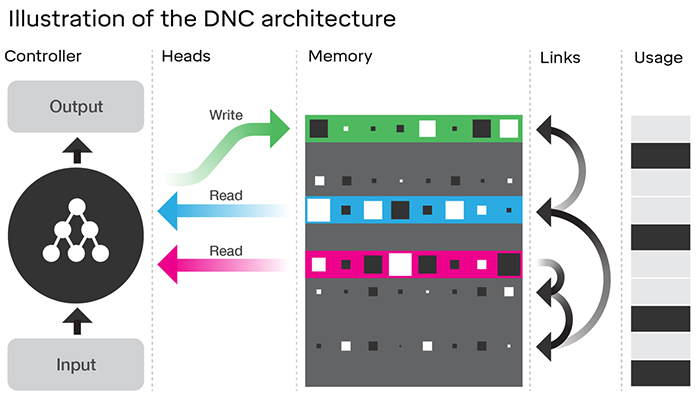
An artist's impression of the DNC. Credit: DeepMind

The DeepMind artificial intelligence (AI) being developed by Google's parent company, Alphabet, can now intelligently build on what's already inside its memory, the system's programmers have announced.

Their new hybrid system – called a Differential Neural Computer (DNC) – pairs a neural network with the vast data storage of conventional computers, and the AI is smart enough to navigate and learn from this external data bank. 

What the DNC is doing is effectively combining external memory (like the external hard drive where all your photos get stored) with the neural network approach of AI, where a massive number of interconnected nodes work dynamically to simulate a brain.

"These models... can learn from examples like neural networks, but they can also store complex data like computers," write DeepMind researchers Alexander Graves and Greg Wayne in a blog post.

At the heart of the DNC is a controller that constantly optimises its responses, comparing its results with the desired and correct ones. Over time, it's able to get more and more accurate, figuring out how to use its memory data banks at the same time.
Take a family tree: after being told about certain relationships, the DNC was able to figure out other family connections on its own – writing, rewriting, and optimising its memory along the way to pull out the correct information at the right time.

Another example the researchers give is a public transit system, like the London Underground. Once it's learned the basics, the DNC can figure out more complex relationships and routes without any extra help, relying on what it's already got in its memory banks.

In other words, it's functioning like a human brain, taking data from memory (like tube station positions) and figuring out new information (like how many stops to stay on for).

Of course, any smartphone mapping app can tell you the quickest way from one tube station to another, but the difference is that the DNC isn't pulling this information out of a pre-programmed timetable – it's working out the information on its own, and juggling a lot of data in its memory all at once.

The approach means a DNC system could take what it learned about the London Underground and apply parts of its knowledge to another transport network, like the New York subway.

The system points to a future where artificial intelligence could answer questions on new topics, by deducing responses from prior experiences, without needing to have learned every possible answer beforehand.
Credit: DeepMind
Of course, that's how DeepMind was able to beat human champions at Go – by studying millions of Go moves. But by adding external memory, DNCs are able to take on much more complex tasks and work out better overall strategies, its creators say.

"Like a conventional computer, [a DNC] can use its memory to represent and manipulate complex data structures, but, like a neural network, it can learn to do so from data," the researchers explain in Nature.

In another test, the DNC was given two bits of information: "John is in the playground," and "John picked up the football." With those known facts, when asked "Where is the football?", it was able to answer correctly by combining memory with deep learning. (The football is in the playground, if you're stuck.)

Making those connections might seem like a simple task for our powerful human brains, but until now, it's been a lot harder for virtual assistants, such as Siri, to figure out.

With the advances DeepMind is making, the researchers say we're another step forward to producing a computer that can reason independently.

And then we can all start enjoying our robot-driven utopia – or technological dystopia – depending on your point of view.

ORIGINAL: ScienceAlert
By DAVID NIELD
14 OCT 2016

jueves, 29 de septiembre de 2016

New Memristor Circuit Mimicks Synapses in the Brain


Illustration: University of Massachusetts, Amherst
To a human brain, picking one particular image out of a thousand is an easy task. Billions of neurons and the synapses that connect them can quickly process information in parallel to make a decision. Seeking to make such processing that easy for machines, scientists and engineers have been working with devices called memristors, which have some similar behaviors to neural synapses. Engineers at the University of Massachusetts report this week that they’ve invented a memristor circuit that matches a synapses’ behavior more closely than any before.

First predicted in 1971 and invented in 2008 by HP, memristors are so named because they remember how much voltage you applied across the device and how long you applied it, storing the information as a change in resistance. HP engineers noticed immediately that such a characteristic was similar to the way the synaptic connection between neurons strengthens with use to form a memory.

Memristors are “kind of the ideal candidate in many aspect” says Jianhua Yang, an electrical engineer at the University of Massachusetts Amherst working on improving their behavior. Low-power, simple circuits of memristors could improve the ability of computers to solve power-intensive computer vision and machine learning tasks that human brains handle with little effort.

In research published in Nature Materials on 26 September, Yang and his team mimicked a crucial underlying component of how synaptic connections get stronger or weaker: the flow of calcium.

The movement of calcium into or out of the neuronal membrane, neuroscientists have found, directly affects the connection. Chemical processes move the calcium in and out— triggering a long-term change in the synapses’ strength. 2015 research in ACS NanoLetters and Advanced Functional Materials discovered that types of memristors can simulate some of the calcium behavior, but not all.

In the new research, Yang combined two types of memristors in series to create an artificial synapse. The hybrid device more closely mimics biological synapse behavior—the calcium flow in particular, Yang says.

The new memristor used--called a diffusive memristor because atoms in the resistive material move even without an applied voltage when the device is in the high resistance state—was a dialectric film sandwiched between Pt or Au electrodes. The film contained Ag nanoparticles, which would play the role of calcium in the experiments.

By tracking the movement of the silver nanoparticles inside the diffusive memristor, the researchers noticed a striking similarity to how calcium functions in biological systems.

A voltage pulse to the hybrid device drove silver into the gap between the diffusive memristor’s two electrodes–creating a filament bridge. After the pulse died away, the filament started to break and the silver moved back— resistance increased.

Like the case with calcium, a force made silver go in and a force made silver go out.

To complete the artificial synapse, the researchers connected the diffusive memristor in series to another type of memristor that had been studied before.

When presented with a sequence of voltage pulses with particular timing, the artificial synapse showed the kind of long-term strengthening behavior a real synapse would, according to the researchers. “We think it is sort of a real emulation, rather than simulation because they have the physical similarity,” Yang says.

He says the next step is to better understand the mechanisms. Then, his team plans to combine the artificial synapses into arrays and eventually build bio-inspired circuits.

“We can have a more direct, more natural, and a more complete emulation to the synaptic system using the silver-based system,” he says.

ORIGINAL: IEEE Spectrum
By Andrew Silver
Posted 29 Sep 2016

lunes, 11 de abril de 2016

First Human Tests of Memory Boosting Brain Implant—a Big Leap Forward

“You have to begin to lose your memory, if only bits and pieces, to realize that memory is what makes our lives. Life without memory is no life at all.” — Luis Buñuel Portolés, Filmmaker

Image Credit: Shutterstock.com
Every year, hundreds of millions of people experience the pain of a failing memory.

The reasons are many:

  • traumatic brain injury, which haunts a disturbingly high number of veterans and football players; 
  • stroke or Alzheimer’s disease, which often plagues the elderly; or 
  • even normal brain aging, which inevitably touches us all.
Memory loss seems to be inescapable. But one maverick neuroscientist is working hard on an electronic cure. Funded by DARPA, Dr. Theodore Berger, a biomedical engineer at the University of Southern California, is testing a memory-boosting implant that mimics the kind of signal processing that occurs when neurons are laying down new long-term memories.

The revolutionary implant, already shown to help memory encoding in rats and monkeys, is now being tested in human patients with epilepsy — an exciting first that may blow the field of memory prosthetics wide open.

To get here, however, the team first had to crack the memory code.

Deciphering Memory
From the very onset, Berger knew he was facing a behemoth of a problem.

We weren’t looking to match everything the brain does when it processes memory, but to at least come up with a decent mimic, said Berger.

“Of course people asked: can you model it and put it into a device? Can you get that device to work in any brain? It’s those things that lead people to think I’m crazy. They think it’s too hard,” he said.

But the team had a solid place to start.

The hippocampus, a region buried deep within the folds and grooves of the brain, is the critical gatekeeper that transforms memories from short-lived to long-term. In dogged pursuit, Berger spent most of the last 35 years trying to understand how neurons in the hippocampus accomplish this complicated feat.

At its heart, a memory is a series of electrical pulses that occur over time that are generated by a given number of neurons, said Berger. This is important — it suggests that we can reduce it to mathematical equations and put it into a computational framework, he said.

Berger hasn’t been alone in his quest.
By listening to the chatter of neurons as an animal learns, teams of neuroscientists have begun to decipher the flow of information within the hippocampus that supports memory encoding. Key to this process is a strong electrical signal that travels from CA3, the “input” part of the hippocampus, to CA1, the “output” node.

This signal is impaired in people with memory disabilities, said Berger, so of course we thought if we could recreate it using silicon, we might be able to restore — or even boost — memory.

Bridging the Gap
Yet this brain’s memory code proved to be extremely tough to crack.

The problem lies in the non-linear nature of neural networks: signals are often noisy and constantly overlap in time, which leads to some inputs being suppressed or accentuated. In a network of hundreds and thousands of neurons, any small change could be greatly amplified and lead to vastly different outputs.

It’s a chaotic black box, laughed Berger.

With the help of modern computing techniques, however, Berger believes he may have a crude solution in hand. His proof?

Use his mathematical theorems to program a chip, and then see if the brain accepts the chip as a replacement — or additional — memory module.

Berger and his team began with a simple task using rats. They trained the animals to push one of two levers to get a tasty treat, and recorded the series of CA3 to CA1 electronic pulses in the hippocampus as the animals learned to pick the correct lever. The team carefully captured the way the signals were transformed as the session was laid down into long-term memory, and used that information — the electrical “essence” of the memory — to program an external memory chip.

They then injected the animals with a drug that temporarily disrupted their ability to form and access long-term memories, causing the animals to forget the reward-associated lever. Next, implanting microelectrodes into the hippocampus, the team pulsed CA1, the output region, with their memory code.

The results were striking — powered by an external memory module, the animals regained their ability to pick the right lever.

Encouraged by the results, Berger next tried his memory implant in monkeys, this time focusing on a brain region called the prefrontal cortex, which receives and modulates memories encoded by the hippocampus.

Placing electrodes into the monkey’s brains, the team showed the animals a series of semi-repeated images, and captured the prefrontal cortex’s activity when the animals recognized an image they had seen earlier. Then with a hefty dose of cocaine, the team inhibited that particular brain region, which disrupted the animal’s recall.

Next, using electrodes programmed with the “memory code,” the researchers guided the brain’s signal processing back on track — and the animal’s performance improved significantly.

A year later, the team further validated their memory implant by showing it could also rescue memory deficits due to hippocampal malfunction in the monkey brain.

A Human Memory Implant
Last year, the team cautiously began testing their memory implant prototype in human volunteers.

Because of the risks associated with brain surgery, the team recruited 12 patients with epilepsy, who already have electrodes implanted into their brain to track down the source of their seizures.

Repeated seizures steadily destroy critical parts of the hippocampus needed for long-term memory formation, explained Berger. So if the implant works, it could benefit these patients as well.

The team asked the volunteers to look through a series of pictures, and then recall which ones they had seen 90 seconds later. As the participants learned, the team recorded the firing patterns in both CA1 and CA3 — that is, the input and output nodes.

Using these data, the team extracted an algorithm — a specific human “memory code” — that could predict the pattern of activity in CA1 cells based on CA3 input. Compared to the brain’s actual firing patterns, the algorithm generated correct predictions roughly 80% of the time.

It’s not perfect, said Berger, but it’s a good start.

Using this algorithm, the researchers have begun to stimulate the output cells with an approximation of the transformed input signal.

We have already used the pattern to zap the brain of one woman with epilepsy, said Dr. Dong Song, an associate professor working with Berger. But he remained coy about the result, only saying that although promising, it’s still too early to tell.

Song’s caution is warranted. Unlike the motor cortex, with its clear structured representation of different body parts, the hippocampus is not organized in any obvious way.

It’s hard to understand why stimulating input locations can lead to predictable results, said Dr. Thoman McHugh, a neuroscientist at the RIKEN Brain Science Institute. It’s also difficult to tell whether such an implant could save the memory of those who suffer from damage to the output node of the hippocampus.

“That said, the data is convincing,” McHugh acknowledged.

Berger, on the other hand, is ecstatic. “I never thought I’d see this go into humans,” he said.

But the work is far from done. Within the next few years, Berger wants to see whether the chip can help build long-term memories in a variety of different situations. After all, the algorithm was based on the team’s recordings of one specific task — what if the so-called memory code is not generalizable, instead varying based on the type of input that it receives?

Berger acknowledges that it’s a possibility, but he remains hopeful.

I do think that we will find a model that’s a pretty good fit for most conditions, he said. After all, the brain is restricted by its own biophysics — there’s only so many ways that electrical signals in the hippocampus can be processed, he said.

“The goal is to improve the quality of life for somebody who has a severe memory deficit,” said Berger. “If I can give them the ability to form new long-term memories for half the conditions that most people live in, I’ll be happy as hell, and so will be most patients.”

ORIGINAL: Singularity Hub

jueves, 21 de enero de 2016

Memory capacity of brain is 10 times more than previously thought

Data from the Salk Institute shows brain’s memory capacity is in the petabyte range, as much as entire Web

LA JOLLA—Salk researchers and collaborators have achieved critical insight into the size of neural connections, putting the memory capacity of the brain far higher than common estimates. The new work also answers a longstanding question as to how the brain is so energy efficient and could help engineers build computers that are incredibly powerful but also conserve energy.

"This is a real bombshell in the field of neuroscience," said Terry Sejnowski from the Salk Institute for Biological Studies. "Our new measurements of the brain's memory capacity increase conservative estimates by a factor of 10 to at least a petabyte (215 Bytes = 1000 TeraBytes), in the same ballpark as the World Wide Web."

Our memories and thoughts are the result of patterns of electrical and chemical activity in the brain. A key part of the activity happens when branches of neurons, much like electrical wire, interact at certain junctions, known as synapses. An output ‘wire’ (an axon) from one neuron connects to an input ‘wire’ (a dendrite) of a second neuron. Signals travel across the synapse as chemicals called neurotransmitters to tell the receiving neuron whether to convey an electrical signal to other neurons. Each neuron can have thousands of these synapses with thousands of other neurons.


“When we first reconstructed every dendrite, axon, glial process, and synapse from a volume of hippocampus the size of a single red blood cell, we were somewhat bewildered by the complexity and diversity amongst the synapses,” says Kristen Harris, co-senior author of the work and professor of neuroscience at the University of Texas, Austin. “While I had hoped to learn fundamental principles about how the brain is organized from these detailed reconstructions, I have been truly amazed at the precision obtained in the analyses of this report.”

Synapses are still a mystery, though their dysfunction can cause a range of neurological diseases. Larger synapses—with more surface area and vesicles of neurotransmitters—are stronger, making them more likely to activate their surrounding neurons than medium or small synapses.

The Salk team, while building a 3D reconstruction of rat hippocampus tissue (the memory center of the brain), noticed something unusual. In some cases, a single axon from one neuron formed two synapses reaching out to a single dendrite of a second neuron, signifying that the first neuron seemed to be sending a duplicate message to the receiving neuron.

At first, the researchers didn’t think much of this duplicity, which occurs about 10 percent of the time in the hippocampus. But Tom Bartol, a Salk staff scientist, had an idea: if they could measure the difference between two very similar synapses such as these, they might glean insight into synaptic sizes, which so far had only been classified in the field as small, medium and large.

In a computational reconstruction of brain tissue in the hippocampus, Salk scientists and UT-Austin scientists found the unusual occurrence of two synapses from the axon of one neuron (translucent black strip) forming onto two spines on the same dendrite of a second neuron (yellow). Separate terminals from one neuron’s axon are shown in synaptic contact with two spines (arrows) on the same dendrite of a second neuron in the hippocampus. The spine head volumes, synaptic contact areas (red), neck diameters (gray) and number of presynaptic vesicles (white spheres) of these two synapses are almost identical. Credit: Salk Institut
To do this, researchers used advanced microscopy and computational algorithms they had developed to image rat brains and reconstruct the connectivity, shapes, volumes and surface area of the brain tissue down to a nanomolecular level.

The scientists expected the synapses would be roughly similar in size, but were surprised to discover the synapses were nearly identical.

"We were amazed to find that the difference in the sizes of the pairs of synapses were very small, on average, only about 8 percent different in size," said Tom Bartol, one of the scientists. "No one thought it would be such a small difference. This was a curveball from nature."

Because the memory capacity of neurons is dependent upon synapse size, this eight percent difference turned out to be a key number the team could then plug into their algorithmic models of the brain to measure how much information could potentially be stored in synaptic connections.

It was known before that the range in sizes between the smallest and largest synapses was a factor of 60 and that most are small.

But armed with the knowledge that synapses of all sizes could vary in increments as little as eight percent between sizes within a factor of 60, the team determined there could be about 26 categories of sizes of synapses, rather than just a few.

“Our data suggests there are 10 times more discrete sizes of synapses than previously thought,” says Bartol. In computer terms, 26 sizes of synapses correspond to about 4.7 “bits” of information. Previously, it was thought that the brain was capable of just one to two bits for short and long memory storage in the hippocampus.

"This is roughly an order of magnitude of precision more than anyone has ever imagined," said Sejnowski. 

What makes this precision puzzling is that hippocampal synapses are notoriously unreliable. When a signal travels from one neuron to another, it typically activates that second neuron only 10 to 20 percent of the time.

“We had often wondered how the remarkable precision of the brain can come out of such unreliable synapses,” says Bartol. One answer, it seems, is in the constant adjustment of synapses, averaging out their success and failure rates over time. The team used their new data and a statistical model to find out how many signals it would take a pair of synapses to get to that eight percent difference.

The researchers calculated that 
  • for the smallest synapses, about 1,500 events cause a change in their size/ability (20 minutes) and 
  • for the largest synapses, only a couple hundred signaling events (1 to 2 minutes) cause a change.
"This means that every 2 or 20 minutes, your synapses are going up or down to the next size," said Bartol. "The synapses are adjusting themselves according to the signals they receive."

From left: Terry Sejnowski, Cailey Bromer and Tom Bartol. Credit: Salk Institute
“Our prior work had hinted at the possibility that spines and axons that synapse together would be similar in size, but the reality of the precision is truly remarkable and lays the foundation for whole new ways to think about brains and computers,” says Harris. “The work resulting from this collaboration has opened a new chapter in the search for learning and memory mechanisms.” Harris adds that the findings suggest more questions to explore, for example, if similar rules apply for synapses in other regions of the brain and how those rules differ during development and as synapses change during the initial stages of learning.

"The implications of what we found are far-reaching. Hidden under the apparent chaos and messiness of the brain is an underlying precision to the size and shapes of synapses that was hidden from us."

The findings also offer a valuable explanation for the brain’s surprising efficiency. The waking adult brain generates only about 20 watts of continuous power—as much as a very dim light bulb. The Salk discovery could help computer scientists build ultra-precise but energy-efficient computers, particularly ones that employ deep learning and neural nets techniques capable of sophisticated learning and analysis, such as speech, object recognition and translation.

"This trick of the brain absolutely points to a way to design better computers,"said Sejnowski. "Using probabilistic transmission turns out to be as accurate and require much less energy for both computers and brains."

Other authors on the paper were Cailey Bromer of the Salk Institute; Justin Kinney of the McGovern Institute for Brain Research; and Michael A. Chirillo and Jennifer N. Bourne of the University of Texas, Austin.

The work was supported by the NIH and the Howard Hughes Medical Institute.

ORIGINAL: Salk.edu
January 20, 2016

martes, 21 de julio de 2015

Peeking into the brain's filing system


Aspects of a single memory can be scattered throughout the outer "cortex" of the brain

Storing information so that you can easily find it again is a challenge. From purposefully messy desks to indexed filing cabinets, we all have our preferred systems. How does it happen inside our brains?

Somewhere within the dense, damp and intricate 1.5kg of tissue that we carry in our skulls, all of our experiences are processed, stored, and - sometimes more readily than others - retrieved again when we need them.

It's what neuroscientists call "episodic memory" and for years, they have loosely agreed on a model for how it works. Gathering detailed data to flesh out that model is difficult.

But the picture is beginning to get clearer and more complete.

A key component is the small, looping structure called the hippocampus, buried quite deep beneath the brain's wrinkled outer layer. It is only a few centimetres in length but is very well connected to other parts of the brain.

People with damage to their hippocampus have profound memory problems and this has made it a major focus of memory research since the 1950s.

Quick learning
It was in the hippocampus, and some of its neighbouring brain regions, that scientists from the University of Leicester got a glimpse of new memories being formed, in a study published this week.

Single brain cells in the hippocampus can form associations very rapidly
They used a rare opportunity to record the fizz and crackle of single human brain cells at work, in epilepsy patients undergoing brain surgery.

Individual neurons that went crazy for particular celebrities, like Clint Eastwood, could be "trained" to respond to, for example, the Statue of Liberty as well - as soon as the patients were given a picture of Clint in front of the statue.

It seemed that single brain cells, in the hippocampus, had been caught in the act of forming a new association. And they do it very fast.

But that outer wrapping of the brain - the cortex - is also important. It is much bigger than the hippocampus and does myriad jobs, from sensing the world to moving our limbs.

When we have a particular experience, like a trip to the beach, different patches of the cortex are called up to help us process different elements: recognising a friend, hearing the seagulls, feeling the breeze.
So traces of that experience are rather scattered across the cortex.To remember it, the brain needs some sort of index to find them all again.

And that, neuroscientists generally agree, is where the hippocampus comes in.

"Think of the [cortex] as a huge library and the hippocampus as its librarian," wrote the prominent Hungarian neuroscientist Gyorgy Buszaki in his 2006 book Rhythms of the Brain.


Does the brain have a librarian?
The elements of our day at the beach might litter the cortex like specific books along miles of shelving; the hippocampus is able to link them together and - if all goes well - pull them off the shelf when we want to reminisce.

Completing patterns
Another brand new study, out this week in the journal Nature Communications, looks inside the brain using fMRI imaging to see this filing system in action.

By getting people to learn and remember imaginary scenarios while inside a brain scanner, Dr Aidan Horner and his colleagues at University College London collected the first firm evidence for "pattern completion" in the human hippocampus.

Pattern completion is the mechanism behind a phenomenon we all recognise, when one particular aspect of a memory - the smell of salt in the air, perhaps - brings all the other aspects flooding back.

"If you have an event that involves the Eiffel tower, your friend and, say, a pink balloon… I can show you a picture of the Eiffel tower, and you remember not only your friend, but also the pink balloon," Dr Horner told the BBC.

While his volunteers had just this sort of experience inside the scanner, Dr Horner saw interplay between different parts of the cortex, associated with different parts of a memory, and the hippocampus.

The brain activity flowed in a way that showed "pattern completion" was indeed underway - and the cortex and the hippocampus were working just like the library and the librarian in Prof Buzsaki's analogy.

The hippocampus (darker brown) is centrally located and very well connected
"If I cue you with the location, and I get you to explicitly retrieve the person, what we also see is activation in the region that's associated with the object for that event," Dr Horner explained. "So even though it's task-irrelevant, you don't have to retrieve it, it seems that we still bring that object to mind.

"And the extent to which we see that activation in the 'object' region correlates with the hippocampal response. So that suggests that it's the hippocampus that's doing the pattern completion, retrieving all these elements.

"It's able to act as an index, I suppose, by linking these things together - and doing it very very quickly, that's the key thing."

If the cortex were left to make its own connections between the fragments of a memory, he added, it would be far too slow.

"That's clearly not a system we want, if we're going to remember a specific event that happens once in a lifetime."

Beat this: Episodic memory is a key challenge for artificial intelligence systems
Dr Horner said the findings also dovetail nicely with the single-neuron, celebrity-spotting results from the Leicester study.

"We can look across the cortex and the hippocampus, and we can relate it to recollection. But what they can do is say look, these cells [in the hippocampus] have learned really quickly.

"So that's the sort of underlying neural basis of what we're looking at, at a slightly broader scale."

Science, it seems, is finally managing to unpick the way our brains record our lives. It is a remarkable, beautiful, fallible system.

Building some sort of memory storage like this is regarded as one of the next key challenges for researchers trying to build intelligent machines.

Our own memories, for all their flaws, are a hard act to follow.


ORIGINAL: BBC
By Jonathan WebbScience reporter, BBC News
5 July 2015 

martes, 31 de marzo de 2015

Memories May Not Live in Neurons’ Synapses

The finding could mean recollections are more enduring than expected and disrupt plans for PTSD treatments

Do memories live outside neurons or within them?
ISTOCKPHOTO
As intangible as they may seem, memories have a firm biological basis. According to textbook neuroscience, they form when neighboring brain cells send chemical communications across the synapses, or junctions, that connect them. Each time a memory is recalled, the connection is reactivated and strengthened. The idea that synapses store memories has dominated neuroscience for more than a century, but a new study by scientists at the University of California, Los Angeles, may fundamentally upend it: instead memories may reside inside brain cells. If supported, the work could have major implications for the treatment of post-traumatic stress disorder (PTSD), a condition marked by painfully vivid and intrusive memories.

More than a decade ago scientists began investigating the drug propranolol for the treatment of PTSD. Propranolol was thought to prevent memories from forming by blocking production of proteins required for long-term storage. Unfortunately, the research quickly hit a snag. Unless administered immediately after the traumatic event, the treatment was ineffective. Lately researchers have been crafting a work-around: evidence suggests that when someone recalls a memory, the reactivated connection is not only strengthened but becomes temporarily susceptible to change, a process called memory reconsolidation. Administering propranolol (and perhaps also therapy, electrical stimulation and certain other drugs) during this window can enable scientists to block reconsolidation, wiping out the synapse on the spot.

The possibility of purging recollections caught the eye of David Glanzman, a neurobiologist at U.C.L.A., who set out to study the process in Aplysia, a sluglike mollusk commonly used in neuroscience research. Glanzman and his team zapped Aplysia with mild electric shocks, creating a memory of the event expressed as new synapses in the brain. The scientists then transferred neurons from the mollusk into a petri dish and chemically triggered the memory of the shocks in them, quickly followed by a dose of propranolol.

Initially the drug appeared to confirm earlier research by wiping out the synaptic connection. But when cells were exposed to a reminder of the shocks, the memory came back at full strength within 48 hours. “It was totally reinstated,” Glanzman says. “That implies to me that the memory wasn't stored in the synapse.” The results were recently published in the online open-access journal eLife.

If memory is not located in the synapse, then where is it?
When the neuroscientists took a closer look at the brain cells, they found that even when the synapse was erased, molecular and chemical changes persisted after the initial firing within the cell itself. The engram, or memory trace, could be preserved by these permanent changes. Alternatively, it could be encoded in modifications to the cell's DNA that alter how particular genes are expressed. Glanzman and others favor this reasoning.

Eric R. Kandel, a neuroscientist at Columbia University and recipient of the 2000 Nobel Prize in Physiology or Medicine for his work on memory, cautions that the study's results were observed in the first 48 hours after treatment, a time when consolidation is still sensitive.

Though preliminary, the results suggest that for people with PTSD, pill popping will most likely not eliminate painful memories. “If you had asked me two years ago if you could treat PTSD with medication blockade, I would have said yes, but now I don't think so,” Glanzman says. On the bright side, he adds, the idea that memories persist deep within brain cells offers new hope for another disorder tied to memory: Alzheimer's.

FURTHER READINGS AND CITATIONS :
ScientificAmerican.com/apr2015/advances


ORIGINAL: Scientific American
Mar 17, 2015

viernes, 5 de diciembre de 2014

Demis Hassabis, Google’s Intelligence Designer

The man behind a startup acquired by Google for $628 million plans to build a revolutionary new artificial intelligence.

WHY IT MATTERS

Demis Hassabis
Software could be vastly more useful if it successfully mimicked the human brain.

Demis Hassabis started playing chess at age four and soon blossomed into a child prodigy. At age eight, success on the chessboard led him to ponder two questions that have obsessed him ever since: first, how does the brain learn to master complex tasks; and second, could computers ever do the same?

Now 38, Hassabis puzzles over those questions for Google, having sold his little-known London-based startup, DeepMind, to the search company earlier this year for a reported 400 million pounds ($650 million at the time).

Google snapped up DeepMind shortly after it demonstrated software capable of teaching itself to play classic video games to a super-human level (see “Is Google Cornering the Market on Deep Learning?”). At the TED conference in Vancouver this year, Google CEO Larry Page gushed about Hassabis and called his company’s technology “one of the most exciting things I’ve seen in a long time.”

Researchers are already looking for ways that DeepMind technology could improve some of Google’s existing products, such as search. But if the technology progresses as Hassabis hopes, it could change the role that computers play in many fields.

DeepMind seeks to build artificial intelligence software that can learn when faced with almost any problem. This could help address some of the world’s most intractable problems, says Hassabis. “AI has huge potential to be amazing for humanity,” he says. “It will really accelerate progress in solving disease and all these things we’re making relatively slow progress on at the moment.”

Renaissance Man
Hassabis’s quest to understand and create intelligence has led him through three careers:

  • game developer, 
  • neuroscientist, and now, 
  • artificial-intelligence entrepreneur. 
After completing high school two years early, he got a job with the famed British games designer Peter Molyneux. At 17, Hassabis led development of the classic simulation game Theme Park, released in 1994. He went on to complete a degree in computer science at the University of Cambridge and founded his own successful games company in 1998.

But the demands of building successful computer games limited how much Hassabis could work on his true calling. “I thought it was time to do something that focused on intelligence as a primary thing,” he says.

So in 2005, Hassabis began a PhD in neuroscience at University College London, with the idea that studying real brains might turn up clues that could help with artificial intelligence. He chose to study the hippocampus, a part of the brain that underpins memory and spatial navigation, and which is still relatively poorly understood. “I picked areas and functions of the brain that we didn’t have very good algorithms for,” he says.

As a computer scientist and games entrepreneur who hadn’t taken high school biology, Hassabis stood out from the medical doctors and psychologists in his department. “I used to joke that the only thing I knew about the brain was that it was in the skull,” he says.

But Hassabis soon made a mark. In a 2007 study recognized by the journal Science as a “Breakthrough of the Year,” he showed that five patients suffering amnesia due to damage to the hippocampus struggled to imagine future events. It suggested that a part of the brain thought to be concerned only with the past is also crucial to planning for the future.

That memory and forward planning are intertwined was one idea Hassabis took with him into his next venture. In 2011, he quit life as a postdoctoral researcher to found DeepMind Technologies, a company whose stated goal was to “solve intelligence.”

High Score
Hassabis founded DeepMind with fellow AI specialist Shane Legg and serial entrepreneur Mustafa Suleyman. The company hired leading researchers in machine learning and attracted noteworthy investors, including Peter Thiel’s firm Founders Fund and Tesla and SpaceX founder Elon Musk. But DeepMind kept a low profile until December 2013, when it staged a kind of debutante moment at a leading research conference on machine learning.

At Harrah’s Casino on the shores of Lake Tahoe, DeepMind researchers showed off software that had learned to play three classic Atari games - Pong, Breakout and Enduro - better than an expert human. The software wasn’t programmed with any information on how to play; it was equipped only with 

  • access to the controls and the display, 
  • knowledge of the score, and 
  • an instinct to make that score as high as possible. 
The program became an expert gamer through trial and error.

No one had ever demonstrated software that could learn to master such a complex task from scratch. DeepMind had made use of a newly fashionable machine learning technique called deep learning, which involves processing data through networks of crudely simulated neurons (see “10 Breakthrough Technologies 2013: Deep Learning”). But it had combined deep learning with other tricks to make something with an unexpected level of intelligence.

“People were a bit shocked because they didn’t expect that we would be able to do that at this stage of the technology,” says Stuart Russell, a professor and artificial intelligence specialist at University of California, Berkeley. “I think it gave a lot of people pause.”

DeepMind had combined deep learning with a technique called reinforcement learning, which is inspired by the work of animal psychologists such as B.F. Skinner. This led to software that learns by taking actions and receiving feedback on their effects, as humans or animals often do.

Artificial intelligence researchers have been tinkering with reinforcement learning for decades. But until DeepMind’s Atari demo, no one had built a system capable of learning anything nearly as complex as how to play a computer game, says Hassabis. One reason it was possible was a trick borrowed from his favorite area of the brain. Part of the Atari-playing software’s learning process involved replaying its past experiences over and over to try and extract the most accurate hints on what it should do in the future. “That’s something that we know the brain does,” says Hassabis. “When you go to sleep your hippocampus replays the memory of the day back to your cortex.”

A year later, Russell and other researchers are still puzzling over exactly how that trick, and others used by DeepMind, led to such remarkable results, and what else they might be used for. Google didn’t take long to recognize the importance of the effort, announcing a month after the Tahoe demonstration that it had acquired DeepMind.

Company Man
Today, Hassabis leads what is now called Google DeepMind. It is still headquartered in London and still has “solve intelligence” as its mission statement. Roughly 75 people strong at the time it joined Google, Hassabis has said he aimed to hire around 50 more. Around 75 percent of the group works on fundamental research. The rest form an “applied research team” that looks for opportunities to apply DeepMind’s techniques to existing Google products.

DeepMind’s technology could be used to refine YouTube’s recommendations or improve the company’s mobile voice search, says Hassabis. “You’ll see some of our technology embedded into those kinds of things in the next few years,” he says. Google isn’t the only one convinced this approach could be a money-spinner. Last month, Hassabis received the Mullard Award from the U.K.’s Royal Society for work likely to benefit the country’s economy.

But Hassabis sounds more excited when he talks about going beyond just tweaking the algorithms behind today’s products. He dreams of creating “AI scientists” that could do things like generate and test new hypotheses about disease in the lab. When prodded, he also says that DeepMind’s software could also be useful to robotics, an area in which Google has recently invested heavily (see “The Robots Running This Way”). “One reason we don’t have more robots doing more helpful things is that they’re usually preprogrammed,” he says. “They’re very bad at dealing with the unexpected or learning new things.”

Hassabis’s reluctance to talk about applications might be coyness, or it could be that his researchers are still in the early stages of understanding how to advance the company’s AI software. One strong indicator that Hassabis expects swift progress toward a powerful new form of AI is that he is setting up an ethics board inside Google to consider the possible downsides of advanced artificial intelligence. “It’s something that we or other people at Google need to be cognizant of. We’re still playing Atari games currently,” he says, laughing. “But we are on the first rungs of the ladder.”

This story was updated on December 3 to reflect that DeepMind’s Atari-playing software did not learn to beat a human expert at Space Invaders.


December 2, 2014