Mostrando entradas con la etiqueta África Central. Mostrar todas las entradas

jueves, 25 de abril de 2013

Elephant Crisis in the Central African Republic

ORIGINAL: WCS
April 25, 2013 

© Cristián Samper/WCS 
With field reports indicating a new wave of elephant slaughter near the Dzanga-Sangha protected areas in the Central African Republic, WCS and WWF call for immediate action. 

WWF and WCS have received alarming reports from their field operations that elephants are being slaughtered in the violence-ridden Central African Republic (CAR), where new powers in place struggle to gain control over the situation. The conservation organizations are issuing today a joint call for immediate action. 

Due to the violence and chaos in the area, the exact number of elephants slaughtered is not known, however initial reports indicate it may be extensive. WWF has confirmed information that forest elephants are being poached near the Dzanga-Sangha protected areas, a World Heritage Site. Elephant meat is reportedly being openly sold in local markets and available in nearby villages. The security situation is preventing park staff from searching the dense forest for elephant carcasses. 

The two organizations, WWF and WCS that have worked in CAR since the 1980s, are calling on the Central African Republic and its neighbors to immediately increase security in the region to protect the area's people and elephants. Governments are meeting next week at an extraordinary meeting to discuss ways to stop the poaching that has plagued the region. Up to 30,000 elephants are killed in Africa each year for their ivory tusks, which are in demand in Asia. 

The following statements have been issued by WWF and WCS: 

Jim Leape, WWF Director General said: 
“The elephant poaching crisis – driven by insatiable ivory demand – is so severe that no area is safe, not even the World Heritage Site Dzanga-Sangha where both WWF and WCS have now worked for the conservation of elephants for decades. Heroic rangers are standing firm in the face of immense danger, but they alone cannot safeguard the special species and places the world treasures. When meeting next week, Central African governments must urgently join forces against this criminal activity that is also threatening the stability and economic development of their countries. I encourage them in the strongest terms to take a stand against wildlife crime and together declare that poaching and illicit trafficking will not be tolerated.” 

Cristián Samper, WCS President and CEO said: 
“Together, WCS and WWF, are calling on the Central African Republic government to immediately increase security in the region to protect these elephants from poachers and are asking other regional governments to provide assistance to stop the killing. Our staffs have been forced to evacuate in the chaos. I recently visited CAR and saw first-hand that without a full-time conservation presence in the region, these elephants are in jeopardy from poachers. WCS and our partners will continue to work tirelessly to protect elephants across their range.” 

WWF has worked in Dzanga-Sangha for 30 years and supports protected area management, gorilla research, law enforcement and tourism development. WCS has been in the area for more than 20 years, in charge of monitoring and research of the elephants of Dzanga Bai, a forest clearing containing a mineral-rich watering hole. In addition, WCS works immediately across the border in the Republic of Congo to protect the same population of elephants where the government is working to ensure their additional security on that side of the border. 

domingo, 16 de diciembre de 2012

Scientists 'Surprised' to Discover Very Early Ancestors Survived On Tropical Plants, New Study Suggests

ORIGINAL: Science Daily

New research suggests that between three million and 3.5 million years ago, the diet of our very early ancestors in central Africa is likely to have consisted mainly of tropical grasses and sedges. (Credit: © timur1970 / Fotolia)
Dec. 14, 2012 — Researchers involved in a new study led by Oxford University have found that between three million and 3.5 million years ago, the diet of our very early ancestors in central Africa is likely to have consisted mainly of tropical grasses and sedges. The findings are published in the early online edition of Proceedings of the National Academy of Sciences.

An international research team extracted information from the fossilised teeth of three Australopithecus bahrelghazali individuals -- the first early hominins excavated at two sites in Chad. Professor Julia Lee-Thorp from Oxford University with researchers from Chad, France and the US analysed the carbon isotope ratios in the teeth and found the signature of a diet rich in foods derived from C4 plants.

Professor Lee-Thorp, a specialist in isotopic analyses of fossil tooth enamel, from the Research Laboratory for Archaeology and the History of Art, said: "We found evidence suggesting that early hominins, in central Africa at least, ate a diet mainly composed of tropical grasses and sedges. No African great apes, including chimpanzees, eat this type of food despite the fact it grows in abundance in tropical and subtropical regions. The only notable exception is the savannah baboon which still forages for these types of plants today. We were surprised to discover that early hominins appear to have consumed more than even the baboons."

The research paper suggests this discovery demonstrates how early hominins experienced a shift in their diet relatively early, at least in Central Africa. The finding is significant in signalling how early humans were able to survive in open landscapes with few trees, rather than sticking only to types of terrain containing many trees. This allowed them to move out of the earliest ancestral forests or denser woodlands, and occupy and exploit new environments much farther afield, says the study.

The fossils of the three individuals, ranging between three million and 3.5 million years old, originate from two sites in the Djurab desert. Today this is a dry, hyper-arid environment near the ancient Bahr el Ghazal channel which links the southern and northern Lake Chad sub-basins. However, in their paper the authors observe that at the time when Australopithecus bahrelghazali roamed, the area would have had reeds and sedges growing around a network of shallow lakes, with floodplains and wooded grasslands beyond.

Previously, it was widely believed that early human ancestors acquired tougher tooth enamel, large grinding teeth and powerful muscles so they could eat foods like hard nuts and seeds. This research finding suggests that the diet of early hominins diverged from that of the standard great ape at a much earlier stage. The authors argue that it is unlikely that the hominins would have eaten the leaves of the tropical grasses as they would have been too abrasive and tough to break down and digest. Instead, they suggest that these early hominins may have relied on the roots, corms and bulbs at the base of the plant.

Professor Lee-Thorp said: "Based on our carbon isotope data we can't exclude the possibility that the hominins' diets may have included animals that in turn ate the tropical grasses. But as neither humans nor other primates have diets rich in animal food, and of course the hominins are not equipped as carnivores are with sharp teeth, we can assume that they ate the tropical grasses and the sedges directly."

The above story is reprinted from materials provided by University of Oxford. 

Note: Materials may be edited for content and length. For further information, please contact the source cited above.

Journal Reference: 
J. Lee-Thorp, A. Likius, H. T. Mackaye, P. Vignaud, M. Sponheimer, M. Brunet. From the Cover: Isotopic evidence for an early shift to C4 resources by Pliocene hominins in Chad. Proceedings of the National Academy of Sciences, 2012; 109 (50): 20369 DOI: 10.1073/pnas.1204209109

martes, 2 de octubre de 2012

Organized Crime Is Responsible For Up To 90 Percent Of Tropical Deforestation, U.N. Report Indicates The Huffington Post | By Sara Gates

ORIGINAL: Huffington Post
Posted: 10/01/2012 4:54 pm EDT

A truck loaded with teak logs runs on a road in Yangon, Myanmar, Thursday, Sept. 27, 2012.(AP Photo/Khin Maung Win)


With more than 80 percent of Earth's forests already destroyed, saving the planet's natural forests has become a prime environmental issue with activists seeking out the main sources of deforestation. The United Nations Environment Program recently released an alarming report indicating organized crime is responsible for 50 to 90 percent of illegal logging in tropical countries in the Amazon basin, Central Africa and South East Asia.

The UNEP released "Green Carbon: Black Trade" in association with international police organization Interpol. The illegal timber trade, which accounts for 15 to 30 percent of the logging industry, is estimated to net between $30 million and $100 million per year.

Taking into account the many concealment techniques used by the cartels, the report found that illegal logging rates are on the rise.

“Illegal logging is not on the decline, rather it is becoming more advanced as cartels become better organized," the authors wrote in the report's preface.

Yet import and export records cannot be trusted as a complete record of legal logging, as organized crime units often forge permits, hack trade databases and even bribe officials to transport the timber.

"What we're shocked about is the sheer scale of timber that goes unaccounted for," report author Christian Nelleman told New Scientist.

Since the practice is so profitable, criminal organizations will likely continue their illegal deforestation efforts at the expense of the environment and indigenous populations. The report calls for the creation of an internationally coordinated enforcement unit to curb the practice. Without an organized effort between countries, cartels could evade authorities, moving their base of operations from one location to the next, the report concludes.

“As long as the profits in illegal logging remain high and the risks of getting caught are very low, there is little incentive to abandon illegal practices,” the authors wrote in the report.

Though the immediate effects of deforestation are well-documented -- mainly, natural forests disappearing -- the long-term repercussions for the planet could be severe. Carbon emissions, as a result of deforestation, have been confirmed to play a critical role in climate change.


ALSO ON HUFFPOST:

The Earth From Above
NASA / AFP / Getty Images
Sandy Cay. This astronaut photograph taken on Nov. 27, 2010, provides a view of tidal flats and channels near Sandy Cay, on the western side of Long Island, and along the eastern margin of the Great Bahama Bank, on the islands of Bahamas. The continuously exposed parts of the island are brown, a result of soil formation and vegetation growth. To the north of Sandy Cay, an off-white tidal flat composed of carbonate sediments is visible; light blue-green regions indicate shallow water on the tidal flat.


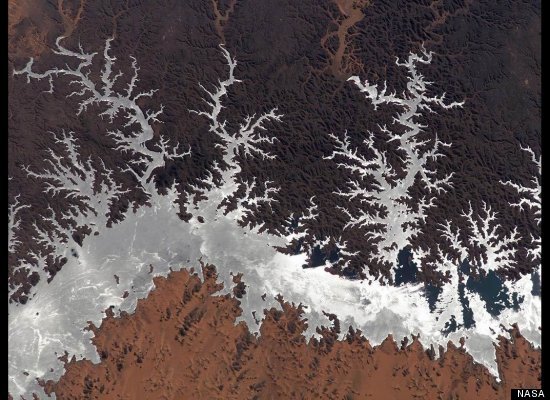
Lake Nasser. Egypt's Lake Nasser was photographed in January 2005 from the International Space Station

Sahara Desert. Tassili n'Ajjer National Park, part of the Sahara Desert, has a bone-dry climate with scant rainfall, yet it doesn't blend in with Saharan dunes. Instead, the rocky plateau rises above the surrounding sand seas. This image from 2000 was made from multiple observations by the Landsat 7 satellite, using a combination of infrared, near-infrared and visible light to better distinguish among the park's various rock types.
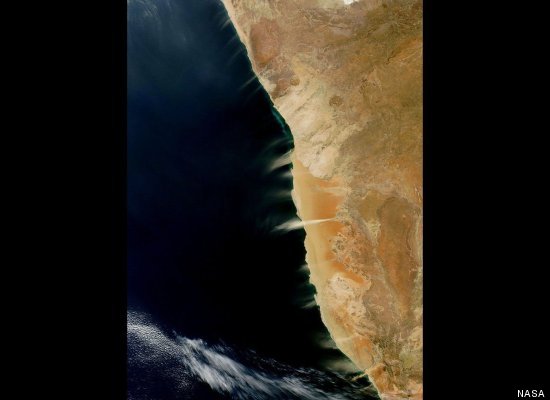
Hydrogen Sulfide and Dust Plumes on Namibia's Coast. Cloudless skies allowed a clear view of dust and hydrogen sulfide plumes along the coast of Namibia in early August 2010. Multiple dust plumes blow off the coast toward the ocean, most or all of them probably arising from stream beds. Unlike the reddish-tan sands comprising the dunes directly south of the Kuiseb River, the stream-channel sediments are lighter in color. Wind frequently pushes dust plumes seaward along the Namibian coast.

viernes, 10 de agosto de 2012

Bonobo Genome Completed: The Final Great Ape to Be Sequenced

June 13, 2012

Max Planck scientists have completed the genome of the bonobo - the final great ape to be sequenced

In a project led by the Max Planck Institute for Evolutionary Anthropology in Leipzig, an international team of scientists has completed the sequencing and analysis of the genome of the last great ape, the bonobo. 

Bonobos, which together with chimpanzees are the closest living relatives of humans, are known for their peaceful, playful and sexual behaviour that contrasts with the more aggressive behaviour of chimpanzees. 

The genome sequence provides insights into the evolutionary relationships between the great apes and may help us to understand the genetic basis of these traits.

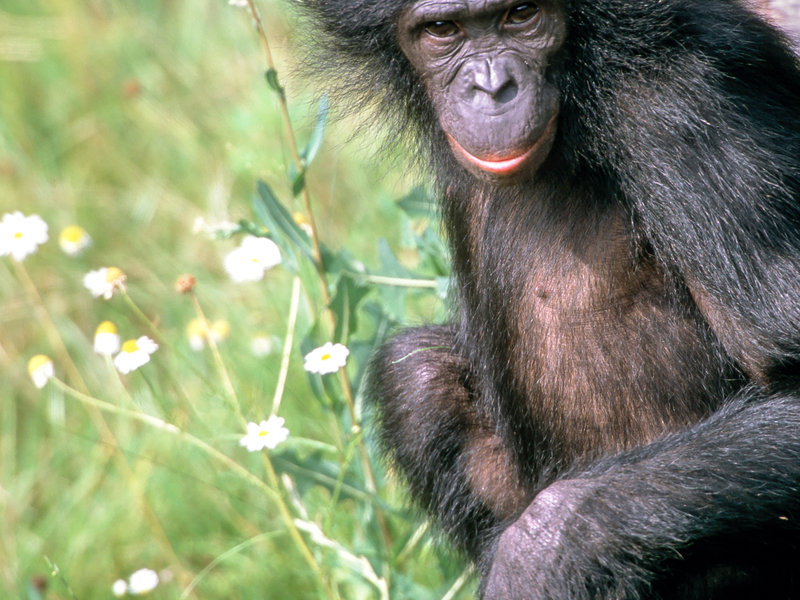
The female Bonobo Ulindi in the Zoo Leipzig. © Michael Seres 
The genome was sequenced from Ulindi, a female bonobo who lives in the Zoo Leipzig. Genome sequences have also been generated from all other great apes – chimpanzee, orang-utan and gorilla - making this the final genome of a great ape to be sequenced and providing insights into their relationships with one another and with humans.

The comparison of the genome sequences of bonobo, chimpanzee, and human show that humans differ by approximately 1.3% from both bonobo and chimpanzee. Chimpanzees and bonobos are more closely related, differing by only 0.4%.

Bonobo and chimpanzee territories in central Africa are close to one another and separated only by the Congo River. It has been hypothesized that the formation of the Congo River separated the ancestors of chimpanzees and bonobos, leading to these distinct apes. Examination of the relationship between bonobos and chimpanzees showed that there appears to have been a clean split and no subsequent interbreeding, which supports this hypothesis.

Despite the fact that on average the genomes of bonobos and chimpanzees are equally distant from human, analysis of the genome sequence of the bonobo revealed that for some particular parts of the genome, humans are closer to bonobos than to chimpanzees, while in other regions the human genome is closer to chimpanzees. Further research will determine whether these regions contribute in any way to the behavioural differences and similarities between humans, chimpanzees, and bonobos.

domingo, 24 de junio de 2012

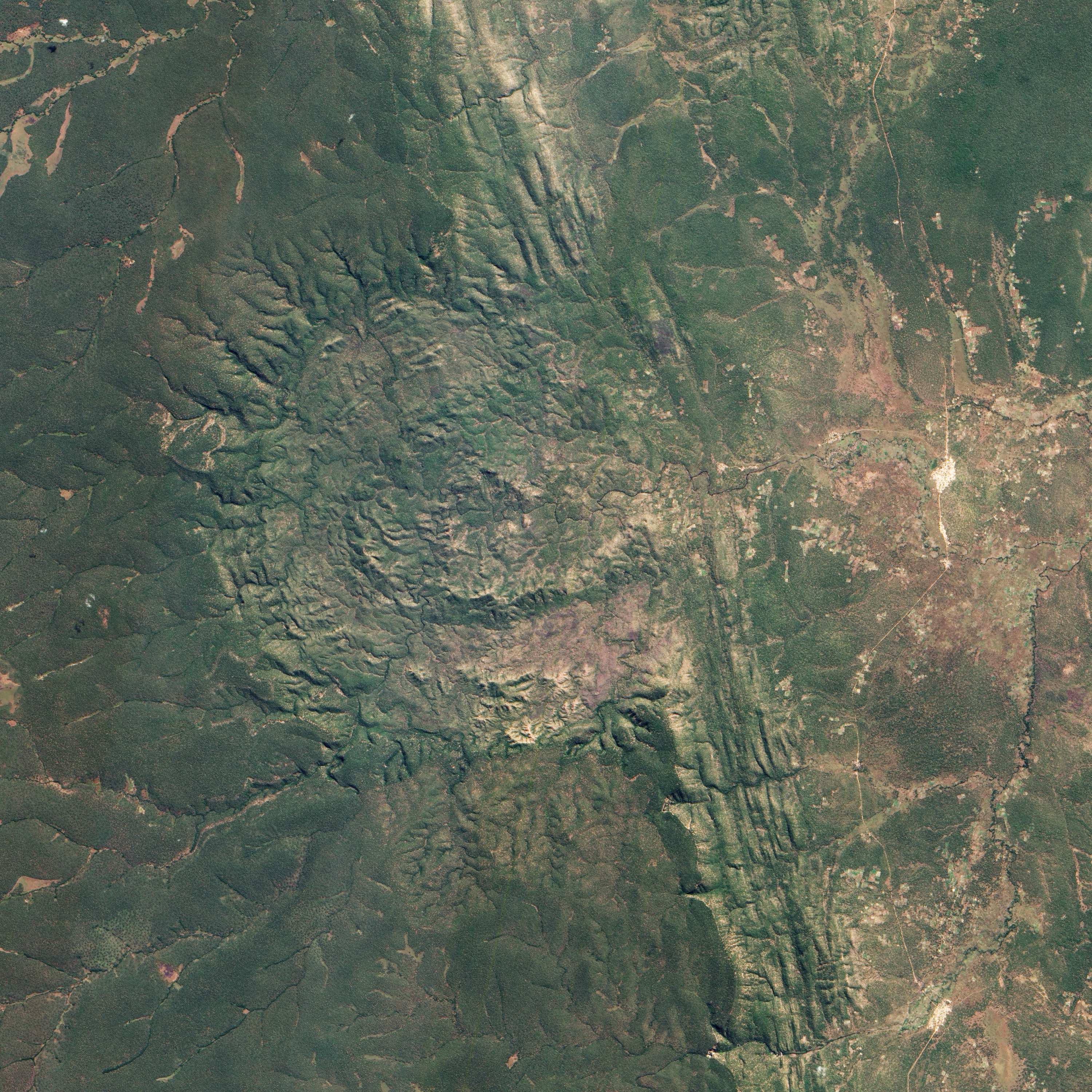
Luizi Crater, Democratic Republic of the Congo


acquired June 2, 2012 download large image (4 MB, JPEG, 3000x3000)


Impact craters can be tough to detect from the ground, especially if they are situated in remote locations and covered by vegetation. Both factors hampered understanding of the Luizi Structure, located in southeastern Congo. The crater is covered by grasses up to a meter (3 feet) high, and tucked away in central Africa.

The Advanced Land Imager (ALI) on NASA’s Earth Observing-1 (EO-1) satellite captured this natural-color image of Luizi on June 2, 2012. It is not perfectly round, but instead fills a semicircular basin where vegetation carpets the complicated topography.

A mention of Luizi made it into a geological report in 1919, but the feature remained unexplored for decades. Satellite imagery of the structure from the 1990s inspired an international team of geologists to look more closely. In 2011, they announced their findings.

Satellite imagery suggested that Luizi might be an impact crater, but volcanoes and even salt domes can form structures that look like impact craters, so the researchers had to go into the field. They found shatter cones, and microscopic analysis of rock samples collected from the site revealed shocked quartz grains. Both shatter cones and shocked quartz are considered strong evidence of meteorite impacts.

Impact craters can be simple or complex. While simple craters have uncomplicated bowl shapes, complex craters sport features that can be counterintuitive, such as inner rings and central peaks. Geologists have linked both crater types to the action of high-velocity impacts.

The researchers studying Luizi reported that the crater spans about 17 kilometers (11 miles) in diameter, with an intermittent ring about 5.2 kilometers (3.2 miles) across, and a smaller, center ring about 2 kilometers (1.2 miles) across. Around the perimeter of the crater, a rim rises approximately 300 to 350 meters (980 to 1,150 feet) above the interior. In short, Luizi is a well-preserved, moderately sized, complex crater.

Exactly when Luizi formed is hard to answer. The researchers estimate that nearby rocks are 575 million years old—more than 300 million years older than the first dinosaurs. But besides knowing that the impact can’t be older than the rock layers it disrupted, the geologists can’t yet say when the impact occurred. Whenever the meteorite arrived, it may have been moving as fast as 72,000 kilometers (45,000 miles) per hour.

Related Resources
Department of Earth Science and Engineering. (2012) The formation of complex craters. Imperial College, London. Accessed June 8, 2012.
Ferrière, L., Lubala, F.R.T., Osinski, G.R., Kaseti, P.K. (2011) The Luizi Structure (Democratic Republic of Congo) — First confirmed meteorite impact crater in Central Africa. 42nd Lunar and Planetary Science Conference, held March 7–11, 2011 at The Woodlands, Texas.
Ferrière, L., Osinski, G.R. (2011) The new Luizi Impact Structure (Democratic Republic of Congo) and implications for central peak and peak ring formation. 42nd Lunar and Planetary Science Conference, held March 7–11, 2011 at The Woodlands, Texas.
Jaggard, V. (2011, March 8) Huge impact crater found in remote Congo. Accessed June 8, 2012.

NASA Earth Observatory image by Jesse Allen and Robert Simmon, using Advanced Land Imager data from the NASA EO-1 team. Caption by Michon Scott.

jueves, 8 de marzo de 2012

El martirio de los elefantes: Una triste historia de codicia

ORIGINAL: AlJazzera
Por Julie Owono, Periodista independiente de Camerún y consultor de relaciones internacionales con sede en París.
07 de marzo 2012

Un reciente masacre en masa de los elefantes muestra el gobierno de Camerún está deplorablemente preparados para lidiar con los cazadores furtivos.

Cazadores furtivos dieron muerte a cerca de 450 elefantes en el país centroafricano de Camerún [EPA]
París, Francia - El año 2012 comenzó dramáticamente para los elefantes en el país de África central de Camerún. Según la ONU, 450 cadáveres de estos animales, una especie protegida - se han encontrado en el Parque Nacional de Bouba N'Djida, cerca de la frontera norte de Camerún y Chad. La masacre es especialmente preocupante dado que, a partir de 2007, la Unión Internacional para la Conservación de la Naturaleza (UICN) estima que sólo entre 1.000 y 5.000 elefantes todavía quedan en Camerún.

La masacre es una muestra lamentable que a pesar de los esfuerzos serios, la caza furtiva continúa dañando la biodiversidad de Camerún, poniendo en peligro a un animal tan importante en el imaginario colectivo de un continente.

El Ministerio para Bosques y de Fauna Silvestre de Camerún, la agencia gubernamental a cargo de la lucha contra la caza furtiva de la política del país, vio recortado su presupuesto de $ 43 millones en 2011 a sólo US $ 33 millones en 2012. El dinero dedicado específicamente a la acción contra la caza furtiva era sólo US $ 2 millones en 2011 - una cantidad claramente insuficiente para abordar el problema.

El Parque Nacional Bouba N'Djida, donde los elefantes fueron asesinados, comprende alrededor de 2.200 kilómetros cuadrados, lo que es el área protegida más grande en el país. Sólo cinco guardias patrullan sus alrededores, uno de ellos fue asesinado en 2011. Ellos reciben un salario modesto de US $ 160 por mes. En abril de 2011, se anunció que la embajada de EE.UU. donó US $ 39,000 dólares en equipo para el parque, incluyendo motocicletas, bicicletas, radios, cámaras digitales y porras.

Teniendo en cuenta que los cazadores furtivos-que se describen como de Sudán y Chad - que jinetes cruzan la frontera armados con Kalashnikovs, sólo podemos tomar nota de la impotencia de los guardias de Camerún. Además, el mal gobierno del país y los altos niveles de corrupción no ayudan.

La creciente demanda de marfil, agrava el problema. La Convención sobre el Comercio Internacional de Especies Amenazadas de Fauna y Flora Silvestres (CITES), trata de regular el comercio internacional de animales salvajes, y mantenerlo en un nivel que no ponga en peligro la supervivencia de las especies. Pero el deseo de marfil ha ido en aumento en Asia, concretamente en China y Tailandia, donde la demanda se dice que es más alta. Ciudadanos ricos están dispuestos a pagar cualquier precio para comprar un bien dice que tiene poderes médicos y mística.