Where do we come from? There are many right answers to this question, and the one you get often depends on who you ask.
For example,
an astrophysicist might say that the chemical components of our bodies were first forged in the nuclear fires of stars.
On the other hand, an evolutionary biologist might look at the similarities between our DNA and that of other primates' and conclude we evolved from apes.
Lisa Randall, a theoretical physicist at Harvard University, has a different, and novel answer, which she describes in her latest book, "Dark Matter and the Dinosaurs."
In her latest book, she posits that the extinction of the dinosaurs — necessary for the emergence of humans — is linked to dark matter. Dark matter is the mysterious, invisible matter that astronomers estimate makes up 85% of all matter in our universe.
One species' extinction is another's head start
Thomson Reuters
Paleontologists largely agree that about 66 million years ago a giant, 9-mile-long celestial body — likely a comet — struck Earth. The impact wiped out 75% of species across the planet, including most of the dinosaurs.
Among the survivors were small primates. Over the next 66 million years these primates diversified, grew larger, learned to walk on two legs, and developed large brains, which they eventually used to invent pizza delivery.
So what caused that giant space rock to collide with our planet in the first place and give primates a chance to thrive?
It could just be chance — or luck, depending on your perspective — but Randall would disagree with both of these ideas.
Business Insider
In her book, Randall describes a dark, pancake-shaped patty of densely packed dark matter within our galaxy that could be responsible for our emergence as a species.
Dark matter has never been directly detected. However, there is enough evidence for its immense gravitational influence on our universe that the vast majority of the scientific community agrees that dark matter is a form of mysterious matter that we can neither see or touch, but that nevertheless must permeate the cosmos.
Generally, dark matter tends to be concentrated in large halos around galaxies like giant bubbles. But Randall thinks that there could also be a so-called dark disc amid the stars, planets, and gas clouds in our galaxy.
Beware the dark disc
If there is dark matter in Randall's hypothetical disc, then it stands to reason that the disc has a powerful gravitational influence on the objects around it — including our solar system.
But our solar system is not always near the disc, which is the crux of Randall's theory.
As the solar system revolves around the center of the Milky Way — the same way Earth revolves around the sun — it moves up and down, or oscillates, through the plane of our galaxy. And the rate of this oscillation is very intriguing.
Below is an illustration of our solar system's oscillation, where the orange dot in the lower left rectangle is our sun and the black line at the center is the dark disc:
A team of astronomers made a rough estimate of this oscillation rate near the turn of this century, calculating that our solar system passes through the plane of the Milky Way about once every 32 million years, which means if there's a dark disc, we pass through that at the same rate.
Interestingly, there's evidence to suggest that mass extinctions in Earth's past happened within this time frame, or about once every 25 to 35 million years.
It's this similarity between the mass-extinction rate and the rate of our solar system's oscillation through the galaxy that made Randall and her Harvard colleague Matthew Reece first suggest the link in a scientific paper published in the journal Physical Review Letters last year, and that Randall explores more in her book.
Randall hypothesizes that when we're passing through the dark disc, the gravity from the dark matter within influences the outer region of our solar system, called the Oort cloud.
The Oort cloud, illustrated below just right of center, sits between roughly 1,000 to 100,000 Astronomical Units (90 billion to 9 trillion miles) from the sun and is thought to contain billions of icy objects at least 12 miles wide.
If something 12 miles wide hit Earth today, it would mean the end of life as we know it. And Randall thinks that's exactly what happened to the dinosaurs 66 million years ago that opened the door for widespread primate evolution.
While it's impossible to wind back the clock, proving the existence of the dark disc would greatly advance Randall's theory.
She's tried to do so by looking at the speed and direction of stars in our galaxy. If stars moved in ways that couldn't be explained by the amount of ordinary, visible matter around them, then it could suggest the presence of the dark disc.
But that's a very tall order. There are about 100 billion stars in the Milky Way, and hunting dark matter is notoriously tricky.
We have a dozen or so functioning detectors underground, on Earth's surface, and in space — and none of them has yet managed to sniff out a dark-matter particle. If they do, it would be a significant step toward supporting Randall's hypothesis.
In her concluding remarks, Randall writes:
"In some global sense, we are all descendants of Chicxulub [the town where the dinosaur-killing meteor impacted]. It's a part of our history that we should want to understand. If true, the additional wrinkle presented in this book would mean that not only was dark matter responsible for irrevocably changing our world, but also that some of it played a crucial role in allowing our existence."
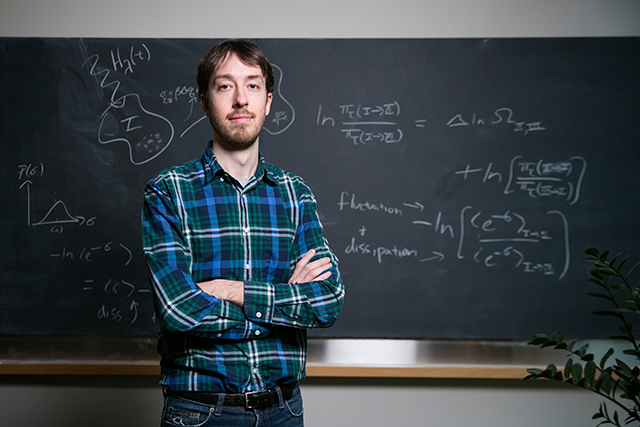
Jeremy England, a 31-year-old physicist at MIT, thinks he has found the
underlying physics driving the origin and evolution of life.
Katherine Taylor for Quanta Magazine
Why does life exist?
Popular hypotheses credit a primordial soup, a bolt of lightning and a colossal stroke of luck. But if a provocative new theory is correct, luck may have little to do with it. Instead, according to the physicist proposing the idea, the origin and subsequent evolution of life follow from the fundamental laws of nature and “should be as unsurprising as rocks rolling downhill.”
From the standpoint of physics, there is one essential difference between living things and inanimate clumps of carbon atoms: The former tend to be much better at capturing energy from their environment and dissipating that energy as heat. Jeremy England, a 31-year-old assistant professor at the Massachusetts Institute of Technology, has derived a mathematical formula that he believes explains this capacity. The formula, based on established physics, indicates that when a group of atoms is driven by an external source of energy (like the sun or chemical fuel) and surrounded by a heat bath (like the ocean or atmosphere), it will often gradually restructure itself in order to dissipate increasingly more energy. This could mean that under certain conditions, matter inexorably acquires the key physical attribute associated with life.
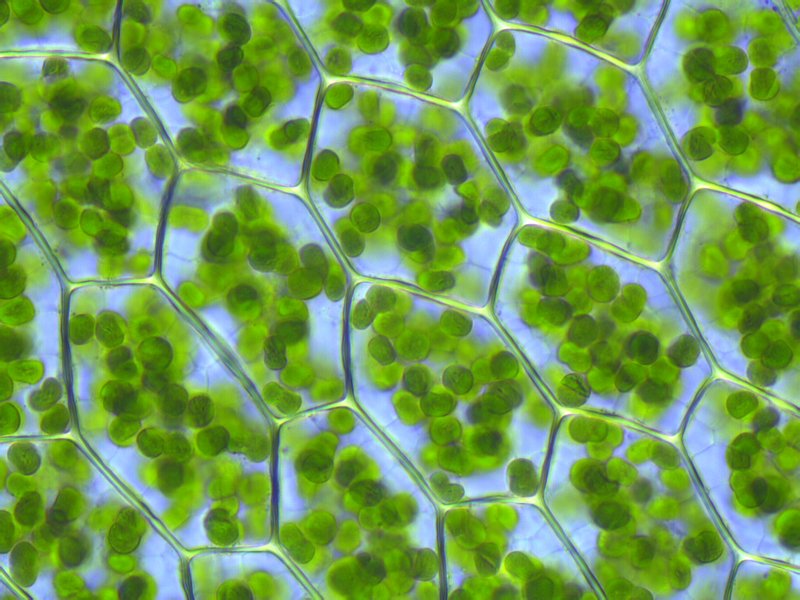
Kristian Peters. Cells from the moss Plagiomnium affine with visible chloroplasts, organelles that conduct photosynthesis by capturing sunlight.
“You start with a random clump of atoms, and if you shine light on it for long enough, it should not be so surprising that you get a plant,” England said.
England’s theory is meant to underlie, rather than replace, Darwin’s theory of evolution by natural selection, which provides a powerful description of life at the level of genes and populations. “I am certainly not saying that Darwinian ideas are wrong,” he explained. “On the contrary, I am just saying that from the perspective of the physics, you might call Darwinian evolution a special case of a more general phenomenon.”
His idea, detailed in a recent paper and further elaborated in a talk he is delivering at universities around the world, has sparked controversy among his colleagues, who see it as either tenuous or a potential breakthrough, or both.
England has taken “a very brave and very important step,” said Alexander Grosberg, a professor of physics at New York University who has followed England’s work since its early stages. The “big hope” is that he has identified the underlying physical principle driving the origin and evolution of life, Grosberg said.
“Jeremy is just about the brightest young scientist I ever came across,” said Attila Szabo, a biophysicist in the Laboratory of Chemical Physics at the National Institutes of Health who corresponded with England about his theory after meeting him at a conference. “I was struck by the originality of the ideas.”
Others, such as Eugene Shakhnovich, a professor of chemistry, chemical biology and biophysics at Harvard University, are not convinced. “Jeremy’s ideas are interesting and potentially promising, but at this point are extremely speculative, especially as applied to life phenomena,” Shakhnovich said.
England’s theoretical results are generally considered valid. It is his interpretation — that his formula represents the driving force behind a class of phenomena in nature that includes life — that remains unproven. But already, there are ideas about how to test that interpretation in the lab.
“He’s trying something radically different,” said Mara Prentiss, a professor of physics at Harvard who is contemplating such an experiment after learning about England’s work. “As an organizing lens, I think he has a fabulous idea. Right or wrong, it’s going to be very much worth the investigation.”
Courtesy of Jeremy England
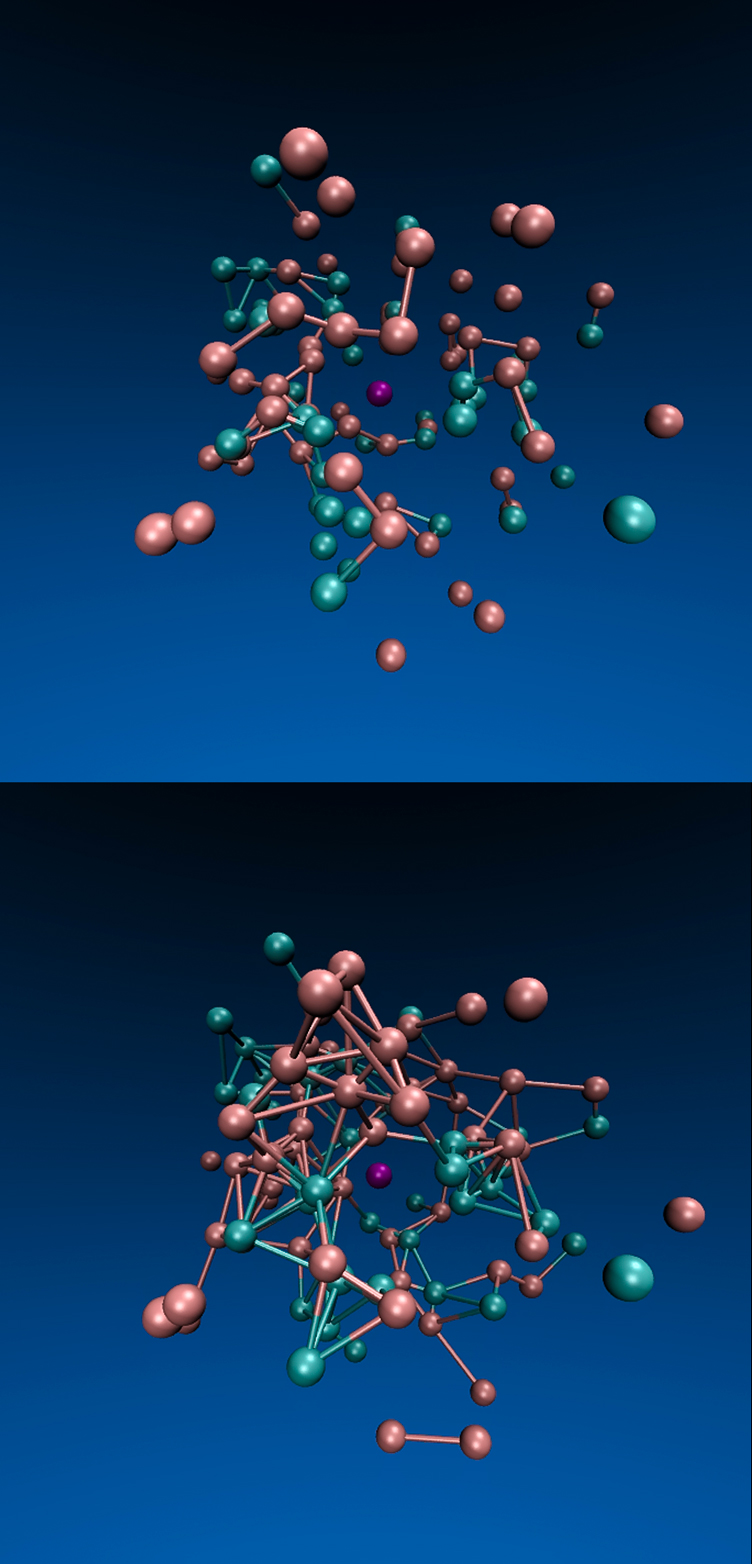
A computer simulation by Jeremy England and colleagues shows a system of particles confined inside a viscous fluid in which the turquoise particles are driven by an oscillating force. Over time (from top to bottom), the force triggers the formation of more bonds among the particles.
At the heart of England’s idea is the second law of thermodynamics, also known as the law of increasing entropy or the “arrow of time.” Hot things cool down, gas diffuses through air, eggs scramble but never spontaneously unscramble; in short, energy tends to disperse or spread out as time progresses. Entropy is a measure of this tendency, quantifying how dispersed the energy is among the particles in a system, and how diffuse those particles are throughout space. It increases as a simple matter of probability: There are more ways for energy to be spread out than for it to be concentrated. Thus, as particles in a system move around and interact, they will, through sheer chance, tend to adopt configurations in which the energy is spread out. Eventually, the system arrives at a state of maximum entropy called “thermodynamic equilibrium,” in which energy is uniformly distributed. A cup of coffee and the room it sits in become the same temperature, for example. As long as the cup and the room are left alone, this process is irreversible. The coffee never spontaneously heats up again because the odds are overwhelmingly stacked against so much of the room’s energy randomly concentrating in its atoms. Although entropy must increase over time in an isolated or “closed” system, an “open” system can keep its entropy low — that is, divide energy unevenly among its atoms — by greatly increasing the entropy of its surroundings. In his influential 1944 monograph “What Is Life?” the eminent quantum physicist Erwin Schrödinger argued that this is what living things must do. A plant, for example, absorbs extremely energetic sunlight, uses it to build sugars, and ejects infrared light, a much less concentrated form of energy. The overall entropy of the universe increases during photosynthesis as the sunlight dissipates, even as the plant prevents itself from decaying by maintaining an orderly internal structure. Life does not violate the second law of thermodynamics, but until recently, physicists were unable to use thermodynamics to explain why it should arise in the first place. In Schrödinger’s day, they could solve the equations of thermodynamics only for closed systems in equilibrium. In the 1960s, the Belgian physicist Ilya Prigogine made progress on predicting the behavior of open systems weakly driven by external energy sources (for which he won the 1977 Nobel Prize in chemistry). But the behavior of systems that are far from equilibrium, which are connected to the outside environment and strongly driven by external sources of energy, could not be predicted.
This situation changed in the late 1990s, due primarily to the work of Chris Jarzynski, now at the University of Maryland, and Gavin Crooks, now at Lawrence Berkeley National Laboratory. Jarzynski and Crooks showed that the entropy produced by a thermodynamic process, such as the cooling of a cup of coffee, corresponds to a simple ratio: the probability that the atoms will undergo that process divided by their probability of undergoing the reverse process (that is, spontaneously interacting in such a way that the coffee warms up). As entropy production increases, so does this ratio: A system’s behavior becomes more and more “irreversible.” The simple yet rigorous formula could in principle be applied to any thermodynamic process, no matter how fast or far from equilibrium. “Our understanding of far-from-equilibrium statistical mechanics greatly improved,” Grosberg said. England, who is trained in both biochemistry and physics, started his own lab at MIT two years ago and decided to apply the new knowledge of statistical physics to biology.
Using Jarzynski and Crooks’ formulation, he derived a generalization of the second law of thermodynamics that holds for systems of particles with certain characteristics: The systems are strongly driven by an external energy source such as an electromagnetic wave, and they can dump heat into a surrounding bath. This class of systems includes all living things. England then determined how such systems tend to evolve over time as they increase their irreversibility. “We can show very simply from the formula that the more likely evolutionary outcomes are going to be the ones that absorbed and dissipated more energy from the environment’s external drives on the way to getting there,” he said. The finding makes intuitive sense: Particles tend to dissipate more energy when they resonate with a driving force, or move in the direction it is pushing them, and they are more likely to move in that direction than any other at any given moment.
“This means clumps of atoms surrounded by a bath at some temperature, like the atmosphere or the ocean, should tend over time to arrange themselves to resonate better and better with the sources of mechanical, electromagnetic or chemical work in their environments,” England explained.
Courtesy of Michael Brenner/Proceedings of the National Academy of Sciences
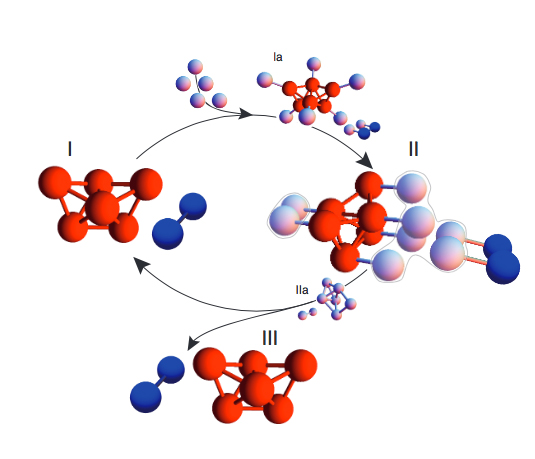
Self-Replicating Sphere Clusters: According to new research at Harvard, coating the surfaces of microspheres can cause them to spontaneously assemble into a chosen structure, such as a polytetrahedron (red), which then triggers nearby spheres into forming an identical structure.
Self-replication (or reproduction, in biological terms), the process that drives the evolution of life on Earth, is one such mechanism by which a system might dissipate an increasing amount of energy over time. As England put it, “A great way of dissipating more is to make more copies of yourself.” In a September paper in the Journal of Chemical Physics, he reported the theoretical minimum amount of dissipation that can occur during the self-replication of RNA molecules and bacterial cells, and showed that it is very close to the actual amounts these systems dissipate when replicating. He also showed that RNA, the nucleic acid that many scientists believe served as the precursor to DNA-based life, is a particularly cheap building material. Once RNA arose, he argues, its “Darwinian takeover” was perhaps not surprising.
The chemistry of the primordial soup, random mutations, geography, catastrophic events and countless other factors have contributed to the fine details of Earth’s diverse flora and fauna. But according to England’s theory, the underlying principle driving the whole process is dissipation-driven adaptation of matter.
This principle would apply to inanimate matter as well. “It is very tempting to speculate about what phenomena in nature we can now fit under this big tent of dissipation-driven adaptive organization,” England said. “Many examples could just be right under our nose, but because we haven’t been looking for them we haven’t noticed them.”
Scientists have already observed self-replication in nonliving systems. According to new research led by Philip Marcus of the University of California, Berkeley, and reported in Physical Review Letters in August, vortices in turbulent fluids spontaneously replicate themselves by drawing energy from shear in the surrounding fluid. And in a paper appearing online this week in Proceedings of the National Academy of Sciences, Michael Brenner, a professor of applied mathematics and physics at Harvard, and his collaborators present theoretical models and simulations of microstructures that self-replicate. These clusters of specially coated microspheres dissipate energy by roping nearby spheres into forming identical clusters. “This connects very much to what Jeremy is saying,” Brenner said.
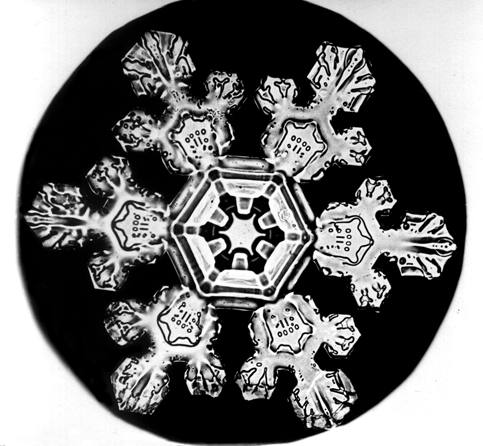
Besides self-replication, greater structural organization is another means by which strongly driven systems ramp up their ability to dissipate energy. A plant, for example, is much better at capturing and routing solar energy through itself than an unstructured heap of carbon atoms. Thus, England argues that under certain conditions, matter will spontaneously self-organize. This tendency could account for the internal order of living things and of many inanimate structures as well. “Snowflakes, sand dunes and turbulent vortices all have in common that they are strikingly patterned structures that emerge in many-particle systems driven by some dissipative process,” he said. Condensation, wind and viscous drag are the relevant processes in these particular cases.
“He is making me think that the distinction between living and nonliving matter is not sharp,” said Carl Franck, a biological physicist at Cornell University, in an email. “I’m particularly impressed by this notion when one considers systems as small as chemical circuits involving a few biomolecules.”
Wilson Bentley
If a new theory is correct, the same physics it identifies as responsible for the origin of living things could explain the formation of many other patterned structures in nature. Snowflakes, sand dunes and self-replicating vortices in the protoplanetary disk may all be examples of dissipation-driven adaptation.
England’s bold idea will likely face close scrutiny in the coming years. He is currently running computer simulations to test his theory that systems of particles adapt their structures to become better at dissipating energy. The next step will be to run experiments on living systems.
Prentiss, who runs an experimental biophysics lab at Harvard, says England’s theory could be tested by comparing cells with different mutations and looking for a correlation between the amount of energy the cells dissipate and their replication rates. “One has to be careful because any mutation might do many things,” she said. “But if one kept doing many of these experiments on different systems and if [dissipation and replication success] are indeed correlated, that would suggest this is the correct organizing principle.”
Brenner said he hopes to connect England’s theory to his own microsphere constructions and determine whether the theory correctly predicts which self-replication and self-assembly processes can occur — “a fundamental question in science,” he said.
Having an overarching principle of life and evolution would give researchers a broader perspective on the emergence of structure and function in living things, many of the researchers said. “Natural selection doesn’t explain certain characteristics,” said Ard Louis, a biophysicist at Oxford University, in an email. These characteristics include a heritable change to gene expression called methylation, increases in complexity in the absence of natural selection, and certain molecular changes Louis has recently studied.
If England’s approach stands up to more testing, it could further liberate biologists from seeking a Darwinian explanation for every adaptation and allow them to think more generally in terms of dissipation-driven organization. They might find, for example, that “the reason that an organism shows characteristic X rather than Y may not be because X is more fit than Y, but because physical constraints make it easier for X to evolve than for Y to evolve,” Louis said.
“People often get stuck in thinking about individual problems,” Prentiss said. Whether or not England’s ideas turn out to be exactly right, she said, “thinking more broadly is where many scientific breakthroughs are made.”
It was the actions of Jupiter and Saturn that quite inadvertently created life on Earth — not the gods of the Roman pantheon, but the giant planets, which once orbited much closer to the sun.
Driven outward, they let loose a cascade of asteroids, known as the Late Heavy Bombardment, that blasted the surface of the young Earth and created the deep pockmarks still visible on the face of the moon.
In the heat of these impacts, carbon from the meteorites reacted with nitrogen in Earth’s atmosphere to form hydrogen cyanide. Though a deadly poison, cyanide is nonetheless the ancient pathway for inert carbon atoms to enter the chemistry of life.
By the time the Late Heavy Bombardment had eased, some 3.8 billion years ago, the cyanide had rained down into pools, reacted with metals, evaporated, been baked and irradiated with ultraviolet light, and dissolved by streams flowing down to a freshwater pool. The chemicals formed from the interactions of cyanide combined there in various ways to generate the precursors of lipids, nucleotides and amino acids. These are the three significant components of a living cell —
lipids make the walls of a cell’s various compartments;
nucleotides store its information; and
amino acids assemble into the proteins that control its metabolism.
All of this is a hypothesis, proposed by John Sutherland, a chemist at the University of Cambridge in England. But he has tested all the required chemical reactions in a laboratory and developed evidence that they are plausible under the conditions expected of primitive Earth.
Having figured out a likely chemistry needed to produce the starting materials of life, Dr. Sutherland then developed this geological scenario because it provides the conditions required by the chemistry.
As for the chemistry itself, that springs from Dr. Sutherland’s discovery six years ago of the key to the RNA world.
Biologists have long favored the idea that the first information-carrying molecule of life was not DNA but its close chemical cousin RNA. RNA can store genetic information and act as an enzyme to create more RNA. Like DNA, RNA is made up of a string of chemical units known as nucleotides. Each nucleotide consists of a sugar, ribose in the case of RNA, joined to a base at one end and to a phosphate group at the other.
The Chemistry of Early Life on Earth
An English chemist has been studying how RNA, a building block of living cells, may have emerged from chemicals present on the Earth’s surface before the first living cells.
The Chemistry of Early Life on Earth
PREVIOUS ATTEMPTS
to explain how RNA formed focused on its three components: a phosphate group, a base and a sugar molecule (ribose).
But chemists could not find a natural way to join the base and sugar to form RNA.
A NEWER MODEL
combines the same starting chemicals in a different order, avoiding the base and sugar molecules.
An RNA molecule can emerge from naturally forming intermediate molecules, part sugar and part base.
Source: Nature
By The New York Times
Researchers trying to reconstruct the chemistry that led to life had shown plausible ways in which ribose and the bases could have arisen. But in prebiotic chemistry, the assumed natural chemistry of Earth before life began, they could find no likely way of joining ribose to a base. So daunting was this obstacle that some began to doubt the idea of an RNA world, looking instead for a pre-RNA system.
After 10 years of testing every possible combination of prebiotic chemicals, Dr. Sutherland discovered that the solution was not to build the ribose and the sugar units separately in textbook fashion, but to construct a substance that was part sugar and part base. The addition of another simple chemical converted this hybrid into a ribonucleotide. The door to the RNA world had at last been opened.
If this step was critical, Dr. Sutherland inferred, then the rest of prebiotic chemistry must somehow be related to it. He and colleagues have spent the last six years doing experiments to see how the ribonucleotide chemistry pathway can be linked back to hydrogen cyanide as its starting point, and how other significant prebiotic chemicals might have emerged from the cyanide-to-nucleotide pathway.
So far they have demonstrated ways to generate
12 of the 20 amino acids used in proteins,
two of the four ribonucleotides of RNA, and
glycerol 1-phosphate, the universal building block of the lipids from which cell membranes are formed.
Though other researchers have shown how several of these substances could have formed on primitive Earth, these required a variety of conditions, some incompatible. This is the first time that so many significant life chemicals have been shown to emerge from the same chemistry.
Dr. Sutherland’s report “lays out for the first time a scenario for generating potentially all of the building blocks of life in one geological setting,” said Jack W. Szostak, a geneticist at Massachusetts General Hospital who studies the origin of life. “The details of the scenario will be debated for some time, but over all, I think it’s a very big advance,” he said. Dr. Szostak shared the Nobel Prize in Medicine in 2009 for the discovery of the mechanism that protects the ends of chromosomes.
Dr. Sutherland’s chemicals cannot all be mixed together at once. His reaction scheme requires them to be delivered in sequence to a central pool. So in his scenario, separate streams flow over mineral deposits and arrive one by one at the pool. Therein lies a possible weakness, Paul J. Bracher, a chemist at Saint Louis University in Missouri, said in a commentary in Nature Chemistry. “This new report represents a fantastically interesting approach, but origin-of-life chemists still have plenty of work to do in the kitchen,” he wrote.
Others have deeper reservations. Steven Benner, the director of the Foundation for Applied Molecular Evolution in Gainesville, Fla., said that many of the reactions in Dr. Sutherland’s scheme “aren’t real,” meaning that pure chemicals might react as proposed in the laboratory but that the process could not be expected to proceed the same way in a natural mix of chemicals.
Dr. Benner also noted that the popular idea of an RNA world is burdened with several unresolved paradoxes.
One is that if you have a pool of chemicals and pump energy in, “you don’t get life, you get asphalt,” he said, meaning that the chemicals will react together to form a gooey tar.
Another is that water is essential for life, as are nucleotides, but water destroys nucleotides.
A third problem is that RNA is assumed to act as an enzyme and as a store of genetic information, but the two roles require contradictory properties: An enzyme must fold up and be reactive, while a genetic molecule should do neither.
The traditional field of prebiotic chemistry has made some headway, in Dr. Benner’s view, but not nearly enough to suggest real answers. “Still, to have these very basic problems left hanging suggests that maybe we’re not answering the correct question,” he said.
Dr. Sutherland is still trying to find plausible routes to the other two RNA nucleotides. He also hopes to understand how the molecules of life could have been built up from their individual units, a process known as polymerization. “In biology, RNA makes protein and proteins make RNA, so the biology is telling you they work in cahoots with each other,” he said. He added that he did not yet know if polymerization would take place on a metal surface, often assumed to be a good catalyst, or inside a cell membrane.
Life may still be unlikely, but at least it’s beginning to seem almost possible.