Mostrando entradas con la etiqueta Bioplastic. Mostrar todas las entradas

miércoles, 25 de septiembre de 2019

Carlo Ratti's orange squeezer serves juice in bioplastic cups made from the peel


Italian studio Carlo Ratti Associati has developed an orange juice bar that turns the waste fruit peel into 3D-printed bioplastic cups to drink the contents from, as an example of the circular economy in practice.

Created for global energy company Eni, Feel the Peel is a prototype orange-squeezing machine that aims to bring circular design into everyday life.

The 3.10-metre-tall experimental juice bar is topped by a circular dome filled with 1,500 oranges. When someone orders a juice, the oranges slide down into the squeezer where they are cut in half and juiced.
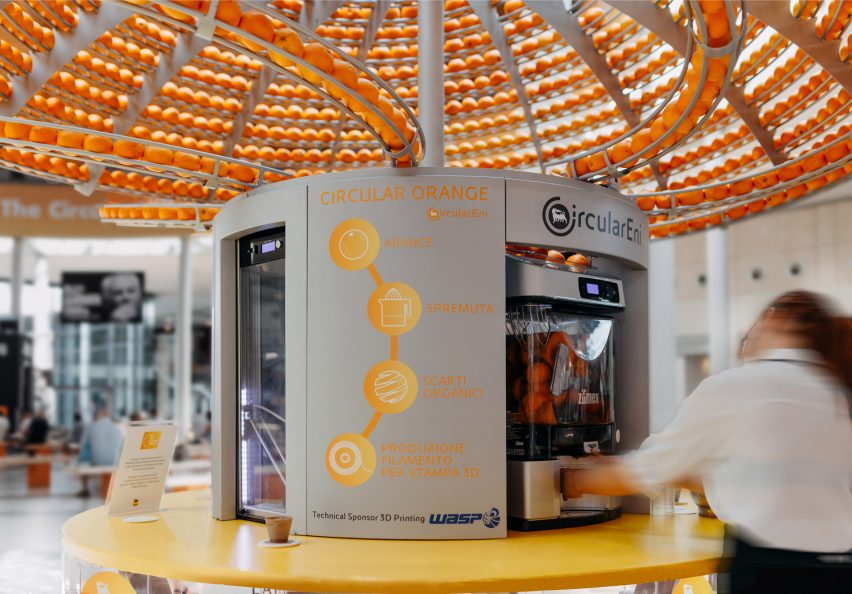
After being juiced, the leftover orange peel falls into a see-through compartment at the bottom of the machine. The collected rinds are then dried and milled to make "orange dust", which is mixed with polylactic acid (PLA) to form a bioplastic material.


Related story

Carlo Ratti grows Gaudí-inspired structures with a kilometre of mushroom mycelium

Grown from a fungus material, the structures were shredded and returned to the soil as compost after the design festival, in a fully circular fashion.


This material is then heated and melted to form a filament, which is fed through a 3D printer incorporated into the machine.
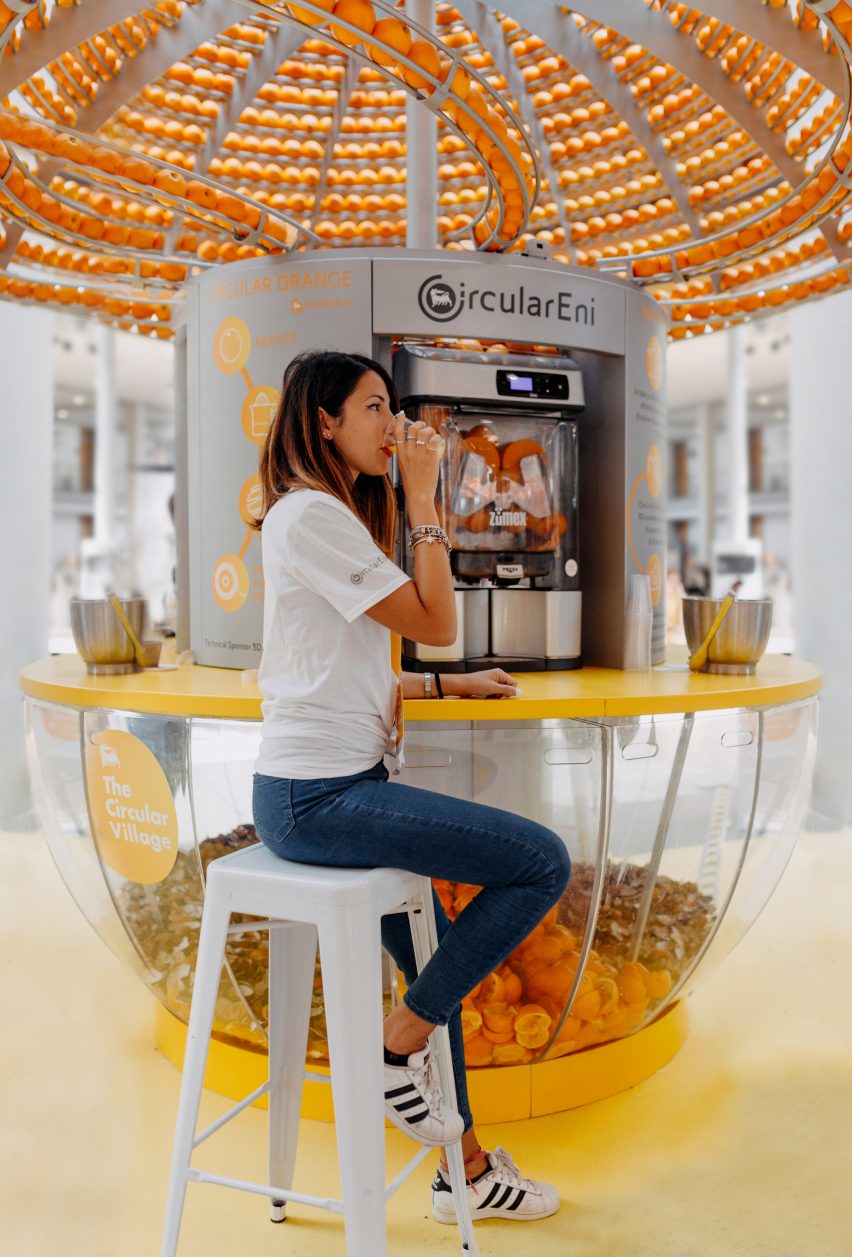
Visitors can watch the printing process as it builds up concentric layers of the filament, before using the finished product to drink the freshly-squeezed juice.

The cup can then be recycled after use, with the material continually broken down and remade into further cups in theory.

The move to a circular economy – which involves designing out waste and pollution from the production and consumption process, and regenerating natural systems – is being encouraged by the Ellen MacArthur Foundation and others.

Last month, MacArthur launched an initiative to persuade 20 million designers to shift from linear to circular principles in their work.
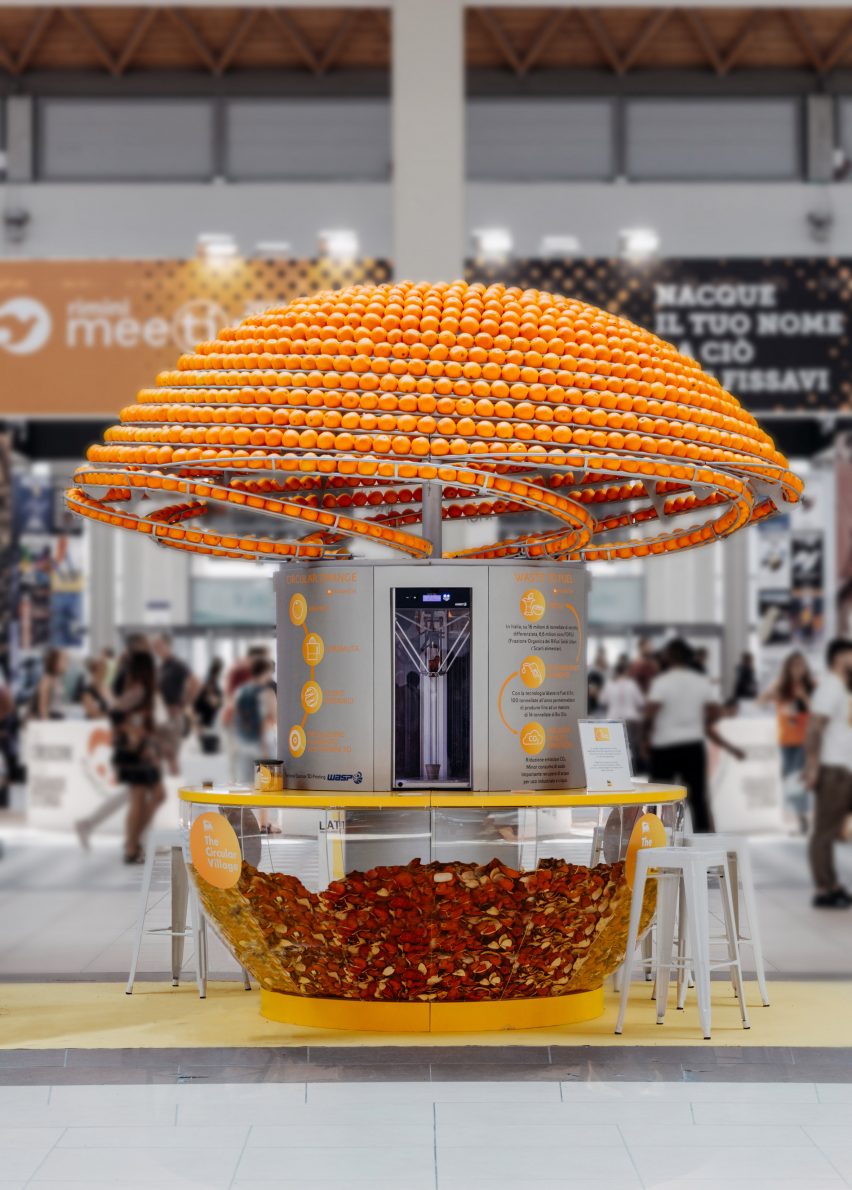
"The principle of circularity is a must for today's objects," said founder Carlo Ratti. "Working with Eni, we tried to show circularity in a very tangible way, by developing a machine that helps us to understand how oranges can be used well beyond their juice."


According to Ratti, the next iterations of Feel the Peel might include new functions, such as printing fabric for clothing from orange peel. 
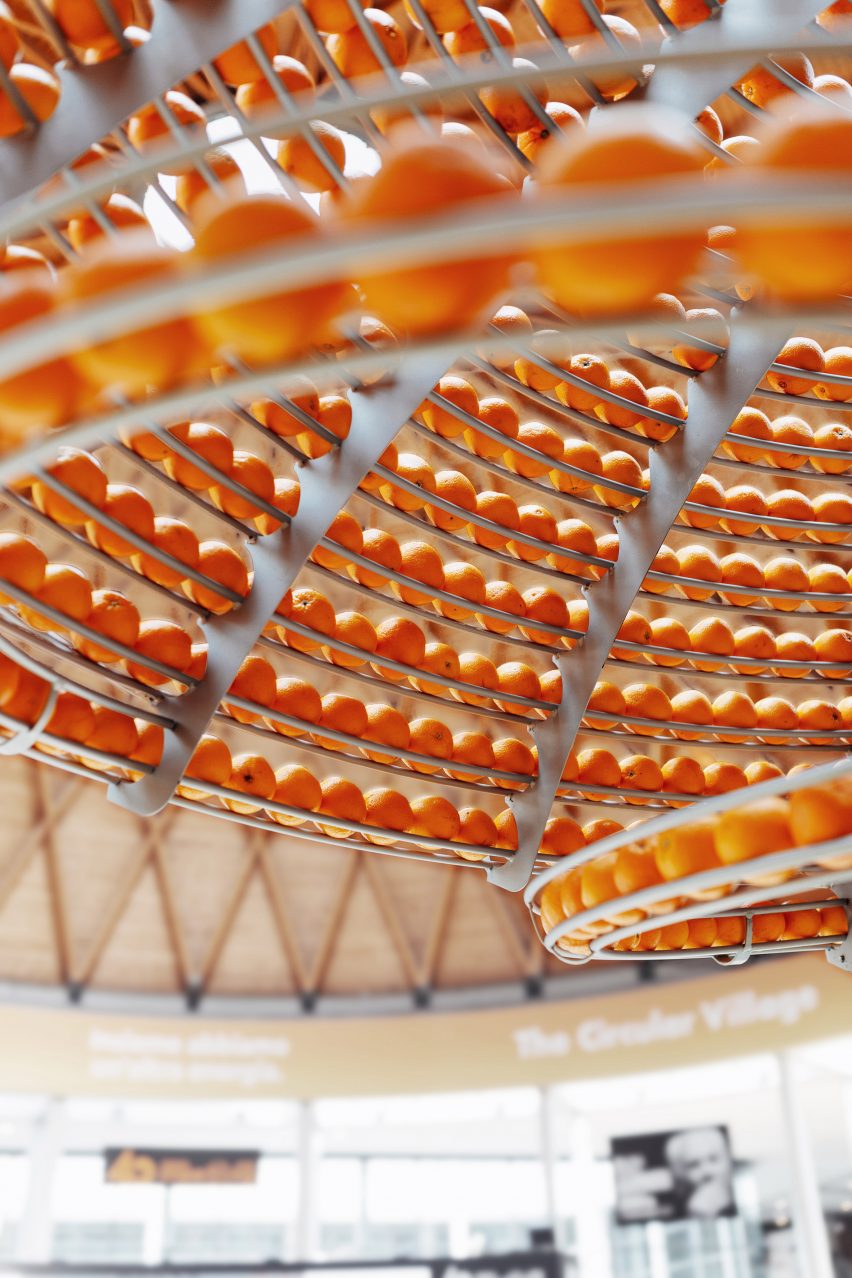

The Circular Juice Bar will be installed at the Singularity University Summit in Milan from 8 to 9 October 2019, before touring around Italy in the following months in a bid to "demonstrate a new approach to environmental circularity in daily life".

Feel the Peel is not the first collaboration between Carlo Ratti Associati and Eni that explores circular design. The pair previously teamed up to present a series of arched architectural structures made from mushroom mycelium at Milan Design Week 2019.


Grown from a fungus material, the structures were shredded and returned to the soil as compost after the design festival, in a fully circular fashion.

miércoles, 4 de noviembre de 2015

Promising solution to plastic pollution

Harvard's Wyss Institute creates bioplastic made from shrimp shells

Wyss Institute Communications
For many people, “plastic” is a one-word analog for environmental disaster. It is made from precious petroleum, after all, and once discarded in landfills and oceans, it takes centuries to degrade.

Then came apparent salvation: “bioplastics,” durable substances made from renewable cellulose, a plant-based polysaccharide. But problems remained. For one, the current bioplastics do not fully degrade in the environment. For another, their use is now limited to packaging material or simple containers for food and drink.

Now researchers at Harvard’s Wyss Institute for Biologically Inspired Engineering have introduced a new bioplastic isolated from shrimp shells. It’s made from chitosan, a form of chitin — the second-most abundant organic material on Earth.

Chitin, a tough polysaccharide, is the main ingredient in the hardy shells of crustaceans, the armorlike cuticles of insects, and even the flexible wings of butterflies.

The Wyss Institute makes its shrilk from chitin from shrimp shells, most which would otherwise be discarded or used in fertilizer or makeup, and a fibroin protein from silk. Researchers discussed it in a March online study in the journal Macromolecular Materials & Engineering.

Shrilk is cheaply and easily fabricated by a novel method that preserves chitosan’s strong mechanical properties. The researchers said that for the first time, this tough, transparent, and renewable material can be used to make large, 3-D objects with complex shapes using traditional casting or injection-molding techniques. That means objects made from shrilk can be mass-manufactured and will be as robust as items made with the everyday plastics used in toys and cell phones.

“There is an urgent need in many industries for sustainable materials that can be mass produced,” Wyss Director Donald E. Ingber said in March. “Our scalable manufacturing method shows that chitosan, which is readily available and inexpensive, can serve as a viable bioplastic that could potentially be used instead of conventional plastics for numerous industrial applications.”

This environmentally safe alternative to plastic could also be used to make trash bags, packaging, and diapers.

Once discarded, shrilk breaks down in just a few weeks — and even releases rich nutrients that support plant growth. In one experiment, Wyss Institute researchers grew a California black-eyed pea plant in soil enriched with its chitosan bioplastic. Within three weeks, the material encouraged plant growth.

In environmental terms, finding viable alternatives for conventional plastics — prized for their lightness, durability, and low price — is an urgent matter. In the United States alone, according researchers at Columbia University, about 34 million tons of plastic waste is generated every year; less than 7 percent is recovered for recycling.

Meanwhile, according to the same researchers, plastics buried in landfills will take 1,000 years to degrade. Plastics discarded into the world’s seas — an estimated 100 million tons so far, circulating in vast oceanic gyres — are a threat to marine life.


The challenge is clear: We will drown in plastic if we don’t find a sustainable alternative. Harvard’s Wyss Institute has been working on a bioplastic that is expected to provide part of the solution. Video courtesy of the Wyss Institute

This story is a combination of two press releases issued by the Wyss Institute in March and May. The content has been edited for length and clarity. To read the original releases, Manufacturing a solution to planet-clogging plastics andChitosan bioplastic, visit the Wyss Institute website.

ORIGINAL: Harvard
Editor's Pick Audio/Video
May 5, 2014 |