Mostrando entradas con la etiqueta Astrobiology. Mostrar todas las entradas

miércoles, 22 de febrero de 2017

NASA Telescope Reveals Largest Batch of Earth-Size, Habitable-Zone Planets Around Single Star

This illustration shows the possible surface of TRAPPIST-1f, one of the newly discovered planets in the TRAPPIST-1 system. Scientists using the Spitzer Space Telescope and ground-based telescopes have discovered that there are seven Earth-size planets in the system.
Credits: NASA/JPL-Caltech

NASA's Spitzer Space Telescope has revealed the first known system of seven Earth-size planets around a single star. Three of these planets are firmly located in the habitable zone, the area around the parent star where a rocky planet is most likely to have liquid water.

The discovery sets a new record for greatest number of habitable-zone planets found around a single star outside our solar system. All of these seven planets could have liquid water – key to life as we know it – under the right atmospheric conditions, but the chances are highest with the three in the habitable zone.

“This discovery could be a significant piece in the puzzle of finding habitable environments, places that are conducive to life,” said Thomas Zurbuchen, associate administrator of the agency’s Science Mission Directorate in Washington. “Answering the question ‘are we alone ?’ is a top science priority and finding so many planets like these for the first time in the habitable zone is a remarkable step forward toward that goal.”

Seven Earth-sized planets have been observed by NASA's Spitzer Space Telescope around a tiny, nearby, ultra-cool dwarf star called TRAPPIST-1. Three of these planets are firmly in the habitable zone.
Credits: NASA

The TRAPPIST-1 star, an ultra-cool dwarf, has seven Earth-size planets orbiting it. This artist's concept appeared on the cover of the journal Nature on Feb. 23, 2017.
Credits: NASA/JPL-Caltech

At about 40 light-years (235 trillion miles) from Earth, the system of planets is relatively close to us, in the constellation Aquarius. Because they are located outside of our solar system, these planets are scientifically known as exoplanets.

This exoplanet system is called TRAPPIST-1, named for The Transiting Planets and Planetesimals Small Telescope (TRAPPIST) in Chile. In May 2016, researchers using TRAPPIST announced they had discovered three planets in the system. Assisted by several ground-based telescopes, including the European Southern Observatory's Very Large Telescope, Spitzer confirmed the existence of two of these planets and discovered five additional ones, increasing the number of known planets in the system to seven.

The new results were published Wednesday in the journal Nature, and announced at a news briefing at NASA Headquarters in Washington.

Using Spitzer data, the team precisely measured the sizes of the seven planets and developed first estimates of the masses of six of them, allowing their density to be estimated.

Based on their densities, all of the TRAPPIST-1 planets are likely to be rocky. Further observations will not only help determine whether they are rich in water, but also possibly reveal whether any could have liquid water on their surfaces. The mass of the seventh and farthest exoplanet has not yet been estimated – scientists believe it could be an icy, "snowball-like" world, but further observations are needed.

"The seven wonders of TRAPPIST-1 are the first Earth-size planets that have been found orbiting this kind of star," said Michael Gillon, lead author of the paper and the principal investigator of the TRAPPIST exoplanet survey at the University of Liege, Belgium. "It is also the best target yet for studying the atmospheres of potentially habitable, Earth-size worlds."

This artist's concept shows what each of the TRAPPIST-1 planets may look like, based on available data about their sizes, masses and orbital distances.
Credits: NASA/JPL-Caltech
In contrast to our sun, the TRAPPIST-1 star – classified as an ultra-cool dwarf – is so cool that liquid water could survive on planets orbiting very close to it, closer than is possible on planets in our solar system. All seven of the TRAPPIST-1 planetary orbits are closer to their host star than Mercury is to our sun. The planets also are very close to each other. If a person was standing on one of the planet’s surface, they could gaze up and potentially see geological features or clouds of neighboring worlds, which would sometimes appear larger than the moon in Earth's sky.

The planets may also be tidally locked to their star, which means the same side of the planet is always facing the star, therefore each side is either perpetual day or night. This could mean they have weather patterns totally unlike those on Earth, such as strong winds blowing from the day side to the night side, and extreme temperature changes.

Spitzer, an infrared telescope that trails Earth as it orbits the sun, was well-suited for studying TRAPPIST-1 because the star glows brightest in infrared light, whose wavelengths are longer than the eye can see. In the fall of 2016, Spitzer observed TRAPPIST-1 nearly continuously for 500 hours. Spitzer is uniquely positioned in its orbit to observe enough crossing – transits – of the planets in front of the host star to reveal the complex architecture of the system. Engineers optimized Spitzer’s ability to observe transiting planets during Spitzer’s “warm mission,” which began after the spacecraft’s coolant ran out as planned after the first five years of operations. 

"This is the most exciting result I have seen in the 14 years of Spitzer operations," said Sean Carey, manager of NASA's Spitzer Science Center at Caltech/IPAC in Pasadena, California. "Spitzer will follow up in the fall to further refine our understanding of these planets so that the James Webb Space Telescope can follow up. More observations of the system are sure to reveal more secrets.”

Following up on the Spitzer discovery, NASA's Hubble Space Telescope has initiated the screening of four of the planets, including the three inside the habitable zone. These observations aim at assessing the presence of puffy, hydrogen-dominated atmospheres, typical for gaseous worlds like Neptune, around these planets.

This 360-degree panorama depicts the surface of a newly detected planet, TRAPPIST 1-d, part of a seven planet system some 40 light years away. Explore this artist’s rendering of an alien world by moving the view using your mouse or your mobile device.
Credits: NASA

In May 2016, the Hubble team observed the two innermost planets, and found no evidence for such puffy atmospheres. This strengthened the case that the planets closest to the star are rocky in nature.

"The TRAPPIST-1 system provides one of the best opportunities in the next decade to study the atmospheres around Earth-size planets," said Nikole Lewis, co-leader of the Hubble study and astronomer at the Space Telescope Science Institute in Baltimore, Maryland. NASA's planet-hunting Kepler space telescope also is studying the TRAPPIST-1 system, making measurements of the star's minuscule changes in brightness due to transiting planets. Operating as the K2 mission, the spacecraft's observations will allow astronomers to refine the properties of the known planets, as well as search for additional planets in the system. The K2 observations conclude in early March and will be made available on the public archive.

This poster imagines what a trip to TRAPPIST-1e might be like.
Credits: NASA/JPL-Caltech
Spitzer, Hubble, and Kepler will help astronomers plan for follow-up studies using NASA's upcoming James Webb Space Telescope, launching in 2018. With much greater sensitivity, Webb will be able to detect the chemical fingerprints of water, methane, oxygen, ozone, and other components of a planet's atmosphere. Webb also will analyze planets' temperatures and surface pressures – key factors in assessing their habitability.

NASA’s Jet Propulsion Laboratory (JPL) in Pasadena, California, manages the Spitzer Space Telescope mission for NASA's Science Mission Directorate. Science operations are conducted at the Spitzer Science Center, at Caltech, in Pasadena, California. Spacecraft operations are based at Lockheed Martin Space Systems Company, Littleton, Colorado. Data are archived at the Infrared Science Archive housed at Caltech/IPAC. Caltech manages JPL for NASA.

For more information about Spitzer, visit:

For more information on the TRAPPIST-1 system, visit:

For more information on exoplanets, visit:

-end-

Felicia Chou / Sean Potter
Headquarters, Washington
202-358-1726 / 202-358-1536

Elizabeth Landau
Jet Propulsion Laboratory, Pasadena, Calif.
818-354-6425
Last Updated: Feb. 22, 2017
Editor: Karen Northon

ORIGINAL: NASA
Feb. 22, 2017
RELEASE 17-015

martes, 21 de febrero de 2017

Strange Life Has Been Found Trapped Inside These Giant Cave Crystals

Alexander Van Driessche/Wikipedia

A NASA scientist just woke them up.

Strange microbes have been found inside the massive, subterranean crystals of Mexico's Naica Mine, and researchers suspect they've been living there for up to 50,000 years.

The ancient creatures appear to have been dormant for thousands of years, surviving in tiny pockets of liquid within the crystal structures. Now, scientists have managed to extract them - and wake them up.

"These organisms are so extraordinary," astrobiologist Penelope Boston, director of the NASA Astrobiology Institute, said on Friday at the annual meeting of the American Association for the Advancement of Science (AAAS) in Boston. 

The Cave of Crystals in Mexico's Naica Mine might look incredibly beautiful, but it's one of the most inhospitable places on Earth, with temperatures ranging from 45 to 65°C (113 to 149°F), and humidity levels hitting more than 99 percent.

Not only are temperatures hellishly high, but the environment is also oppressively acidic, and confined to pitch-black darkness some 300 metres (1,000 feet) below the surface.

Peter Williams/Flickr
In lieu of any sunlight, microbes inside the cave can't photosynthesise - instead, they perform chemosynthesis using minerals like iron and sulphur in the giant gypsum crystals, some of which stretch 11 metres (36 feet) long, and have been dated to half a million years old.

Researchers have previously found life living inside the walls of the cavern and nearby the crystals - a 2013 expedition to Naica reported the discovery of creatures thriving in the hot, saline springs of the complex cave system.

But when Boston and her team extracted liquid from the tiny gaps inside the crystals and sent them off to be analysed, they realised that not only was there life inside, but it was unlike anything they'd seen in the scientific record.

They suspect the creatures had been living inside their crystal castles for somewhere between 10,000 and 50,000 years, and while their bodies had mostly shut down, they were still very much alive.

"Other people have made longer-term claims for the antiquity of organisms that were still alive, but in this case these organisms are all very extraordinary - they are not very closely related to anything in the known genetic databases," Boston told Jonathan Amos at BBC News.

What's perhaps most extraordinary about the find is that the researchers were able to 'revive' some of the microbes, and grow cultures from them in the lab.

"Much to my surprise we got things to grow," Boston told Sarah Knapton at The Telegraph. "It was laborious. We lost some of them - that's just the game. They've got needs we can't fulfil."

At this point, we should be clear that the discovery has yet to be published in a peer-reviewed journal, so until other scientists have had a chance to examine the methodology and findings, we can't consider the discovery be definitive just yet.

The team will also need to convince the scientific community that the findings aren't the result of contamination - these microbes are invisible to the naked eye, which means it's possible that they attached themselves to the drilling equipment and made it look like they came from inside the crystals. 

"I think that the presence of microbes trapped within fluid inclusions in Naica crystals is in principle possible," Purificación López-García from the French National Centre for Scientific Research, who was part of the 2013 study that found life in the cave springs, told National Geographic.

"[But] contamination during drilling with microorganisms attached to the surface of these crystals or living in tiny fractures constitutes a very serious risk," she says. I am very skeptical about the veracity of this finding until I see the evidence."

That said, microbiologist Brent Christner from the University of Florida in Gainesville, who was also not involved in the research, thinks the claim isn't as far-fetched as López-García is making it out to be, based on what previous studies have managed with similarly ancient microbes.

"[R]eviving microbes from samples of 10,000 to 50,000 years is not that outlandish based on previous reports of microbial resuscitations in geological materials hundreds of thousands to millions of years old," he told National Geographic.

For their part, Boston and her team say they took every precaution to make sure their gear was sterilised, and cite the fact that the creatures they found inside the crystals were similar, but not identical to those living elsewhere in the cave as evidence to support their claims.

"We have also done genetic work and cultured the cave organisms that are alive now and exposed, and we see that some of those microbes are similar but not identical to those in the fluid inclusions," she said.

Only time will tell if the results will bear out once they're published for all to see, but if they are confirmed, it's just further proof of the incredible hardiness of life on Earth, and points to what's possible out there in the extreme conditions of space.

ORIGINAL: Science Alert
BEC CREW
20 FEB 2017

domingo, 26 de junio de 2016

New Life Found That Lives Off Electricity

Scientists have figured out how microbes can suck energy from rocks. Such life-forms might be more widespread than anyone anticipated.

Yamini Jangir and Moh El-Naggar 

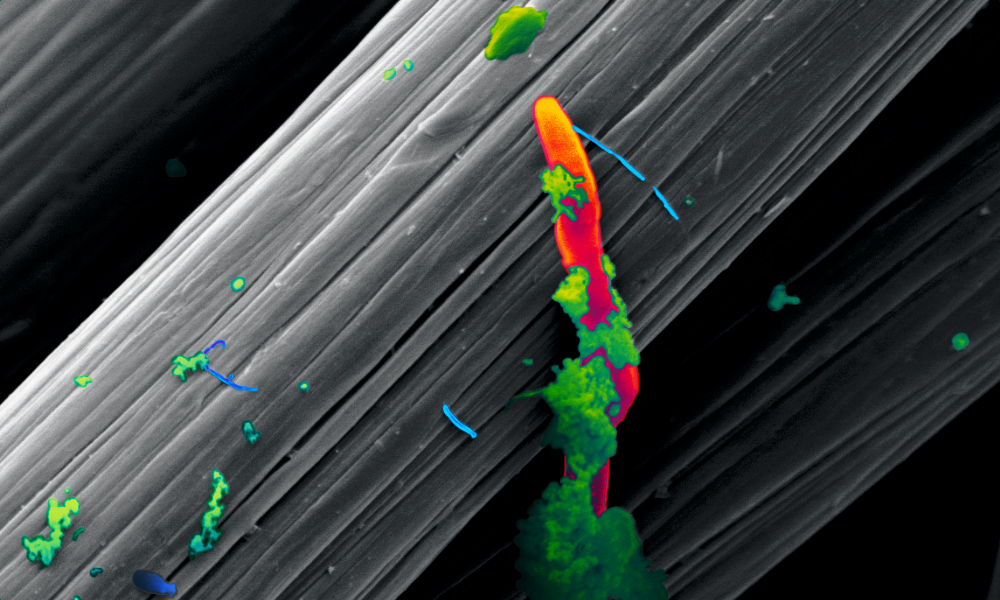
Scientists use carbon-fiber electrodes (gray) to lure electricity-eating microbes (orange). These microbes grow incredibly slowly, so attracting them can take time. Researchers left this electrode underground for five months.

Last year, biophysicist Moh El-Naggar and his graduate student Yamini Jangir plunged beneath South Dakota’s Black Hills into an old gold mine that is now more famous as a home to a dark matter detector. Unlike most scientists who make pilgrimages to the Black Hills these days, El-Naggar and Jangir weren’t there to hunt for subatomic particles. They came in search of life.

In the darkness found a mile underground, the pair traversed the mine’s network of passages in search of a rusty metal pipe. They siphoned some of the pipe’s ancient water, directed it into a vessel, and inserted a variety of electrodes. They hoped the current would lure their prey, a little-studied microbe that can live off pure electricity.

The electricity-eating microbes that the researchers were hunting for belong to a larger class of organisms that scientists are only beginning to understand. They inhabit largely uncharted worlds: 
  • the bubbling cauldrons of deep sea vents; 
  • mineral-rich veins deep beneath the planet’s surface; 
  • ocean sediments just a few inches below the deep seafloor. 
The microbes represent a segment of life that has been largely ignored, in part because their strange habitats make them incredibly difficult to grow in the lab.

Yet early surveys suggest a potential microbial bounty. A recent sampling of microbes collected from the seafloor near Catalina Island, off the coast of Southern California, uncovered a surprising variety of microbes that consume or shed electrons by eating or breathing minerals or metals. El-Naggar’s team is still analyzing their gold mine data, but he says that their initial results echo the Catalina findings. Thus far, whenever scientists search for these electron eaters in the right locations — places that have lots of minerals but not a lot of oxygen — they find them.

As the tally of electron eaters grows, scientists are beginning to figure out just how they work. How does a microbe consume electrons out of a piece of metal, or deposit them back into the environment when it is finished with them? A study published last year revealed the way that one of these microbes catches and consumes its electrical prey. And not-yet-published work suggests that some metal eaters transport electrons directly across their membranes — a feat once thought impossible.

The Rock Eaters
Though eating electricity seems bizarre, the flow of current is central to life. All organisms require a source of electrons to make and store energy. They must also be able to shed electrons once their job is done. In describing this bare-bones view of life, Nobel Prize-winning physiologist Albert Szent-Györgyi once said, “Life is nothing but an electron looking for a place to rest.”

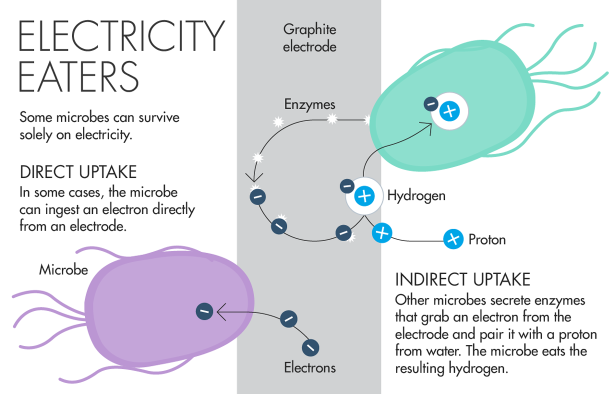
Humans and many other organisms get electrons from food and expel them with our breath. The microbes that El-Naggar and others are trying to grow belong to a group called lithoautotrophs, or rock eaters, which harvest energy from inorganic substances such as iron, sulfur or manganese. Under the right conditions, they can survive solely on electricity.

The microbes’ apparent ability to ingest electrons — known as direct electron transfer — is particularly intriguing because it seems to defy the basic rules of biophysics. The fatty membranes that enclose cells act as an insulator, creating an electrically neutral zone once thought impossible for an electron to cross. “No one wanted to believe that a bacterium would take an electron from inside of the cell and move it to the outside,” said Kenneth Nealson, a geobiologist at the University of Southern California, in a lecture to the Society for Applied Microbiology in London last year.

Lucy Reading-Ikkanda for Quanta Magazine
In the 1980s, Nealson and others discovered a surprising group of bacteria that can expel electrons directly onto solid minerals. It took until 2006 to discover the molecular mechanism behind this feat: A trio of specialized proteins sits in the cell membrane, forming a conductive bridge that transfers electrons to the outside of cell. (Scientists still debate whether the electrons traverse the entire distance of the membrane unescorted.)

Inspired by the electron-donators, scientists began to wonder whether microbes could also do the reverse and directly ingest electrons as a source of energy. Researchers focused their search on a group of microbes called methanogens, which are known for making methane. Most methanogens aren’t strict metal eaters. But in 2009, Bruce Logan, an environmental engineer at Pennsylvania State University, and collaborators showed for the first time that a methanogen could survive using only energy from an electrode. The researchers proposed that the microbes were directly sucking up electrons, perhaps via a molecular bridge similar to the ones the electron-producers use to shuttle electrons across the cell wall. But they lacked direct proof.

Then last year, Alfred Spormann, a microbiologist at Stanford University, and collaborators poked a hole in Logan’s theory. They uncovered a way that these organisms can survive on electrodes without eating naked electrons.

The microbe Spormann studied, Methanococcus maripaludis, excretes an enzyme that sits on the electrode’s surface. The enzyme pairs an electron from the electrode with a proton from water to create a hydrogen atom, which is a well-established food source among methanogens. “Rather than having a conductive pathway, they use an enzyme,” said Daniel Bond, a microbiologist at the University of Minnesota Twin Cities. “They don’t need to build a bridge out of conductive materials.”

Though the microbes aren’t eating naked electrons, the results are surprising in their own right. Most enzymes work best inside the cell and rapidly degrade outside. “What’s unique is how stable the enzymes are when they [gather on] the surface of the electrode,” Spormann said. Past experiments suggest these enzymes are active outside the cell for only a few hours, “but we showed they are active for six weeks.”

Spormann and others still believe that methanogens and other microbes can directly suck up electricity, however. “This is an alternative mechanism to direct electron transfer, it doesn’t mean direct electron transfer can’t exist,” said Largus Angenent, an environmental engineer at Cornell University, and president of the International Society for Microbial Electrochemistry and Technology. Spormann said his team has already found a microbe capable of taking in naked electrons. But they haven’t yet published the details.

Microbes on Mars
Only a tiny fraction — perhaps 2 percent — of all the planet’s microorganisms can be grown in the lab. Scientists hope that these new approaches — growing microbes on electrodes rather than in traditional culture systems — will provide a way to study many of the microbes that have been so far impossible to cultivate.

“Using electrodes as proxies for minerals has helped us open and expand this field,” said Annette Rowe, a postdoctoral researcher at USC working with El-Naggar. “Now we have a way to grow the bacteria and monitor their respiration and really have a look at their physiology.”

Rowe has already had some success.
In 2013, she went on a microbe prospecting trip to the iron-rich sediments that surround California’s Catalina Island. She identified at least 30 new varieties of electric microbes in a study published last year. “They are from very diverse groups of microbes that are quite common in marine systems,” Rowe said. Before her experiment, no one knew these microbes could take up electrons from an inorganic substrate, she said. “That’s something we weren’t expecting.”

Just as fishermen use different lures to attract different fish, Rowe set the electrodes to different voltages to draw out a rich diversity of microbes. She knew when she had a catch because the current changed — metal eaters generate a negative current, as the microbes suck electrons from the negative electrode.
Connie A. Walter and Matt Kapust
Yamini Jangir, then a graduate student in Moh El-Naggar’s lab at the University of Southern California, collects water from a pipe at the Sanford Underground Research Facility nearly a mile underground.

The different varieties of bacteria that Rowe collected thrive under different electrical conditions, suggesting they employ different strategies for eating electrons. “Each bacteria had a different energy level where electron uptake would happen,” Rowe said. “We think that is indicative of different pathways.”

Rowe is now searching new environments for additional microbes, focusing on fluids from a deep spring with low acidity. She’s also helping with El-Naggar’s gold mine expedition. “We are trying to understand how life works under these conditions,” said El-Naggar. “We now know that life goes far deeper than we thought, and there’s a lot more than we thought, but we don’t have a good idea for how they are surviving.”

El-Naggar emphasizes that the field is still in its infancy, likening the current state to the early days of neuroscience, when researchers poked at frogs with electrodes to make their muscles twitch. “It took a long time for the basic mechanistic stuff to come out,” he said. “It’s only been 30 years since we discovered that microbes can interact with solid surfaces.”

Given the bounty from these early experiments, it seems that scientists have only scratched the surface of the microbial diversity that thrives beneath the planet’s shallow exterior. The results could give clues to the origins of life on Earth and beyond. One theory for the emergence of life suggests it originated on mineral surfaces, which could have concentrated biological molecules and catalyzed reactions. New research could fill in one of the theory’s gaps — a mechanism for transporting electrons from mineral surfaces into cells.

Moreover, subsurface metal eaters may provide a blueprint for life on other worlds, where alien microbes might be hidden beneath the planet’s shallow exterior. “For me, one of the most exciting possibilities is finding life-forms that might survive in extreme environments like Mars,” said El-Naggar, whose gold mine experiment is funded by NASA’s Astrobiology Institute. Mars, for example, is iron-rich and has water flowing beneath its surface. “If you have a system that can pick up electrons from iron and have some water, then you have all the ingredients for a conceivable metabolism,” said El-Naggar. Perhaps a former mine a mile underneath South Dakota won’t be the most surprising place that researchers find electron-eating life.

ORIGINAL: Quanta Magazine
June 21, 2016

miércoles, 15 de junio de 2016

Scientists just detected this life-forming molecule in interstellar space for the first time


Colour-composite image of the Galactic Centre and Sagittarius B2, where the chiral molecule was detected. Credit: ESO/APEX & MSX/IPAC/NASA
For the first time ever, scientists have detected a complex organic molecule called a chiral molecule in the reaches of interstellar space, and the discovery could greatly enhance our understanding of how biological life came to be on Earth – and maybe even life's prospects for evolving elsewhere in the galaxy.

The molecule in question, propylene oxide, was discovered in a gigantic gas cloud called Sagittarius B2, located about 390 light-years from the centre of the Milky Way. Sagittarius B2 has a mass around 3 million times the mass of the Sun, and now we know that this huge conglomeration contains chiral molecules in its midst, which had never previously been detected outside our Solar System.

"This is the first molecule detected in interstellar space that has the property of chirality, making it a pioneering leap forward in our understanding of how prebiotic molecules are made in the Universe and the effects they may have on the origins of life," said chemist Brett McGuire from the National Radio Astronomy Observatory in Virginia.

Chirality is a geometric property of molecules, where asymmetric molecules display an almost identical chemical composition, but in an altered configuration – much like a mirror image – in what are called left-handed or right-handed versions.

It's a key chemical property of life on Earth, where every molecule that helps to form living things – such as amino acids, proteins, enzymes, and sugars – appears in only the left- or right-handed version of itself. This is called homochirality, and while it gives a biological benefit – as the matching molecules can fit better with one another to make larger organic structures – nobody knows how this 'chiral bias' came about.

As such, the discovery that chirality exists well outside our Solar System – with the detection of a 'handed' molecule in Sagittarius B2 – is a pretty big deal. Why? Because it could help explain why life essentially picks one molecular orientation over another.

"Propylene oxide is among the most complex and structurally intricate molecules detected so far in space," said one of the researchers, Brandon Carroll from the California Institute of Technology in Pasadena. "Detecting this molecule opens the door for further experiments determining how and where molecular handedness emerges, and why one form may be slightly more abundant than the other."

The researchers identified the molecular signature of propylene oxide using the Green Bank Telescope (GBT) in West Virginia, with supporting observations coming from the CSIRO's Parkes radio telescope in Australia.

The team thinks complex molecules like this could form in the gas cloud from thin mantles of ice that develop on extremely tiny dust grains floating in space. These ice mantles would enable the molecules to form larger molecular structures, and help produce other chemical reactions within the cloud should the ice evaporate.

It sounds like a glacial process, but the fact that chiral molecules are doing this at all in deep space could help explain how they later make their way onto asteroids and comets – which might end up seeding the molecules on the surface of planets in the event of an impact.
The two 'handed' versions of propylene oxide. Credit: B. Saxton, NRAO/AUI/NSF from data provided by N.E. Kassim, Naval Research Laboratory, Sloan Digital Sky Survey
"Meteorites in our Solar System contain chiral molecules that predate Earth itself, and chiral molecules have recently been discovered in comets," said Carroll. "Such small bodies may be what pushed life to the handedness we see today."

In other words, these molecules – and the chance we now have to study them in isolation – could tell us a lot about where life comes from and how it evolves the way it does, including why it's so choosey about being a lefty or a righty.

"By discovering a chiral molecule in space, we finally have a way to study where and how these molecules form before they find their way into meteorites and comets," said McGuire, "and to understand the role they play in the origins of homochirality and life."

The findings are published in Science.

ORIGINAL: Science Alert
PETER DOCKRILL
15 JUN 2016

lunes, 28 de septiembre de 2015

NASA Confirms Evidence That Liquid Water Flows on Today’s Mars

These dark, narrow, 100 meter-long streaks called recurring slope lineae flowing downhill on Mars are inferred to have been formed by contemporary flowing water. Recently, planetary scientists detected hydrated salts on these slopes at Hale crater, corroborating their original hypothesis that the streaks are indeed formed by liquid water. The blue color seen upslope of the dark streaks are thought not to be related to their formation, but instead are from the presence of the mineral pyroxene. The image is produced by draping an orthorectified (Infrared-Red-Blue/Green(IRB)) false color image (ESP_030570_1440) on a Digital Terrain Model (DTM) of the same site produced by High Resolution Imaging Science Experiment (University of Arizona). Vertical exaggeration is 1.5.
Credits: NASA/JPL/University of Arizona

New findings from NASA's Mars Reconnaissance Orbiter (MRO) provide the strongest evidence yet that liquid water flows intermittently on present-day Mars.

Using an imaging spectrometer on MRO, researchers detected signatures of hydrated minerals on slopes where mysterious streaks are seen on the Red Planet. These darkish streaks appear to ebb and flow over time. They darken and appear to flow down steep slopes during warm seasons, and then fade in cooler seasons. They appear in several locations on Mars when temperatures are above minus 10 degrees Fahrenheit (minus 23 Celsius), and disappear at colder times.

“Our quest on Mars has been to ‘follow the water,’ in our search for life in the universe, and now we have convincing science that validates what we’ve long suspected,” said John Grunsfeld, astronaut and associate administrator of NASA’s Science Mission Directorate in Washington. “This is a significant development, as it appears to confirm that water -- albeit briny -- is flowing today on the surface of Mars.”

These downhill flows, known as recurring slope lineae (RSL), often have been described as possibly related to liquid water. The new findings of hydrated salts on the slopes point to what that relationship may be to these dark features. The hydrated salts would lower the freezing point of a liquid brine, just as salt on roads here on Earth causes ice and snow to melt more rapidly. Scientists say it’s likely a shallow subsurface flow, with enough water wicking to the surface to explain the darkening.

Dark narrow streaks called recurring slope lineae emanating out of the walls of Garni crater on Mars. The dark streaks here are up to few hundred meters in length. They are hypothesized to be formed by flow of briny liquid water on Mars. The image is produced by draping an orthorectified (RED) image (ESP_031059_1685) on a Digital Terrain Model (DTM) of the same site produced by High Resolution Imaging Science Experiment (University of Arizona). Vertical exaggeration is 1.5.
Credits: NASA/JPL/University of Arizona
"We found the hydrated salts only when the seasonal features were widest, which suggests that either the dark streaks themselves or a process that forms them is the source of the hydration. In either case, the detection of hydrated salts on these slopes means that water plays a vital role in the formation of these streaks," said Lujendra Ojha of the Georgia Institute of Technology (Georgia Tech) in Atlanta, lead author of a report on these findings published Sept. 28 by Nature Geoscience.

Ojha first noticed these puzzling features as a University of Arizona undergraduate student in 2010, using images from the MRO's High Resolution Imaging Science Experiment (HiRISE). HiRISE observations now have documented RSL at dozens of sites on Mars. The new study pairs HiRISE observations with mineral mapping by MRO’s Compact Reconnaissance Imaging Spectrometer for Mars (CRISM).

The spectrometer observations show signatures of hydrated salts at multiple RSL locations, but only when the dark features were relatively wide. When the researchers looked at the same locations and RSL weren't as extensive, they detected no hydrated salt.

Ojha and his co-authors interpret the spectral signatures as caused by hydrated minerals called perchlorates. The hydrated salts most consistent with the chemical signatures are likely a mixture of magnesium perchlorate, magnesium chlorate and sodium perchlorate. Some perchlorates have been shown to keep liquids from freezing even when conditions are as cold as minus 94 degrees Fahrenheit (minus 70 Celsius). On Earth, naturally produced perchlorates are concentrated in deserts, and some types of perchlorates can be used as rocket propellant.

Perchlorates have previously been seen on Mars. NASA's Phoenix lander and Curiosity rover both found them in the planet's soil, and some scientists believe that the Viking missions in the 1970s measured signatures of these salts. However, this study of RSL detected perchlorates, now in hydrated form, in different areas than those explored by the landers. This also is the first time perchlorates have been identified from orbit.

MRO has been examining Mars since 2006 with its six science instruments.

"The ability of MRO to observe for multiple Mars years with a payload able to see the fine detail of these features has enabled findings such as these: first identifying the puzzling seasonal streaks and now making a big step towards explaining what they are," said Rich Zurek, MRO project scientist at NASA's Jet Propulsion Laboratory (JPL) in Pasadena, California.

For Ojha, the new findings are more proof that the mysterious lines he first saw darkening Martian slopes five years ago are, indeed, present-day water.

"When most people talk about water on Mars, they're usually talking about ancient water or frozen water," he said. "Now we know there’s more to the story. This is the first spectral detection that unambiguously supports our liquid water-formation hypotheses for RSL."

The discovery is the latest of many breakthroughs by NASA’s Mars missions.
“It took multiple spacecraft over several years to solve this mystery, and now we know there is liquid water on the surface of this cold, desert planet,” said Michael Meyer, lead scientist for NASA’s Mars Exploration Program at the agency’s headquarters in Washington. “It seems that the more we study Mars, the more we learn how life could be supported and where there are resources to support life in the future.” 


This animation simulates a fly-around look at one of the places on Mars where dark streaks advance down slopes during warm seasons, possibly involving liquid water. This site is within Hale Crater. The streaks are roughly the length of a football field.

There are eight co-authors of the Nature Geoscience paper, including Mary Beth Wilhelm at NASA’s Ames Research Center in Moffett Field, California and Georgia Tech; CRISM Principal Investigator Scott Murchie of the Johns Hopkins University Applied Physics Laboratory in Laurel, Maryland; and HiRISE Principal Investigator Alfred McEwen of the University of Arizona Lunar and Planetary Laboratory in Tucson, Arizona. Others are at Georgia Tech, the Southwest Research Institute in Boulder, Colorado, and Laboratoire de Planétologie et Géodynamique in Nantes, France.

The agency’s Jet Propulsion Laboratory (JPL) in Pasadena, California manages the Mars Reconnaissance Orbiter Project for NASA's Science Mission Directorate, Washington. Lockheed Martin built the orbiter and collaborates with JPL to operate it.

More information about NASA's journey to Mars is available online at:

For more information about the Mars Reconnaissance Orbiter, visit:

ORIGINAL: NASA

martes, 14 de julio de 2015

Where are all the aliens?

Is there anybody out there? (Reuters/NASA)
Everyone feels something when they’re in a really good starry place on a really good starry night and they look up and see this:

(Reuters/Amr Dalsh)
Some people stick with the traditional—feeling struck by the epic beauty or blown away by the insane scale of the universe. Personally, I go for the old “existential meltdown followed by acting weird for the next half hour.” But everyone feels something.

Physicist Enrico Fermi felt something too—“Where is everybody?”

A really starry sky seems vast—but all we’re looking at is our very local neighborhood. On the very best nights, we can see up to about 2,500 stars (roughly one hundred-millionth of the stars in our galaxy), and almost all of them are less than 1,000 light years away from us (or 1% of the diameter of the Milky Way). So what we’re really looking at is this:

(Nick Risinger) waitbutwhy.com
When confronted with the topic of stars and galaxies, a question that tantalizes most humans is, “Is there other intelligent life out there?” Let’s put some numbers to it:

As many stars as there are in our galaxy (100 to 400 billion), there are roughly an equal number of galaxies in the observable universe—so for every star in the colossal Milky Way, there’s a whole galaxy out there. All together, that comes out to the typically quoted range of between 1022 and 1024 total stars, which means that for every grain of sand on every beach on Earth, there are 10,000 stars out there.

The science world isn’t in total agreement about what percentage of those stars are “sun-like” (similar in size, temperature, and luminosity)—opinions typically range from 5% to 20%. Going with the most conservative side of that (5%), and the lower end for the number of total stars (1022), gives us 500 quintillion, or 500 billion billion sun-like stars.

There’s also a debate over what percentage of those sun-like stars might be orbited by an Earth-like planet (one with similar temperature conditions that could have liquid water and potentially support life similar to that on Earth). Some say it’s as high as 50%, but let’s go with the more conservative 22% that came out of a recent Proceedings of the National Academy of Science (PNAS) study. That suggests that there’s a potentially-habitable Earth-like planet orbiting at least 1% of the total stars in the universe—a total of 100 billion billion Earth-like planets.

So there are 100 Earth-like planets for every grain of sand in the world. Think about that next time you’re on the beach.

Moving forward, we have no choice but to get completely speculative. Let’s imagine that after billions of years in existence, 1% of Earth-like planets develop life (if that’s true, every grain of sand would represent one planet with life on it). And imagine that on 1% of those planets, the life advances to an intelligent level like it did here on Earth. That would mean there were 10 quadrillion, or 10 million billion intelligent civilizations in the observable universe.

Moving back to just our galaxy, and doing the same math on the lowest estimate for stars in the Milky Way (100 billion), we’d estimate that there are 1 billion Earth-like planets and 100,000 intelligent civilizations in our galaxy.[1]

SETI (Search for Extraterrestrial Intelligence) is an organization dedicated to listening for signals from other intelligent life. If we’re right that there are 100,000 or more intelligent civilizations in our galaxy, and even a fraction of them are sending out radio waves or laser beams or other modes of attempting to contact others, shouldn’t SETI’s satellite array pick up all kinds of signals?

But it hasn’t. Not one. Ever.

Where is everybody?
It gets stranger. Our sun is relatively young in the lifespan of the universe. There are far older stars with far older Earth-like planets, which should in theory mean civilizations far more advanced than our own. As an example, let’s compare our 4.54 billion-year-old Earth to a hypothetical 8 billion-year-old Planet X.


If Planet X has a similar story to Earth, let’s look at where their civilization would be today (using the orange timespan as a reference to show how huge the green timespan is):


The technology and knowledge of a civilization only 1,000 years ahead of us could be as shocking to us as our world would be to a medieval person. A civilization 1 million years ahead of us might be as incomprehensible to us as human culture is to chimpanzees. And Planet X is 3.4 billion years ahead of us…

There’s something called the Kardashev Scale, which helps us group intelligent civilizations into three broad categories by the amount of energy they use:
  • A Type I Civilization has the ability to use all of the energy on their planet. We’re not quite a Type I Civilization, but we’re close. (Carl Sagan created a formula for this scale which puts us at a Type 0.7 Civilization.)
  • A Type II Civilization can harness all of the energy of their host star. Our feeble Type I brains can hardly imagine how someone would do this, but we’ve tried our best, imagining things like a Dyson Sphere.
  • A Type III Civilization blows the other two away, accessing power comparable to that of the entire Milky Way galaxy.
If this level of advancement sounds hard to believe, remember Planet X above and their 3.4 billion years of further development. If a civilization on Planet X were similar to ours and were able to survive all the way to Type III level, the natural thought is that they’d probably have mastered inter-stellar travel by now, possibly even colonizing the entire galaxy.

One hypothesis as to how galactic colonization could happen is by creating machinery that can travel to other planets, spend 500 years or so self-replicating using the raw materials on their new planet, and then send two replicas off to do the same thing. Even without traveling anywhere near the speed of light, this process would colonize the whole galaxy in 3.75 million years, a relative blink of an eye when talking in the scale of billions of years:

(Scientific American)
Continuing to speculate, if 1% of intelligent life survives long enough to become a potentially galaxy-colonizing Type III Civilization, our calculations above suggest that there should be at least 1,000 Type III Civilizations in our galaxy alone—and given the power of such a civilization, their presence would likely be pretty noticeable. And yet, we see nothing, hear nothing, and we’re visited by no one.

So where is everybody?

Welcome to the Fermi Paradox.
We have no answer to the Fermi Paradox—the best we can do is “possible explanations.” And if you ask ten different scientists what their hunch is about the correct one, you’ll get ten different answers. You know when you hear about humans of the past debating whether the Earth was round or if the sun revolved around the Earth or thinking that lightning happened because of Zeus, and they seem so primitive and in the dark? That’s about where we are with this topic.

In taking a look at some of the most-discussed possible explanations for the Fermi Paradox, let’s divide them into two broad categories—those explanations which assume that there’s no sign of Type II and Type III Civilizations because there are none of them out there, and those which assume they’re out there and we’re not seeing or hearing anything for other reasons:

Explanation Group 1: There are no signs of higher (Type II and III) civilizations because there are no higher civilizations in existence.

Those who subscribe to Group 1 explanations point to something called the non-exclusivity problem, which rebuffs any theory that says, “There are higher civilizations, but none of them have made any kind of contact with us because they all _____.” Group 1 people look at the math, which says there should be so many thousands (or millions) of higher civilizations, that at least one of them would be an exception to the rule. Even if a theory held for 99.99% of higher civilizations, the other .01% would behave differently and we’d become aware of their existence.

Therefore, say Group 1 explanations, it must be that there are no super-advanced civilizations. And since the math suggests that there arethousands of them just in our own galaxy, something else must be going on.

This something else is called the Great Filter.

The Great Filter theory says that at some point from pre-life to Type III intelligence, there’s a wall that all or nearly all attempts at life hit. There’s some stage in that long evolutionary process that is extremely unlikely or impossible for life to get beyond. That stage is the Great Filter.


If this theory is true, the big question is, Where in the timeline does the Great Filter occur?

It turns out that when it comes to the fate of humankind, this question is very important. Depending on where the Great Filter occurs, we’re left with three possible realities: 
  1. We’re rare, 
  2. we’re first, or 
  3. we’re fucked.

1. We’re rare (the Great Filter is behind us)
One hope we have is that the Great Filter is behind us—we managed to surpass it, which would mean it’s extremely rare for life to make it to our level of intelligence. The diagram below shows only two species making it past, and we’re one of them.


This scenario would explain why there are no Type III Civilizations… but it would also mean that we could be one of the few exceptions now that we’ve made it this far. It would mean we have hope. On the surface, this sounds a bit like people 500 years ago suggesting that the Earth is the center of the universe—it implies that we’re special. However, something scientists call “observation selection effect” suggests that anyone who is pondering their own rarity is inherently part of an intelligent life “success story”—and whether they’re actually rare or quite common, the thoughts they ponder and conclusions they draw will be identical. This forces us to admit that being special is at least a possibility.

And if we are special, when exactly did we become special—i.e. which step did we surpass that almost everyone else gets stuck on?

  • One possibility: The Great Filter could be at the very beginning—it might be incredibly unusual for life to begin at all. This is a candidate because it took about a billion years of Earth’s existence to finally happen, and because we have tried extensively to replicate that event in labs and have never been able to do it. If this is indeed the Great Filter, it would mean that not only is there no intelligent life out there, there may be no other life at all.
  • Another possibility: The Great Filter could be the jump from the simple prokaryote cell to the complex eukaryote cell. After prokaryotes came into being, they remained that way for almost two billion years before making the evolutionary jump to being complex and having a nucleus. If this is the Great Filter, it would mean the universe is teeming with simple prokaryote cells and almost nothing beyond that.
  • There are a number of other possibilities—some even think the most recent leap we’ve made to our current intelligence is a Great Filter candidate. While the leap from semi-intelligent life (chimps) to intelligent life (humans) doesn’t at first seem like a miraculous step, Steven Pinker rejects the idea of an inevitable “climb upward” of evolution: “Since evolution does not strive for a goal but just happens, it uses the adaptation most useful for a given ecological niche, and the fact that, on Earth, this led to technological intelligence only once so far may suggest that this outcome of natural selection is rare and hence by no means a certain development of the evolution of a tree of life.”
Most leaps do not qualify as Great Filter candidates. Any possible Great Filter must be one-in-a-billion type thing where one or more total freak occurrences need to happen to provide a crazy exception—for that reason, something like the jump from single-cell to multi-cellular life is ruled out, because it has occurred as many as 46 times, in isolated incidents, just on this planet alone. For the same reason, if we were to find a fossilized eukaryote cell on Mars, it would rule the above “simple-to-complex cell” leap out as a possible Great Filter (as well as anything before that point on the evolutionary chain)—because if it happened onboth Earth and Mars, it’s almost definitely not a one-in-a-billion freak occurrence.

If we are indeed rare, it could be because of a fluky biological event, but it also could be attributed to what is called the Rare Earth Hypothesis, which suggests that though there may be many Earth-like planets, theparticular conditions on Earth—whether related to the specifics of this solar system, its relationship with the moon (a moon that large is unusual for such a small planet and contributes to our particular weather and ocean conditions), or something about the planet itself—are exceptionally friendly to life.

2. We’re the first

For Group 1 Thinkers, if the Great Filter is not behind us, the one hope we have is that conditions in the universe are just recently, for the first time since the Big Bang, reaching a place that would allow intelligent life to develop. In that case, we and many other species may be on our way to super-intelligence, and it simply hasn’t happened yet. We happen to be here at the right time to become one of the first super-intelligent civilizations.

One example of a phenomenon that could make this realistic is the prevalence of gamma-ray bursts, insanely huge explosions that we’ve observed in distant galaxies. In the same way that it took the early Earth a few hundred million years before the asteroids and volcanoes died down and life became possible, it could be that the first chunk of the universe’s existence was full of cataclysmic events like gamma-ray bursts that would incinerate everything nearby from time to time and prevent any life from developing past a certain stage. Now, perhaps, we’re in the midst of an astrobiological phase transition and this is the first time any life has been able to evolve for this long, uninterrupted.

3. We’re fucked (the Great Filter is ahead of us)

If we’re neither rare nor early, Group 1 thinkers conclude that the Great Filter must be in our future. This would suggest that life regularly evolves to where we are, but that something prevents life from going much further and reaching high intelligence in almost all cases—and we’re unlikely to be an exception.

One possible future Great Filter is a regularly-occurring cataclysmic natural event, like the above-mentioned gamma-ray bursts, except they’re unfortunately not done yet and it’s just a matter of time before all life on Earth is suddenly wiped out by one. Another candidate is the possible inevitability that nearly all intelligent civilizations end up destroying themselves once a certain level of technology is reached.

This is why Oxford University philosopher Nick Bostrom says that “no news is good news.” The discovery of even simple life on Mars would be devastating, because it would cut out a number of potential Great Filters behind us. And if we were to find fossilized complex life on Mars, Bostrom says “it would be by far the worst news ever printed on a newspaper cover,” because it would mean The Great Filter is almost definitely ahead of us—ultimately dooming the species. Bostrom believes that when it comes to the Fermi Paradox, “the silence of the night sky is golden.”

Explanation Group 2: Type II and III intelligent civilizations are out there—and there are logical reasons why we might not have heard from them.

Group 2 explanations get rid of any notion that we’re rare or special or the first at anything—on the contrary, they believe in the Mediocrity Principle, whose starting point is that there is nothing unusual or rare about our galaxy, solar system, planet, or level of intelligence, until evidence proves otherwise. They’re also much less quick to assume that the lack of evidence of higher intelligence beings is evidence of their nonexistence—emphasizing the fact that our search for signals stretches only about 100 light years away from us (0.1% across the galaxy) and suggesting a number of possible explanations. Here are 10:

  1. Possibility 1) Super-intelligent life could very well have already visited Earth, but before we were here. In the scheme of things, sentient humans have only been around for about 50,000 years, a little blip of time. If contact happened before then, it might have made some ducks flip out and run into the water and that’s it. Further, recorded history only goes back 5,500 years—a group of ancient hunter-gatherer tribes may have experienced some crazy alien shit, but they had no good way to tell anyone in the future about it.
  2. Possibility 2) The galaxy has been colonized, but we just live in some desolate rural area of the galaxy. The Americas may have been colonized by Europeans long before anyone in a small Inuit tribe in far northern Canada realized it had happened. There could be an urbanization component to the interstellar dwellings of higher species, in which all the neighboring solar systems in a certain area are colonized and in communication, and it would be impractical and purposeless for anyone to deal with coming all the way out to the random part of the spiral where we live.
  3. Possibility 3) The entire concept of physical colonization is a hilariously backward concept to a more advanced species. Remember the picture of the Type II Civilization above with the sphere around their star? With all that energy, they might have created a perfect environment for themselves that satisfies their every need. They might have crazy-advanced ways of reducing their need for resources and zero interest in leaving their happy utopia to explore the cold, empty, undeveloped universe.
    An even more advanced civilization might view the entire physical worldas a horribly primitive place, having long ago conquered their own biology and uploaded their brains to a virtual reality, eternal-life paradise. Living in the physical world of biology, mortality, wants, and needs might seem to them the way we view primitive ocean species living in the frigid, dark sea. FYI, thinking about another life form having bested mortality makes me incredibly jealous and upset.
  4. Possibility 4) There are scary predator civilizations out there, and most intelligent life knows better than to broadcast any outgoing signals and advertise their location. This is an unpleasant concept and would help explain the lack of any signals being received by the SETI satellites. It also means that we might be the super naive newbies who are being unbelievably stupid and risky by ever broadcasting outward signals. There’s a debate going on currently about whether we should engage in METI (Messaging to Extraterrestrial Intelligence—the reverse of SETI) or not, and most people say we should not. Stephen Hawking warns, “If aliens visit us, the outcome would be much as when Columbus landed in America, which didn’t turn out well for the Native Americans.” Even Carl Sagan (a general believer that any civilization advanced enough for interstellar travel would be altruistic, not hostile)called the practice of METI “deeply unwise and immature,” and recommended that “the newest children in a strange and uncertain cosmos should listen quietly for a long time, patiently learning about the universe and comparing notes, before shouting into an unknown jungle that we do not understand.” Scary.
  5. Possibility 5) There’s only one instance of higher-intelligent life—a “superpredator” civilization (like humans are here on Earth)—who is far more advanced than everyone else and keeps it that way by exterminating any intelligent civilization once they get past a certain level. This would suck. The way it might work is that it’s an inefficient use of resources to exterminate all emerging intelligences, maybe because most die out on their own. But past a certain point, the super beings make their move—because to them, an emerging intelligent species becomes like a virus as it starts to grow and spread. This theory suggests that whoever was the first in the galaxy to reach intelligence won, and now no one else has a chance. This would explain the lack of activity out there because it would keep the number of super-intelligent civilizations to just one.
  6. Possibility 6) There’s plenty of activity and noise out there, but our technology is too primitive and we’re listening for the wrong things. Like walking into a modern-day office building, turning on a walkie-talkie, and when you hear no activity (which of course you wouldn’t hear because everyone’s texting, not using walkie-talkies), determining that the building must be empty. Or maybe, as Carl Sagan has pointed out, it could be that our minds work exponentially faster or slower than another form of intelligence out there—e.g. it takes them 12 years to say “Hello,” and when we hear that communication, it just sounds like white noise to us.
  7. Possibility 7) We are receiving contact from other intelligent life, but the government is hiding it.The more I learn about the topic, the more this seems like an idiotic theory, but I had to mention it because it’s talked about so much.
  8. Possibility 8) Higher civilizations are aware of us and observing us (AKA the “Zoo Hypothesis”). As far as we know, super-intelligent civilizations exist in a tightly-regulated galaxy, and our Earth is treated like part of a vast and protected national park, with a strict “Look but don’t touch” rule for planets like ours. We wouldn’t notice them, because if a far smarter species wanted to observe us, it would know how to easily do so without us realizing it. Maybe there’s a rule similar to the Star Trek’s “Prime Directive” which prohibits super-intelligent beings from making any open contact with lesser species like us or revealing themselves in any way, until the lesser species has reached a certain level of intelligence.
  9. Possibility 9) Higher civilizations are here, all around us. But we’re too primitive to perceive them. Michio Kaku sums it up like this:
    Lets say we have an ant hill in the middle of the forest. And right next to the ant hill, they’re building a ten-lane super-highway. And the question is “Would the ants be able to understand what a ten-lane super-highway is? Would the ants be able to understand the technology and the intentions of the beings building the highway next to them?
    So it’s not that we can’t pick up the signals from Planet X using our technology, it’s that we can’t even comprehend what the beings from Planet X are or what they’re trying to do. It’s so beyond us that even if they really wanted to enlighten us, it would be like trying to teach ants about the internet.
    Along those lines, this may also be an answer to “Well if there are so many fancy Type III Civilizations, why haven’t they contacted us yet?” To answer that, let’s ask ourselves—when Pizarro made his way into Peru, did he stop for a while at an anthill to try to communicate? Was he magnanimous, trying to help the ants in the anthill? Did he become hostile and slow his original mission down in order to smash the anthill apart? Or was the anthill of complete and utter and eternal irrelevance to Pizarro? That might be our situation here.
  10. Possibility 10) We’re completely wrong about our reality. There are a lot of ways we could just betotally off with everything we think. The universe might appear one way and be something else entirely, like ahologram. Or maybe we’re the aliens and we were planted here as an experiment or as a form of fertilizer. There’s even a chance that we’re all part of a computer simulation by some researcher from another world, and other forms of life simply weren’t programmed into the simulation.
As we continue along with our possibly-futile search for extraterrestrial intelligence, I’m not really sure what I’m rooting for. Frankly, learning either that we’re officially alone in the universe or that we’re officially joined by others would be creepy, which is a theme with all of the surreal storylines listed above—whatever the truth actually is, it’s mindblowing.

Beyond its shocking science fiction component, The Fermi Paradox also leaves me with a deep humbling. Not just the normal “Oh yeah, I’m microscopic and my existence lasts for three seconds” humbling that the universe always triggers. The Fermi Paradox brings out a sharper, more personal humbling, one that can only happen after spending hours of research hearing your species’ most renowned scientists present insane theories, change their minds again and again, and wildly contradict each other—reminding us that future generations will look at us the same way we see the ancient people who were sure that the stars were the underside of the dome of heaven, and they’ll think “Wow they really had no idea what was going on.”

Compounding all of this is the blow to our species’ self-esteem that comes with all of this talk about Type II and III Civilizations. Here on Earth, we’re the king of our little castle, proud ruler of the huge group of imbeciles who share the planet with us. And in this bubble with no competition and no one to judge us, it’s rare that we’re ever confronted with the concept of being a dramatically inferior species to anyone. But after spending a lot of time with Type II and III Civilizations over the past week, our power and pride are seeming a bit David Brent-esque.

That said, given that my normal outlook is that humanity is a lonely orphan on a tiny rock in the middle of a desolate universe, the humbling fact that we’re probably not as smart as we think we are, and the possibility that a lot of what we’re sure about might be wrong, sounds wonderful. It opens the door just a crack that maybe, just maybe, there might be more to the story than we realize.

Wait But Why posts regularly. We send each post out by email to over 170,000 people—enter your email here and we’ll put you on the list (we only send a few emails each month). You can also follow Wait But Why on Facebook and Twitter. We welcome your comments at ideas@qz.com.

MOST POPULAR: NASA took the best photo ever taken of Pluto and put it on Instagram


ORIGINAL: QZ
2015/07/14

This post originally appeared at WaitButWhy.com.