Mostrando entradas con la etiqueta Modelo estándar. Mostrar todas las entradas

jueves, 14 de marzo de 2013

New results indicate that particle discovered at CERN is a Higgs boson

ORIGINAL: CERN / CMS
Candidate events in the CMS SM Higgs Search. CMS, 13 May 2012, 21.08.
A typical candidate event including two high-energy photons.

HIG-13-002 Event 1: Event recorded with the CMS detector in 2012 at a proton-proton centre-of-mass energy of 8TeV. The event shows characteristics expected from the decay of the SM Higgs boson to a pair of Z bosons, one of which subsequently decays to a pair of electrons (green lines and green towers) and the other Z decays to a pair of muons (red lines). The event could also be due to known Standard Model background processes. Image 1 of 16. HIG-13-002 Event 1: Event recorded with the CMS detector in 2012 at a proton-proton centre-of-mass energy of 8 TeV. The event shows characteristics expected from the decay of the SM Higgs boson to a pair of Z bosons, one of which subsequently decays to a pair of electrons (green lines and green towers) and the other Z decays to a pair of muons (red lines). The event could also be due to known Standard Model background processes. Image: CERN, CMS
Geneva, 14 March 2013. At the Moriond Conference today, the ATLAS and CMS collaborations at CERN1’s Large Hadron Collider (LHC) presented preliminary new results that further elucidate the particle discovered last year. Having analysed two and a half times more data than was available for the discovery announcement in July, they find that the new particle is looking more and more like a Higgs boson, the particle linked to the mechanism that gives mass to elementary particles. It remains an open question, however, whether this is the Higgs boson of the Standard Model of particle physics, or possibly the lightest of several bosons predicted in some theories that go beyond the Standard Model. Finding the answer to this question will take time. 

Whether or not it is a Higgs boson is demonstrated by how it interacts with other particles, and its quantum properties. For example, a Higgs boson is postulated to have no spin, and in the Standard Model its parity – a measure of how its mirror image behaves – should be positive. CMS and ATLAS have compared a number of options for the spin-parity of this particle, and these all prefer no spin and positive parity. This, coupled with the measured interactions of the new particle with other particles, strongly indicates that it is a Higgs boson. 

“The preliminary results with the full 2012 data set are magnificent and to me it is clear that we are dealing with a Higgs boson though we still have a long way to go to know what kind of Higgs boson it is.” said CMS spokesperson Joe Incandela. 

"The beautiful new results represent a huge effort by many dedicated people. They point to the new particle having the spin-parity of a Higgs boson as in the Standard Model. We are now well started on the measurement programme in the Higgs sector," said ATLAS spokesperson Dave Charlton. 

Image 4 of 16. HIG-13-004 Event 1: Event recorded with the CMS detector in 2012 at a proton-proton centre-of-mass energy of 8 TeV. The event shows characteristics expected from the decay of the SM Higgs boson to a pair of τ leptons. Such an event is characterised by the production of two forward-going jets, seen here in opposite endcaps. One of the τs decays to a muon (red lines on the right) and neutrinos, while the other τ decays into a charged hadron and a neutrino
To determine if this is the Standard Model Higgs boson, the collaborations have, for example, to measure precisely the rate at which the boson decays into other particles and compare the results to the predictions. The detection of the boson is a very rare event - it takes around 1 trillion (1012) proton-proton collisions for each observed event. To characterize all of the decay modes will require much more data from the LHC. 

Footnote(s): 
1. CERN, the European Organization for Nuclear Research, is the world's leading laboratory for particle physics. It has its headquarters in Geneva. At present, its member states are Austria, Belgium, Bulgaria, the Czech Republic, Denmark, Finland, France, Germany, Greece, Hungary, Italy, the Netherlands, Norway, Poland, Portugal, Slovakia, Spain, Sweden, Switzerland and the United Kingdom. Romania is a candidate for accession. Cyprus, Israel and Serbia are associate members in the pre-stage to membership. India, Japan, the Russian Federation, the United States of America, Turkey, the European Commission and UNESCO have observer status.

miércoles, 4 de julio de 2012

Higgs within reach. Our understanding of the universe is about to change…

ORIGINAL: CERN


The ATLAS and CMS experiments at CERN today presented their latest results in the search for the long-sought Higgs boson. Both experiments see strong indications for the presence of a new particle, which could be the Higgs boson, in the mass region around 126 gigaelectronvolts (GeV).

The experiments found hints of the new particle by analysing trillions of proton-proton collisions from the Large Hadron Collider (LHC) in 2011 and 2012. The Standard Model of particle physics predicts that a Higgs boson would decay into different particles – which the LHC experiments then detect.
A proton-proton collision event in the CMS experiment producing two high-energy photons (red towers). This is what we would expect to see from the decay of a Higgs boson but it is also consistent with background Standard Model physics processes. © CERN 2012
Both ATLAS and CMS gave the level of significance of the result as 5 sigma on the scale that particle physicists use to describe the certainty of a discovery. One sigma means the results could be random fluctuations in the data, 3 sigma counts as an observation and a 5-sigma result is a discovery. The results presented today are preliminary, as the data from 2012 is still under analysis. The complete analysis is expected to be published around the end of July.

PR17.12
04.07.2012


CERN experiments observe particle consistent with long-sought Higgs boson


Geneva, 4 July 2012. At a seminar held at CERN1 today as a curtain raiser to the year’s major particle physics conference, ICHEP2012 in Melbourne, the ATLAS and CMS experiments presented their latest preliminary results in the search for the long sought Higgs particle. Both experiments observe a new particle in the mass region around 125-126 GeV.

“We observe in our data clear signs of a new particle, at the level of 5 sigma, in the mass region around 126 GeV. The outstanding performance of the LHC and ATLAS and the huge efforts of many people have brought us to this exciting stage,” said ATLAS experiment spokesperson Fabiola Gianotti, “but a little more time is needed to prepare these results for publication.”


"The results are preliminary but the 5 sigma signal at around 125 GeV we’re seeing is dramatic. This is indeed a new particle. We know it must be a boson and it’s the heaviest boson ever found,” said CMS experiment spokesperson Joe Incandela. “The implications are very significant and it is precisely for this reason that we must be extremely diligent in all of our studies and cross-checks."

“It’s hard not to get excited by these results,” said CERN Research Director Sergio Bertolucci. “ We stated last year that in 2012 we would either find a new Higgs-like particle or exclude the existence of the Standard Model Higgs. With all the necessary caution, it looks to me that we are at a branching point: the observation of this new particle indicates the path for the future towards a more detailed understanding of what we’re seeing in the data.”

The results presented today are labelled preliminary. They are based on data collected in 2011 and 2012, with the 2012 data still under analysis. Publication of the analyses shown today is expected around the end of July. A more complete picture of today’s observations will emerge later this year after the LHC provides the experiments with more data.

The next step will be to determine the precise nature of the particle and its significance for our understanding of the universe. Are its properties as expected for the long-sought Higgs boson, the final missing ingredient in the Standard Model of particle physics? Or is it something more exotic? The Standard Model describes the fundamental particles from which we, and every visible thing in the universe, are made, and the forces acting between them. All the matter that we can see, however, appears to be no more than about 4% of the total. A more exotic version of the Higgs particle could be a bridge to understanding the 96% of the universe that remains obscure.

“We have reached a milestone in our understanding of nature,” said CERN Director General Rolf Heuer. “The discovery of a particle consistent with the Higgs boson opens the way to more detailed studies, requiring larger statistics, which will pin down the new particle’s properties, and is likely to shed light on other mysteries of our universe.”

Positive identification of the new particle’s characteristics will take considerable time and data. But whatever form the Higgs particle takes, our knowledge of the fundamental structure of matter is about to take a major step forward.

Contact:
CERN press office, press.office@cern.ch
+41 22 767 34 32
+41 22 767 21 41

Further information:
Follow CERN at:

1. CERN, the European Organization for Nuclear Research, is the world's leading laboratory for particle physics. It has its headquarters in Geneva. At present, its Member States are Austria, Belgium, Bulgaria, the Czech Republic, Denmark, Finland, France, Germany, Greece, Hungary, Italy, the Netherlands, Norway, Poland, Portugal, Slovakia, Spain, Sweden, Switzerland and the United Kingdom. Romania is a candidate for accession. Israel and Serbia are Associate Members in the pre-stage to Membership. India, Japan, the Russian Federation, the United States of America, Turkey, the European Commission and UNESCO have Observer status.

martes, 26 de junio de 2012

El CERN se prepara para revelar los resultados de su búsqueda del Bosón de Higgs

ORIGINAL: MadrI+D
FUENTE | Agencia EFE 26/06/2012

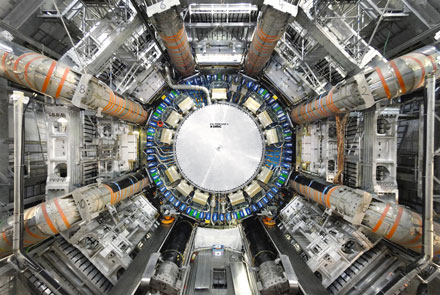
Detector ATLAS. Foto CERN
El Centro Europeo de Física de Partículas (CERN) ha reunido en sólo tres meses más del doble de datos experimentales que todo el pasado año, lo que le acerca a un resultado definitivo sobre la existencia o no del Bosón de Higgs, la última partícula a descubrir en el modelo estándar de física.

Así lo reveló el CERN al anunciar que la próxima semana celebrará un seminario científico para aportar "la última actualización en la búsqueda del Bosón de Higgs".

El director de Aceleradores y Tecnología del CERN, Steve Myers, indicó que terminó la toma de datos para presentar los resultados preliminares en la mayor conferencia internacional de física de partículas del año, la ICHEP, que se celebra julio en Melburne (Australia).

El calendario de funcionamiento del acelerador LHC se diseñó especialmente para obtener "la mayor cantidad posible de datos de los experimentos" antes de ese gran evento científico, de forma que entre abril y junio de 2012 se consiguieron más informaciones que en todo 2011.

En ese periodo se incrementó la energía a la que circulaban los haces de protones hasta llegar a una intensidad jamás alcanzada por otra máquina y se mejoraron las técnicas de análisis para seleccionar datos que podrían probar la existencia del Bosón.

La información reunida "debería ser suficiente para ver si las tendencias que observamos en 2011 todavía están allí o si por el contrario han desaparecido", sostuvo el director de investigación e informática del CERN, Sergio Bertolucci.

A finales del pasado año, científicos del CERN aseguraron que el análisis de los primeros resultados arrojaba indicios "intrigantes" de la eventual existencia del Bosón de Higgs, pero explicaron que con el nivel de datos reunidos hasta entonces no era posible dar una confirmación científica de la partícula más buscada de la física moderna.