Mostrando entradas con la etiqueta Richard Feynman. Mostrar todas las entradas

domingo, 15 de septiembre de 2013

The Feynman Lectures on Physics, Volume I

The Feynman Lectures on Physics

Feynman • Leighton • Sands

Caltech and The Feynman Lectures Website are pleased to present this online edition of The Feynman Lectures on Physics. Now, anyone with internet access and a web browser can enjoy reading a high-quality up-to-date copy of Feynman's legendary lectures. This edition has been designed for ease of reading on devices of any size or shape; text, figures and equations can all be zoomed without degradation.1
served by Caltech (generally faster)

served by The Feynman Lectures Website
mainly mechanics, radiation and heat

mainly mechanics, radiation and heat
For comments or questions about this edition please contact Michael Gottlieb.
 
 
Richard Feynman, Robert Leighton and Matthew Sands, talking with a teaching assistant after the lecture on The Dependence of Amplitudes on Time,  April 29, 1963.
Photograph by Tom Harvey. Copyright © California Institute of Technology.


Contributions from many parties have enabled and benefitted the creation of the HTML edition of The Feynman Lectures on Physics. We wish to thank
  • Carver Mead, for his warm encouragement and generous financial support, without which this edition would have been impossible,
  • Thomas Kelleher and Basic Books, for their open-mindedness in allowing this edition to be published free of charge,
  • Adam Cochran, for tying up the many slippery loose ends that needed to come together in order for this edition to be realized,
  • Alan Rice for his steadfast enthusiasm for this project, and for rallying the support of Caltech's Division of Physics Math and Astronomy ,
  • Michael Hartl and Evan Dorn, for the excellent job they did converting Volume I of the FLP LaTeX manuscript into HTML.


  1. This HTML5-based edition features LaTeX equations rendered by MathJax JavaScript, and scalable vector graphic (SVG) figures. Your browser must support javascript and permit scripts from mathjax.org. We recommend using a modern browser; some older browsers may not display this edition correctly. PNG figures (that degrade when scaled) may be served to browsers that do not support SVG. We do not support versions of Internet Explorer older than 8.0. For information about MathJax features and accessibility options, please visit the MathJax User Help page. (This is a work in progress. Initially we are publishing Volume I; We hope to eventually publish Volumes II and III, and lectures will be posted as time and funds permit.)↩


The Feynman Lectures on Physics, Volume I

Preface to the New Millennium Edition

Feynman's Preface
Add caption
These are the lectures in physics that I gave last year and the year before to the freshman and sophomore classes at Caltech. The lectures are, of course, not verbatim---they have been edited, sometimes extensively and sometimes less so. The lectures form only part of the complete course. The whole group of 180 students gathered in a big lecture room twice a week to hear these lectures and then they broke up into small groups of 15 to 20 students in recitation sections under the guidance of a teaching assistant. In addition, there was a laboratory session once a week.

The special problem we tried to get at with these lectures was to maintain the interest of the very enthusiastic and rather smart students coming out of the high schools and into Caltech. They have heard a lot about how interesting and exciting physics is---the theory of relativity, quantum mechanics, and other modern ideas. By the end of two years of our previous course, many would be very discouraged because there were really very few grand, new, modern ideas presented to them. They were made to study inclined planes, electrostatics, and so forth, and after two years it was quite stultifying. The problem was whether or not we could make a course which would save the more advanced and excited student by maintaining his enthusiasm.

The lectures here are not in any way meant to be a survey course, but are very serious. I thought to address them to the most intelligent in the class and to make sure, if possible, that even the most intelligent student was unable to completely encompass everything that was in the lectures---by putting in suggestions of applications of the ideas and concepts in various directions outside the main line of attack. For this reason, though, I tried very hard to make all the statements as accurate as possible, to point out in every case where the equations and ideas fitted into the body of physics, and how---when they learned more---things would be modified. I also felt that for such students it is important to indicate what it is that they should---if they are sufficiently clever---be able to understand by deduction from what has been said before, and what is being put in as something new. When new ideas came in, I would try either to deduce them if they were deducible, or to explain that it was a new idea which hadn't any basis in terms of things they had already learned and which was not supposed to be provable---but was just added in.

At the start of these lectures, I assumed that the students knew something when they came out of high school---such things as geometrical optics, simple chemistry ideas, and so on. I also didn't see that there was any reason to make the lectures in a definite order, in the sense that I would not be allowed to mention something until I was ready to discuss it in detail. There was a great deal of mention of things to come, without complete discussions. These more complete discussions would come later when the preparation became more advanced. Examples are the discussions of inductance, and of energy levels, which are a first brought in in a very qualitative way and are later developed more completely.

At the same time that I was aiming at the more active student, I also wanted to take care of the fellow for whom the extra fireworks and side applications are merely disquieting and who cannot be expected to learn most of the material in the lecture at all. For such students I wanted there to be at least a central core or backbone of material which he could get. Even if he didn't understand everything in a lecture, I hoped he wouldn't get nervous. I didn't expect him to understand everything, but only the central and most direct features. It takes, of course, a certain intelligence on his part to see which are the central theorems and central ideas, and which are the more advanced side issues and applications which he may understand only in later years.

In giving these lectures there was one serious difficulty: in the way the course was given, there wasn't any feedback from the students to the lecturer to indicate how well the lectures were going over. This is indeed a very serious difficulty, and I don't know how good the lectures really are. The whole thing was essentially an experiment. And if I did it again I wouldn't do it the same way---I hope I don't have to do it again! I think, though, that things worked out---so far as the physics is concerned---quite satisfactorily in the first year.

In the second year I was not so satisfied. In the first part of the course, dealing with electricity and magnetism, I couldn't think of any really unique or different way of doing it---of any way that would be particularly more exciting than the usual way of presenting it. So I don't think I did very much in the lectures on electricity and magnetism. At the end of the second year I had originally intended to go on, after the electricity and magnetism, by giving some more lectures on the properties of materials, but mainly to take up things like fundamental modes, solutions of the diffusion equation, vibrating systems, orthogonal functions, … developing the first stages of what are usually called "the mathematical methods of physics.'' In retrospect, I think that if I were doing it again I would go back to that original idea. But since it was not planned that I would be giving these lectures again, it was suggested that it might be a good idea to try to give an introduction to the quantum mechanics---what you will find in Volume III.

It is perfectly clear that students who will major in physics can wait until their third year for quantum mechanics. On the other hand, the argument was made that many of the students in our course study physics as a background for their primary interest in other fields. And the usual way of dealing with quantum mechanics makes that subject almost unavailable for the great majority of students because they have to take so long to learn it. Yet, in its real applications---especially in its more complex applications, such as in electrical engineering and chemistry---the full machinery of the differential equation approach is not actually used. So I tried to describe the principles of quantum mechanics in a way which wouldn't require that one first know the mathematics of partial differential equations. Even for a physicist I think that is an interesting thing to try to do---to present quantum mechanics in this reverse fashion---for several reasons which may be apparent in the lectures themselves. However, I think that the experiment in the quantum mechanics part was not completely successful---in large part because I really did not have enough time at the end (I should, for instance, have had three or four more lectures in order to deal more completely with such matters as energy bands and the spatial dependence of amplitudes). Also, I had never presented the subject this way before, so the lack of feedback was particularly serious. I now believe the quantum mechanics should be given at a later time. Maybe I'll have a chance to do it again someday. Then I'll do it right.

The reason there are no lectures on how to solve problems is because there were recitation sections. Although I did put in three lectures in the first year on how to solve problems, they are not included here. Also there was a lecture on inertial guidance which certainly belongs after the lecture on rotating systems, but which was, unfortunately, omitted. The fifth and sixth lectures are actually due to Matthew Sands, as I was out of town. The question, of course, is how well this experiment has succeeded. My own point of view---which, however, does not seem to be shared by most of the people who worked with the students---is pessimistic. I don't think I did very well by the students. When I look at the way the majority of the students handled the problems on the examinations, I think that the system is a failure. Of course, my friends point out to me that there were one or two dozen students who---very surprisingly---understood almost everything in all of the lectures, and who were quite active in working with the material and worrying about the many points in an excited and interested way. These people have now, I believe, a first-rate background in physics---and they are, after all, the ones I was trying to get at. But then, "The power of instruction is seldom of much efficacy except in those happy dispositions where it is almost superfluous.'' (Gibbon)

Still, I didn't want to leave any student completely behind, as perhaps I did. I think one way we could help the students more would be by putting more hard work into developing a set of problems which would elucidate some of the ideas in the lectures. Problems give a good opportunity to fill out the material of the lectures and make more realistic, more complete, and more settled in the mind the ideas that have been exposed.

I think, however, that there isn't any solution to this problem of education other than to realize that the best teaching can be done only when there is a direct individual relationship between a student and a good teacher---a situation in which the student discusses the ideas, thinks about the things, and talks about the things. It's impossible to learn very much by simply sitting in a lecture, or even by simply doing problems that are assigned. But in our modern times we have so many students to teach that we have to try to find some substitute for the ideal. Perhaps my lectures can make some contribution. Perhaps in some small place where there are individual teachers and students, they may get some inspiration or some ideas from the lectures. Perhaps they will have fun thinking them through---or going on to develop some of the ideas further.

Richard P. Feynman

June, 1963


Copyright © 1963, 2006, 2013 by the California Institute of Technology,
Michael A. Gottlieb, and Rudolf Pfeiffer

lunes, 8 de julio de 2013

Quantum computing: The next information revolution

ORIGINAL: AAAS
Author: Freelance Writer Brad Hooker
November 16, 2012

An artist's conception of an array of spin qubits based on subatomic nuclear memory. (Illustration by Peter Allen, courtesy of David Awschalom, UCSB)
Curiosity drives humanity. When confronted with a new phenomenon, we are compelled to search for understanding. We can then control the science with new technologies, making life easier. This, says AAAS fellow Raymond Laflamme, grants us time to be curious.

In the rapidly evolving field of quantum computing, curiosity over the last hundred years has driven scientists to the brink of controlling this once exotic world.

Quantum computers, with the capacity to complete in an instant calculations that a classical computer with all the time and energy in the universe could never solve, will propel the next information revolution. Yet the concept of quantum computing is young and, so far, no scientist can predict with certainty when that revolution will occur.

For one AAAS fellow and his team of researchers, the missing tool to jump-start this revolution may be found in diamonds.

The subatomic ocean

Observations and theories in quantum mechanics have led to stories of subatomic particles breaking all known laws of classical physics, essentially walking through walls, teleporting across vast distances and traveling back in time.

Quantum particles can occupy two states at the same time. Incredibly sensitive, their characteristics change in the simple process of observing them. Yet in measuring the interactions of particles with higher mass, experimenters can calculate minute energy fluctuations, allowing a better understanding of this quantum soup.

“Quantum mechanics tells you that the quantum [computing] bit or the quantum coin can be both tails and heads at the same time. And this is really changing how the world works,” says Laflamme, the executive director of the University of Waterloo’s Institute for Quantum Computing.

An early scientist to envision a computing system to harness the nature of quantum physics, Richard Feynman, a renowned physicist and mathematician, suggested in 1982 that the strange ability of quantum particles to occupy multiple states—known as superposition—would theoretically allow for parallel calculations. The idea presented a method far more efficient for solving certain problems than the linear factoring system of classical computing that is based on 1s and 0s.

“We already have the technology to harness a small part of the quantum world. That’s what lasers are and that’s what magnetic resonance imaging is,” says Laflamme. “We want to go further than this and there’s quite a big ocean. So now that we have dipped our big toe in the water of the ocean of the quantum world, we try to go deeper.”

Yet this pursuit has been obstructed by defects found in the nanostructures of traditional computers – imperfections magnified exponentially on the quantum scale. This led physicists in the field to scoff at the idea of being able to contain and control these particles.

In five years – a comparative leap in the long history of quantum research – that thinking changed.

“So all of the work culminated in roughly the year 2000 in what is called the accuracy threshold theory,” says Laflamme. “In other words, it says that in principal imprecision and imperfection of a realistic device can be controlled.”

And with control came new technologies.

One in a sea of particles

Every two years the number of transistors on a computer chip doubles, according to the famous observation known as Moore’s Law. In shrinking the size of transistors, processor manufacturers can fit more computing power into a smaller space, enabling new technologies like smart phones and ultralight laptops. Yet these electron transistors can only be so small before fans can no longer cool them. The end result is overheating and melting.

“Most of the world of technology has really focused on making very clean and perfect types of material of nanostructures,” says University of California, Santa Barbara physicist and AAAS Fellow David Awschalom. “Oddly enough it’s the defects in certain materials that can very strongly attract one electron and hold it there in a very convenient way.”

One such material is diamonds.

Rather than being plucked from the earth, this type of diamond is synthesized in a lab: chemical vapors deposit single crystal fillings to make a strand large enough to be applied in experiments.

The defects in the diamonds – the missing atoms – trap the electrons, allowing Awschalom and his team to study these particles and the interference on their spins that is created by other particles, by other spins, by molecules and a number of other interactions. The scientists can also manipulate the spin of the particle using ultra high frequency circuits.

The spin direction, in this way, counts as a point of memory. Through superposition, multiple points of memory can be recorded. Each of these particles represents a single quantum bit, or qubit. By lining up about 20 to 50 qubits, scientists can perform searching and sorting algorithms – the equivalent of matching a single phone number in a New York City phone book.

“What’s been interesting about systems like diamonds is that all of these physics and dynamics work on the desktop,” says Awschalom in explaining how this material eliminates the need for supercooling. “So it’s made very accessible to a lot of scientists, including ourselves.”

Beyond the information horizon

In 1994, Laflamme faced a growing concern in the field he studied then, quantum cosmology. How could you factor in the distribution of the universe when so much quantum noise is interfering with every interaction of every particle? Quantum computing, as it turned out, was dealing with the same hurdle. To better understand this issue, Laflamme’s mentor sent him to a conference that year on quantum computing. As it turns out, this became the catalyst for Laflamme’s sudden emergence into this growing field.

The speaker, a professor at the Massachusetts Institute of Technology, was Peter Shor.

“This is a mathematician who proved that in principle a computer based on the laws of quantum physics could factor large numbers, which is the basis of all our cryptography,” says AAAS Fellow Steve Rolston, co-director of the University of Maryland’s Joint Quantum Institute.

Shor’s algorithm predicted that a quantum computer could find all the prime factors of a given integer and it could do it far faster than a classical computer ever could. Over night the encryption method for banking systems, online shopping and myriad other code-based networks, became immensely vulnerable. The fact that it was impossible to factor large numbers in this way now stood in doubt.

“Suddenly the attention came to the NSA (National Security Agency),” recalls LaFlamme. “And then they started to say, ‘Is that really true? Is that guy Peter Shor a crank or is he a real scientist?’” If all the encryption the intelligence agency has been using will now be in jeopardy, he says, they want to know when it will happen – when a functioning quantum computer will be built.

With the subsequent boon in funding for quantum research, scientists from an assortment of fields grew fascinated with this emerging science.

“You always hear people talk about interdisciplinary things all the time and sometimes it’s just a buzz word,” says Rolston. “But here it’s really true – physicists of varying types, computer scientists and mathematicians. It’s intellectually stimulating.”

The field is now redefining what information is and how it will be delivered.

“The information revolution was really a quantum revolution because all our electronics are based on the laws of quantum mechanics, the semiconductors, the transistors, etc.,” says Rolston. “So now what we’re trying to do is see if we can’t do that again, but using those other aspects of quantum mechanics that haven’t been exploited so far. The sky’s the limit in some sense.”

The first likely technology to result from the manipulation of sensitive quantum states will be sensors. In fields like chemistry and biology this could lead to extraordinary advances in imaging the nuclear structure of proteins, changing the way pharmaceuticals are designed.

In time, a machine to capture the immense information capacities of the mysterious quantum frontier may one day fit inside a shirt pocket and will enable humanity to build technologies that top scientists in the field have yet to dream up.

“Once we have quantum computers we’ll have harnessed the quantum world,” says Laflamme. “We’ll be swimming in it in kind of a backstroke. Anything we want to do we’ll be able to do it. It’s our holy grail, quantum computing.”

Related Links:
Raymond Laflamme and the potential of quantum computers


martes, 23 de abril de 2013

Richard Feynman Introduces the World to Nanotechnology with Two Seminal Lectures (1959 & 1984)

ORIGINAL: Open Culture
April 23rd, 2013


In December of 1959, Richard Feynman gave a talk called “There’s Plenty of Room at the Bottom” at an annual meeting of the American Physical Society at Caltech. In this famous lecture, Feynman laid the conceptual foundations for the field now called nanotechnology when he imagined a day when things could be miniaturized — when huge amounts of information could be encoded onto increasingly small spaces, and when machinery could be made considerably smaller and more compact. He asked his audience: 

I don’t know how to do this on a small scale in a practical way, but I do know that computing machines are very large; they fill rooms. Why can’t we make them very small, make them of little wires, little elements, and by little, I mean little? 

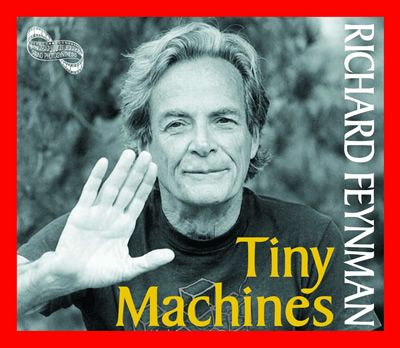
Although some have questioned the degree to which Feynman influenced the rise of nanotechnology, his lecture is still seen as a seminal event in the short history of the nano field. It’s important enough that, 25 years later, Feynman was invited to give an updated version of “There’s Plenty of Room at the Bottom” at a weeklong seminar held at the Esalen Institute in October, 1984. This time around, he called his talk “Tiny Machines.” And while sticking close to the 1959 script, Feynman’s revised lecture shows what technological advances had been made since he first outlined his vision for a nano world. You can watch the full 79 minute talk above. 

Finally, since we’re talking about things nano, let me leave you with this — Stephen Fry’s 2010 primer on nanoscience. Produced in partnership with Cambridge University, NANO YOU was named the best short film at the Scinema Science Film Festival and it does a pretty good job of explaining the nano world in 17 short minutes.

sábado, 30 de junio de 2012

Richard Feynman - The Pleasure Of Finding Things Out


The Pleasure of Finding Things Out was filmed in 1981 and will delight and inspire anyone who would like to share something of the joys of scientific discovery. Feynman is a master storyteller, and his tales -- about childhood, Los Alamos, or how he won a Nobel Prize -- are a vivid and entertaining insight into the mind of a great scientist at work and play.

In this candid interview Feynman touches on a wide array of topics from the beauty of nature to particle physics. He explains things that are hard to grasp in layman's terms much like Carl Sagan did in the cosmos series. His explanation of the scientific method covers what we know, why we know it and most importantly, what we don't know and the pleasure of figuring it out.

Professor Sir Harry Kroto, Nobel Prize for Chemistry said "The 1981 Feynman Horizon is the best science program I have ever seen. This is not just my opinion -- it is also the opinion of many of the best scientists that I know who have seen the program... It should be mandatory viewing for all students whether they be science or arts students."