Mostrando entradas con la etiqueta Cuántica. Mostrar todas las entradas

lunes, 8 de julio de 2013

Quantum computing: The next information revolution

ORIGINAL: AAAS
Author: Freelance Writer Brad Hooker
November 16, 2012

An artist's conception of an array of spin qubits based on subatomic nuclear memory. (Illustration by Peter Allen, courtesy of David Awschalom, UCSB)
Curiosity drives humanity. When confronted with a new phenomenon, we are compelled to search for understanding. We can then control the science with new technologies, making life easier. This, says AAAS fellow Raymond Laflamme, grants us time to be curious.

In the rapidly evolving field of quantum computing, curiosity over the last hundred years has driven scientists to the brink of controlling this once exotic world.

Quantum computers, with the capacity to complete in an instant calculations that a classical computer with all the time and energy in the universe could never solve, will propel the next information revolution. Yet the concept of quantum computing is young and, so far, no scientist can predict with certainty when that revolution will occur.

For one AAAS fellow and his team of researchers, the missing tool to jump-start this revolution may be found in diamonds.

The subatomic ocean

Observations and theories in quantum mechanics have led to stories of subatomic particles breaking all known laws of classical physics, essentially walking through walls, teleporting across vast distances and traveling back in time.

Quantum particles can occupy two states at the same time. Incredibly sensitive, their characteristics change in the simple process of observing them. Yet in measuring the interactions of particles with higher mass, experimenters can calculate minute energy fluctuations, allowing a better understanding of this quantum soup.

Quantum mechanics tells you that the quantum [computing] bit or the quantum coin can be both tails and heads at the same time. And this is really changing how the world works,” says Laflamme, the executive director of the University of Waterloo’s Institute for Quantum Computing.

An early scientist to envision a computing system to harness the nature of quantum physics, Richard Feynman, a renowned physicist and mathematician, suggested in 1982 that the strange ability of quantum particles to occupy multiple states—known as superposition—would theoretically allow for parallel calculations. The idea presented a method far more efficient for solving certain problems than the linear factoring system of classical computing that is based on 1s and 0s.

We already have the technology to harness a small part of the quantum world. That’s what lasers are and that’s what magnetic resonance imaging is,” says Laflamme. “We want to go further than this and there’s quite a big ocean. So now that we have dipped our big toe in the water of the ocean of the quantum world, we try to go deeper.

Yet this pursuit has been obstructed by defects found in the nanostructures of traditional computers – imperfections magnified exponentially on the quantum scale. This led physicists in the field to scoff at the idea of being able to contain and control these particles.

In five years – a comparative leap in the long history of quantum research – that thinking changed.

So all of the work culminated in roughly the year 2000 in what is called the accuracy threshold theory,” says Laflamme. “In other words, it says that in principal imprecision and imperfection of a realistic device can be controlled.

And with control came new technologies.

One in a sea of particles

Every two years the number of transistors on a computer chip doubles, according to the famous observation known as Moore’s Law. In shrinking the size of transistors, processor manufacturers can fit more computing power into a smaller space, enabling new technologies like smart phones and ultralight laptops. Yet these electron transistors can only be so small before fans can no longer cool them. The end result is overheating and melting.

Most of the world of technology has really focused on making very clean and perfect types of material of nanostructures,” says University of California, Santa Barbara physicist and AAAS Fellow David Awschalom. “Oddly enough it’s the defects in certain materials that can very strongly attract one electron and hold it there in a very convenient way.

One such material is diamonds.

Rather than being plucked from the earth, this type of diamond is synthesized in a lab: chemical vapors deposit single crystal fillings to make a strand large enough to be applied in experiments.

The defects in the diamonds – the missing atoms – trap the electrons, allowing Awschalom and his team to study these particles and the interference on their spins that is created by other particles, by other spins, by molecules and a number of other interactions. The scientists can also manipulate the spin of the particle using ultra high frequency circuits.

The spin direction, in this way, counts as a point of memory. Through superposition, multiple points of memory can be recorded. Each of these particles represents a single quantum bit, or qubit. By lining up about 20 to 50 qubits, scientists can perform searching and sorting algorithms – the equivalent of matching a single phone number in a New York City phone book.

What’s been interesting about systems like diamonds is that all of these physics and dynamics work on the desktop,” says Awschalom in explaining how this material eliminates the need for supercooling. “So it’s made very accessible to a lot of scientists, including ourselves.”

Beyond the information horizon

In 1994, Laflamme faced a growing concern in the field he studied then, quantum cosmology. How could you factor in the distribution of the universe when so much quantum noise is interfering with every interaction of every particle? Quantum computing, as it turned out, was dealing with the same hurdle. To better understand this issue, Laflamme’s mentor sent him to a conference that year on quantum computing. As it turns out, this became the catalyst for Laflamme’s sudden emergence into this growing field.

The speaker, a professor at the Massachusetts Institute of Technology, was Peter Shor.

This is a mathematician who proved that in principle a computer based on the laws of quantum physics could factor large numbers, which is the basis of all our cryptography,” says AAAS Fellow Steve Rolston, co-director of the University of Maryland’s Joint Quantum Institute.

Shor’s algorithm predicted that a quantum computer could find all the prime factors of a given integer and it could do it far faster than a classical computer ever could. Over night the encryption method for banking systems, online shopping and myriad other code-based networks, became immensely vulnerable. The fact that it was impossible to factor large numbers in this way now stood in doubt.

Suddenly the attention came to the NSA (National Security Agency),” recalls LaFlamme. “And then they started to say, ‘Is that really true? Is that guy Peter Shor a crank or is he a real scientist?’” If all the encryption the intelligence agency has been using will now be in jeopardy, he says, they want to know when it will happen – when a functioning quantum computer will be built.

With the subsequent boon in funding for quantum research, scientists from an assortment of fields grew fascinated with this emerging science.

You always hear people talk about interdisciplinary things all the time and sometimes it’s just a buzz word,” says Rolston. “But here it’s really true – physicists of varying types, computer scientists and mathematicians. It’s intellectually stimulating.

The field is now redefining what information is and how it will be delivered.

The information revolution was really a quantum revolution because all our electronics are based on the laws of quantum mechanics, the semiconductors, the transistors, etc.,” says Rolston. “So now what we’re trying to do is see if we can’t do that again, but using those other aspects of quantum mechanics that haven’t been exploited so far. The sky’s the limit in some sense.

The first likely technology to result from the manipulation of sensitive quantum states will be sensors. In fields like chemistry and biology this could lead to extraordinary advances in imaging the nuclear structure of proteins, changing the way pharmaceuticals are designed.

In time, a machine to capture the immense information capacities of the mysterious quantum frontier may one day fit inside a shirt pocket and will enable humanity to build technologies that top scientists in the field have yet to dream up.

Once we have quantum computers we’ll have harnessed the quantum world,” says Laflamme. “We’ll be swimming in it in kind of a backstroke. Anything we want to do we’ll be able to do it. It’s our holy grail, quantum computing.”

Related Links:
Raymond Laflamme and the potential of quantum computers


miércoles, 3 de julio de 2013

Scientists Confirm D-Wave's Computer Chips Compute Using Quantum Mechanics

ORIGINAL: IEEE Spectrum
By Jeremy Hsu
Posted 3 Jul 2013 | 18:05 GMT

Photo: Steve Cohn/USC News
A strategy of "show, don't tell" for quantum computing seems to be paying off for Canadian company D-Wave. The latest validation for D-Wave's quantum computer claims comes from a paper published in the June 28 edition of the journal Nature Communications.

Testing of the D-Wave chip—housed at the USC-Lockheed Martin Quantum Computing Center—suggested that the device does use quantum mechanics to solve optimization problems. Once quantum computers scale up to have enough processing power, they could prove much faster than classical computers in tackling certain problems, according to the new paper.

"Our work seems to show that, from a purely physical point of view, quantum effects play a functional role in information processing in the D-Wave processor," says Sergio Boixo, a researcher who led the study while he was a research assistant professor in computer science at the University of Southern California, in a press release.

Most research labs have only succeeded in building quantum computing processors with just a few quantum bits (qubits). Unlike classical computing bits that exist as either a 1 or 0, qubits can exist in multiple states at the same time due to the strange rules of quantum physics that dominate reality at very small scales.

That's why D-Wave initially drew skepticism for claiming to have built quantum processors with hundreds of qubits. But rather than follow research labs in trying to build general-purpose quantum computers, D-Wave has developed specialized quantum annealing devices for solving optimization problems.

The Canadian company has slowly won over some critics by giving independent researchers access to its D-Wave machines and inviting them to test its claims. One such test revealed that D-Wave machines could already beat classical computers in solving certain optimization problems.

D-Wave has also attracted notable tech giants as its first commercial customers. The company made its first commercial sale to Lockheed Martin in 2011, and has sold a second chip to Google for future installation at NASA's Ames Research Center in Moffett Field, California.

Members of the University of California team previously published a paper about D-Wave's quantum computing device on the arXiv preprint server in April. Their new paper in Nature Communicationsa test of a D-Wave "Rainier" chip with 108 functional qubits—may give former skeptics fresh hope that quantum computing has, in fact, become a reality.

The USC team has barely paused for breath in its race to study quantum computing. USC's Quantum Computing Center received an upgrade to a new 512-qubit "Vesuvius" chip two months ago—the next machine up for a test drive.

viernes, 17 de mayo de 2013

NASA And Google Partner To Work With A D-Wave Quantum Computer

NASA And Google Partner To Work With A D-Wave Quantum Computer
ORIGINAL: FORBES
Alex Knapp. Forbes Staff 
5/16/2013

D-Wave 512-Qubit Bonded Processor - Recent Generation (Credit: D-Wave)

D-Wave, the Canadian-based company that is the first to offer a commercial quantum computer, announced today that it’s sold its second $10 million D-Wave Two system. The contract is between the Universities Space Research Association and D-Wave. Google, USRA, and NASA will be collaborating on the use of the machine.

The system will be installed at a new lab, which will be located at NASA’s Ames Research Center. The computer is expected to go online in the third quarter of 2013. In addition to the sale, D-Wave will also be providing ongoing services such as maintenance. The company also expects to work closely with NASA, Google and USRA on the system.

Lockheed Martin Installs Quantum Computer 


Jeff Bezos And The CIA Invest In D-Wave's Quantum Computer


D-Wave Adds Two Silicon Valley Vets To Its C-Suite 


“I expect this to be a collaboration,” D-Wave’s U.S. President Bo Ewald told me. “Some of our scientists, mathematicians and computer scientists will be working at the Center.


Prior to selecting the contract with D-Wave, the partnership first conducted a series of benchmarks on the 512-qubit D-Wave Two system, and found that its specifications were met or exceeded. The computer will be upgraded to a 2,048 qubit system once D-Wave has perfected that chip.

It’s important to note that the D-Wave system is not a general computer like your PC. Rather, it’s optimized to solve particular types of problem, and it likely uses quantum effects to solve those problems.

(Whether the D-Wave system uses a quantum process for its computation has been a matter of hot dispute in academia. However, recent research by a USC team working with Lockheed Martin LMT -0.05%‘s D-Wave system appears to show that there are, indeed, quantum effects happening with the system. Whether those quantum effects produce a “speedup” – that is, computation faster than classical methods – is still an open question.)

The laboratory at Ames will be using the D-Wave System for a number of applications, but they’ll be focused on improving algorithms that are used to improve machine learning and artificial intelligence. The lab will also investigate whether the system can optimize the search for planets outside of our solar system.

We hope it helps researchers construct more efficient, effective models for everything from speech recognition, to web search, to protein folding,” Google said in a statement.

Under the terms of the agreement, 20% of the usage of the computer will be granted to University research. Research teams will compete to have their proposal use the machine selected. Once they’ve passed through that selection process, however, they’ll be granted use of the system free of charge.

For his part, Ewald is pretty excited about this step for the fledgling company. “For a company that’s just starting out, having Lockheed Martin as our first customer, then Google and NASA as number two? Well, that’s just a great way to start.

Update: An earlier version of this article indicated that NASA had partnered to purchase the D-Wave System. A NASA spokesperson clarified that while NASA is partnered with Google and USRA to use the system, NASA is “not purchasing or leasing it”.

lunes, 25 de marzo de 2013

Nanowire solar cells raises efficiency limit


Scientists from the Nano-Science Center at the Niels Bohr Institut, Denmark and the Ecole Polytechnique Fédérale de Lausanne, Switzerland, have shown that a single nanowire can concentrate the sunlight up to 15 times of the normal sun light intensity. The results are surprising and the potential for developing a new type of highly efficient solar cells is great.
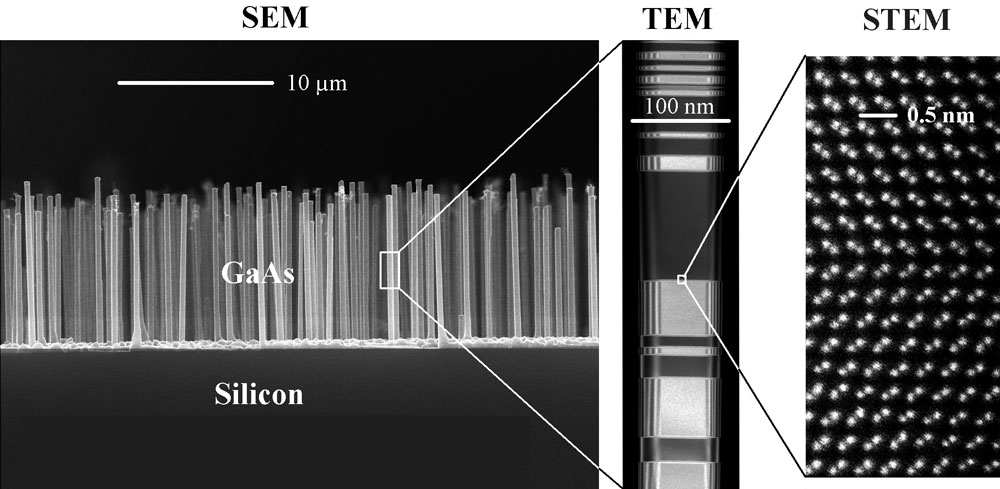
Nanowire crystals used as the solar cells. SEM (Scaning Electron Microscope) image of GaAs nanowire crystal grown on a Silicon substrate
- Due to some unique physical light absorption properties of nanowires, the limit of how much energy we can utilize from the sun's rays is higher than previous believed. These results demonstrate the great potential of development of nanowire-based solar cells, says PhD Peter Krogstrup on the surprising discovery that is described in the journal Nature Photonics.

The research groups have during recent years studied how to develop and improve the quality of the nanowire crystals, which is a cylindrical structure with a diameter of about 10,000 part of a human hair. The nanowires are predicted to have great potential in the development not only of solar cells, but also of future quantum computers and other electronic products.

- It turns out that the nanowires naturally concentrate the sun's rays into a very small area in the crystal by up to a factor 15. Because the diameter of a nanowire crystal is smaller than the wavelength of the light coming from the sun it can cause resonances in the intensity of light in and around nanowires. Thus, the resonances can give a concentrated sunlight, where the energy is converted, which can be used to give a higher conversion effeciency of the sun's energy, says Peter Krogstrup, who with this discovery contributes to that the research in solar cell technology based on nanowires get a real boost.
The figure shows that the sun's rays are drawn into a nanowire, which stands on a substrate. At a given wavelength the sunlight is concentrated up to 15 times. Consequently, there is great potential in using nanowires in the development of future solar cells. (credit: Niels Bohr Institute)

New efficiency limit
The typical efficiency limit - the so-called "Shockley-Queisser Limit" - is a limit, which for many years has been a landmark for solar cells efficiency among researchers, but now it seems that it may be increased.

- It's exciting as a researcher to move the theoretical limits, as we know. Although it does not sound like much, that the limit is moved by only a few percent, it will have a major impact on the development of solar cells, exploitation of nanowire solar rays and perhaps the extraction of energy at international level. However, it will take some years years before production of solar cells consisting of nanowires becomes a reality, says Peter Krogstrup who just completed his PhD at the Niels Bohr Institute, University of Copenhagen.

The research is conducted in collaboration with the Laboratory des Matériaux Semiconducteurs, Ecole Polytechnique Fédérale de Lausanne, the Foundation and the company SunFlake A / S. Their scientific findings work support results published in the journal Science in January. Here, a group of researchers from Lund, showed that the sun’s rays was sucked into the nanowires due to the high amount of power that their solar cell produced.

Article in Nature Photonics >>

miércoles, 10 de octubre de 2012

Nobel de Física 2012: Serge Haroche y David J. Wineland

ORIGINAL: La Vanguardia
Josep Corbella. Barcelona
09/10/2012


El francés Serge Haroche y el estadounidense David Wineland han ganado el premio por sus investigaciones pioneras


Imagen de los dos ganadores del Nobel de Física. A la izquierda, el científico francés Serge Haroche, y a la derecha el investigador estadounidense David Wineland Afp / Efe
El científico francés Serge Haroche y el estadounidense David Wineland han ganado el premio Nobel de Física por sus investigaciones pioneras en el campo de la óptica cuántica.

Los premiados han abierto la vía a una nueva era de experimentación en la física cuántica al demostrar la observación directa de partículas cuánticas individuales sin destruirlas”, destaca la Real Academia de Ciencias de Suecia en el comunicado en que anuncia los premios Nobel.

Sus descubrimientos han sentado las bases de la actual investigación fotónica, que aprovecha las propiedades de las partículas de la luz (los fotones) para crear nuevas tecnologías y profundizar en la comprensión de las leyes físicas. Entre los avances que se han derivado de esta línea de investigación, la academia sueca destaca los ordenadores cuánticos ultrarrápidos y los relojes cuánticos ultraprecisos.

Haroche, de 68 años, es profesor del Collège de France y de la École Normale Supérieure en París. Wineland, también de 68 años, es físico del Instituto Nacional de Estándares y Tecnología (NIST) en Boulder (Colorado, EE.UU.). Ambos compartirán los 8 millones de coronas suecas (unos 900.000 euros) del premio.

Trabajando de manera independiente, Wineland y Haroche consiguieron un hito que se consideraba inalcanzable: manipular partículas individuales sin que se perdieran sus propiedades cuánticas. Wineland lo consiguió utilizando fotones para inmovilizar átomos con carga eléctrica (iones) y estudiar sus propiedades. Haroche lo consiguió utilizando la estrategia opuesta: utilizó átomos para inmovilizar fotones y estudiar sus propiedades.

Antes de que Wineland y Haroche presentaran estos avances, no era posible investigar experimentalmente las propiedades cuánticas de las partículas. Tampoco era posible desarrollar nuevas tecnologías basadas en estas propiedades.

Dado que las partículas individuales pierden sus propiedades cuánticas en cuanto interactúan con su entorno, las investigaciones se veían limitadas a trabajos teóricos hasta que Wineland y Haroche lograron capturarlas y estudiarlas una a una.

Sus métodos innovadores han permitido hacer los primeros pasos hacia la construcción de un nuevo tipo de ordenador superrápido basado en la física cuántica”, destaca la academia sueca. Fue el propio Wineland quien demostró por primera vez que era posible hacer operaciones de computación con bits cuánticos (o qubits). Aunque estas operaciones se han limitado hasta ahora a unos pocos qubits, “no hay motivo para pensar a priori que no sea posible conseguir estas operaciones con muchos más qubits. El ordenador cuántico, según la academia sueca “tal vez cambiará nuestra vida diaria de un modo tan radical como el ordenador clásico la cambió en el siglo pasado”.

También Wineland construyó un reloj cuántico cien veces más preciso que los relojes atómicos de cesio que se utilizan actualmente para medir el tiempo. Su precisión es tan alta que, si se hubiera puesto en marcha al principio del tiempo hace 13.700 millones de años, cuando se produjo el big bang, hoy día sólo estaría desfasado por cinco segundos.

martes, 31 de julio de 2012

9 Scientists Receive a New Physics Prize

ORIGINAL: NYTimes
Published: July 31, 2012

Physicists are rarely wealthy or famous, but a new prize rewarding research at the field’s cutting edges has made nine of them instant multimillionaires. 

Simon Dawson/Bloomberg News.
Yuri Milner
The nine are recipients of the Fundamental Physics Prize, established by Yuri Milner, a Russian physics student who dropped out of graduate school in 1989 and later earned billions investing in Internet companies like Facebook and Groupon.

It knocked me off my feet,” said Alan H. Guth, a professor of physics at the Massachusetts Institute of Technology who was among the winners. He came up with the idea of cosmic inflation, that there was a period of extremely rapid expansion in the first instant of the universe.

When he was told of the $3 million prize, he assumed that the money would be shared among the winners. Not so: Instead, each of this year’s nine recipients will receive $3 million, the most lucrative academic prize in the world. The Nobel Prize currently comes with an award of $1.2 million, usually split by two or three people. The Templeton Prize, which honors contributions to understanding spiritual dimensions of life, has been the largest monetary award given to an individual, $1.7 million this year.

The $3 million has already appeared in Dr. Guth’s bank account, one that had had a balance of $200. “Suddenly, it said, $3,000,200,” he said. “The bank charged a $12 wire transfer fee, but that was easily affordable.

Mr. Milner said that he wanted to recognize advances in delving into the deepest mysteries of physics and the universe. “This intellectual quest to understand the universe really defines us as human beings,” he said.

Four of the physicists work at the Institute for Advanced Study in Princeton, N.J.: Nima Arkani-Hamed, Juan Maldacena, Nathan Seiberg and Edward Witten. They work on theories trying to tie together the basic particles and forces of the universe, particularly with a mathematical machinery known as string theory.

The other winners are Andrei Linde, a physicist at Stanford who also worked on cosmic inflation; Alexei Kitaev, a professor of physics at the California Institute of Technology who works on quantum computers; Maxim Kontsevich, a mathematician at the Institute of Advanced Scientific Studies outside Paris whose abstract mathematical findings proved useful to physicists unraveling string theory; and Ashoke Sen, a string theorist at Harish-Chandra Research Institute in India.

Mr. Milner personally selected the inaugural group, but future recipients of the Fundamental Physics Prize, to be awarded annually, will be decided by previous winners.

He declined to explain in detail how he selected which accomplishments to honor or why all of the winners are men. “I truly see this as a start,” Mr. Milner said. “Going forward, it’s going to be up to the committee to make those considerations.

According to the rules, the prize in future years may be split among multiple winners, and a researcher will be able to win more than once. Mr. Milner also announced that there would be a $100,000 prize to honor promising young researchers.

Unlike the Nobel in physics, the Fundamental Physics Prize can be awarded to scientists whose ideas have not yet been verified by experiments, which often occurs decades later. Sometimes a radical new idea “really deserves recognition right away because it expands our understanding of at least what is possible,” Mr. Milner said.

Dr. Arkani-Hamed, for example, has worked on theories about the origin of the Higgs boson, the particle thought to have been discovered recently at the Large Hadron Colliderin Switzerland, and about how that collider could discover new dimensions. None of his theories have been proved yet. He said several were “under strain” because of the new data.

Several of the winners said they hoped that the new prize, with its large cash award, would help raise recognition of physics and draw more students into the field. “It’ll be great to have this sort of showcase for what’s going on in the subject every year,” Dr. Arkani-Hamed said.

The winners said they had not yet decided what to do with their windfall.

There are some rather mundane things, like paying out the mortgage,” said Mr. Kitaev, who added that he was thinking about putting some of the money into education efforts.

My success is in large part due to good education, my teachers and the atmosphere of excitement in science when I grew up,” he said. “I might try to help restore this atmosphere as much as I can.

Dr. Guth agreed. “I do think prizes like this help put across to the public that fundamental physics is important, and it’s not just heavyweight boxing that’s worthy of prizes,” he said.

But he was going to warn his students not to get the wrong idea. “Certainly, it’s still not a great idea to go into physics for the money,” he said.


This article has been revised to reflect the following correction:

Correction: August 1, 2012
An article on Tuesday about the new Fundamental Physics Prize misattributed a quotation by a winner about how he would spend the $3 million in prize money. It was Alexei Kitaev, a professor of physics at the California Institute of Technology — not Maxim Kontsevich, a mathematician at the Institute of Advanced Scientific Studies outside Paris who is among the eight other prizewinners — who said, in part, “There are some rather mundane things, like paying out the mortgage.” The article also gave an outdated amount for the monetary award to winners of the Nobel Prize. The prize was reduced this year to about $1.2 million, from about $1.5 million.

jueves, 26 de enero de 2012

Video con billones de imágenes por segundo

ORIGINAL: MIT
Larry Hardesty, Oficina de Noticias, MIT
13 de diciembre 2011

Mediante el uso de equipos ópticos de una manera totalmente inesperada, los investigadores del MIT han creado un sistema de imagen que hace ver lenta la luz.

Investigadores del MIT han creado un nuevo sistema de imágenes que se pueden obtener datos visuales a un ritmo de un billón de exposiciones por segundo. Eso es lo suficientemente rápido como para producir un video en cámara lenta de una explosión de luz que viaja a lo largo de una botella de un litro, rebotando en la tapa y que se refleja de nuevo al fondo de la botella.

Media Lab postdoc Andreas Velten, uno de los desarrolladores del sistema, lo llama lo "último" en cámara lenta: "No hay nada en el universo que sea rápido para  la cámara", dice.

Video: Melanie Gonick

El sistema se basa en una tecnología reciente llamada cámara por tramos, aplicada de una manera totalmente inesperada. La apertura de la cámara por tramos es una ranura estrecha. Las partículas de luz - fotones - entrar en la cámara a través de la hendidura y se convierten en electrones, que pasan a través de un campo eléctrico que los desvía en una dirección perpendicular a la ranura. Debido a que el campo eléctrico está cambiando muy rápidamente, desvía los electrones correspondientes a los fotones-que llegan más tarde de los correspondientes a los primeros que llegan.

La imagen obtenida por la cámara es, pues, dos dimensiones, pero sólo una de las dimensiones - la correspondiente a la dirección del corte - es espacial. La otra dimensión, que corresponde al grado de desviación, es el tiempo. La imagen representa, pues, el momento de la llegada de los fotones que pasan a través de una porción de una dimensión del espacio.

La cámara fue diseñado para ser utilizada en experimentos donde la luz pasa a través o se emite por una muestra de productos químicos. Dado que los químicos están interesados ​​principalmente en las longitudes de onda de luz que absorbe una muestra, o en la forma en la intensidad de los cambios de la luz emitida a través del tiempo, el hecho de que la cámara registra sólo una dimensión espacial es irrelevante.

Pero es un serio inconveniente en una cámara de vídeo. Para producir sus videos de super-cámara lenta, Velten, Media Lab Profesor Ramesh Raskar y Moungi Bawendi, el profesor de Química Lester Wolfe, deben realizar el mismo experimento - como pasar un pulso de luz a través de una botella - una y otra vez, continuamente reposicionamiento de la cámara por tramos para construir poco a poco una imagen de dos dimensiones. Sincronizando la cámara y el láser que genera el pulso, por lo que el tiempo de cada exposición es el mismo, requiere una batería de equipos ópticos sofisticado y exquisito control mecánico. Se tarda sólo un nanosegundo - una mil millonésima de un segundo - para que la luz se disperse a través de una botella, pero se necesita una hora para recoger todos los datos necesarios para el video final. Por esa razón, Raskar llama al nuevo sistema "la cámara más rápida y más lenta en el mundo."

Haciendo cuentas
Después de una hora, los investigadores se acumulan cientos de miles de conjuntos de datos, por cada uno de los tramos que corresponden a las posiciones de una dimensión de fotones en contra de su tiempo de llegada. Raskar, Velten y otros miembros del Grupo de Cultura de la Cámara de Raskar  en el Media Lab han desarrollado unos algoritmos que puede unir los datos en bruto en una serie secuencial de imágenes en dos dimensiones.

La cámara por tramos y el láser que genera los pulsos de luz - ambos dispositivos de última generación con un precio acumulado de 250.000 dólares - fueron suministrados por Bawendi, un pionero en la investigación sobre puntos cuánticos: pequeños, racimos de partículas de semiconductores emisores de luz que tienen potencial aplicaciones en
  • computación cuántica, 
  • video-tecnología de pantalla, 
  • imágenes biológicas, 
  • células solares y 
  • una serie de otras áreas.
Media Lab postdoc Andreas Velten, a la izquierda, y Profesor Asociado Ramesh Raskar con el montaje experimental que utilizan para producir video en cámara lenta de la dispersión de la luz a través de una botella de plástico. Foto: M. Scott Brauer
El  sistema de imágenes de billones de marcos por segundo, que los investigadores han presentado tanto en la Conferencia sobre Registro y Detección Computacional de Imágenes Ópticas de la Optical Society y en Siggraph, es un spin-off de otro proyecto de Cultura de Cámara, una cámara que puede ver en las esquinas. Esa cámara hace rebotar la luz en una superficie reflectante - por ejemplo, la pared de enfrente de una puerta - y midiendo el tiempo que tarda fotones diferentes a regresar. Sin embargo, aunque ambos sistemas utilizan ráfagas ultracorto de luz láser y cámaras por tramos, la disposición de sus otros componentes ópticos y sus algoritmos de reconstrucción se adaptan a sus tareas dispares.

 Video en cámara lenta de la dispersión de la luz a través de una botella de plástico

Debido a que el sistema ultrarrápido de imágenes requiere de varios pasos para producir sus videos, no puede registrar los eventos que no son exactamente repetibles. Aplicaciones prácticas supondrán probablemente los casos en que la forma en que se dispersa la luz - o rebota cuando golpea superficies diferentes - que es en sí misma una fuente de información útil. Hay casos, sin embargo, pueden incluir el análisis de la estructura física de los materiales de fabricación y los tejidos biológicos - "como el ultrasonido con luz", como lo propone Raskar.

Como investigador cámara durante mucho tiempo, Raskar también ve una aplicación potencial en el desarrollo de mejores flashes de cámaras "Un sueño es, ¿cómo se puede crear iluminación como de estudio a partir de un Flash? ¿Cómo puedo llevar una cámara portátil que tiene un flash pequeño y crear la ilusión de que tengo todos estos paraguas, y las luces deportiva, y así sucesivamente ", pregunta Raskar, profesor asociado para el Desarrollo la Carrera de Artes y Ciencias Mediáticas de NEC. "Con nuestras imágenes ultrarrápidas, en realidad podemos analizar cómo los fotones viajan a través del mundo. Y luego puede volver a crear una nueva foto, creando la ilusión de que los fotones salieron de otro lugar. "

"Es un trabajo muy interesante. Estoy muy impresionado ", dice Nils Abramson, un profesor de holografía aplicada en el Royal Suecia Institute of Technology. A finales de 1970, Abramson fue pionero en una técnica llamada holografía de luz durante el vuelo, que finalmente demostró ser capaz de capturar imágenes de las ondas de luz a un ritmo de 100 mil millones fotogramas por segundo.

Sin embargo, como señala Abramson, su técnica requiere de luz coherente llamada, lo que significa que las depresiones y crestas de las ondas de luz que produce la imagen que se alinean unos con otros. "Si sucede que se destruye la coherencia cuando la luz pasa a través de diferentes objetos, entonces no funciona", dice Abramson. "Así que creo que es mucho mejor si usted puede usar la luz ordinaria, como Ramesh".

De hecho, Velten dice: "Como los fotones rebotan en los objetos de la escena o en el interior, pierden la coherencia. Sólo un método de detección incoherentes como el nuestro pueden ver los fotones" Y los fotones, dice Velten, podría dejar que los investigadores "aprendieran más acerca de las propiedades del material de los objetos, sobre lo que está bajo su superficie y sobre el diseño de la escena. Porque podemos ver los fotones, podríamos utilizarlos para observar el interior de los objetos - por ejemplo, para las imágenes médicas, o para identificar los materiales ".

"Estoy sorprendido de que el método que hemos estado utilizando no haya sido más popular", añade Abramson. "Me he sentido bastante solo. Estoy muy contento de que alguien está haciendo algo similar. Porque creo que hay muchas cosas interesantes para encontrar cuando usted pueda hacer este tipo de estudio de la luz en sí misma. "

Visualización de fotones en movimiento en un billón de fotogramas por segundo


Vídeo de una fruta iluminado por un pulso láser de femtosegundo y capturaron a billones de cuadros por segundo efectivos. La luz se mueve a menos de 1 mm por cuadro.

Hemos construido una solución de imagen que permite visualizar la propagación de la luz a una tasa efectiva de un billón de marcos por segundo. La grabación directa de la luz en una frecuencia de imagen con el suficiente brillo es casi imposible. Utilizamos un método indirecta "estroboscópico" que combina millones de mediciones repetidas mediante el escaneo cuidadoso en el tiempo y los puntos de vista.

El dispositivo ha sido desarrollado por el grupo de Cultura de Cámara del Media Lab de MIT en colaboración con Bawendi Laboratorio en el Departamento de Química en el MIT. Un pulso de láser que dura menos de una billonésima de segundo se utiliza como un flash y la luz que vuelve de la escena es recogida por una cámara a una tasa equivalente a aproximadamente un billón fotogramas por segundo. Sin embargo, debido a los tiempos de exposición son muy cortos (alrededor de una billonésima de segundo) y un estrecho campo de visión de la cámara, el vídeo se captura durante varios minutos por muestreo repetido y periódico.