Mostrando entradas con la etiqueta Modular. Mostrar todas las entradas

martes, 28 de febrero de 2017

Microfluidic LEGO bricks put biomedical research in the hands of the masses


3D printed master molds have been used to create microfluidic LEGO bricks that facilitate the study of liquid flow for medical research. The LEGO brick method is being explored by the Department of Biomedical Engineering at the University of California, Irvine, with findings published in the Journal of Micromechanics and Microengineering, January 2017.

What is microfluidics?
Microfluidics is the manipulation and study of sub-microscopic litres of liquid. In a device such as the University of California’s LEGO bricks, liquids are channelled through empty vessels spanning no more than 500 μm (microns, for comparison: a human hair is 50 μm in diameter).
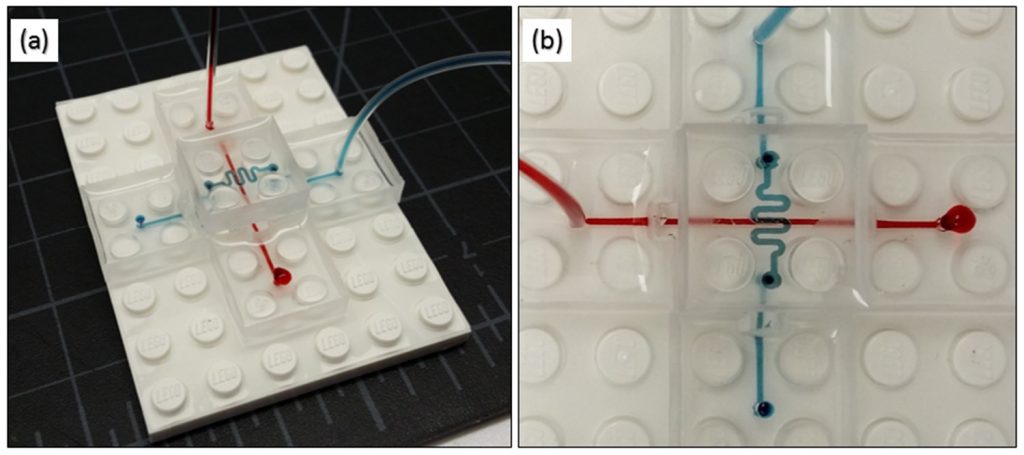
Testing the flow of liquids through the LEGO bricks with colored inks. Image via: Kevin Vittayarukskul and Abraham Phillip Lee

The way a liquid behaves during a flow, and when mixed with other nanoliquids tells researchers certain things about its biological behaviour, Microfludics can also be controlled in a way to produce autonomous movement, as in the example of Harvard University’s soft-robotic Octobot.


Moving .gif shows Harvard’s Octobot that harnesses microfluidic principles to move. Clip via: @NatureNews

In biomedical research microfluidic chips are used to conduct assays that test the reactions between substances, as in lab-on-a-chip technology. Using these devices is preferable to some traditional assay methods as the microscale parts consume less time and resources. California’s LEGO bricks seek to promote these qualities by providing more recognisable devices that are also capable of being mass produced.

Making the microfluidic LEGO bricks
Kevin Vittayarukskul and Professor Abraham Lee’s approach uses Autodesk’s AutoCAD software to first design blocks with an embedded microfluidic channel.

From this a mold is also designed, and then 3D printed on a Perfactory 3 Mini 3D printer by EnvisionTEC that uses the DLP method of vat polymerisation to cure the material. PDMS, (Polydimethylsiloxane) a silicone-based polymer is then used to cast the LEGO bricks.
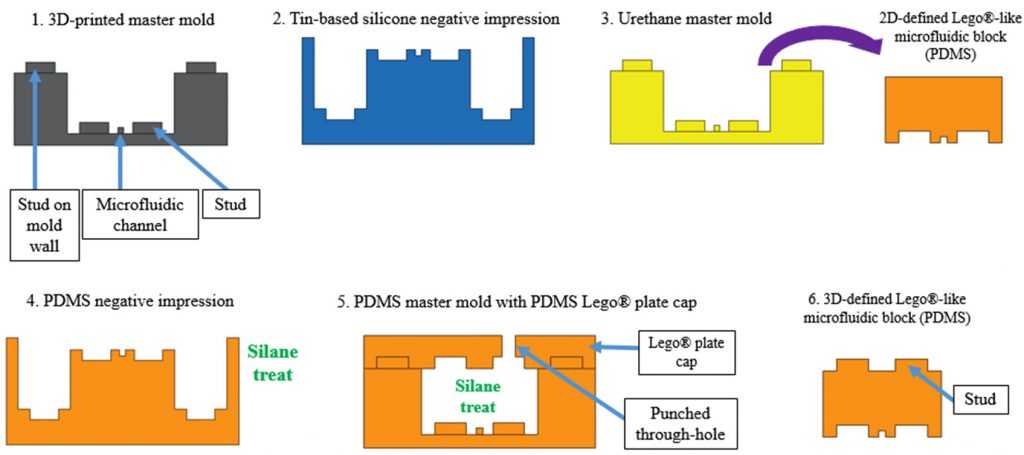
Process of making the microfluidic LEGO mold. Image via: Kevin Vittayarukskul and Abraham Phillip Lee

The properties of PDMS make it naturally transparent and biocompatible, which is ideal for this kind of research. It is also known for its ability to exactly match the shape of a cast into which it is poured, meaning that none of the DLP 3D printed quality is lost on the final cast.

A microfluidic LEGO kit?
The advantages of being able to stack the microfluidic blocks is that researchers can combine even more channels into a single space. It also allows easy assembly of varying channels, i.e. one straight vessel in to a winding one.

Using a tried and tested building block such as a LEGO brick also means that it has great potential for mass-production. The case with medical research is that it often isn’t accessible by other scholars that could make use of the technology. But a microfluidic LEGO kit could be just the ticket to encourage future biomedical research.

Speaking to EE Times Europe A truly LEGO®-like modular microfluidics platform co-author Professor Abraham Lee explains:
The main goal of this project was to train and educate the next generation of microfluidic developers and researchers. By using actual LEGO’s as the building block and assembly platform, our hope was to attract students as early as young as high schoolers to be interested in the field, learn about microfluidics and stimulate their imagination for new products for applications over a very wide range.
Testing the flow of liquids through the LEGO bricks with colored inks. Image via: Kevin Vittayarukskul and Abraham Phillip Lee


A truly Lego®-like modular microfluidics platform
Kevin Vittayarukskul
and Abraham Phillip Lee
  • Published 24 January 2017 • © 2017 IOP Publishing Ltd
Journal of Micromechanics and Microengineering, Volume 27, Number 3
Author e-mails
Author affiliations
  • Department of Biomedical Engineering, University of California, Irvine, CA, USA
Dates
  • Received 11 October 2016
  • Accepted 15 December 2016
  • Published 24 January 2017
Citation
  • Kevin Vittayarukskul and Abraham Phillip Lee 2017 J. Micromech. Microeng. 27 035004  
DOI: https://doi.org/10.1088/1361-6439/aa53ed

ORIGINAL: 3DPrintingIndustry

Beau Jackson Writer based in London, originally from Yorkshire. Fan of lab-on-a-chip technology, microfluidics, scanning, tech-inspired art and 3D Benchy.
January 25, 2017
 

martes, 18 de noviembre de 2014

Jellyfish Barge

The World Bank predicts that the world population will grow to almost 10 billion in the next four decades. By 2050, the global demand for food is expected to be 60-70% higher than today. Scarcity of water and cultivable land are the main obstacles to meet the quantitative and qualitative shifts of the world’s demand. Most of the potentially arable land is concentrated in a few geographical areas, and it is extremely scarce in many of the regions with high population growth rates, such as North Africa and the Arabian Peninsula. Agriculture is the human activity that relies most on the existing water resources. Currently in many parts of the world, such India, Pakistan and Southern Spain, the demand for water for agricultural purposes is satisfied by unsustainable methods such as over-extraction from underground reservoirs.

The scarcity of arable land and fresh water for agriculture is being exacerbated by changes in the climate, exposing many areas to increased risks and contribute to make them even more vulnerable to the problem of water and food security. The rising sea level, for example, contributes to flooding of extensive areas of fertile land with salt water. This phenomenon has already begun to occur with alarming frequency all over the Bay of Bengal.

Video by Studiomobile

Floating, self-sufficient cultivation module


© Matteo de Mayda 2014

Tackling these challenges in a holistic way can produce considerable improvement in water and food security of coastal communities. Jellyfish Barge is a module for crop cultivation that doesn’t rely on soil, fresh water and chemical energy consumption. Jellyfish Barge is a floating agricultural greenhouse, able to purify salt, brackish or polluted water using solar energy. Jellyfish Barge is built with low-cost technologies and simple materials, also appropriate to the self-construction paradigm. It consists of a wooden base of about 70 square meters that floats on recycled plastic drums and supports a glass greenhouse for crop cultivation.

Inside the greenhouse, a high-efficiency hydroponic cultivation method provides up to 70% of water savings compared to traditional hydroponic systems. The Jellyfish Barge has an innovative automated system with remote monitoring and control. Required water is supplied by 7 solar desalination units arranged around the perimeter that are able to produce up to 150 liters per day of clean fresh water from salt, brackish, or polluted water. Solar distillation is a natural phenomenon: in the seas, the sun’s energy evaporates water, which then falls as rain water.

The solar desalination system of the Jellyfish Barge replicates this phenomenon on a smaller scale, sucking in moist air and forcing it to condense within the drums in contact with the cold surface of the sea. The low energy required to power fans and pumps is provided by solar panels, mini wind turbines and an innovative system that exploits waves to produce electricity.


According to FAO, long-term successful strategies for agricultural development depend on technological innovation as well as on the ability of small farmers to be economic agents and to meet their own needs. Thus, Jellyfish Barge is novel in its ability to respond effectively with limited resources. For this reason it has been designed relatively small in size, capable of supporting two families, and is thus easy to build even in conditions with economic constraints. However, it is modular, so a single element is completely autonomous, while various flanked barges create a stronger and more resilient organism.


Jellyfish Barge comes from a project by Antonio Girardi and Cristiana Favretto (Studiomobille) called Jellyfish Farm. It exploits the seawater desalinization process to cultivate floating vegetable gardens. The installation is sort of “neo-nature”, where recycled objects become an autonomous living organism.


© Studiomobile 2010


Jellyfish Barge is also a new sustainable lifestyle.
© Pnat 2014

See above how it can be inproved!

ORIGINAL: PNAT

sábado, 3 de agosto de 2013

Researchers Create Versatile 3D Nanostructures Using DNA "Bricks"

ORIGINAL: Wyss Institute - Harvard
Nov 29, 2012 

Wyss Institute researchers have created more than 100 three-dimensional nanostructures using DNA building blocks that function like Lego® bricks. This animation illustrates the process used to build these structures.

New method greatly expands repertoire of nanobiotechnology applications in medicine and beyond.
Wyss Institute researchers have created more than 100 three-dimensional nanostructures using DNA building blocks that function like Lego® bricks. This video illustrates how DNA is used to build these structures.


Boston, MA -- Researchers at the Wyss Institute for Biologically Inspired Engineering at Harvard University have created more than 100 three-dimensional (3D) nanostructures using DNA building blocks that function like Lego® bricks -- a major advance from the two-dimensional (2D) structures the same team built a few months ago.

In effect, the advance means researchers just went from being able to build a flat wall of Legos®, to building a house. The new method, featured as a cover research article in the 30 November issue of Science, is the next step toward using DNA nanotechnologies for more sophisticated applications than ever possible before, such as "smart" medical devices that target drugs selectively to disease sites, programmable imaging probes, templates for precisely arranging inorganic materials in the manufacturing of next generation computer circuits, and more.
Computer-generated 3D models (left) and corresponding 2D projection microscopy images (right) of nanostructures self-assembled from synthetic DNA strands called DNA bricks. A master DNA brick collection defines a 25-nanometer cubic "molecular canvas" with 1000 voxels. By selecting subsets of bricks from this canvas, Ke et al. constructed a panel of 102 distinct shapes exhibiting sophisticated surface features as well as intricate interior cavities and tunnels. These nanostructures may enable diverse applications ranging from medicine to nanobiotechnology and electronics. [Image Credit: Yonggang Ke, Wyss Institute, Harvard University.]
The nanofabrication technique, called "DNA-brick self-assembly," uses short, synthetic strands of DNA that work like interlocking Lego® bricks. It capitalizes on the ability to program DNA to form into predesigned shapes thanks to the underlying "recipe" of DNA base pairs: A (adenosine) only binds to T (thymine) and C (cytosine) only binds to G (guanine).

Earlier this year, the Wyss team reported in Nature how they could create a collection of 2D shapes by stacking one DNA brick (42 bases in length) upon another.

But there's a "twist" in the new method required to build in 3D.
The trick is to start with an even smaller DNA brick (32 bases in length), which changes the orientation of every matched-up pair of bricks to a 90 degree angle -- giving every two Legos® a 3D shape. In this way, the team can use these bricks to build "out" in addition to "up," and eventually form 3D structures, such as a 25-nanometer solid cube containing hundreds of bricks. The cube becomes a "master" DNA "molecular canvas"; in this case, the canvas was comprised of 1000 so-called "voxels," which correspond to eight base-pairs and measure about 2.5 nanometers in size - meaning this is architecture at its tiniest.

The master canvas is where the modularity comes in: by simply selecting subsets of specific DNA bricks from the large cubic structure, the team built 102 3D structures with sophisticated surface features, as well as intricate interior cavities and tunnels. "This is a simple, versatile and robust method," says Peng Yin, Ph.D., Wyss core faculty member and senior author on the study.


The DNA-brick technique capitalizes on the ability of DNA strands to selectively attach to other strands, thanks to the underlying "recipe" of DNA base pairs. This animation shows how the DNA strands self-assemble to build a structure.  View Animation above

Another method used to build 3D structures, called DNA origami, is tougher to use to build complex shapes, Yin said, because it relies on a long "scaffold" strand of DNA that folds to interact with hundreds of shorter "staple" strands - and each new shape requires a new scaffold routing strategy and hence new staples. In contrast, the DNA brick method does not use any scaffold strand and therefore has a modular architecture; each brick can be added or removed independently.

"We are moving at lightning speed in our ability to devise ever more powerful ways to use biocompatible DNA molecules as structural building blocks for nanotechnology, which could have great value for medicine as well as non-medical applications," says Wyss Institute Founding Director Don Ingber, M.D., Ph.D.

The research team led by Yin, who is also an assistant professor of systems biology at Harvard Medical School (HMS), included Wyss Postdoctoral Fellow Yonggang Ke, Ph.D., and Wyss Graduate Student Luvena Ong. Another contributor was Wyss Core Faculty member William Shih, Ph.D., who also holds appointments at HMS and the Dana-Farber Cancer Institute. Visit Molecular-systems.net to learn more about the team's work.

The research was supported by the Office of Naval Research, the Army Research Office, the National Science Foundation, the National Institutes of Health, and the Wyss Institute for Biologically Inspired Engineering at Harvard University.

For more information, contact Kristen Kusek
Kristen.kusek@wyss.harvard.edu
+1 617-432-8266

###

About the Wyss Institute for Biologically Inspired Engineering at Harvard University
The Wyss Institute for Biologically Inspired Engineering at Harvard University (http://wyss.harvard.edu) uses Nature's design principles to develop bioinspired materials and devices that will transform medicine and create a more sustainable world. Working as an alliance among Harvard's Schools of Medicine, Engineering, and Arts & Sciences, and in partnership with Beth Israel Deaconess Medical Center, Brigham and Women's Hospital, Boston Children's Hospital, Dana Farber Cancer Institute, Massachusetts General Hospital, the University of Massachusetts Medical School, Spaulding Rehabilitation Hospital, Boston University and Tufts University, the Institute crosses disciplinary and institutional barriers to engage in high-risk research that leads to transformative technological breakthroughs. By emulating Nature's principles for self-organizing and self-regulating, Wyss researchers are developing innovative new engineering solutions for healthcare, energy, architecture, robotics, and manufacturing. These technologies are translated into commercial products and therapies through collaborations with clinical investigators, corporate alliances, and new start-ups. The Wyss Institute was recently awarded the prestigious World Technology Network award for innovation in biotechnology.

lunes, 21 de mayo de 2012