Mostrando entradas con la etiqueta Texas A-M. Mostrar todas las entradas

jueves, 13 de diciembre de 2012

Old Ocean Mold

ORIGINAL: The Scientist
By Beth Marie Mole
December 12, 2012

Fungi in 100 million year-old seafloor sediments could possess novel antibiotics.
microscopic image of Penicillium sp.Wikimedia, Y_tambe
Digging 127 meters below the Pacific Ocean floor, into 100 million year-old sediments, researchers have discovered flourishing fungi, including some that belong to the genus Penicillium—the source of penicillin. The discovery, reported last week (December 6) at the meeting of the American Geophysical Union in San Francisco, California, provides hope of finding novel antibiotics deep below the ocean, as well as understanding how life can thrive in such a nutrient-poor environment.

“[The study] extends what we understand about the limits of life on the planet,” molecular geo­microbiologist Heath Mills of the Texas A&M University in College Station, who studied the fungi, told Nature. Moreover, “this is adding a new family of potential drugs,” added biogeochemist Brandi Reese, of the University of Southern California in Los Angeles, who collaborated with Mills on the study.

The researchers isolated the fungi from sediments collected on a South Pacific drilling expedition in 2010. Back in the lab, they found genetic sequences from at least eight groups of fungi, and were able to grow four fungi from the sediments.

Mills and Reese hypothesize that the fungi may play critical roles in the deep-sea sediment ecosystems, such as deconstructing organic matter in the ancient sediment for other organisms to use. Moreover, the remote fungi may have evolved unique biological weapons—antibiotics—to defeat competing microbes in its unique environment. “What if this is a new version of penicillin?” Mills posed to Nature—one that may be effective against pathogens that have grown resistant to traditional antibiotics “That’s one of the benefits of going to the deep biosphere.”

viernes, 28 de septiembre de 2012

Why the Next UT-A&M Rivalry Could Be Fought in the Lab

ORIGINAL: NPR
SEPTEMBER 14, 2012 | 1:54 PM


PHOTO BY MOSE BUCHELE

UT Research Engineer Robert Pearsal looks into a vat of algae.

Two teams, racing against the clock. A long-standing rivalry that up til now has been played on the football field. And at the end, the prize: gooey, stinky algae.

While the University of Texas and Texas A&M University football teams no longer play each other after A&M left the Big 12 conference for the SEC (beginning their membership with a loss to Florida last Saturday), there is a new rivalry between the two campuses: who can make algae into a commercially-viable fuel fastest.

The specifics are well over our pay grade, involving words like microfluidic and B. Braunii. But suffice to say that the idea behind all this research is to create a fuel from algae that can be used in combustion engines.

At UT, as we reported in a story in December, the Open Algae team is hard at work trying to commercialize algae biofuels.

And at A&M they’re aiming to do the same.

A new report by Texas A&M Agrilife Today says that a team at the university may be within four years of a commercially-viable, fuel-grade algae oil.

“The team, with a combined expertise from agriculture to engineering, has received a $2 million National Science Foundation grant to help hasten the process,” Agrilife Today writes.

TEXAS AGRILIFE RESEARCH PHOTO BY KATHLEEN PHILLIPS

A team at A&M recently received a $2 million grant to find ways to make algae biofuels commercially viable.

One of the collaborators on the project is Dr. Tim Devarenne, a Texas A&M AgriLife Research biochemist and collaborator on the project. He says that one benefit of algae isn’t just that it’s renewable, but also that it’s much less carbon intensive. “If we harvest algae and process them into fuels, we don’t emit any excess carbon into the atmosphere that is currently being emitted from petroleum fossil fuels,” he tells Agrilife Today.

If all goes well, the A&M team could partner with industry to make algae fuel commercially viable.

“If we can produce an alga that produces high amounts of oil and grows fast,” Devarenne says, “an industry partner could grow large amounts of it, extract the oil, convert that oil into gasoline or diesel fuel and sell it just like at a normal gasoline pump.”

RELATED

POSTS

TOPICS


Algae can be grown using municipal wastewater, Devarenne says, or by using emissions from coal power plants. That means that carbon dioxide used to make algae fuel would come from existing carbon dioxide already in the atmosphere. The UT team has already produced biofuels from a sewage treatment plant outside of Austin.

And a recent study by UT found that it’s possible algae could produce 500 times more energy than it takes to grow. Oil and gas, by comparison, create 30 to 40 times as much energy as it takes to produce (i.e. drill) them, making algae potentially much more efficient to produce.

“Algae take CO2 out of the atmosphere to make the oil and then when we burn the oil as fuel, we just put that CO2 back into the atmosphere,” Devarenne tells Agrilife Today. “That is different from petroleum because the CO2 from petroleum has been stored underground for hundreds of millions of years and then we release that into the atmosphere when we burn fuels created from petroleum.”

lunes, 28 de mayo de 2012

Mims: Lack of bugs may be drought-related

ORIGINAL: My San Antonio
By Forrest M. Mims III, Express-News columnist
May 20, 2012

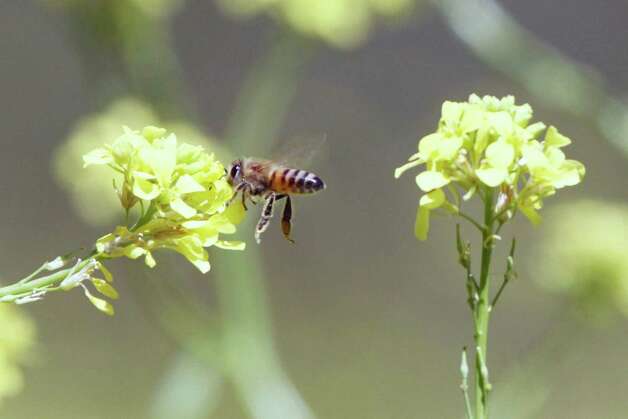
Whether due to colony collapse disorder, the drought or both, bees, such as this April visitor, are rare on the Mims place this spring. Photo: Forrest M. Mims III, For The Express-News / ALL RIGHTS RESERVED. 
By now myriad bees and exotic flies should be sipping nectar from wildflowers. Wasps, dragonflies and spiders should be prowling the landscape looking for dinner.

Where are these creatures and the critters that eat them?

There might be a normal population of insects and spiders in some areas, especially in cities and towns where lawns and gardens were watered during last summer's record drought. But there's a very obvious shortage of insects, spiders and lizards on our rural place.

Only two or three honeybees can be seen in 6-foot-square sections of Indian blanket wildflowers here. In a normal year, the count would be much higher. Bluebonnets require insects to pollinate their flowers, so I examined four patches of bluebonnets on our place. Only 53 per cent of their flower spikes produced seed pods.

So far this spring, only two carpenter bees have appeared where a dozen or more usually patrol the sky. Only one red wasp, two grasshoppers, several dragonflies and a few beetles, crickets and pill bugs have been observed during daily walks. Only one toad, several geckos and no other lizards have been seen around our house.

Some species have returned, apparently assisted by abundant winter rain. While no fireflies appeared during 2011, each evening a dozen or so can be seen flashing away at the edge the woods behind our house.

Last month, countless crane flies invaded portions of South Central Texas.

Butterflies are now in abundance.

Paul Schattenberg wrote about the effect of the 2011 drought on Texas insects in the June 14 issue of Agrilife Today, a Texas A&M publication.

Fire ant mounds are smaller, presumably because their builders are less active.

Another drought spin-off is that some creatures are moving into homes to find moisture and food. This includes scorpions, and that's certainly the case at our place.

A search of the Web for insect activity during droughts revealed that populations of some insects that attack crops and trees can increase during droughts.

There are also insect reports virtually identical to what I am observing. For example, a report by Edward Mawley about the 1898 drought in England summarized surveys by rural observers who found sharply reduced insect populations with very few wasps.

Spiders are beginning to return to our place, and this may signal an increase in the insect population.

It will be interesting to see what happens next, especially if the drought returns.

While it might seem good to have fewer bugs around, they form a vital link in nature's food chain. Many pollinate wildflowers, fruit trees and various vegetables.

Forrest Mims, an expert reviewer for the Intergovernmental Panel on Climate Change (IPCC), was named one of the 50 Best Brains in Science by Discover Magazine. His science is featured at www.forrestmims.org. Email him at forrest.mims@ieee.org.