Cone snails might not seem like deadly predators, especially when you consider how easily a fish could outswim them. However, these snails await the cover of darkness to prey on sleeping fish. They appear to release paralysing chemicals before using a venomous barb to finally put the fish out of its misery.

Mostrando entradas con la etiqueta depredadores. Mostrar todas las entradas
Mostrando entradas con la etiqueta depredadores. Mostrar todas las entradas
domingo, 24 de junio de 2012

lunes, 4 de junio de 2012
Rescuing Olive Ridley Sea Turtles in India
ORIGINAL: Humane Society International/(HSI) India
HSI teams up with the local community to protect sea turtle nests
 Located on the eastern coast of India, the state of Orissa is known to host the world’s largest olive ridley sea turtle nesting site. Every year, between the months of December and April, thousands of olive ridleys emerge from the cool, clear waters of the Bay of Bengal for their famed mass nesting, also known asarribada, derived from the Spanish word for arrival.
In India, the rapid pace of development has had serious environmental consequences. Orissa is no exception. Development along and close to the shore of the Bay of Bengal includes several ports, shipbuilding yards, petro-chemical manufacturing hubs and a Special Investment Region (SIR) meant to spur urbanization.
Conservation status
 Not surprisingly, data released by the state’s forest and wildlife department reveals a sharp decline in the number of olive ridley turtles in the last decade. In recent times, some historical arribada sites have only recorded intermittent nesting. Shockingly, beach erosion caused some turtles to nest in a fishing village this year—despite all the human activity! Global numbers have declined to a point where the olive ridley turtle is now classified as Vulnerable by the IUCN.
Happily, direct intervention by our team in India has already helped save the lives of several hundred olive ridley hatchlings this year, and the community teams trained by our wildlife experts could go on to save thousands.
“Close to 75 percent of the turtles’ nests throughout the coasts have been submerged in water due to high tides this year,” said HSI’s Soham Mukherjee. While mass nesting sites received a great deal of attention from conservationists, irregularly used sites were almost entirely ignored.
Working together to help
HSI partnered with a local NGO, Action for Protection of Wild Animals (APOWA), which has been working on olive ridley conservation in the region for several years. Along with members from the local fishing community, we surveyed the stretch of the Pir Jahania beach. The first few days of our survey revealed the various threats faced by the ridley nests. Several had been dug up and feasted upon by feral dogs and pigs. Another obstacle to the survival of the hatchlings was the unseasonal rain that made the sand wet and heavy. By the time the hatchlings had dug their way out of the nests, our team found them exhausted and unable to reach the sea without assistance.
While in other parts of the world, impoverished local communities often poach eggs or trap turtles for their skin, Hindu mythology gives the turtle divine status. Fishermen in the region steer clear of causing deliberate harm to the olive ridley. This offers conservation teams a fantastic opportunity to tap into local communities for volunteers and assistance.
Learning what to do
 Three local beaches have been identified as sporadic nesting sites. A team of volunteers trained by our experts will patrol them to protect olive ridley nests from feral dogs. They will continue to assist hatchlings into the ocean and educate other community members and tourists.
“They were amazing. Very, very receptive and eager to learn,” said Mukherjee, who is an expert in humane handling, about the local fishermen who had been recruited to help with conservation. Fishing is officially banned during the nesting season and engaging the public during this period is a sustainable, long-term solution. The men were very eager to help, some even having attempted rescue efforts on their own in the past.
 For the first time, the volunteers were trained in proper handling of olive ridley turtles. “Various subtle nuances of conservation efforts, like releasing the hatchling immediately into the ocean to avoid unnecessary handling and ensuring that the volunteer’s flashlight does not unintentionally disorient the turtles, were taught through practical sessions on the beach,” Mukherjee explained. Our team supervised several rescue efforts by the volunteers during and after the formal training sessions.
“It was a moonless night and when you switched off your flashlight, all you could see was an abyss of darkness… and then there was a lone female emerging to lay her eggs. Meanwhile, just a few meters away, a pack of 10 dogs stood waiting. Thankfully, all 105 eggs that that gorgeous female laid that night were rescued,” said Rahul Sehgal, director of HSI/India.
Project timeline
HSI and APOWA’s olive ridley sea turtle conservation project will continue over the next few weeks. Our hope is to have safeguarded at least 5,000 hatchlings by the end of the month.
lunes, 28 de mayo de 2012
Mims: Lack of bugs may be drought-related
ORIGINAL: My San Antonio
By Forrest M. Mims III, Express-News columnist
May 20, 2012
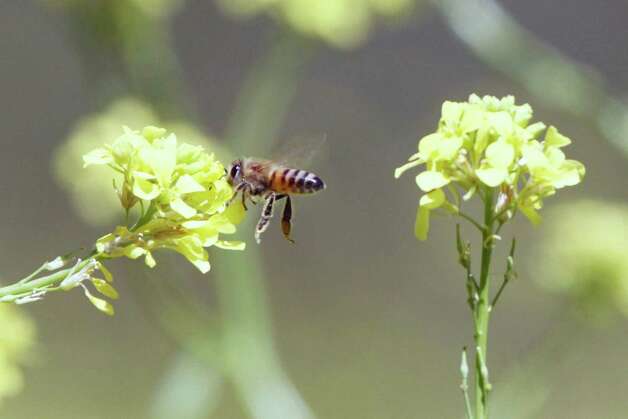 |
| Whether due to colony collapse disorder, the drought or both, bees, such as this April visitor, are rare on the Mims place this spring. Photo: Forrest M. Mims III, For The Express-News / ALL RIGHTS RESERVED. |
By now myriad bees and exotic flies should be sipping nectar from wildflowers. Wasps, dragonflies and spiders should be prowling the landscape looking for dinner.
Where are these creatures and the critters that eat them?
There might be a normal population of insects and spiders in some areas, especially in cities and towns where lawns and gardens were watered during last summer's record drought. But there's a very obvious shortage of insects, spiders and lizards on our rural place.
Only two or three honeybees can be seen in 6-foot-square sections of Indian blanket wildflowers here. In a normal year, the count would be much higher. Bluebonnets require insects to pollinate their flowers, so I examined four patches of bluebonnets on our place. Only 53 per cent of their flower spikes produced seed pods.
So far this spring, only two carpenter bees have appeared where a dozen or more usually patrol the sky. Only one red wasp, two grasshoppers, several dragonflies and a few beetles, crickets and pill bugs have been observed during daily walks. Only one toad, several geckos and no other lizards have been seen around our house.
Some species have returned, apparently assisted by abundant winter rain. While no fireflies appeared during 2011, each evening a dozen or so can be seen flashing away at the edge the woods behind our house.
Last month, countless crane flies invaded portions of South Central Texas.
Butterflies are now in abundance.
Paul Schattenberg wrote about the effect of the 2011 drought on Texas insects in the June 14 issue of Agrilife Today, a Texas A&M publication.
Fire ant mounds are smaller, presumably because their builders are less active.
Another drought spin-off is that some creatures are moving into homes to find moisture and food. This includes scorpions, and that's certainly the case at our place.
A search of the Web for insect activity during droughts revealed that populations of some insects that attack crops and trees can increase during droughts.
There are also insect reports virtually identical to what I am observing. For example, a report by Edward Mawley about the 1898 drought in England summarized surveys by rural observers who found sharply reduced insect populations with very few wasps.
Spiders are beginning to return to our place, and this may signal an increase in the insect population.
It will be interesting to see what happens next, especially if the drought returns.
While it might seem good to have fewer bugs around, they form a vital link in nature's food chain. Many pollinate wildflowers, fruit trees and various vegetables.
Forrest Mims, an expert reviewer for the Intergovernmental Panel on Climate Change (IPCC), was named one of the 50 Best Brains in Science by Discover Magazine. His science is featured at www.forrestmims.org. Email him at forrest.mims@ieee.org.
Suscribirse a:
Entradas (Atom)