Mostrando entradas con la etiqueta Sumatra. Mostrar todas las entradas

sábado, 10 de agosto de 2013

World first

ORIGINAL: Durrell

Incredible, never-seen-before footage of the "miracle birth" of a Sumatran orangutan has been caught on video by Durrell Staff. See an exclusive video below and find out more information on this amazing story.

Click here to adopt baby Kea


The back story... 


“ Dana and her new baby girl are now thriving at Durrell Wildlife Park! ”
Our amazing team of Keepers, Vets and even some of Jersey General Hospital’s Obstetric staff, are proud to be part of the safe arrival of Dana's new baby girl.

This is especially remarkable because Dana's previous pregnancy in 2009 suffered terrible complications that endangered her health sadly resulting in in a stillborn infant.

Dana was left with blocked fallopian tubes, leaving her infertile. However, expert intervention by Jersey General Hospital’s Head Obstetrician, Neil MacLachlan, allowed Dana and 28 year-old dominant male ‘Dagu’ to conceive again against all the odds, in late 2012.

Neil visited Dana throughout her pregnancy working with our team who, using trained behaviour techniques, carried out ultrasound scanning of Dana’s bump. This gave us the best possible chance of a healthy mother and baby.

Our team also worked hard at capturing the events leading up to and during the birth, that led to a BBC documentary to highlight our work with Critically Endangered animals globally and how we continue to save species from extinction.


Earlier this year 30 year-old female ‘Anette’s’ son ‘Jantho’ was born. Jantho is named after the release site for rehabilitated orangutans in Sumatra, where individuals rescued from deforested areas or from the pet trade are reintroduced to relative safety.


The Sumatran orangutan population, classified as Critically Endangered (IUCN Red list of threatened species), is thought to number a mere 6,600 individuals, and reportedly loses 10 to 15% of forest habitat to logging and palm oil plantations every year. Durrell maintain close ties, and share funds collected at the orangutan exhibit with the highly active Sumatran Orangutan Conservation Project (SOCP) which is headed by former Durrell keeper Dr. Ian Singleton.

For media enquires click here

Watch the BBC documentary 'Refugees of the Lost Rainforest' on iPlayer


The orangutan population in Sumatra is spiraling towards the unthinkable - the loss of this species forever.

With your kind help, we can make sure that Dana’s baby and her cousins in the wild have a future... please consider donating any amount you can spare, and in turn we will spare no effort in keeping our friends from the forest from disappearing forever.

Donate

martes, 1 de mayo de 2012

The EPA’s most important decision this year could be over... vegetable oil?

ORIGINAL: Washington Post
04/27/2012

Okay, quick quiz: Which country is the world’s third-largest emitter of greenhouse gases, after the United States and China?

There are around 6,600 orangutans on Indonesia’s Sumatra island, but more than two-thirds of the area has been divided up into palm oil concessions. (Reuters)
The answer, at least in some recent years, has been Indonesia. That’s surprising. It’s not the world’s third-largest economy. It’s not an industrial powerhouse. But Indonesia has been clearing its vast rain forests and burning through its peatlands of late, releasing huge stores of carbon into the air. One of the big culprits here has been the country’s fast-growing production of palm oil, an edible vegetable oil that’s increasingly being harvested to make biodiesel fuel for cars and trucks in Europe and elsewhere.

This isn’t just a bit of environmental trivia. Currently, there’s a fierce battle in the United States over whether the Environmental Protection Agency should allow more diesel made from palm oil to be used by U.S. refineries. Agribusiness groups are lobbying for its use. Environmentalists are trying to block it — with some saying this could be the EPA’s most important climate-change decision of the year.

Here’s the backstory: In 2007, Congress expanded a requirement for U.S. refineries to blend a certain amount of “renewable fuel” in with their gasoline. Ethanol or biofuels could count. They just had to be 20 percent cleaner than traditional fossil fuels. And, in January, the EPA released a preliminary analysis suggesting that biodiesel and renewable diesel made from palm oil didn’t quite make the cut, thanks in part to the deforestation effect. (Over the course of their lifecycle, the EPA found, palm-oil fuels emitted between 11 percent to 17 percent fewer greenhouse gases than regular gasoline.)

But the EPA hasn’t fully made up its mind yet. The agency is gathering comments on its analysis until Friday, April 27. And industry groups from Indonesia, Malaysia, and the United States have sharply criticized the agency’s analysis, with the American Palm Oil Council claiming that the EPA’s conclusion was “based on faulty data and erroneous assumptions.”

What do they mean? Robert Shapiro, a former Clinton administration economist who now does analysis for business groups, argued in his comment that it’s “highly speculative” to calculate how, exactly, the production of biofuels will drive deforestation. Efforts to figure out how biofuels indirectly affect land use — by, say, displacing cooking-oil production elsewhere — are still a relatively new area of science. If you remove this from the analysis, Shapiro argued, then palm-oil fuels look considerably cleaner and easily qualify as a renewable fuel. What’s more, he noted, palm-oil producers will likely increase their yields on existing lands in the future, which means they’ll cut down fewer forests.

Palm-oil skeptics aren’t buying it. In a conference call with reporters on Thursday, Jeremy Martin, a biofuels expert at the Union of Concerned Scientists, argued that the EPA’s analysis actually understimates the destructive impact of palm-oil production in Indonesia and Malaysia. His group’s comments to the EPA can be found here.

For one thing, Martin explained, much of the forest area that’s being cleared for palm oil is peatland, whose soils store considerable amounts of methane, a potent greenhouse gas. The EPA assumed that only around 9 to 13 percent of future palm-oil production would occur on peatland, whereas a new study in the Proceedings of the National Academy of Sciences found the number was already above 50 percent. And, Martin said, the EPA was too optimistic about the ability of countries like Indonesia to enforce their forestry laws.

When all of these factors are taken into account, said Martin, “the emissions of palm oil based biofuels substantially exceed the emissions from conventional petroleum diesel.”

There’s a lot at stake in getting this right. Palm oil is a potentially lucrative industry for developing countries like Indonesia and Malaysia. But Indonesia’s peatlands also contain an enormous amount of carbon-dioxide. (To get a sense for the scale here, one particularly large peatland fire in Kalimantan in 1997 released more total greenhouse-gas emissions than the entire United States over that period.) And, according to the PNAS study, peatland emissions from palm-oil production are expected to surge in the years ahead. Palm-oil producers are also razing habitats for elephants, tigers, rhinos, and orangutans on various islands in Southeast Asia.

Some green activists have placed their hopes in sustainable palm-oil production to navigate these concerns — after all, poorer communities in Southeast Asia aren’t just going to agree to an outright ban. But, increasingly, attention has shifted toward wealthy countries that are artificially inflating palm-oil production with government mandates on biofuels.

The EPA decision will help determine whether the United States becomes a major buyer. But, for now, the biggest market for palm-oil based fuels is still the European Union, which has a law requiring 10 percent of all transportation fuel to come from renewable sources by 2020. The problem with this rule, said Chris Malins of the International Council on Clean Transportation, is that the European Union never considered the indirect deforestation effects from biofuels. The science on this only really emerged in 2008 or so, after the E.U. law was largely crafted.

“What Europe did was basically consistent with the best life-cycle emissions analyses of the past,” said Malins. “But,” he added, “Europe recognizes that there’s an issue here, and there’s an ongoing process to change that.”

Which means that the EPA’s decision here in the United States could very well influence how governments around the world think about palm oil. In a quiet year for climate policy, that could stand out as a major move.

sábado, 14 de abril de 2012

Indonesia va investigar la concesiones de aceite de palma impugnadas luego que el actual gobernante perdió las elecciones en Sumatra

ORIGINAL: Mongabalay.com
12 de abril 2012
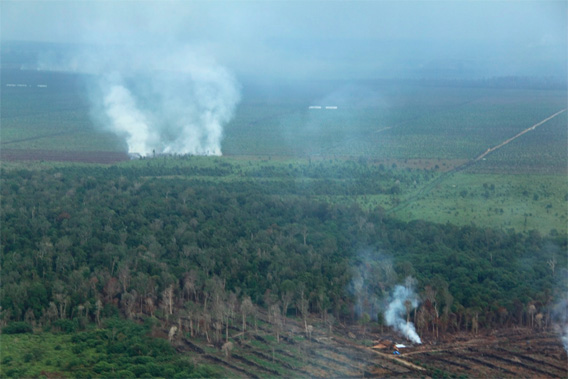
Los incendios en Tripa (bosques de turba).
Cortesía del 
 programa para la conservación del orangután de Sumatra (SOCP).
Un funcionario de alto rango de Indonesia está siendo investigando por el otorgamiento de una polémica concesión de la palma de aceite dentro de un área protegida de bosques de turba en Aceh en la isla de Sumatra, según informa el Globo de Yakarta.

Kuntoro Mangkusubroto, jefe del  Grupo de Trabajo REDD+  de Indonesia ("Reducing Emissions from Deforestation and Forest Degradation" Reducción de Emisiones por Deforestación y Degradación de los Bosques), dijo al diario que ha pedido a la Agencia Nacional de Tierras (CRT) que suministre un mapa de la zona Tripa para que se puedan investigar las violaciónes alegadas por grupos ambientalistas y las comunidades locales. Los críticos de la concesión de aceite de palma, que está dirigido por PT Kallista Alam, dicen que se concedió en violación de una moratoria nacional sobre la conversión de los bosques de turba y la oposición de los lugareños. Los conservacionistas sostienen que la zona está protegida como parte del ecosistema de Leuser.

Kuntoro está de acuerdo en que las circunstancias alrededor de la concesión son irregulares.

"Está dentro de la plantación de bosques protegidos. Es extraño que se puede obtener un permiso. Sospecho que algo hubo  detrás de la expedición del permiso ", fue citado por el diario.

La semana pasada, el gobernador de Aceh Irwandi Yusuf admitió que la concesión era "moralmente incorrecta". Añadió que su objetivo en la concesión del permiso era para dar a conocer que el mundo ha tardado en hacer realidad el compromiso de apoyar los esfuerzos para proteger los bosques de Aceh.

"La comunidad internacional piensa que nuestro bosque es un sumidero a disposición de sus emisiones de carbono", dijo el Sydney Morning Herald. "Cada día que ellos están diciendo que quieren un aire limpio y para proteger los bosques ... pero que quieren respirar el aire limpio sin tener que pagar nada".


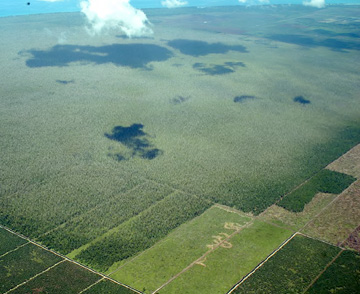
Una gran parte de los restantes bosques de pantano Tripa fotografiado en agosto de 2008. En primer plano están bloques de aceite de palma plantados y sin plantar, con bloques de más para su evacuación antes de limpiar. Estos bloques han sido ya desactivados. Imagen cortesía de Tim Koalisi Penyelematan Rawa Tripa.
Irwandi Sin embargo perdió su intento de reelección para  gobernador el lunes. El impacto en la pérdida de las elecciones en Aceh en los bosques incierto. Hasta la controversia Tripa, Irwandi había sido un campeón de los esfuerzos de la preservación del bosque. Se estableció unilateralmente una moratoria sobre la deforestación en 2007 y surgió como un líder dentro del clima de los Gobernadores y el Grupo de Trabajo Forestal, una iniciativa que pretende crear incentivos financieros  provisionales entre los estados y provincias en las naciones ricas y tropicales al frente del programa  REDD + (Reducción de Emisiones de Deforestación y Degradación).

Los estudios biológicos en la década de 1990 mostraron que Tripa albergó una vez algunas de las mayores densidades de orangutanes de Sumatra en el mundo, que se consideran en peligro crítico debido a la pérdida de hábitat. Sin embargo, la población ha disminuido rápidamente en las áreas en las cuales los bosques de turba han sido drenados y despejados para las plantaciones de palma aceitera.

Las selvas tropicales de Sumatra y las turberas se han destruido rápidamente en las últimas décadas. Durante la década de 1990 la isla perdió 3,7 millones de hectáreas, en su mayoría una consecuencia de la expansión agrícola, pulpa de papel y las plantaciones y la producción de aceite de palma. Sumatra es el último refugio de varias especies carismáticas y amenazadas, como tigres de Sumatra, rinocerontes, elefantes y orangutanes.

Los incendios forestales como resultado de la destrucción de los bosques de Sumatra, en algunos años proyectan una sombra sobre los países vecinos, especialmente Singapur - y lanzó millones de toneladas de carbono a la atmósfera.

viernes, 30 de marzo de 2012

Amigos de Verdad

ORIGINAL: Let Your Spirit Shine


Después de perder a sus padres, este orangután de 3 años estaba tan deprimido que no quería comer y no respondía a los tratamientos médicos. Los veteranarians pensó que moriría de la tristeza. El zoológico guardianes encontró un perro enfermo de edad en los terrenos del parque en el parque zoológico, donde vivía el orangután y se llevó al perro al centro de tratamiento de los animales. El perro llegó al mismo tiempo el orangután estaba siendo tratado allí. Las 2 las almas perdidas se reunieron y han sido inseparables desde entonces.

El orangután encontró una nueva razón para vivir y cada uno siempre trata de su mejor esfuerzo para ser un buen compañero a su nuevo amigo. Ellos están juntos las 24 horas del día en todas sus actividades.

Viven en el norte de California, donde la natación es su pasatiempo favorito, a pesar de Roscoe (el orangután) es un poco de miedoso del agua y necesita la ayuda de su amigo para nadar.

Juntos han descubierto la alegría y la risa en la vida y el valor de la amistad. Han encontrado más que un hombro amigo en quien apoyarse. - Con Teresa Leigh Lowery y Vanroye Hilde.


Otro caso de una orangután pequeña que fue rescatada estando atada en malas condiciones en una plantación.


Orangutanes Sumatran  - en riesgo crítico
Sólo 6.600 orangutanes de Sumatra en peligro de extinción permanecen en estado silvestre. 6.000 de ellos dependen para su supervivencia en la selva del hábitat proporcionado por el Parque Nacional de Gunung LESSEUR en el norte de Sumatra. La eliminación de las plantaciones ilegales de palma aceitera, reforestación y protección del territorio hogar del Orangután junto con la educación y campañas de información pública se llevan a cabo por el Centro de orangután de Sumatra y la Sociedad del orangután con el apoyo de Rainforest Rescue.


viernes, 24 de febrero de 2012

Concern Over Rare Rhino Rouses Clean Energy Drive in Malaysia

Jeff Smith
Published February 22, 2012

Plans for a coal plant near one of the last remaining habitats for the rare Sumatran rhino were scuttled, but Sabah, Malaysia still faces a power crunch. Waste from the palm oil industry (a plantation in Malaysia is seen below) could help meet demand.
Photograph by Nick Garbutt, Steve Bloom Images/Alamy

Potential threats to the rare Sumatran rhino, coral reefs, and other fragile animals helped galvanize a highly publicized fight last year to stop a coal-fired plant from being built on the east coast of Sabah, Malaysia.

The activists were armed with evidence that renewable energy such as hydropower, geothermal, and waste from the region's abundant oil palm mills could compete with coal in costs.

Activists won the impassioned battle when government officials killed the plant in February 2011. But they haven't yet achieved their goal of getting this ecotourism destination—one of the most biologically diverse spots on earth—to go renewable and serve as a model for other environmentally sensitive areas around the globe.

Instead, a 300-megawatt natural gas plant, announced earlier this month, is slated to ease Sabah's power crunch. The capacity of the proposed plant dwarfs that of renewable energy plants in Sabah. Renewable energy has been progressing slowly, and a key financial incentive for new projects is in limbo.

"The natural gas plant is our only viable option at the moment," Masidi Manjun, Sabah state minister of tourism, culture and environment, said by email. Natural gas is readily available offshore, he noted, and will generate the reliable electricity needed for economic growth. "This includes the development of new resorts, especially beach resorts, that are in short supply at the moment." He predicted renewable energy will have a significant role—in the future.

Natural Gas for Now
Activists knew a year ago this could be the outcome, at least in the short term.
"The government is going with the natural gas option to fuel our immediate energy needs," while making "cautious moves towards renewable energy," said Cynthia Ong, executive director of Malaysia-based Land Empowerment Animals People (LEAP). "During the anti-coal campaign, we took the position that the state needed to explore using its own natural gas resources (offshore) over importing coal . . . and of course we advocated strongly for renewable energy."

An environmental impact assessment hasn't been completed for the gas plant, but concerns aren't likely to be as high as they were for the coal plant. Gas is a cleaner fuel, and the plant will be in an industrial area far from the ecosystems that ignited the coal debate.

Sabah, on the northern end of the island of Borneo, is part of a region known as the Coral Triangle. Its rugged terrain and coral reefs have brought it world acclaim for its biodiversity and beauty.

The coal plant was planned along Sabah's coastline, 12 miles (19 kilometers) from the border of the Tabin Wildlife Reserve, Malaysia's largest animal park and one of the last remaining habitats for the Sumatran rhinoceros. The world's smallest rhinoceros at only about 4.3 feet (1.3 meters) tall, the Sumatran rhino is one of the most critically endangered species on Earth, with only 200 remaining in areas of Indonesia and Malaysia, according to the International Rhino Foundation. Poachers, hunters, and encroaching habitats have trimmed the number of rhinos on Borneo to an estimated 30 to 50. (For some rhinos, it's too late already. The Javan rhino in Vietnam recently was declared extinct by conservationists for many of the same reasons. In South Africa, more than 1,000 rhinos have been slaughtered in the past six years.)
(Related: "Rhino Wars")
Rivaling the price of gold on the black market, rhino horn is at the center of a bloody poaching battle. Stirton Photography

The Tabin reserve also includes Pygmy elephants, Bornean orangutans, sun bears, and leopards.

But in addition to being an important wildlife habitat, Sabah's east coast has experienced unplanned power outages due to the lack of electrical capacity. Almost all of its power comes from dirty and unreliable diesel plants that the government wants to replace with cleaner sources.

Currently, fossil fuels account for about 90 percent of power capacity in Sabah. The challenge, is "how to green the mix in an economically viable way," says Daniel Kammen, director of the Renewable and Appropriate Energy Laboratory at the University of California, Berkeley.

Ong recruited Kammen, an adviser to National Geographic's Great Energy Challenge initiative, in 2010 to study energy options for a coalition of five nongovernmental organizations dubbed GREEN Surf (Sabah Unite to Re-Power the Future).

Kammen's research team concluded that hydropower and biomass waste projects could be cost-competitive with coal, with geothermal slightly less so (but competitive with natural gas). The researchers highlighted palm oil waste as having the potential to produce up to 700 megawatts of power by 2020.

Malaysia is the second largest producer of palm oil in the world, and Sabah has more acreage under cultivation—3.5 million acres in 2010—than any other region of the country.
"Our process was to do the math, do the assessment, come up with a plan," Kammen said in an interview. "We went in not knowing what would work out."

Kammen traveled to Sabah to present his findings at a public meeting that was broadcast on local television. He also met individually with local officials, meetings he believes were critical to helping persuade government officials to back down from the proposed coal power plant.
By that time, the coal controversy already had stretched over several years, with two previous proposed sites dropped partly because of community opposition to such environmental impacts as ash ponds and carbon dioxide emissions.

LEAP and other environmental and civil society organizations also had complained that the environmental impact assessment (EIA) for the coal plant failed to adequately consider impacts on marine and animal life, and climate change. They said the assessment also listed species that aren't present in Sabah while omitting others such as the rhinoceros. Ong said those involved in the EIA process showed a lack of understanding of principles of environmental protection. For example, during one informal meeting, she recalls, a consultant working on the EIA said there was "no issue with fish, because fish could swim away."

Ong said many government officials were supportive of the anti-coal campaign in private meetings, but "the way politics works in Malaysia if the top guy says something you don't oppose it." But she said she believes the proposed coal plant became such a hot local political issue that Prime Minister Najib Razak felt compelled to stop it.

A statement issued in February 2011 by Musa Aman, Sabah state government's chief minister, indicated that Najib made the call in recognition that "one of Sabah's greatest assets is its natural attractions and still somewhat pristine environment."

Najib has been trying to position Malaysia as a leader in reducing carbon emissions.

At the 2009 climate change conference in Copenhagen, Najib pledged to cut carbon dioxide emissions by 40 percent from 2005 levels by 2020. Malaysia enacted a renewable energy law in 2011 that, among other things, created a Sustainable Energy Development Authority.
A premium tariff was established, enabling renewable energy producers to sell their power to utilities at prices roughly 50 percent above the current rate.

In Sabah, two oil palm biomass plants totaling about 25 megawatts of capacity have qualified for that premium tariff, as well as two small hydro plants totaling about 6.5 megawatts of capacity, according to Malaysia's Sustainable Energy Development Authority.

A company named Tawau Green Energy plans to build a 30-megawatt geothermal plant on Sabah's east coast. But the tariff isn't available for new renewable energy projects in Sabah at this time, said SEDA spokesman Wei-nee Chen. He said by email that the central government "is in talks with the state government of Sabah for them to contribute to the renewable energy fund. Once an agreement has been reached, then the (premium) tariff will be opened to Sabah for new projects."

Kammen's research team calculated that the income from electricity sales at the current tariff wouldn't quite be enough to cover the cost of operating an oil palm waste plant. But the researchers said the projects could be cost-competitive when taking into account potential carbon credits.

Creating a Renewable Industry
Palm biomass projects aren't without environmental concerns.
Louis Verchot, the leading climate change scientist for the Bogor, Indonesia-based Center for International Forestry Research, said using oil palm waste to produce electricity generally is a good idea because such waste usually is burned or left to decompose slowly.
However, he cautioned, if palm oil waste production generates profits, it could create economic incentives to expand oil palm plantations, leading to more deforestation.

Malaysia already has suffered greatly from deforestation of its hardwoods and peatlands. Verchot's team has published several analyses over the past two years that have shown that such biomass cultivation has a negative effect on the atmosphere and on natural habitat. That's especially true if the cultivation occurs on peatlands, which naturally store carbon.
Ong said her group has had a few meetings with Sabah's big oil palm players on the possibility of generating electricity from palm oil waste. But, she said, "It was a little bit of a challenge to convince them to pioneer what was basically going to be a new industry. The bottom line is their focus."

LEAP instead is working with a group of indigenous oil palm farmers on a small project to convert waste into biomass pellets, in hopes of proving its viability as a commercial enterprise.

Ong said she is optimistic about renewable energy over the long term, but believes it will be up to the people to engage the government and "provoke and take leadership in pioneering the renewable energy industry." LEAP is putting together a Southeast Asia renewable energy group and also has been asked to help an anti-dam group in Sarawak, Sabah's Borneo neighbor.

Said Masidi Manjun, Sabah's environment minister: "Renewable energy will not only have a significant role in the future but perhaps is the only viable option if the world is serious about conservation and tackling climatic change . . . . This is the way forward-that is, if we are interested in saving the world."

This story is part of a special series that explores energy issues. For more, visit The Great Energy Challenge.