Mostrando entradas con la etiqueta Self Driving Cars. Mostrar todas las entradas

martes, 5 de enero de 2016

NVIDIA DRIVE PX 2. NVIDIA Accelerates Race to Autonomous Driving at CES 2016

NVIDIA today shifted its autonomous-driving leadership into high gear.

At a press event kicking off CES 2016, we unveiled artificial-intelligence technology that will let cars sense the world around them and pilot a safe route forward.

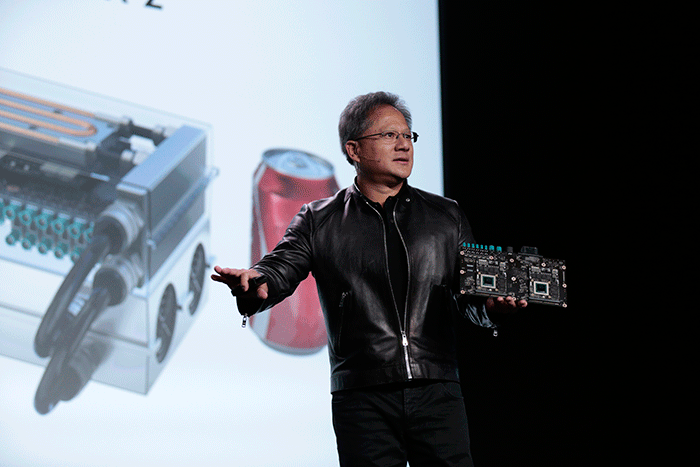
Dressed in his trademark black leather jacket, speaking to a crowd of some 400 automakers, media and analysts, NVIDIA CEO Jen-Hsun Huang revealed DRIVE PX 2, an automotive supercomputing platform that processes 24 trillion deep learning operations a second. That’s 10 times the performance of the first-generation DRIVE PX, now being used by more than 50 companies in the automotive world.

The new DRIVE PX 2 delivers 8 teraflops of processing power. It has the processing power of 150 MacBook Pros. And it’s the size of a lunchbox in contrast to earlier autonomous-driving technology being used today, which takes up the entire trunk of a mid-sized sedan. 

Self-driving cars will revolutionize society,” Huang said at the beginning of his talk. “And NVIDIA’s vision is to enable them.

Volvo to Deploy DRIVE PX in Self-Driving SUVs
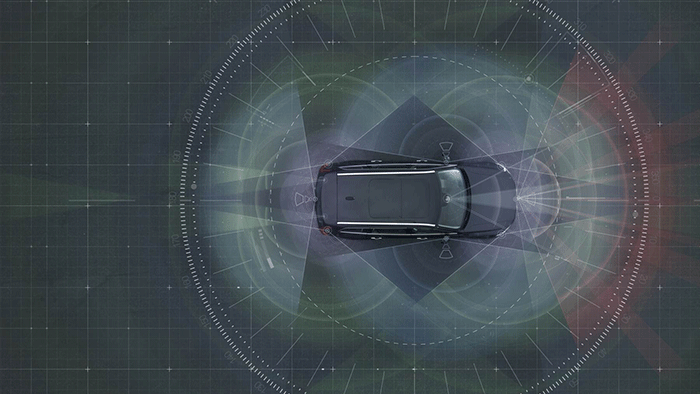
As part of its quest to eliminate traffic fatalities, Volvo will be the first automaker to deploy DRIVE PX 2.
Huang announced that Volvo – known worldwide for safety and reliability – will be the first automaker to deploy DRIVE PX 2.

In the world’s first public trial of autonomous driving, the Swedish automaker next year will lease 100 XC90 luxury SUVs outfitted with DRIVE PX 2 technology. The technology will help the vehicles drive autonomously around Volvo’s hometown of Gothenburg, and semi-autonomously elsewhere.

DRIVE PX 2 has the power to harness a host of sensors to get a 360 degree view of the environment around the car.

The rear-view mirror is history,” Jen-Hsun said.

Drive Safely, by Not Driving at All
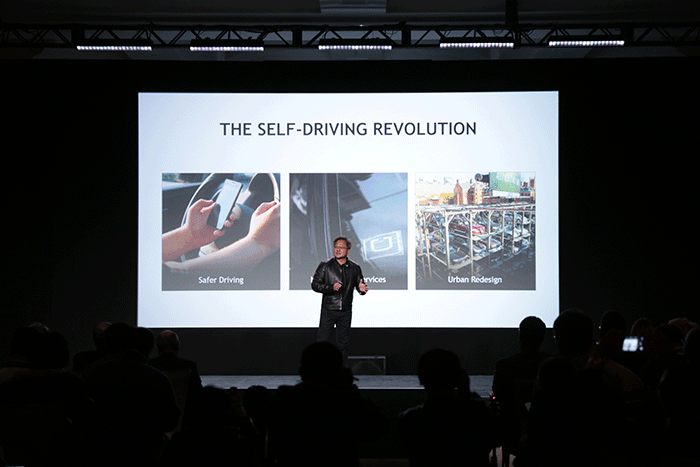
Not so long ago, pundits had questioned the safety of technology in cars. Now, with Volvo incorporating autonomous vehicles into its plan to end traffic fatalities, that script has been flipped. Autonomous cars may be vastly safer than human-piloted vehicles.

Car crashes – an estimated 93 percent of them caused by human error kill 1.3 million drivers each year. More American teenagers die from texting while driving than any other cause, including drunk driving.

There’s also a productivity issue. Americans waste some 5.5 billion hours of time each year in traffic, costing the U.S. about $121 billion, according to an Urban Mobility Report from Texas A&M. And inefficient use of roads by cars wastes even vaster sums spent on infrastructure.

Deep Learning Hits the Road
Self-driving solutions based on computer vision can provide some answers. But tackling the infinite permutations that a driver needs to react to – stray pets, swerving cars, slashing rain, steady road construction crews – is far too complex a programming challenge.

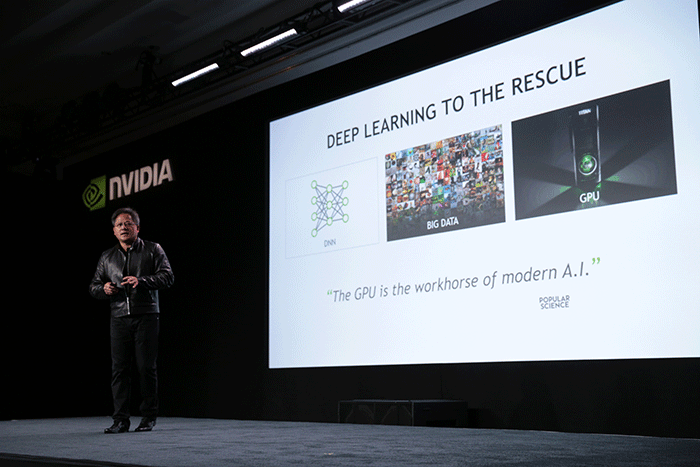
Deep learning enabled by NVIDIA technology can address these challenges. A highly trained deep neural network – residing on supercomputers in the cloud – captures the experience of many tens of thousands of hours of road time.

Huang noted that a number of automotive companies are already using NVIDIA’s deep learning technology to power their efforts, getting speedup of 30-40X in training their networks compared with other technology. BMW, Daimler and Ford are among them, along with innovative Japanese startups like Preferred Networks and ZMP. And Audi said it was able in four hours to do training that took it two years with a competing solution.
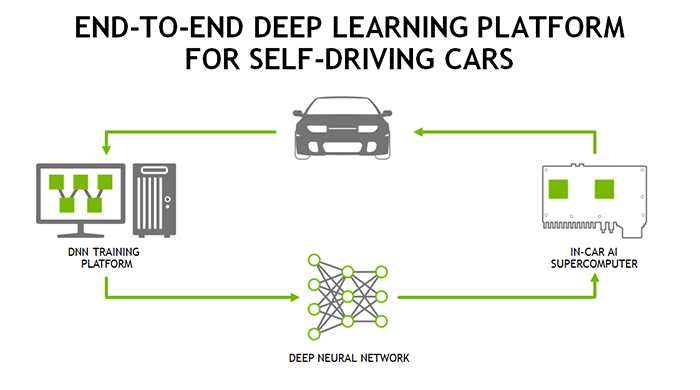
  NVIDIA DRIVE PX 2 is part of an end-to-end platform that brings deep learning to the road.

NVIDIA’s end-to-end solution for deep learning starts with NVIDIA DIGITS, a supercomputer that can be used to train digital neural networks by exposing them to data collected during that time on the road. On the other end is DRIVE PX 2, which draws on this training to make inferences to enable the car to progress safely down the road. In the middle is NVIDIA DriveWorks, a suite of software tools, libraries and modules that accelerates development and testing of autonomous vehicles.

DriveWorks enables sensor calibration, acquisition of surround data, synchronization, recording and then processing streams of sensor data through a complex pipeline of algorithms running on all of the DRIVE PX 2’s specialized and general-purpose processors.

During the event, Huang reminded the audience that machines are already beating humans at tasks once considered impossible for computers, such as image recognition. Systems trained with deep learning can now correctly classify images more than 96 percent of the time, exceeding what humans can do on similar tasks.

He used the event to show what deep learning can do for autonomous vehicles.

A series of demos drove this home, showing in three steps how DRIVE PX 2 harnesses a host of sensors – lidar, radar and cameras and ultrasonic – to understand the world around it, in real time, and plan a safe and efficient path forward.

The World’s Biggest Infotainment System
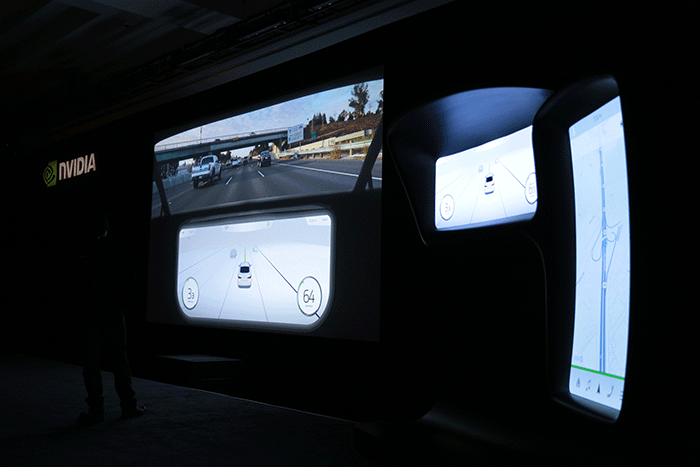

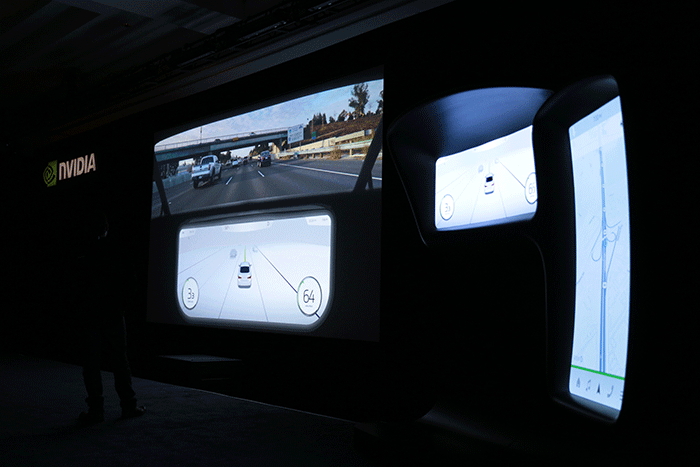
The highlight of the demos was what Huang called the world’s largest car infotainment system — an elegant block the size of a medium-sized bedroom wall mounted with a long horizontal screen and a long vertical one.

While a third larger screen showed the scene that a driver would take in, the wide demo screen showed how the car — using deep learning and sensor fusion — “viewed” the very same scene in real-time, stitched together from its array of sensors. On its right, the huge portrait-oriented screen shows a highly precise map that marked the car’s progress.

It’s a demo that will leave an impression on an audience that’s going to be hear a lot about the future of driving in the week ahead.

Photos from Our CES 2016 Press Event

NVIDIA Drive PX-2

ORIGINAL: Nvidia
By Bob Sherbin on January 3, 2016

sábado, 11 de julio de 2015

It’s No Myth: Robots and Artificial Intelligence Will Erase Jobs in Nearly Every Industry

It’s No Myth: Robots and Artificial Intelligence Will Erase Jobs in Nearly Every Industry AI, Fulfillment, Human, Jobs, Robotics, Self Driving Cars, Google, Telecommuting,

Image Credit: Tupungato/Shutterstock.com

With the unemployment rate falling to 5.3 percent, the lowest in seven years, policy makers are heaving a sigh of relief. Indeed, with the technology boom in progress, there is a lot to be optimistic about.
  • Manufacturing will be returning to U.S. shores with robots doing the job of Chinese workers; 
  • American carmakers will be mass-producing self-driving electric vehicles; 
  • technology companies will develop medical devices that greatly improve health and longevity; 
  • we will have unlimited clean energy and 3D print our daily needs. 
The cost of all of these things will plummet and make it possible to provide for the basic needs of every human being.

I am talking about technology advances that are happening now, which will bear fruit in the 2020s.

But policy makers will have a big new problem to deal with: the disappearance of human jobs. Not only will there be fewer jobs for people doing manual work, the jobs of knowledge workers will also be replaced by computers. Almost every industry and profession will be impacted and this will create a new set of social problems — because most people can’t adapt to such dramatic change.

If we can develop the economic structures necessary to distribute the prosperity we are creating, most people will no longer have to work to sustain themselves. They will be free to pursue other creative endeavors. The problem, however, is that without jobs, they will not have the dignity, social engagement, and sense of fulfillment that comes from work. The life, liberty and pursuit of happiness that the constitution entitles us to won’t be through labor, it will have to be through other means.

It is imperative that we understand the changes that are happening and find ways to cushion the impacts.

The technology elite who are leading this revolution will reassure you that there is nothing to worry about because we will create new jobs just as we did in previous centuries when the economy transitioned from agrarian to industrial to knowledge-based. Tech mogul Marc Andreessen has called the notion of a jobless future a “Luddite fallacy,” referring to past fears that machines would take human jobs away. Those fears turned out to be unfounded because we created newer and better jobs and were much better off.

True, we are living better lives. But what is missing from these arguments is the timeframe over which the transitions occurred. The industrial revolution unfolded over centuries. Today’s technology revolutions are happening within years. We will surely create a few intellectually-challenging jobs, but we won’t be able to retrain the workers who lose today’s jobs. They will experience the same unemployment and despair that their forefathers did. It is they who we need to worry about.

The first large wave of unemployment will be caused by self-driving cars. These will provide tremendous benefit by eliminating traffic accidents and congestion, making commuting time more productive, and reducing energy usage. But they will eliminate the jobs of millions of taxi and truck drivers and delivery people. Fully-automated robotic cars are no longer in the realm of science fiction; you can see Google’s cars on the streets of Mountain View, Calif. There are also self-driving trucks on our highways and self-driving tractors on farms. Uber just hired away dozens of engineers from Carnegie Mellon University to build its own robotic cars. It will surely start replacing its human drivers as soon as its technology is ready — later in this decade. As Uber CEO Travis Kalanick reportedly said in an interview, “The reason Uber could be expensive is you’re paying for the other dude in the car. When there is no other dude in the car, the cost of taking an Uber anywhere is cheaper. Even on a road trip.
The dude in the driver’s seat will go away.

Manufacturing will be the next industry to be transformed. Robots have, for many years, been able to perform surgery, milk cows, do military reconnaissance and combat, and assemble goods. But they weren’t dexterous enough to do the type of work that humans do in installing circuit boards. The latest generation of industrial robots by ABB of Switzerland and Rethink Robotics of Boston can do this however. ABB’s robot, Yumi, can even thread a needle. It costs only $40,000.


China, fearing the demise of its industry, is setting up fully-automated robotic factories in the hope that by becoming more price-competitive, it can continue to be the manufacturing capital of the world. But its advantage only holds up as long as the supply chains are in China and shipping raw materials and finished goods over the oceans remains cost-effective. Don’t forget that our robots are as productive as theirs are; they too don’t join labor unions (yet) and will work around the clock without complaining. Supply chains will surely shift and the trickle of returning manufacturing will become a flood.

But there will be few jobs for humans once the new, local factories are built.
With advances in artificial intelligence, any job that requires the analysis of information can be done better by computers. This includes the jobs of physicians, lawyers, accountants, and stock brokers. We will still need some humans to interact with the ones who prefer human contact, but the grunt work will disappear. The machines will need very few humans to help them.

This jobless future will surely create social problems — but it may be an opportunity for humanity to uplift itself. Why do we need to work 40, 50, or 60 hours a week, after all? Just as we were better off leaving the long and hard agrarian and factory jobs behind, we may be better off without the mindless work at the office. What if we could be working 10 or 15 hours per week from anywhere we want and have the remaining time for leisure, social work, or attainment of knowledge?

Yes, there will be a booming tourism and recreation industry and new jobs will be created in these — for some people.

There are as many things to be excited about as to fear. If we are smart enough to develop technologies that solve the problems of disease, hunger, energy, and education, we can — and surely will — develop solutions to our social problems. But we need to start by understanding where we are headed and prepare for the changes. We need to get beyond the claims of a Luddite fallacy — to a discussion about the new future.


ORIGINAL: Singularity Hub
ON JUL 07, 2015


Vivek Wadhwa is a fellow at Rock Center for Corporate Governance at Stanford University, director of research at Center for Entrepreneurship and Research Commercialization at Duke, and distinguished fellow at Singularity University.

His past appointments include Harvard Law School, University of California Berkeley, and Emory University. Follow him on Twitter @wadhwa.