Mostrando entradas con la etiqueta Evolution. Mostrar todas las entradas

viernes, 4 de noviembre de 2016

A Conductor of Evolution’s Subtle Symphony

At first, the biologist Richard Lenski thought his long-term experiment on evolution might last for 2,000 generations. Nearly three decades and over 65,000 generations later, he’s still amazed by evolution’s “awesome inventiveness.”
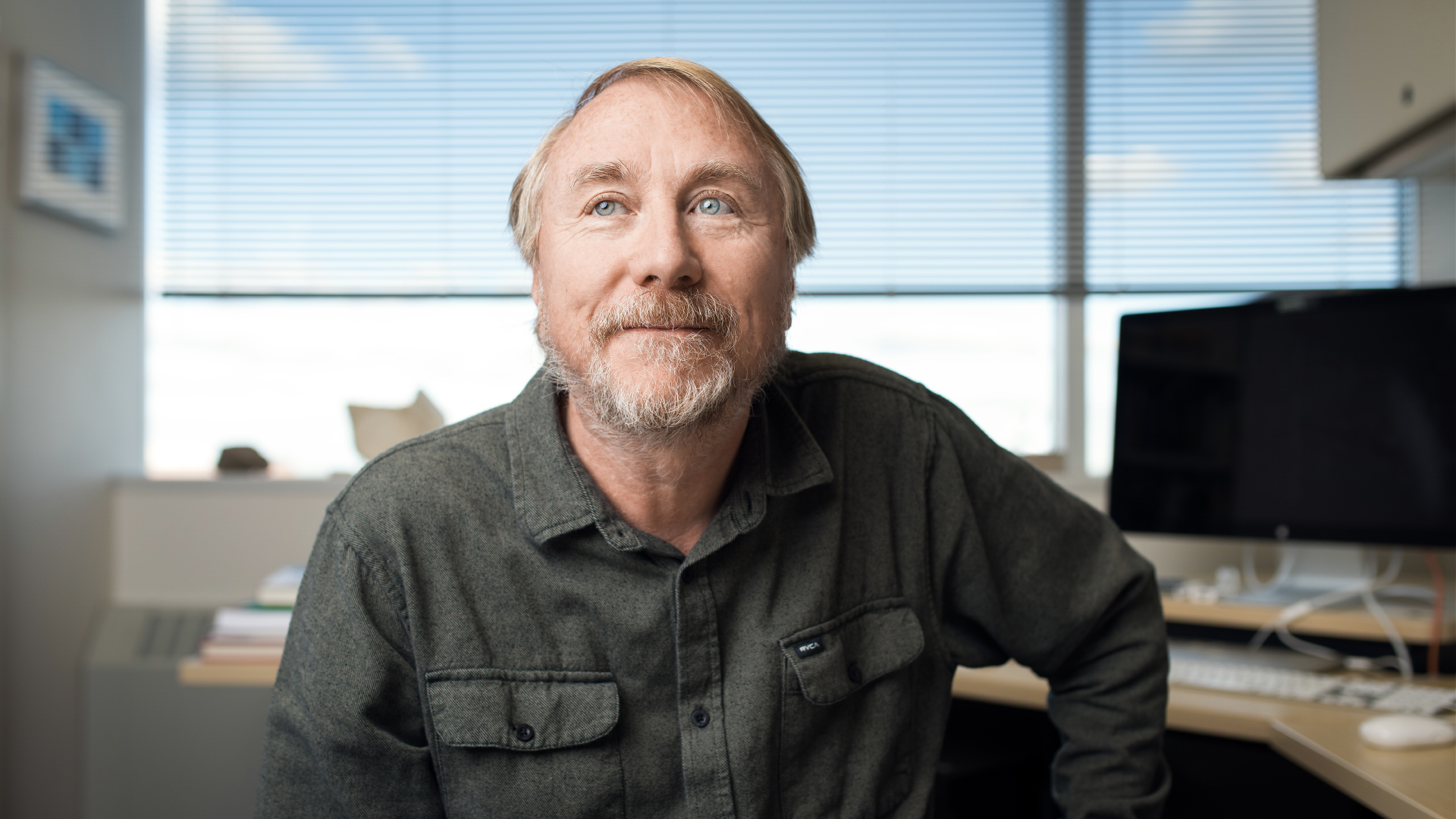
Logan Zillmer for Quanta Magazine
Early in his career, the decorated biologist Richard Lenski thought he might be forced to evolve. After his postdoctoral research grant was canceled, Lenski began to look tentatively at other options. With one child and a second on the way, Lenski attended a seminar about using specific types of data in an actuarial context — the same type of data he had worked with as a graduate student. Lenski collected a business card from the speaker, thinking he might be able to make use of his background in a new career.

But then, as it sometimes does — and I was very lucky — the tide turned,” Lenski told Quanta Magazine in his high-rise office at Michigan State University. “We got the grant renewed, and soon thereafter, I started getting faculty offers.

Lenski, a professor of microbial ecology at Michigan State, is best known for his work on what’s known as the long-term evolution experiment. The project, started in 1988, examines evolution in action. He and his lab members have been growing 12 populations of E. coli continuously for over 65,000 generations, tracking the development and mutations of the 12 separate strains.

The results have garnered attention and accolades — including a MacArthur “genius” grant, which Lenski received in 1996 — both for the enormity of the undertaking and for the intriguing findings the study has yielded. Most notably, in 2003, Lenski and his collaborators realized that one strain of E. coli had evolved the ability to use citrate as an energy source, something no previous population of E. coli was able to do.

Lenski is also interested in digital organisms, computer programs that have been designed to mimic the process of evolution. He was instrumental in the push to open the Beacon Center at Michigan State, which gives computer scientists and evolutionary biologists the opportunity to forge unique collaborations.

Quanta Magazine met with Lenski in his office to talk about his own evolving interests in the field of evolutionary biology — and about the time he almost pulled the plug on the long-term experiment. An edited and condensed version of the conversation follows.
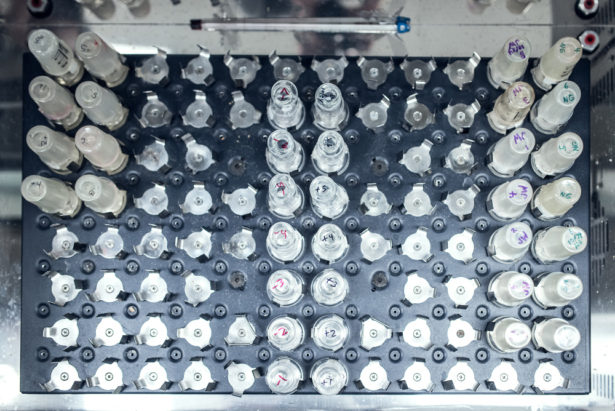
Logan Zillmer for Quanta Magazine. Vials containing the E. coli strains that make up the long-term evolution experiment.

QUANTA MAGAZINE: What sort of questions have been driving forces in your career?

RICHARD LENSKI: One question that has always intrigued me is about the reproducibility or repeatability of evolution. Stephen Jay Gould, the paleontologist and historian of science, posed this question: If we could rewind the tape of life on Earth, how similar or dissimilar would it be if we watched the whole process play out again? The long-term experiment that we do has allowed us to gather a lot of data about this question.

So is evolution repeatable?
Yes and no! I sometimes tell people it’s been a fascinating motivating question, but on one level, it is a terrible question, and one you would never tell a graduate student to go after. That’s because it is very open-ended, and it does not have a very clear-cut answer.

From the long-term experiment, we’ve seen

  • some really beautiful examples of things that are remarkably reproducible, and 
  • on the other hand some other crazy things where one population goes off and does things that are entirely different from the other 11 populations in the experiment.
How did you first come up with the idea for the long-term experiment?
I had been working already for several years on experimental evolution with bacteria, as well as viruses that infect bacteria. Those were fascinating, but everything became so complicated so quickly that I said, “Let’s reduce evolution down to its bare bones.In particular, I wanted to go after this question of reproducibility or repeatability of evolution. And if I wanted to be able to look at the reproducibility of evolution, I wanted a system that was very simple. When I started the long-term experiment, my original goal was that I would call it the long-term experiment when I got to 2,000 generations.

How long did that take you?
The actual running of the experiment was about 10 or 11 months, but by the time we had collected data, wrote it up, and got the paper published, it was more like two and a half years or so. By then the experiment had already passed 5,000 generations, and I realized we should keep it going.
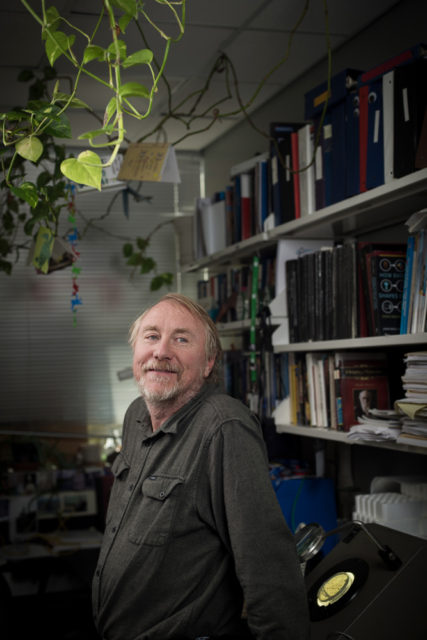
Logan Zillmer for Quanta Magazine. Richard Lenski in his office.

Did you anticipate the experiment going on for as long as it has?
No. No, I didn’t. There was a five-year period, maybe from the late ’90s into the early 2000s, where I thought about possibly stopping the experiment. This was for a couple of different reasons. One was that I was getting hooked on this other way of studying evolution, which involved looking at evolution in self-replicating computer programs, which was absolutely fascinating. Suddenly I saw this even shinier way of studying evolution, where it could go even more generations and do even more, seemingly neater, experiments.

How have your views on studying evolution via these digital organisms changed over time?
I had this sort of “puppy love” when I first learned about it. At first, it was just so extraordinarily interesting and exciting to be able to watch self-replicating programs, to be able to change their environments, and to watch evolution happen.

One of the really exciting things about digital evolution is that it shows that we think of evolution as being about stuff with blood and guts and DNA and RNA and proteins. But the idea of evolution really comes down to some very basic ideas of heredity, replication and competition. The philosopher of science Daniel Dennett has emphasized that we see evolution as this instantiation, this form of biological life, but the principles of it are much more general than that.

I would say that my latest directions of research have been primarily by way of talking with super-smart colleagues and serving on committees of graduate students who are using these systems. I’m less involved in designing experiments or formulating specific hypotheses, because that field has been moving extremely quickly. I feel I was very lucky to pick off some of the low-hanging fruit, but now I feel like I’m in there as a biologist, maybe criticizing hypotheses, suggesting controls that might be done in some experiments.

So your interest in digital organisms was one reason you considered shutting down the long-term experiment. What was the other?
At that point, the other thing that was a little frustrating about the long-term lines was that the rate at which the bacteria were changing was slowing down. The way I thought about it, it was almost as though evolution had stopped. I thought that this was just too simple an environment, and there wasn’t that much more for them to do.

So those two different things made me think about stopping the experiment. And I spoke to a few colleagues and they basically told me: You can’t do that. You shouldn’t do that. I talked with my wife, Madeleine, by the way, when I was getting very interested in these digital organisms — we were actually on sabbatical in France at that time — and I said, “Maybe I should call home and shut down the lab.” And she said, “I don’t think you should do that.

Why did your wife and your colleagues have that reaction?
The experiment had already been quite profitable in a scientific sense, providing very rich data about the dynamics of evolutionary change. It was more or less unique in the timescales it was probing. So I think it was very good advice they gave me. I don’t know whether I could have ever quite pulled the plug myself. I certainly was a bit frustrated and thinking about it — but anyhow, people said no!


Logan Zillmer for Quanta Magazine
Video: Lenski discusses how he has been surprised by evolution.

Did you get past the plateau where you said you felt like the organisms weren’t evolving that much?
That actually has been one of the really cool findings from the experiment. When I started the long-term experiment, I thought that the bacteria would quickly reach some sort of limit to their growth. It was only a few years ago that we began to realize that the bacteria would always be able to beat anything we had inferred in the past about what their hard limit might be. I realized that we’re just fundamentally not thinking about this the right way. Even in the simplest environment, there’s always the potential for organisms to do any step in their metabolism, or any step in their biochemistry, a little bit better. And natural selection, although it won’t get it right on any given step, will over the long term always be favoring these subtle improvements.

One line of bacteria evolved the ability to use citrate as a food source. Did that happen before or after you were thinking of shutting down the experiment?
That was one of the things that made me realize we wouldn’t shut down the experiment. In 2003, one lineage evolved the ability to use citrate. That became a game changer: realizing that even in this super simple environment, there were some major things for the bacteria to evolve and figure out.

I like to say that the bacteria would eat dinner every night without realizing there was this nice, lemony dessert right around the corner. And so far, even after 65,000 generations, only one of the 12 populations has figured out how to consume that citrate.

You also mentioned that certain populations within your experiment have developed mutations at a greater rate. What does that look like?
After over 60,000 generations, six out of the 12 populations have evolved to be hypermutable. They’ve evolved changes in their DNA repair and DNA metabolic processes that causes them to have new mutations somewhere on the order of 100 times the rate at which the ancestor [at the start of the experiment] did.
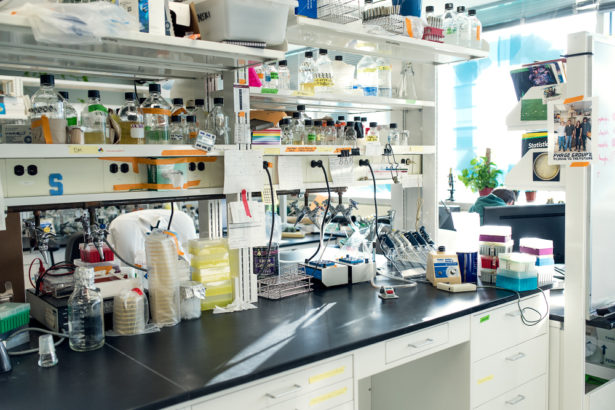
Logan Zillmer for Quanta Magazine. Lenski’s laboratory at Michigan State University.
It’s a very interesting process, because it’s both good and bad from the bacteria’s perspective. It’s bad because most mutations are harmful or at best neutral. Only the rare nugget in the mine is a beneficial mutation. The bacteria that have the higher mutation rate are a little bit more likely to discover one of those nuggets. But on the other hand, they’re also more likely to produce children and grandchildren with deleterious mutations.

Was the line that was able to consume citrate part of the group that had evolved to be hypermutable?
That’s a great question. The line that evolved the ability to use citrate did not have an elevated mutation rate. Interestingly, it became one of the ones with a higher mutation rate, but only after it evolved the ability to use citrate. It’s consistent with the benefit of the higher mutation rate — the additional capacity for exploration. The bacteria were actually quite poor at using citrate to begin with, so there were a lot of opportunities after they evolved the ability to use citrate to refine that ability.

How does the long-term experiment help you understand the evolution of life on a larger scale?
For me, one of the lessons of the long-term experiment has been how rich and interesting life can be, even in the dullest, simplest environment. The fact that evolution can generate this diversity, and discover doors left slightly ajar that it can push through, speaks to the awesome inventiveness of evolution. And if it can be so inventive and creative on this minuscule spatial and temporal scale, and in such a dull environment, it just creates more awe in me, when I think of how much more remarkable it is out in nature.

What most surprised you about this project?
That it’s still going on after all these years. One of my goals in life is to make sure that the experiment continues. I would like to raise an endowment to keep the experiment going on in perpetuity.

What’s your hope for the long-term experiment in the future?
My hope for the project is that it will yield many more surprises. For instance, two lineages have coexisted for 60,000 generations in one of the populations, where one of them is feeding off of the product that the other one is generating. I think it’s fascinating to wonder if, at some point, that might turn into something more like a predator-prey interaction. It’s certainly not outside the realm of possibilities. Whether it would ever happen, I don’t know.

It has also been a tremendous joy to work with students, postdocs and collaborators, and to see them grow and develop. That’s really the biggest joy for me of being a scientist. I like to tell people that I’m a bigamist. I have two families: 

  • I have my lab family and 
  • my biological family, and 
they both are incredibly wonderful.


Correction: This post was revised on November 3 to reflect that the citrate-using bacteria appeared in 2003, not 2008. The paper describing that change was published in 2008.

ORIGINAL: Quanta Magazine
By Stephanie Bucklin
November 3, 2016

martes, 12 de julio de 2016

Monkeys In Brazil Entered The Stone Age 700 Years Ago

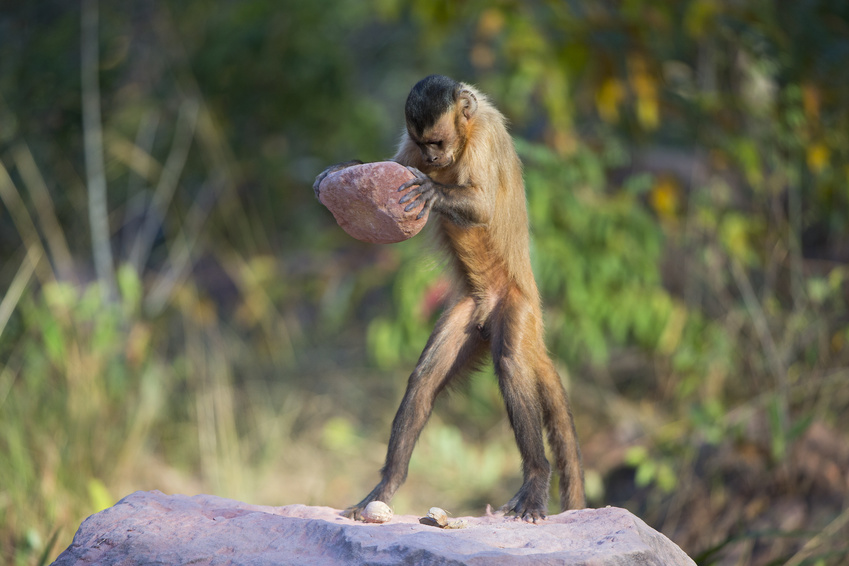
A CAPUCHIN WIELDING A HAMMER AGAINST A NUT RESTING ON AN ANVIL. UNIVERSITY OF OXFORD
Humanity is no longer the only species on Earth that has entered the Stone Age. It’s been known for some time now that various other primates use stone tools, including chimpanzees, capuchins, and macaques. Just recently, a study revealed that there was enough archaeological evidence to prove that macaques in Thailand have been crafting geological tools for at least half a century.

Now, it seems that capuchins have them beat. Tools in Brazil, undoubtedly made by capuchin hands, have been dated to be at least 700 years old. This means that just as the Renaissance was beginning in Italy, capuchins were crafting little chisels and hammers out of various stones in South America – although, in all likelihood, they had entered the Stone Age long before this.

As the study in the journal Current Biology notes, the field of primate archaeology is relatively nascent. Michael Haslam, the lead author of this research and the head of the Primate Archaeology (Primarch) project at the University of Oxford, is a pioneer in the field. He’s previously uncovered evidence of stone tool use in Thailand by macaques, but this new discovery is far more of a game-changer.

Until now, the only archaeological record of pre-modern, non-human animal tool use comes from a study of three chimpanzee sites in Cote d'Ivoire in Africa, where tools were dated to between 4,300 and 1,300 years old,” Haslam said in a statement. “Here, we have new evidence that suggests monkeys and other primates out of Africa were also using tools for hundreds, possibly thousands of years.

Brazilian capuchins entered the Stone Age at least 700 years ago. University of Oxford

Capuchins are indubitably clever monkeys. Researchers have long observed them using stones as hand-held hammers and anvils to break open hard, shelled food like cashews and seeds, while younglings watch their elders hammer away and learn from observation.

Their geological knowledge was found to be quite astute anvils were four times heavier than the hammers, and the hammers were four times heavier than the average stones nearby. The anvils tended to be made of layered, flat sandstones, whereas the hammers were forged from pointed, angular quartzite.

Whenever a capuchin is full of delicious nuts, it tends to leave its stone tools by a cache of discarded shells, which over time gets buried by sand and soil. After waiting for the capuchins to scuttle off, the researchers sauntered over to these sites and dug into the ground to see if they could find any older tools.

Using distinctive identifying marks on the tools made by the grinding, slamming, hammering action of long-gone capuchins, 69 tools were successfully excavated from a depth of up to 0.7 meters (2.3 feet), and radiocarbon dated using small pieces of charcoal. The oldest tools were 600 to 700 years of age, which means that 100 generations of capuchins – at least – have been using stone tools. 

They think it’s only a matter of time until older tools are found.
There is an even more tantalizing prospect to this discovery. The European invasion didn’t occur until the year 1500, so the capuchin Stone Age predates this by around 200 years. The indigenous populations of Brazil, therefore, may have come across capuchins breaking open cashew nuts native to this particular area.

It is possible,” Haslam notes, “that the that the first humans to arrive here learned about this unknown food through watching the monkeys and their primate cashew-processing industry.” So instead of monkeys or apes mimicking humans, in this case, it may have been the other way around.
Humans living in the Amazon may have educated themselves about certain stone tools from monkeys once upon a time. ANDRE DIB/Shutterstock

ORIGINAL: IFL Science

sábado, 18 de junio de 2016

Where does intelligence come from?

Add caption

It is amazing how intelligent we can be. We can construct shelter, find new ways of hunting, and create boats and machines. Our unique intelligence has been responsible for the emergence of civilization.

But how does a set of living cells become intelligent? How can flesh and blood turn into something that can create bicycles and airplanes or write novels?

This is the question of the origin of intelligence.

This problem has puzzled many theorists and scientists, and it is particularly important if we want to build intelligent machines. They still lag well behind us. Although computers calculate millions of times faster than we do, it is we who understand the big picture in which these calculations fit. Even animals are much more intelligent than machines. A mouse can find its way in a hostile forest and survive. This cannot be said for our computers or robots.

The question of how to achieve intelligence remains a mystery for scientists.

Recently, however a new theory has been proposed that may resolve this very question. The theory is called practopoiesis and is founded in the most fundamental capability of all biological organisms—their ability to adapt.

Darwin’s theory of evolution describes one way how our genomes adapt. By creating offspring new combinations of genes are tested; the good ones are kept and the bad ones are disposed of. The result is a genome better adapted to the environment.

Practopoiesis tells us that somewhat similar adaptation mechanisms of trials and errors occur while an organism grows, while it digests food and also, while it acts intelligently or thinks.

For example, the growth of our body is not precisely programmed by the genes. Instead, our genes perform experiments, which require feedback from the environment and corrections of errors. Only with trial and errors can our body properly grow.

Our genes contain an elaborate knowledge of which experiments need to be done, and this knowledge of trial-and-error approaches has been acquired through eons of evolution. We kept whatever worked well for our ancestors.

However, this knowledge alone is not enough to make us intelligent.

To create intelligent behavior such as thinking, decision making, understanding a poem, or simply detecting one’s friend in a crowd of strangers, our bodies require yet another type of trial-and-error knowledge. There are mechanisms in our body that also contain elaborate knowledge for experimenting, but they are much faster. The knowledge of these mechanisms is not collected through evolution but through the development over the lifetime of an individual.

These fast adaptive mechanisms continually adjust the big network of our connected nerve cells. These adaptation mechanisms can change in an eye-blink the way the brain networks are effectively connected. It may take less than a second to make a change necessary to recognize one’s own grandmother, or to make a decision, or to get a new idea on how to solve a problem.

The slow and the fast adaptive mechanisms share one thing: They cannot be successful without receiving feedback and thus iterating through several stages of trial and error; for example, testing several possibilities of who this person in distance could be.

Practopoiesis states that the slow and fast adaptive mechanisms are collectively responsible for creation of intelligence and are organized into a hierarchy. 
  • First, evolution creates genes at a painstakingly slow tempo. Then genes slowly create the mechanisms of fast adaptations
  • Next, adaptation mechanisms change the properties of our nerve cells within seconds
  • And finally, the resulting adjusted networks of nerve cells route sensory signals to muscles with the speed of lightning. 
  • At the end behavior is created.
Probably the most groundbreaking aspect of practopoietic theory is that our intelligent minds are not primarily located in the connectivity matrix of our neural networks, as it has been widely held, but instead in the elaborate knowledge of the fast adaptive mechanisms. The more knowledge our genes store into our quick abilities to adapt nerve cells, the more capability we have to adjust in novel situations, solve problems, and generally, act intelligently.

Therefore, our intelligence seems to come from the hierarchy of adaptive mechanisms, from the very slow evolution that enables the genome to adapt over a lifetime, to the quick pace of neural adaptation expressing knowledge acquired through its lifetime. Only when these adaptations have been performed successfully can our networks of neurons perform tasks with wonderful accuracy.

Our capability to survive and create originates, then, 
  • from the adaptive mechanisms that operate at different levels and 
  • the vast amounts of knowledge accumulated by each of the levels.
 The combined result of all of them together is what makes us intelligent.


May 16, 2016

Danko Nikolić
About the Author:
Danko Nikolić is a brain and mind scientist, running an electrophysiology lab at the Max Planck Institute for Brain Research, and is the creator of the concept of ideasthesia. More about practopoiesis can be read here

domingo, 13 de marzo de 2016

Craig Venter: Future Pathways for Synthetic Genomics

Is a Genomic Version of Moore’s Law in the Offing?

J. Craig Venter, Ph.D.
J. Craig Venter, Ph.D., is regarded as one of the leading scientists of the 21st century for his numerous contributions to genomic research. In addition to his past key positions, he is founder, current chairman, and CEO of the J. Craig Venter Institute (JCVI), a not-for-profit, research organization dedicated to human, microbial, plant, synthetic, and environmental genomic research, and the exploration of social and ethical issues in genomics.

Dr. Venter, who is also co-founder, executive chairman, and co-chief scientist of Synthetic Genomics (SGI) and co-founder, executive chairman, and CEO of Human Longevity, spoke to GEN.

GEN: Dr. Venter, you have been on the frontlines of genomics, synthetic genomics, and synthetic biology. Please talk about your research in synthetic biology and synthetic genomics?

Dr. Venter: JCVI’s synthetic biology program started in 1995, when my team sequenced the first genome. That same year we sequenced a second genome, the smallest one known (Mycloplasma genitalium) in collaboration with Clyde Hutchinson, who was then at the University of North Carolina. That led Clyde and I, along with our colleague Hamilton Smith, M.D., to start discussing the concept of comparative genomics and wondering what the most primitive and simplest genome that could exist would be.

That is basically how the field of synthetic genomics got started. We felt that the only way to answer this question would be to make a synthetic chromosome that contained all the necessary genes, and to use that to create a new life form.

That idea took close to 20 years to achieve. In 2010 we recorded the first synthetic cell. It involved making a synthetic version of, mostly, Mycoplasma mycoides. Although it contained a number of significant changes, it was primarily based on a pre-existing species, and with it we were able to show that the creation of a new life form was possible.

Ongoing work at JCVI with funding mainly by Synthetic Genomics (SGI), a company that was spun out of the Institute, and done together with Dan Gibson’s team at SGI, has been focusing on designing a species from scratch on the computer on first principles.

In our final design of this synthetic cell, more than 10% of the genes that are essential for life are of unknown function. That reality somewhat limits what can be done in terms of synthetic genomics. We define synthetic genomics as truly 

  • designing biological processes and genomes and then 
  • building them from scratch chemically

with the process improving as you gain more experience.

However, if we can’t design even the smallest organism based on first principles, because we don’t know what all the components do, the challenge is greater than we initially thought. This, though, should also alleviate a lot of people’s fears about the ease of being able to design super-bugs, super-organisms, and super-species. It’s proving hard to do with less than 500 genes, let alone at a much more complex level. 

GEN: Given this new reality, how are you now moving forward with your synthetic genomics program?

Dr. Venter: We are using a lot of computer metaphors and are in the process of defragging the genome. Two billion years of evolution have not been highly orderly; in fact, they’ve been quite messy. In any genome we have looked at there is not a lot of order to it except, for example, some symmetry around origins of replication that have been maintained. Despite what people used to think, that gene functions would be more organized, they tend to be scattered all over the genome based on changes that genomes have been subject to throughout evolution.

It’s analogous to what happens to a computer hard drive when it gets highly fragmented over time, with information stored haphazardly and not in any organized fashion. You can run a program to defrag your hard drive and organize the information back into files. We have been defragging the genome by rebuilding the chromosome and linking together related genes: for example, grouping all of the genes associated with glycolysis in a single cassette, and the genes associated with cell division in another cassette. In this way, future design can at least start with these cassettes. I suppose we will also have to create a cassette of genes of unknown function, at least until they get sorted out.

We think that this new fundamental cell, largely created by direct design, will be a great experimental tool. We are even thinking of creating a public contest around it and awarding a prize to whoever adds on the best evolutionary functions to the cell. This self-replicating cell represents an early, relatively primitive form of cellular life. If we add genes and complex functions to it we should be able to convert the cell into a much more complex organism.

During research I did while writing my book, Life at the Speed of Light, I came across some of the early history from researchers in the 1800s and early 1900s, where one French researcher said, essentially, give me a basic protoplasm and I will be able to recreate all of life. At that time it wasn’t known what was in the protoplasm—they didn’t know what DNA was or that proteins were discrete molecules—but the assumption was that it contained the building blocks of life.

Now we can attempt to recapitulate evolution on a much faster stage, and certainly use this ability as a very informative learning tool.

GEN: Focusing now on synthetic biology, how would you describe the progress being made and the direction in which this field is heading?

Dr. Venter: I think synthetic biology is more or less a redefinition of the field of molecular biology. And systems biology is, perhaps, a more modern term for physiology. People are largely doing the same things they were doing before, but maybe with a different goal in mind. People who were mainly doing fundamental molecular biology now claim that they are doing synthetic biology.

There are so many directions in which this could go. With the discovery of CRISPRs we have a new tool set to enable things perhaps to go faster and in a different direction than just taking straight synthetic approaches. I think the combination of CRISPRs and synthetic biology is pretty stunning.

One of the most important programs at Synthetic Genomics is the company’s collaboration with United Therapeutics, in which it is literally rewriting the pig genome to create pig organs that will survive in humans as replacement organs for transplantation, e.g., hearts, lungs, kidneys, and livers. Similar to what was done with monoclonal antibodies early on, in which they were humanized and replaced with human gene constructs, making it possible to grow human monoclonal antibodies in mice. Obviously, changing everything associated with rejection of allogeneic transplants is much more complex, but we have already had some limited success. We are literally starting at the design phase.

We have created a new, highly accurate version of the pig genome that we’ll be working with, which carries all of the genes that we have identified as being important, and we are going through and systematically changing those in the pig genome. For some of those we rewrite the gene and put a wholly new synthetic construct and a landing pad into the pig genome; whereas for others, when there are only minor edits needed between the pig and human genes, we use CRISPRs just to edit the genes and convert the pig sequence to a human sequence.

Dan Gibson at SGI made a big breakthrough early on in this process when he found that he could combine all of the different enzymes for all of the different processes in a single tube at a single temperature. This is called the “Gibson assembly,” and it allowed the process to be carried out by a robot. SGI has an instrument called the BioXp™, which is an automated DNA assembly robot that takes oligonucleotides or subsets and builds them into larger constructs. It is a commercial instrument currently being used in several labs. If we are not able to write large pieces of DNA, then there won’t be a lot of development in the field. 

"Future Pathways for Synthetic Genomics" is part 1 of a 2 part interview with Craig Venter. Part 2 will appear in the April 1 issue of GEN, and will focus on tools and technologies needed to advance synthetic genomics research.

ORIGINAL: GEN
Mar 1, 2016 (Vol. 36, No. 5)

martes, 19 de enero de 2016

Why Spiderman can't exist: Geckos are size limit for sticking to walls

Latest research reveals why geckos are the largest animals able to scale smooth vertical walls - even larger climbers would require unmanageably large sticky footpads. Scientists estimate that a human would need adhesive pads covering 40% of their body surface in order to walk up a wall like Spiderman, and believe their insights have implications for the feasibility of large-scale, gecko-like adhesives.

Source: The Amazing Spiderman Game
A new study, published today in PNAS ("Extreme positive allometry of animal adhesive pads and the size limits of adhesion-based climbing"), shows that in climbing animals from mites and spiders up to tree frogs and geckos, the percentage of body surface covered by adhesive footpads increases as body size increases, setting a limit to the size of animal that can use this strategy because larger animals would require impossibly big feet.

Dr David Labonte and his colleagues in the University of Cambridge's Department of Zoology found that tiny mites use approximately 200 times less of their total body area for adhesive pads than geckos, nature's largest adhesion-based climbers. And humans? We'd need about 40% of our total body surface, or roughly 80% of our front, to be covered in sticky footpads if we wanted to do a convincing Spiderman impression.
This image shows a gecko and ant. (Image courtesy of A Hackmann and D Labonte)
Once an animal is big enough to need a substantial fraction of its body surface to be covered in sticky footpads, the necessary morphological changes would make the evolution of this trait impractical, suggests Labonte.

"If a human, for example, wanted to walk up a wall the way a gecko does, we'd need impractically large sticky feet - our shoes would need to be a European size 145 or a US size 114," says Walter Federle, senior author also from Cambridge's Department of Zoology.

The researchers say that these insights into the size limits of sticky footpads could have profound implications for developing large-scale bio-inspired adhesives, which are currently only effective on very small areas.

As animals increase in size, the amount of body surface area per volume decreases – an ant has a lot of surface area and very little volume, and an elephant is mostly volume with not much surface area” explains Labonte.

This poses a problem for larger climbing animals because, when they are bigger and heavier, they need more sticking power, but they have comparatively less body surface available for sticky footpads. This implies that there is a maximum size for animals climbing with sticky footpads – and that turns out to be about the size of a gecko.

Huge Lizard Caught On The Side Of Australian House. photo credit: Eric Holland
The researchers compared the weight and footpad size of 225 climbing animal species including insects, frogs, spiders, lizards and even a mammal.

We covered a range of more than seven orders of magnitude in body weight, which is roughly the same weight difference as between a cockroach and Big Ben” says Labonte.

How sticky footpad area changes with size. (Image: David Labonte)
“Although we were looking at vastly different animals – a spider and a gecko are about as different as a human is to an ant – their sticky feet are remarkably similar,” says Labonte.

Adhesive pads of climbing animals are a prime example of convergent evolution – where multiple species have independently, through very different evolutionary histories, arrived at the same solution to a problem. When this happens, it’s a clear sign that it must be a very good solution.

There is one other possible solution to the problem of how to stick when you’re a large animal, and that’s to make your sticky footpads even stickier.

We noticed that within some groups of closely related species pad size was not increasing fast enough to match body size yet these animals could still stick to walls,” says Christofer Clemente, a co-author from the University of the Sunshine Coast.

We found that tree frogs have switched to this second option of making pads stickier rather than bigger. It’s remarkable that we see two different evolutionary solutions to the problem of getting big and sticking to walls,” says Clemente.

Across all species the problem is solved by evolving relatively bigger pads, but this does not seem possible within closely related species, probably since the required morphological changes would be too large. Instead within these closely related groups, the pads get stickier in larger animals, but the underlying mechanisms are still unclear. This is a great example of evolutionary constraint and innovation.
Diversity of sticky footpads. (Image: David Labonte) 
The researchers say that these insights into the size limits of sticky footpads could have profound implications for developing large-scale bio-inspired adhesives, which are currently only effective on very small areas.

Our study emphasises the importance of scaling for animal adhesion, and scaling is also essential for improving the performance of adhesives over much larger areas. There is a lot of interesting work still to be done looking into the strategies that animals use to make their footpads stickier - these would likely have very useful applications in the development of large-scale, powerful yet controllable adhesives,” says Labonte.

Source: Cambridge University

ORIGINAL: Nanowerk
Jan 19, 2016

sábado, 5 de diciembre de 2015

Crazy “missing link” Darwin fish can breathe air, walk on land AND climb trees!


Nathan Waltham/James Cook University
In Australia, there is a fish that has lungs, can walk on dry land, and breathe air, for up to six days. It’s not a new species, but it’s on the move. This has scientists warning that if the reaches the mainland, it could be devastating to native species, who are simply not equipped to share an environment with a super-powered creature such as this.
Nathan Waltham/James Cook University
The fish, known as the aggressive climbing perch, is just a little guy, ranging six to eight inches long at adulthood. Small stature aside, this critter is basically terrifying. It can “walk” on land, using its gill plates to crawl across the ground. The perch has lungs, as well as gills, so it can breathe air as well as any mammal—for up to six days, at least. This bizarre, evolutionary ‘missing link’ of fish can even suffocate a predator who attempts to swallow the perch, by swelling up inside the attacker’s throat. Oh, and did we mention it’s called a climbing perch because of its ability to climb trees? For real.

The climbing perch, originally discovered over 200 years ago, is native to Papua New Guinea and was already known to have spread to Indonesia. The land-loving fish has more recently been discovered in northern Australia, which has wildlife scientists more or less freaking out. An invasive species like this could spell “major disaster” for native animals, and it’s not just the other fish who are in danger, according to Nathan Waltham, an ecologist at Australia’s James Cook University. He believes this fish would also wreak havoc for turtle and bird populations. Waltham manages the TropWATER program, aimed at educating the public about this and other dangerous invasive species.

Let’s recap some of the amazing abilities of this freaky freshwater fish:
  • walks on dry land
  • has lungs and can breathe air for six days
  • climbs trees!!!
  • suffocates its predators from the inside
  • can tolerate saltwater (despite being a freshwater dweller)
  • hibernates in the mud for up to six months
  • scares the begeezus out of rational humans


Images and video via Nathan Waltham/James Cook University
ORIGINAL: Inhabitat

sábado, 19 de septiembre de 2015

Scientists Have Drafted a Complete Tree of Life


Humans, bacteria, daffodils: We’re a diverse bunch on the surface, but trace each and every Earthling back far enough, and you’ll arrive at a common ancestor. For the first time, scientists have built a comprehensive tree of life that binds us all together.

A draft of the One Tree, published Friday in the Proceedings of the National Academies of Sciences, includes the roughly 2.3 million named species of animals, plants, fungi and microbes. It shows how all of the major branches relate to one another and traces each individual group back to its shared beginnings in a prebiotic soup 3.5 billion years ago.

This is the first real attempt to connect the dots and put it all together,” said principal investigator Karen Cranston of Duke University in a statement. “Think of it as Version 1.0.
This family tree of Earth’s lifeforms is considered a first draft of the 3.5-billion-year history of how life evolved and diverged. Image Credit: opentreeoflife.org
To build the tree of all life, researchers compiled thousands of smaller trees that had already been published online. One of the big challenges was simply accounting for the different taxonomic names, spellings and misspellings that crop up across scientific papers. For instance, in a strange fluke of taxonomy that I can only hope has inspired some fantastically weird artwork, spiny anteaters once shared their scientific name with moray eels.

The tree will continue to receive updates over time, of course — scientists are still discovering new species of plants, animals and fungi every year, and with our growing arsenal of genomic sequencing tools, we’re finally beginning to unlock the vast diversity of the microbial world. The team behind the tree is developing software tools that’ll enable researchers to log in and revise things as new data is collected.

In the meanwhile, the biology nerds in the room can start exploring all of this juicy data right now. The tree, along with the raw data and source code that built it, is available for free online at

[Read the full scientific paper at PNAS h/t phys.org]

Follow the author @themadstone

ORIGINAL: Gizmodo

sábado, 2 de mayo de 2015

Is That Really You or Just Your Brain?


Recently, I spent a long weekend with a handful of the smartest people I know, including Juan Enriquez, a biotech venture capitalist and founding director of the Harvard Business School Life Sciences Project. Juan had sent each of us a draft of his new book, out now, called Evolving Ourselves: How Unnatural Selection and Nonrandom Mutation Are Changing Life on Earth.

The book, written with his colleague Steve Gullans, who was a professor at Harvard Medical School for 18 years, is a fascinating, scary and remarkably optimistic tour of how quickly humans are becoming adept at changing their bodies and their own evolution. It’s a perfect primer for investors on the power of genetics research. I highly recommend you get a copy.

As my friends were discussing aspects of the book, we drifted into a really spooky conversation about the state of the art of transplant surgeries and various strategies for keeping the body from rejecting a transplant when it isn’t a perfect genetic match from an identical twin. The book delves into this subject wholeheartedly, discussing the ethical boundaries of transplanting parts, or all, of a human brain.

In the book, Enriquez and Gullans point out that when the first heart transplants were entertained, people wondered “if the recipient would fall in love with the donor’s wife.” That weekend, we got into a discussion about what the effects might be of a brain/head transplant. “Would memories and emotions transfer along with the brain?” ask Enriquez and Mullens in the book. Indeed. “Or will it turn out that that the brain, too, is simply a type of electrochemical organ and not the custodian of all emotion and consciousness?

The question sparked quite a debate among us, and I’ve been carrying it everywhere with me since, asking neuroscientists, computer whizzes and biologists, among others, what they think. The range of answers is remarkable, but the level of uncertainty is too.

Danny Hillis, the computer genius who co-founded Thinking Machines, the company that built some of the first parallel supercomputers, asked me when I discussed this idea with him while we were both at the TED conference in Vancouver if I thought I’d be more feminine if my brain were transplanted in a woman. He guessed my personality would change in a different hormonal environment. Wow.

But so far, the killer question belongs to Enriquez. Starting with the assumption that most people think the brain is the center of consciousness — the “soul,” if you like — he innocently asked: “Suppose we do a head transplant and we don’t remember who we are. Then where is consciousness?

What if there is a car accident and four people are nearly killed. Two victims have their bodies crushed beyond repair and two victims have crushed skulls. So doctors transplant the two savable brains into the two savable bodies. Do the brains have a continuous experience, or do they reboot and start over?

Is the brain so simple an organ, or something truly unique?

These are not idle questions. We are rapidly approaching the day when this level of surgical expertise will be a reality. Developments with stem cells will only hasten the day when the experiment can be done.

Meanwhile, we’re certainly not close to being able to handle the moral and ethical questions involved. So let’s continue the discussion. Write me at tomorrowinreview@agorafinancial.com with your thoughts about a brain/head transplant. I’ll publish the most interesting musings.

To a bright future,


ORIGINAL: Daily Reckoning
May 1, 2015

sábado, 22 de noviembre de 2014

Hamlet’s Transhumanist Dilemma: Will Technology Replace Biology?

To be, or not to be: that was the question back when

Machines did not challenge the reign of men.

Will technology replace biology: that is the question now

When computers get exponentially smarter: why shouldn’t we bow?

Thus the dilemma facing the human race

Is about hardware and coding: What type to embrace?

Whether ’tis nobler to run DNA

On an ancient biological hardware – Evolution’s play!

Or ‘tis better to get up-to-date

And run binary code on the supercomputers of late.

But who is to say?

Is it nobler to suffer in the flesh

The slings and arrows of biology as destiny?

Or to hack ‘tis cursed body; and by technology

To live. Forever!

No more sickness, no more aging, no more death

Our mortal flesh is heir to.

The choice is yours and mine to make

But what a bind we find ourselves into:

To pick between humanity and immortality.

But what is human anyway?

A temporary grouping of the bits

En route to fall apart…

Or is there more to it?

A soul? A genome code? A conscience? Or, a pattern?

Some kind of essence, anyway?

I still don’t know for sure what it is

So, why am I afraid to lose what I don’t know?


Authors’ note:
As you may see this post is neither polished nor really finished. It is a work in progress and as such it may and probably will change as my personal thoughts and feelings about the technological singularity evolve.

Feel free to contribute your thoughts and feelings on the subject…


ORIGINAL: Singularity
by Socrates
September 18, 2010