Mostrando entradas con la etiqueta Hormigas. Mostrar todas las entradas

sábado, 3 de agosto de 2013

Enzymes, ants and bio fuel - Audio Transcription

ORIGINAL: Univeristy of Wisconsin - Madison
Frank Aylward:, Research Fellow
Department of Bacteriology
UW-Madison College of Agricultural and Life Sciences
faylward@wisc.edu
Phone: (608) 265-0689

August 2nd, 2013

2:59 - Total Time
0:17 - New enzymes discovered
0:49 - What is and enzyme
1:01 - What makes this discovery different
1:27 - A set of entirely new enzymes
2:05 - Much like brewing beer
2:32 - A few years to go
2:49 - Lead out

Frank Aylward. Dept. of Bacteriology UW-Madison, 6145 Microbial Sciences 1550 Linden Dr., Madison, WI 53706. faylward (at) wisc.edu
TRANSCRIPT
Sevie Kenyon: Frank, can you introduce us to this new enzyme you found?

Frank Aylward: These enzymes are produced by a fungus cultivated by leafcutter ants. So the name of the fungus is Leucoagaricus gongylophorus, but it is cultivated by leafcutter ants in Central and South America. It’s essentially a mushroom, and it produces a lot of these enzymes, a lot of these proteins that are very useful for taking plant biomass and converting it into simple sugars. And we’re very interested in finding novel enzymes that can be used to degrade plant biomass and convert it into sugars.

Sevie Kenyon: Can you tell us what an enzyme is?

Frank Aylward: An enzyme is a protein that is a catalyst, and in this case, it will degrade plant biomass and convert it into a simple sugar.

Sevie Kenyon: And this enzyme you discovered, what makes it different?

Frank Aylward: Well these enzymes have never been identified before. So it’s a novel genome with novel enzymes that have not been characterized before. We think that the enzymes are particularly useful for the degradation of plant biomass because ants, leafcutter ants are extremely good at taking huge volumes of plant biomass and converting it into nutrients for themselves.

Sevie Kenyon: How many different kinds of enzymes are there?

Frank Aylward: We identified over two-hundred total. So we have a lot of enzymes that are sort of working towards a common goal. It’s like a team is working towards this common goal of winning a game. So with the enzymes, it’s very difficult to evaluate a specific enzyme individually because they all work together, they’re all synergistic. So that’s why we really think it’s interesting that we found this set of about two-hundred or so enzymes, because altogether they are degrading plant biomass very efficiently, and that’s why we’re really interested in the fungus- garden ecosystem itself.

Sevie Kenyon: Do you think these enzymes will come in buckets, and they’ll be dumped on corn stover? How might that look?

Frank Aylward: The actual fermentation process is probably going to be very similar to what you might expect at a brewery. In that respect, it’s not all that different than what many of us are very familiar with. I think this is a great example of how by analyzing ants, by looking at leafcutter ants in Panama, we’re actually able to come up with some enzymes which may have a tangible impact on our lives here in Wisconsin.

Sevie Kenyon: Frank, how long do you think it will be before we’re actually using these enzymes?

Frank Aylward: Well, you know it could be very soon, it could be a few years from now; it really depends on the future directions of this research. So I think the next step is to start testing these enzymes for the degradation of plant biomass, and you know how soon we can actually start using these enzymes for the production of bio fuel.

Sevie Kenyon: We’ve been visiting with Frank Aylward. Department of bacteriology, University of Wisconsin in the College of Agricultural and Life Sciences, Madison, Wisconsin, and I am Sevie Kenyon.

Podcast: Download (Duration: 2:59 — 2.7MB)

Aylward, F.O., Burnum-Johnson, K.E., Tringe, S.G., Teiling, C., Tremmel, D.M., Moeller, J.A., Scott, J.J., Barry, K.W., Piehowski, P.D., Nicora, C.D., Malfatti, S.A., Monroe, M.E., Purvine, P.O., Goodwin, L.A., Smith, R.D., Weinstock, G.M., Gerardo, N.M., Suen, G., Lipton, M.S., and C.R. Currie . Leucoagaricus gongylophorus produces diverse enzymes for the degradation of recalcitrant plant polymers in leaf-cutter ant fungus gardens. Applied and Environmental Microbiology. 2013, 79(12):3770-3778. , DOI: 10.1128/AEM.03833-12 

jueves, 24 de enero de 2013

¿Como nos pueden ayudar las hormigas a mejorar la gestión de las aguas residuales?

ORIGINAL: iAgua.es
23/01/13

Depuradora gestionada por Promedio Badajoz

La tesis elaborada por Marta Verdaguer lleva por título "Evaluación del paradigma de agentes en la gestión de un sistema complejo de aguas residuales"

El trabajo se ha desarrollado en el marco del grupo de investigación Laboratorio de Ingeniería Química y Ambiental (LEQUIA) Recibe nuestro newsletter diario 

(UDG) ¿Como nos pueden ayudar las hormigas a mejorar la gestión del agua residual? Esta pregunta también se la ha hecho la investigadora de la Universidad de Girona (UdG) Marta Verdaguer.

A partir del estudio de su comportamiento, se referencia un método que - mediante hormigas virtuales - permite optimizar procesos y que la científica ha adaptado a la gestión de las aguas residuales.

Este proceso de priorización, conjuntamente con una metodología de agentes, ha permitido conceptualizar el sistema de saneamiento como un sistema multiagente

Esta metodología ha servido para instanciar un tipo de algoritmo que prioriza los efluentes industriales que se quieren aportar a un sistema de tratamiento de aguas residuales cuando éste no dispone de capacidad disponible suficiente (en volumen y cargas contaminantes) para admitir todas las aportaciones.

Este proceso de priorización, conjuntamente con una metodología de agentes, ha permitido conceptualizar el sistema de saneamiento como un sistema multiagente. 

El avance permite que las aguas residuales del alcantarillado se puedan gestionar de manera que compongan un influyente al tratamiento que no provoque sobrecargas y, al mismo tiempo, tenga unas características de composición que sean o se acerquen a las características que en el diseño del tratamiento se definen para su óptima eficacia.

Herramienta útil
La implementación del sistema y la ejecución de ciclos consecutivos de simulación han demostrado que la aplicación del paradigma de agentes, considerado un sistema de ayuda a la decisión autónomo, constituye una herramienta factible para resolver el complejo problema de la gestión del sistema de saneamiento.

La tesis elaborada por Marta Verdaguer lleva por título "Evaluación del paradigma de agentes en la gestión de un sistema complejo de aguas residuales" y ha sido dirigida por los doctores Manel Poch y Narciso Clara. El trabajo se ha desarrollado en el marco del grupo de investigación Laboratorio de Ingeniería Química y Ambiental (LEQUIA).

Se puede consultar este trabajo en la web de Tesis Doctorales en Red (TDR).

domingo, 2 de septiembre de 2012

1,000 English Ants to Receive Radio Tags

ORIGINAL: Live Science
Wynne Parry, LiveScience Senior Writer
Date: 31 August 2012 Time: 08:34 AM ET

A radio tag, the metallic rectangle, has been attached to the back of this ant.  CREDIT: Changing Views Ltd. 
About 1,000 northern hairy wood ants are expected to have tiny radio tags, about 0.04 inches (1 millimeter) long, attached to their bodies, allowing researchers to track their movements on a protected English estate. 

The wood ants, which get their name from the "eyebrows" visible through a microscope, live in colonies housed within nests connected by trails worn into the ground by years of ant traffic. The biologist doing the work, Samuel Ellis of the University of York, intends to examine how the ants interact with one another.

The results are expected to help staff at the Longshaw Estate in Derbyshire manage the estate — a natural and archaeological site —with the ants' needs in mind.

"I think this is a world first. It has not been done in the wild before," said Ellis in a video produced by the U.K. National Trust, which manages the estate. [See Photos of the Tagged Wood Ants]

Ellis is not certain how long they will stay attached to the insects.

"The tags act like a bar code," he said in the video. "It gives each ant an individual identity and what this means is you can see which ants are going where and how individual ants interactions work together to make the colony long behaviors."

An estimated 50 million hairy wood ants, Formica lugubris, inhabit the estate. They are the largest species of ants native to the British Isles with workers reaching up to 0.4 inches (10 mm) long. To get food for their young, the ants gently stroke sap-sucking aphids, which then produce honeydew; in return, the ants protect these aphids.

The ants defend themselves from predators by spraying smelly, vinegar-like formic acid. Some birds, like Jays and Green Woodpeckers, use the formic acid spray as a cleansing agent to get rid of parasites, according to the University of York.

Follow Wynne Parry on Twitter @Wynne_ParryorLiveScience @livescience. We're also onFacebook & Google+.

miércoles, 4 de abril de 2012

Estudio de colonias, da a entender que las hormigas se vacunan entre sí para prevenir epidemias.

ORIGINAL: HuffingtonPost
Por: Jennifer Welsh, escritor LiveScience

04/03/2012 17:05 EDT el LiveScience

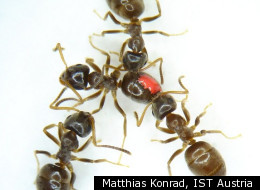
Obrears saludables de la hormiga invasora de jardín,
(Lasiusneglectus) remueven el hongo infeccioso patógeno
 (Metarhiziumanisopliae) de un individuo que ha sido
expuesto a él (marcado con el punto rojo), aseándose  entre sí
Al igual que las megaciudades atestadas, las colonias de hormigas ocupadas enfrentan un alto riesgo de brotes de enfermedades. Una nueva investigación indica que estas "hormigas urbanas" también saben cómo prevenir las epidemias - cuando una hormiga infectada entra en la colonia, sus compañeras de nido cuidadosamente lamen el hongo infeccioso.

"Esto aumento de la supervivencia del individuo que ha sido expuesto originalmente", le dijo a LiveScience la investigadora del estudio Sylvia Cremer, del Instituto de Ciencia y Tecnología de Austria.

Y resulta que comportamiento también puede ayudar a quienes lamen al infectado, dándoles inmunidad individual superior al hongo infeccioso. Los insectos no tienen la "adaptación" del sistema inmunológico que lo hacen los mamíferos, pero son siendo capaces de ajustar sus sistemas de lucha contra la enfermedad de reaccionar a amenazas específicas.

Hongo fluorescente

Cremer, dijo que en la naturaleza, las hormigas pueden recoger una infección por hongos o de otro tipo pueda realizar durante el forrajeo cuando corretean a través de un cadáver de una hormigas o grillo infectado, por ejemplo.

Para averiguar cómo las hormigas Lasius neglectus reaccionarían a un compañero enfermo en la colonia, los investigadores infectaron a una hormiga individual con esporas de hongos marcadas con fluorescencia y dejaron que ellos interactuaran con otros miembros de su colonia, siguiendo, donde terminaron las esporas fluorescentes.

Los investigadores encontraron que cuando esta hormiga infectada regresó a la colonia, sus compañeros de nido no lo evitarlon. En lugar de correr a alejarse del insecto infectado y contagioso, las hormigas se acercaron a su compañero de la colonia y la lamieron, aparentemente para eliminar los agentes patógenos del cuerpo de la hormiga enferma, un comportamiento de acicalamiento social.

Los investigadores vieron que la hormiga infectada originalmente tenían menos probabilidades de morir una vez que sus compañeros de nido eliminaron las esporas. Este comportamiento de lamer expone  las hormigas sanas a una cantidad muy pequeña de los hongos, lo cual era suficiente para ser detectados por las pruebas que hicieron los científicos. Sin embargo, la pequeña cantidad de hongos no hizo las hormigas  que lamieron enfermaran.

Los investigadores observaron que durante la infección de bajo nivel, un conjunto de genes relacionados con las defensas de inmunidad anti-hongos se activaran en las hormigas. Las pruebas de laboratorio revelaron que cuando posteriormente eran expuestas a este hongo, estas hormigas estaban en mejores condiciones para combatir.

Inmunidad de grupo

Los investigadores crearon un modelo informático con los datos de sus experimentos y descubrió que este comportamiento de lamer, mientras que mata a un bajo número de hormigas, permite a una colonia como un todo para recuperarse de una infección por hongos más rápidamente.

El comportamiento de lamer es similar al concepto humano de una vacuna, que expone a las personas a una cepa debilitada o muerta del virus para cebar el sistema inmunitario. Los seres humanos no descubrieron la inmunidad protectora hasta que Edward Jenner creó la vacuna contra la viruela en 1796.

Este tipo de intervenciones funcionan mejor cuando toda la población es tratada, dando lugar a la "inmunidad de rebaño", en el que incluso los individuos no inmunizados no corren el riesgo de la enfermedad, ya que están rodeados de personas inmunes.

El estudio fue publicado hoy (03 de abril) en la revista PLoS Biology.

Puedes seguir LiveScience redactora Jennifer Welsh en Twitter @ microbelover. Siga LiveScience lo último en noticias sobre ciencia y los descubrimientos en Twitter @ LiveScience y en Facebook.


sábado, 4 de febrero de 2012

The Secret of Ant Transportation Networks


Just how ants create the highly efficient network of trails around their nests has never been fully understood. Now researchers think they've cracked it

02/02/2012

Among the most impressive transportation networks on the planet are the complex trails that ants create around their nests. These networks arise through the ants' exploration of their environment and end up channelling the distribution of food for the colony and the daily movements hundreds of thousands of individuals.

What's more, these networks aren't just a random criss-crossing of space. Instead, they are a highly efficient solutions to the problem of searching and transporting food. Various groups have created ant-like foraging algorithms to do other types of virtual exploration.  

One question that has fascinated biologists is how ants build these networks. They've known for some time that ants leave small deposits of pheromones as they travel and that other ants follow these trails, leaving their own deposits. This increases the concentration of the pheromone, strengthening the trail. 

But the precise algorithm that governs the way ants respond to pheromones has been harder to pin down. Many experiments show that a trail can only be reinforced if ants have a disproportionately higher probability to follow a  trail with higher pheromone concentration.  

Biologists have always assumed that this disproportionate response means ants must have a non-linear response to the chemical. In other words, an ant's tendency to turn towards a pheromone deposit is related in a non-linear fashion to the concentration.

But that seems to conflict with one of the great triumphs of experimental biology--Weber's Law, which relates the perceived intensity of a stimulus to its physical magnitude. Biologists know this holds for the human perception of many stimuli, such as the intensity of sound, and have also verified it in many insects. So why not in ants?

Today, Andrea Perna at the Complex Systems Institute of Paris Ile de France and a few pals, resolve the issue. These guys have developed an entirely new way to image pheromone trails which allows them to study ant response to pheromones in more detail than ever before

They say the structure of ant trails can be entirely explained if the ants's response to a pheromone droplet concentration is linear. "One ant will turn to the left in proportion to the difference between the pheromone it has on its left side and the pheromone on its right," say Perna and co.

They also point out that this is exactly what Weber's law predicts.

So where does the non-linearity required to create trails come from? Perna and co say that ant behaviour is inevitably noisy.  "We show that the required non-linearity does not reside in the perceptual response of the ants, but in the noise associated with their movement," they say.

That's a fascinating result because it reveals how complexity in nature forms with the simplest of inputs

And it clearly has implications for the study of other complex structures that ants create, such as their nests. Just how ants create these huge vibrant structures has long puzzled biologists. 

Perna and friends hint at an answer in their conclusion. "We can imagine that other collective phenomena, such as group decision-making, could also be founded on coupling between Weber’s Law and simple feedback mechanisms."

In the case of nests, this mechanism would have to operate in three dimensions rather than two. But that shouldn't be too much of a challenge. Perhaps a problem that a relatively simple computer model could help solve.    

Ref: arxiv.org/abs/1201.5827Individual Rules For Trail Pattern Formation In Argentine Ants (Linepithema Humile)

miércoles, 1 de febrero de 2012

La arqueología de una colonia de hormigas

ORIGINAL: OpenCulture
01 de febrero 2012


Las hormigas no dejan de sorprender. Viajan por el mundo con un podómetro interno. Pueden construir una balsa salvavidas en 100 segundos. Y, lo que demuestra la notable capacidad de inteligencia de-centralizada, que pueden crear un túnel en la tierra y producir extensas colonias subterráneas, estructuras equivalentes en los seres humanos a la construcción de la Gran Muralla de China. 

El vídeo procede del documental "Las Hormigas: El poder secreto de la naturaleza", que aparece a continuación en su totalidad. H / T BoingBoing.