Mostrando entradas con la etiqueta Tsinghua U. Mostrar todas las entradas

viernes, 3 de julio de 2015

One of the Most Important Tools in Science Now Fits Inside Your Phone

A spectrometer that fits in your mobile devices could let you scan yourself for skin cancer.

Illustration by Mary O'Reilly
We use them to spy on exoplanets, diagnose skin-cancer, and ID the makeup of unknown chemicals. They're on NASA spacecraft flying around Saturn's moons right now. Yes, right alongside the microscope, the optical spectrometer—an instrument that breaks down the light that something reflects or emits, telling you what its made of—is one of the most ubiquitous tools in all of science. Today, Jie Bao, a physicist at Tsinghua University in Beijing, China, has just discovered a fascinating way to make them smaller, lighter, and less expensive than we ever thought possible.

By using tiny amounts of strange, light-sensitive inks, Bao and his colleague Moungi Bawendi—a chemist at MIT—have designed a working spectrometer that's small enough to fit on your smartphone. Because of the tool's simple design and its need for only an incredibly small amount of the inks, Bao says, his spectrometer only requires a few dollars worth of materials to make. They report the research today in the journal Nature.

"THAT'S WHAT I'M REALLY HOPING FOR, SEEING THEM IN CELLPHONES IN THE VERY NEAR FUTURE."

"Of course we still have a lot of room for improvement. But performance-wise, even at this preliminary stage, our spectrometer works very close to what's currently being sold in the market," Bao says. "I think that's one of the most attractive results of our research: [This spectrometer] is already so close to a real product."

Printable Detectors
The way spectrometers work goes back to the 17th century, when Issac Newton showed that a prism could break up white light into distinct bars (technically wavelengths) of different colored light. Depending on the source of the light—say, a candle or the sun—that rainbow spectrum would change. Today, we know this happens because the atomic or molecular makeup of everything that either gives off or reflects light leaves an indelible fingerprint. And if you understand which materials leave which fingerprints, you can use light alone to find out what something is made of.

Bao says most modern spectrometers are made in more or less the same way. They diffract incoming light, then push it through a mechanically movable slit to see which exactly which wavelengths of light fit through which slits. This setup, because it involves complex moving pieces, is a total pain to shrink down in size. It's expensive, too, because accurate spectrometers require high-precision components and delicate alignment.
Jie Bao
But Bao's spectrometer works in a much simpler way. As if making micro-sized stained glass windows, Bao prints a tiny grid of 195 different-colored liquid inks directly onto a flat sensor. (That sensor, called a CCD sensor, is what your phone's camera uses to pick up light.) Each of the 195 windows is made of a material called colloidal quantum dots, and each "absorbs certain wavelengths of light, and lets others go," says Bao. When light hits each window and travels through, the underlying sensor records how the light changed. Later, a computer can compare the data from all of the windows and reconstruct what wavelengths made up the original light.

Cellphone Spectrometers
Right now, Bao's spectrometer is about the size of a quarter, and he says the underlying CCD sensors he uses can be bought online for less than a dollar a pop. Because he's using just a tiny drop of each of the colloidal quantum dot inks (which have only recently been developed) the cost all 195 drops is only on the order of a few dollars.

"THE PEOPLE WHO ARE PLANNING SPACE MISSIONS ARE WEIGHING EVERY GRAM."

Because spectrometers are so widely used in science, Bao sees a rainbow of possible uses for his new device. For one, he says, his spectrometers could be easily integrated into commercial smartwatches and phones, allowing everyday people to do things like self-identify skin cancer. "That's what I'm really hoping for, seeing them in cellphones in the very near future," he says.

And because spectrometers are so widely used on exploratory spacecraft, Bao sees an easier and far cheaper way to deck out the next generation of space explorers. "The people who are planning space missions are pretty much weighing every gram, and so this would be a very easy way to lose weight."

Jul 1, 2015 

miércoles, 18 de septiembre de 2013

On the Road to Fault-Tolerant Quantum Computing:

ORIGINAL: Lawrence Berkeley National Laboratory
Lynn Yarris
September 16, 2013
Collaboration at Berkeley Lab’s Advanced Light Source Induces High Temperature Superconductivity in a Toplogical Insulator
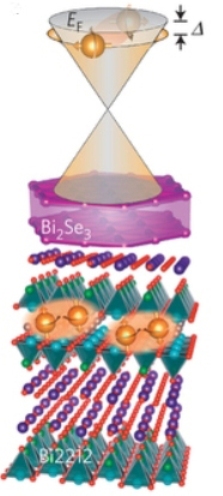
This schematic of a bismuth selenide/BSCCO cuprate (Bi2212)
heterostructure shows a proximity-induced high-temperature superconducting gap on the surface states of the bismuth selenide topological insulator.

Reliable quantum computing would make it possible to solve certain types of extremely complex technological problems millions of times faster than today’s most powerful supercomputers. Other types of problems that quantum computing could tackle would not even be feasible with today’s fastest machines. The key word is “reliable.” If the enormous potential of quantum computing is to be fully realized, scientists must learn to create “fault-tolerant” quantum computers. A small but important step toward this goal has been achieved by an international collaboration of researchers from China’s Tsinghua University and the U.S. Department of Energy (DOE)’s Lawrence Berkeley National Laboratory (Berkeley Lab) working at the Advanced Light Source (ALS).

Using premier beams of ultraviolet light at the ALS, a DOE national user facility for synchrotron radiation, the collaboration has reported the first demonstration of high-temperature superconductivity in the surface of a topological insulator – a unique class of advanced materials that are electrically insulating on the inside but conducting on the surface. Inducing high-temperature superconductivity on the surface of a topological insulator opens the door to the creation of a pre-requisite for fault-tolerant quantum computing, a mysterious quasiparticle known as the “Majorana zero mode.”

“We have shown that by interfacing a topological insulator, bismuth selenide, with a high temperature superconductor, BSCCO (bismuth strontium calcium copper oxide), it is possible to induce superconductivity in the topological surface state,” says Alexei Fedorov, a staff scientist for ALS beamline 12.0.1, where the induced high temperature superconductivity of the topological insulator heterostructure was confirmed. “This is the first reported demonstration of induced high temperature superconductivity in a topological surface state.”

The results of this research are presented in the journal Nature Physics in a paper titled “Fully gapped topological surface states in Bi2Se3 induced by a d-wave high temperature superconductor.” The corresponding authors are Shuyun Zhou and Xi Chen of Tsinghua University in Beijing, China. The lead authors are Eryin Wang and Hao Ding, also with Tsinghua University. Wang is currently an ALS Doctoral fellow in residence.

For all of its boundless potential, quantum computing faces a serious flaw. The quantum data bit or “qubit” used to process and store information is fragile and easily perturbed by electrons and other elements in its surrounding environment. Utilizing topological insulators is considered one promising approach for solving this “decoherence” problem because qubits in a topological quantum computer would be made from Majorana zero modes, which are naturally immune from decoherence. Information processed and stored in such topological qubits would always be preserved. While the ALS collaboration has not yet identified a Majorana zero mode in their bismuth selenide/BSCCO heterostructures, they believe their material is fertile ground for doing so.

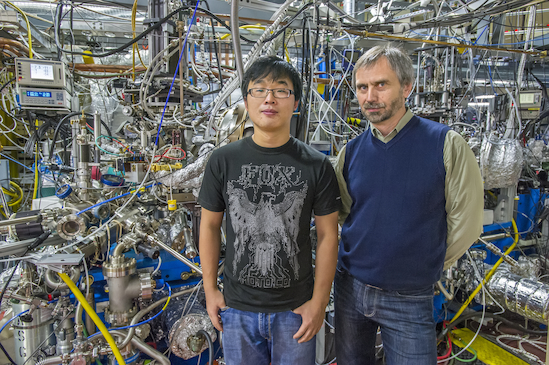
Eryin Wang (left)and Alexei Fedorov at ALS Beamline 12.0.1 where the induced high temperature superconductivity in a topological insulator was confirmed. (Photo by Roy Kaltschmidt)


“Our studies reveal a large superconducting pairing gap on the topological surface states of thin films of the bismuth selenide topological insulator when grown on BSCCO,” Fedorov says. “This suggests that Majorana zero modes are likely to exist, bound to magnetic vortices in this material, but we will have to do other types of measurements to find it.”

The high quality bismuth selenide/BSCCO topological thin film heterostructure was made at Tsinghua University in the laboratory of Xi Chen and Qi-Kun Xue using molecular beam epitaxy.

“Our study was made possible by the high quality topological insulator film heterostructure that the Chen and Xue groups managed to grow,” says Zhou, who did much of her research at the ALS before returning to China. “Bismuth selenide and the BSSCO ceramic have very different crystal structures and symmetries, which made the growth of such a heterostructure particularly challenging.”

Says Chen, “By controlling the growth kinetics carefully using molecular beam epitaxy, we managed to grow a topological insulator film with controlled thickness on a freshly cleaved BSCCO surface. This provided a cleaner and better-controlled interface, and also opened up opportunities for surface sensitive measurements.”

The bismuth selenide/BSCCO material was brought to the ALS to study the electronic states on its surface using a technique known as ARPES, for angle-resolved photoemission spectroscopy. In ARPES, a beam of X-ray photons striking the material’s surface causes the photoemission of electrons. The kinetic energy of these photoelectrons and the angles at which they are ejected are then measured to obtain an electronic spectrum.

“Previous work on topological insulators revealed superconductivity at only a few Kelvin with a gap of about one milli-electron volt,” Fedorov says. “Such a small energy scale and ultra-low temperature makes it particularly challenging to realize Majorana zero modes experimentally, and to distinguish these modes from other states. Using ARPES, we show evidence of a superconducting gap persisting in the surfaces of our material up to the transition temperature of BSCCO. As the gap and transition temperature in our heterostructure reflect almost an order of magnitude increase over previous work, we believe ours is a better system to search for Majorana zero modes.”

This research was primarily supported by the National Natural Science Foundation of China.

# # #

Lawrence Berkeley National Laboratory addresses the world’s most urgent scientific challenges by advancing sustainable energy, protecting human health, creating new materials, and revealing the origin and fate of the universe. Founded in 1931, Berkeley Lab’s scientific expertise has been recognized with 13 Nobel prizes. The University of California manages Berkeley Lab for the U.S. Department of Energy’s Office of Science. For more, visit www.lbl.gov.

The Advanced Light Source is a third-generation synchrotron light source producing light in the x-ray region of the spectrum that is a billion times brighter than the sun. A DOE national user facility, the ALS attracts scientists from around the world and supports its users in doing outstanding science in a safe environment. For more information visit www-als.lbl.gov/.The Advanced Light Source is a third-generation synchrotron light source producing light in the x-ray region of the spectrum that is a billion times brighter than the sun. A DOE national user facility, the ALS attracts scientists from around the world and supports its users in doing outstanding science in a safe environment. For more information visit http://www.als.lbl.gov/. TAGS: Advanced Light Source, computational research, computing, materials, quantum computing, superconductors