ORIGINAL: EFE CNet en Español

Mostrando entradas con la etiqueta Marte. Mostrar todas las entradas
Mostrando entradas con la etiqueta Marte. Mostrar todas las entradas
martes, 16 de junio de 2015

miércoles, 24 de septiembre de 2014
India makes history with successful maiden voyage to Mars
Indian space agency's low-cost mission to Mars has successfully entered the red planet's orbit, crowning India as first country to execute such a project in its maiden attempt
India has triumphed in its first interplanetary attempt by successfully putting a satellite into orbit around Mars.
Scientists broke into wild cheers on Wednesday morning as the orbiter's engines completed 24 minutes of burn time and maneuvered into its designated place around the red planet.

The success of India's Mars Orbiter Mission, affectionately nicknamed MOM, brings India into an elite club of Martian explorers that includes United States, the European Space Agency and the former Soviet Union.
The success of the Mars Orbiter Mission, lauded for its low price tag of $74 million, will boost India's five-decade-old space programme that newly-elected Prime Minister Narendra Modi aims to expand with better infrastructure and technology.
ORIGINAL: Telegraph
India has triumphed in its first interplanetary attempt by successfully putting a satellite into orbit around Mars.
Scientists broke into wild cheers on Wednesday morning as the orbiter's engines completed 24 minutes of burn time and maneuvered into its designated place around the red planet.
The rocket launch (DD)
The success of India's Mars Orbiter Mission, affectionately nicknamed MOM, brings India into an elite club of Martian explorers that includes United States, the European Space Agency and the former Soviet Union.
The success of the Mars Orbiter Mission, lauded for its low price tag of $74 million, will boost India's five-decade-old space programme that newly-elected Prime Minister Narendra Modi aims to expand with better infrastructure and technology.
ORIGINAL: Telegraph
viernes, 30 de agosto de 2013
Are We Martians After All?
ORIGINAL: Science
2013-08-29
 |
| NASA/JPL-Caltech/MSSS. Life’s cradle? According to biochemist Steven Benner, life on Earth may have originated in martian rock samples like these. |
If you looked in a mirror this morning, you may have seen a descendant of creatures from Mars. That is, if biochemist Steven Benner of the Westheimer Institute of Science and Technology in Gainesville, Florida, is right. “Life started on Mars and came to Earth on a rock,” Benner declares. Today, at the European Association of Geochemistry’s Goldschmidt Conference in Florence, Italy, Benner made what many in the origin-of-life debate call an interesting, but not convincing, new case for our martian heritage.
However and wherever life began, one thing is sure: Its first organic building blocks, called hydrocarbons, had a number of hurdles to clear before evolving into living cells. Fed with heat or light and left to themselves, hydrocarbons tend to turn into useless tarlike substances. And even when complex molecules like RNA (most biologists' best guess for the first genetic molecule) arise, water quickly breaks them down again.
Benner argues that those chemical hurdles would have been lower on early Mars than on young Earth. To begin with, early Earth was probably a water world, completely covered by oceans, but water covered only parts of Mars’s surface. Moreover, he notes, rocks on Mars had a stronger oxidizing effect than rocks on Earth, so oxygen-bearing molecules would have formed more easily there. "This is established by observations today on both planets, as well as by models for how planets form," he says.
As a result, molybdates—molecules that contain molybdenum and oxygen—could have existed on Mars, but probably not on Earth. Like oxidized boron (which occurs in dry regions and would also have been rare on a water-covered early Earth), molybdates tend to prevent organic materials from turning into tar. Benner says laboratory experiments show that molybdates can convert certain organic molecules into ribose—an important component of DNA. “This is a fact,” he says.
That would make it more likely that life originated on our planetary neighbor, Benner says. Martian microorganisms could have reached Earth on meteorites, flung away from the Red Planet’s surface by cosmic impacts.
Benner’s hypothesis “is a neat idea, but not yet proven,” says biochemist William Bains of the Massachusetts Institute of Technology in Cambridge. Some theories for the origin of life do not need molybdenum at all, Bains says, and scientists don’t know for sure whether early Earth was completely covered in water while early Mars was not.
Astrobiologist Paul Davies of Arizona State University, Tempe, agrees that Benner’s argument “greatly strengthens the case” for Mars as the first home of terrestrial life. But, he adds, “It comes down to probabilities. The case is suggestive but not overwhelming.” Even if early life existed on Mars, he says, it would be hard to prove that those life forms planted the seeds of our own existence. “In fact, because the traffic of [meteoritic] material between Earth and Mars is so prolific, once life gets going on one it will be transferred to the other very quickly, making the place of origin almost impossible to discern.”
Astrochemist Pascale Ehrenfreund of George Washington University in Washington, D.C., is a bit more optimistic about resolving the issue. Laboratory experiments under conditions that resemble early Mars might lead to realistic answers, she says. But she doesn’t find Benner’s “interesting idea” convincing.
Benner himself concedes that scientists may never know how and where life emerged. "We will likely need to be satisfied with answers to a more indirect question: How might life have emerged?” Finding martian life, either extant or extinct, could help by revealing information about ancient martian biochemistry. “This could lead to an ‘Aha!’ moment that opens new thinking relevant to the historical question.”
As for pinpointing the location of the origin of life once and for all, Benner quips, “Building a time machine will help.”
jueves, 25 de abril de 2013
15-Year-Old May Be on Her Way to Mars
ORIGINAL: Mashable

It was nothing short of fate when Abigail Harrison spotted her hero, astronaut Luca Parmitano, in an airport security line.
At just 15 years old, Harrison knows what she wants to do with her life: become the first astronaut on Mars in 2030. And the ever-so-keen Harrison — a well-spoken Minnesota high school student who has a confidence that doesn't come naturally to most teenagers — knew picking Parmitano's brain would bring her one step closer.
"He had an hour before flight, and we talked for the whole time," she tells Mashable. "He was really interested in my dream and wanted to stay in touch."
Parmitano lived up to his promise, and now the two are undertaking an unprecedented project. When Parmitano travels to the International Space Station on board a Russian Soyuz spacecraft this May, Harrison will serve as his Earth-based liaison.
Each day, Parmitano will correspond via email with Harrison, who will in turn distribute his photos, video and research to the world on her blog. Their hope is to continue the buzz that Twitter's favorite astronaut Chris Hadfield, who returns to Earth in May, has generated while on the ISS.
"Commander Hadfield has done such amazing job of getting the public interested in the ISS, and we don't want that to go away when he comes back down," she says. "Luca is going to carry on the flag."
 |
| Abigail Harrison video chats with astronaut Luca Parmitano. Image courtesy of Abigail/Nicole Harrison |
Harrison, who operates under the online persona "Astronaut Abby," has already amassed an impressive following. \Harrison's niche celebrity, though, wasn't her original intention. It all started with an eighth-grade project she was doing about the ISS.
"My mom helped me set up Twitter to get in touch with NASA employees for quotes," she says. "So I started sharing pictures of projects I was working on and writing about my dreams."
NASA and other influencers in the space community took notice and helped fill her plate with projects. Harrison now travels around the country promoting space and STEM careers in schools. She's introducing a pen-pal program in which she'll send readers personal emails about her experiences. This August, she will speak at a convention for the Mars Society about her No. 1 love: the importance of putting a human on the Red Planet.
"I was raised on a diet of sci-fi and Star Wars, but the science drew me," Harrison says.
"I was raised on a diet of sci-fi and Star Wars, but the science drew me," Harrison says. "The curiosity of the unknown is why I'm focused on Mars. There is so much we can learn; it's just an outstanding amount of knowledge waiting there for us to discover."
Even as she manages these projects, her public-facing appearance and an upcoming trip to Russia for Parmitano's launch, Harrison is still a kid. She's studying hard to get into her college of choice — she plans to double major in biology and geology — and has social plans for the summer.
So she relies heavily on her mother, Nicole, who says she knew her daughter's space aspiration was not merely a childhood fascination.
"I told her [...] if she was serious she needs to research what it would take because it's a very hard career to attain," Mrs. Harrison tells Mashable via email.
"She came back a week later with two sheets of paper and said, 'Mom there are two ways to become an astronaut: civilian and military. Here are the two paths and this is what I am going to do to make my dream happen.'"
Today, Mrs. Harrison helps her daughter with article ideas, editing and publishing her posts, and assisting her on social outreach to make sure her news is getting out in a timely manner. Perhaps most importantly, Mrs. Harrison reviews and monitors all of her daughter's communications.
"Reaching out to budding scientists and kids around the globe is what really drives Abby to chase her dreams. I've been so inspired by her as she continues to achieve her goals," Mrs. Harrison says. "At the rate she is going, I have no doubt she'll be the first astronaut on Mars."
martes, 23 de abril de 2013
A one-way ticket to Mars, apply now
ORIGINAL: CNN
By Ben Brumfield and Elizabeth Landau, CNN
April 22, 2013
 |
| Would you take a one-way trip to Mars? |
STORY HIGHLIGHTS
- Mars One wants to fly people to Mars and leave them there to live
- Every two years, a new crew would join them
- There is no return flight; you die there
- Some of it is media hype, but some is not, a source says
(CNN) -- Step right up and prove why you should get a one-way ticket to Mars! Well, wait -- you might want to know a little more about the venture first.
A Dutch company called Mars One began looking Monday for volunteer astronauts to fly to Mars. Departure for the Red Planet is scheduled for 2022, landing seven months later in 2023.
The space travelers will return ... never. They will finish out their lives on Mars, representatives from the nonprofit said.
"It's likely that there will be a crematorium," said CEO Bas Lansdorp. "It's up to the people on Mars to decide what to do with their dead."
Still, the company said it has received more than 10,000 e-mails from interested would-be spacefarers.
The one-way ticket makes the mission possible because it greatly reduces costs, and the technology for a return flight doesn't exist, according to Mars One's website. At a news conference, Lansdorp maintained that "no new inventions are needed to land humans on Mars."
The biggest obstacles, he said, are financial. The company has revealed some of its sponsors and hopes to gain more via media coverage. It's not clear whether enough money will be collected in time.
There are also practical issues: Can the kinks in having a sustainable system for people to survive in such a harsh environment be worked out by 2023?
"Questions of reliability and robustness have to be answered before we leave Earth," said Grant Anderson of Paragon Space Development Corporation, which builds life-support systems and is joining the Mars One effort.
Anyone may apply, for a fee

The company announced a casting call for candidates at a news conference in New York City.
Anyone 18 or older may apply via video but there is an application fee -- $38 for U.S. applicants. The money will fund the mission.
Mars One wants to build a colony that will be able to grow with an ever-expanding crew. The group has a plan for testing the technology that would transport people and things.
The group wants to launch a supply mission that will land on Mars as soon as October 2016. A "settlement rover" will land in 2018.
The landing systems will be tested a total of eight times before they're used to transport humans, which Lansdorp says would make this "much safer than moon missions."
The colony's budget comes in at "about $6 billion," Lansdorp said. "The $6 billion is for the first crew that goes there."
By comparison, NASA's rover Curiosity, the most advanced and biggest robot to ever traverse Mars, is a $2.5 billion mission.
Where exactly the $6 billion will go remains a mystery. Lansdorp said he didn't want to release an itemized budget because of competition.
Mars One intends for a second crew to join the first one in 2025, and more will follow regularly. Each flight will carry two men and two women, so reproduction on Mars would be feasible but not intended.
"We will certainly not send couples," Lansdorp said.
At the news conference, Lansdorp said he'd like to go to Mars himself, but he isn't because his girlfriend won't come along.
"I have a really nice girlfriend, and she doesn't want to come with me, so I'm staying right here."
Are they for real?
The idea of starting a colony on Mars in 10 years seems so out of this world that CNN contacted one of the mission's potential suppliers to check on Mars One's credibility.
"I don't think they deserve to be dismissed," said a spokesman for an aerospace company that contracted for NASA's current Mars mission.
The spokesman did not want his company named because he didn't want to damage the company's relationship with Mars One, but he felt he should talk to CNN to help put the Dutch start-up into perspective for a news audience, he said.
With space opening up to the private sector, many companies large and small are trying to get in on the game, he said. Mars One's idea is one of the most audacious ones.
Strange, dangerous mission
As far as getting to Mars, Lansdorp said his organization is in discussions with SpaceX, the company that has now completed two commercial cargo missions to the International Space Station. The idea would be to use a slightly enlarged version of the Dragon capsule and land with retro-propulsion, not by parachute.
If they get there, Mars astronauts will face a lonely life of danger, subsisting for extended periods on dried and canned food. They will get some of their water by recycling their urine.
They will have to take care of sickness and injuries themselves.
"There will be emergencies and deaths," Lansdorp said. "We need to make sure that crew members can continue without those people."
Mars astronauts will have to be mentally fit to deal with the unusual stresses, he said.
"Their psychological skills will be the main selection criteria we will use," he said.
Once selected, a group of 40 astronauts will undergo seven years of training.
The flight to Earth's neighbor, with its barren red desert landscape and thin carbon dioxide atmosphere, sounds almost worse than a lifetime on it. The crew of four will be cooped up on a rocket for seven months with a limited supply of food and water.
It also might smell bad.
"Showering with water will not be an option," according to Mars One's website.
Mars, the greatest show on Earth
Mars One plans to fund the mission partly from the sale of technology developed during the mission, Lansdorp said. It will share it with potential suppliers, which Mars One lists on its website.
Media coverage will provide the main funding for the mission, Mars One said. Publicity is key, and the media event begins now with the casting of the astronauts.
"Not unlike the televised events of the Olympic Games, Mars One intends to maintain an ongoing, global media event, from astronaut selection to training, from liftoff to landing," it says.
How much money will that yield? It's tough to say, but the NCAA projects it will take in $700 million for television broadcast rights for its 2013 college sporting events.
Lansdorp said that after consulting with media experts and ad agencies, he's confident life on Mars will remain a hit for decades on Earth and will be able to weather any financial crisis or war on Earth.
"If humans land on Mars, everyone will want to watch," he said. "It will be bigger than the Olympic Games."
If all goes well, Earthling television viewers can look forward to a decades-long reality show, though Lansdorp said the astronauts will be allowed to turn the cameras off at times.
It's not just about the hype
The spokesman for the aerospace company credits Mars One for creating a media spectacle and marrying it to technology.
"They very aggressively seem to be pursuing the reality-TV angle," he said.
It has gotten the small company to a stage that it can begin feasibility studies with aerospace companies, he said. It's also allowing scientists to work on ideas they otherwise might not have been able to pursue.
"It may fund development that would otherwise not get funded," he said.
The aerospace spokesman is hopeful Lansdorp and his team may one day say, "Mission accomplished." Even if they don't, though, they will likely reach other milestones.
"We can't predict how far they'll get," he said.
If the mission flops, Lansdorp has ideas about what the nonprofit would do with any leftover money: Donate it to organizations that support space travel, such as the Planetary Society.
You might be thinking that $6 billion would be better spent on Earth, but Lansdorp says the money won't mean much on our planet.
Besides, he said, "I don't have a business case to solve the problems on Earth. I have a really good business case to get humans to Mars."
martes, 2 de abril de 2013
Collision Course? A Comet Heads for Mars
ORIGINAL: NASA
March 27, 2013: Over the years, the spacefaring nations of Earth have sent dozens of probes and rovers to explore Mars. Today there are three active satellites circling the red planet while two rovers, Opportunity and Curiosity, wheel across the red sands below. Mars is dry, barren, and apparently lifeless.
Soon, those assets could find themselves exploring a very different kind of world.
"There is a small but non-negligible chance that Comet 2013 A1 will strike Mars next year in October of 2014," says Don Yeomans of NASA's Near-Earth Object Program at JPL. "Current solutions put the odds of impact at 1 in 2000."

The nucleus of the comet is probably 1 to 3 km in diameter, and it is coming in fast, around 56 km/s (125,000 mph). "It if does hit Mars, it would deliver as much energy as 35 million megatons of TNT," estimates Yeomans.
For comparison, the asteroid strike that ended the dinosaurs on Earth 65 million years ago was about three times as powerful, 100 million megatons. Another point of comparison is the meteor that exploded over Chelyabinsk, Russia, in February of 2013, damaging buildings and knocking people down. The Mars comet is packing 80 million times more energy than that relatively puny asteroid.
An impact wouldn't necessarily mean the end of NASA's Mars program. But it would transform the program-- along with Mars itself.
"I think of it as a giant climate experiment," says Michael Meyer, lead scientist for the Mars Exploration Program at NASA headquarters. "An impact would loft a lot of stuff into the Martian atmosphere--dust, sand, water and other debris. The result could be a warmer, wetter Mars than we're accustomed to today."
Meyer worries that solar-powered Opportunity might have a hard time surviving if the atmosphere became opaque. Nuclear-powered Curiosity, though, would carry on just fine. He also notes that Mars orbiters might have trouble seeing the surface, for a while at least, until the debris begins to clear.
 |
| Opportunity might have trouble observing the aftermath of a comet impact if dust in the air cuts sunlight to the rover's solar panels. More |
A direct impact remains unlikely. Paul Chodas of NASA's Near-Earth Object Program stresses that a 1 in 2000 chance of impact means there's a 1999 in 2000 chance of no impact. "A near-miss is far more likely," he points out.
Even a near miss is a potentially big event. The latest orbit solutions put the comet somewhere within 300,000 km of the red planet at closest approach. That means Mars could find itself inside the comet's gassy, dusty atmosphere or "coma." Visually, the comet would reach 0th magnitude, that is, a few times brighter than a 1st magnitude star, as seen from the Red Planet.
"Cameras on ALL of NASA's spacecraft currently operating at Mars should be able to take photographs of Comet 2013 A1," says Jim Bell, a planetary scientist and Mars imaging specialist at Arizona State University. "The issue with Mars Odyssey and the Mars Reconnaissance Orbiter will be the ability to point them in the right direction; they are used to looking down, not up. Mission designers will have to figure out if that is possible."
"The issue with the Opportunity and Curiosity rovers will be power for imaging at night," he continues. "Opportunity is solar powered and so would need to dip into reserve battery power to operate the cameras at night. Whether or not we will be able to do this will depend on how much power the rover is getting from dusty solar panels in the daytime. On the other hand, Curiosity is nuclear powered, so it could have better odds at night-time imaging."
Researchers will be keenly interested to see how the comet's atmosphere interacts with the atmosphere of Mars. For one thing, there could be a meteor shower. "Analyzing the spectrum of disintegrating meteors could tell us something interesting about the chemistry of the upper atmosphere," notes Meyer.
 |
| Click to view an interactive 3D orbit of Comet 2013 A1. |
Another possibility is Martian auroras. Unlike Earth, which has a global magnetic field that wraps around our entire planet, Mars is only magnetized in patches. Here and there, magnetic umbrellas sprout out of the ground, creating a crazy-quilt of magnetic poles concentrated mainly in the southern hemisphere. Ionized gases hitting the top of the Martian atmosphere could spark auroras in the canopies of the magnetic umbrellas.
Even before the comet flyby was known, NASA had already decided to send a spacecraft to Mars to study the dynamics of the Martian atmosphere. If the probe, named MAVEN (short for "Mars Atmosphere and Volatile Evolution"), is launched on time in November 2013, it would reach Mars just a few weeks before the comet in 2014.
However, notes MAVEN's principal investigator Bruce Jakosky of the University of Colorado, the spacecraft won't be ready to observe the comet when it reaches Mars. "It takes a while to get into our science mapping orbit, deploy the booms, turn on and test the science instruments--and so on," he explains. "MAVEN won't be fully operational until perhaps two weeks after the comet passes. There are some effects that I would expect to linger for a relatively long period--especially if the comet hits Mars--and we will be able to observe those changes."
Astronomers around the world are monitoring 2013 A1. Every day, new data arrive to refine the comet's orbit. As the error bars shrink, Yeomans expects a direct hit to be ruled out. "The odds favor a flyby, not a collision," he says.
Either way, this is going to be good. Stay tuned for updates as the comet approaches.
lunes, 1 de abril de 2013
Curiosity's Hit-and-Run Leads to Another Martian Discovery
ORIGINAL: The Atlantic
Behold: "One of the whitest things" we've seen on the Red Planet
 |
| The white planet? The "Tintina" rock Curiosity cut through in its travels (NASA/JPL-Caltech) |
Back in January, the Mars Curiosity rover did what it was built to do: It plowed over some rock. On this particular day, however, one of the rocks the rover roved over broke apart -- revealing, in pictures beamed back to Earth, a shiny-white interior that stands in sharp relief against the dusty-red Martian landscape. "This is one of the brightest and whitest things we've seen with the Mastcam [Curiosity's camera] at the Gale Crater site," Caltech's Melissa Rice said of the object.
Scientists have since been analyzing information about the mystery rock -- nicknamed, awesomely, "Tintina" -- and today, at the annual Lunar and Planetary Science Conference (LPSC) in Texas, they've released their findings.
And those findings, like so many of the things we learn about Mars with the help of our little robotic liaison, represent both "discovery" and "mystery." We know, for example, that the chalky-white rock is roughly 1.2 inches by 1.6 inches -- the size, basically, of a large marble. The images of Tintina's seam would also seem to indicate the presence of hydrated minerals -- the kind so familiar to us here on Earth. Which might also indicate the presence (or, the erstwhile presence) of water. And which offers yet more evidence that the area Curiosity is roving -- Yellowknife Bay -- was once home to the life-friendly liquid.
As Rice explained to the BBC: "What Mastcam is seeing is water that is bound in the mineral structure of the rocks. This water is left over from a previous wet era and is now trapped and preserved in these hydrated minerals."
The Tintina announcement comes hot on the heels of one of Curiosity's biggest findings: that Mars boasts environmental conditions that could once have supported life as we know it. And Curiosity has observed, as well, what scientists believe to be the remains of an ancient riverbed near its landing site at the Gale Crater. "The picture that seems to be emerging," the BBC put it in a report from the LPSC, "is one where sediments were transported downhill from the eroding crater rim into a network of streams that then flowed into a lake environment represented by the mudstone drilled by Curiosity." And it's a picture made a little clearer by Curiosity's serendipitous excavation. Mars, site of an ancient Slip 'n Slide! Just one more piece of information about the Red Planet, brought to you by a white rock.
martes, 19 de marzo de 2013
Last Week In Science. IFLS
ORIGINAL: Elise Andrew
 |
Teeth: http://bit.ly/13RjIRT
Higgs Boson: http://nyti.ms/XLnJUR
HIV: http://bit.ly/ZTdyvg
Mars: http://bit.ly/YbObXe
Extinct frog: http://bit.ly/13Xi8y2
Liver: http://bit.ly/1008qaW
miércoles, 13 de marzo de 2013
NASA Rover Finds Conditions Once Suited for Ancient Life on Mars
ORIGINAL: NASA
March 12, 2013
PASADENA, Calif. -- An analysis of a rock sample collected by NASA's Curiosity rover shows ancient Mars could have supported living microbes.
Scientists identified sulfur, nitrogen, hydrogen, oxygen, phosphorus and carbon -- some of the key chemical ingredients for life -- in the powder Curiosity drilled out of a sedimentary rock near an ancient stream bed in Gale Crater on the Red Planet last month.
"A fundamental question for this mission is whether Mars could have supported a habitable environment," said Michael Meyer, lead scientist for NASA's Mars Exploration Program at the agency's headquarters in Washington. "From what we know now, the answer is yes."
Clues to this habitable environment come from data returned by the rover's Sample Analysis at Mars (SAM) and Chemistry and Mineralogy (CheMin) instruments. The data indicate the Yellowknife Bay area the rover is exploring was the end of an ancient river system or an intermittently wet lake bed that could have provided chemical energy and other favorable conditions for microbes. The rock is made up of a fine-grained mudstone containing clay minerals, sulfate minerals and other chemicals. This ancient wet environment, unlike some others on Mars, was not harshly oxidizing, acidic or extremely salty.
The patch of bedrock where Curiosity drilled for its first sample lies in an ancient network of stream channels descending from the rim of Gale Crater. The bedrock also is fine-grained mudstone and shows evidence of multiple periods of wet conditions, including nodules and veins.
Curiosity's drill collected the sample at a site just a few hundred yards away from where the rover earlier found an ancient streambed in September 2012.
"Clay minerals make up at least 20 percent of the composition of this sample," said David Blake, principal investigator for the CheMin instrument at NASA's Ames Research Center in Moffett Field, Calif.
These clay minerals are a product of the reaction of relatively fresh water with igneous minerals, such as olivine, also present in the sediment. The reaction could have taken place within the sedimentary deposit, during transport of the sediment, or in the source region of the sediment. The presence of calcium sulfate along with the clay suggests the soil is neutral or mildly alkaline.
Scientists were surprised to find a mixture of oxidized, less-oxidized, and even non-oxidized chemicals, providing an energy gradient of the sort many microbes on Earth exploit to live. This partial oxidation was first hinted at when the drill cuttings were revealed to be gray rather than red.
"The range of chemical ingredients we have identified in the sample is impressive, and it suggests pairings such as sulfates and sulfides that indicate a possible chemical energy source for micro-organisms," said Paul Mahaffy, principal investigator of the SAM suite of instruments at NASA's Goddard Space Flight Center in Greenbelt, Md.
An additional drilled sample will be used to help confirm these results for several of the trace gases analyzed by the SAM instrument.
"We have characterized a very ancient, but strangely new 'gray Mars' where conditions once were favorable for life," said John Grotzinger, Mars Science Laboratory project scientist at the California Institute of Technology in Pasadena, Calif. "Curiosity is on a mission of discovery and exploration, and as a team we feel there are many more exciting discoveries ahead of us in the months and years to come."
Scientists plan to work with Curiosity in the "Yellowknife Bay" area for many more weeks before beginning a long drive to Gale Crater's central mound, Mount Sharp. Investigating the stack of layers exposed on Mount Sharp, where clay minerals and sulfate minerals have been identified from orbit, may add information about the duration and diversity of habitable conditions.
NASA's Mars Science Laboratory Project has been using Curiosity to investigate whether an area within Mars' Gale Crater ever has offered an environment favorable for microbial life. Curiosity, carrying 10 science instruments, landed seven months ago to begin its two-year prime mission. NASA's Jet Propulsion Laboratory in Pasadena, Calif., manages the project for NASA's Science Mission Directorate in Washington.
For more about the mission, visit: http://www.jpl.nasa.gov/msl , http://mars.jpl.nasa.gov/msl/ and http://www.nasa.gov/msl . You can follow the mission on Facebook and Twitter at: http://www.facebook.com/marscuriosity and http://www.twitter.com/marscuriosity
DC Agle 818-393-9011
Jet Propulsion Laboratory, Pasadena, Calif.
agle@jpl.nasa.gov
Dwayne Brown 202-358-1726
NASA Headquarters, Washington
Dwayne.c.brown@nasa.gov
 |
| Two Different Aqueous Environments |
This set of images compares rocks seen by NASA's Opportunity rover and Curiosity rover at two different parts of Mars. On the left is " Wopmay" rock, in Endurance Crater, Meridiani Planum, as studied by the Opportunity rover.
 |
| First Curiosity Drilling Sample in the Scoop. This image from NASA's Curiosity rover shows the first sample of powdered rock extracted by the rover's drill. Image credit: NASA/JPL-Caltech/MSSS |
 |
| Minerals at 'Rocknest' and 'John Klein' |
This side-by-side comparison shows the X-ray diffraction patterns of two different samples collected from the Martian surface by NASA's Curiosity rover. These images, made from data obtained by Curiosity's Chemistry and Mineralogy instrument (CheMin), show the patterns obtained from a drift of windblown dust and sand called "Rocknest" and from a powdered rock sample drilled from the "John Klein" bedrock.
The presence of abundant clay minerals in the John Klein drill powder and the lack of abundant salt suggest a fresh water environment. The presence of calcium sulfates rather than magnesium or iron sulfates (as found at Meridiani Planum by NASA's Mars Exploration Rover Opportunity) suggests a neutral to mildly alkaline pH environment. The Rocknest sand shadow mineralogy suggests a dry, aeolian (wind-shaped) environment with low water activity. The John Klein mineralogy suggests a lacustrine (lakebed) environment with high water activity.
As seen on the left, the Rocknest data reveal abundant plagioclase feldspar, pyroxene and olivine minerals. The data also indicate reveal small amounts of magnetite and anhydrite. In addition, the Rocknest sample contains 25 to 35 percent amorphous, or non-crystalline, material.
X-ray diffraction analysis of the John Klein drill powder reveals abundant phyllosilicate (a class of clay minerals called smectites that form by the action of relatively pure and neutral pH water on source minerals), plagioclase feldspar, pyroxene, magnetite and olivine. Alternatively, the clay minerals could have been transported by water from sources higher up the sediment fan to form the John Klein mineral assemblage. The region of the pattern indicating the phyllosilicates is labeled in the annotated version of this image. The data also show minor amounts of anhydrite and bassanite. The John Klein sample also contains about 20 percent amorphous material.
 |
| NASA's Jet Propulsion Laboratory, a division of Caltech in Pasadena, manages the project for NASA's Science Mission Directorate, Washington, and built Curiosity and CheMin. |
An Earth Analog to Mars' Yellowknife Bay. This set of images shows a modern terrestrial analog to the "Yellowknife Bay" area that NASA's Curiosity rover is exploring. At left is a sampling pit exposing clay-bearing lake sediments, deposited in a basaltic basin in southern Australia. Image Credit: NASA/JPL-Caltech/Ames
 |
| Location of John Klein Drill Site |
 |
| Studying Habitability in Ancient Martian Environments |
This set of images shows the results from the rock abrasion tool from NASA's Mars Exploration Rover Opportunity (left) and the drill from NASA's Curiosity rover (right). Note how the rock grindings from Opportunity are brownish red, indicating the presence of hematite, a strongly oxidized iron-bearing mineral. Such minerals are less supportive of habitability and also may degrade organic compounds. The diameter of the abraded circle is 1.8 inches (4.5 centimeters). The image was cropped from an image

taken on Sol 35 (the 35th Martian day of Opportunity's operations, or Feb. 28, 2004, on Earth) by Opportunity's panoramic camera at a target called "Guadalupe" inside Eagle Crater.
On the right is the hole produced by Curiosity during the first drilling into a rock on Mars to collect a sample from inside the rock. In this case, the rock produced gray tailings -- not red -- suggesting the presence of iron that is less oxidized. One possibility is magnetite, which was determined to be present by Curiosity's Chemistry and Mineralogy instrument. Magnetite has less oxygen than hematite and would be more compatible with habitability and the preservation of organics, all other factors being equal. These other factors would include the primary concentration of organics in the sedimentary environment, in addition to later exposure of rock to surface radiation. The diameter of the hole is 0.63 inch (1.6 centimeters), which is approximately 1/3 of that on the left-hand image. The image was cropped fromPIA16726. It was taken on Sol 182 (the 182d Martian day of Curiosity's operations, or Feb. 8, 2013, on Earth) by the Mars Hand Lens Imager on Curiosity's arm after that day's drilling at a target rock called "John Klein."
JPL manages the Mars Science Laboratory/Curiosity for NASA's Science Mission Directorate in Washington. The rover was designed, developed and assembled at JPL, a division of the California Institute of Technology in Pasadena.
For more about NASA's Curiosity mission, visit: http://www.jpl.nasa.gov/msl, http://www.nasa.gov/mars, andhttp://mars.jpl.nasa.gov/msl.
 |
| Major Gases Released from Drilled Samples of the 'John Klein' Rock |
An analysis of a drilled rock sample from NASA's Curiosity rover shows the presence of water, carbon dioxide, oxygen, sulfur dioxide, and hydrogen sulfide released on heating. The results analyzing the high temperature water release are consistent with smectite clay minerals.
Curiosity's Sample Analysis at Mars (SAM) instrument suite conducted the analysis. The first step in the analysis of a portion of this drilled sample was to heat the sample in a quartz oven to 1,535 degrees Farenheit (835 degrees Celsius) and analyze the gases as they were released using SAM's quadrupole mass spectrometer (QMS). The signatures of more than five hundred mass values were sampled during the heating of this drilled sample and analyzed by the QMS. Five are shown in the graph. These traces are diagnostic of water, carbon dioxide, oxygen, and two forms of sulfur (sulfur dioxide, the oxidized form, and hydrogen sulfide, the reduced form) measured by the QMS.
The second step in the analysis was to send a portion of the gas released from the sample to the tunable laser spectrometer (TLS) to measure isotopes of carbon, oxygen and hydrogen, in both water and carbon dioxide. The ratio of deuterium (a heavy form of hydrogen) to the lighter, more abundant form of hydrogen was lower than the deuterium-to-hydrogen ratio measured by SAM in more loosely bound water in the sample from the "Rocknest" drift. The high deuterium-to-hydrogen ratio in water in the Mars atmosphere is a signature of the lighter hydrogen more rapidly escaping to space over geological time. Therefore, measuring the deuterium-to-hydrogen in water released from rocks is one tool that can be used to explore ancient reservoirs of water on Mars.
The third step in the analysis was to inject gas trapped during the heating process into SAM's third instrument, the gas chromatograph. Individual compounds separate out in time in a long capillary column in this instrument and are then introduced into the QMS. The gas chromatograph mass spectrometer is a prime tool in the SAM search for organic compounds.
The ratio of reduced species to oxidized species released by the SAM ovens is significantly higher in this drilled bedrock than in the previously scooped dust samples. These results indicate a significant amount of available chemical energy because oxidized and less oxidized versions of molecules are present. This result, combined with suitable aqueous conditions at this site in the distant past, made this a potentially habitable environment.
The SAM analysis was conducted on Sol 200 (the 200th Martian day of Curosity's operations, which was Feb. 27, 2013, on Earth).
JPL manages the Mars Science Laboratory/Curiosity for NASA's Science Mission Directorate in Washington. The rover was designed, developed and assembled at JPL, a division of the California Institute of Technology in Pasadena.
For more about NASA's Curiosity mission, visit: http://www.jpl.nasa.gov/msl, http://www.nasa.gov/mars, andhttp://mars.jpl.nasa.gov/msl.
 |
| Chlorinated Forms of Methane at 'John Klein' Site |
NASA's Curiosity rover has detected the simple carbon-containing compounds chloro- and dichloromethane from the powdered rock sample extracted from the "John Klein" rock on Mars. These species were detected by the gas chromatograph mass spectrometer (GCMS) on Curiosity's Sample Analysis at Mars instrument (SAM).
The blue peak on the left shows the presence of chloromethane and the two red peaks on the right show the presence of dichloromethane. The powdered rock sample from John Klein was heated and some of the gas released was injected into the capillary column of the GCMS. The time at which different compounds exited the gas chromatograph column and entered the mass spectrometer, and the patterns produced in the mass spectrometer indicated molecular identity.
This chart also indicates "blank runs," which were conducted on Mars prior to delivery of this drilled sample to SAM. The runs helped to insure that signals from the gases released from the John Klein sample were above background levels. Curiosity began drilling at John Klein in February 2013. The SAM analysis was conducted on Sol 200 (the 200th Martian day of Curosity's operations, which was Feb. 27, 2013, on Earth).
Both chloro- and dichloromethane were also detected earlier by SAM at the "Rocknest" drift. It is possible that these simple carbon-containing compounds were produced by the reaction between Martian carbon and chlorine released when this sample was heated in the SAM oven. However, analysis of an additional drilled sample is required to help scientists understand if instead any residual terrestrial carbon from the drill, or perhaps chlorine left over from the Rocknest sample, is responsible for the generation of some or all of these compounds. In any case, these detections demonstrate clearly that the SAM GCMS is performing as designed and ready to continue the search for organic compounds in Gale Crater.
JPL manages the Mars Science Laboratory/Curiosity for NASA's Science Mission Directorate in Washington. The rover was designed, developed and assembled at JPL, a division of the California Institute of Technology in Pasadena.
For more about NASA's Curiosity mission, visit: http://www.jpl.nasa.gov/msl, http://www.nasa.gov/mars, andhttp://mars.jpl.nasa.gov/msl.
domingo, 21 de octubre de 2012
Mars Soil Sample Delivered for Analysis Inside Rover. NASA's Mars Curiosity Rover Report #11 -- October 19, 2012
Three bite marks left in the Martian ground by the scoop on the robotic arm of NASA's Mars rover Curiosity are visible in this image taken by the rover's right Navigation Camera during the mission's 69th Martian day, or sol (Oct. 15, 2012).
 The robotic arm on NASA's Mars rover Curiosity delivered a sample of Martian soil to the rover's observation tray for the first time during the mission's 70th Martian day, or sol (Oct. 16, 2012). Image Credit: NASA/JPL-Caltech/MSSS
 This image shows part of the small pit or bite created when NASA's Mars rover Curiosity collected its second scoop of Martian soil at a sandy patch called "Rocknest." Image Credit: NASA/JPL-Caltech/MSSS
Mission Status Report
PASADENA, Calif. -- NASA's Mars rover Curiosity has ingested its first solid sample into an analytical instrument inside the rover, a capability at the core of the two-year mission.
The rover's Chemistry and Mineralogy (CheMin) instrument is analyzing this sample to determine what minerals it contains.
"We are crossing a significant threshold for this mission by using CheMin on its first sample," said Curiosity's project scientist, John Grotzinger of the California Institute of Technology in Pasadena. "This instrument gives us a more definitive mineral-identifying method than ever before used on Mars: X-ray diffraction. Confidently identifying minerals is important because minerals record the environmental conditions under which they form."
The sample is a sieved portion -- about as much material as in a baby aspirin -- from the third scoop collected by Curiosity as a windblown patch of dusty sand called "Rocknest." The rover's robotic arm delivered the sample to CheMin's opened inlet funnel on the rover's deck on Oct. 17.
The previous day, the rover shook the scooped material inside sample-processing chambers to scrub internal surfaces of any residue carried from Earth. One earlier scoopful was also used for cleaning. Additional repetitions of this cleaning method will be used before delivery of a future sample to the rover's other internal analytic instrument, the Sample Analysis at Mars investigation, which studies samples' chemistry.
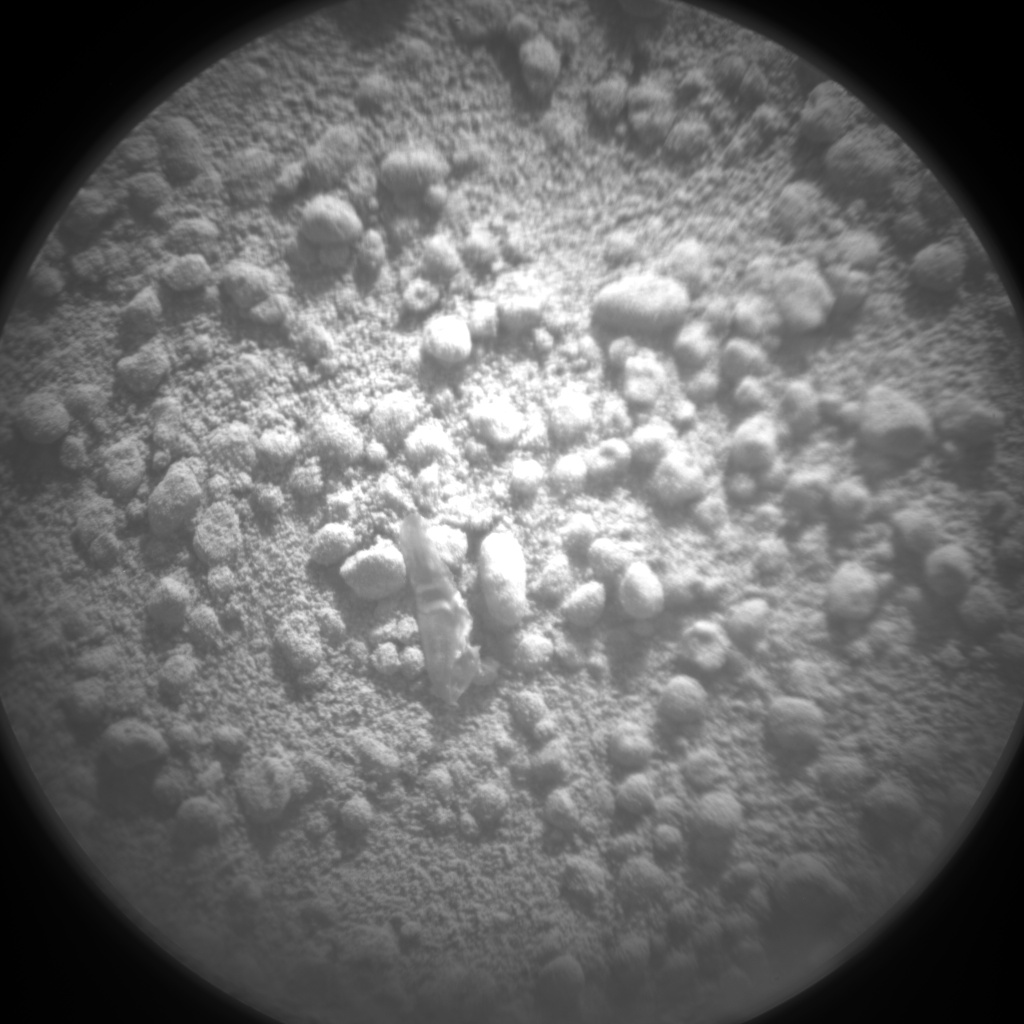
Various small bits of light-toned material on the ground at Rocknest have affected the rover's activities in the past several days. One piece about half an inch (1.3 centimeters) long was noticed on Oct. 7. The rover team postponed use of the robotic arm for two days while investigating this object, and assessed it to be debris from the spacecraft.
Images taken after Curiosity collected its second scoop of Rocknest material on Oct. 12 showed smaller bits of light-toned material in the hole dug by the scooping action. This led to discarding that scoopful rather than using it to scrub the processing mechanisms. Scientists assess these smaller, bright particles to be native Martian material, not from the spacecraft.
"We plan to learn more both about the spacecraft material and about the smaller, bright particles," said Curiosity Project Manager Richard Cook of NASA's Jet Propulsion Laboratory, Pasadena. "We will finish determining whether the spacecraft material warrants concern during future operations. The native Mars particles become fodder for the mission's scientific studies."
During a two-year prime mission, researchers are using Curiosity's 10 instruments to assess whether the study area has ever offered environmental conditions favorable for microbial life. JPL, a division of Caltech, manages the project and built Curiosity. For more about Curiosity, visit: http://www.nasa.gov/msl and http://mars.jpl.nasa.gov/msl .
You can follow the mission on Facebook and Twitter at: http://www.facebook.com/marscuriosity and http://www.twitter.com/marscuriosity .
Guy Webster 818-354-6278
Jet Propulsion Laboratory, Pasadena, Calif.
guy.webster@jpl.nasa.gov
A NASA's Mars Curiosity rover team member gives an update on developments and status of the planetary exploration mission. The Mars Science Laboratory spacecraft delivered Curiosity to its target area on Mars at 1:31:45 a.m. EDT on Aug. 6, which includes the 13.8 minutes needed for confirmation of the touchdown to be radioed to Earth at the speed of light. The rover will conduct a nearly two-year prime mission to investigate whether the Gale Crater region of Mars ever offered conditions favorable for microbial life.
Curiosity carries 10 science instruments with a total mass 15 times as large as the science payloads on NASA's Mars rovers Spirit and Opportunity. Some of the tools, such as a laser-firing instrument for checking rocks' elemental composition from a distance, are the first of their kind on Mars. Curiosity will use a drill and scoop, which are located at the end of its robotic arm, to gather soil and powdered samples of rock interiors, then sieve and parcel out these samples into the rover's analytical laboratory instruments.
miércoles, 10 de octubre de 2012
View of Curiosity's First Scoop Also Shows Bright Object
ORIGINAL: NASA
 |
| Image credit: NASA/JPL-Caltech/MSSS |
This image was taken during the mission's 61st Martian day, or sol (Oct. 7, 2012), the same sol as the first scooping. After examining Sol 61 imaging, the rover team decided to refrain from using the arm on Sol 62 (Oct. 8). Instead, the rover was instructed to acquire additional imaging of the bright object, on Sol 62, to aid the team in assessing possible impact, if any, to sampling activities.
For scale, the scoop is 1.8 inches (4.5 centimeters) wide, 2.8 inches (7 centimeters) long.
Suscribirse a:
Entradas (Atom)