Mostrando entradas con la etiqueta futuro. Mostrar todas las entradas

jueves, 21 de agosto de 2014

Preparing Your Students for the Challenges of Tomorrow


Right now, you have students. Eventually, those students will become the citizens -- employers, employees, professionals, educators, and caretakers of our planet in 21st century. Beyond mastery of standards, what can you do to help prepare them? What can you promote to be sure they are equipped with the skill sets they will need to take on challenges and opportunities that we can't yet even imagine?

Following are six tips to guide you in preparing your students for what they're likely to face in the years and decades to come.
1. Teach Collaboration as a Value and Skill Set Students of today need new skills for the coming century that will make them ready to collaborate with others on a global level. Whatever they do, we can expect their work to include finding creative solutions to emerging challenges.
2. Evaluate Information Accuracy 
New information is being discovered and disseminated at a phenomenal rate. It is predicted that 50 percent of the facts students are memorizing today will no longer be accurate or complete in the near future. Students need to know 
  • how to find accurate information, and 
  • how to use critical analysis for 
  • assessing the veracity or bias and 
  • the current or potential uses of new information. 
These are the executive functions that they need to develop and practice in the home and at school today, because without them, students will be unprepared to find, analyze, and use the information of tomorrow.
3. Teach Tolerance 
In order for collaboration to happen within a global community, job applicants of the future will be evaluated by their ability for communication with, openness to, and tolerance for unfamiliar cultures and ideas. To foster these critical skills, today's students will need open discussions and experiences that can help them learn about and feel comfortable communicating with people of other cultures.
4. Help Students Learn Through Their Strengths 
Children are born with brains that want to learn. They're also born with different strengths -- and they grow best through those strengths. One size does not fit all in assessment and instruction. The current testing system and the curriculum that it has spawned leave behind the majority of students who might not be doing their best with the linear, sequential instruction required for this kind of testing. Look ahead on the curriculum map and help promote each student's interest in the topic beforehand. Use clever "front-loading" techniques that will pique their curiosity.

5. Use Learning Beyond the Classroom
New "learning" does not become permanent memory unless there is repeated stimulation of the new memory circuits in the brain pathways
. This is the "practice makes permanent" aspect of neuroplasticity where neural networks that are the most stimulated develop more dendrites, synapses, and thicker myelin for more efficient information transmission. These stronger networks are less susceptible to pruning, and they become long-term memory holders. Students need to use what they learn repeatedly and in different, personally meaningful ways for short-term memory to become permanent knowledge that can be retrieved and used in the future. Help your students make memories permanent by providing opportunities for them to "transfer" school learning to real-life situations.
6. Teach Students to Use Their Brain Owner's Manual
The most important manual that you can share with your students is the owner's manual to their own brains. When they understand how their brains take in and store information (PDF, 139KB), they hold the keys to successfully operating the most powerful tool they'll ever own. When your students understand that, through neuroplasticity, they can change their own brains and intelligence, together you can build their resilience and willingness to persevere through the challenges that they will undoubtedly face in the future.

How are you preparing your students to thrive in the world they'll inhabit as adults?


ORIGINAL: Edutopia 
Judy Willis MD's Profile

August 20, 2014

jueves, 20 de marzo de 2014

TED 2014: Larry Page on Google's robotic future

 
Larry Page was interviewed at Ted by US television host Charlie Rose


Larry Page wants patients to hand over their data to researchers in order to save "100,000 lives".

It's just one of the ideas expressed in a wide-ranging interview at the Ted (Technology, Entertainment and Design) conference in Vancouver.

Google's co-founder criticised the US government for its mass surveillance programs.

But he added that consumers need to accept that a new era of open data is inevitable. Smarter computers

Interviewed on the Ted stage by US television host Charlie Rose, Mr Page was asked why Google bought the UK machine learning firm DeepMind.

"I was looking at search and trying to understand how to make computers less clunky and also thinking about how speech recognition is not very good," said Mr Page.

"We are still at the very early stages with search. Computers don't know where you are and what you are doing," he added.

He was drawn to DeepMind because it had helped make computers smarter - teaching them how to play computer games.

"It was really exciting, we have not been able to do this before. Imagine if that intelligence is thrown at your schedule," said Mr Page.

He said that Google was working on its own machine learning project, using YouTube to "teach" computers.

"It has learnt what cats are," he said. Tremendous disservice

Mr Page was also asked about the Edward Snowden revelations, following a surprise appearance from the whistle-blower at Ted.

"It is disappointing that the government secretly did this stuff and didn't tell us about it," said Mr Page.

"It is not possible to have a democracy if we have to protect our users from the government. The government has done itself a tremendous disservice and we need to have a debate about it," he added.

Google has had its fair share of criticism for the way it collects users data. It is currently embroiled in row with European regulators over its privacy policy.

Mr Page was in defiant mood and warned that people were at risk of "throwing out the baby with the bathwater" over plans to tighten privacy.

"We are not thinking about the tremendous good that can come with sharing information with the right people in the right ways," he said.

He said that anonymised medical records should be made available to researchers.

"It could save 100,000 lives this year," he said.

Health data has personal resonance with Mr Page who developed a hoarse voice after a cold 15 years ago from which he has never recovered. Sharing details about his condition helped him, he said.

"I was scared to share but Sergey [Brin] encouraged me and we got thousands of people with similar conditions," he said. Gaining space

Mr Page also talked about some of his "crazy ideas", including Google Loon, a project to use balloons to provide internet access to parts of the world without any.

He revealed that he got the idea off the ground with a Google search.

"I found that 30 years ago someone had put up a balloon and it had gone round the world multiple times," he said.

He realised that a similar thing was possible to connect the two-thirds of the world that have no net access.

"We can build a world-wide mesh of balloons to cover the whole planet."

Google plans to launch its automated cars on the roads by 2017. The project has been a personal obsession for 18 years, he told the Ted audience.

"It started when I was at college in Michigan. I was waiting for the bus and it was cold and snowing," he said.

He believes that automated cars can help save lives - currently 20 million people are injured each ear in car accidents and in the US crashes are the biggest cause of death for the under 35s.

He finished the interview with a call to firms to embrace new technologies.

"Most businesses fail because they miss the future," he said.

It is a mistake he has made himself, he added.

He said that he "felt guilty for wasting time" working on the Android operating system, which at the time was a side project for Google.

"That was stupid, it was the future," he said.


ORIGINAL: BBC
By Jane Wakefield Technology reporter, Vancouver
20 March 2014

miércoles, 19 de septiembre de 2012

9 tecnologías subestimadas que podrían transformar el mundo radicalmente

ORIGINAL: PijamaSurf io9
18/09/2012


Más allá de los reflectores y el marketing hay desarrollos tecnológicos que, de concretarse en sus promesas y popularizarse, podrían revolucionar el mundo tal y como lo conocemos.


El lugar común dicta que la nuestra es una época de vertiginoso desarrollo tecnológico, de cambios incesantes en el mundo de los dispositivos electrónicos que cada cierto tiempo —muy poco para algunos— se superan a sí mismos en la particular función que desempeñan.

Pero más allá de los reflectores —de las computadoras y los gadgets que el marketing nos hace creer importantes— existen desarrollos tecnológicos que, de concretarse y popularizarse, podrían cambiar radicalmente el mundo tal y como lo conocemos.

1. Secuenciador barato y veloz de ADN


La secuenciación de ADN, uno de los logros mayores de nuestra especie en los últimos años, se vuelve un recurso cada vez más asequible, a diferencia de la época en que su empleo costaba miles de millones de dólares (por ejemplo, durante el tiempo del Proyecto del Genoma Humano). La reducción significativa de costos en esta tecnología —actualmente se cotiza en mil dólares por genoma— podría hacer realidad la medicina altamente personalizada, en la que un tratamiento se dirigiría a un genoma específico.

2. Dinero digital


La desaparición del dinero, del “circulante” según la terminología técnica y ya un poco anticuada, podría realizarse pronto para dar paso a monedas digitales, lo cual supondría una de las mayores revoluciones admitidas por el sistema financiero dominante, generando escenarios en los que ciertas operaciones positivas para el sistema se facilitarían y, al mismo tiempo, otras situaciones adversas podrían potenciarse (fraudes, control de unos cuantos sobre la mayoría, etc.).

3. “Memorisencia”


Neologismo que busca significar una resistencia de memoria a corto plazo, la memorisencia [memristor] es un desarrollo planteado originalmente en la década los 70 por Leon Chua, de la Universidad de California en Berkeley. Su función sería “recordar” cargas incluso cuando la energía se ha perdido, con lo cual podría convertirse en un dispositivo de almacenamiento y pieza clave de una hipotética computadora de recuerdos. HP construyó un prototipo en 2008, pero la versión final se comercializará solo hasta finales de 2014.

4. Robots con extravagantes y futuristas habilidades


La robótica está llamada a construir un mundo paralelo al nuestro y prácticamente autónomo, funcional independientemente de la intervención humana (de hecho parece más probable que sea nuestra especie la que dependa de ellos). Ya hoy uno de los escenarios más comunes —pero que hace algunas generaciones todavía tenía un tinte ominoso— es el de máquinas construyendo otras máquinas, y el porvenir parece ensancharse en el mismo sentido.

5. Biocombustibles


Nuestro desarrollo industrial se ha centrado por más de dos siglos casi exclusivamente en los combustibles fósiles, los cuales, por ser no renovables, nos tienen al borde de una crisis energética que, según algunos, podría evitarse con los biocombustibles. Además de su valor ecológico (son menos contaminantes que los fósiles), los biocombustibles representan uno de los mayores cambios en el paradigma energético desde la Revolución Industrial. Con todo, recordemos que si bien hay métodos para obtenerlos a través de los desechos orgánicos (de hecho Suecia importa la basura de sus vecinos europeos para su programa de energía), en otros casos su síntesis se obtiene de plantas como el maíz, con lo cual terrenos que de otro modo se destinarían a la producción de alimentos, ahora se cosechan para el aprovechamiento energético, sobre todo de países desarrollados, abriendo así otra situación de desequilibrio e inequidad entre países ricos y países pobres, entre alimentación o desarrollo industrial.

6. Terapia genética


En la genética, claman algunos, se encuentra el futuro de la salud humana. Si este campo cumple con sus promesas, con el tiempo algunas enfermedades como la fibrosis cística, que actualmente se tratan con cirugía, podrían erradicarse sin ningún tipo de intervención invasiva, incluso prevenirse con tratamientos indoloros. Asimismo, la genética abre la posibilidad del “superhombre”: seres humanos con inteligencia o memoria aumentadas o con un periodo de vida ampliada más allá de lo que hasta ahora se conoce.

7. Interferencia del RNA


En 2006, el descubrimiento de la interferencia del RNA (RNAi) le valió a Andrew Fire y Craig C. Mello la obtención del premio Nobel. Su importancia radica en que gracias a la RNAi es posible manipular los genes, destruir o interrumpir mensajeros moleculares para activar algún gen en específico. En el caso del tratamiento de cáncer y de la enfermedad de Lou Gehrig (también llamada enfermedad de Charcot o esclerosis lateral amiotrófica), la interferencia del RNA podría ser decisiva para obtener la curación.

8. Órganos Electrónicos
La simbiosis funcional entre tejido vivo y tejido inerte, específicamente robótico, podría volverse parte de nuestra cotidianidad inmediata, prótesis mecánicas que, adaptadas cabalmente a nuestros sistemas orgánicos, nos volverían mitad humanos y mitad máquinas. Entre las ventajas de este desarrollo se encuentra un escenario en que un órgano dañado se sustituiría con otro armado en un taller sin necesidad de esperar a un donante. El verdadero reto se encuentra, sin embargo, en la posibilidad de emular nuestro complejo sistema neuronal.

9. Energía solar concentrada


Se dice que la energía solar es tan abundante como desaprovechada, pero quizá no por más tiempo. La energía solar concentrada (CSP, por sus siglas en inglés) es un sistema de concentración y distribución masivas que, altamente eficiente, permite montar plantas que generarían una enorme cantidad de gigawatts de energía solar. Pero sus beneficios no terminan aquí, pues la infraestructura también podría utilizarse como una estación desalinizadora.

[io9]

martes, 28 de febrero de 2012

El futuro, según Eric Schmidt

ORIGINAL: ABC.es
29/02/2012

El presidente ejecutivo de Google dice que existirán tres estratos: una élite «hiperconectada» y asistida por robots, una clase media y una mayoría con acceso limitado a internet

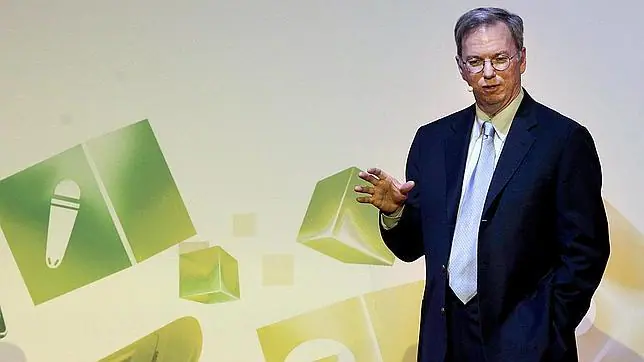
EFE. Eric Smidcht, en el Mobile World Congress

El presidente ejecutivo de Google ha compartido en el Mobile World Congress su visión sobre el futuro. Según Eric Schmidt las sociedades se dividirán entre tres estratos, y lo harán en función del uso que hagan de la tecnología. Existirá
  • una élite, “hiper-conectada” a la Red y asistida por robots, 
  • una clase media y 
  • una mayoría con acceso limitado a internet.
Eric Schmidt ha hablado en el Mobile World Congress de cómo ve el futuro. El planteamiento del que ha sido CEO de Google durante 10 años, hasta abril de 2011, y ahora es su presidente ejecutivo entra en el ámbito social, mediatizado éste totalmente por la tecnología.

Schmidt cree que la sociedad del futuro en nuestro planeta se dividirá en tres estratos, según recoge SiliconFilter. La pertenencia a uno u otro estará definida por el uso que se hace de la tecnología y el acceso que se tiene a ella.


Los tres estratos

Unos pocos privilegiados serán los «hiperconectados», quienes dispondrán de acceso a redes de conexión de alta velocidad y una potencia de procesamiento ilimitada. Estos medios estarán presentes en la mayoría de las grandes ciudades. Las posibilidades de esta élite tecnológica sólo estarán limitadas por lo que la tecnología puede hacer.

Este grupo será asistido por robots, hasta el punto de poder estar en dos sitios al mismo tiempo, mediante hologramas en 3D, tal y como señalan desde VentureBeat. Los coches autopilotados, con los que Google ya está experimentando, reducirán los accidentes y la Red será como electricidad, estará en todas partes y los integrantes de este estrato estarán tan acostumbrados que ni siquiera notarán que está ahí.

Un segundo grupo utilizará tecnología más barata para su trabajo y vida cotidiana, pero seguirá disponiendo de herramientas efectivas. Constituirán la clase media del futuro, según Schmidt, y podrán utilizar los avances técnicos para cambiar el mundo. En este grupo se incluirían los desarrolladores, a quienes calificó de “ingenieros de la libertad humana”.

Después de resaltar que programar es “algo más que construir programas”, Schmidt también apuntó el papel de los consumidores en este grupo de clase media. Ellos apoyarán las creaciones de los primeros y defenderán los principios de la Red.

Por último el presidente ejecutivo de Google se fijó en el tercer grupo, el que estaría menos favorecido. Éste provendría de esos 5.000 millones de personas que en estos momentos no tienen acceso a Internet. Constituirán una “mayoría que aspira” a subir de escalón social. Dispondrán de un acceso limitado internet, con proliferación de redes locales, la forma más barata de procurar una conexión.

Sin embargo, el mensaje de Schmidt fue positivo. Una de las reflexiones que planteó el presidente ejecutivo de Google fue: “Pensad en lo fascinante que es la web hoy en día con solo 2.000 millones de personas”. Si es así con 2.000 millones, sumando los 5.000 millones de habitantes del planeta restantes el espacio sería mucho más enriquecedor.