Mostrando entradas con la etiqueta Quitina. Mostrar todas las entradas

viernes, 28 de noviembre de 2014

Harvard Scientists May Have Just Solved One of the Biggest Environmental Issues of Our Time

Image Credit: Getty

For years, researchers have been attempting to find a viable, biodegradable alternative to plastic.

Plastic is all around us, in the containers we store our food and in the bottles we drink our beverages from. Our groceries and shopping purchases are all brought home in plastic bags, which have earned the distinction of being "the most ubiquitous consumer item in the world," according to the Guinness World Records.

That's all great, except for the fact that plastic is not a biodegradable product. It takes years for plastic to turn into smaller pieces, but it never breaks down into simple compounds that can be harmlessly reabsorbed by the environment. Instead, it becomes a dangerous pollutant, clogging up waterways, damaging the marine ecosystem and entering the food chain.

But it seems we're closer to the solution than we might think. On Monday, researchers at Harvard University's Wyss Institute announced they have created a new bioplastic based off a novel source: shrimp shells.


How it works: The main component is chitosan, a form of chitin, the second most abundant organic compound in the world. It is found in everything from crustacean shells to insect cuticles and butterfly wings.

Usually, shrimp shells would be discarded or used in fertilizers or makeup. But the Harvard researchers have been able to process these shrimp shells to create a material that is strong, transparent and renewable. They've named it "shrilk."

"There is an urgent need in many industries for sustainable materials that can be mass produced," said Wyss director Donald E. Ingber. "Our scalable manufacturing method shows that chitosan, which is readily available and inexpensive, can serve as a viable bioplastic that could potentially be used instead of conventional plastics for numerous industrial applications."

The best part is that not only does shrilk biodegrade in a matter of weeks once it's discarded, it actually releases nutrients into the environment as it breaks down. Researchers have been able to grow a plant in soil that is enriched with chitosan, demonstrating how man-made garbage can actually contribute to the environment.

Image Credit: Wikimedia

Why this is important: Plastic garbage has been a problem for decades, and it's only getting worse. Over the past decade, we have produced more plastic than in the entirety of the 20th century, and half was for single-use products such as soda cups, straws and plastic bags. We use 500 billion plastic bags alone every year.

All that junk is not going anywhere anytime soon. Most plastic trash ends up in the oceans and accumulates in gyres, which are massive whirlpools created by the current. These giant, rotating heaps of garbage cover as much as 40% of the Earth's ocean surface; the biggest one, the infamous Great Pacific Garbage Patch, is located off the coast of California and is twice the size of Texas. Researchers predict that these gyres are only going to get bigger in coming years:


Creating plastic is not very efficient, either. Almost 3% of America's total petroleum consumption is due to plastic production, as well as around 2% of total U.S. natural gas consumption. And though we have all been told to do our part and "reuse, reduce and recycle," the latter doesn't really apply to plastic; due to the way they are processed, we can only recover 5% of the plastics we produce.

Given all these difficulties, a new material like shrilk could be a true game-changer, not only in the conservation movement, but in global consumer behavior. It will be many years before something like shrilk can be mass-produced and introduced to average consumers. But given that in our lifetime, we'll never be able clean up all the plastic trash we've already produced, it's certainly the right step to find a suitable alternative — especially if it can return nutritious byproducts to the environment.

ORIGINAL: MIC.com
May 7, 2014

Eileen Shim
Eileen is a writer living in New York. She studied comparative literature and international studies at Yale University, and enjoys writing about the intersection of culture and politics.

domingo, 23 de marzo de 2014

Magnified Photos Show the Intricate Details of Butterfly Wings

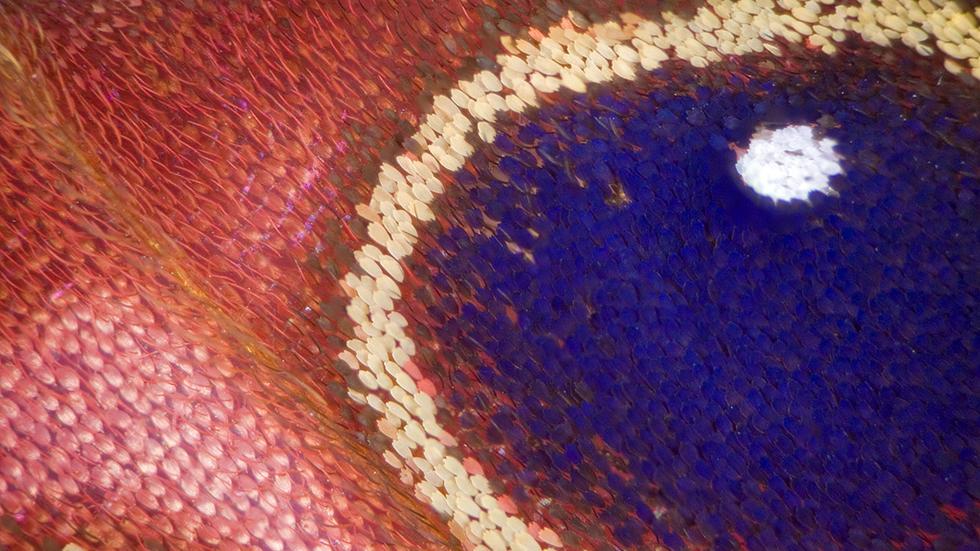
This image shows the colorful sunset moth's wing. (Linden Gledhill)

This image shows the colorful sunset moth's wing. (Linden Gledhill)
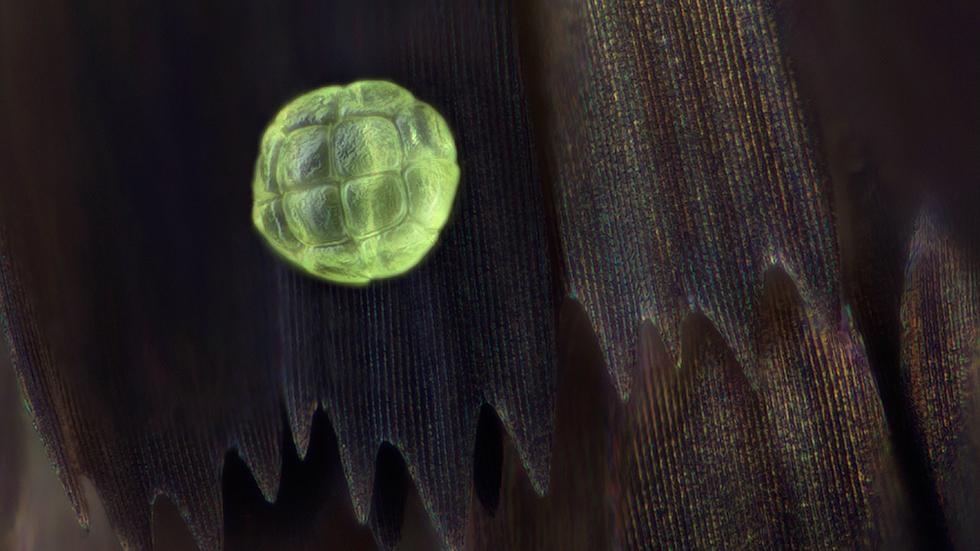
A pollen grain rests on a Protographium agesilaus butterfly wing. (Linden Gledhill)
The above image shows a magnified Salamis Parhassus wing. (Linden Gledhill)
The above image shows a Citharias aurorean wing. (Linden Gledhill)
More images:

Many photographers aim to catch the beauty of butterflies. But Linden Gledhill takes his photography a step further, showing us the gorgeous patterns at the cellular level.

Gledhill develops biopharmaceuticals to treat cancer and diabetes at an international pharmaceutical company. His photography blends his love of science into an artform. He spends nights and vacations working on his photography projects.

I love applying my knowledge and skills in science to achieve images which often people don’t see,” Gledhill told weather.com.

According to the Library of Congress, the powder seen on butterflies’ wings is similar to scales. Their wings are made of very thin layers of chitin, a derivative of glucose. Similar to solar panels, the wings soak up heat from the sun in order to keep the butterfly warm, The New York Times reported.

In the past, Gledhill has used a standard camera fitted with old microscope lenses on extension tubes. He now uses an Olympus BHT metrology microscope fitted with a StackShot drive to create the images. He also uses LED lighting and high-speed flash along with the microscope.

He usually uses damaged preserved specimens from farm-raised butterflies.

Gledhill’s images cover a range of species and they include moths as well. “I select those with interesting coloration or scale shapes… one of the most spectacular examples is the sunset moth, Urania ripheus,” said Gledhill. “People often think of moths as being drab. This is a day-flying species, hence the bright colors, most of which are achieved by physical structure and not pigments.

ORIGINAL: Weather Channel
By Nicole Bonaccorso weather.com

lunes, 14 de enero de 2013

The Brazilian Treehopper may be the strangest creature we’ve ever laid eyes on

ORIGINAL: io9
 Robert T. Gonzalez
JAN 14, 2013

Top image of a sculpture by Alfred Keller;
Because holy crap, just look at that headgear. Everyone, meet Bocydium globulare. Better known as the Brazilian treehopper, B. globulare excels at living a solitary life, hanging out on the leaves of glory bushes, and head-sphering its way into your nightmares.

The Brazilian treehopper is 100% real, but the image up top is of a beautifully crafted model, created by legendary science sculptor Alfred Keller (1902—1955). Over on Why Evolution is True, Jerry Coyne reflects on a 2010 Nature profile on Keller (warning: paywall), his sculptures, and the utter weirdness of B. globulare.

"The first thing a biologist does on seeing a model like this is think, 'This can't be real,' and resorts to some Googling," writes Coyne. "Sure enough, it's a real insect."

He continues:

The second thing one asks is, "What the bloody hell is all that ornamentation on the thorax?" (Note that the "balls" on the antenna-like structure aren't eyes, but simply spheres of chitin.) A first guess is that it's a sexually-selected trait, but those are often limited to males, and these creatures (and the ones below) show the ornaments in both sexes. [Art Historian Martin Kemp, an expert on visualization in art and science] hypothesizes-and this seems quite reasonable-that "the hollow globes, like the remarkable excrescences exhibited by other treehoppers, probably deter predators." It would be hard to grab, much less chow down on, a beast with all those spines and excrescences.

Note, though, that the ornament sports many bristles. If these are sensory bristles, and not just deterrents to predation or irritating spines, then the ornament may have an unknown tactile function.

photo of live treehopper by Patrick Landmann

See more photos of living treehoppers like the one pictured above — along with several other photos of membracids, the headgeared group of insects to which Bocydium globulare belongs — over on Why Evolution Is True.

See also: this gallery of weird treehopper insects, courtesy of New Scientist, and this series of amazing membracid photographs by photographer Patrick Landmann.

Tip of the peduncular hat to Maria!