|
| Top image via Jon Dhyr. |
When it comes to insect flight, we usually only think about how the insect's wings contribute to aerial stability. But scientists have now discovered that the abdominal movements of some insects also play a large role in flight control, particularly when hovering — a finding that could lead to improved aerial drones.
Scientists often take cues from nature when building robots. And given that an insect's wings provide the lift and thrust forces necessary for flight, they've been the focus of a lot of research. But biologists have long wondered if insects also use their abdomens to help with flight control. After all, numerous studies have documented tethered insects making exaggerated abdominal movements in response to changes in their visual environment.
Some scientists have speculated that the insects employ their abdomens, which make up a good portion of their bodies, as steering rudders. That is, by moving their abdomens in one direction or another, insects can increase the drag forces on parts of their bodies, helping them to turn. Alternatively, an insect may move its abdomen during flight to shift its center of mass relative to its center of lift, creating a moment of inertia that essentially counteracts the rotation the insect may be experiencing from, say, a gust of wind.
But nobody has ever tested whether either of these theories is true, or if the observed abdominal movements are merely a result of being tethered. So a group of biologists and engineers set out to do just that.
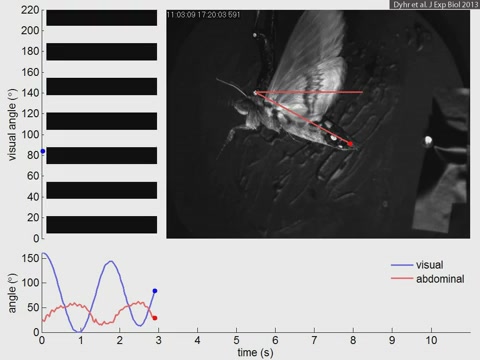
They began by tethering a hawkmoth (Manduca sexta) into a circular flight arena and surrounding it with an LED display system. They created a grating pattern of green and black bars on the screen (seen in the image above), and rotated the pattern up and down.
"If you were to see something like this in a movie theatre, you would get that funny feeling that you were rotating in the opposite direction as the lights," says study researcher Noah Cowan, an engineer at Johns Hopkins University. "We basically built a little IMAX theatre for the moth to give it the sensation that it's moving around."
They presented the moth with two different types of pattern oscillations, or modes. In one mode, the pattern oscillated with increasing frequency, giving the moth the impression that it was tumbling at an accelerated rate. The other mode was "pseudo-random," where the pattern oscillated at different speeds and degrees.
They found that the moth moved its abdomen in direct response to its shifting visual environment. "If the pattern is rotating up (clockwise), the moth would raise its abdomen up (counterclockwise)," says study co-author Jonathan Dyhr, a University of Washington biologist. "The moth was raising or lowering its abdomen to counteract the movement."
The moth moves its abdomen in response to the rotation of the grating pattern (which makes it feel as if its falling forward or backward). Credit: Jon Dhyr
Importantly, the moth tuned its abdominal movements to the different specific oscillations, with larger pattern movements resulting in larger abdominal movements (as you can see in the videos). "It has a very stereotyped dynamical response," Cowan told io9, adding that these responses allowed the team to mathematically model the moth's behavior and accurately predict how it would respond to different oscillations.
With their observations and their model, the researchers determined that the moths use their abdomens for flight control via two mechanisms. First, the abdominal movements shift the moth's center of mass relative to the center of lift, counteracting the rotation, as previously theorized. Additionally, when the moth rotates its abdomen, its thorax rotates in the opposite direction to conserve angular momentum — this causes the aerodynamic forces produced by the wings, which are attached the thorax, to redirect, helping to correct the loss of stability.
Dyhr notes that the team didn't disprove the rudder theory. They really only looked at the case of hovering, so the moths may still use their abdomens as rudders when flying forward. The researchers also suggest that other insects probably use this technique as well (though smaller insects will find it less effective).
Cowan says that their discovery could improve the stability of aerial robots — in fact, the team has already demonstrated its use in a robotic quadrotor. These flying drones have four propellers controlled by four independent motors, all of which are powered by an attached battery. The scientists unmounted the battery, hung it below the quadrotor and implemented a sensor and control system that automatically adjusted the position of the battery in response to the robot's pitch. Similar to the moth, when the robot moved its battery, the aerodynamic forces from the propellers redirected, resulting in increased stability (see the video below).
The researchers essentially gave the robot's battery a second function. "In engineering, people tend to focus on 'one part, one function,' but in bio
The moth moves its abdomen in response to the rotation of the grating pattern (which makes it feel as if its falling forward or backward). Credit: Jon Dhyr
logy you see these incredibly complex, integrated systems." Cowan says. "The lesson to learn here is the incredible success that nature has in adapting designs to take advantage of and exploit multifunctionality."
The new design allows the quadrotor to stabilize itself after being knocked around. Credit Alican Demir.