Mostrando entradas con la etiqueta anfibio. Mostrar todas las entradas

miércoles, 15 de enero de 2014

Scientists Discover the Very First Hipster

You’ve seen the cartoon before: a fish hoisting itself up on land with its front fins, being greeted with some snarky sign like, “Evolve at your own risk,” or something similar. 
This fish has become a meme, so much so that when the discovery of Tiktaalik roseae, a 375-million year old fossil that displays a mix of fish and tetrapod characters, was announced in 2006 by the lab I was working in at the University of Chicago, I thought I’d start a movement with the geekiest version of the Darwin fish ever:
The world's geekiest version of the Darwin fish bumper sticker. Too bad it's WRONG!

Well, wouldn’t ya know it, that pesky thing called progress has unseated the “front-wheel drive” version of life invading land and replaced it with something much more… well, hipster. More evidence is in, and Tiktaalik, it seems, was built like an old Volvo – with rear-wheel drive.

A new paper in the January 13th early edition of PNAS describes Tiktaalik‘s newly discovered tail end, complete with a beautifully preserved pelvic bone and partial hind fin from the same specimen that made headlines in 2006. Finally, a near-complete image of Tiktaalik is emerging:

Tiktaalik reconstruction © Kalliopi Monoyios

What is so incredible about this find is a delightful detail of the pelvis. The hip socket is smooth and round – a ball and socket joint – that suggests the hind fin had quite a wide range of motion. This is unlike the shoulder joint which has an oblong shape with an angled facet that would have prevented the front fin from rotating up and around. Judging by fossil data alone, the front fins were robust and capable of supporting weight but they were probably not helping Tiktaalik walk like an amphibian on land without some serious body drag. The hind fins were also quite strong and clearly played a part in holding up the beast. But what of the ball and socket hip joint?

The trouble with fossils is that they’re terribly static. We can learn a lot about what was physically possible from looking at the anatomy, but we can never hot-wire a fossil into moving again, and we certainly can’t observe their behaviors in their natural environment. But this is where interdisciplinary studies can be so powerful.

Upstairs from Neil Shubin’s paleontology lab at the University of Chicago in 2010 was a graduate student named Heather King. King was studying the biomechanics of African lungfish and had rigged up a long, thin aquarium where she could film the lungfish as they did what lungfish do (spoiler alert: not much). Very occasionally, she noticed a bizarre behavior: the lungfish would use their whip-like hind fins to walkalong the bottom of the tank.

It was at a presentation to her advisory committee that King first revealed this behavior, and Shubin and another adviser familiar with Tiktaalik‘s pelvis, Michael Coates, nearly fainted. Lungfish, after all, are one of Tiktaalik‘s closest living relatives, being part of a group of fish known as lobe-finned fish (most of the fish you can think of – tuna, goldfish, blobfish, chub – belong to a different group, the ray-fins). Suddenly, the round hip socket of Tiktaalik came sharply into focus. Would Tiktaalikhave been capable of walking along the bottom of a stream with its hind fins like its cousin the lungfish? Was Tiktaalik a rear-wheel drive beast?

And with that revelation, I declare it’s time for a new meme:
Rear-wheel drive fish by Ed Heck, http://edheck.com

Articles cited:
  • Neil H. Shubin, Edward B. Daeschler, & Farish A. Jenkins, Jr. (2014). The Pelvic Girdle and Fin of Tiktaalik roseae PNAS :10.1073/pnas.1322559111
  • King HM, Shubin NH, Coates MI, & Hale ME (2011). Behavioral evidence for the evolution of walking and bounding before terrestriality in sarcopterygian fishes.Proceedings of the National Academy of Sciences of the United States of America, 108 (52), 21146-51 PMID: 22160688

By Kalliopi Monoyios
January 15, 2014

domingo, 15 de diciembre de 2013

IROS 2013: Aqua Hexapod Gets New Amphibious 'Ninja Legs'


RHex-type legged robots are great at getting around. Like, really, really, really great. They can walk and run on land, and a RHex-based hexapod called Aqua can swim in water as well, with just a simple change of legs from something rigid for walking to something flexible for swimming. Technically, this makes RHex amphibious, but in practice, it's more like the robot is amphibious if you've got a human around to swap its legs out. The problem is that it's impossible to make legs that are flexible enough for efficient swimming and simultaneously rigid enough for efficient walking. And when we say "impossible," we mean "impossible until someone figured out how to do it," which happened at IROS last month.

These new amphibious legs from McGill University roboticists—the creators of the Aqua robot—are called "Ninja legs," because the researchers figure that "the design resembles a spinning ninja star." I'm not sure I entirely get that, but it's a cool name anyway. Essentially, Ninja legs are flippers that can flex up to 120 degrees, each contained inside a carbon fiber and spring steel frame that are mounted on Aqua's rotary leg joints . On land, the frame works just fine as a leg, while in the water, the frame allows the flipper inside it to move freely, resulting in efficient swimming.

As is usually the case when you take two very different things and combine them into one thing, the Ninja legs involve some compromises. The most obvious disadvantage is perhaps complexity, and the efficiency for both walking and swimming decreases relative to legs that are designed and optimized specifically to perform one of those tasks. This decrease is not nearly as bad as might be expected, though. For walking gaits, the ninja legs require perhaps 15 to 20 percent more power to rotate at a given frequency, but they can also achieve higher stable speeds due to higher inherent compliance. And for swimming, the Ninja legs hit a sweet spot at a 2.5 hertz oscillation frequency and 50 degree oscillation amplitude where they produce nearly as much thrust as flippers can (35 N as opposed to 40 N). 

There is a lot more that can be done as far as figuring out whether the Ninja legs might do better with a completely different gait than a more traditional RHex configuration, so it's possible that they could get even more efficient. And there's also plenty of space for hardware optimization. The future work that we're most looking forward to, however, is some more field testing to see just what hexapods with Ninja legs are capable of.

"Ninja Legs: Amphibious One Degree of Freedom Robotic Legs," by Bir Bikram Dey, Sandeep Manjanna, and Gregory Dudek from the Centre for Intelligent Machines at McGill University, was presented last month at IROS 2013 in Tokyo, Japan.

ORIGINAL: IEEE Spectrum
By Evan Ackerman
Posted 9 Dec 2013

viernes, 3 de agosto de 2012

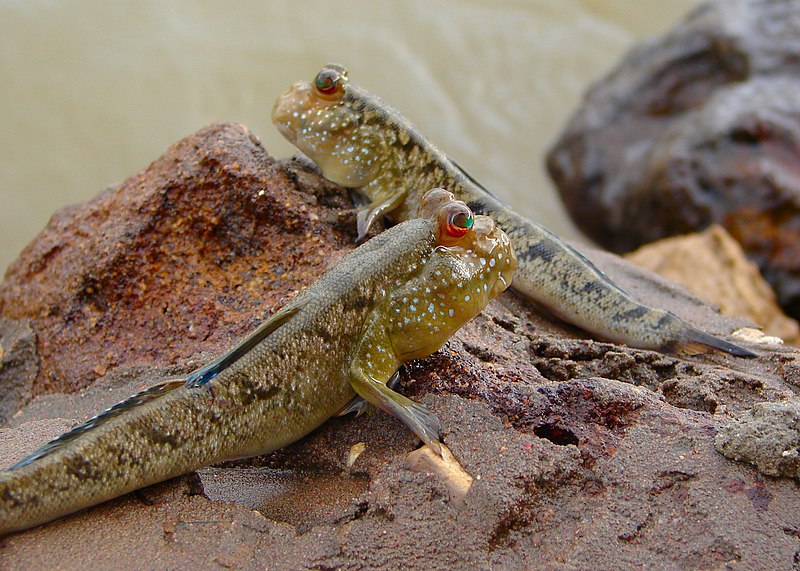
Mudskipper: a fish that lives on land

ORIGINAL: BBC-YouTube / Wkipedia

Excerpt from BBC's Life series

Just an example how fish can evolve to live on land.

Mudskippers are members of the subfamily Oxudercinae (tribePeriophthalmini),[1] within the family Gobiidae (Gobies). They are completely amphibious fish, fish that can use their pectoral fins to walk on land.[2][3] Being amphibious, they are uniquely adapted tointertidal habitats, unlike most fish in such habitats which survive the retreat of the tide by hiding under wet seaweed or in tidal pools.[4] Mudskippers are quite active when out of water, feeding and interacting with one another, for example to defend theirterritories. They are found in tropical, subtropical and temperateregions, including the Indo-Pacific and the Atlantic coast of Africa.

lunes, 19 de marzo de 2012

Descubren en la India extraña especie de anfibios sin piernas y con duro cráneo (FOTOS)

ORIGINAL: Pijamasurf

Luego de 5 años de exhaustivas exploraciones, científicos descubre a los chikilidae, una extraña especie anfibia que carece de extremidades inferiores pero cuenta con un cráneo que puede penetrar duras superficies.


Toda la exuberancia que nos despierta la sola mención de la India, ese vasto territorio que justificadamente recibió el mote de “país-continente”, se ve confirmada una vez más con el descubrimiento de una especie animal hasta ahora desconocida.

Se trata de un sorprendente anfibio cuya principal característica es que carece de extremidades inferiores, encontrado por Sathyabhama Das Biju, profesor en la Unversidad de Delhi, luego de pasar 5 años penetrando los suelos del bosque tropical del país en colaboración con otros investigadores adscritos al Museo de Historia Natural de Londres y la Universidad Vrije de Bruselas.

Estos “chikilidae” son una de las especies más primitivas que sobreviven en el planeta, pertenecientes al género de los cecilidos y al parecer con antiguas raíces con otras especies endémicas de África. Y justo por esta respetable genealogía, el descubrimiento alimenta las esperanzas de comprender mejor ciertos procesos evolutivos como la migración de especies prehistóricas y la influencia de la separación de continentes en la evolución de los animales.

La singularidad del nombre, por cierto, se debe a que Biju eligió la misma denominación que los locales dan a estos animales en su lengua materna, el garo, con la esperanza de que al advertir que este vocablo se utiliza en todo el mundo, den más importancia al anfibio y lo protejan de su extinción. Por desgracia muchas de las zonas ricas en biodiversidad en territorio indio se encuentran amenazadas por agresivos proyectos de desarrollo industrial.


En este sentido, el llamado “Hombre rana de la India” por sus logros en el campo de la herpetología, se lamentó de que muchas especies pudieran estar perdiéndose incluso antes de ser conocidas y catalogadas. Una “extinción anónima” en la que “ni siquiera sabemos lo que estamos perdiendo”, dijo Biju.

A pesar de su aspecto que algunos podrían considerar atemorizante, los chikilidae son creaturas inofensivas que alcanzan una talla de 10 centímetros. Son especialmente elusivos porque cuentan con un cráneo sumamente duro que pueden penetrar superficies sólidas fácilmente. Según Biju, esto los convierte en un “cohete”: “Si pierdes el primer intento, nunca lo atraparás de nuevo”. Este enterramiento puede llegar hasta a los 40 centímetros de profundidad.