(From left) Junyoung Kim, Professor Guntae Kim, and Ohhun Gwona are part of the team who developed the Hybrid-SOEC, a more efficient new system for producing hydrogen(Credit:UNIST)
Clean and plentiful, hydrogen is a promising fuel source, but there are a few problems standing in the way of it becoming mainstream. South Korean scientists have now developed a new system for producing hydrogen from water, which that they say overcomes some of these issues and produces the gas more efficiently than other water electrolysis systems.
The new device was developed by a research team consisting of scientists from the
and is based on an existing design called a solid oxide electrolyzer cell (SOEC).
These work like other electrolyzers in that an electrical current splits water into its constituent molecules – hydrogen and oxygen – which can then be harvested. The difference is that in this setup, both electrodes are solid-state, as is the electrolyte that carries the ions between them.
This has a few advantages over systems that use liquid electrolytes – namely,
the liquids need to be topped up occasionally, and over time they tend to corrode other components.
And since solid-state electrolyzers operate at higher temperatures, they don't need as much electrical energy to function because they can draw energy from that heat.
But SOECs still have room for improvement. There are two main designs that use different electrolytes:
One allows only oxygen ions to pass through, and
the other only hydrogen ions.
In either case, that one-way street limits the amount of hydrogen that can be produced.
So the researchers developed a new Hybrid-SOEC, which uses a mixed-ion conductor to transport both negatively-charged oxygen ions and positively-charged hydrogen ions (protons) at the same time. The end result had all the benefits of a solid-state electrolyzer, with improved efficiency.
"By controlling the driving environment of the hydrogen ion conductive electrolyte, a 'mixed ion conductive electrolyte' in which two ions pass can be realized," says Junyoung Kim, first author of the study. "In Hybrid-SOEC where this electrolyte was first introduced, water electrolysis occurred at both electrodes, which results in significant increase in total hydrogen production."
Using the mixed-ion conductor and electrodes made of layered perovskite, the Hybrid-SOEC produced 1.9 liters (0.5 gal) of hydrogen per hour, running at a cell voltage of 1.5 V and a temperature of 700° C (1,292° F). The researchers say that's four times more efficient than existing water electrolysis systems, and after running the device continuously for 60 hours, there were no signs of that performance degrading.
The research was published in the journal Nano Energy.
Tetrapods, those curious concrete structures that resemble oversized toy jacks, protect shores across the world from life-threatening waves—but they’re not environmentally friendly or sustainable. Inspired to create a “stronger yet greener sea defense” system, Taiwanese designer Sheng-Hung Lee designed the TetraPOT, a fusion between the concrete tetrapod and natural mangroves. The innovative design uses the iconic four-pronged tetrapod shape with the insertion of a biodegradable pre-seeded pot to grow mangrove trees that filter water pollution, protect the shores, and beautify coastlines.
Lee envisions the TetraPOT as a hybrid between artificial sea defense and natural sea defense, an idea encapsulated in his design slogan: “It is not only a defense, but also an ecosystem. A home for other living [things].” The TetraPOT is an opportunity to restore the world’s mangrove forests, 35% of which has been destroyed. Unlike the common tetrapod, the TetraPOT is partly hollowed out to create room for a biodegradable pot insert, soil, and space for roots to grow. When rising tides water the pre-seeded layers, the organic layers will begin to decompose and allow the mangrove trees to expand its root system through three lower openings.
Over time, roots from one TetraPOT will connect with its neighbors as well as the shoreline to reinforce the sea defense system, reducing the risk of dislodgment. The mangroves will also attract greater biodiversity to the region and help clean the air and water. Lee, who currently works with IDEO in Shanghai, plans to work with the local government to test out TetraPOT prototypes on Chongming Island. The TetraPOT has received several prestigious awards, including the James Dyson Award and red dot Design Award.
Spiders sprayed with water containing carbon nanotubes and graphene flakes have produced the toughest fibers ever measured, say materials scientists.
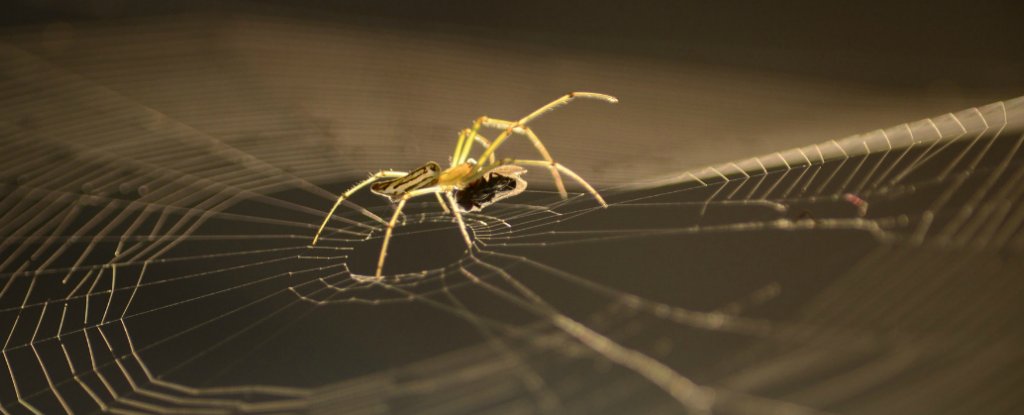
Spider silk is one of the more extraordinary materials known to science. The protein fiber, spun by spiders to make webs, is stronger than almost anything that humans can make.
The dragline silk spiders use to make a web’s outer rim and spokes is amazing stuff. It matches high-grade alloy steel for tensile strength but is about a sixth as dense. It is also highly ductile, sometimes capable of stretching to five times its length.
This combination of strength and ductility makes spider silk extremely tough, matching the toughness of state-of-the-art carbon fibers such as Kevlar.
So it goes without saying that the ability to make spider silk even stronger and tougher would be a significant scientific coup. Which is why the work of Nicola Pugno at the University of Trento in Italy and a few pals is something of a jaw-dropper.
These guys have found a way to incorporate carbon nanotubes and graphene into spider silk and increase its strength and toughness beyond anything that has been possible before. The resulting material has properties such as
fracture strength,
Young’s modulus, and
toughness modulus
higher than anything ever measured.
The team’s approach is relatively straightforward. They started with 15 Pholcidae spiders, collected from the Italian countryside, which they kept in controlled conditions in their lab. They collected samples of dragline silk produced by these spiders as a reference.
The team then used a neat trick to introduce carbon nanotubes and graphene flakes into the spider silk. They simply sprayed the spiders with water containing the nanotubes or flakes and then measured the mechanical properties of the silk that the spiders produced.
For each strand of silk, they fixed the fiber between two C-shaped cardboard holders and placed it in a device that can measure the load on a fiber with a resolution of 15 nano-newtons and any fiber displacement with a resolution of 0.1 nanometers.
The results make for impressive reading. “We measure a fracture strength up to 5.4 GPa, a Young’s modulus up to 47.8 GPa and a toughness modulus up to 2.1 GPa,” say Pugno and co. “This is the highest toughness modulus for a fibre, surpassing synthetic polymeric high performance fibres (e.g. Kelvar49) and even the current toughest knotted fibers,” they say.
In other words, giving spiders water that is infused with carbon nanotubes makes them weave silk stronger than any known fiber.
The work raises some interesting questions. For a start, exactly how the spiders incorporate carbon nanotubes and graphene flakes into their silk is not clear. The team use spectroscopic methods to show that the carbon-based materials are present in the fiber but are unable to show exactly how.
One possibility is that the silk becomes coated with these carbon-based materials after it is spun. Pugno and co cannot rule this out but say it is unlikely because the resulting structure would not have the strength they measured. “Such external coating on the fibre surface is not expected to significantly contribute to the observed mechanical strengthening,” they say.
Instead, the team say it is more likely that the spiders ingest the water along with the carbon-based materials and these are then incorporated into the fiber as it is spun. So the nanotubes and graphene end up in the central part of each fibere where they can have the biggest impact on its strength.
The team have even simulated the resulting molecular structure and say that the mechanical properties are in good agreement with the experimental results.
There are challenges ahead, of course. Nobody has discovered an efficient way to harvest spider silk, although not for lack of trying. So an important future step will be the development of such a technique that can work on an industrial scale. That would open the way to widespread applications in everything from tissue repair to garment design.
This isn’t the first time that researchers have attempted to modify spider silk. Various groups have added metallic elements by placing the silk in the appropriate vapor. In this way they have significantly increased the strength and toughness of the silk, although never to the extent that Pugno and co have managed.
Which is why their work is impressive. The extraordinary properties of spider silk are the result of 400 million years of evolution. So such a significant improvement is clearly something special.
And the technique’s simplicity suggests that a similar approach could be used on other organisms. “This new reinforcing procedure could also be applied to other animals and plants, leading to a new class of bionic materials,” they say.
Ref:arxiv.org/abs/1504.06751 : Silk Reinforced With Graphene Or Carbon Nanotubes Spun By Spiders
This year, one startup shook the industry with the potential to push 3D printing to the next level and it wasn’t Carbon3D. Though Carbon3D’s ultra-fast CLIP technology has huge implications for the potential of 3D printing, it can only satiate the desire for speed and instant gratification. Still, CLIP will be, at least as it was presented to the public, a method for producing parts. Voxel8, however, is working towards the ability to produce, not parts, but completely functional objects with their Developer’s Kit, a unique desktop platform for 3D printing electronics and other multi-material objects. And, now, the Boston-based Harvard spin-out has obtained $12 million to push this technology even farther.
Today, Voxel8 announced the closure of a Series A funding round that saw the startup receive $12 million in capital, led by Braemar Energy Ventures and ARCH Venture Partners, with participation from Autodesk’s Spark Fund and In-Q-Tel, the investment arm of the Intelligence Community. I had the opportunity to speak with CEO and Founder Dr. Jennifer Lewis, along with Co-Founder & Business Lead Daniel Oliver, about the new funding, what it means for Voxel8, and what Voxel8’s technology means for the future of 3D printing.
CEO and Founder of Voxel8, Dr. Jennifer Lewis.
“There are two pathways that we’re going to be executing on with that funding,” Dr. Lewis began, “First and foremost, we’re going to be using those funds to ramp up manufacturing of the Developer’s Kits, for which we’ve received pre-orders across multiple industry sectors: aerospace, automotive, consumer electronics, and beyond. We’re still targeting shipment of these pre-orders for Q4 of this year.” Manufacturing of the Developer’s Kits will be performed in house, which ensures the quality of each product, while also educating the startup as to the proper methods for building a quality assurance operation.
Then came the really exciting news, “And, at the same time, there’s a lot of market pull for our next advanced industrial-scale – what we’re calling – a ‘pro printer’, if you will. So, some of those dollars will go towards bringing that product to market, as well.”
What is the Developer’s Kit?
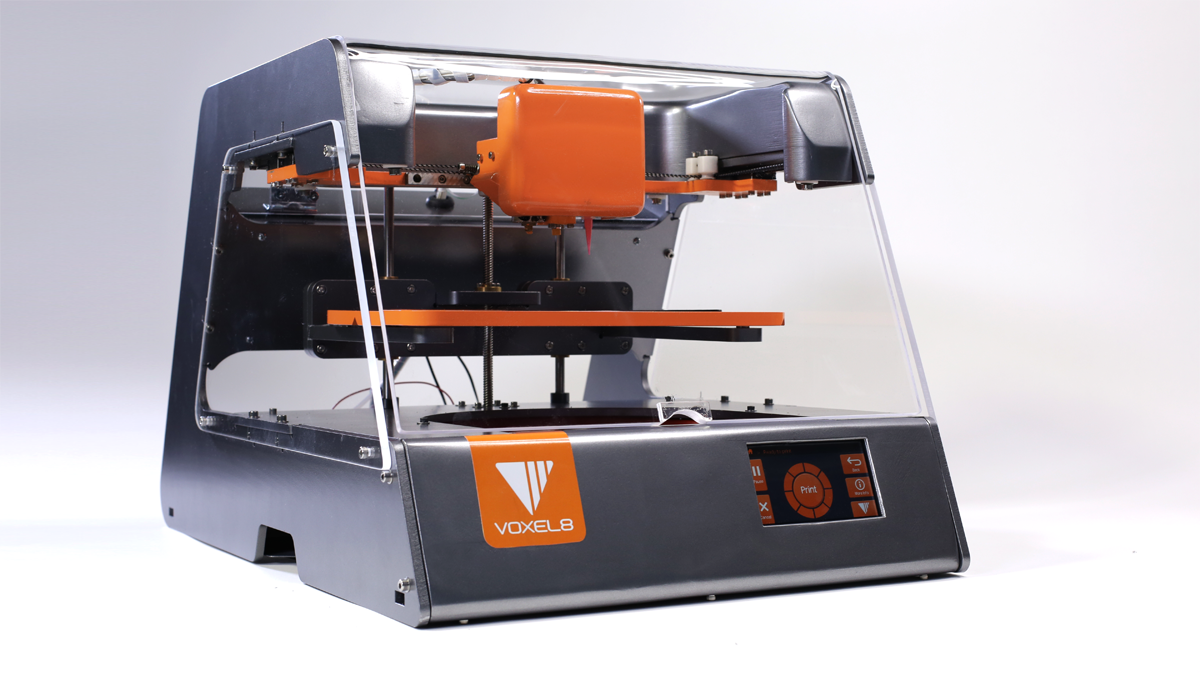
Currently, the Developer’s Kit works with two materials,
PLA plastic and
conductive silver ink,
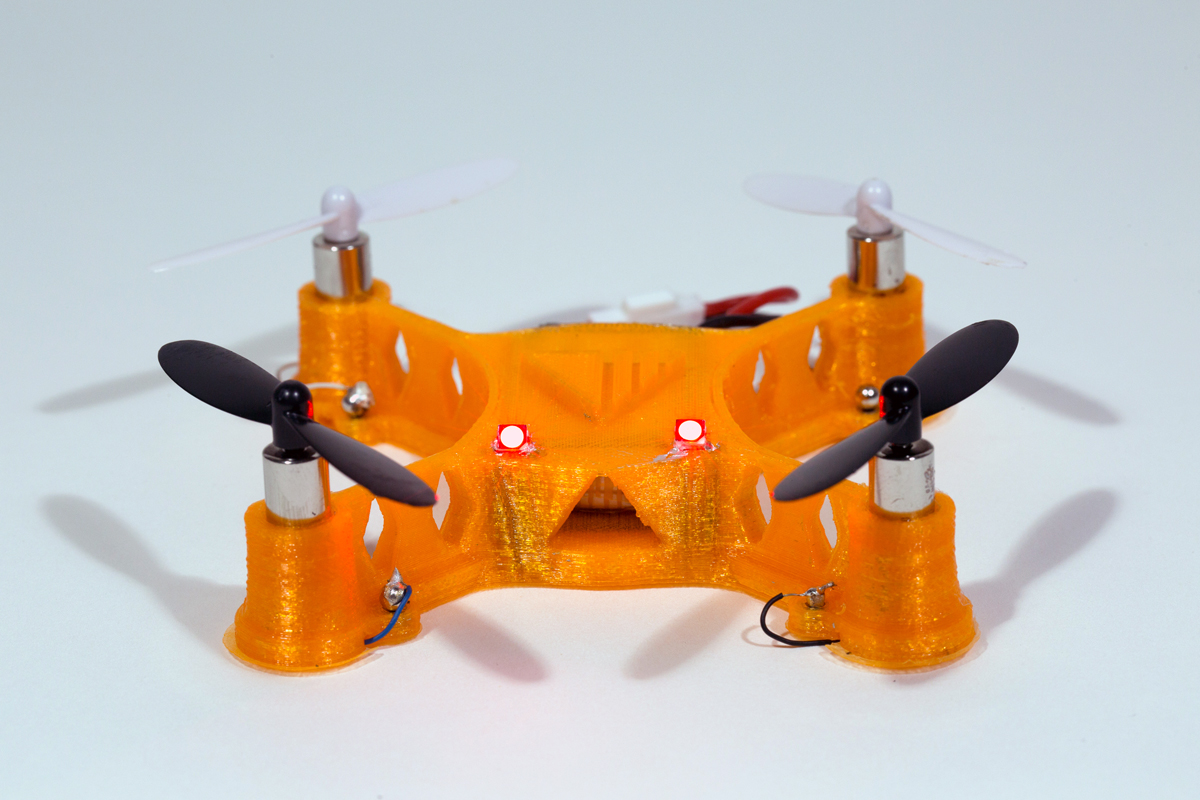
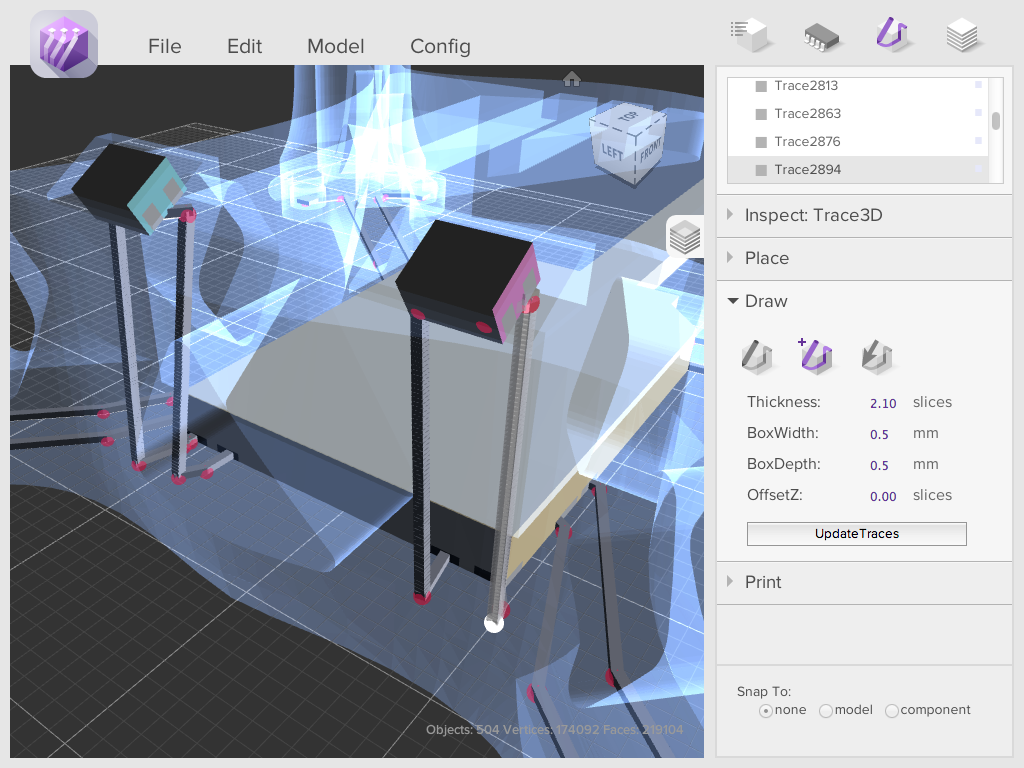
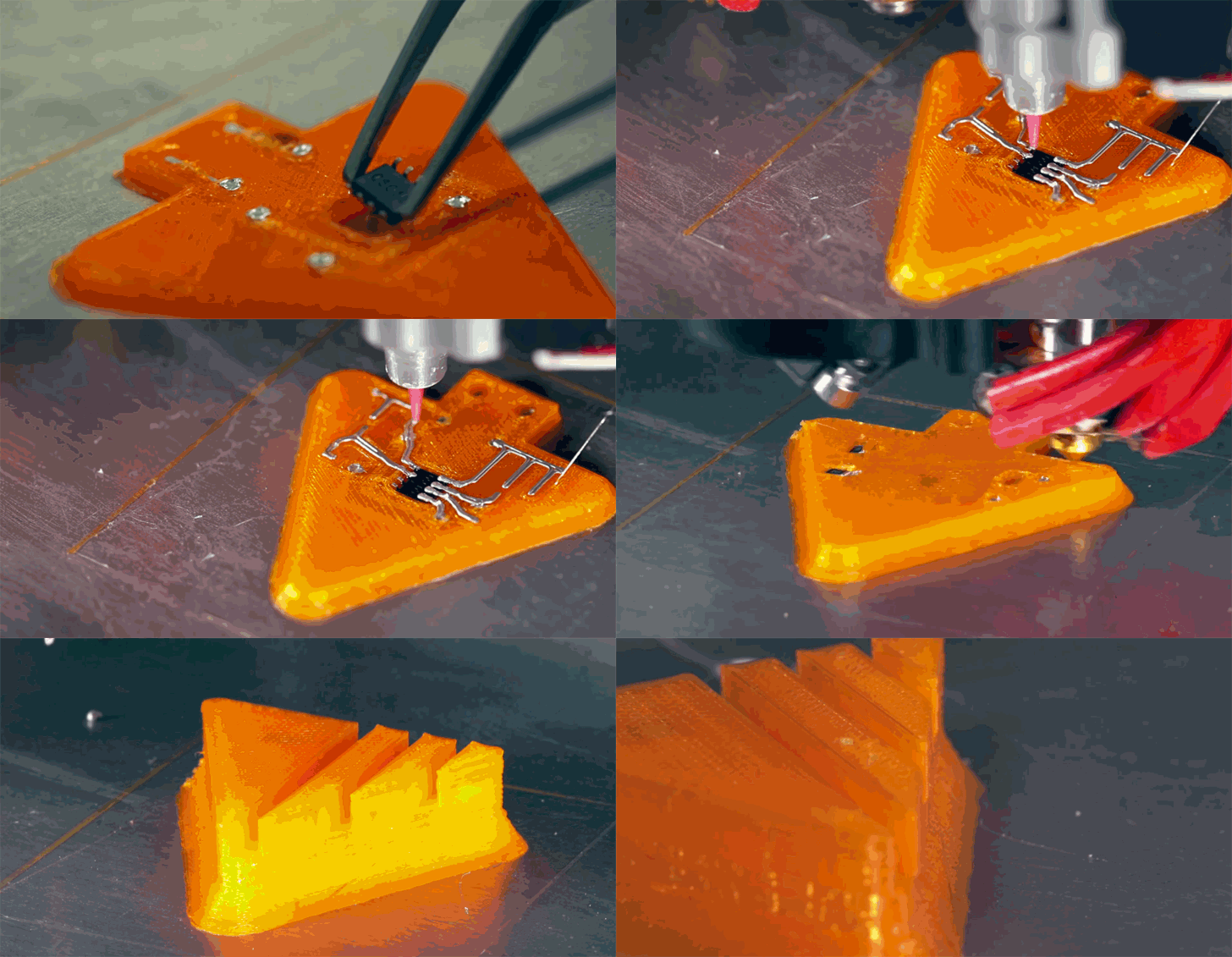
to combine traditional fused filament printing with electronic circuitry. Plastic is extruded out of one portion of the printhead and the conductive ink is dispensed out of another to create electric traces. With the help of Autodesk’s Project Wire, users can drag and drop components, such as transistors and resistors, into a CAD model so that, using Voxel8’s proprietary toolpath software, the printer can pause at the appropriate moment during a print task for the manual embedding of these electronics within the print. Printing then continues and, in the end, the user has a fully-functional object. The startup showcased this ability by 3D printing a quadcopter that, once completed, was able to fly off of its printbed.
The, now famous, Voxel8 3D printed quadcopter, unveiled at CES.
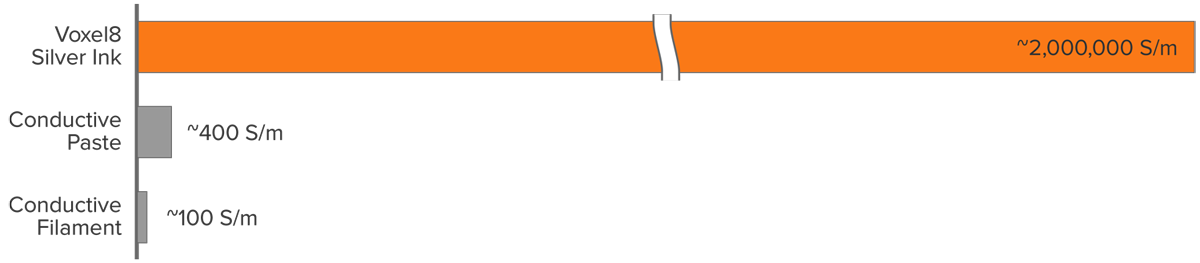
There are already conductive filaments on the market, meant for 3D printing projects that involve electronics, so I asked the Voxel8 founder to elaborate on the difference between their conductive ink and the filaments currently being sold. Lewis replied,“Right now, so, if people get desktop printers that use filaments – They’re typically carbon-filled, so they have really low conductivity because carbon particles are much less conductive than metallic particles. So, we’re developing these silver-based inks. First of all, they have this higher-conductivity particle phase and, secondly, they’re not based on polymer filaments. It’s really a low-viscosity solvent.”
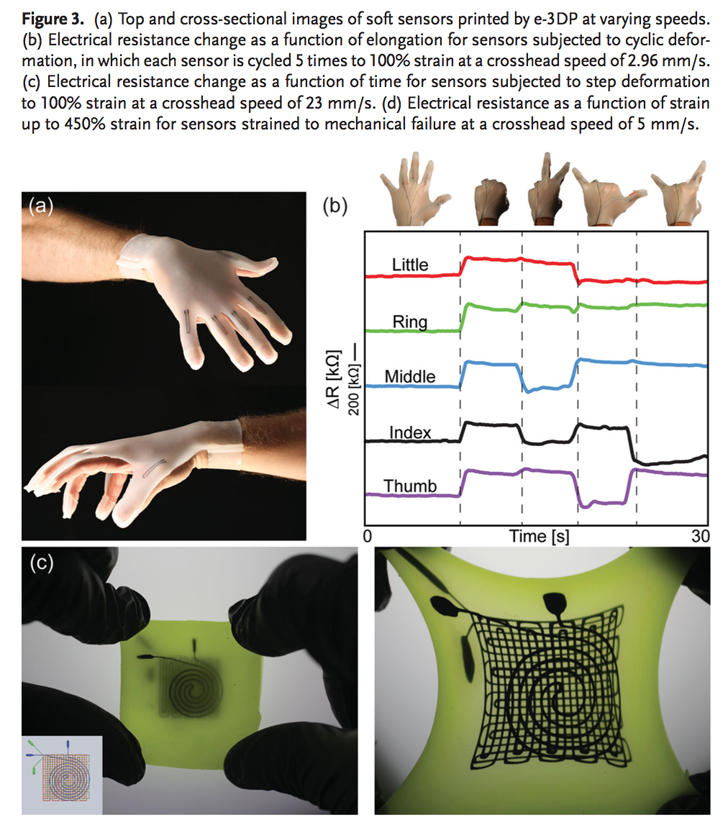
The conductivity of Voxel8’s silver ink, as compared to other conductive 3D printing materials on the market.
She goes on to discuss the dispensing mechanism that makes the Voxel8 platform possible, “It’s an extrusion-based, pneumatic dispenser and that’s one of the really big innovations on the desktop printing platform. We’re moving beyond fused filament deposition and we’re complementing that with pneumatically dispensed inks. That opens up, basically, every ink design we’ve developed in my lab at Harvard, all of which are dispensed in that fashion. So we can bring a broad range of materials to the printing platform.”
Combining multiple materials, Oliver adds, gives users the ability to interface objects created by the Developer’s Kit with other technologies, “The ability to print multiple materials together really works well with interfacing with other technologies.
We can print conductive traces.
We’re able to interface with a large amount of electronic components out there.
So, you can see the power of these electronic components within a 3D printed object and we look to expand that in the future. The key here though is being able to print multiple materials together on the same printer. And that allows you to interface with more and more technologies, really expanding the dimensions of what’s on the printer.”
Challenges in Developing the Developer’s Kit
As you might imagine, bringing the hardware, software, and materials together in just the right way to pull off multimaterial electronics printing is no easy task. Dr. Lewis describes the different obstacles Voxel8 has overcome to bring about this novel device,“The challenges we’re tackling on all fronts. It’s materials integration: trying to integrate disparate materials, like thermoplastics with conductive inks. It’s the hardware, which brings together multiple printheads.”
She continues, “And this, frankly speaking, is also on the software side. We’ve been very fortunate to partner with Autodesk, through their Spark platform on the software Project Wire, which allows designers and engineers to actually create, in their CAD models, the ability to embed these conductive features and electronic parts. But then Voxel8 has proprietary software for slicing for toolpath planning and, as you start to think about co-printing multiple types of materials – the matrix, the plastic, and the conductive materials – that toolpath planning is also very important.”
The CEO concludes, “So, tertially speaking, there’s challenges across all three key components of the printing platform – the materials, the hardware, and the software. And Voxel8 is tackling those.”
The Voxel8 Pro
Details about Voxel8’s “pro printer” are still “locked down” at this point, according to Lewis, but Dan Oliver was able to elaborate on the fact that it will be developed based off of input from their first Developer’s Kit customers, “We’re working with our current customers and our initial partners to effectively guide the design of the next, pro platform. Michael, as you and I have talked about in the past, the idea with the Developer’s Kit was to get them out there and to spark people’s imagination. We’ve gotten really great feedback of what people would want down the line and they’re super excited to get their printers. So, we’ll be working with those initial customers to help define what those next types of platforms would look like and make sure we’re executing on our customers’ input.”
As exciting as conductive ink is, my mind was reeling with possibilities for the next generation machine – which I label in my mind “the Voxel8 Pro”. Dr. Lewis’s work with her Harvard lab and, previously, her University of Illinois lab, fill the spectrum of materials sciences and 3D printing, from 3D printing microscale lithium ion batteries to fabricating channels for possible uses with bioprinting. Though some of this work may not necessarily make it into her startup, the pneumatic dispenser at the heart of Voxel8’s hardware was developed right out of her lab and opens the doors to a huge array of materials for desktop printing.
So, while the Voxel8 Pro may be an overall improved machine, it will also likely have the ability to print a greater variety of materials, including epoxy and elastomers. Lewis explains, “It’s not only the printing platform – you know, bringing an improved platform with higher resolution and these kinds of things to market – but it’s also a broader palette of materials. Releasing a customized set of materials that best meets our users’ needs. In addition to the conductive ink that’s going to be launched with our Developer’s Kit, we’re going to broaden the matrix materials to include epoxy and elastomeric materials. Just a broader palette of matrix and functional inks.”
Who Wants to Buy a Voxel8 Printer?
The ability to 3D print electronics and, in the future, elastic materials with rigid materials, has, naturally, garnered a lot of attention. Without disclosing their customers, Dr. Lewis was able to speak to one possible application for their platform,“We can talk generically about some use cases. We’ve been given, by prospective customers and people that have already pre-ordered our developer’s kit, applications in the biomedical space – we see hearing aids as a big target opportunity. There are use cases in almost every vertical I’ve mentioned already that we’ve either received CAD files for or have had discussions.”
As enticing as it would be know who these clients were, Oliver was quick to point out that the diverse industries represented by their clients indicate just how widely applicable the Voxel8 platform could be. “The most interesting thing to talk about here is our customer list,” Oliver explains. “You have the leading companies in automotive, aerospace, consumer electronics, medical devices, and apparel. We have really interesting companies that have bought the printer, so, the use cases span the gamut of those customers.”
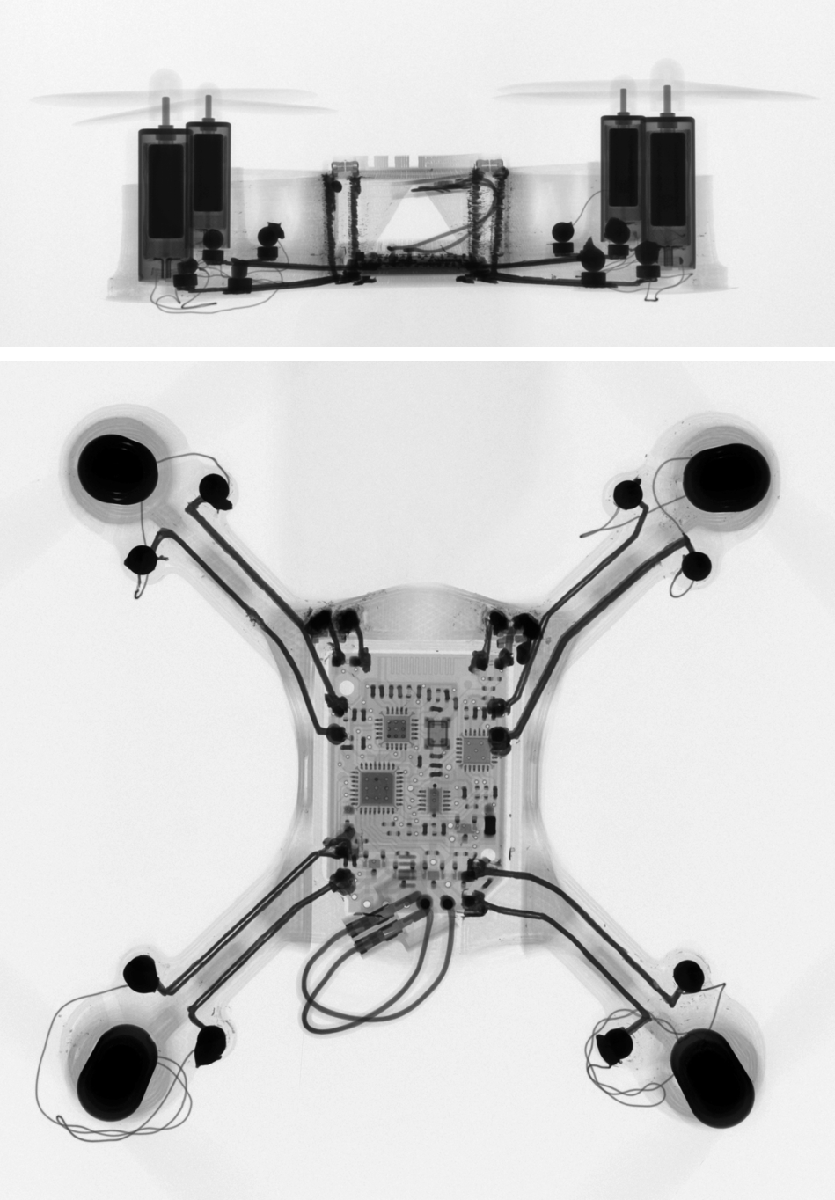
Voxel8’s 3D printed quadcopter under CT scan.
Dr. Lewis added, “We should also mention the defense companies, because they’re also prominent early adopters.”In fact, Voxel8 has already received interest from some pretty important customers. Among them is In-Q-Tel, the non-profit venture capital arm of the Intelligence Community, who have just contributed even more to the startup. As you may have guessed, this work is top secret, but the investment speaks to the profound power that multi-material electronics 3D printing has.
Voxel8 has also signed an agreement with the government-focused MITRE Corporation, for whom the startup is researching the possibilities of 3D printing antenna arrays. Of course, as they’re doing this work on behalf of an unnamed government sponsor, this work is also under wraps. “We can’t really say more than that we’re working on 3D printed embedded antenna and antenna arrays. That’s all that we’re at liberty to say. But I think you can imagine that what our printer can deliver is three-dimensional antenna designs that simply can’t be manufactured by other means.”
Dan Oliver, however, was able to elaborate on the benefits that 3D printing brings to fabricating antennas. “Standard antennas are made on standard PCB boards, which are two-dimensional. Antennas themselves, though, really live in the three-dimensional world. So, we’ve created these large-footprint antennas by forcing them to live in two dimensions,”Oliver says. “But what we’re really excited about is being to create these high-performance antennas that are three-dimensional. And ours is one of the few technologies that’s able to do that.”
Voxel8 2.0 & 3D Assembly
These projects will only be pushed further with the latest funding round and the future of the technology looks bright. At the moment, electronic components must be manually placed into an object during the printing process, but this is definitely a feature that could be made obsolete. Lewis and Oliver explain that all of the technologies to automatically fabricate fully functional electronic devices already exist, but separately from one another.
When asked about the possibility of automatically inserting transistors and resistors into 3D printed objects, Lewis responded, “Yes. At this point, with our desktop printer, we’re already embedding these kinds of functional objects. We’re doing it by manual pick and place, but it’s very easy to conceive that, on our road map, transitioning to automated pick and place is the future. So, absolutely, that will be accommodated by our printing platforms.”
Oliver elaborated, “One thing we think about a lot is, ‘what is the next printer going to look like?’ And the answer to that is to ask what is needed. Effectively, the technologies to print that all automatically exist separately, if you combined our technology with pick and place technology. So. it becomes, not solving the technological problems – though we still have work to do there – it’s what things we need to put together that’s really going to push this to the next level.”
In fact, Oliver says, there is a lot going on behind the closed doors of the Voxel8 lab that just aren’t ready to be launched with this first product. “So, something like the quad copter. We’re already doing that. We don’t have an automatic pick and place system because that doesn’t make sense for the developer’s kit. So, a lot of these things that seem futuristic, we’re doing every day out back in the lab.”
But, when, I wondered aloud, will someone be able to take a Voxel8 printer and fabricate a quadcopter completely without manual intervention. Dr. Lewis gave me, what I thought, was a very promising response, “I would say within the next few years is our target.”
A Team Effort
All of this news and the opportunity to speak directly with the innovators behind what has been, to me, the most important development in 3D printing so far this year, was truly exciting. And, from the sound of it, Dr. Lewis was on an exciting ride herself. “I think it’s really gratifying to see some of the ideas we’ve worked on in the lab to move out into the commercial sector and really have a chance to have a major impact in that way. For me and the research group, it’s really exciting to have this opportunity.”
Lewis says, though, that this isn’t a one-person operation, “I really want to emphasize that that wouldn’t be happening without the amazing team we have at Voxel8. The boundaries between my lab and Voxel8 is one where we’ve done lab-based research at Harvard and at my former institution at Illinois, but to take that to the next level and do commercialization, the team at Voxel8 is just doing incredible well. You know, with Dan Oliver and with the three other team leads: Michael Bell, Travis Busbee, Jack Minardi – materials, hardware, and software – it’s really just been tremendous… Dan, of course, has been pushing forward on the marketing side and driving the whole team forward. The four co-founders are incredibly invaluable… The energy, the drive, the talent and expertise that Voxel8 have is really just making this happen.”
The new funding, of course, allows them to build this team even further, Lewis says.“We’ll definitely expand the team. We’ve already made some really exciting hires from some IT companies, like iRobot, Philips Medical, Warby Parker, and DEKA, which is behind Dean Kamen’s Segway. We’ve been able to attract a lot of really awesome talent and that’s only going to continue to build as we go forward with the new funding.”
What they do next, whether it’s “locked down” or not, is sure to be amazing. In some ways, what’s been left unsaid – potential materials and customers – really paints a powerful picture. Without knowing who or what will be involved, my mind is left to illustrate a wild painting that sees Nike printing smart orthotics, the CIA building tiny spyplanes, or e-NABLE 3D printing bionic arms. Then, Dr. Lewis leaves me with the conclusion, “It just comes back to our driving motivation: to establish 3D printing platforms that enable the integration of form and function. So, to go beyond prototyping shapes or complex forms and to really create things that have embedded functionality.”
Michael is Editor-In Chief of 3D Printing Industry and the founder of The Reality™ Institute, a service institute dedicated to determining what’s real and what’s not so that you don’t have to. He is a graduate of the MFA Critical Studies & Writing Program at CalArts, and a firm advocate of world peace. Michael currently resides in San Pedro with his magical wife, Danielle.
Wrightspeed CEO Ian Wright displays some of the company's electric-powered trucks on Thursday, Feb. 12, 2015, in San Jose , Calif. Wright helped bring electric cars to market when he co-founded Tesla Motors a decade ago. Now he's targeting trucks that deliver packages, haul trash and make frequent stops on city streets. His company, Wrightspeed, makes electric powertrains that can be installed on commercial trucks, making them more energy-efficient. (AP Photo/Marcio Jose Sanchez)
Twelve years ago, Ian Wright and some fellow engineers launched Tesla Motors, a Silicon Valley company that has helped jumpstart the market for electric cars.
Now, the Tesla co-founder wants to electrify noisy, gas-guzzling trucks that deliver packages, haul garbage and make frequent stops on city streets.
His latest venture, Wrightspeed, doesn't make the whole truck. Rather it sells electric powertrains that can be installed on medium-and heavy-duty commercial vehicles, making them cleaner, quieter and more energy-efficient.
"We save a lot on fuel. We save a lot on maintenance, and we make the emissions compliance much easier," said Wright, a New Zealand-born engineer who left Tesla when it was still a small startup in 2005.
Wrightspeed is one of a growing number of companies that are trying to transform the market for commercial trucks that consume billions of gallons of fuel while spewing tons of carbon dioxide, nitrogen oxide and other pollutants.
While more consumers are switching to electric cars like the Nissan Leaf, Chevy Volt or Tesla Model S, convincing commercial fleet owners to replace their diesel trucks won't be easy.
"It takes a lot of technological ambition to break into such an old and established market," said Mark Duvall, a research director at the Electric Power Research Institute in Palo Alto. "If you want to sell a fleet owner an electric truck, you have to convince them that it's better than what they're already using. So the bar is set very high."
Wright's company is installing its powertrains on 25 FedEx delivery trucks and 17 garbage trucks for the Ratto Group, a Santa Rosa-based waste management company. Its plug-in powertrains feature an electric engine, battery system and on-board power generator that runs on diesel or natural gas and recharges the battery when it gets low.
Wrightspeed CEO Ian Wright explains the technology behind a electric-powered engine which will be used for FedEx delivery trucks at the company's headquarters, Thursday, Feb. 12, 2015, in San Jose , Calif. Wright helped bring electric cars to market when he co-founded Tesla Motors a decade ago. Now he's targeting trucks that deliver packages, haul trash and make frequent stops on city streets. His company, Wrightspeed, makes electric powertrains that can be installed on commercial trucks, making them more energy-efficient. (AP Photo/Marcio Jose Sanchez)
It costs $150,000 to $200,000 to install a Wrightspeed motortrain, while it costs, for example, about $500,000 for a new garbage truck.
The San Jose-based company is generating interest from trucking fleet owners who are scrambling to meet California's increasingly strict emissions standards but don't want to replace the entire vehicle, Wright said.
"You can take this truck that you've invested all this money in and it's still in good shape, and you can swap out the powertrain for our powertrain and suddenly you're emissions-compliant," Wright said.
To meet growing demand, Wrightspeed is preparing to move into a former aircraft hangar at the decommissioned U.S. Naval Air Station in Alameda. The company plans to expand its workforce from roughly 25 to 250 employees over the next three years, Wright said.
The Ratto Group, which collects garbage and recycling in Marin and Sonoma counties, is giving Wrightspeed a chance, retrofitting some of its garbage trucks. It could convert many more of its 300 vehicles if the technology performs as hoped.
"My hope is that this is something we can prove together with Wrightspeed and that we can be on the cutting edge of this, and I can transform my fleet and hopefully transform my industry," said Lou Ratto, the company's chief operating officer.
Wrightspeed CEO Ian Wright unplugs an electric-powered truck as he gets ready for a test drive at the company's headquarters Thursday, Feb. 12, 2015, in San Jose , Calif. Wright helped bring electric cars to market when he co-founded Tesla Motors a decade ago. Now he's targeting trucks that deliver packages, haul trash and make frequent stops on city streets. His company, Wrightspeed, makes electric powertrains that can be installed on commercial trucks, making them more energy-efficient. (AP Photo/Marcio Jose Sanchez)
When Wright left Tesla to start Wrightspeed, he planned to make high-performance electric sports cars, but he struggled to raise money from investors because the market wasn't big enough.
So Wright switched gears and set his sights on the roughly 2.2 million commercial trucks in the U.S. that burn roughly 20 times more fuel than a passenger car and are a major source of air pollution and greenhouse gas emissions.
Wrightspeed has raised Silicon Valley venture capital and secured grants from the California Energy Commission, which funds alternative fuel technologies that could help the state's dependence on fossil fuels. Gov. Jerry Brown wants to cut petroleum use in cars and trucks by 50 percent by 2030.
Wrightspeed CEO Ian Wright drives an electric-powered truck at the company's headquarters Thursday, Feb. 12, 2015, in San Jose, Calif. Wright helped bring electric cars to market when he co-founded Tesla Motors a decade ago. Now he's targeting trucks that deliver packages, haul trash and make frequent stops on city streets. His company, Wrightspeed, makes electric powertrains that can be installed on commercial trucks, making them more energy-efficient. (AP Photo/Marcio Jose Sanchez)
A truck with a Wrightspeed powertrain can run on batteries for about 30 miles before the turbine, which runs on diesel or natural gas, kicks in and recharges the battery. The system roughly doubles the fuel efficiency of trucks and reduces the cost of maintenance, Wright said.
While trucks aren't as sleek as Tesla's sports cars, a popular vehicle among Silicon Valley elites, Wright believes his powertrains can do more to reduce carbon pollution because trucks are such heavy polluters.
"I think what they've done is absolutely fantastic, but what we're doing is the next thing," Wright said. "It's even better."
The Route™ A Range-Extending Generator
Decoupled loads: generator works to charge batteries, while batteries provide power to turn the wheels.
Open generator architecture: the Wrightspeed Route ™ can use any number of on-board power generation options, including micro-turbines and piston engines.
No range anxiety! The Route ™, given refueling, has an unlimited range.
B High-Power Battery System
Exceptional regen capability: 400 hp
The high-power battery system provides peak power, allowing the generator to operate at its most efficient point.
PLUG IT IN, for up to 40 miles on grid energy.
C Extended Battery Life
Actively cooled for long battery life.
Software protected for long battery life.
D The Geared Traction Drive (GTD)
Integrates an electric motor, a two-speed gear box & an inverter
Two per driveaxle
Compact, lightweight
Direct traction control at drivewheels
125-250 horsepower, continuous
18,000 ft-lbs total axle torque
75 mph max speed (limited)
400 hp regen braking power, with slip limiting
E Fuel Tank
The Wrightspeed Route™ can be custom fitted to run diesel, gasoline, biofuels, CNG, or landfill gas at up to 7% sulfides.
The Route is a plug and play repower kit for medium duty fleet trucks that maximizes efficiency without compromising performance.
Torque / Power for The Route
Max Continuous Power: 125-250hp(software limited, fully configurable)
Max Wheel Torque: 18,000 ft-lbs(for each drive axle, 9,000 ft-lbs/wheel)
Max Regenerative Power: 400hp(0.3g braking below 42mph@ 12k lbs)
Fuel System Options:
Liquid: diesel, biodiesel, Jet A
Gaseous: natural gas, propane, sour gas
Emissions: CARB 2010 HDD, with no exhaust after-treatment
Technology The GTD (Geared Traction Drive)
Add caption
Wrightspeed was able to make the fully integrated GTD by designing
the inverter, 250 hp motor, and multi-speed transmission from the ground
up, optimizing compatibility and system efficiency.
250 hp motor (shown here without inverter)
Integrated inverter, electric motor, and gearbox
This Silicon Valley “systems approach” has yielded an exceptionally
high-power, compact, and lightweight system. Wrightspeed’s Drivesystem
is geared to optimize low-end torque, for hauling up hills, while
preserving top highway cruising speeds.
Wrightspeed’s Powertrains move the complexity from mechanical systems
into electronic and software systems, making them lighter, cheaper, and
more efficient. Clutchless gear shifting is a good example of this:
Traditional multi-speed transmissions use clutches (synchro rings,
multi-disc wet clutches, twin-clutch arrangements) to achieve
synchronization before engagement; this makes them, heavy, expensive,
and less efficient. But with electric motors, it becomes possible to
control the motor speed so precisely, and change it so quickly, that the
shifter dog-clutches can be engaged without clashing. The sync function
that used to be performed by mechanical means has been shifted into
software control of electronics, driving the electric motor with
precision. The system is therefore lighter, cheaper, and more efficient.
Wrightspeed’s control software weighs nothing, costs nothing to
manufacture, doesn’t wear out, and uses the electronics that are already
present to drive the motor.
The Wrightspeed GTD is shown here, on a dynamometer, simulating
acceleration from stop to first gear, shifting to second gear, back down
to first gear and then a full torque stop. The shifting is too quiet to
hear. The sound produced here is the motor accelerating and
decelerating at maximum torque. The GTD jumps when the motor changes
speed due to torque reaction (torque reaction can be observed under the
hood of a conventional car, when accelerated hard in neutral).
Simulated Truck Acceleration, Full Torque Stop
Motor is accelerated to 20,700 rpm in first gear, Upshift (Shift from 1st gear to 2nd gear)
Motor torque is reduced to zero
Shift actuator is moved to neutral position (mid-stroke)
Motor speed is synchronized to the correct speed for second gear, 9000 rpm (80 ms)
Shift actuator moves to second gear
Torque is reapplied to maintain “vehicle speed”, Downshift (Shift from 2nd gear to 1st gear)
Motor torque is reduced to zero
Shift actuator is moved to neutral position (mid-stroke)
Motor speed is synchronized to the correct speed for first gear, 20,700 rpm (80 ms)
Shift actuator moves to first gear, Full-Torque Traction Drive Stop






 ABOUT THE AUTHOR


