Mostrando entradas con la etiqueta Rice U. Mostrar todas las entradas

domingo, 9 de noviembre de 2014

DARPA funds $11 million tool that will make coding a lot easier


DARPA is funding a new project by Rice University called PLINY, and it's neither a killer robot nor a high-tech weapon. PLINY, named after Pliny the Elder who wrote one of the earliest encyclopedias ever, will actually be a tool that can automatically complete a programmer's draft -- and yes, it will work somewhat like the autocomplete on your smartphones. Its developers describe it as a repository of terabytes upon terabytes of all the open-source code they'll find, which people will be able to query in order to easily create complex software or quickly finish a simple one. Rice University assistant professor Swarat Chaudhuri says he and his co-developers "envision a system where the programmer writes a few of lines of code, hits a button and the rest of the code appears." Also, the parts PLINY conjures up "should work seamlessly with the code that's already been written."

In the video below, Chaudhuri used a sheet of paper with a hole in the middle to represent a programmer's incomplete work. If he uses PLINY to fill that hole, the tool will look through the billions of lines of code in its collection to find possible solutions (represented by different shapes in the video). Once it finds the nearest fit, the tool will clip any unnecessary parts, polish the code further to come up with the best solution it can, and make sure the final product has no security flaws. More than a dozen Rice University researchers will be working on PLINY for the next four years, fueled by the $11 million funding from the Pentagon's mad science division.

[Image credit: Shutterstock / Yellowj]


ORIGINAL: Engadget
November 9, 2014

lunes, 27 de enero de 2014

Free text experiment a success, say UGA students, faculty

Faculty and students in a University of Georgia experiment with free digital textbooks say the experiment worked. 

Students in two UGA introductory biology courses got the free textbooks last semester and this semester. Surveyed afterward, most said the free digital text from OpenStax was as good as or better than a traditional biology textbook.

For us it was like a proof of concept,” said Eddie Watson, director of UGA’s Center for Teaching and Learning.

The concept, he explained, was simply that students in large classes might cumulatively save a lot of money with a free digital textbook.

The experiment was part of a "Complete College Georgia” incubator grant program of the University System of Georgia, designed to make attending college more affordable, and therefore improve graduation rates.

The state gave UGA a $25,000 grant to try out the free text, used by biology professors Peggy Brickman, Erin Dolan and Tessa Andrews in a two-course biology sequence, with the help of So Mi Kim, a graduate student and instructional designer. Kim worked with the biology professors to reorganize the courses and tailor the OpenStax textbook to the UGA course requirements.

When nearly 700 students completed surveys following the courses this fall, a big majority said the free digital textbook they used was as good as or better than a regular print textbook.

Only 14 percent of 673 students who responded said the OpenStax textbook was of lower quality than other textbooks they have had; 65 percent said it was about the same, and 21 percent said it was of higher quality.

The students did have some complaints. The book could be slow to load, and searching through it was sometimes unwieldy. Reading on a computer gave some students eyestrain, and some said they just like having a paper copy in front of them.

But those shortcomings seemed to be outweighed by the positives. The digital textbook was easily accessible, they said, and students liked the fact that they could print out individual sections or chapters if they wished.

They also liked that it was free, saving each student $97, not counting the possible money they might have recouped by reselling the textbook at a lower price.

Estimating that a little more than 2,000 students a year take these courses, that adds up to a cumulative savings of nearly $200,000, Watson figures.

The cost of textbooks is an important part of what students pay to go to college, he said.

Forty percent of the students who took the biology courses said they have trouble paying for textbooks. More than half said they pay more than $300 per semester for books, and 21 percent said they paid more than $400.

Many students say they sometimes don’t even buy required textbooks; they’re too expensive, and they’re often unnecessary to pass the class, more than half the students in the survey said.

Nearly 60 percent said they rarely use them.

Watson expects to see more courses with free textbooks, and instructors using other kinds of free resources in UGA classrooms as well as different and more active learning models.

It’s promising. There’s lots of opportunity,” he said. “We know that there’s reasonable quality content out there.

There’s more involved in switching to a free digital textbook than just switching from one to the other, Watson said.

The change required some redesign of the course.

The big challenge is for faculty to have the time and support to engage in this,” he said.

The biology text experiment worked because of faculty members, he said, beginning with Brickman, who last year won UGA’s top teaching award. And the teachers had help from a top graduate student, Kim, he said.

We have a fantastic, well-motivated graduate student coupled with a fantastic, well-motivated faculty member,” he said.


• Follow education reporter Lee Shearer at www.facebook.com/LeeShearerABH or https://twitter.com/LeeShearer.

ORIGINAL: On Line Athens
By Lee Shearer
updated Saturday, January 25, 2014

sábado, 21 de septiembre de 2013

One brilliant idea... HIGH-QUALITY, FREE, OPEN TEXTS AND RESOURCES.

ORIGINAL: OpenStaxCollege


One brilliant idea... HIGH-QUALITY, FREE, OPEN TEXTS AND RESOURCES.

In just a few months, OpenStax College's free and openly licensed textbooks have already had a huge impact on students. You can make a difference for your students today. Adopt. Adapt. Recommend.

Learn more at http://openstaxcollege.org


GOAL:

PROVIDE LOW-COST TEXTBOOKS TO 10,000,000 STUDENTS.
CLICK HERE to see the schools that are helping students reach this goal. 

It’s innovation in education. And the time is right. OpenStax College offers students free textbooks that meet scope and sequence requirements for most courses. These are peer-reviewed texts written by professional content developers. Adopt a book today for a turnkey classroom solution or modify it to suit your teaching approach. Free online and low-cost in print, OpenStax College books are built for today’s student budgets. Stay informed through our newsletter, like us on Facebook, or tweet about @openstaxcollege.

Education is priceless, but who can afford it? In just a few months, OpenStax College's free and openly licensed textbooks have already had a huge impact on students. You can make a difference for your students today. Adopt. Adapt. Recommend.

viernes, 30 de agosto de 2013

New Form of Carbon is Stronger Than Graphene and Diamond

August 15, 2013

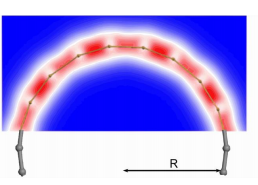
Chemists have calculated that chains of double or triple-bonded carbon atoms, known as carbyne, should be stronger and stiffer than any known material.

Photo: Rice University
Add caption

The sixth element, carbon, has given us an amazing abundance of extraordinary materials. Once there was simply carbon, graphite and diamond. But in recent years chemists have added buckyballs, nanotubes and any number of exotic shapes created out of graphene, the molecular equivalent of chickenwire.

So it’s hard to believe that carbon has any more surprises up its sleeve. And yet today, Mingjie Liu and pals at Rice University in Houston calculate the properties of another form of carbon that is stronger, stiffer and more exotic than anything chemists have seen before.

The new material is called carbyne. It is a chain of carbon atoms that are linked either by alternate triple and single bonds or by consecutive double bonds.

Carbyne is something of a mystery. Astronomers believe they have detected its signature in interstellar space but chemists have been bickering for decades over whether they had ever created this stuff on Earth. A couple of years ago, however, they synthesised carbyne chains up to 44 atoms long in solution.

The thinking until now has been that carbyne must be extremely unstable. In fact some chemists have calculates that two strands of carbyne coming into contact would react explosively.

Nevertheless, nanotechnologists have been fascinated with potential of this material because it ought to be both strong and stiff and therefore useful. But exactly how strong and how stiff, no one has been quite sure.

This is where Liu and co step in. These guys have calculated from first principles the bulk properties of carbyne and the results make for interesting reading. 

For a start, they say that carbyne is about twice as stiff as the stiffest known materials today. Carbon nanotubes and grapheme, for example, have a stiffness of 4.5 x 10^8 N.m/kg but carbyne tops them with a stiffness of around 10^9 N.m/kg

Just as impressive is the new material’s strength. Liu and co calculate that it takes around 10 nanoNewtons to break a single strand of carbyne. “This force translates into a specific strength of 6.0–7.5×10^7 N·m/kg, again significantly outperforming every known material including graphene (4.7–5.5×10^7 N·m/ kg), carbon nanotubes (4.3–5.0×10^7 N·m/ kg), and diamond (2.5–6.5×10”7 N·m/kg4),” they say.

Carbyne has other interesting properties too. Its flexibility is somewhere between that of a typical polymer and double-stranded DNA. And when twisted, it can either rotate freely or become torsionally stiff depending on the chemical group attached to its end.

Perhaps most interesting is the Rice team’s calculation of carbyne’s stability. They agree that two chains in contact can react but there is an activation barrier that prevents this happening readily. “This barrier suggests the viability of carbyne in condensed phase at room temperature on the order of days,” they conclude.

All this should whet the appetite of nanotechnologists hoping to design ever more exotic nanomachines, such as nanoelectronic and spintronic devices. Given the advances being made in manufacturing this stuff, we may not have long to wait before somebody begins exploiting the extraordinary mechanical properties of carbyne chains for real.

Ref: arxiv.org/abs/1308.2258 : Carbyne From First Principles: Chain Of C Atoms, A Nanorod Or A Nanorope?

viernes, 1 de junio de 2012

Discovery Uses 'Fracture Putty' to Repair Broken Bone in Days

ORIGINAL: ScienceDaily

ScienceDaily (Feb. 7, 2012) — Broken bones in humans and animals are painful and often take months to heal. Studies conducted in part by University of Georgia Regenerative Bioscience Center researchers show promise to significantly shorten the healing time and revolutionize the course of fracture treatment.

A team of University of Georgia researchers created a new "fracture putty" to speed healing of bone fractures. From left to right are Steve Stice, Jennifer Mumaw, Erin Jordan and John Peroni. (Credit: Image courtesy of University of Georgia)
"Complex fractures are a major cause of amputation of limbs for U.S. military men and women," said Steve Stice, a Georgia Research Alliance Eminent Scholar, animal and dairy scientist in the UGA College of Agricultural and Environmental Sciences and director of the UGA Regenerative Bioscience Center.

"For many young soldiers, their mental health becomes a real issue when they are confined to a bed for three to six months after an injury," he said. "This discovery may allow them to be up and moving as fast as days afterward."

Stice is working with Dr. John Peroni to develop a fast bone healing process. "This process addresses both human and veterinary orthopedic needs," said Peroni, an associate professor of large animal surgery in the UGA College of Veterinary Medicine and a member of the RBC.

Peroni and Stice are leading a large animal research project funded by the U.S. Department of Defense. The project includes scientists and surgeons from the Baylor University College of Medicine, Rice University and the University of Texas, who conducted the early studies.

Engineering new bone

"Healing of critical-size defects is a major challenge to the orthopedic research community," Peroni said. "Large-bone defects must be stabilized and necessitate technologies that induce rapid bone formation in order to replace the missing tissue and allow the individual to return to rapid function. To date, no single material can suffice."

The group they lead is a multidiscipline and multi-institutional group actively working on bone tissue engineering.

"Our group has been working productively together on numerous projects through the last several years," Stice said, "So, a collegial relationship and successful collaborative working relationship is already established."

Between 2009 and 2011, the collaborations received a $1.4 million grant from the DOD for the use of stem cells in fracture healing to be tested in sheep.

"In our experiences with large animal models, following the guidelines established by our animal care and use committee," Stice said, "we have been successful in formulating a product that contains mesenchymal stem cells and allows them to survive in the environment of the fracture long enough to elicit the rapid formation of new bone."

This year, the group showed bone can be generated in sheep in less than four weeks. The speed in which bone is formed is one of the truly unique features of this study.

Fracture putty

To start the bone regeneration process, the RBC used adult stem cells that produce a protein involved in bone healing and generation. They then incorporated them into a gel, combining the healing properties into something Stice calls "fracture putty."

With Peroni's assistance, the Houston-based team used a stabilizing device and inserted putty into fractures in rats. Video of the healed animals at two weeks shows the rats running around and standing on their hind legs with no evidence of injury. The RBC researchers are testing the material in pigs and sheep, too.

"The small-animal work has progressed, and we are making good progress in large animals," he said.

More work is needed to get to human medical trials, but the threat of losing federal funding for biomedical work through the DOD means they will have to find new ways to fund the project.

Next steps

"The next step is to show that we can rapidly and consistently heal fractures in a large animal," Peroni said, "then to convert it to clinical cases in the UGA [College of Veterinary Medicine] clinics where clinicians treat animals with complex fractures all the time."

Once they have something that works for animals, it will be passed over to the DOD for human use.

Peroni, who is chairman of the North American Veterinary Regenerative Medicine Association, is hopeful this material will be promoted to the veterinary and human medical fields through the educational efforts of NAVRMA and the RBC.

However, the RBC isn't the only group working on a faster fix for broken bones.

"Our approach is biological with the putty," Stice said. "Other groups are looking at polymers and engineering approaches like implants and replacements which may eventually be combined with our approach. We are looking at other applications, too, using this gel, or putty, to improve spinal fusion outcomes."

One of the best hopes for the fracture putty is in possible facial cranial replacements, an injury often seen on the battlefield.


The project ends in mid-2012. "By then we are to deliver the system to the DOD," Stice said.