Mostrando entradas con la etiqueta Gratis. Mostrar todas las entradas

lunes, 27 de enero de 2014

Free text experiment a success, say UGA students, faculty

Faculty and students in a University of Georgia experiment with free digital textbooks say the experiment worked. 

Students in two UGA introductory biology courses got the free textbooks last semester and this semester. Surveyed afterward, most said the free digital text from OpenStax was as good as or better than a traditional biology textbook.

“For us it was like a proof of concept,” said Eddie Watson, director of UGA’s Center for Teaching and Learning.

The concept, he explained, was simply that students in large classes might cumulatively save a lot of money with a free digital textbook.

The experiment was part of a "Complete College Georgia” incubator grant program of the University System of Georgia, designed to make attending college more affordable, and therefore improve graduation rates.

The state gave UGA a $25,000 grant to try out the free text, used by biology professors Peggy Brickman, Erin Dolan and Tessa Andrews in a two-course biology sequence, with the help of So Mi Kim, a graduate student and instructional designer. Kim worked with the biology professors to reorganize the courses and tailor the OpenStax textbook to the UGA course requirements.

When nearly 700 students completed surveys following the courses this fall, a big majority said the free digital textbook they used was as good as or better than a regular print textbook.

Only 14 percent of 673 students who responded said the OpenStax textbook was of lower quality than other textbooks they have had; 65 percent said it was about the same, and 21 percent said it was of higher quality.

The students did have some complaints. The book could be slow to load, and searching through it was sometimes unwieldy. Reading on a computer gave some students eyestrain, and some said they just like having a paper copy in front of them.

But those shortcomings seemed to be outweighed by the positives. The digital textbook was easily accessible, they said, and students liked the fact that they could print out individual sections or chapters if they wished.

They also liked that it was free, saving each student $97, not counting the possible money they might have recouped by reselling the textbook at a lower price.

Estimating that a little more than 2,000 students a year take these courses, that adds up to a cumulative savings of nearly $200,000, Watson figures.

The cost of textbooks is an important part of what students pay to go to college, he said.

Forty percent of the students who took the biology courses said they have trouble paying for textbooks. More than half said they pay more than $300 per semester for books, and 21 percent said they paid more than $400.

Many students say they sometimes don’t even buy required textbooks; they’re too expensive, and they’re often unnecessary to pass the class, more than half the students in the survey said.

Nearly 60 percent said they rarely use them.

Watson expects to see more courses with free textbooks, and instructors using other kinds of free resources in UGA classrooms as well as different and more active learning models.

“It’s promising. There’s lots of opportunity,” he said. “We know that there’s reasonable quality content out there.”

There’s more involved in switching to a free digital textbook than just switching from one to the other, Watson said.

The change required some redesign of the course.

“The big challenge is for faculty to have the time and support to engage in this,” he said.

The biology text experiment worked because of faculty members, he said, beginning with Brickman, who last year won UGA’s top teaching award. And the teachers had help from a top graduate student, Kim, he said.

“We have a fantastic, well-motivated graduate student coupled with a fantastic, well-motivated faculty member,” he said.


• Follow education reporter Lee Shearer at www.facebook.com/LeeShearerABH or https://twitter.com/LeeShearer.

ORIGINAL: On Line Athens
By Lee Shearer
updated Saturday, January 25, 2014

miércoles, 25 de abril de 2012

U of M opens up to open source textbooks

by Stephen Smith, Minnesota Public Radio
April 23, 2012

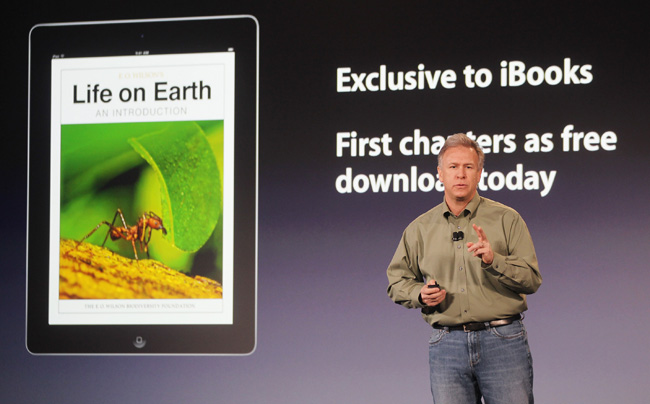
Larger viewPhilip Schiller, Apple's senior vice president of Worldwide Marketing, speaks about Apple's plan to "reinvent" textbooks at an event at the Guggenheim Museum on January 19, 2012 in New York City. Apple announced iBooks 2, a new free app featuring iPad interactive textbooks. The company also announced iBook Author, an application to create digital textbooks, and iTunes U, an educational app for students and teachers. (Mario Tama/Getty Images)

St. Paul, Minn. — The University of Minnesota bookstore has one of the largest textbook departments in the country, with rows of shelves piled high with titles — everything from Algebra One to Nuclear Physics.

Students can buy Shakespeare's books for less than $10, but that's only because the literary rights have long ago expired. The average price of the store's books is about $50 and some titles fetch as much as $225 — another sign of the rising price of college education.

Paying for textbooks is becoming such a burden for college students, that today the University of Minnesota is launching an online project to hunt down free textbooks to replace the pricey ink-and-paper versions. It's part of a national movement to cut the cost of textbooks.

The university has an extensive used and rental program to help make textbooks more affordable. But students like Hengyi Huang try to avoid the campus bookstore altogether.

Huang, a computer science student from China, buys his textbooks on Amazon or eBay. He said it can be tricky to find the right edition required in class.

"Textbooks keep renewing every year," Huang said. "There's only a tiny change in some of the pages. But the instructor requires us to buy the newest edition, which I don't think is necessary."

The average college student spends $1,000 or more each year on textbooks. That annoys pre-med student Amanda Benarroch, of Rochester, Minn.

"Tuition is already higher than it used to be," she said. "Textbook companies are kind of obnoxious."

Obnoxious or not, commercially printed textbooks dominate the market. There's a growing effort to change that, as dozens of so-called open-source textbooks are available online for free.

But such books have been slow to catch on, said David Ernst, director of academic and information technology for the College of Education and Human Development.

"The open textbooks are out there," Ernst said. "And they're scattered."

As a result, it's hard for teachers to find them.

"The second reason is that they don't know what is quality when they do find them," Ernst said.

Written by experts in their fields, open-source textbooks generally allow users to edit the texts or make "mash-ups" from several books.

Ernst is leading a new project at the University of Minnesota that will review open-source textbooks and collect the ones that pass muster in an online catalog. He said the project will concentrate first on the most widely taught courses, like introductory biology and math.

"You know the world doesn't need another $150 Algebra One book," he said. "Algebra One hasn't changed for centuries, probably."

University of Minnesota faculty will be paid $500 to write a review of an open-source textbook. They'll earn the same amount to adopt such a book in class.

Nicolle Allen, textbook advocate for the Student Public Interest Research Group, said Minnesota's peer-reviewed catalog could be a real boost.

"There are some sites that list reviews of open textbooks but I think this one is significant because it's actually developed by a Big Ten, well-respected university," said Allen, director of the research group's Make Textbooks Affordable Project.

The catalog is part of a national effort to create cheaper alternatives to commercially published textbooks. Some educational foundations have paid scholars to write free textbooks. Other publishers offer electronic versions for free, but charge for printed copies.

But the $4 billion commercial textbook industry still retains one big advantage: the financial power to create ancillary materials like study plans, exams, and course-management software. Surveys show that instructors prize those materials above all else, said publishing industry analyst Al Greco of Fordham University.

Another priority for professors is that books be up to date and compatible with their academic viewpoint.

"While we're told price is very important, it's always fourth," said Greco, a marketing professor. "As of today, open access textbooks have very little traction in the business."

Meanwhile another big change is on the textbook horizon, Greco said.

Apple is expected to enter the college market soon, just as it has with K-12 textbooks, where publishers create multimedia textbooks for the iPad.