Mostrando entradas con la etiqueta Carbono. Mostrar todas las entradas

viernes, 30 de agosto de 2013

New Form of Carbon is Stronger Than Graphene and Diamond

August 15, 2013

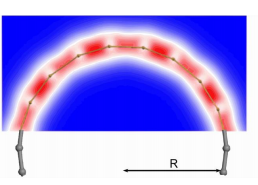
Chemists have calculated that chains of double or triple-bonded carbon atoms, known as carbyne, should be stronger and stiffer than any known material.

Photo: Rice University
Add caption

The sixth element, carbon, has given us an amazing abundance of extraordinary materials. Once there was simply carbon, graphite and diamond. But in recent years chemists have added buckyballs, nanotubes and any number of exotic shapes created out of graphene, the molecular equivalent of chickenwire.

So it’s hard to believe that carbon has any more surprises up its sleeve. And yet today, Mingjie Liu and pals at Rice University in Houston calculate the properties of another form of carbon that is stronger, stiffer and more exotic than anything chemists have seen before.

The new material is called carbyne. It is a chain of carbon atoms that are linked either by alternate triple and single bonds or by consecutive double bonds.

Carbyne is something of a mystery. Astronomers believe they have detected its signature in interstellar space but chemists have been bickering for decades over whether they had ever created this stuff on Earth. A couple of years ago, however, they synthesised carbyne chains up to 44 atoms long in solution.

The thinking until now has been that carbyne must be extremely unstable. In fact some chemists have calculates that two strands of carbyne coming into contact would react explosively.

Nevertheless, nanotechnologists have been fascinated with potential of this material because it ought to be both strong and stiff and therefore useful. But exactly how strong and how stiff, no one has been quite sure.

This is where Liu and co step in. These guys have calculated from first principles the bulk properties of carbyne and the results make for interesting reading. 

For a start, they say that carbyne is about twice as stiff as the stiffest known materials today. Carbon nanotubes and grapheme, for example, have a stiffness of 4.5 x 10^8 N.m/kg but carbyne tops them with a stiffness of around 10^9 N.m/kg. 

Just as impressive is the new material’s strength. Liu and co calculate that it takes around 10 nanoNewtons to break a single strand of carbyne. “This force translates into a specific strength of 6.0–7.5×10^7 N·m/kg, again significantly outperforming every known material including graphene (4.7–5.5×10^7 N·m/ kg), carbon nanotubes (4.3–5.0×10^7 N·m/ kg), and diamond (2.5–6.5×10”7 N·m/kg4),” they say.

Carbyne has other interesting properties too. Its flexibility is somewhere between that of a typical polymer and double-stranded DNA. And when twisted, it can either rotate freely or become torsionally stiff depending on the chemical group attached to its end.

Perhaps most interesting is the Rice team’s calculation of carbyne’s stability. They agree that two chains in contact can react but there is an activation barrier that prevents this happening readily. “This barrier suggests the viability of carbyne in condensed phase at room temperature on the order of days,” they conclude.

All this should whet the appetite of nanotechnologists hoping to design ever more exotic nanomachines, such as nanoelectronic and spintronic devices. Given the advances being made in manufacturing this stuff, we may not have long to wait before somebody begins exploiting the extraordinary mechanical properties of carbyne chains for real.

Ref: arxiv.org/abs/1308.2258 : Carbyne From First Principles: Chain Of C Atoms, A Nanorod Or A Nanorope?

viernes, 12 de octubre de 2012

Descubren planeta más grande que la Tierra formado por diamantes

ORIGINAL: EMOL

El estudio estima que un tercio de su masa, es decir el equivalente a tres veces nuestro planeta, sería de este material.

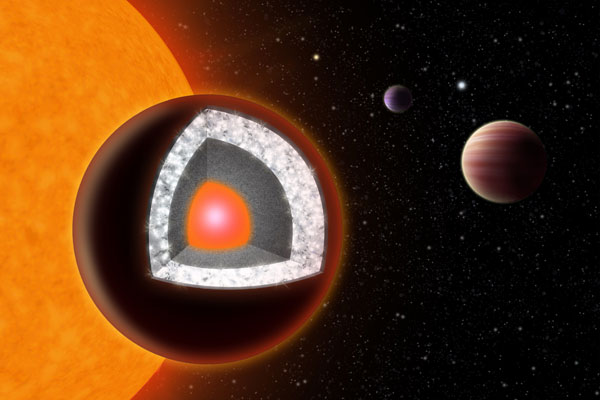
Representación artística del planeta ''55 Cancri e''. Foto: AFP
LONDRES- Un equipo de investigadores estadounidenses y franceses descubrió un planeta el doble de grande que la Tierra y compuesto en su mayoría por diamantes. El planeta rocoso, llamado "55 Cancri e", orbita en torno a una estrella similar al Sol en la constelación de Cáncer, y se mueve tan deprisa que un año allí dura apenas 18 horas.

El radio de este planeta es el doble del de la Tierra, pero es mucho más denso y su masa es ocho veces mayor. También está muy caliente, con temperaturas en la superficie de hasta 1.648 grados centígrados.

"La superficie de este planeta está probablemente cubierta de grafito y diamante, en lugar de agua y granito", dijo Nikku Madhusudhan, el investigador de Yale cuyo hallazgo se publicará en la revista Astrophysical Journal Letters.

El estudio, realizado con Olivier Mousis, del Instituto de Recherche en Astrophysique et Planetologie en Toulouse, Francia, estima que al menos un tercio de la masa del cuerpo celeste, una masa equivalente a unas tres Tierras, podría ser de diamante.

Si bien ya se han identificado otros planetas de diamantes, éste es el primero que se ve orbitando en torno a una estrella similar a la del Sol.

"Este es nuestro primer atisbo de un mundo rocoso con una química fundamentalmente diferente a la de la Tierra", dijo Madhusudhan, añadiendo que el descubrimiento de este planeta rico en carbono supone que ya no puede asumirse que los planetas rocosos tienen componentes químicos, interiores, atmósferas o biologías similares a los de la Tierra.

David Spergel, astrónomo de la Universidad de Princeton, dijo que es relativamente simple determinar la estructura básica y la historia de una estrella una vez conoces su masa y edad.

"Los planetas son mucho más complejos. Esta 'súper Tierra rica en diamante' es probablemente un ejemplo de la riqueza de los descubrimientos que nos esperan mientras empezamos a explorar planetas en torno a estrellas cercanas", comentó.

martes, 17 de abril de 2012

Bucky Balls Could Double Your Lifespan

ORIGINAL: Gizmodo
Buckminster fullerene molecules, the naturally occurring spheres made up of 60 carbon atoms, have long been suspected to have biological benefits. Now, a study that set out to establish if they were toxic when administered orally has proven quite the opposite—they almost doubled the lifespan of the rats that they were fed to.

The experiments, which were carried out at the Université Paris Sud, France, set out to assess what adverse reactions might be caused by ingesting Bucky balls orally. To do that, they fed three groups of rats differently. Along with their normal diet, one group was held as a control; a second was fed olive oil; and a third group was fed olive oil doped with a 0.8 mg/ml concentration of Buckminster fullerene.

The results, which appear in Biomaterials, took the researchers by surprise. The control group had a median lifespan of 22 months, and the olive oil group one of 26 months. But the Bucky ball group? They stuck it out for 42 months. That's almost double the control group.

The researchers have established that the effect is mediated by a reduction in oxidative stress—an imbalance in living cells that contributes to ageing. To say these results are important is an understatement: the desire to live longer runs strong in many of us, and it's a feat scientists have been hoping to achieve for centuries.

But while it's a remarkable finding, it's worth remembering that it's just a single study. It's going to take a hell of a lot more work before the scientific community is completely convinced that we should all be splashing Bucky-enriched olive oil on our salads, that's for sure. [Biomaterials via Extreme Longevity]