Mostrando entradas con la etiqueta Estratosfera. Mostrar todas las entradas

domingo, 14 de octubre de 2012

La Física del salto de Felix Baumgartner

ORIGINAL: Naukas
14 octubre, 2012

Acabamos de ser testigos del éxito final en la aventura de Félix Baumgartner, el hombre que pretendía romper la barrera del sonido a pecho descubierto (o casi). Nuestro amigo Wicho ha hecho un buen trabajo en Teledeporte, pero mi torpe cabeza estaba en otra parte y solamente pude ver los segundos finales del salto.

Aun así, este profe estaba de guardia y atento, así que podemos hacer algunos números y estudiar el salto. Sobre todo, nos interesa responder a la pregunta del millón: ¿se ha batido finalmente la barrera del sonido? Según los datos que obtengo de la web de Teledeporte, la velocidad máxima es de unos 1.173 km/h, que no llegan a los 1.230 km/h considerados como velocidad del sonido en la superficie terrestre.

Pero, por supuesto, el punto donde Félix Baumgartner alcanzó la velocidad máxima no estaba precisamente en la superficie terrestre. Un factor importante es que la velocidad del sonido depende de la temperatura, que a su vez varía con la altura. A 39 km de altura, la temperatura es de unos 15-20ºC bajo cero, lo que corresponde a una velocidad de unos 1.130-1.150 km/h; a una altura inferior, digamos a 30 km, la temperatura desciende hasta los -40ºC aproximadamente, y la velocidad del sonido disminuye hasta los 1.090 km/h.

Foto: Red Bull - Stratos
Necesitamos, entonces, saber en qué punto se alcanzó la velocidad máxima, y si dicha velocidad es superior o no a la del sonido en esa región. Como dije en el anterior artículo, calcular analíticamente la velocidad de caída es una tarea difícil, pero resulta fácil si se dispone de una hoja de cálculo para efectuar los cálculos numéricos. Recordemos que la velocidad límite para una caída en régimen turbulento era del tipo:

V = raíz cuadrada de [(mg)/(rho*A*C)]

donde

  • rho es la densidad del fluido (que también depende de la altura), 
  • A es la sección del objeto (es decir, la superficie de un corte hecho al objeto en dirección perpendicular al movimiento), y 
  • C es un coeficiente que depende de la forma del objeto. 

En mi anterior artículo supuse que A=1m^2 y C=0,1. Los datos proporcionados provisionalmente por Teledeporte (a saber: 1.173 km/h de velocidad máxima alcanzada a los 46 segundos de caída) son consistentes con un rozamiento de C=0,2. Eso significa que la fuerza de rozamiento será mayor que lo que creí, y que incluso una mayor altura (39.000 metros en lugar de los 36.000 originales) no será garantía de éxito. Mi cálculo inicial de Mach 2 es una exageración.

Bien, vamos con los números. ¿Tenemos Mach 1?

Aparentemente, sí. La velocidad máxima de 1.170 km/h fue alcanzada a los 46 segundos, a una altura que calculo en torno a los 29.500 metros. A esa altura, la temperatura ronda los 30-40 grados centígrados bajo cero (no puedo precisar más), y eso se corresponde con una velocidad del sonido de aproximadamente 1.090-1.115 km/h, lo que nos da Mach 1,05-1,08. Según eso, y a la espera de datos más precisos, me atrevo a asegurar que en efecto, el señor Félix Baumgartner se ha convertido en la primera persona que ha atravesado la barrera del sonido sin ayuda mecánica.

Hay un detalle adicional que quiero compartir con ustedes. Según mi fiel hoja Excel, si el salto se hubiese efectuado a 36.000-36.500 metros de altura, como estaba previsto en un principio, la velocidad máxima no hubiera superado a la del sonido, ya que se habría quedado en unos 1.050-1.070 km/h. Ha hecho muy bien en elevarse hasta los 39 kilómetros, porque así no quedarán dudas al respecto.

Desde aquí, felicito al señor Baumgartner y le deseo que disfrute de sus récords, que se los ha ganado al pulso. Por mi parte, aprovecharé muy bien su salto, porque va a ir de cabeza a la lista de ejemplos que les pongo a mis alumnos en clase. El año pasado algunos me dijeron que deseaban ver ejemplos de problemas más actuales. Se van a enterar.


Felix Baumgartner lands safely on Earth after record-breaking skydive

ORIGINAL: The Guardian / EFE
Dominic Rushe in New York
Sunday 14 October 2012


Austrian skydiver jumped from 24 miles above New Mexico, falling at speeds up to 725mph in bid to break sound barrier
Photo: Red Bull Stratos

Felix Baumgartner in the capsule on a screen at mission control center during the final manned flight in Roswell, New Mexico. Photograph: Reuters

In 10 heart-stopping minutes on Sunday Felix Baumgartner leapt fromspace, falling to earth in a record breaking parachute jump 24 miles (38.6 km) above New Mexico.


Baumgartner, a man for whom the term adrenaline junkie hardly does justice, landed on the run in Roswell, New Mexico, after plunging from a capsule that had pulled him 127,000ft (m)above the planet, a new world record. He fell to earth at speeds reaching 725mph.

Cheers broke out as Baumgartner, 43, jumped from a tiny shelf outside the 11-by-8-foot (3.3-by-2.4 metre) fiberglass and acrylic capsule that was carried to 128,000 feet by an enormous balloon.

"We love you Felix!" screamed the crowd as he plunged through the stratosphere. "My visor is fogging up," he gasped over the radio and he fell through the air moments before his parachute opened to the applause of the crowd on the ground, including his teary-eyed mother, father and girlfriend, watching on monitors miles below.

He landed about 10 minutes later, having broken the world record for the highest altitude jump by a skydiver, sponsors said.

As he prepared to jump from the pressurized capsule, Baumgartner went through a checklist of 40 items with project adviser Joe Kittinger, holder of a 19-mile high altitude parachute jump record that Baumgartner hopes to smash.

He checked through an equipment list from his seat and expressed concern that his astronaut-like helmet was not heating properly.

"This is very serious, Joe," said Baumgartner as the capsule, designed to remain at 55 degrees Fahrenheit ascended in skies where temperatures were expected to plunge below -91.8 F (-67.8 C), according to the project's website. 
"Sometimes it's getting foggy when I exhale. ... I do not feel heat."

Baumgartner's ascent into the stratosphere took about 2 1/2 hours.


The 30m-cubic-foot (850,000-cubic-metre) plastic balloon, is about one-tenth the thickness of a Ziploc bag, or roughly as thin as a dry cleaner bag.

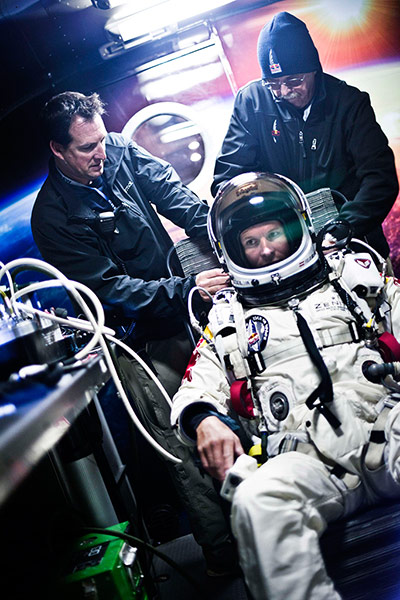
Baumgartner makes final prepartions before the flight

Red Bull Stratos - freefall from the edge of space official LIVE Video full length

lunes, 20 de agosto de 2012

Could Pumping Aerosols into the Atmosphere Stop Global Warming?

ORIGINAL: Live Science
16 August 2012 
Rachel Kaufman, InnovationNewsDaily Contributor


A British climate-cooling balloon experiment would have sprayed water into the atmosphere to test its effect on reflecting sunlight. CREDIT: Hugh Hunt, SPICE project 
Heat waves. Drought. Storms. The extreme weather that has battered much of the planet in the past few years, up through the heat wave cooking most of the United States this summer, has more scientists thinking about extreme solutions to the climate crisis.

Geoengineering – making large-scale changes to the environment – is no longer fringe science, with the debate shifting from whether it should be done to how.

One controversial idea gaining traction among scientists is injecting small particles, known as aerosols, into the stratosphere to block the sun's radiation.

Aerosols reflect solar radiation back into space, lowering Earth surface temperatures. They can also provide "seeds" around which water droplets coalesce to form clouds, thus further increasing the planet's reflectivity. The particles are fairly long-lived in the stratosphere, a stable region of the atmosphere that begins five to six miles up. This makes the idea of aerosols' use as a worldwide planet-cooler fairly attractive.

The effects of aerosol injections are at least somewhat known, since volcanic eruptions produce aerosols naturally and have produced cooling in the past. Mount Pinatubo, a volcano in the Philippines that erupted in 1991, spewed so much sulfur dioxide into the stratosphere that the planet cooled by 1 degree Fahrenheit (0.55 degrees Celsius) and stayed cool for more than two years.

Skeptics of the idea, however, say it's one thing when a volcano erupts; imitating nature would be another thing entirely. While Pinatubo-like amounts of sulfur (roughly 20 million tons) pumped into the atmosphere could linger three to four years, cooling the planet within the first months, reversing sea ice melt, and possibly even promoting tree growth, the side effects are uncertain. A 2009 paper found that stratospheric aerosol injection (SAI) could lead to drought in Africa and Asia and deplete the ozone layer, and it would not stop ocean acidification.

A miscalculation in the injections could be a costly mistake, ushering in a new ice age. And if scientists were to stop regular injections without cleaning up the greenhouse gases in the atmosphere, the rebound effect could be worse for crops, animals and ecosystems than if they had done nothing. [Could Space Mirrors Stop Global Warming?]

Beyond that, critics say, regular aerosol injections would change the sky's color, ruin astronomy for optical telescopes on Earth, and remove the incentive for nations to clean up their own acts. And in a final act of irony, with less sunlight reaching the Earth's surface, solar panels would produce less power.

Despite these potential drawbacks, research continues. A group of Cambridge scientists recently published a study of the proposed options for getting the aerosols to the stratosphere. (The report favored using a large tethered balloon with a hose attached to a high-pressure pump.) A study in mid-2012 found that the sky would look no different post-geoengineering than it currently does in urban areas, which have higher levels of aerosols due to pollution. And many scientists have concluded that aerosol injection is the most effective, most timely and cheapest solution to warming that has been proposed thus far, costing about $50 billion per year.

However, until scientists know more about the potential side effects of geoengineering through tests (as opposed to computer models), it's not likely to happen. A 2010 government report found only one field experiment related to aerosols and noted that the U.S. spent only about $2 million over two years investigating solar radiation management techniques.

The problem? Testing large-scale climate engineering techniques in the field requires large-scale tests in the field. In the words of climate change scientist Mike Hulme, writing in Progress in Physical Geography: "Research and deployment become one and the same." To test the technology, it has to be put into effect – and the consequences of that are still largely unknown.

This story was provided by InnovationNewsDaily, a sister site to LiveScience. Follow InnovationNewsDaily on Twitter @News_Innovation, or on Facebook.