
ORIGINAL: TheNational
Gethin Chamberlain
Apr 20, 2012
 |
| A watchtower built to keep lookout for elephants. |
The moment the elephant's trunk wrapped itself around Fulmani Urao's waist, she must have known it was all over. She did not even try to struggle. There was no point.
 |
| Asman Urao survived an attack in which his mother was killed. |
It was about 1.30am when the huge, bad-tempered bull elephant smashed its way into Fulmani's house. Her five-year-old son Asman, asleep in her lap, managed to wriggle free, but there would be no escape for his mother. This was an elephant with murder in mind.
The animal dragged her out of the house, onto the road, and beat her head against the ground until she was dead. Afterwards, just to make sure, he trampled her body. Then he trumpeted and faded back into the night.
 |
| An Indian elephant in Chilapata forest in northern Bengal. Photos by Gethin Chamberlain |
It is a myth that the ground shakes as elephants approach. The truth is that for Fulmani and hundreds of thousands of others who find themselves in the path of the wild herds, death comes on five-tonne tiptoes.
At least 400 people a year are killed by elephants in India and the conflict between humans and elephants is growing as India's human population expands inexorably, increasing the demand for land and eating into the elephants' territory.
Forests are cut down and converted into agricultural land; corridors along which the animals traditionally move have been farmed, built upon and traversed by railway tracks. At the same time the success of anti-poaching campaigns has seen elephant numbers rise. In north Bengal, where Fulmani lived, the last elephant census in 2010 counted more than 500 animals.
Indian elephants are slightly smaller than their African counterparts, with the largest males standing about 3.5 metres high. They usually weigh between three and five tonnes. There is a perception that the Asian elephant is less aggressive than the African, but that is little consolation for those who do battle with these creatures every night.
In the darkness on the edge of the Chilapata forest a group of men are lighting bundles of jute sticks to use as torches. The harvest is over, but the elephants are still around, hungry for the stored crop. Every night they come and every night the villagers form up in these halla (noise) parties to chase them off.
 |
| Ramkishor Kindo and fellow villagers use torches to drive off animals. |
The dogs are barking; the herd is on the move. Orange flames leap from the torches, clouds of sparks rising into the night air. A few of the men are carrying sticks; one has a large spear.
A mile away, Jayanta Roy stands in the middle of a paddy field, turning slowly, searching for signs of the herd, the beam of his powerful torch cutting through the dark. He turns again and suddenly there they are, two large males, no more than 40 metres away, staring straight at him. There is a split second to register the shock and then he is running for his life. It is like this every night, the villagers say.
It is two weeks since Nikil Rava heard the elephant tearing up the paddy field. His father Bilu Rava, 60, sits on the step of the house in the village of Mendabari, a long spear cradled in his lap.
Bilu is looking at an X-ray of Nikil's arm, which shows an ugly break, the bone snapped clean through and projecting through the skin. The young man is still in hospital.
 |
| X-ray of the broken arm of Nikil Rava, 26, who was trampled by an elephant as he tried to drive it away from fields next to his village in Mendabari, north Bengal. His right arm was snapped in two. The area is the frontline of a growing conflict between elephants and humans which claims the lives of about 400 people a year in India. |
"Nikil was trying to scare the elephant away but he stumbled and fell on the ground," he says. "I remember that before trampling him, the elephant sounded a trumpeting noise. My son was screaming, he was saying 'father, I've lost my hand'."
 When the rice is being harvested, he and the other landowners from the village build watchtowers in the fields and sit up every night waiting to chase the elephants away. The spear is to prod the animals, not to kill them, he says. Like many Hindus, he regards the animals as sacred.
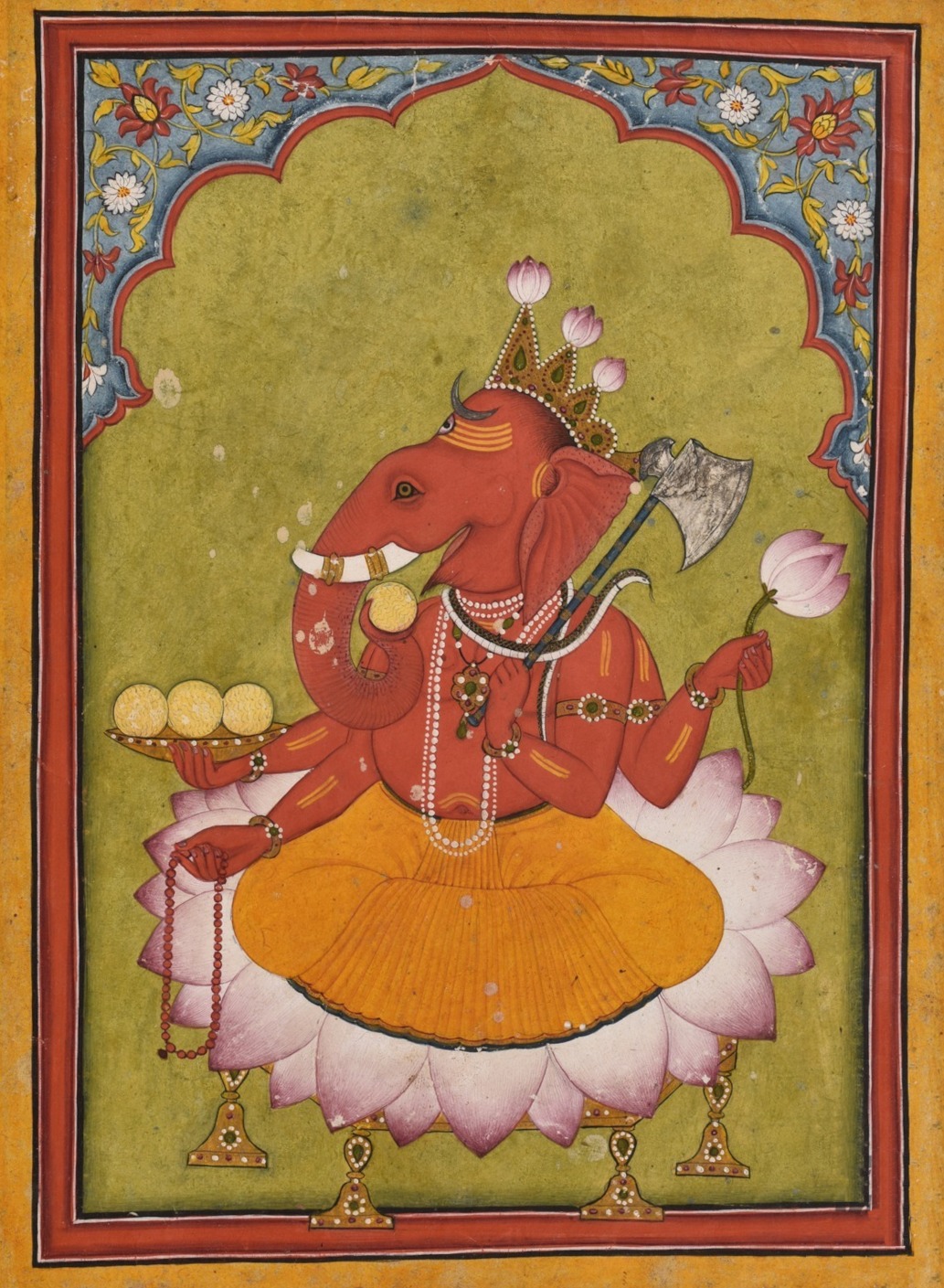
In the village of Singhijhora, Ganga Adhikari perches on the step of the family home, watching her mother Debi praying in front of their shrine to Ganesha, the elephant-headed Hindu deity. A wire clothesline runs behind the shrine; it saved her life, says Ganga.
"We were trying to drive the elephant back into the forest. I shouted but then the searchlight stopped working and he started to chase me. He was chasing so fast that I knew I would not reach our house, so I tried to run to a neighbour's."
She darted under the washing line and in doing so saved her life. The elephant halted. "It is something in their heads," says Ganga. "Mentally they have to know what it is in front of them, that it won't hurt them. It didn't know, so it stopped and I had time to get inside. But I was crying for a long time afterwards."
The worst months are October, when the rice is harvested, and March and April, the corn reaping season, when the elephants know they will find the grain stored inside people's homes.
Each night the men take to the watchtowers that dot the landscape. Yet so silent are the animals, that for many watchers the first inkling of the presence of an elephant is when the tower starts to fall.
Ratan Ray, 24, was supposed to be protecting the potato crop, but it had been a quiet night and by 1.30am he and his brother Tapan, 22, had dozed off. "I woke up and found myself on the ground," he says. The elephant had torn one of the tower legs out of the earth.
He looked up to see the elephant pushing against the remains of the tower with its head, while his brother clung on desperately. "There was a bamboo stick next to me and all I could think was to grab it and hit the elephant on the legs," he says. It worked. The elephant lumbered off into the darkness.
But this is not an entirely one-sided conflict. Local records show that in 2010 there were 52 people killed by elephants in the Dooars region (an area of about 9,000 square kilometres in the foothills of the Himalayas), while in the previous five years, 49 elephants were killed by trains, illegal electric fences or by pesticides used in tea plantations.
As the problem intensifies, so too does the search for a solution. In a clearing on the edge of the jungle, the forestry department's great hope is eating a banana.
Shankari is three years old. The little female elephant stands in the shade of a tall tree, a thick chain fastening one of her hind legs to the tree trunk to stop her escaping.
 |
| Shankari, a three-year-old wild elephant calf, is used to chase herds away from both villages and crops. |
Shankari was born wild in the jungle. Somehow she became separated from the herd and was found by the mahouts, who brought her here to train as a kunki - a captive elephant used to drive off the wild herds.
When a wild herd enters a village area, the mahouts arm themselves with firecrackers and guns, climb up onto their kunkis and head out.
"It is a very difficult situation," says Sunil Kheria, the chief mahout. "I would never go alone into a wild herd. You have to think of yourself and make sure you are properly armed."
But it is working, he says: the wild herds are not coming as often as they once did here. Other states are trying different methods including electric fences, deep trenches and chilli-coated ropes.
In Singhijhora, Nidhi Singh is banking on string. She has persuaded a group of farmers to encircle their fields with the stuff, which is attached to a musical alarm that plays a Hindu religious song. It works, up to a point, but if the elephants are determined enough, they will get through. Something more is needed, she says; people have to be prepared to share the land with the elephants, instead of blocking their traditional routes.
"Our thought process in India is traditionally to coexist," she says. "We can live together but greed has increased with commercialisation. Greed is everywhere, in the minds of farmers, forest officials, tea plantation owners, so that is creating conflict. There has to be a will to change."
Gethin Chamberlain is a photojournalist based in South India.


