Mostrando entradas con la etiqueta XNAs. Mostrar todas las entradas

viernes, 5 de diciembre de 2014

World's First Artificial Enzymes Created From Synthetic Genetic Material

photo credit: University of Liverpool Faculty of Health and Life Sciences, via Flickr. CC BY 2.0

Scientists have made a breakthrough in the field of synthetic biology by creating, for the first time, enzymes from artificial genetic material that does not exist in nature. This exciting new work not only offers new insights into the origins of life on Earth, but also has implications for our search for extraterrestrial life on other planets.

The foundations for this study were laid a couple of years ago when UK scientists created synthetic versions of DNA, the molecule that carries the genetic information of all living things on Earth, and its close chemical cousin, RNA. This synthetic genetic material was created using the same building blocks that are found in DNA and RNA, but the scientists strung them together with different molecules. These resulting synthetic molecules, which were dubbed ‘XNAs,’ or xeno nucleic acid, were found to be capable of storing and passing on genetic information.

Although it was widely believed that DNA and RNA, together with proteins, were the only molecules that could form enzymes, the same researchers have now demonstrated that it is possible to create synthetic enzymes using only these XNAs. These molecules, which have been named ‘XNAzymes,’ were capable of chopping up and stitching together bits of RNA, just like natural enzymes. One of them was even capable of joining up fragments of XNA.

Enzymes, nature’s catalysts, are fundamental to life on Earth because almost all of the biochemical reactions taking place in cells are inefficient at ambient temperatures. Enzymes are therefore required to give reactions, such as synthesizing DNA or digesting food, a kick-start, allowing them to occur at rates sufficient for life to exist.

Although the majority of enzymes are proteins, some RNA molecules possess catalytic activity. It’s widely believed that the evolution of early pieces of genetic information, which may have been RNA, into self-replicating enzymes was likely a key event in the emergence of life on Earth. This work is therefore important because it recreates one of the earliest stages towards life. However, it also teases us with the possibility that life could evolve without DNA or RNA, which are widely regarded as the prerequisites for life.

“Our work suggests that, in principle, there are a number of possible alternatives to nature’s molecules that will support the catalytic processes required for life,” said lead scientist Philip Holliger. “Life’s ‘choice’ of RNA and DNA may just be an accident of prehistoric chemistry.”

Because it is possible to create genetic material and enzymes from building blocks that don’t occur naturally, this suggests that life could emerge from different molecular backbones on other planets. This could therefore “potentially widen the number of exoplanets that one could consider would be hospitable for some form of life,” according to Holliger.

This work, the researchers say, could also lead to a new wave of treatments for a variety of diseases. As explained by Dr. Holliger, it may be possible to synthesize XNAs that are capable of chopping up pieces of RNA produced from cancer genes or fragments of viral RNA. And because the XNAs don’t occur naturally, it is unlikely that they will be recognized and destroyed by other enzymes in the body.


ORIGINAL: IFLScience
by Justine Alford
December 2, 2014

jueves, 19 de abril de 2012

ADN alternativo creado por científicos

ORIGINAL: TheGuardian
Ian Sample
19 Abril 2012

El material genético artificial - XNAs - se espera que revele cómo las moléculas se replicaron inicialmente y que impulse la investigación en biotecnología

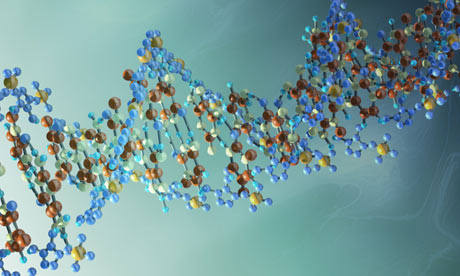
ADN y el ARN se han convertido en alternativas de polímeros genéticos llamados XNAs por los investigadores en Cambridge. Fotografía: Mopic / Alamy
Los científicos han creado el material genético artificial que puede almacenar información y evolucionar a través de generaciones de una manera similar al ADN - una hazaña que espera que de un impulso a la investigación en Medicina y Biotecnología, y arroje luz sobre cómo las moléculas se replicaron inicialmente y se ensamblaron en miles de millones de años de vida.

En última instancia, la creación de alternativas al ADN podría permitir a los científicos para hacer nuevas formas de vida en el laboratorio.

Los investigadores del Laboratorio de Biología Molecular MRC, en Cambridge, desarrollaron procedimientos químicos para activar el ADN y ARN, las bases moleculares de toda la vida conocida, en seis polímeros alternativos genéticos llamados XNAs.

El proceso intercambia la desoxirribosa y ribosa (la "d" y "r" en el ADN y el ARN) por otras moléculas. Se encontró los XNAs podría formar una doble hélice con el ADN y eran más estables que el material genético natural.

En la revista Science, los investigadores describen la forma en que lograron que una de las XNAs se adheriese a una proteína, una habilidad que puede significar los polímeros podría implementarse como drogas trabajando como los anticuerpos.

Philipp Holliger, autor principal del estudio, dijo que el trabajo demostró que dos sellos distintivos de la vida, la herencia y la evolución - era posibles usando alternativas al material genético natural.

"No hay nada de esecialidad ("Goldilocks") en el ADN y el ARN", dijo Holliger a Science. "No hay ningún imperativo abrumador o funcional para que los sistemas genéticos o la biología se basen en estos dos ácidos nucleicos".

Vitor Pinheiro, un co-autor del artículo, dijo que la investigación podría ayudar a los científicos no elegir cómo el ADN y el ARN se hizo tan crucial en la evolución de la vida, y tal vez incluso ayudar en la búsqueda de organismos extraterrestres. "Si un sistema genético no tiene que estar basado en ADN y ARN, ¿Entonces cómo vas a  definir la vida? ¿Cómo buscarías vida?" dijo.

En un artículo adjunto, Gerald Joyce, del Instituto de Investigación Scripps en La Jolla, California, dice que el estudio anuncia una "era de la genómica sintética, con implicaciones para la exobiología [que se ocupa de la vida extraterrestre] vida, la biotecnología y la comprensión de sí mismo". Y añade: "La construcción de los sistemas genéticos basados en plataformas de productos químicos alternativos en última instancia, puede conducir a la síntesis de nuevas formas de vida".

Otros científicos, entre ellos un equipo de la J Craig Venter Institute, en Rockville, Maryland, están esperando para hacer organismos sintéticos desde cero, pero la mayoría de los trabajos hasta el momento ha utilizado el ADN convencional.

En su artículo sobre el estudio de Cambridge, Joyce alude a los peligros potenciales de la genómica sintética. Él escribe: "A medida que uno contempla todas las formas de vida alternativas que podrían ser posibles con XNAs y otras moléculas genéticas más exóticas, las palabras de Arthur C. Clarke, vienen a la mente En "Año 2010: Odisea dos", HAL del equipo le dice a la humanidad,
" todos estos mundos son suyos ", pero advierte -.., intenta desembarcar en ellos excepto en Europa (la luna de Júpiter)".
Hay biólogos están empezando a retozar en los mundos alternativos de la genética, pero no se debe andar en áreas que tienen el potencial de dañar nuestra biología."